Racing with 
DROIDS 
@zer0m 
em
#whoami - Peter Hlavaty (@zer0mem) 
[ KEEN TEAM ] 
 Background 
 @K33nTeam 
 Previously ~4 years in ESET 
 Contact 
 twitter : @zer0mem 
 weibo : weibo.com/u/5238732594 
 blog : http://zer0mem.sk 
 src : https://github.com/zer0mem
outline 
TTY 
▪ Bug 
▪ Resources 
▪ SLAB 
▪ target 
▪ Race 
DROIDS 
▪ TOCTOU + CVE 
▪ Out Of Boundary 
▪ Information gathering 
▪ State of exploitation 
▪ Hardenings 
▪ 0days, what for ?
[ PART-I=> RACE ]
TTY racing issue 
weak lock ... 
1. Requesting for available 
space is locked => SAFE 
2. Afterwards working with 
memory not locked, but 
fast & SHOULD be safe 
3. Updating “used” member 
is NOT locked => BUG
TTY racing issue 
core of the BUG 
PROBLEM : 
• TTY { master + slave } 
• Multithread access! 
GOAL : 
• attempt to return there IS a space, even there is NOT! 
PLAN : 
• write to master 
• write to slave 
• cause RACE-CONDITION 
TIMING ISSUE : 
• memcpy + memset prologon execution gap 
• write(tb->size) to slave (SLOW!) 
• write(1) to master (FAST!)
Race OK! What is next ? 
1. Race for size confusion 
2. buffer overflow 
3. control content of 
consecutive blocks ! 
4. do overwrite to 
consecutive blocks 
5. gain control
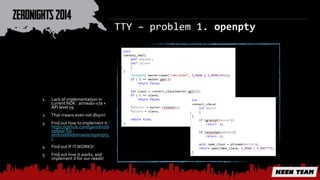
TTY – problem 1. openpty 
1. Lack of implementation in 
current NDK : armeabi-v7a + 
API level 19 
2. That means even not dlsym! 
3. Find out how to implement it : 
https://github.com/gavinlin/dr 
opbear-for-android/ 
blob/master/openpty. 
c 
4. Find out IF IT WORKS! 
5. Find out how it works, and 
implement it for our needs!
TTY - PoC vs android vs 
TTY PoC TTY boosted PoC 
http://blog.includese 
curity.com/2014/06/e 
xploit-walkthrough-cve- 
2014-0196-pty-kernel- 
race-condition. 
html 
implementation
TTY - PoC vs android vs 
implementation 
▪ write to slave/master are 
‘asynchronous’! (ECHO flag!) 
– not necessary thread for race! 
▪ open("/dev/ptmx") instead of 
openpty 
– open just master! 
– used for SLAB ‘magic’ 
▪ ioctl calls just for slaves 
– open slave to master when it comes to 
exploitation 
▪ now it should be clear from code, 
what is doing! 
https://blog.nelhage.com/2009/12/a-brief-introduction-to-termios-termios3-and-stty/
TTY – problem 2. 
android debug ? 
Windows ;) Linux :O
Linux debugging – but ...
Linux debugging – but ... 
TTY Race – vbox + emulator! Goldfish + Source Inside ?
[ PART-II ] 
TARGET
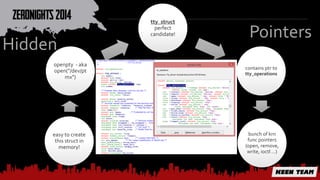
tty_struct 
perfect 
candidate! 
contains ptr to 
tty_operations 
bunch of krn 
func pointers 
(open, remove, 
write, ioctl …) 
Hidden 
openpty - aka 
open("/dev/pt 
mx") 
easy to create 
this struct in 
memory! 
Pointers
Not so hidden tty_operations 
TTY Bonus! 
1. sizeof(tty_struct) == 0x… 
2. sizeof(tty_buffer) == 0x… 
3. Both covered by same SLAB 
4. 0x400 SLAB buffer 
5. 1Page == 0x1000 
6. SLAB for 0x400 contains 4 
consecutive pages! 
7. SLAB is very simple algo 
 PREDICATBLE! 
8. but just 4blocks really sucks!
SLAB allocator 
(going to be obsolete) 
1. Bonwick paper : 
https://www.usenix.org/legac 
y/publications/library/procee 
dings/bos94/full_papers/bon 
wick.a 
2. Understanding the Linux 
Virtual Memory Manager : 
https://www.kernel.org/doc/g 
orman/pdf/understand.pdf 
3. mm/slab.c 
4. Btw. Seems good book for 
windows : What Makes It 
Page?: The Windows 7 (x64) 
Virtual Memory Manager
SLAB allocator - Array cache 
1. Kalloc, takes memory from 
ARRAY-CACHE 
2. ARRAY-CACHE contains XY 
(0x36, ..) memory blocks 
3. Those memory blocks are 
from SLAB 
4. 4TTY possible in one SLAB 
5. 5th TTY can be pages away! 
6. As seen on the picture, 
Cache2 is for TTY – different 
NOT-CONSECUTIVE SLABS 
7. Big Object means less 
predicatable
SLAB allocator - Array cache 
1. Allocated in order 
2. --ac->avail 
3. Means predicatable 
4. BUT 
5. Just 4pages to play with
PART III 
are we done ?
__wake_up_common 
1. Rewrite tty_struct, be aware 
to not overwrite all data! 
2. tb->char_buf_ptr for chars 
are controllable 
3. tb->flags_buf_ptr are not 
4. memset(flags, size) follows 
memcpy(buf, size) 
5. means we memset tty_struct 
before we reach it by 
memcpy 
6. Fail going to happen!
__wake_up_common 
1. Need to correctly rewrite 
rest of struct 
2. Did you see another 
REALLY hidden pointer ? 
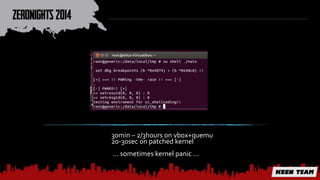
30min – 2/3hours on vbox+quemu 
20-30sec on patched kernel 
… sometimes kernel panic ...
Am I missing something there … ? 
x64, SMAP, SMEP (PXN), W^E, KASLR
2 selected common cases on DROIDs 
Out of Boundary TOCTOU
CVE-2014-8299 
TOCTOU 
1. TOCTOU 
2. Direct user deref 
3. failed copy_from_user 
practice 
4. Large time window by 
wait method 
5. write-where-what
Droid race 
Prepare data & racer & invoke syscall 
Racing syscall
Out of Boundary
Out Of Boundary 
1. Trivial to exploit 
2. Generic implementation 
3. write/read – where 
4. NO -SMAP 
5. but sometimes PXN
Information gathering 
NO-KASLR 
SWI vector table trick, on some device not available anymore 
/proc/kallsyms (gather export info, no addresses) 
ReadVuln + parse symbols / walk structs 
PoolSpray + (semi)blind overwrite 
SLAB abusing 
Relative structs targeting
Write / Read WHERE 
no-KASLR 
1. NO – KASLR 
2. Read-Where vuln 
3. Known base 
4. Resolving symbols 
5. Walking structures
Write / Read WHERE 
no-KASLR 
1. NO – KASLR 
2. Read-Where vuln 
3. Known base 
4. Resolving symbols 
5. /proc/kallsyms pairing! 
https://github.com/fi01/kallsymsprint for more detailed example
Droids hardening I. 
ops pre-read 
1. Pre-read buffer to kernel 
2. TOCTOU safe 
3. But not possible check 
future calcs from 
4. Depends again on safety 
checks 
5. Most common fails => 
boundary checks
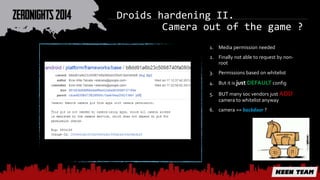
Droids hardening II. 
Camera out of the game ? 
1. Media permission needed 
2. Finally not able to request by non-root 
3. Permissions based on whitelist 
4. But it is just DEFAULT config 
5. BUT many soc vendors just ADD 
camera to whitelist anyway 
6. camera == backdoor ?
Droids hardening / fixing 
ops 
hooks 
Camera 
for users 
just as a 
service 
PXN W^X 
Proper copy_from_user 
Safety checks – what about 
inner calcs ? 
NICE ! But still no 
UDEREF used on droids 
sure SANE thing 
… but not solution … 
still useful for kernel rootkits 
GOOD ! but patching is 
nowdays obsolete anyway 
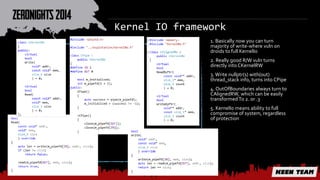
Kernel IO framework 
1. Basically now you can turn 
majority of write-where vuln on 
droids to full KernelIo 
2. Really good R/W vuln turns 
directly into CKernelRW 
3. Write nullptr(s) with(out) 
thread_stack info, turns into CPipe 
4. OutOfBoundaries always turn to 
CAlignedRW, which can be easily 
transformed To 2. or .3 
5. KernelIo means ability to full 
compromise of system, regardless 
of protection
一步一步Step-by-step 
• Resolve symbols 
• Prepare payload 
write-where- 
(semi)what 
thread_info 
->addr_limit • root + su 
• Leak thread stack 
• Pool spray – 
pthread_create(*) 
Access policy bypass 
• kernel escape + 
driver & hook ops 
Full compromise 
of system
State of exploitation => DROIDS 
Primitive 
tech … 
works! 
Mixing 
kernel / 
user data .. 
No SMAP 
Why leaks ? 
No KASLR 
successful PWN 
1. Need improve technique, if 
generic simple one works ? 
2. No need to sophisticated leaks 
3. Easy to use in-context 
methods 
4. PXN can be issue, but no with 
full read/write to kernel
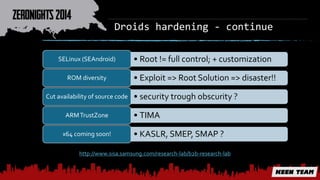
Droids hardening - continue 
SELinux (SEAndroid) • Root != full control; + customization 
ROM diversity • Exploit => Root Solution => disaster!! 
Cut availability of source code • security trough obscurity ? 
ARM TrustZone • TIMA 
x64 coming soon! • KASLR, SMEP, SMAP ? 
http://www.sisa.samsung.com/research-lab/b2b-research-lab
State of rooting => DROIDS 
▪ Root != FULL control 
▪ SEAndroid and customization 
in place 
▪ Strict policy on permissions 
▪ Part of config, not open 
sourced… 
▪ Reverse engineering & deep 
study of policy 
Patch 
data in 
kernel 
FULL 
control 
bypass 
logic 
kernel 
escape 
Patch 
code .. 
bad 
practice
DROID kernel research 
Exploitation 
▪ High ROM diversity 
▪ Check device permissions 
▪ Dump / Download kernel 
▪ Debug kernel & develop exploit 
Policy (not covered in this talk) 
▪ High ROM diversity 
▪ Dump / Download Kernel 
▪ Bin diff policy changes 
▪ Reverse engineer configuration 
& customizations
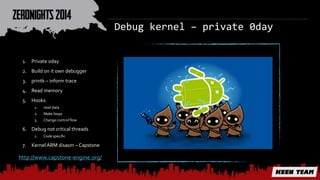
Debug kernel – private 0day 
1. Private 0day 
2. Build on it own debugger 
3. printk – inform trace 
4. Read memory 
5. Hooks 
1. read data 
2. Make loops 
3. Change control flow 
6. Debug not critical threads 
1. Code specific 
7. Kernel ARM disasm – Capstone 
http://www.capstone-engine.org/
Acknowledge 
Thanks to : 
jfang 
liac 
wushi nforest 
geohot 
j00ru 
gynvael
We are hiring! 
▪ #1 vulnerability research team in China 
– http://www.k33nteam.org/cvelist.htm 
▪ Enjoying research ? 
– Mobile (Android, iOS, WP) 
– PC (Windows, OS X, Chrome OS, etc.) 
▪ Willing to move to Shanghai ? 
– Beijing ? 
▪ Want to join our team ? 
– Application security 
– Kernel security
2014 - $500,000 
2015 - $???????? Pick a device, name your own challenge!
Q & A 
follow us 
@K33nTeam

Racing with Droids

  • 1.
  • 2.
    #whoami - PeterHlavaty (@zer0mem) [ KEEN TEAM ]  Background  @K33nTeam  Previously ~4 years in ESET  Contact  twitter : @zer0mem  weibo : weibo.com/u/5238732594  blog : http://zer0mem.sk  src : https://github.com/zer0mem
  • 3.
    outline TTY ▪Bug ▪ Resources ▪ SLAB ▪ target ▪ Race DROIDS ▪ TOCTOU + CVE ▪ Out Of Boundary ▪ Information gathering ▪ State of exploitation ▪ Hardenings ▪ 0days, what for ?
  • 4.
  • 5.
    TTY racing issue weak lock ... 1. Requesting for available space is locked => SAFE 2. Afterwards working with memory not locked, but fast & SHOULD be safe 3. Updating “used” member is NOT locked => BUG
  • 6.
    TTY racing issue core of the BUG PROBLEM : • TTY { master + slave } • Multithread access! GOAL : • attempt to return there IS a space, even there is NOT! PLAN : • write to master • write to slave • cause RACE-CONDITION TIMING ISSUE : • memcpy + memset prologon execution gap • write(tb->size) to slave (SLOW!) • write(1) to master (FAST!)
  • 7.
    Race OK! Whatis next ? 1. Race for size confusion 2. buffer overflow 3. control content of consecutive blocks ! 4. do overwrite to consecutive blocks 5. gain control
  • 8.
    TTY – problem1. openpty 1. Lack of implementation in current NDK : armeabi-v7a + API level 19 2. That means even not dlsym! 3. Find out how to implement it : https://github.com/gavinlin/dr opbear-for-android/ blob/master/openpty. c 4. Find out IF IT WORKS! 5. Find out how it works, and implement it for our needs!
  • 9.
    TTY - PoCvs android vs TTY PoC TTY boosted PoC http://blog.includese curity.com/2014/06/e xploit-walkthrough-cve- 2014-0196-pty-kernel- race-condition. html implementation
  • 10.
    TTY - PoCvs android vs implementation ▪ write to slave/master are ‘asynchronous’! (ECHO flag!) – not necessary thread for race! ▪ open("/dev/ptmx") instead of openpty – open just master! – used for SLAB ‘magic’ ▪ ioctl calls just for slaves – open slave to master when it comes to exploitation ▪ now it should be clear from code, what is doing! https://blog.nelhage.com/2009/12/a-brief-introduction-to-termios-termios3-and-stty/
  • 11.
    TTY – problem2. android debug ? Windows ;) Linux :O
  • 12.
  • 13.
    Linux debugging –but ... TTY Race – vbox + emulator! Goldfish + Source Inside ?
  • 14.
    [ PART-II ] TARGET
  • 15.
    tty_struct perfect candidate! contains ptr to tty_operations bunch of krn func pointers (open, remove, write, ioctl …) Hidden openpty - aka open("/dev/pt mx") easy to create this struct in memory! Pointers
  • 16.
    Not so hiddentty_operations TTY Bonus! 1. sizeof(tty_struct) == 0x… 2. sizeof(tty_buffer) == 0x… 3. Both covered by same SLAB 4. 0x400 SLAB buffer 5. 1Page == 0x1000 6. SLAB for 0x400 contains 4 consecutive pages! 7. SLAB is very simple algo  PREDICATBLE! 8. but just 4blocks really sucks!
  • 17.
    SLAB allocator (goingto be obsolete) 1. Bonwick paper : https://www.usenix.org/legac y/publications/library/procee dings/bos94/full_papers/bon wick.a 2. Understanding the Linux Virtual Memory Manager : https://www.kernel.org/doc/g orman/pdf/understand.pdf 3. mm/slab.c 4. Btw. Seems good book for windows : What Makes It Page?: The Windows 7 (x64) Virtual Memory Manager
  • 18.
    SLAB allocator -Array cache 1. Kalloc, takes memory from ARRAY-CACHE 2. ARRAY-CACHE contains XY (0x36, ..) memory blocks 3. Those memory blocks are from SLAB 4. 4TTY possible in one SLAB 5. 5th TTY can be pages away! 6. As seen on the picture, Cache2 is for TTY – different NOT-CONSECUTIVE SLABS 7. Big Object means less predicatable
  • 19.
    SLAB allocator -Array cache 1. Allocated in order 2. --ac->avail 3. Means predicatable 4. BUT 5. Just 4pages to play with
  • 20.
    PART III arewe done ?
  • 21.
    __wake_up_common 1. Rewritetty_struct, be aware to not overwrite all data! 2. tb->char_buf_ptr for chars are controllable 3. tb->flags_buf_ptr are not 4. memset(flags, size) follows memcpy(buf, size) 5. means we memset tty_struct before we reach it by memcpy 6. Fail going to happen!
  • 22.
    __wake_up_common 1. Needto correctly rewrite rest of struct 2. Did you see another REALLY hidden pointer ? 
  • 23.
    30min – 2/3hourson vbox+quemu 20-30sec on patched kernel … sometimes kernel panic ...
  • 24.
    Am I missingsomething there … ? x64, SMAP, SMEP (PXN), W^E, KASLR
  • 25.
    2 selected commoncases on DROIDs Out of Boundary TOCTOU
  • 26.
    CVE-2014-8299 TOCTOU 1.TOCTOU 2. Direct user deref 3. failed copy_from_user practice 4. Large time window by wait method 5. write-where-what
  • 27.
    Droid race Preparedata & racer & invoke syscall Racing syscall
  • 28.
  • 29.
    Out Of Boundary 1. Trivial to exploit 2. Generic implementation 3. write/read – where 4. NO -SMAP 5. but sometimes PXN
  • 30.
    Information gathering NO-KASLR SWI vector table trick, on some device not available anymore /proc/kallsyms (gather export info, no addresses) ReadVuln + parse symbols / walk structs PoolSpray + (semi)blind overwrite SLAB abusing Relative structs targeting
  • 31.
    Write / ReadWHERE no-KASLR 1. NO – KASLR 2. Read-Where vuln 3. Known base 4. Resolving symbols 5. Walking structures
  • 32.
    Write / ReadWHERE no-KASLR 1. NO – KASLR 2. Read-Where vuln 3. Known base 4. Resolving symbols 5. /proc/kallsyms pairing! https://github.com/fi01/kallsymsprint for more detailed example
  • 33.
    Droids hardening I. ops pre-read 1. Pre-read buffer to kernel 2. TOCTOU safe 3. But not possible check future calcs from 4. Depends again on safety checks 5. Most common fails => boundary checks
  • 34.
    Droids hardening II. Camera out of the game ? 1. Media permission needed 2. Finally not able to request by non-root 3. Permissions based on whitelist 4. But it is just DEFAULT config 5. BUT many soc vendors just ADD camera to whitelist anyway 6. camera == backdoor ?
  • 35.
    Droids hardening /fixing ops hooks Camera for users just as a service PXN W^X Proper copy_from_user Safety checks – what about inner calcs ? NICE ! But still no UDEREF used on droids sure SANE thing … but not solution … still useful for kernel rootkits GOOD ! but patching is nowdays obsolete anyway 
  • 36.
    Kernel IO framework 1. Basically now you can turn majority of write-where vuln on droids to full KernelIo 2. Really good R/W vuln turns directly into CKernelRW 3. Write nullptr(s) with(out) thread_stack info, turns into CPipe 4. OutOfBoundaries always turn to CAlignedRW, which can be easily transformed To 2. or .3 5. KernelIo means ability to full compromise of system, regardless of protection
  • 37.
    一步一步Step-by-step • Resolvesymbols • Prepare payload write-where- (semi)what thread_info ->addr_limit • root + su • Leak thread stack • Pool spray – pthread_create(*) Access policy bypass • kernel escape + driver & hook ops Full compromise of system
  • 38.
    State of exploitation=> DROIDS Primitive tech … works! Mixing kernel / user data .. No SMAP Why leaks ? No KASLR successful PWN 1. Need improve technique, if generic simple one works ? 2. No need to sophisticated leaks 3. Easy to use in-context methods 4. PXN can be issue, but no with full read/write to kernel
  • 39.
    Droids hardening -continue SELinux (SEAndroid) • Root != full control; + customization ROM diversity • Exploit => Root Solution => disaster!! Cut availability of source code • security trough obscurity ? ARM TrustZone • TIMA x64 coming soon! • KASLR, SMEP, SMAP ? http://www.sisa.samsung.com/research-lab/b2b-research-lab
  • 40.
    State of rooting=> DROIDS ▪ Root != FULL control ▪ SEAndroid and customization in place ▪ Strict policy on permissions ▪ Part of config, not open sourced… ▪ Reverse engineering & deep study of policy Patch data in kernel FULL control bypass logic kernel escape Patch code .. bad practice
  • 41.
    DROID kernel research Exploitation ▪ High ROM diversity ▪ Check device permissions ▪ Dump / Download kernel ▪ Debug kernel & develop exploit Policy (not covered in this talk) ▪ High ROM diversity ▪ Dump / Download Kernel ▪ Bin diff policy changes ▪ Reverse engineer configuration & customizations
  • 42.
    Debug kernel –private 0day 1. Private 0day 2. Build on it own debugger 3. printk – inform trace 4. Read memory 5. Hooks 1. read data 2. Make loops 3. Change control flow 6. Debug not critical threads 1. Code specific 7. Kernel ARM disasm – Capstone http://www.capstone-engine.org/
  • 43.
    Acknowledge Thanks to: jfang liac wushi nforest geohot j00ru gynvael
  • 44.
    We are hiring! ▪ #1 vulnerability research team in China – http://www.k33nteam.org/cvelist.htm ▪ Enjoying research ? – Mobile (Android, iOS, WP) – PC (Windows, OS X, Chrome OS, etc.) ▪ Willing to move to Shanghai ? – Beijing ? ▪ Want to join our team ? – Application security – Kernel security
  • 45.
    2014 - $500,000 2015 - $???????? Pick a device, name your own challenge!
  • 46.
    Q & A follow us @K33nTeam