Find Your Own iOS
    Kernel Bug
      Chen Xiaobo
           &
        Xu Hao


           1
Content
iOS Kernel Basics

Summary of Known Bugs

Passive Fuzz

Active Fuzz

Analyze Real Bug

Conclusion

                    2
iOS Kernel Basics
OSX is older that iOS
  Guess iOS kernel is developed based on OSX kernel

  Learn from OSX kernel

OSX kernel concepts
  Early derived from FreeBSD kernel

  Named as XNU

    Open source


                           3
XNU
Open Source

 http://www.opensource.apple.com/source/xnu/
 xnu-2050.7.9/

Important components

 Mach - Low level abstraction of kernel

 BSD - High level abstraction of kernel

 IOKit - Apple kernel extension framework

                           4
BSD
Implement File System, Socket and ...

Export POSIX API
  Basic interface between kernel and user space

  sysent[] - store kernel function address

    typedef int32_t sy_call_t(struct proc *, void *, int *);

  function call number - /usr/include/sys/syscall.h


                                5
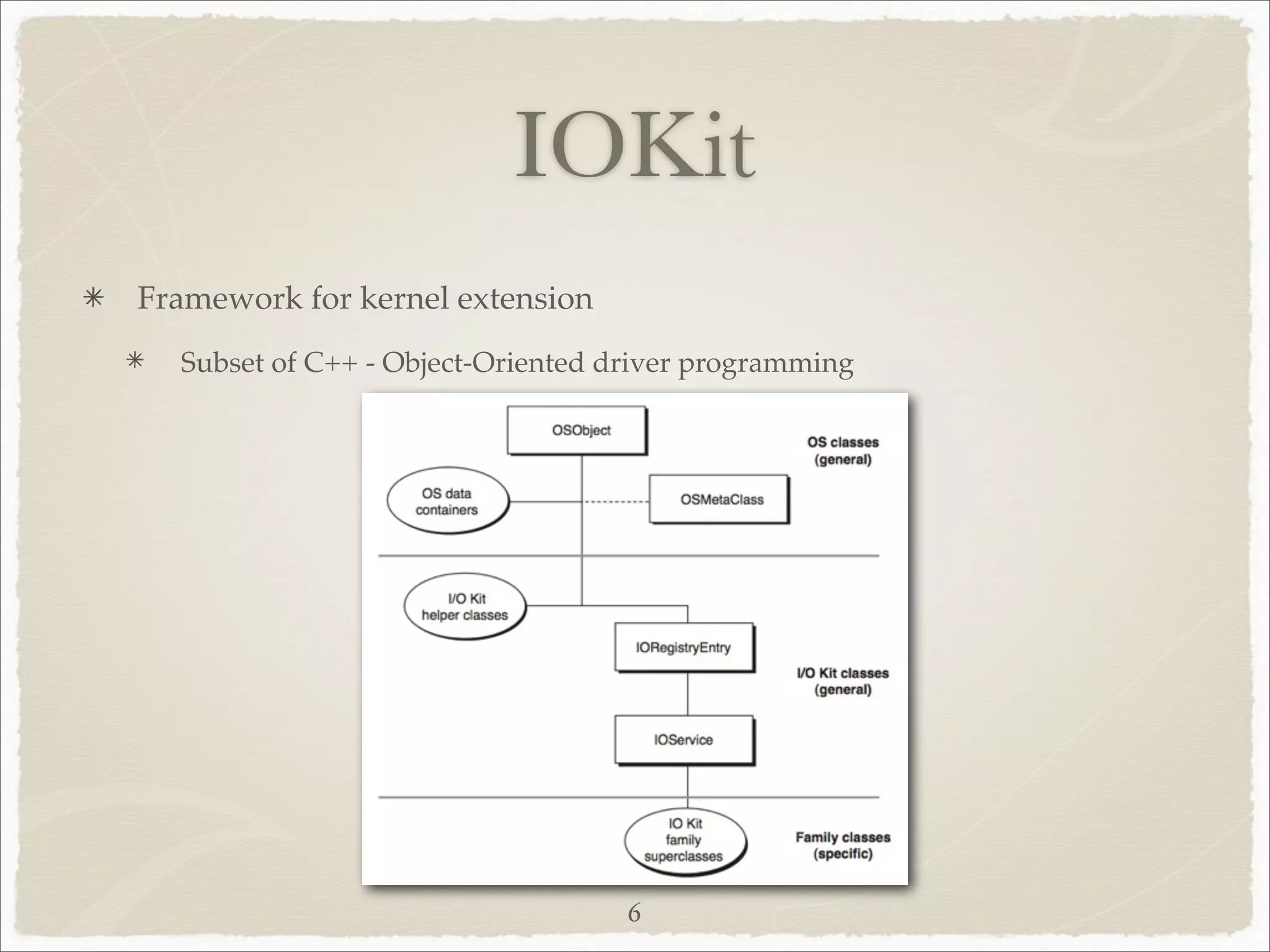
IOKit
Framework for kernel extension
  Subset of C++ - Object-Oriented driver programming


                                   6
IOKit Objects
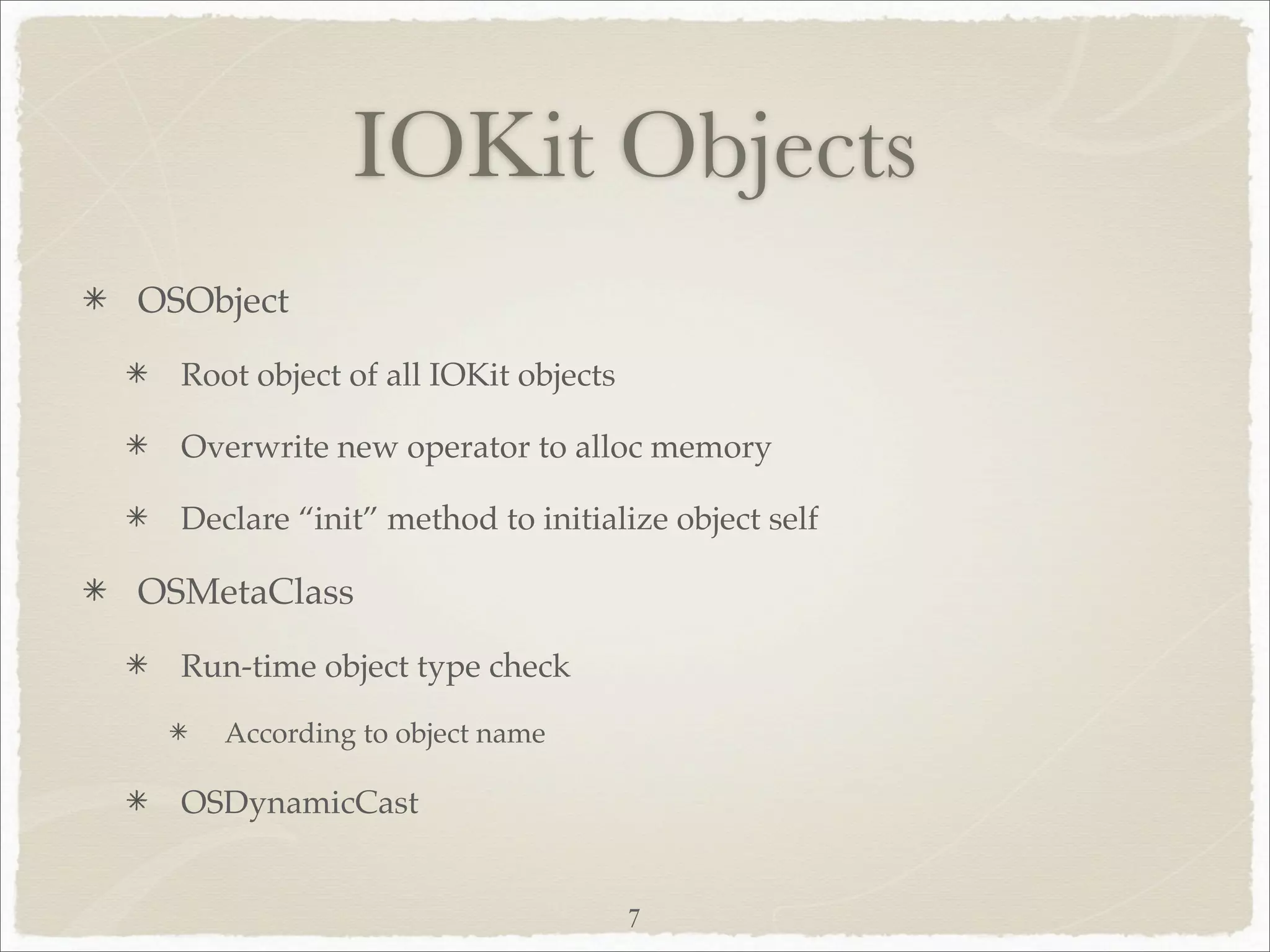
OSObject
  Root object of all IOKit objects

  Overwrite new operator to alloc memory

  Declare “init” method to initialize object self

OSMetaClass
  Run-time object type check

     According to object name

  OSDynamicCast


                                     7
IOKit Objects
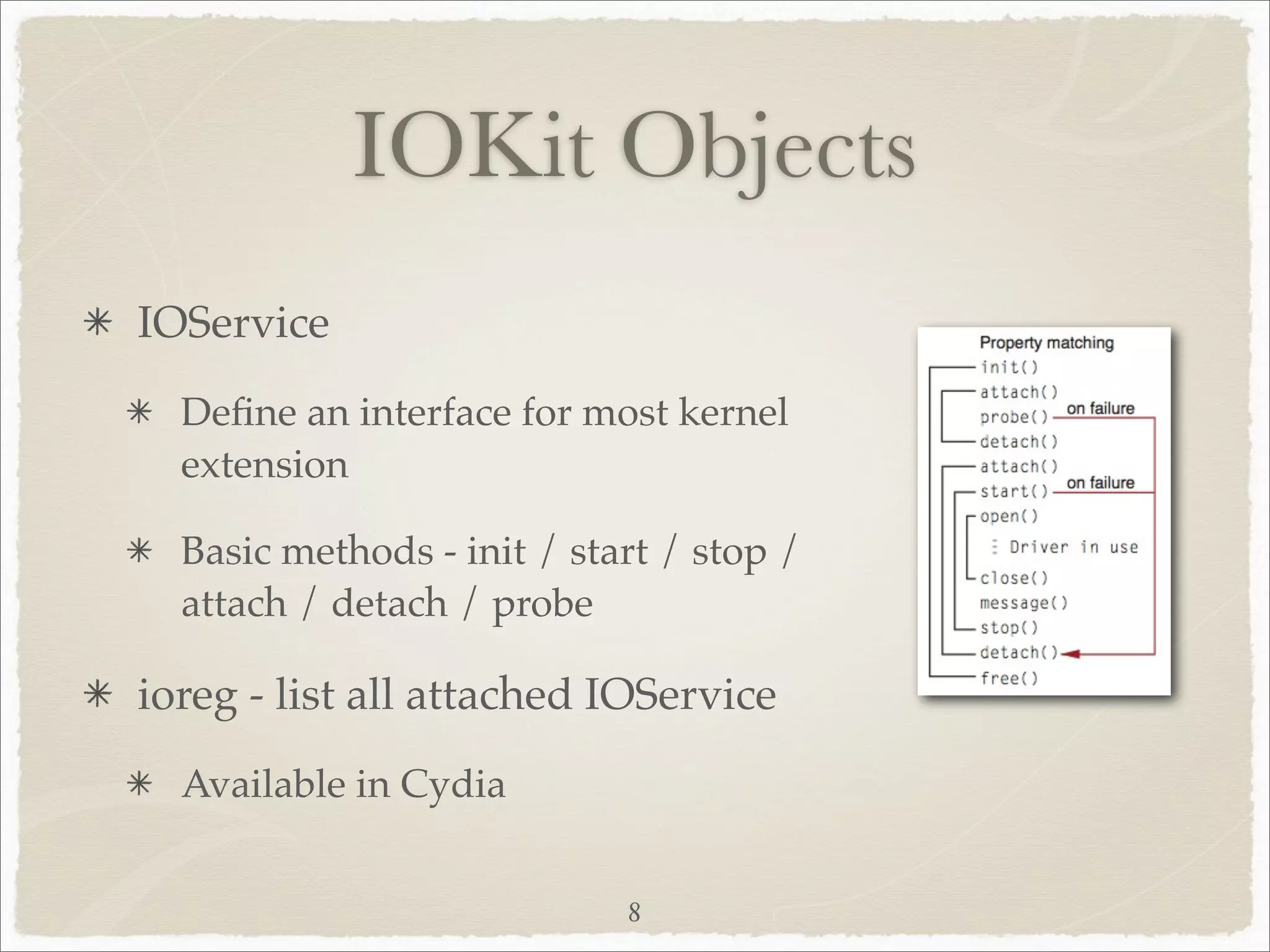
IOService
  Define an interface for most kernel
  extension

  Basic methods - init / start / stop /
  attach / detach / probe

ioreg - list all attached IOService
  Available in Cydia


                            8
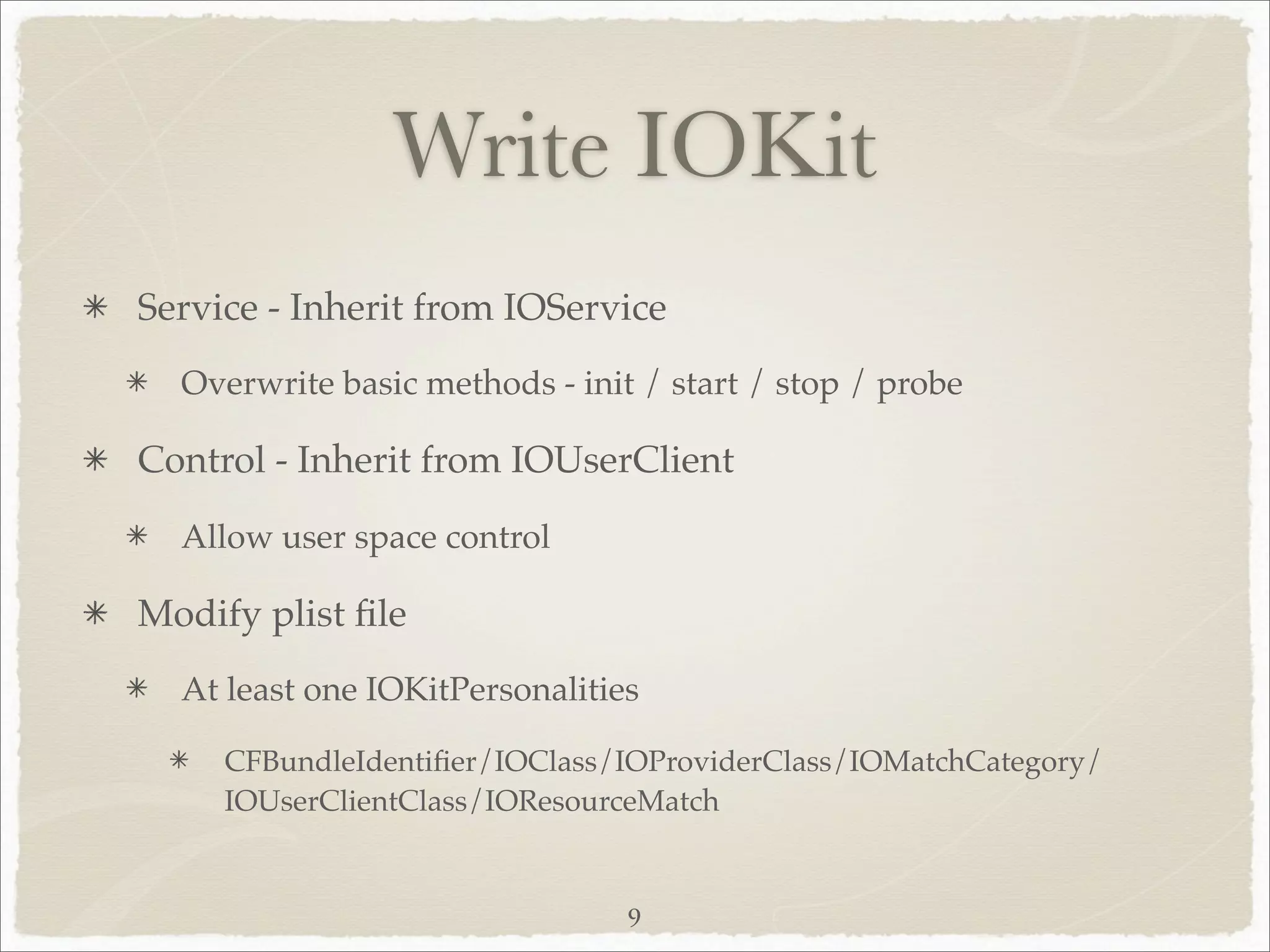
Write IOKit
Service - Inherit from IOService
  Overwrite basic methods - init / start / stop / probe

Control - Inherit from IOUserClient
  Allow user space control

Modify plist file
  At least one IOKitPersonalities

     CFBundleIdentifier/IOClass/IOProviderClass/IOMatchCategory/
     IOUserClientClass/IOResourceMatch


                                9
Kernelcache
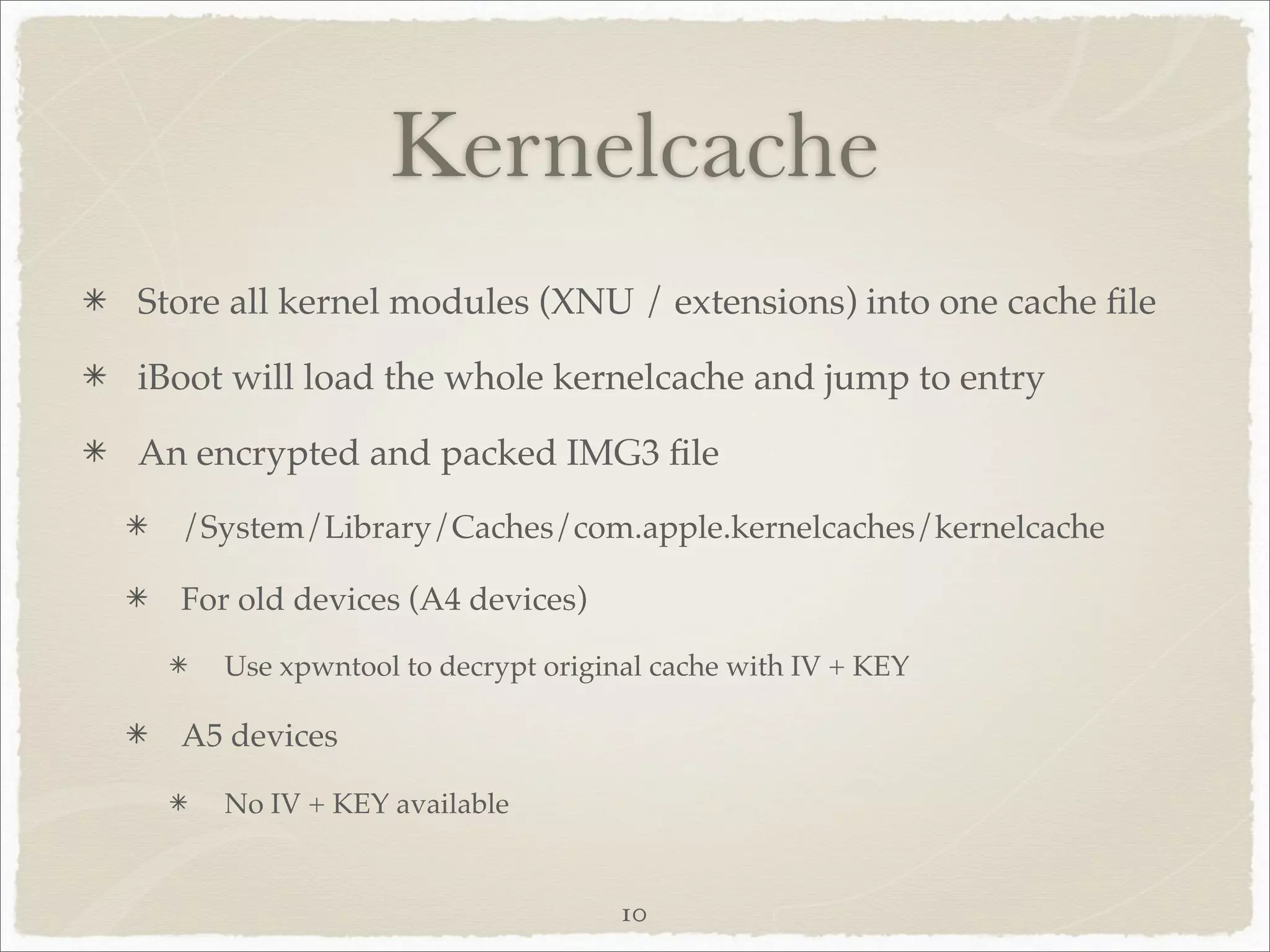
Store all kernel modules (XNU / extensions) into one cache file

iBoot will load the whole kernelcache and jump to entry

An encrypted and packed IMG3 file
  /System/Library/Caches/com.apple.kernelcaches/kernelcache

  For old devices (A4 devices)

     Use xpwntool to decrypt original cache with IV + KEY

  A5 devices

     No IV + KEY available


                                   10
Kernelcache
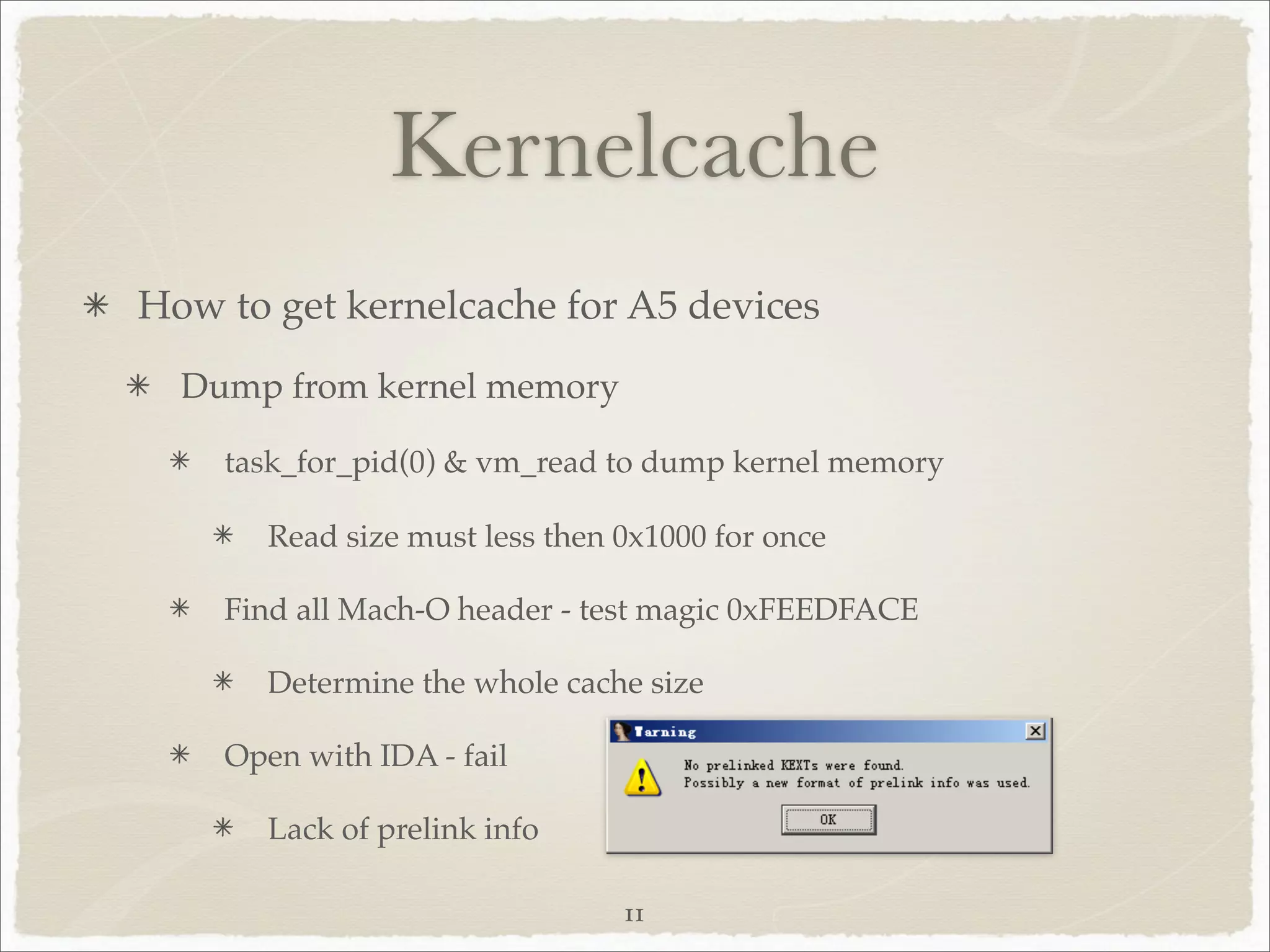
How to get kernelcache for A5 devices
  Dump from kernel memory

    task_for_pid(0) & vm_read to dump kernel memory

       Read size must less then 0x1000 for once

    Find all Mach-O header - test magic 0xFEEDFACE

       Determine the whole cache size

    Open with IDA - fail

       Lack of prelink info

                                11
Kernelcache
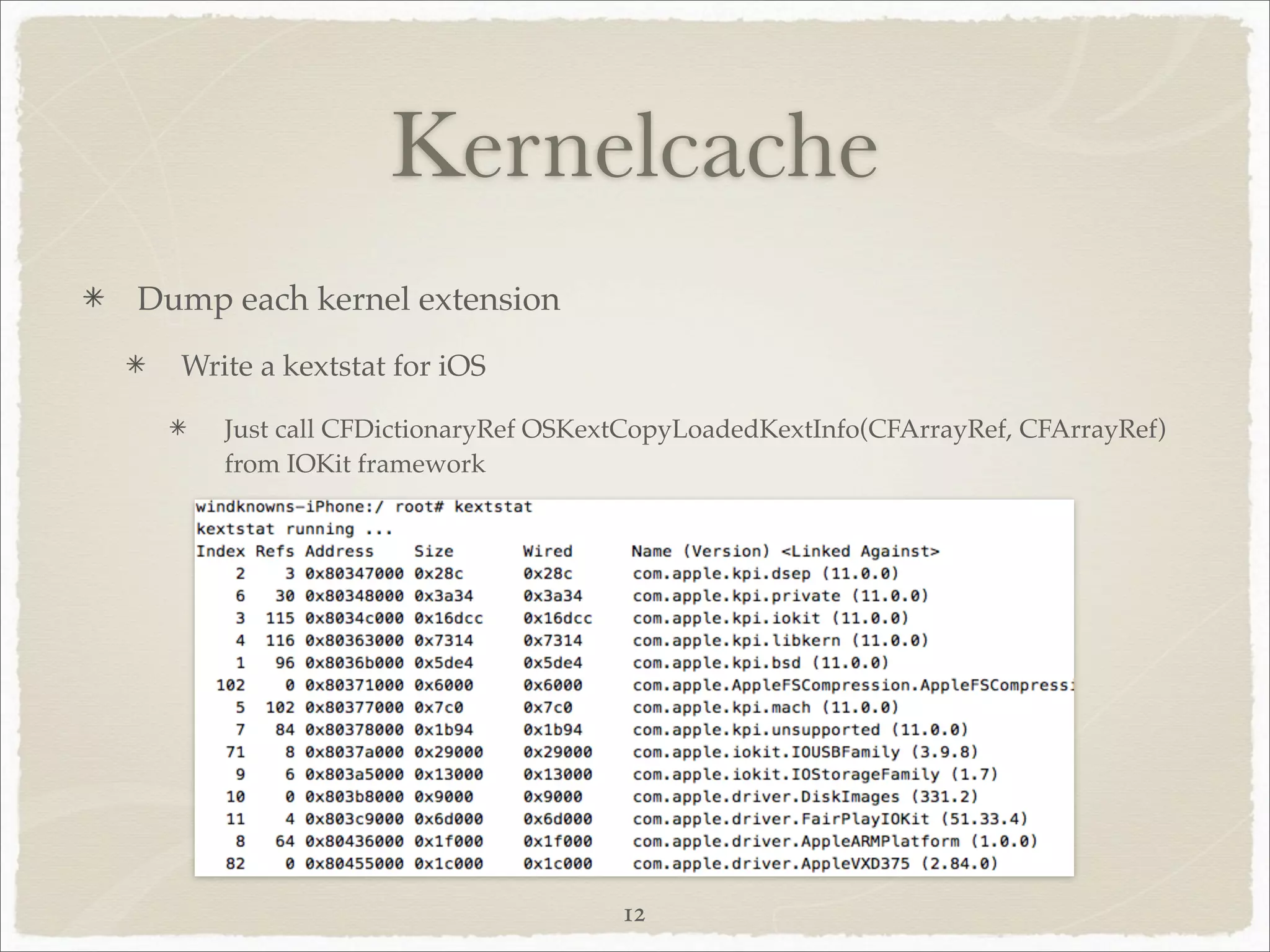
Dump each kernel extension
  Write a kextstat for iOS

     Just call CFDictionaryRef OSKextCopyLoadedKextInfo(CFArrayRef, CFArrayRef)
     from IOKit framework


                                    12
Reverse Kernel
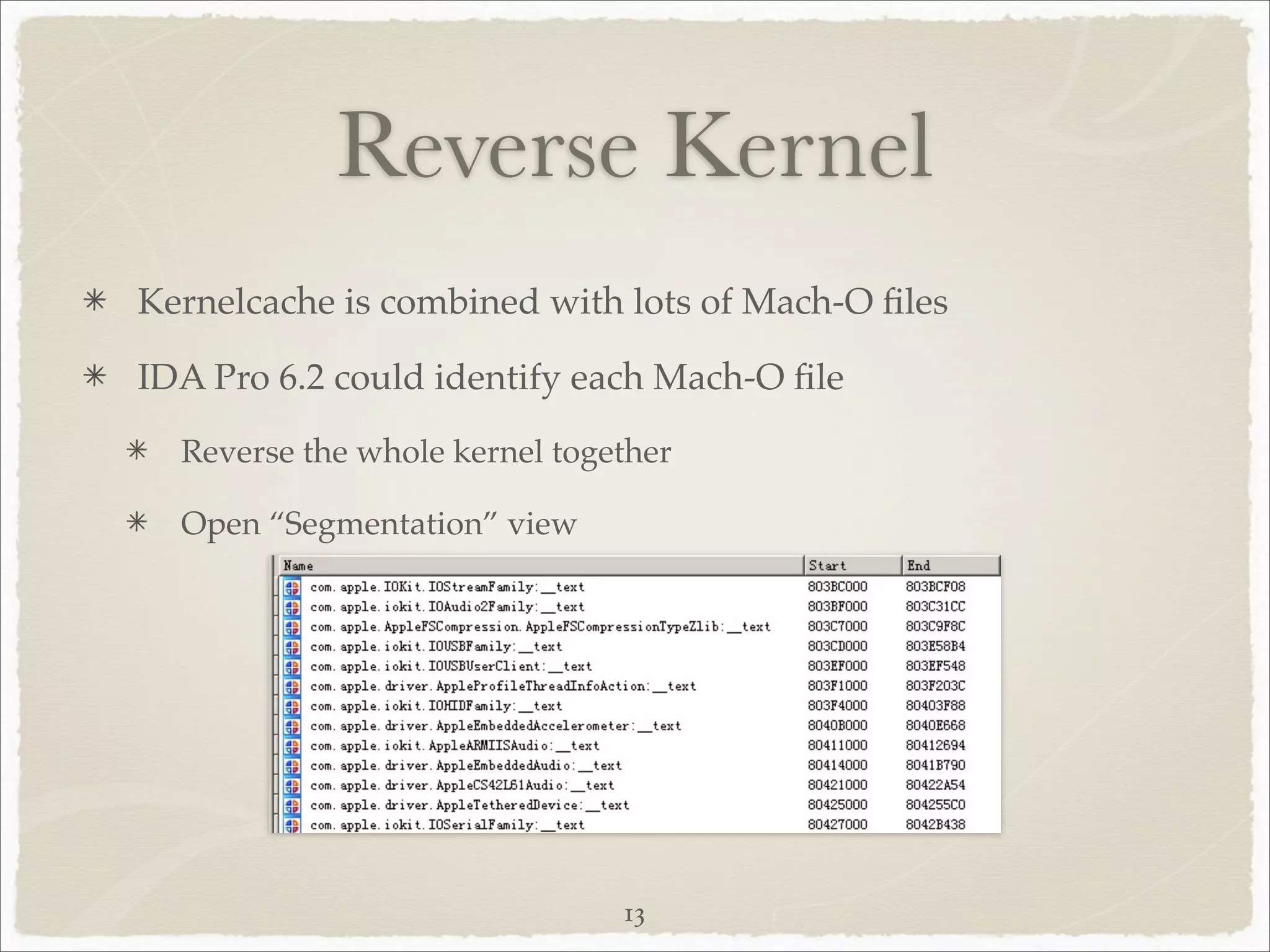
Kernelcache is combined with lots of Mach-O files

IDA Pro 6.2 could identify each Mach-O file
  Reverse the whole kernel together

  Open “Segmentation” view


                               13
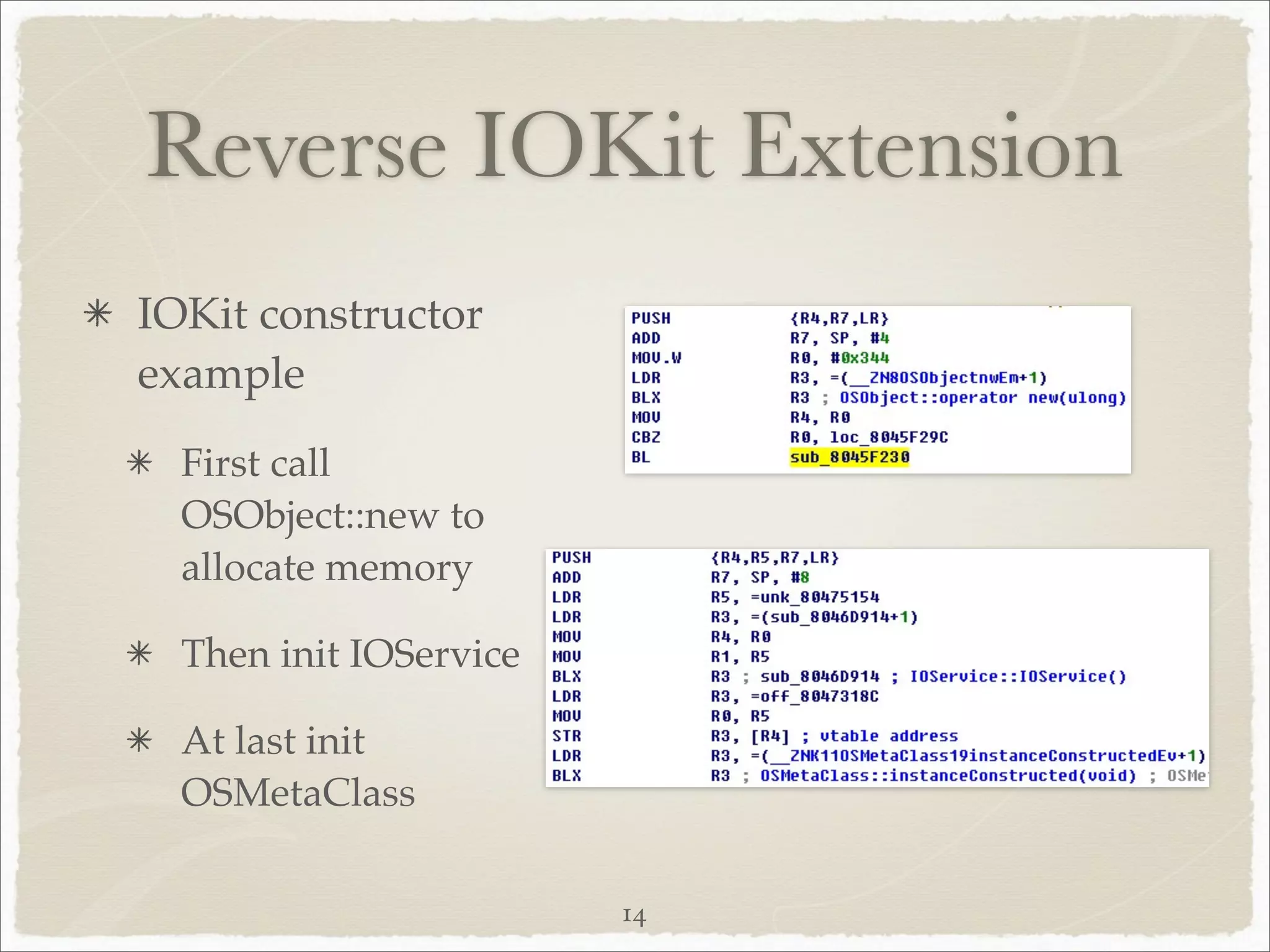
Reverse IOKit Extension
IOKit constructor
example
  First call
  OSObject::new to
  allocate memory

  Then init IOService

  At last init
  OSMetaClass

                        14
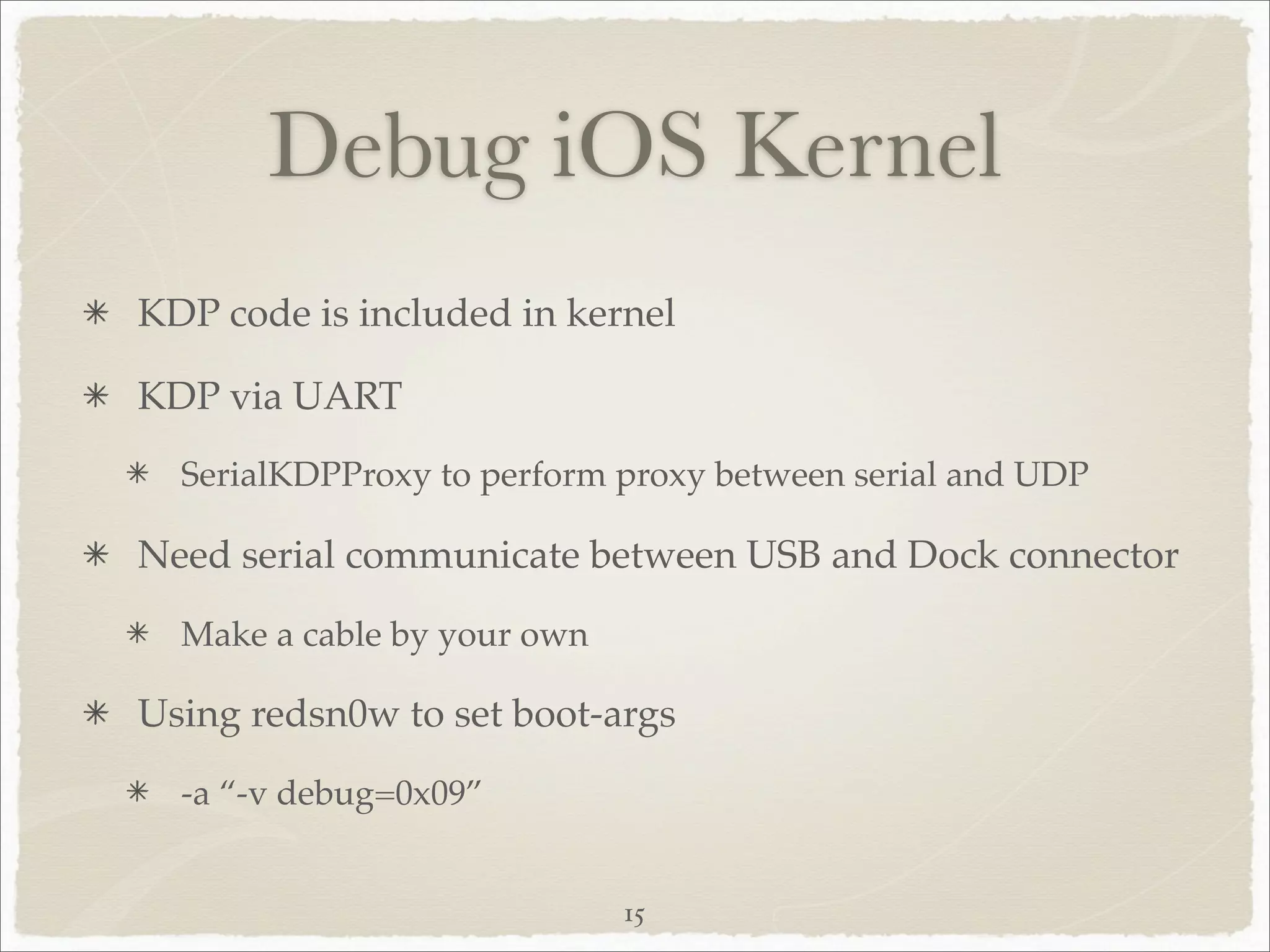
Debug iOS Kernel
KDP code is included in kernel

KDP via UART
  SerialKDPProxy to perform proxy between serial and UDP

Need serial communicate between USB and Dock connector
  Make a cable by your own

Using redsn0w to set boot-args
  -a “-v debug=0x09”


                             15
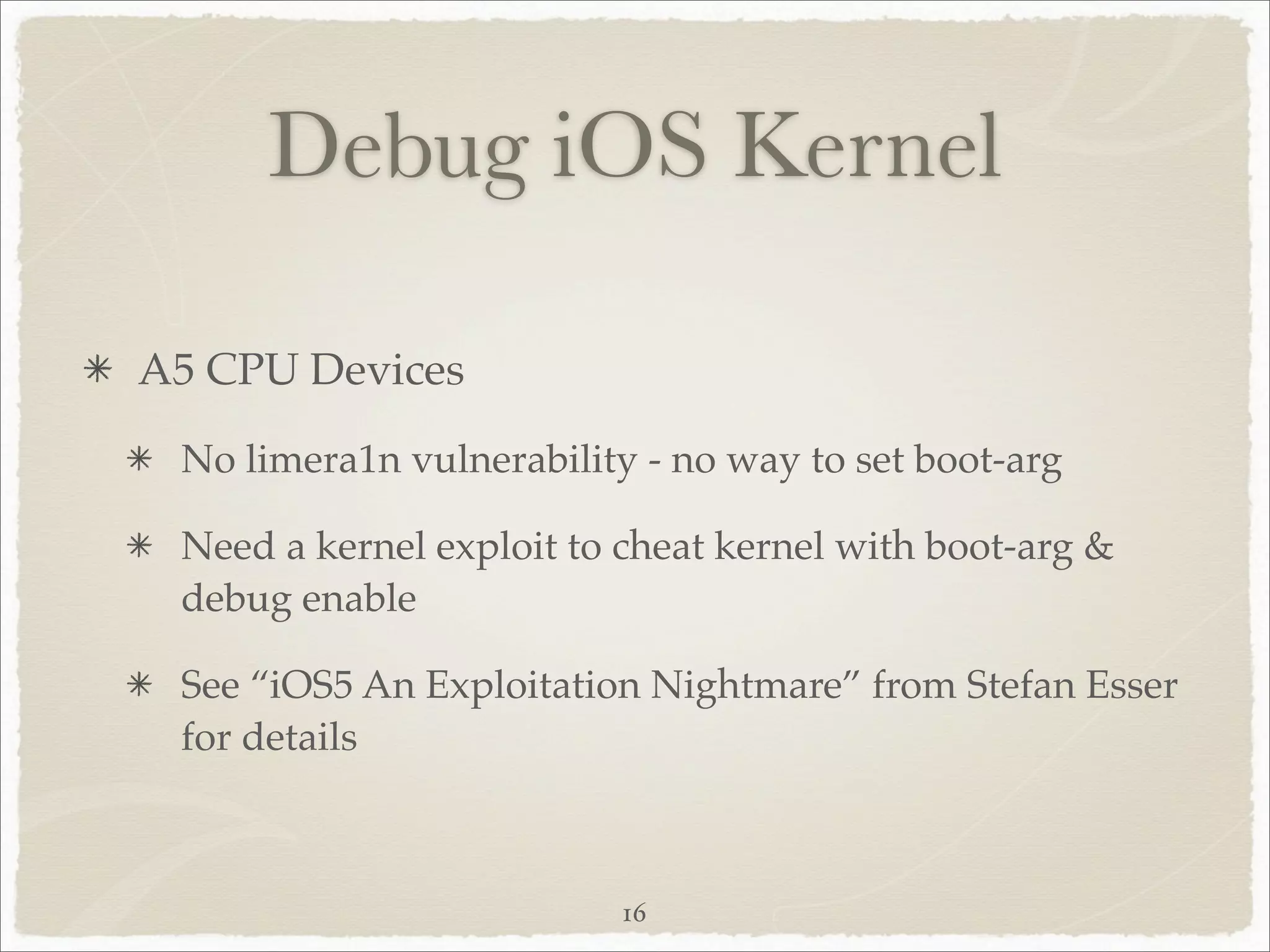
Debug iOS Kernel

A5 CPU Devices
 No limera1n vulnerability - no way to set boot-arg

 Need a kernel exploit to cheat kernel with boot-arg &
 debug enable

 See “iOS5 An Exploitation Nightmare” from Stefan Esser
 for details


                          16
Content
iOS Kernel Basics

Summary of Known Bugs

Passive Fuzz

Active Fuzz

Analyze Real Bug

Conclusion

                    17
Summary of Known Bugs
iOS kernel attack surface
  Socket/Syscalls

    ioctl

  FileSystem drivers

    HFS

  iOKit

    Device drivers (USB/Baseband etc)


                             18
CVE-2010-2973
CVE-2010-2973 - IOSurfaceRoot integer overflow

  Used in the jailbreakme 2 as PE exploit

    Can be triggered by mobile user apps (MobileSafari)

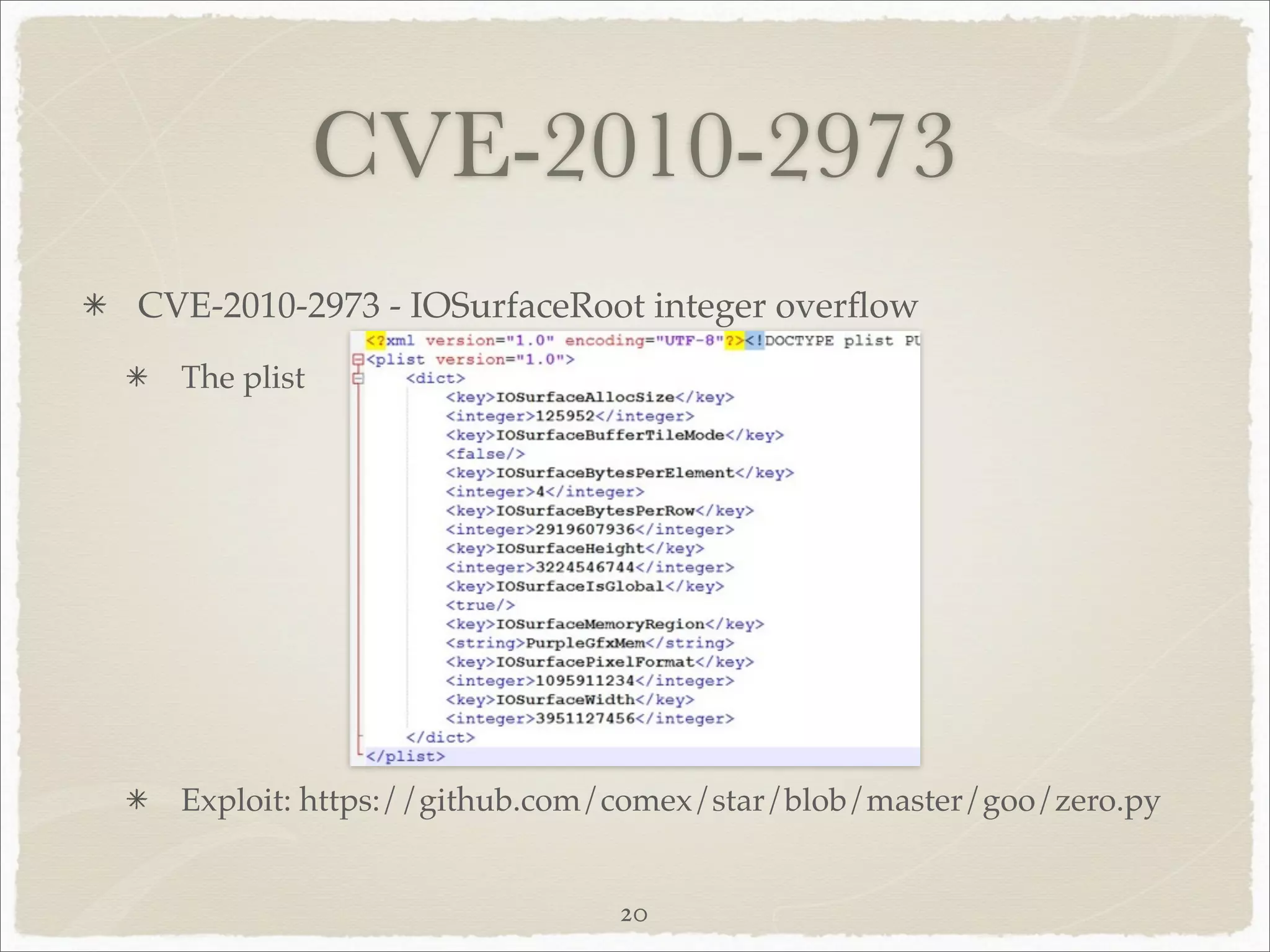
  Malformed IOSurfaceAllocSize/IOSurfaceBytesPerRow/
  IOSurfaceHeight/IOSurfaceWidth values in the plist

  Create a Surface object using above plist and return a userland ptr

  Calling memcpy to overflow the important kernel structure to
  disable the security protection


                                 19
CVE-2010-2973
CVE-2010-2973 - IOSurfaceRoot integer overflow
  The plist


  Exploit: https://github.com/comex/star/blob/master/goo/zero.py


                             20
CVE-2011-0227
CVE-2011-0227 - IOMobileFrameBuffer Type
Conversion Issue
 RootCause happens in the IOMobileFrameBuffer are not
 properly to check the object when doing conversion

 Suppose to call OSDynamicCast() while doing type
 casting/conversion

 The user able to control the vtable function pointer to get
 code execution

                           21
CVE-2011-0227
CVE-2011-0227 - IOMobileFrameBuffer Type Conversion Issue
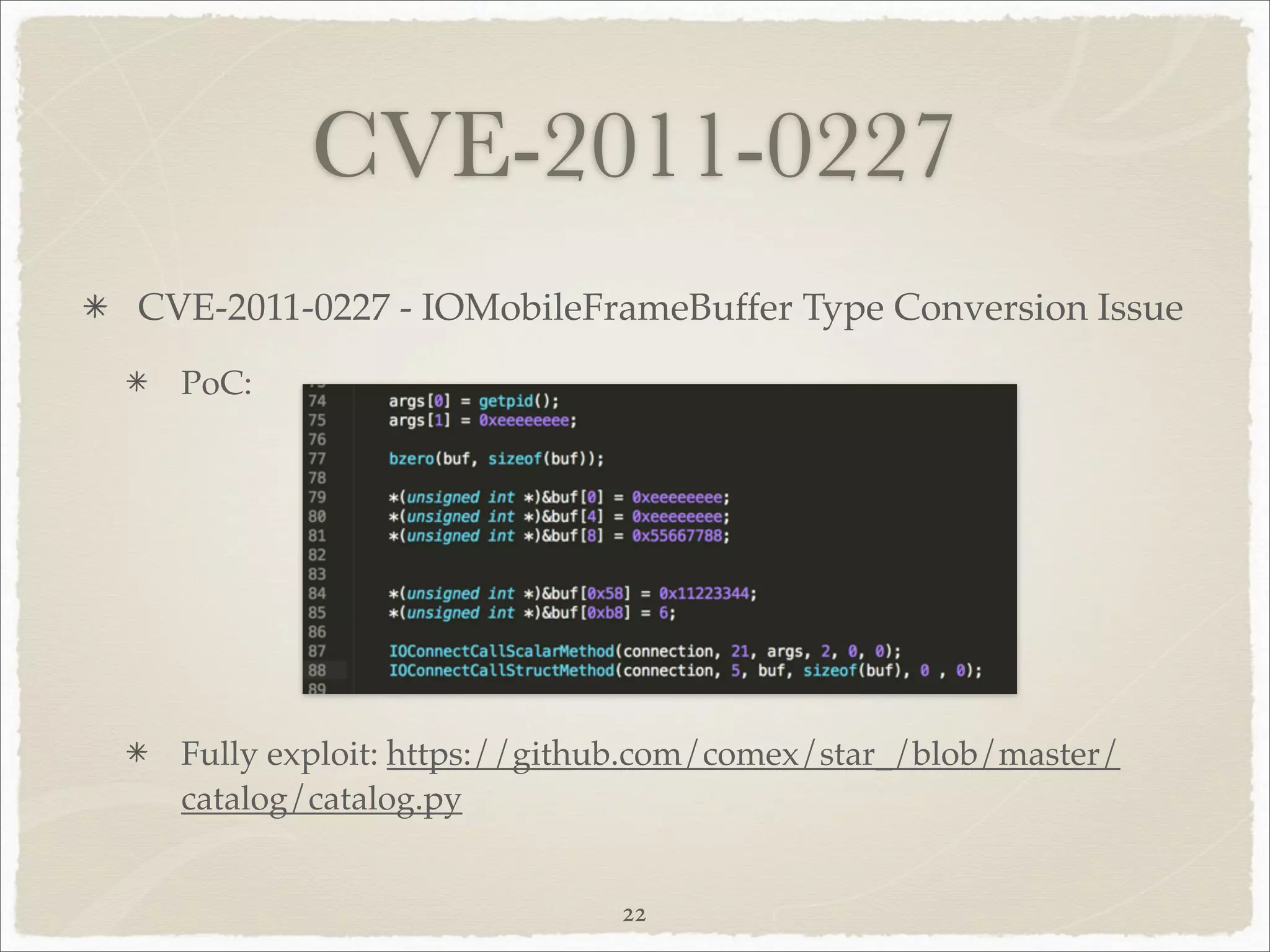
  PoC:


  Fully exploit: https://github.com/comex/star_/blob/master/
  catalog/catalog.py


                             22
Summary of Known Bugs

 Conclusion

   They are both PE vulns because it is happens in the IOKit
   drivers framework

   Closed source and less people pay attention

   Good target for bug hunting!


                            23
Content
iOS Kernel Basics

Summary of Known Bugs

Passive Fuzz

Active Fuzz

Analyze Real Bug

Conclusion

                    24
Passive Fuzz
Passive Fuzz

  First idea coming out is fuzzing

  Less work with good results

  Write a IOKit client to understand how the IOKit works

  Fuzzing parameters for IOConnectCallStructMethod/
  IOConnectCallScalarMethod

  In the low-level both above APIs are calling to the
  IOConnectCallMethod


                            25
Passive Fuzz

Why we need passive fuzzing?

  They key point is pay less works because we are lazy to audit
  code :P

  Just like hook DeviceIoControl on the win32 to hunting kernel
  bugs

  We are going to hook IOConnectCallMethod to do the passive
  fuzzing


                           26
Passive Fuzz
The Preparation

  Finding a good hook framework for iOS

    MobileSubstrate

       http://iphonedevwiki.net/index.php/MobileSubstrate

    MSHookFunction/MSHookMessage for C/Object Method
    hook

    Not much documents but enough to make it work


                         27
Passive Fuzz
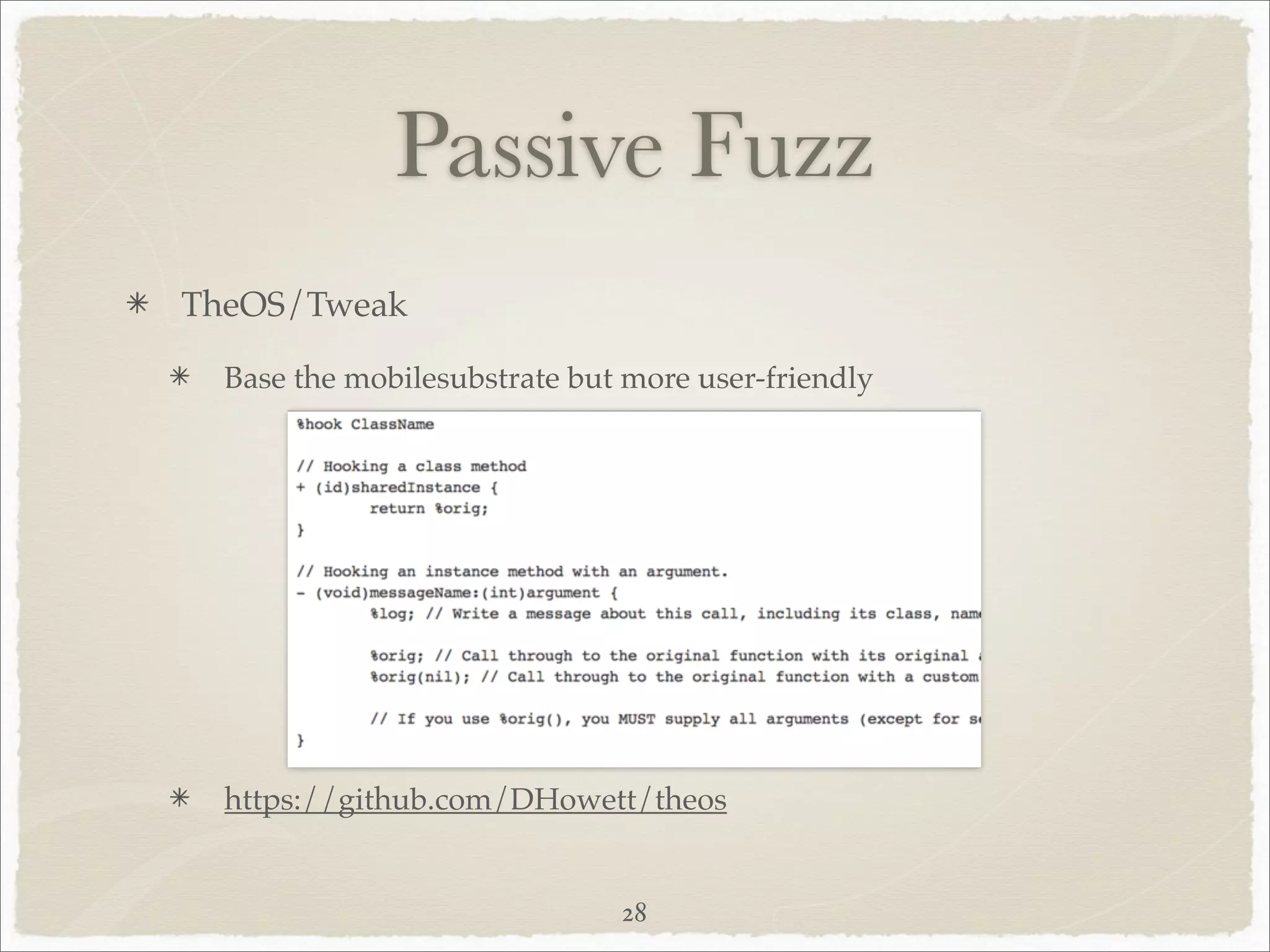
TheOS/Tweak

  Base the mobilesubstrate but more user-friendly


  https://github.com/DHowett/theos


                              28
Passive Fuzz

You can also using interpose (dyld function)

    Redirect the functions in the import table

    No libmobilesubstrate required.

Inject your dylib via DYLD_INSERT_LIBRARIES to
make your fuzzer running!


                           29
Passive Fuzz
Tips

  Struct object could be Data/Plist(XML), So pay some work
  here.

  Scalar object are integer values only, random enough to find
  some interesting stuffs.

  Results:

       NULL pointer deference/Kernel Use-after-free/handled
       panic exception


                            30
Content
iOS Kernel Basics

Summary of Known Bugs

Passive Fuzz

Active Fuzz

Analyze Real Bug

Conclusion

                    31
Active Fuzz
Weakness of passive fuzz
  Only cover small amount of IOKit interfaces

  Needs interaction - keep using your iPhone

  Not so efficient - waste time

Advantage of active fuzz
  Cover most of IOKit interfaces

  Automatically and efficient


                             32
Rough Idea


Find all IOKit drivers with IOUserClient

Identify all external methods of the driver

Test all those methods


                         33
External Methods
External methods are used by IOKit to provide function to user-
space application

Application call IOConnectCallMethod to control driver


selector - which method should be called

input / output - Array of uint64_t or struct data

                              34
Kernel Dispatch
IOConnectCallMethod -> IOUserClient:: externalMethod


if dispatch != NULL
  Check input and output size & call dispatch->function

else call getTargetAndMethodForIndex


  Check type and size & call method->func


                                 35
IOKit Implement
Overwrite externalMethod
 Example


                     36
IOKit Implement


       37
IOKit Implement
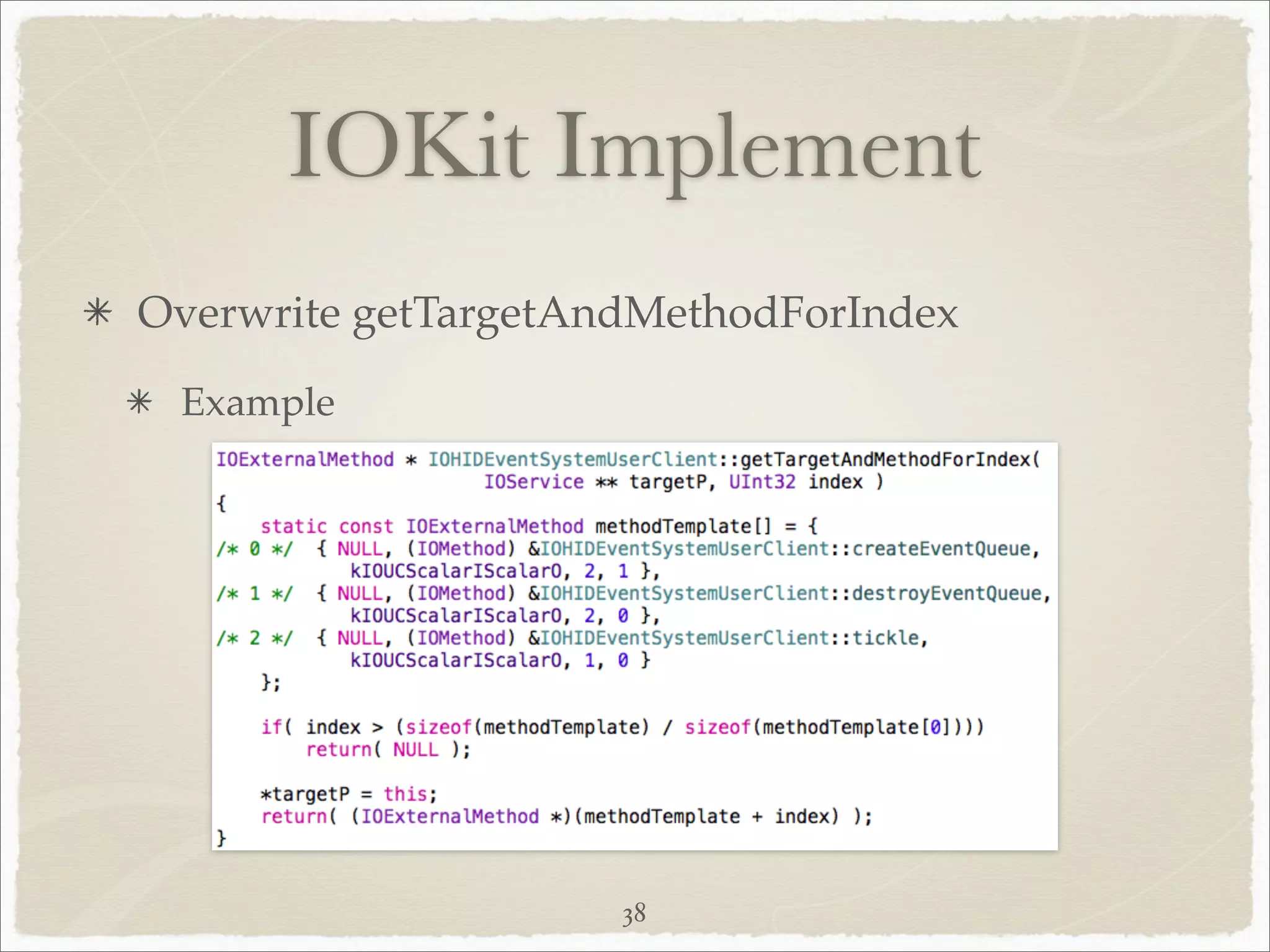
Overwrite getTargetAndMethodForIndex
 Example


                     38
Key Point


Know what to fuzz
 Get IOExternalMethodDispatch sMethods[]

 Get IOExternalMethod methodTemplate[]


                       39
How
For the IOKit drivers without source code
  Reverse the KernelCache with symbol problem resolved

  IOKit structure you should know

    IOExternalMethodDispatch & IOExternalMethod

  Filter the IOKit keywords in the IDA name window

    sMethods etc.

  Will list all the IOKit drivers interface

                              40
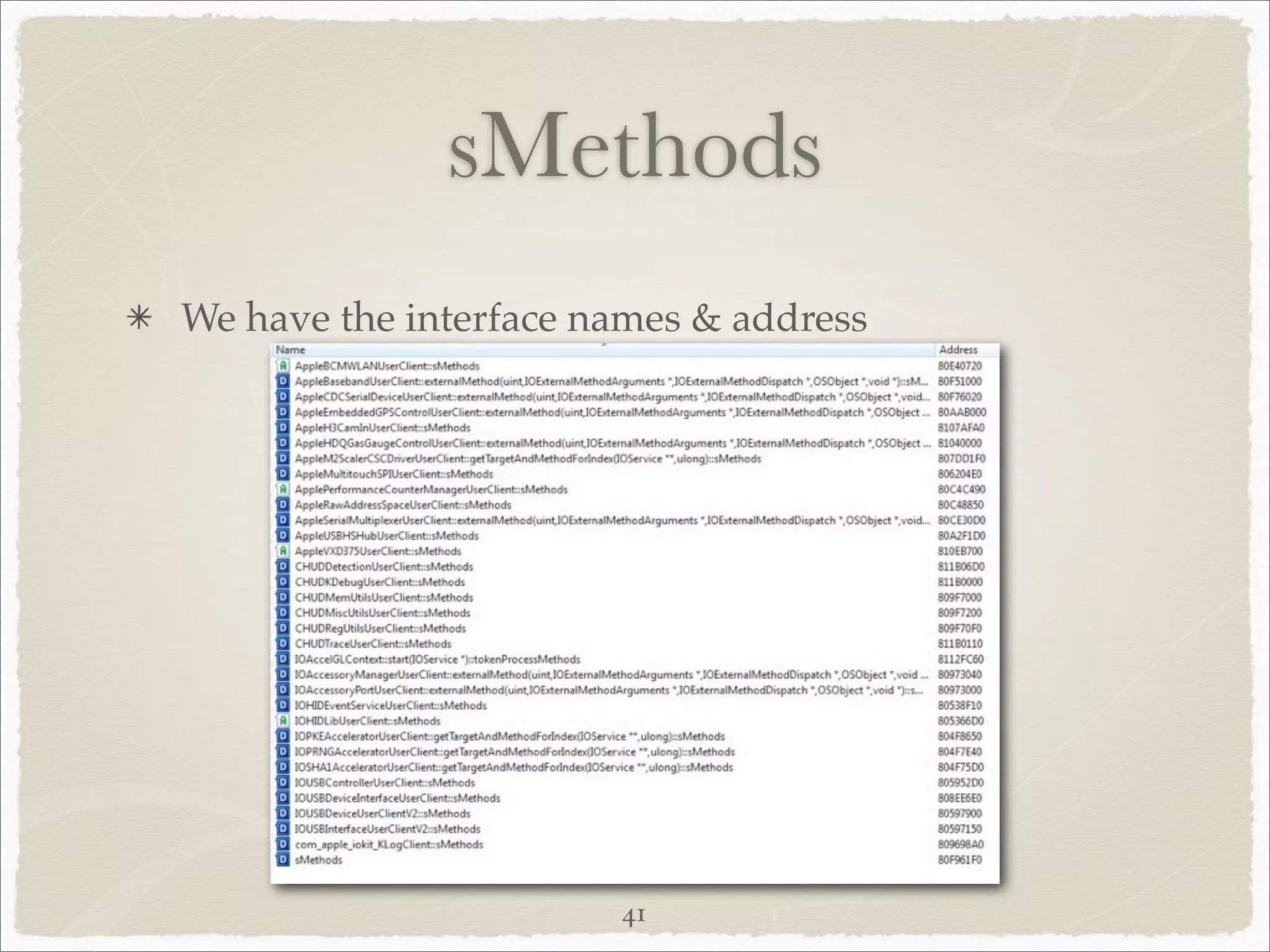
sMethods
We have the interface names & address


                       41
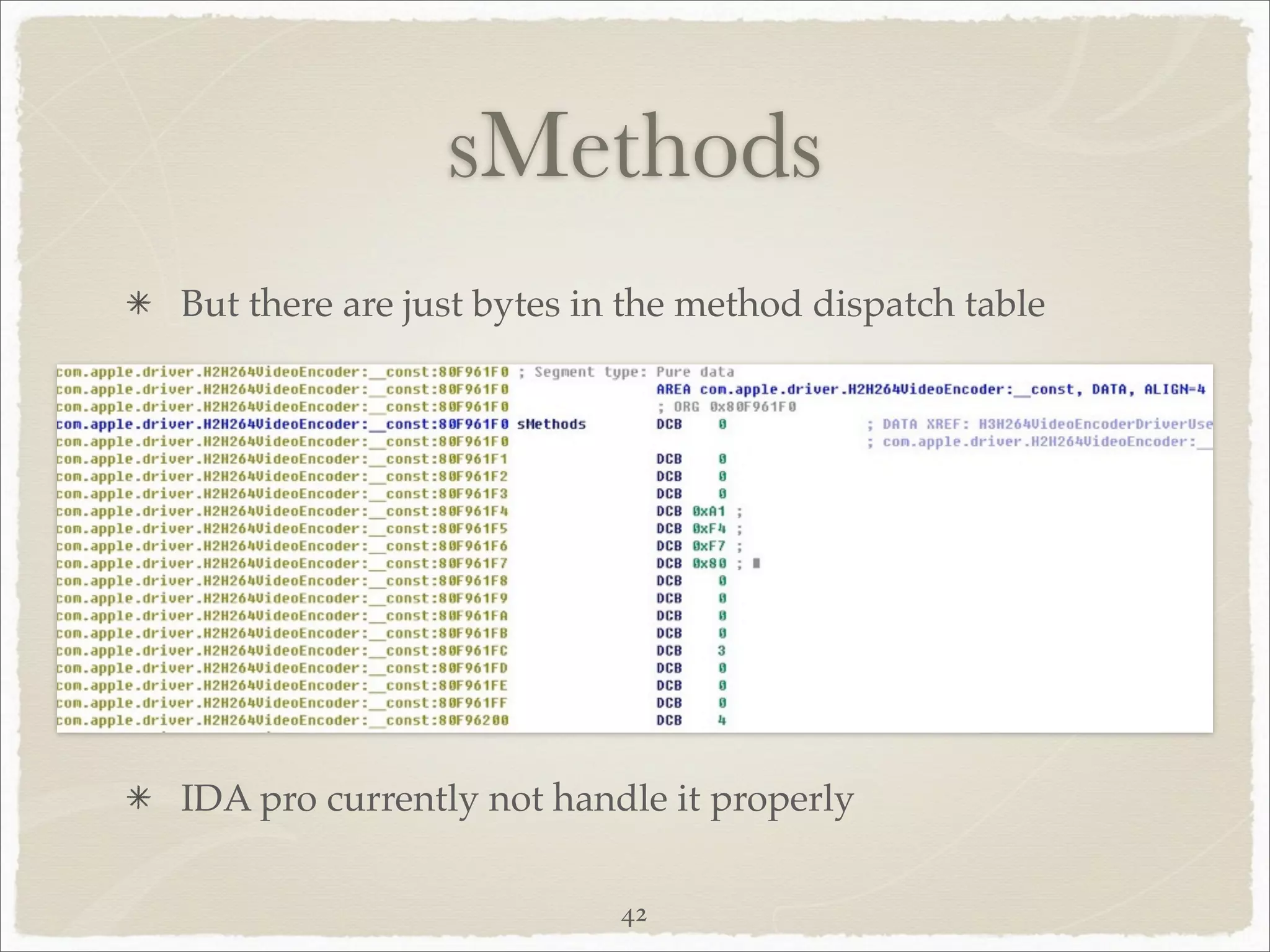
sMethods
But there are just bytes in the method dispatch table


IDA pro currently not handle it properly

                          42
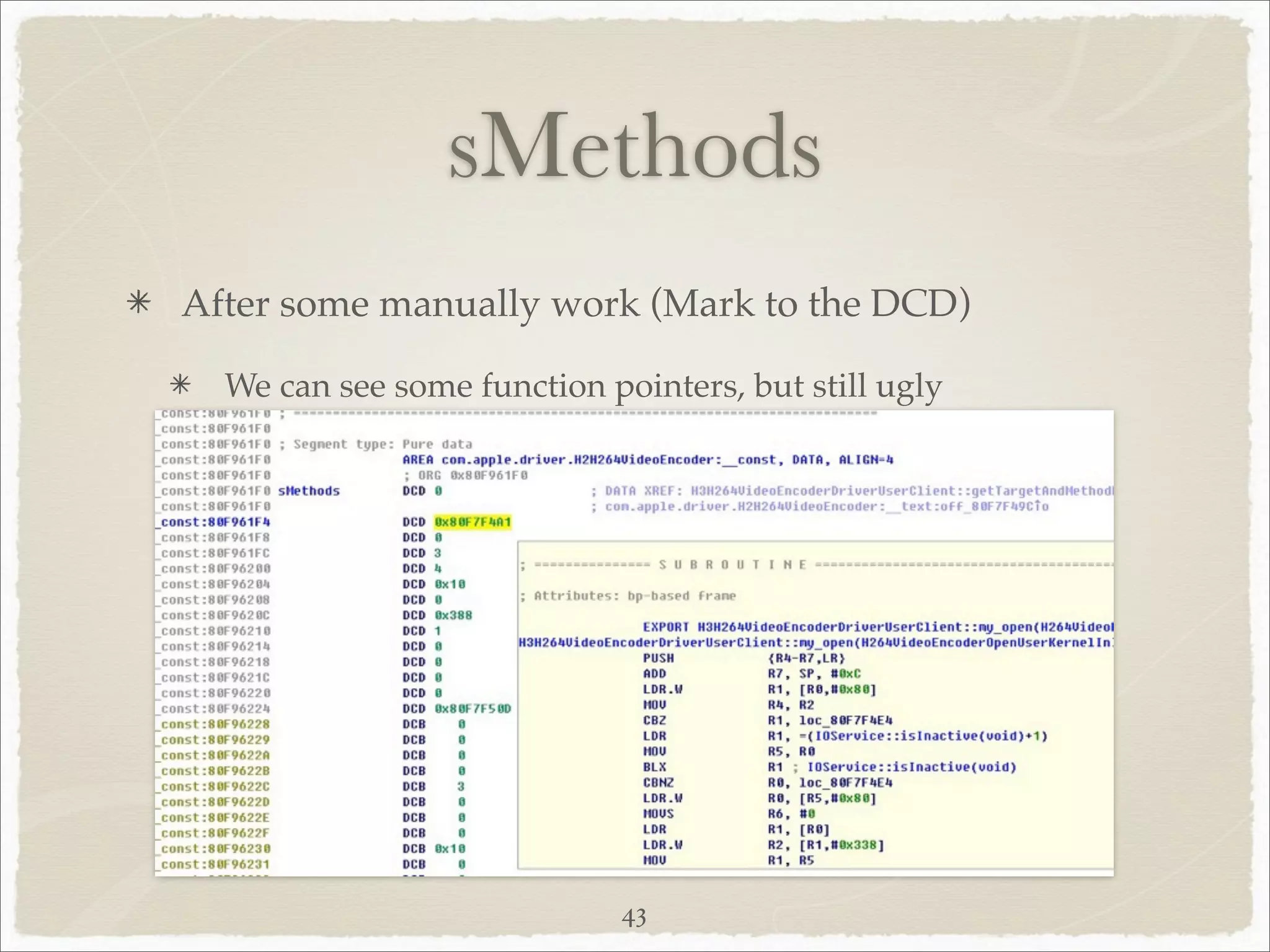
sMethods
After some manually work (Mark to the DCD)

  We can see some function pointers, but still ugly


                             43
Work Todo

Need some IDA Python works here

Add IOKit struct information in the idb file

  (IOExternalMethodDispatch & IOExternalMethod)

Find the dispatch table range and mark it to the correct
struct.


                         44
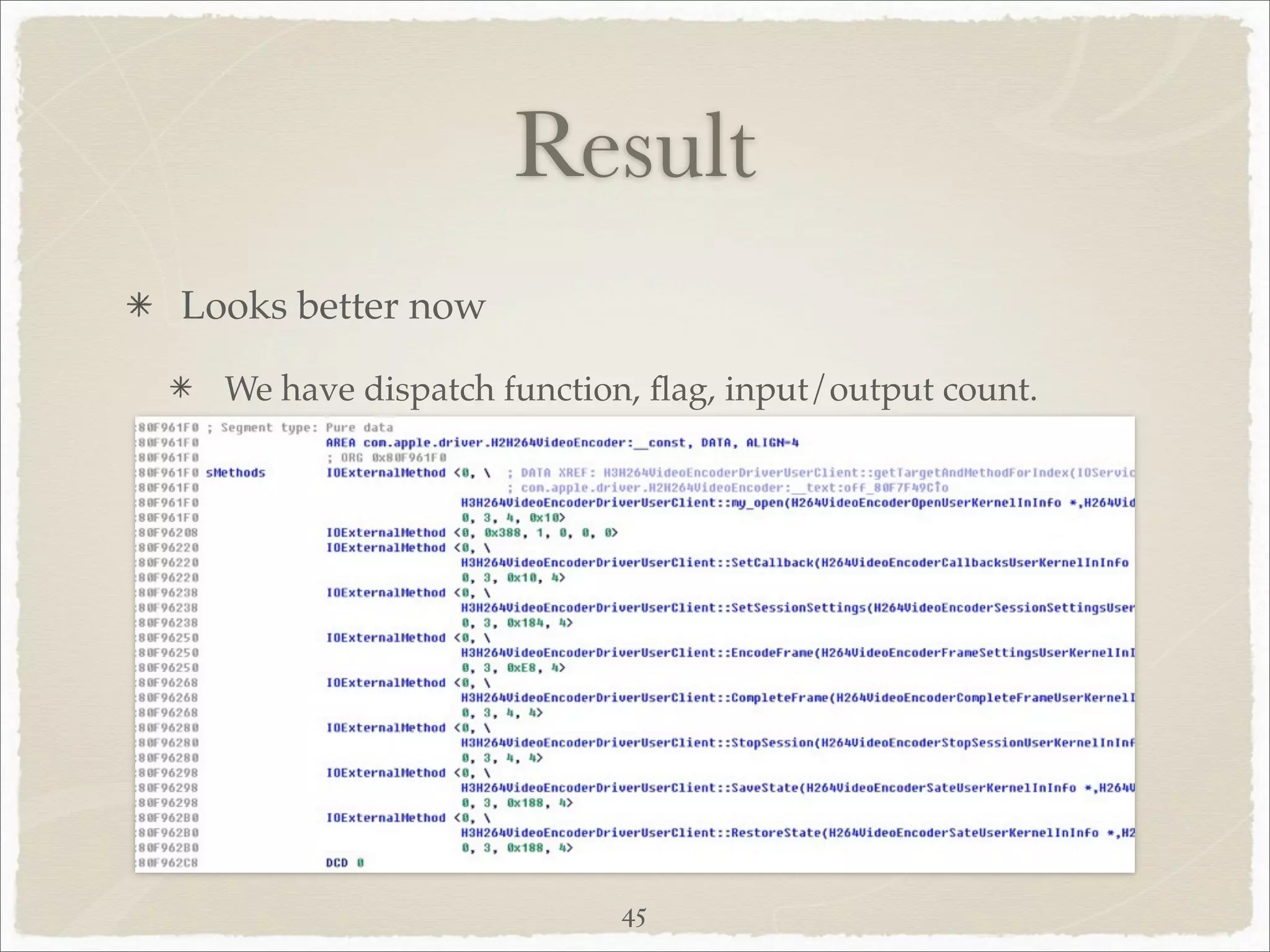
Result
Looks better now

  We have dispatch function, flag, input/output count.


                          45
Correct Input
Flags defines

  I = input O = output

  For example, type 3 means:

    Struct input & output

We must pass the correct input/output type and count,
otherwise the request will be rejected

Start coding your own actively fuzzer!


                            46
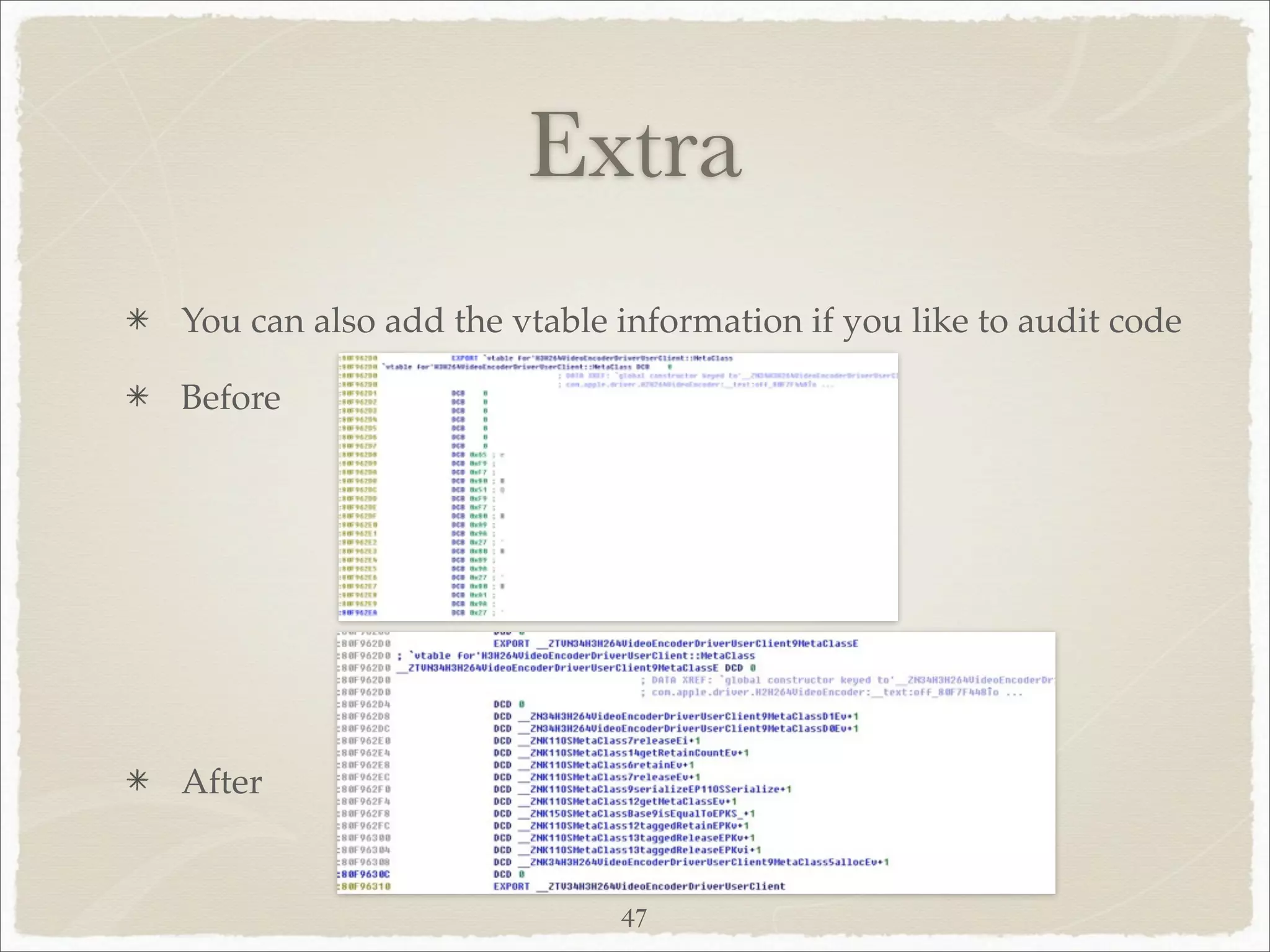
Extra
You can also add the vtable information if you like to audit code

Before


After


                            47
Content
iOS Kernel Basics

Summary of Known Bugs

Passive Fuzz

Active Fuzz

Analyze Real Bug

Conclusion

                    48
Are There Bugs?
Definitely YES
  Crashes could be easily generated by our fuzzer

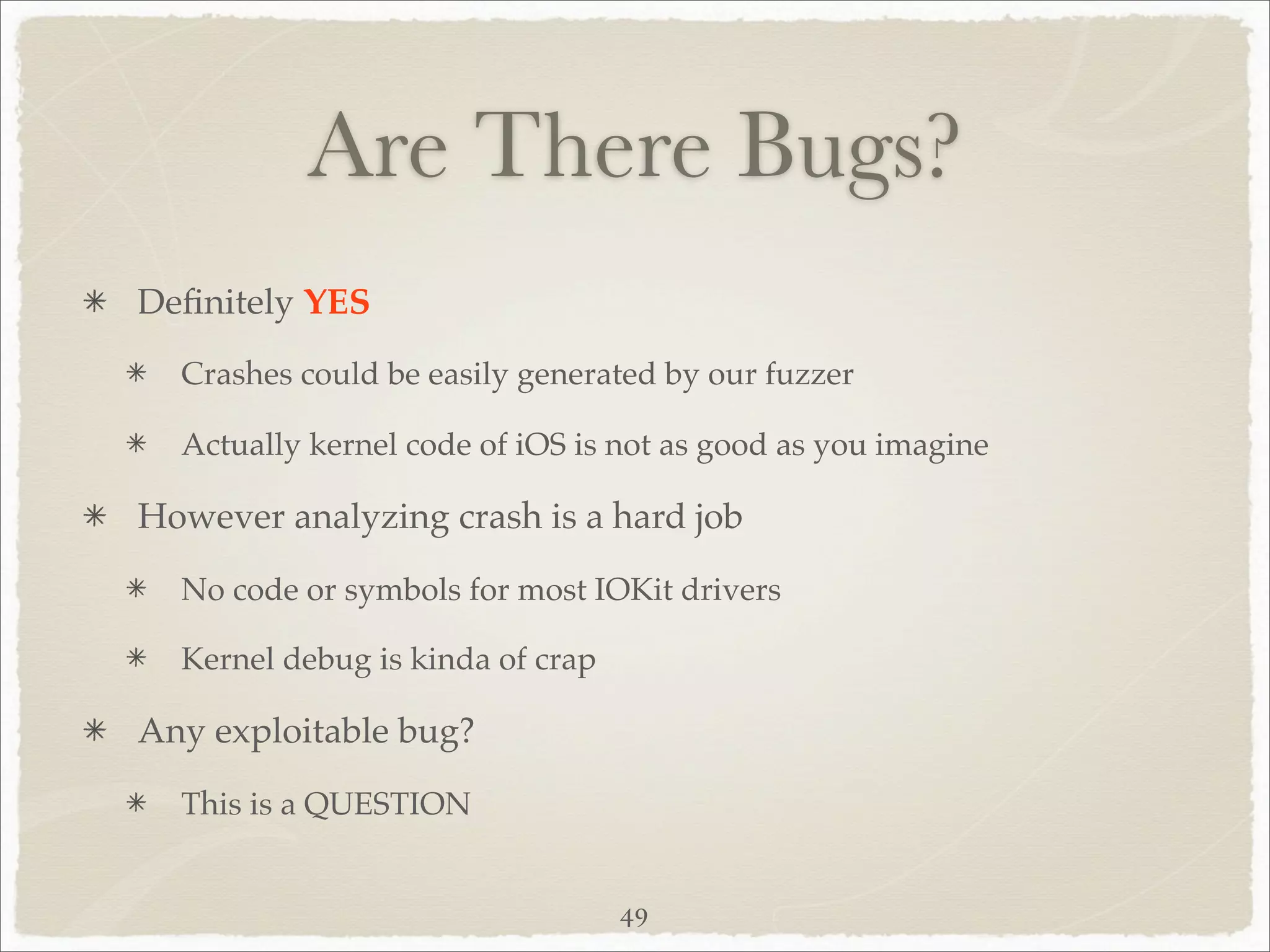
  Actually kernel code of iOS is not as good as you imagine

However analyzing crash is a hard job

  No code or symbols for most IOKit drivers

  Kernel debug is kinda of crap

Any exploitable bug?

  This is a QUESTION


                                  49
IOKit Bug Analysis
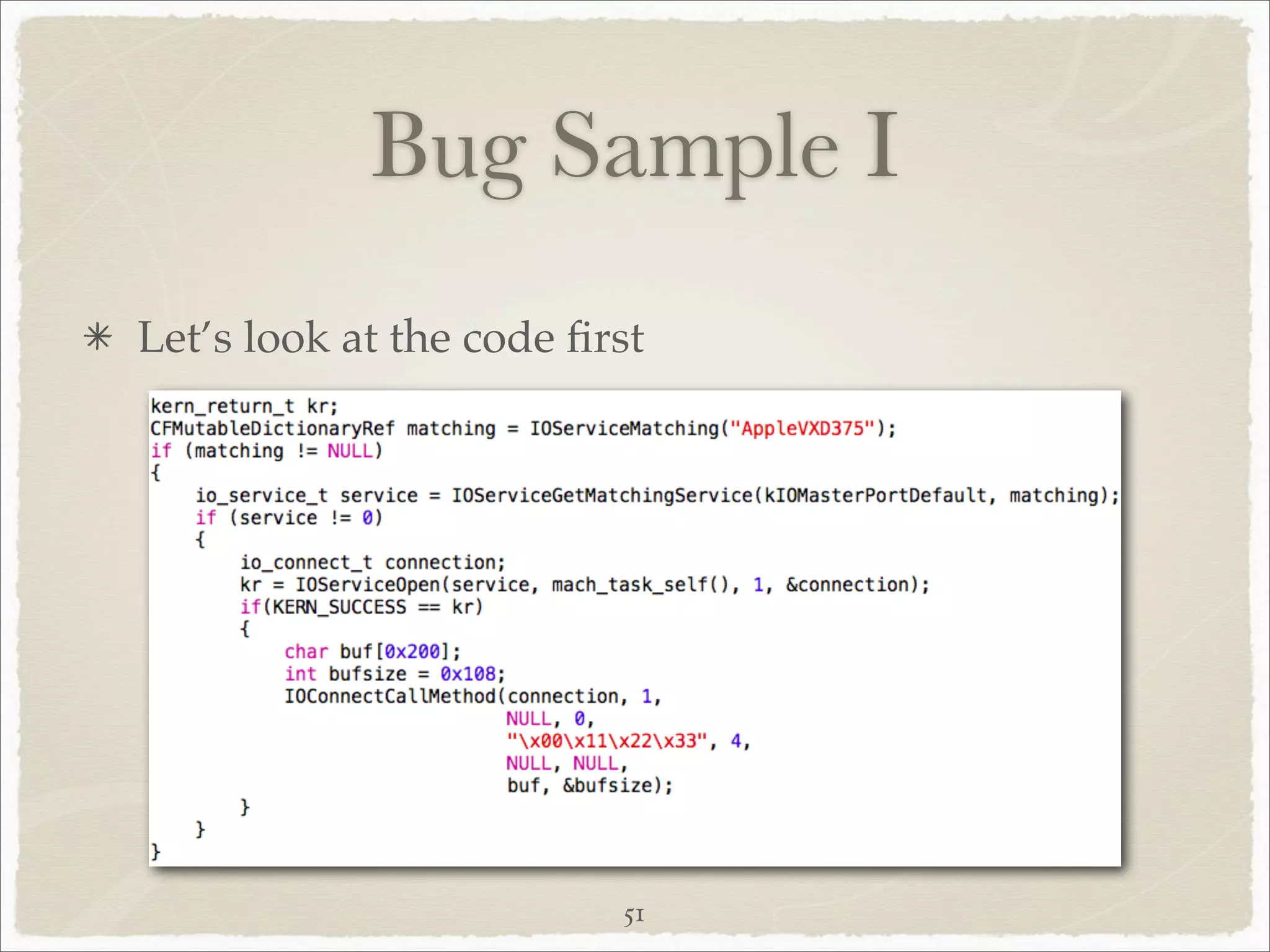
Simplify crash code
   Code is generated by fuzzer - there are many IOConnectCallMethod calls

   Simplify the code could help you a lot when doing static analysis

Look at panic log
   fault_type & register values

Static analysis
   Understand the bug and trigger path

Debug
   Write exploit


                                      50
Bug Sample I
Let’s look at the code first


                         51
Bug Sample I
Then the panic log
  PC = 0x80455c3c

  fault_addr = 0x0


                     52
Bug Sample I
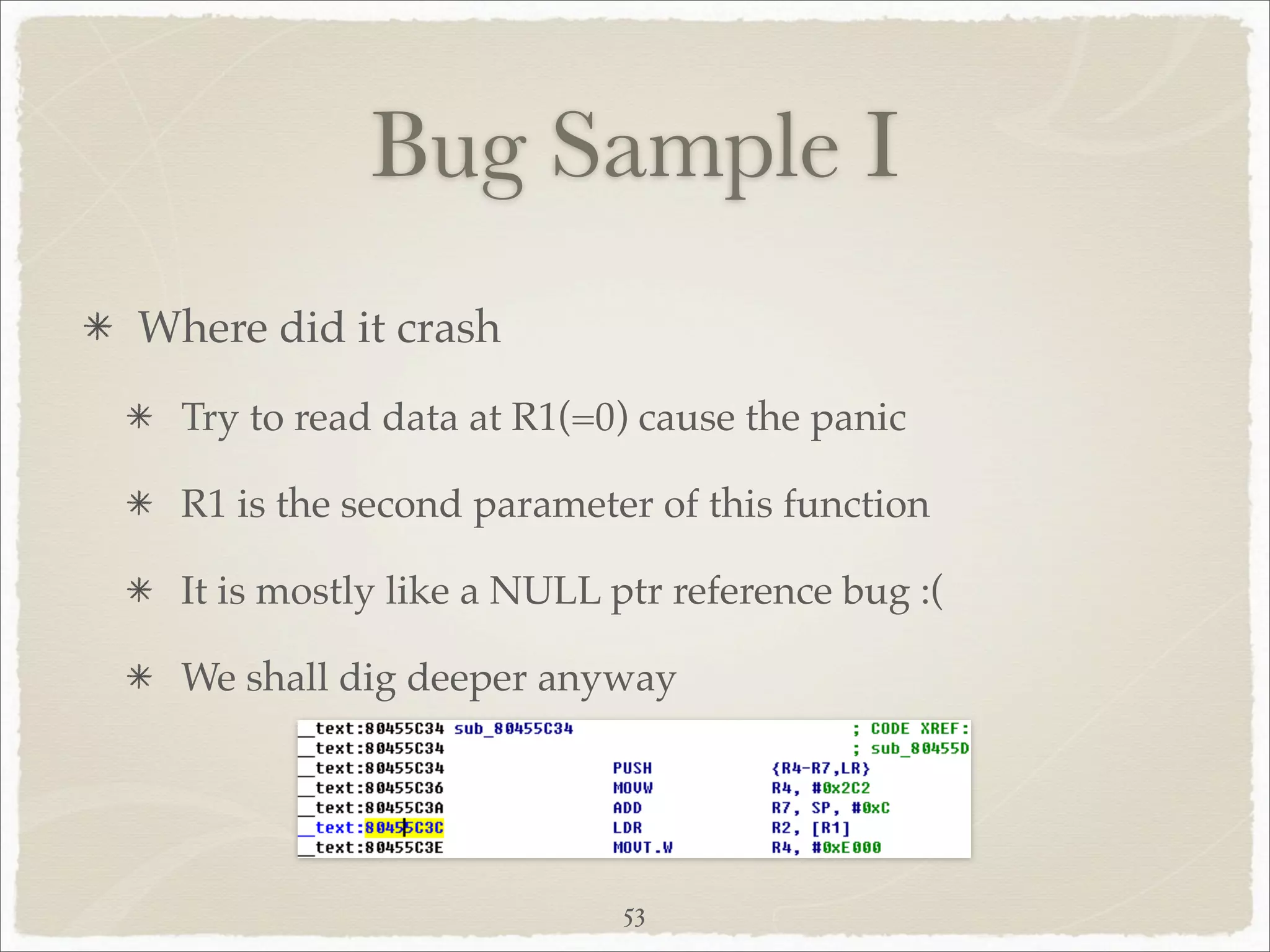
Where did it crash
  Try to read data at R1(=0) cause the panic

  R1 is the second parameter of this function

  It is mostly like a NULL ptr reference bug :(

  We shall dig deeper anyway


                            53
Bug Sample I
Locate sMethod array
  First to find AppleVXD375UserClient::externalMethod, which
  should overwrite IOUserClient’s method

  IOUserClient has symbols, see vtable for it

  externalMethod pointer offset in vtable


                              54
Bug Sample I
Locate sMethod array
  Search IOUserClient::registerNotificationPort address in “const”
  segment

  Find externalMethod pointer in vtable for AppleVXD375UserClient


  AppleVXD375UserClient::externalMethod

    Get IOExternalMethodDispatch struct from sMethod array

    Call IOUserClient::externalMethod to dispatch it


                                  55
Bug Sample I
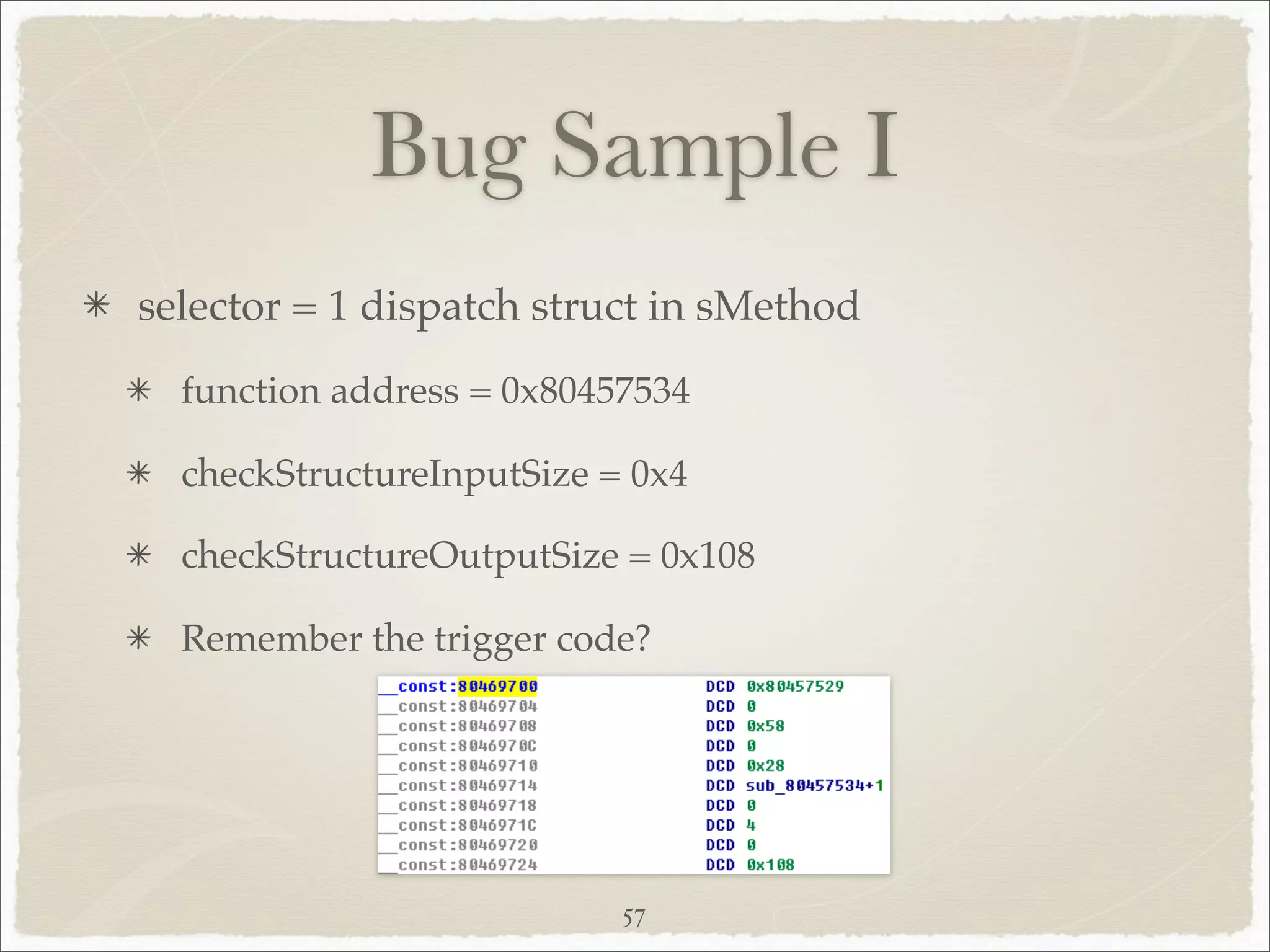
sMethod = 0x80469700


                       56
Bug Sample I
selector = 1 dispatch struct in sMethod
  function address = 0x80457534

  checkStructureInputSize = 0x4

  checkStructureOutputSize = 0x108

  Remember the trigger code?


                           57
Bug Sample I
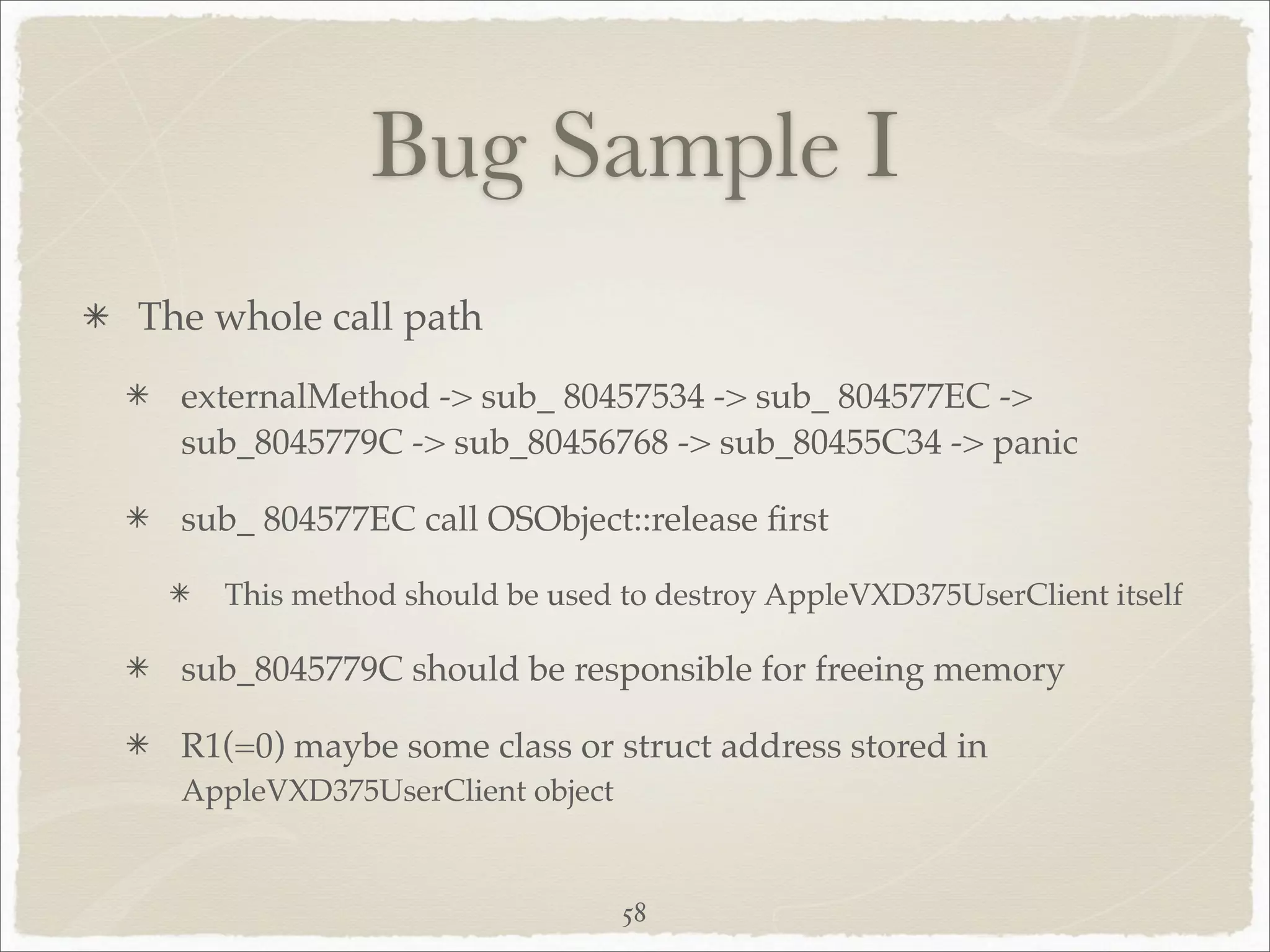
The whole call path
  externalMethod -> sub_ 80457534 -> sub_ 804577EC ->
  sub_8045779C -> sub_80456768 -> sub_80455C34 -> panic

  sub_ 804577EC call OSObject::release first

    This method should be used to destroy AppleVXD375UserClient itself

  sub_8045779C should be responsible for freeing memory

  R1(=0) maybe some class or struct address stored in
  AppleVXD375UserClient object


                                 58
Bug Sample I
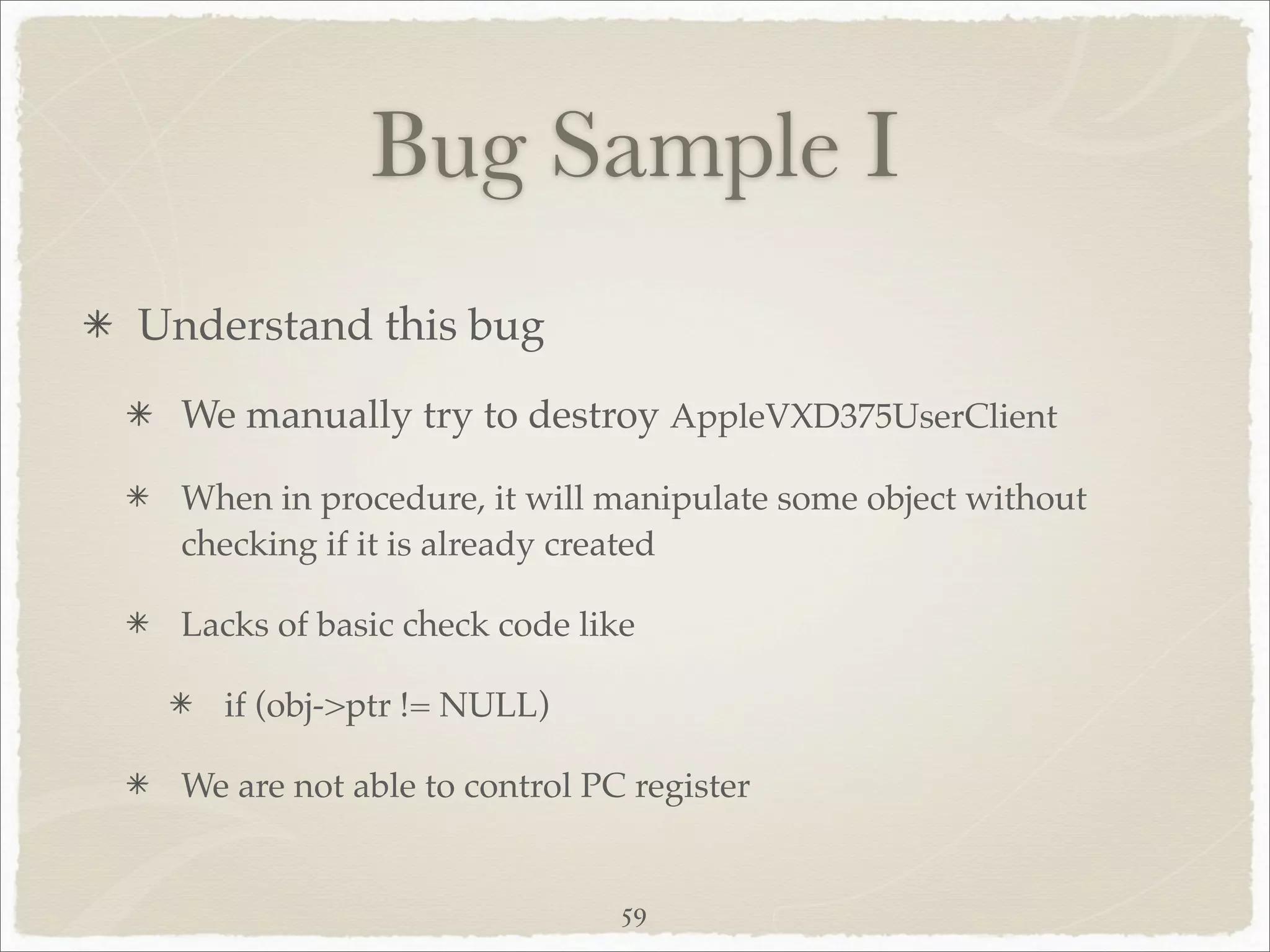
Understand this bug
  We manually try to destroy AppleVXD375UserClient

  When in procedure, it will manipulate some object without
  checking if it is already created

  Lacks of basic check code like

    if (obj->ptr != NULL)

  We are not able to control PC register


                               59
Bug Sample II
Code first


                  60
Bug Sample II
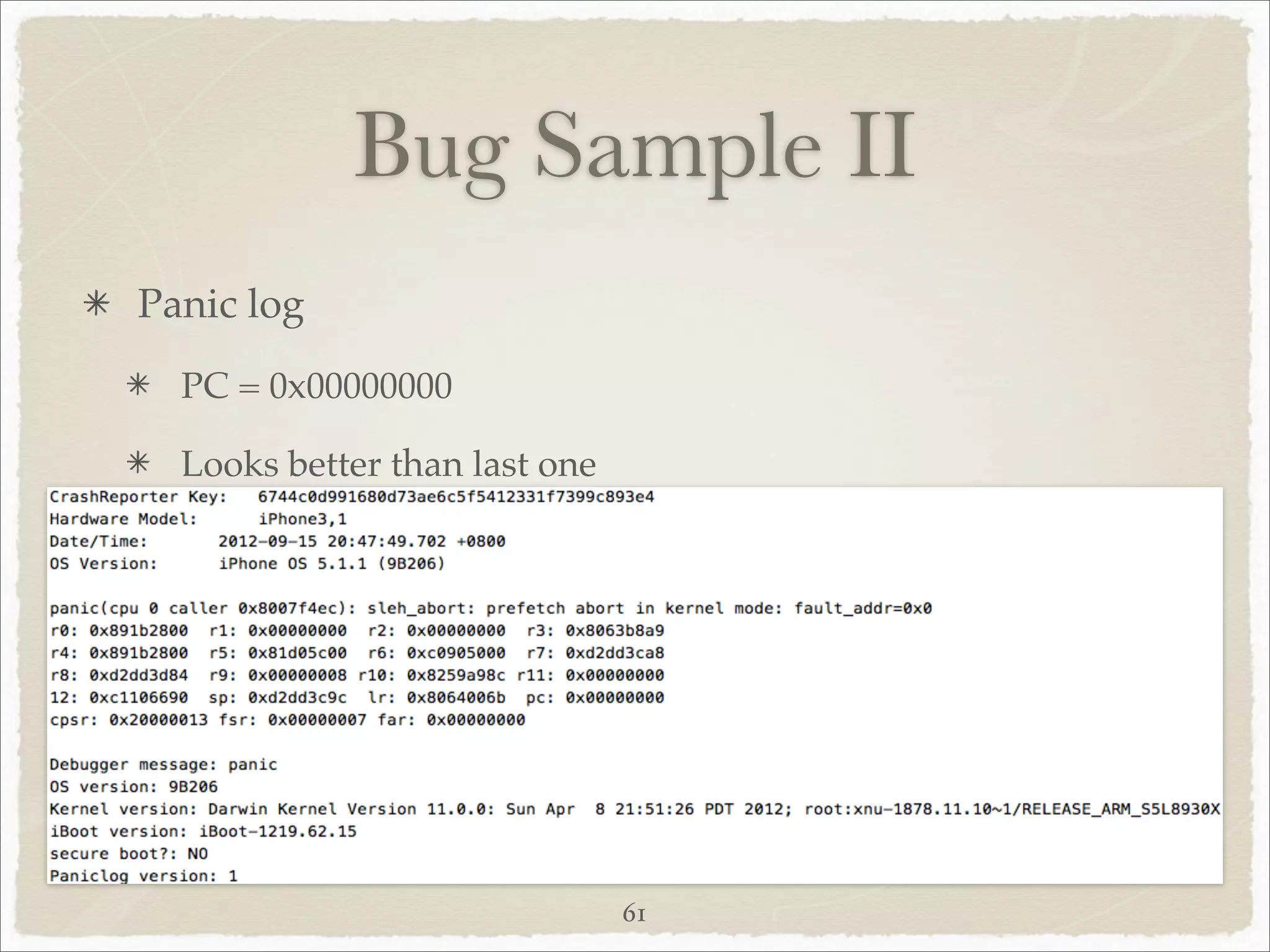
Panic log
  PC = 0x00000000

  Looks better than last one


                               61
Bug Sample II
Where did it crash

  We got useless PC and no call stack

  But luckily we had LR - store return address

  Looks like calling method of certain object

    R4 - object pointer

    R0 - vtable


                            62
Bug Sample II
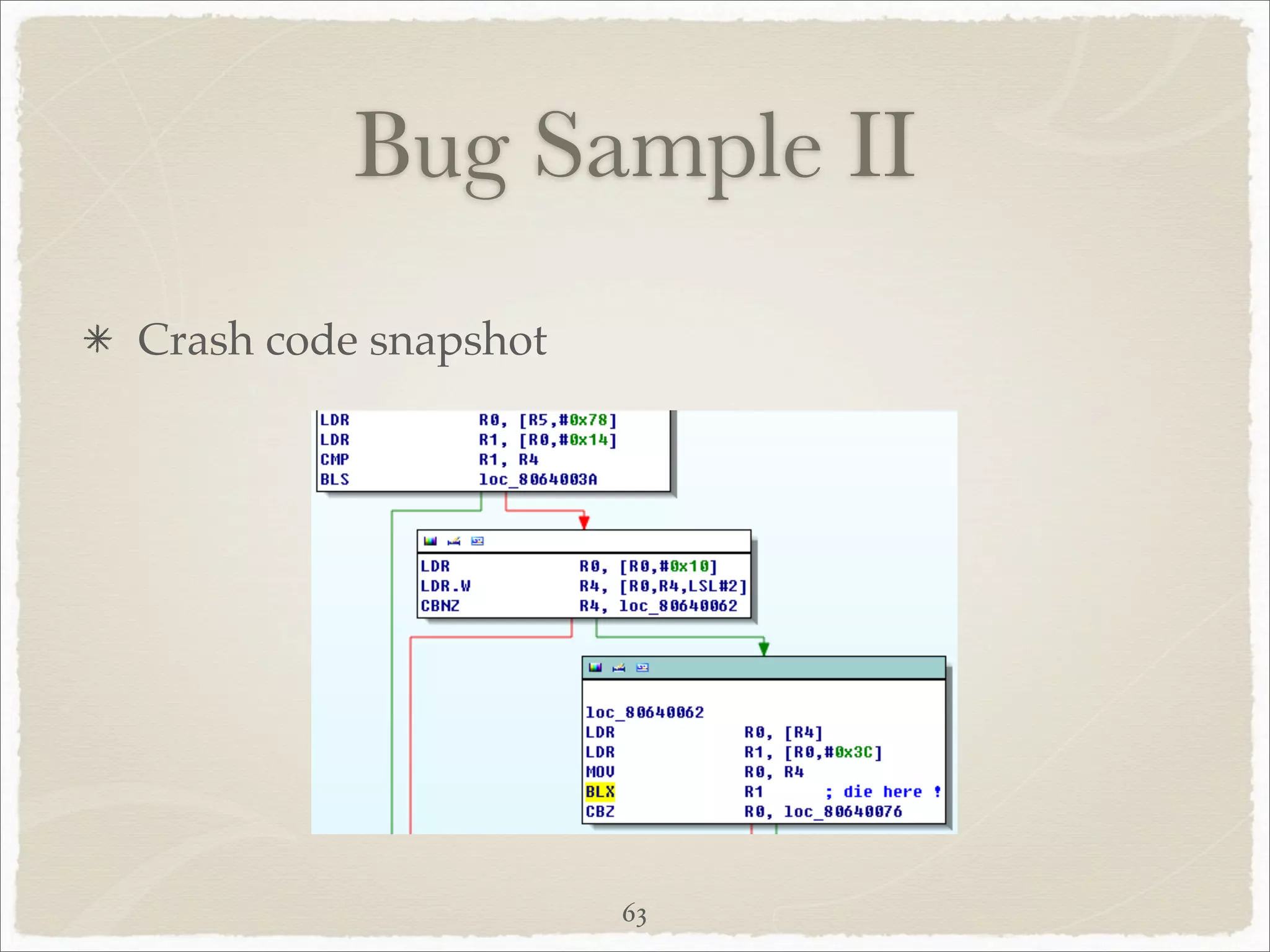
Crash code snapshot


                      63
Bug Sample II
Crash code analysis
  Input

    R0 - IOAccelUserClient *self

    R1 - int index

  IOAccel *service = self + 0x78

  OSObject *array[] = service + 0x10

  Call array[index]->method = NULL

                              64
Bug Sample II
Weird
 Why the object’s method pointer is NULL

Guess
 Mistake it as a different object without checking

Todo
 Figure out what’s at 0x10 offset


                          65
Bug Sample II
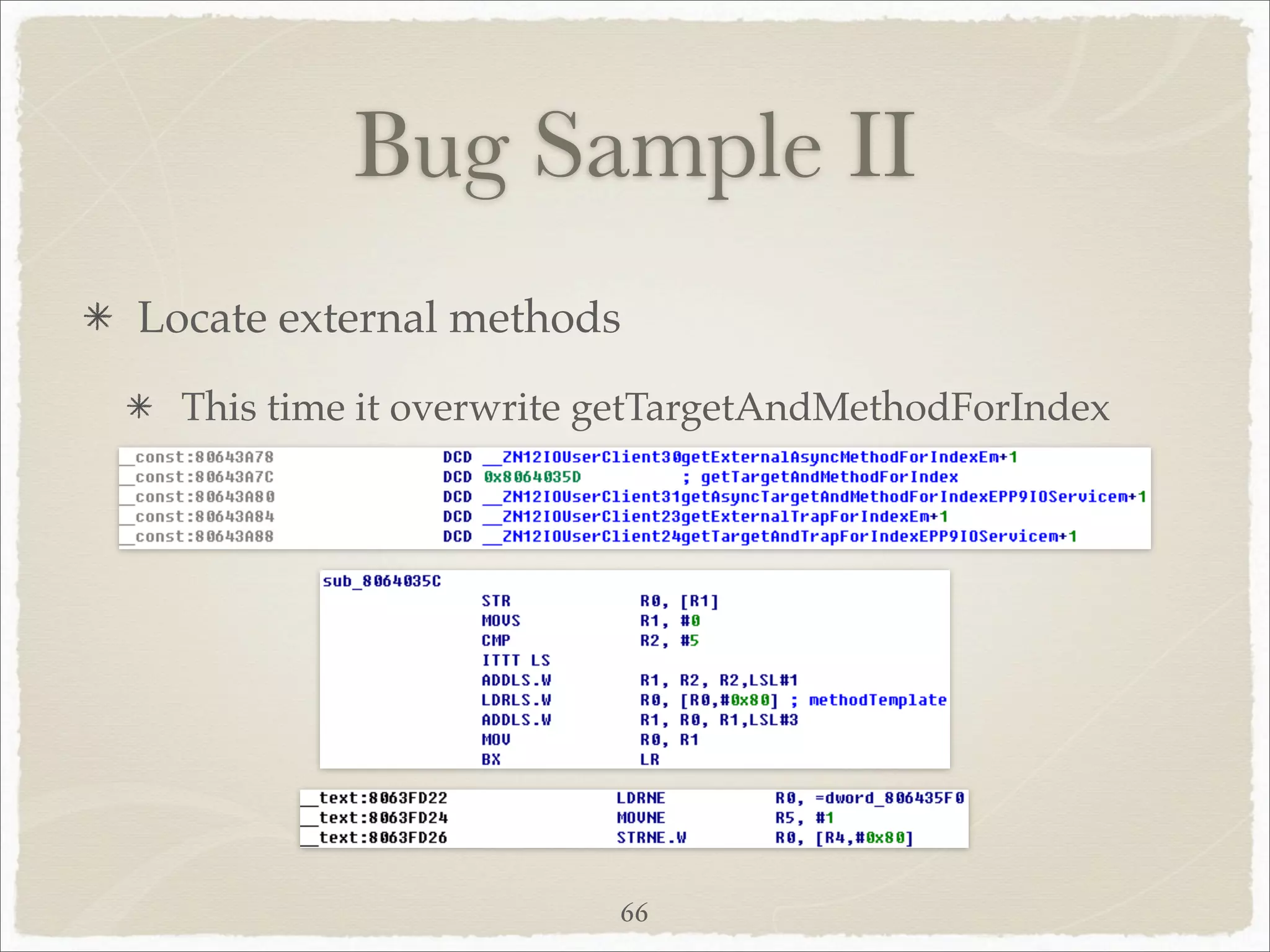
Locate external methods
  This time it overwrite getTargetAndMethodForIndex


                         66
Bug Sample II
IOExternalMethod methodTemplate[5]


                        67
Bug Sample II
Where is selector 6 function ?
  Check reference to IOAccelUserClient::vtable


  It has a child object - IOIMGSGXUserClient

  Easy to find getTargetAndMethodForIndex again


                          68
Bug Sample II
When selector > 5, use its own methodTemplate[3]


                       69
Bug Sample II
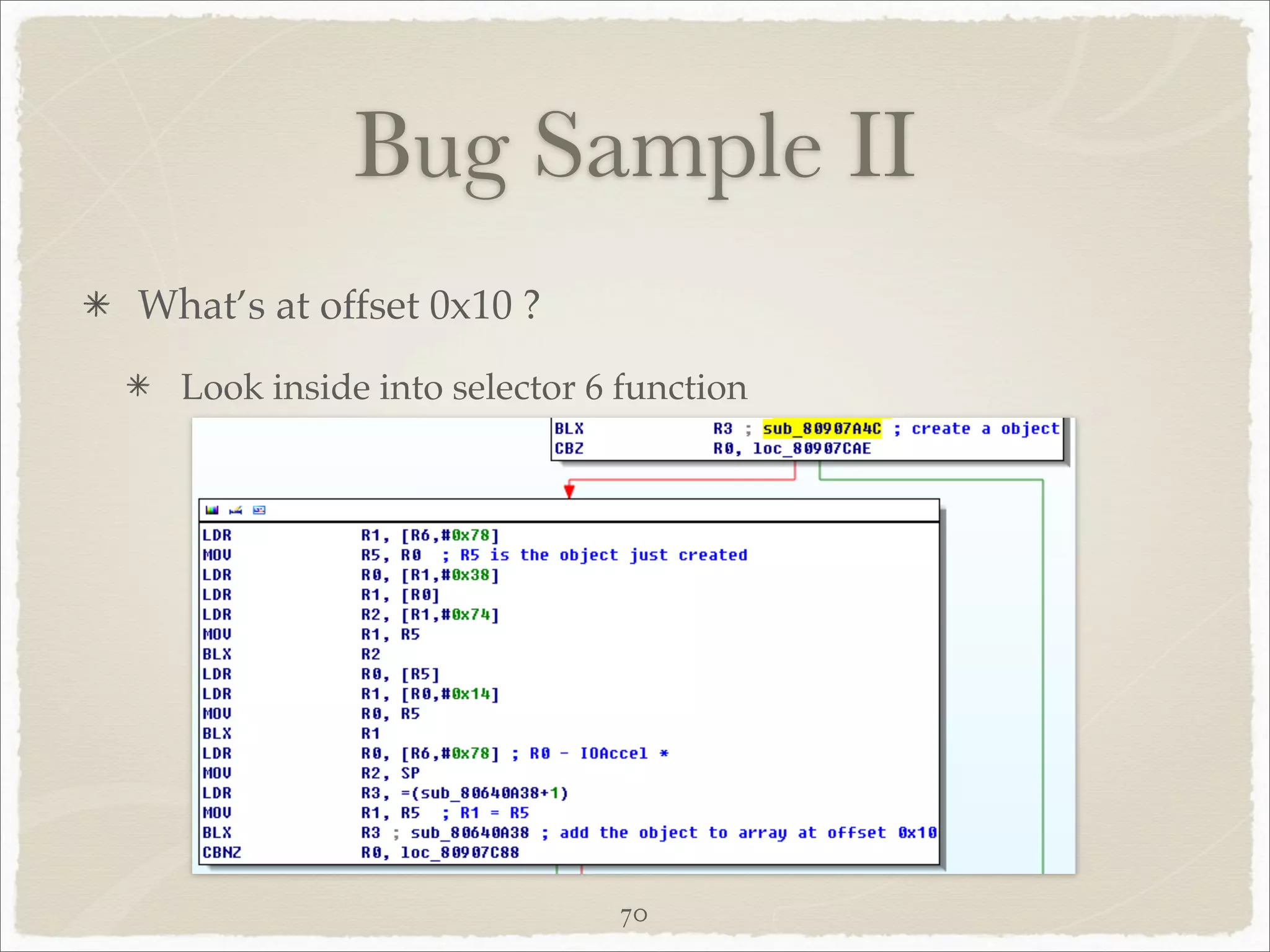
What’s at offset 0x10 ?
  Look inside into selector 6 function


                             70
Bug Sample II

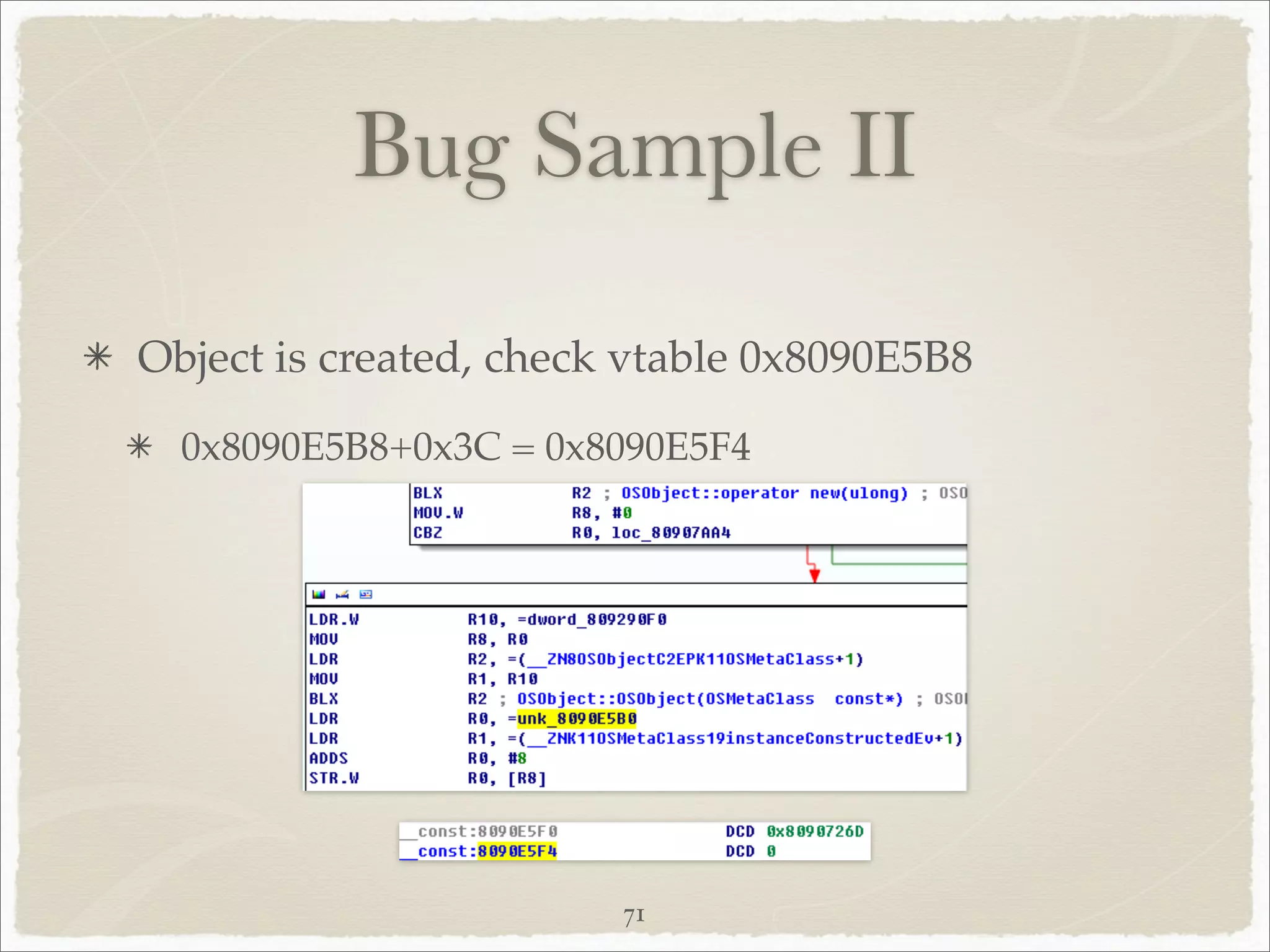
Object is created, check vtable 0x8090E5B8
  0x8090E5B8+0x3C = 0x8090E5F4


                        71
Bug Sample II
Here is the story
  selector 6 function call sub_80907A4C to create an object
  and put it in object array at 0x10 offset

  selector 3 function get object pointer from the array and call
  its method without checking its class type

  Actually the child has its own create/destroy method. If the
  child create an object and make father to destroy it, PANIC !

  Apple should call more OSMetaClassBase::safeMetaCast :P


                             72
Content
iOS Kernel Basics

Summary of Known Bugs

Passive Fuzz

Active Fuzz

Analyze Real Bug

Conclusion

                    73
Conclusion

Apple should audit iOS kernel code, especially code
of IOKit extensions

Since debug is quite hard, static analysis according to
panic log is very helpful

Fuzz your own iOS kernel bug !


                         74