Logo Visual Thinking
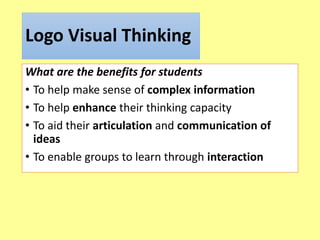
What are the benefits for students
• To help make sense of complex information
• To help enhance their thinking capacity
• To aid their articulation and communication of
ideas
• To enable groups to learn through interaction
What does LVT involve?
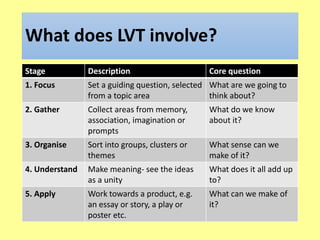
Stage Description Core question
1. Focus Set a guiding question, selected
from a topic area
What are we going to
think about?
2. Gather Collect areas from memory,
association, imagination or
prompts
What do we know
about it?
3. Organise Sort into groups, clusters or
themes
What sense can we
make of it?
4. Understand Make meaning- see the ideas
as a unity
What does it all add up
to?
5. Apply Work towards a product, e.g.
an essay or story, a play or
poster etc.
What can we make of
it?
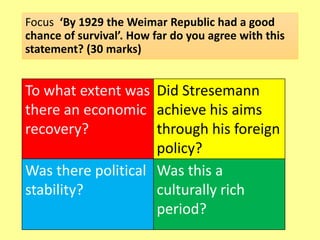
Focus ‘By 1929 the Weimar Republic had a good
chance of survival’. How far do you agree with this
statement? (30 marks)
To what extent was
there an economic
recovery?
Did Stresemann
achieve his aims
through his foreign
policy?
Was there political
stability?
Was this a
culturally rich
period?
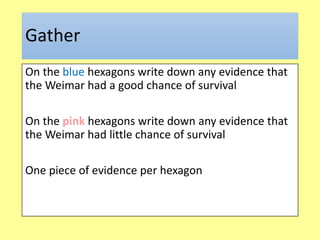
Gather
On the blue hexagons write down any evidence that
the Weimar had a good chance of survival
On the pink hexagons write down any evidence that
the Weimar had little chance of survival
One piece of evidence per hexagon
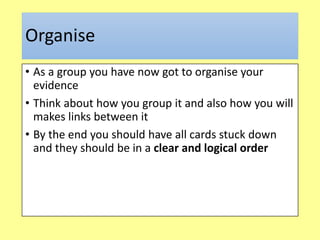
Organise
• As a group you have now got to organise your
evidence
• Think about how you group it and also how you will
makes links between it
• By the end you should have all cards stuck down
and they should be in a clear and logical order
Understand
• You are going to share you organised cards with the
group
Apply
Write a plan to the essay question
‘By 1929 the Weimar Republic had a good chance of
survival’. How far do you agree with this statement?
(30 marks)
When can it be used?
• At the start of a topic when you want to see
students prior knowledge/ understanding
• At the end of a topic when you are trying help
students make sense of information
• When you are trying to encourage students to
come up with ideas/ solve a problem

Logo visual thinking

  • 1.
  • 2.
    Logo Visual Thinking Whatare the benefits for students • To help make sense of complex information • To help enhance their thinking capacity • To aid their articulation and communication of ideas • To enable groups to learn through interaction
  • 3.
    What does LVTinvolve? Stage Description Core question 1. Focus Set a guiding question, selected from a topic area What are we going to think about? 2. Gather Collect areas from memory, association, imagination or prompts What do we know about it? 3. Organise Sort into groups, clusters or themes What sense can we make of it? 4. Understand Make meaning- see the ideas as a unity What does it all add up to? 5. Apply Work towards a product, e.g. an essay or story, a play or poster etc. What can we make of it?
  • 4.
    Focus ‘By 1929the Weimar Republic had a good chance of survival’. How far do you agree with this statement? (30 marks) To what extent was there an economic recovery? Did Stresemann achieve his aims through his foreign policy? Was there political stability? Was this a culturally rich period?
  • 5.
    Gather On the bluehexagons write down any evidence that the Weimar had a good chance of survival On the pink hexagons write down any evidence that the Weimar had little chance of survival One piece of evidence per hexagon
  • 6.
    Organise • As agroup you have now got to organise your evidence • Think about how you group it and also how you will makes links between it • By the end you should have all cards stuck down and they should be in a clear and logical order
  • 7.
    Understand • You aregoing to share you organised cards with the group
  • 8.
    Apply Write a planto the essay question ‘By 1929 the Weimar Republic had a good chance of survival’. How far do you agree with this statement? (30 marks)
  • 9.
    When can itbe used? • At the start of a topic when you want to see students prior knowledge/ understanding • At the end of a topic when you are trying help students make sense of information • When you are trying to encourage students to come up with ideas/ solve a problem