Challenge for all
The magenta principles in science
The
Magenta
Principles
‘
Challenge
DepthEngagement
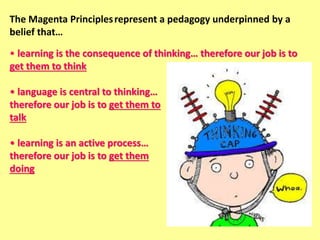
The Magenta Principlesrepresent a pedagogy underpinned by a
belief that…
• learning is the consequence of thinking… therefore our job is to
get them to think
• language is central to thinking…
therefore our job is to get them to
talk
• learning is an active process…
therefore our job is to get them
doing
What are your students required
to do to / with the information
they encounter in the classroom
in order to make it stick?
• Reduce it
• Change it
• Assemble it
• Search for it
• Connect it
• Arrange it
• Enlarge it
• Simplify it
• Classify it
• Compare and contrast it
• Deconstruct it
• Apply it
• Prioritise it
• Act it out
The Magenta Principles in your teaching?
Themes…
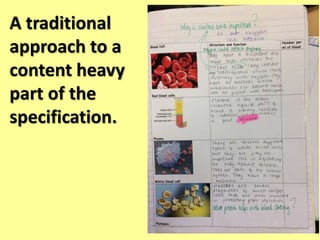
A traditional
approach to a
content heavy
part of the
specification.
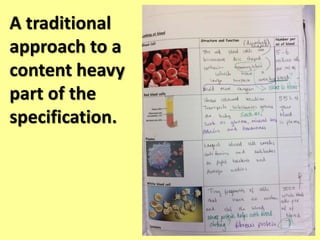
A traditional
approach to a
content heavy
part of the
specification.
REDUCE
5-5-1 the composition of blood (see sheet)
OR
Sum up the work on the composition of blood
in 5 key bullet points and justify why you have
chosen them.
PRIORITISE
What are the three most important things to
know about red blood cells?
OR
Which feature of the red blood cell is the most
important and why?
CHANGE
Change your written work on white blood cells
into a
picture/diagram/storyboard/flowchart/cartoon
OR
Change your last piece of written work on white
blood cells into an annotated diagram
ASSEMBLE
Create a mind map about the components of
blood
OR
Create a six question test about the
composition of blood. Test a friend!
Looking at blood: time for reflection…
A more
reflective
approach…
A more
reflective
approach…
Challenge for All High Expectations
Have high expectations of all
students and expect them to
succeed.
Challenging Learning
Outcomes.
Have challenging learning
outcomes for all students.
Avoid all, most, some.
Bright Spots
Find bright spots of excellent
work in lessons. Share and
discuss excellence and aim for it.
Return sub-standard work
Return sub-standard work if
students have not tried. Students
should redraft until they have hit
the standard.
Feedback
Use feedback to encourage
students to reach their best.
The power of ‘yet’
Turn the phrase ‘I can’t do it’ into ‘I
can’t do it yet’.
The struggle zone
Deliberately allow the students to
be in the struggle zone to build
resilience.
Support with questions
When students are stuck support
them with questions rather than
give them the answers.
Challenging Questions
Plan challenging questions
throughout the lesson which
stretch. Give them time to think
them through.
Ban ‘I don’t know’
Ban the phrase ‘I don’t know’. Use
questioning to support and enable
them to understand.
Academic Atmosphere
Have an academic atmosphere in
terms of expectations and quality
of spoken and written language.
Make students think.
Ensure that students are asked
to do something to/ with the
information to make them think.
Avoid rounding up
During discussions avoid rounding
up their answers to make them
seem better than they were.
Purpose
Link to the big picture of where
students are going and why their
learning is important.
Display excellence
Display examples of exceptional
work around your classroom/
department.
The Magenta Principles in your teaching?
Think about a lesson you are teaching before half
term.
Where are the opportunities to include these
principles / themes?
What are your students required to do to / with the
information they encounter in the classroom in
order to make it stick?

T&l october2016

  • 1.
    Challenge for all Themagenta principles in science
  • 2.
  • 3.
    The Magenta Principlesrepresenta pedagogy underpinned by a belief that… • learning is the consequence of thinking… therefore our job is to get them to think • language is central to thinking… therefore our job is to get them to talk • learning is an active process… therefore our job is to get them doing
  • 4.
    What are yourstudents required to do to / with the information they encounter in the classroom in order to make it stick?
  • 5.
    • Reduce it •Change it • Assemble it • Search for it • Connect it • Arrange it • Enlarge it • Simplify it • Classify it • Compare and contrast it • Deconstruct it • Apply it • Prioritise it • Act it out The Magenta Principles in your teaching? Themes…
  • 6.
    A traditional approach toa content heavy part of the specification.
  • 7.
    A traditional approach toa content heavy part of the specification.
  • 8.
    REDUCE 5-5-1 the compositionof blood (see sheet) OR Sum up the work on the composition of blood in 5 key bullet points and justify why you have chosen them. PRIORITISE What are the three most important things to know about red blood cells? OR Which feature of the red blood cell is the most important and why? CHANGE Change your written work on white blood cells into a picture/diagram/storyboard/flowchart/cartoon OR Change your last piece of written work on white blood cells into an annotated diagram ASSEMBLE Create a mind map about the components of blood OR Create a six question test about the composition of blood. Test a friend! Looking at blood: time for reflection… Looking at blood: time for reflection… Looking at blood: time for reflection… Looking at blood: time for reflection…
  • 9.
  • 10.
  • 11.
    Challenge for AllHigh Expectations Have high expectations of all students and expect them to succeed. Challenging Learning Outcomes. Have challenging learning outcomes for all students. Avoid all, most, some. Bright Spots Find bright spots of excellent work in lessons. Share and discuss excellence and aim for it. Return sub-standard work Return sub-standard work if students have not tried. Students should redraft until they have hit the standard. Feedback Use feedback to encourage students to reach their best. The power of ‘yet’ Turn the phrase ‘I can’t do it’ into ‘I can’t do it yet’. The struggle zone Deliberately allow the students to be in the struggle zone to build resilience. Support with questions When students are stuck support them with questions rather than give them the answers. Challenging Questions Plan challenging questions throughout the lesson which stretch. Give them time to think them through. Ban ‘I don’t know’ Ban the phrase ‘I don’t know’. Use questioning to support and enable them to understand. Academic Atmosphere Have an academic atmosphere in terms of expectations and quality of spoken and written language. Make students think. Ensure that students are asked to do something to/ with the information to make them think. Avoid rounding up During discussions avoid rounding up their answers to make them seem better than they were. Purpose Link to the big picture of where students are going and why their learning is important. Display excellence Display examples of exceptional work around your classroom/ department.
  • 12.
    The Magenta Principlesin your teaching? Think about a lesson you are teaching before half term. Where are the opportunities to include these principles / themes? What are your students required to do to / with the information they encounter in the classroom in order to make it stick?

Editor's Notes