+
SHINE A LIGHT
This project intends to shine a light on the social/emotional issues that impact students with
disabilities in and outside of the classroom.The project will help to build cultural awareness as it
relates to the social and emotional issues that impact students with disabilities. By building awareness
among teachers, the project intends to develop a more welcoming school community for students with
disabilities and their families.
+
Supporting Research
 According to the Journal of Education and Psychological
Consultation: In light of today’s world (from gun violence in
the United States to world wide terrorism) children must face
numerous situations that are negatively impacting their
social emotional development and ultimately their happiness
in life.
 According to Learning Disability Quarterly, in an article that
reflects on children with learning disabilities, its research
shows that characteristics of students with LD reflected lower
academic self-concepts than peers, showed deficits in social
perceptions, and were more likely to experience negative
affect/emotions when compared to students without LD (with
feelings of loneliness ranging as high as 25% in children
with disabilities).
+
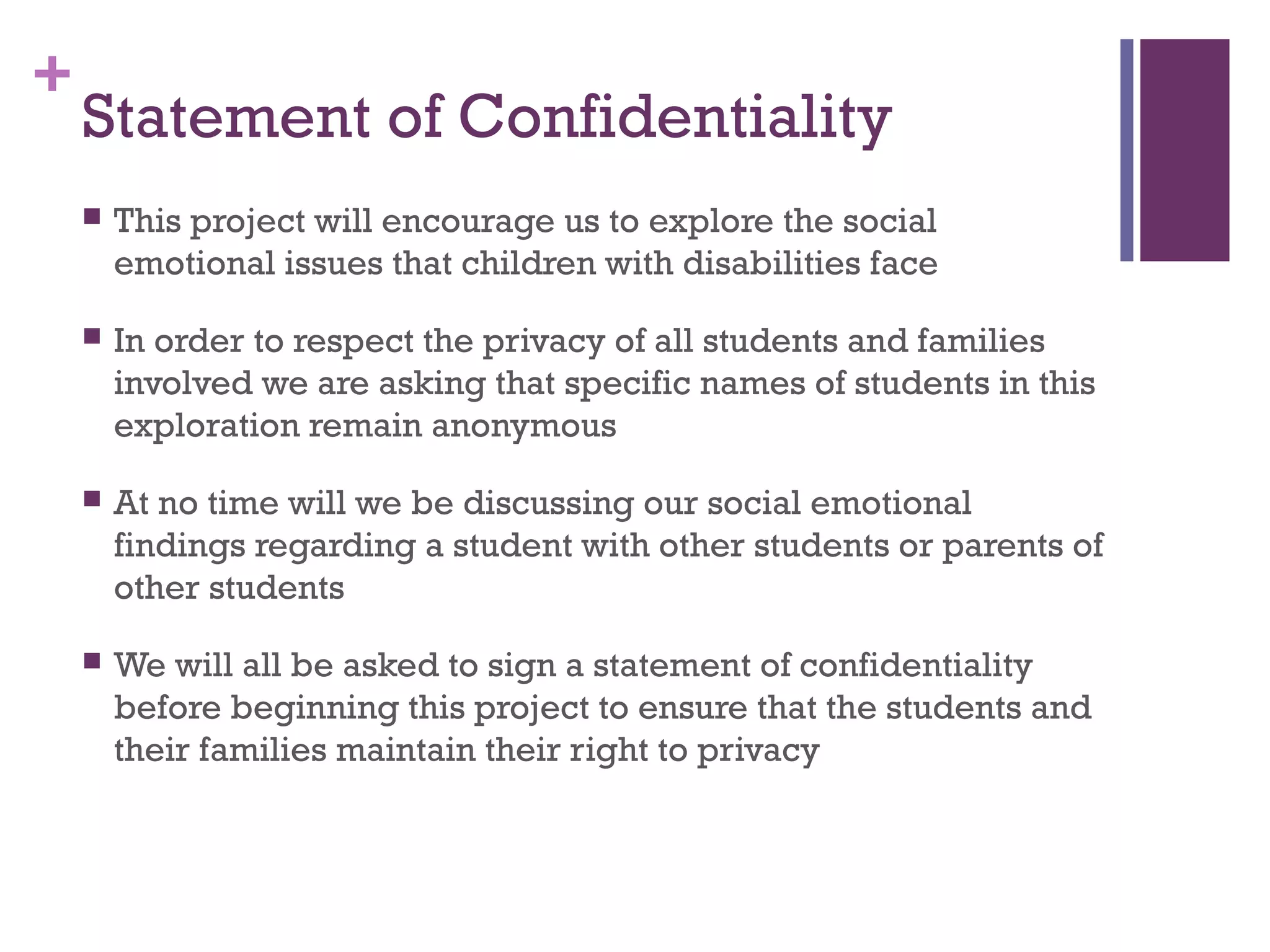
Initial Survey Results
+
Statement of Confidentiality
 This project will encourage us to explore the social
emotional issues that children with disabilities face
 In order to respect the privacy of all students and families
involved we are asking that specific names of students in this
exploration remain anonymous
 At no time will we be discussing our social emotional
findings regarding a student with other students or parents of
other students
 We will all be asked to sign a statement of confidentiality
before beginning this project to ensure that the students and
their families maintain their right to privacy
+
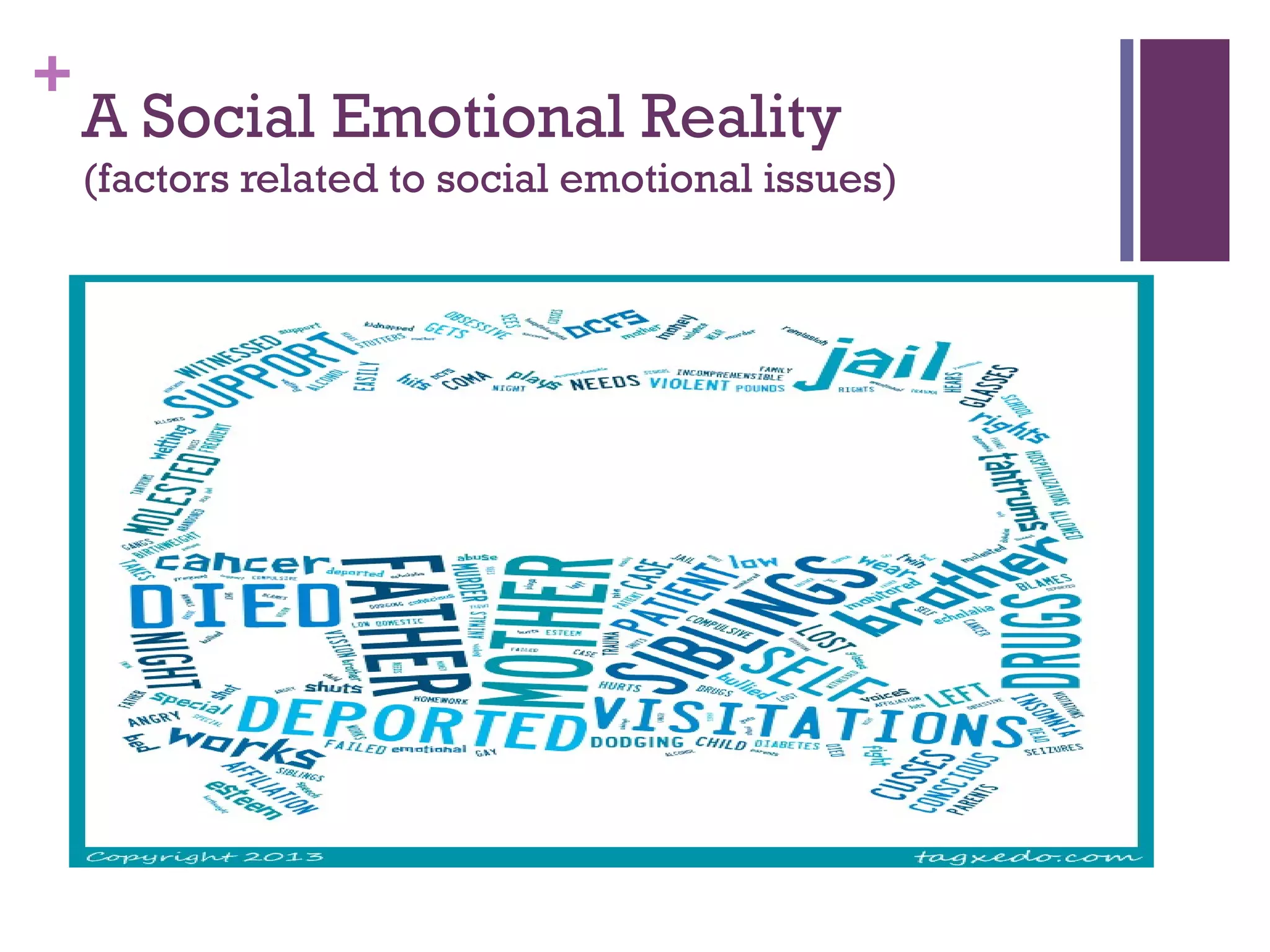
A Social Emotional Reality
(factors related to social emotional issues)
+
Workshop Schedule and Agenda
 Jan. 21, 2014-Looking at the Roots of Special Education
(Special Education Overview and Project Opening)
 Feb. 18, 2014-Trauma and the Brain; Select student for case
study; Initial quick write
 March 25, 2014-Signs, Signals, and Reactions of Trauma;
Further explorations with case study
 April 22, 2014-Psychological 1st
Aid/Teacher Self-Care;
LPCMT through role playing; Final quick write
+
Connecting Social Emotional
Issues and the Brain
 In order to better understand the social emotional issues that
impact students with disabilities we will start by trying to
understand what role the brain plays when considering the
social emotional issues that impact students with disabilities.
 From there we can take this information about the brain to
help support all students, family members, colleagues, and
ourselves.
+
The Brain
 The human brain is an astonishing organ that takes care
of each function and action of the body.
 The brain acts as a center to receive, interpret and direct
the information throughout the body.
 It is divided into three main divisions called the
forebrain, midbrain and hindbrain.
 There are various areas and structures that make up
these three division of the brain. Let us have a look at
these areas and learn more about their functions.
+
The Central Core
The central core consists of the following
five regions which are the central areas that
regulate breathing, pulse, arousal, balance,
sleep and early stages of processing
sensory information.
+
The 5 Regions of the Central Core
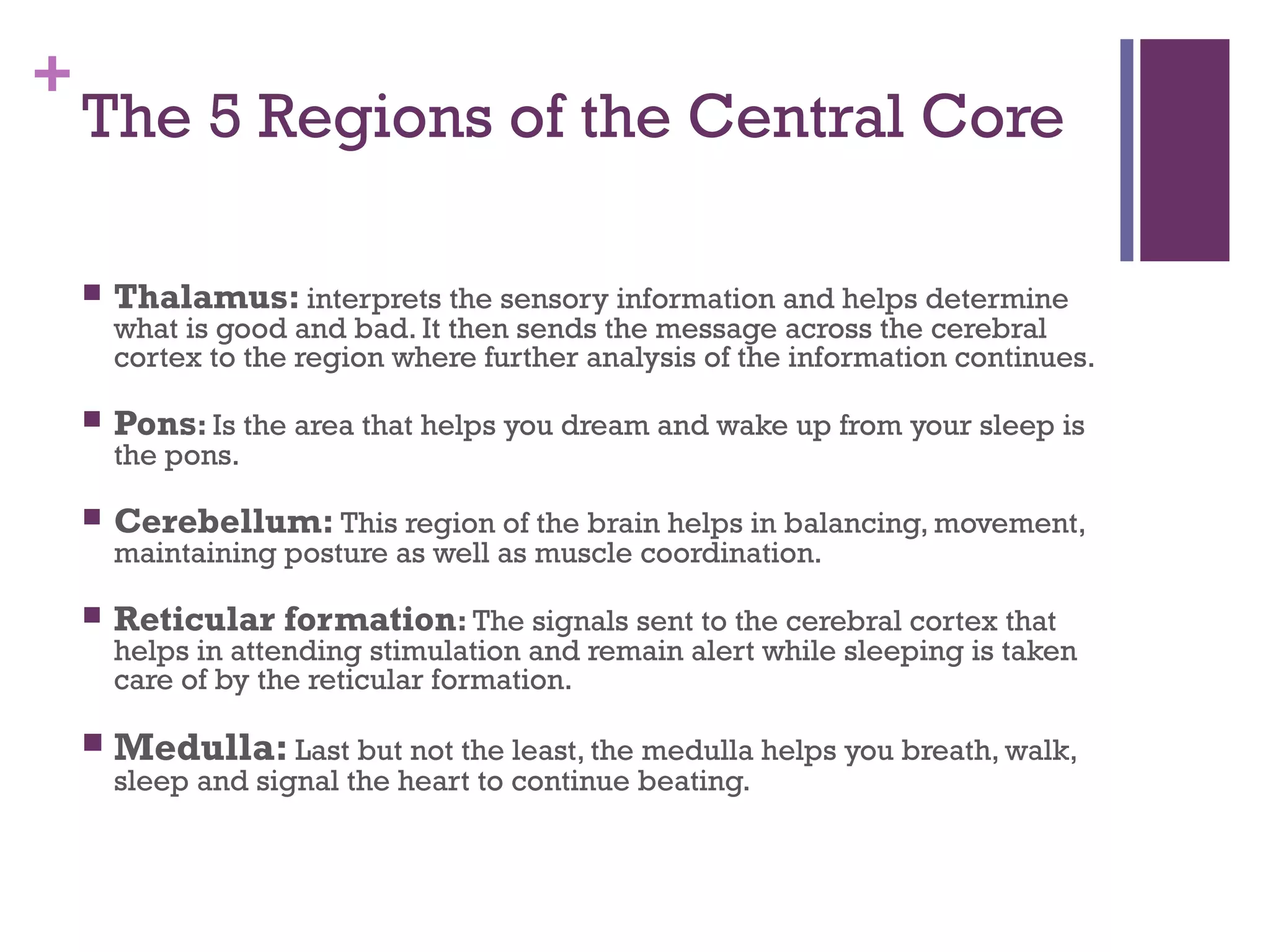
 Thalamus: interprets the sensory information and helps determine
what is good and bad. It then sends the message across the cerebral
cortex to the region where further analysis of the information continues.
 Pons: Is the area that helps you dream and wake up from your sleep is
the pons.
 Cerebellum: This region of the brain helps in balancing, movement,
maintaining posture as well as muscle coordination.
 Reticular formation: The signals sent to the cerebral cortex that
helps in attending stimulation and remain alert while sleeping is taken
care of by the reticular formation.
 Medulla: Last but not the least, the medulla helps you breath, walk,
sleep and signal the heart to continue beating.
+
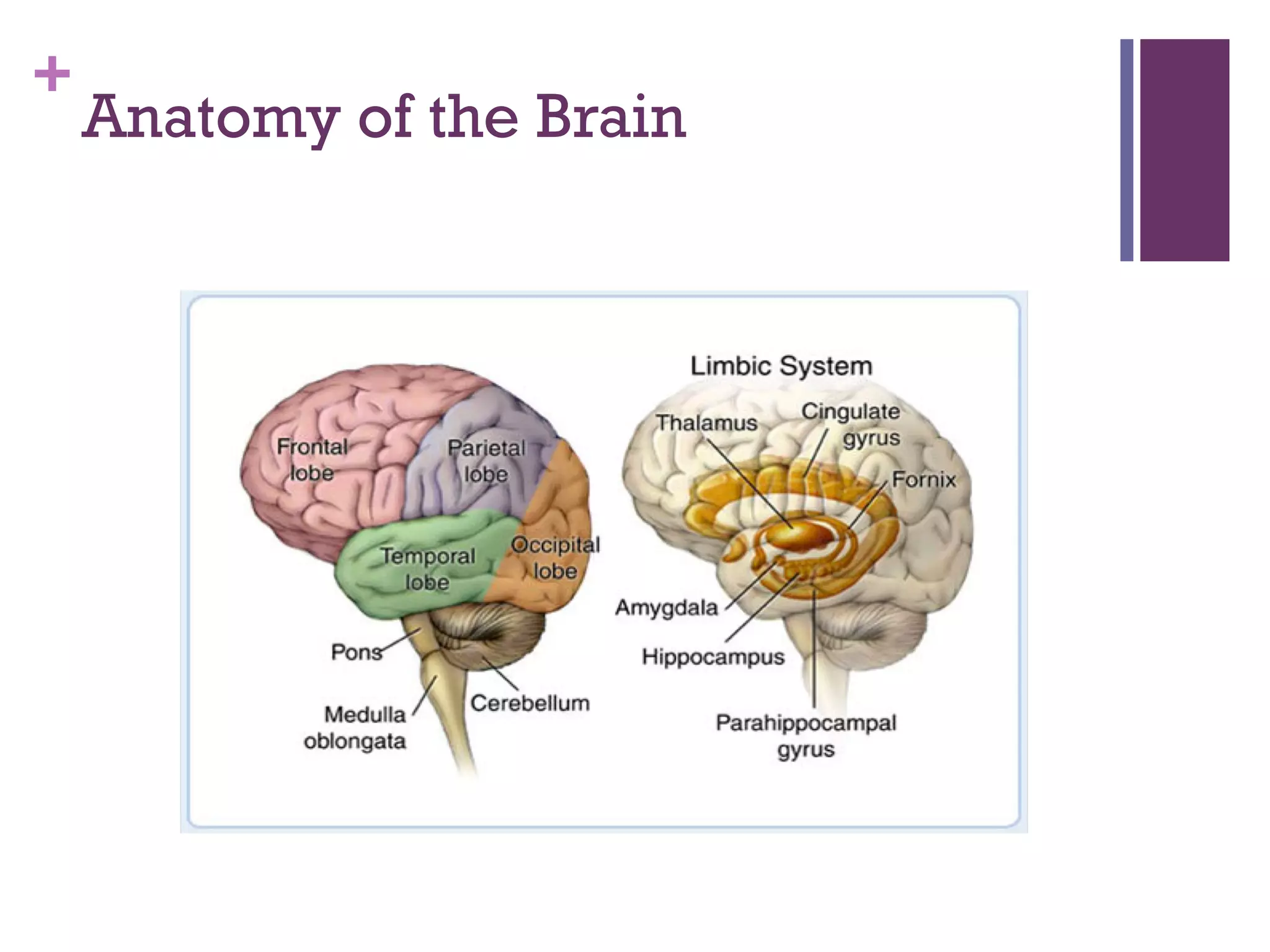
Anatomy of the Brain
+
Limbic System
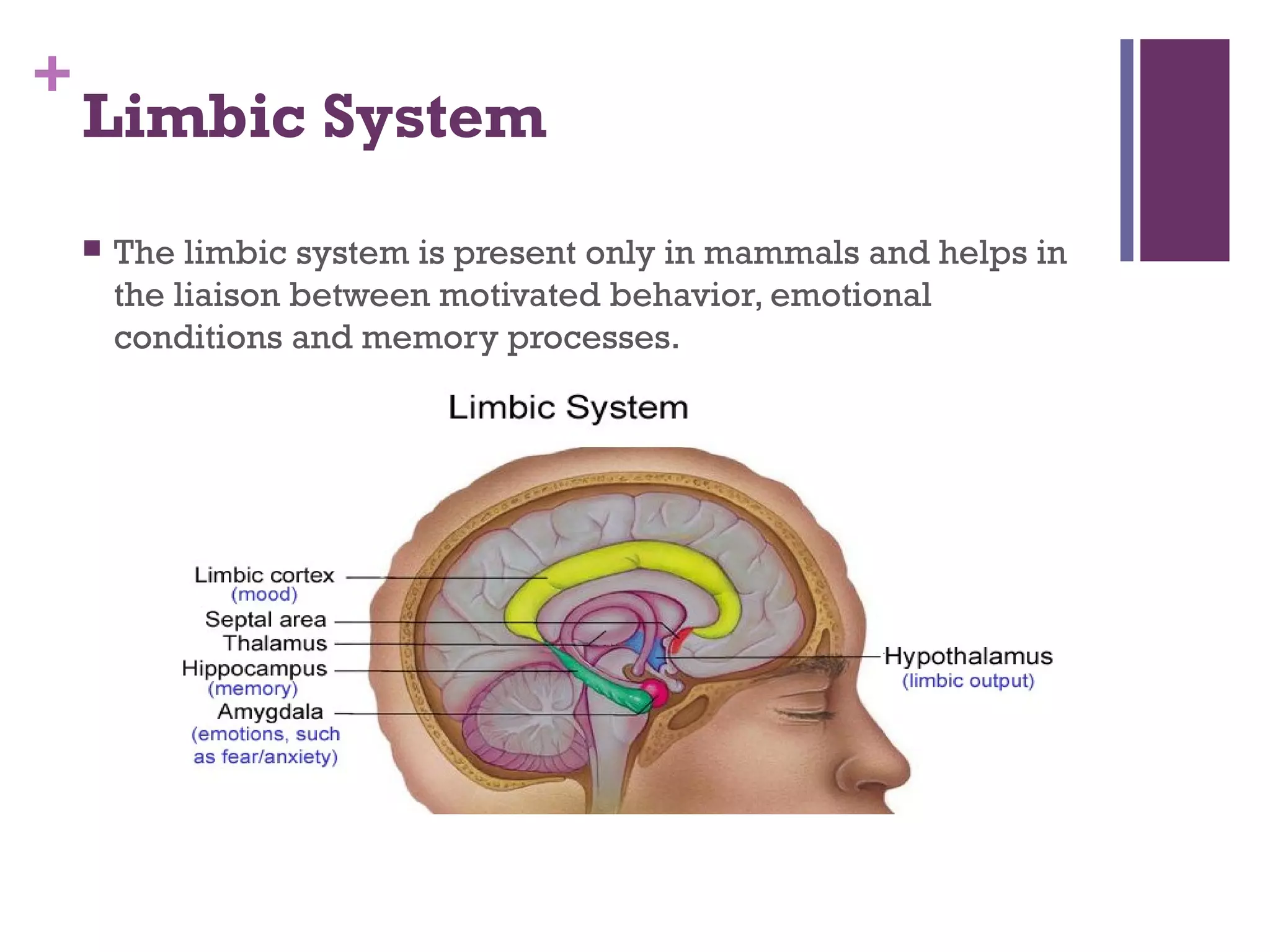
 The limbic system is present only in mammals and helps in
the liaison between motivated behavior, emotional
conditions and memory processes.
+
The 3 Regions of the Limbic
System
 Hippocampus: This region is located deep within the brain
and helps store memories for long-term. If this region was not present,
people would be stuck with old memories and would never be able to
develop or process new memories.
 Amygdala:Takes care of aggression, emotions are perceived and
reactions like anger and fear are analyzed, eating, drinking and the
carnal instincts, that is, sexual urges are control. Recently, it was found
to be associated with mental conditions such as autism as well as
depression.The Amygdala is larger in size in males.
 Hypothalamus: Looks after the blood glucose, salt, blood
pressure, temperature of the body, hormones and controls the sensation
of appetite and body weight. It regulates the body processes, as it is
connected to both the central and autonomic nervous systems and the
endocrine systems.
+
Cerebral Cortex
This is the region that makes humans
as humans. It is the region of higher
cognitive and emotional functions. It is
divided into two symmetrical halves
called the cerebral hemispheres.
+
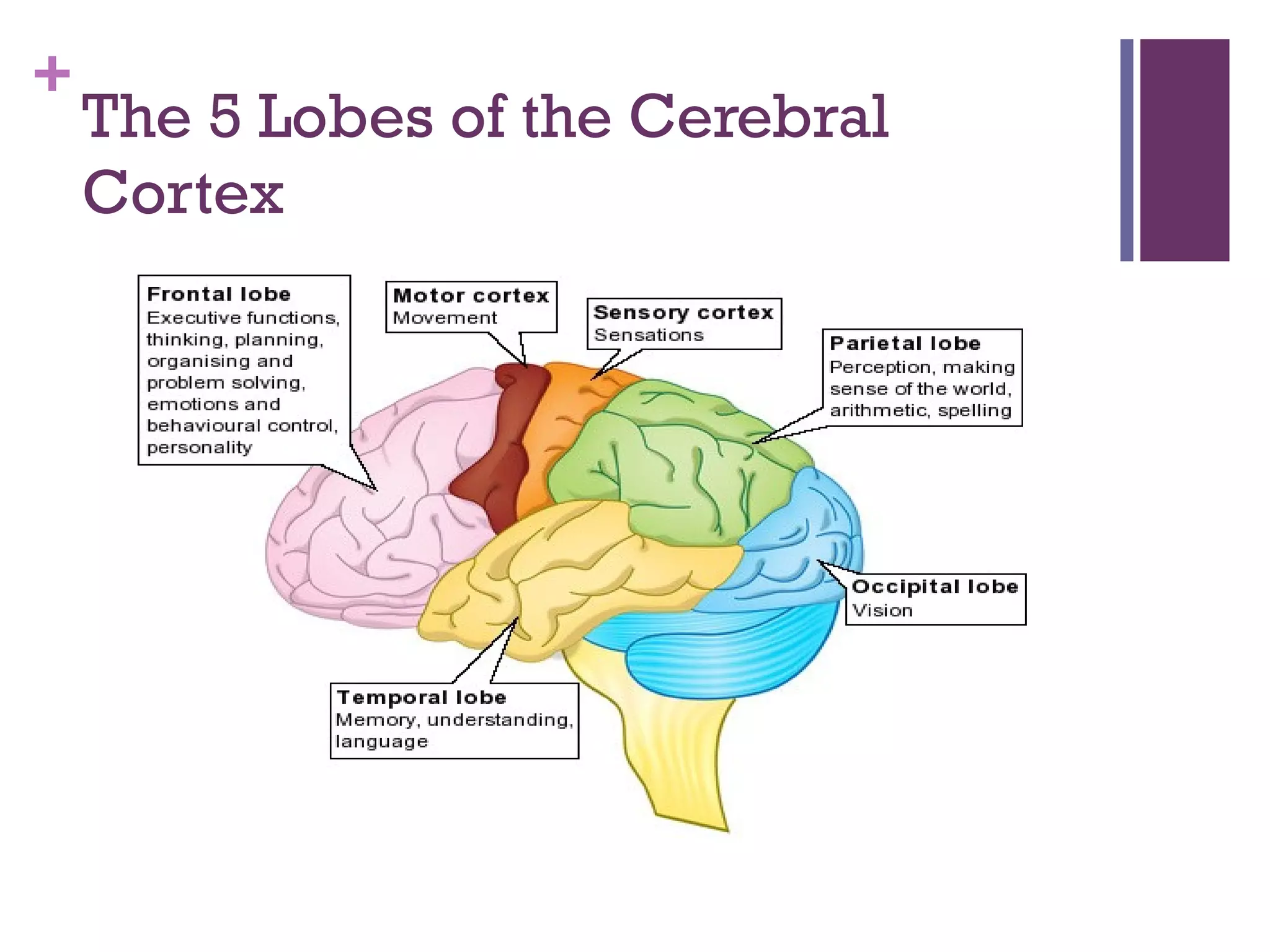
The 5 Lobes of the Cerebral
Cortex
+
The 4 Lobes of the Cerebral
Cortex
 The Frontal Lobe: The frontal lobe helps in organizing complex
problems, helps plan steps to achieve an objective, connects the present
to future, develops verbal skills, and is involved in decision-making,
problem solving and planning.
 Occipital Lobe: The visual images are passed to the parietal and
temporal lobes through the occipital lobe.
 Parietal Lobe: The sensory processes, spatial interpretation,
attention and language comprehension is controlled by the parietal
lobe.
 Temporal Lobe: Lastly, the auditory perception, language
comprehension and visual recognition is controlled by the temporal
lobe.
+
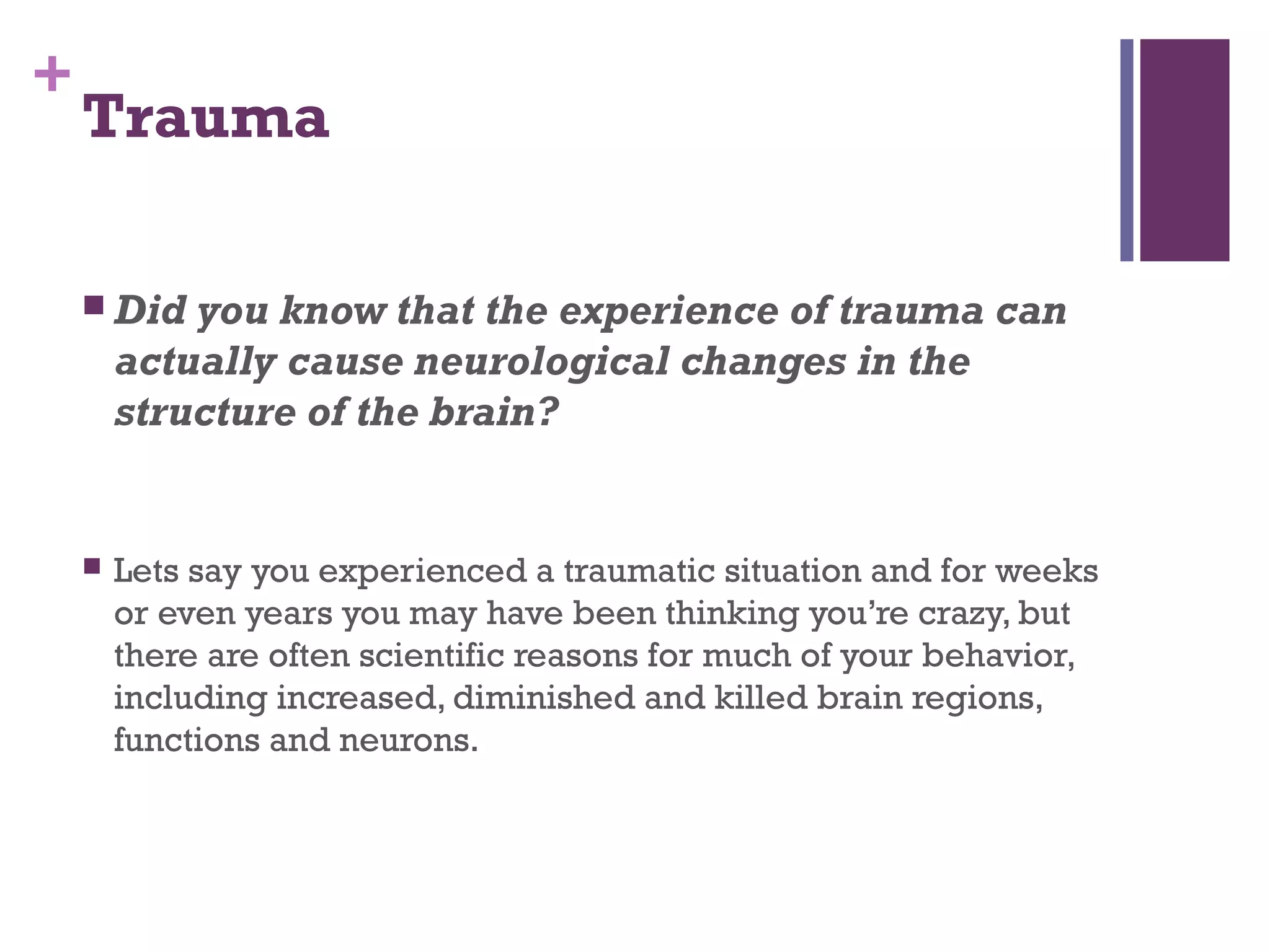
Trauma
 Did you know that the experience of trauma can
actually cause neurological changes in the
structure of the brain?
 Lets say you experienced a traumatic situation and for weeks
or even years you may have been thinking you’re crazy, but
there are often scientific reasons for much of your behavior,
including increased, diminished and killed brain regions,
functions and neurons.
+
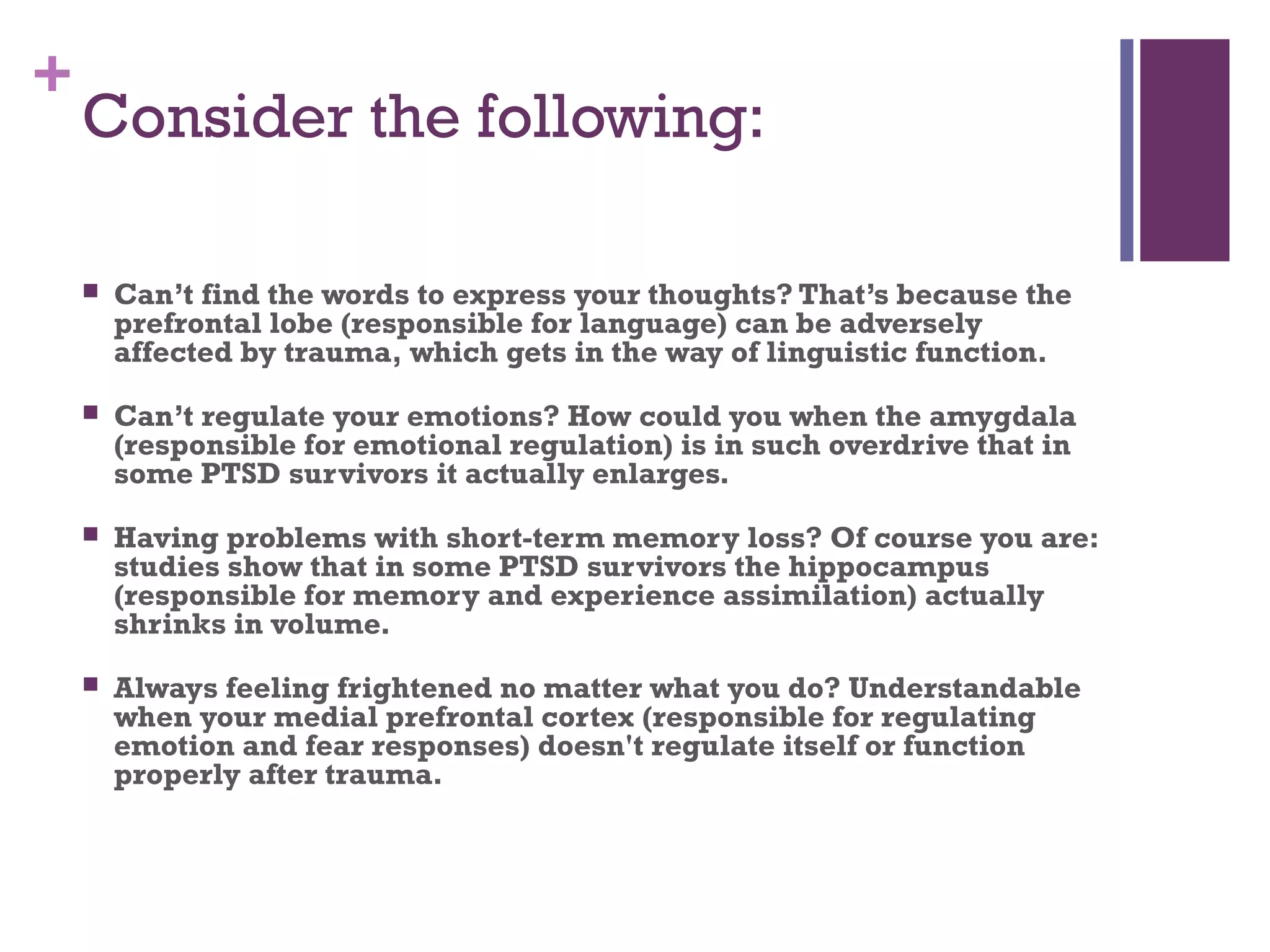
Consider the following:
 Can’t find the words to express your thoughts? That’s because the
prefrontal lobe (responsible for language) can be adversely
affected by trauma, which gets in the way of linguistic function.
 Can’t regulate your emotions? How could you when the amygdala
(responsible for emotional regulation) is in such overdrive that in
some PTSD survivors it actually enlarges.
 Having problems with short-term memory loss? Of course you are:
studies show that in some PTSD survivors the hippocampus
(responsible for memory and experience assimilation) actually
shrinks in volume.
 Always feeling frightened no matter what you do? Understandable
when your medial prefrontal cortex (responsible for regulating
emotion and fear responses) doesn't regulate itself or function
properly after trauma.
+
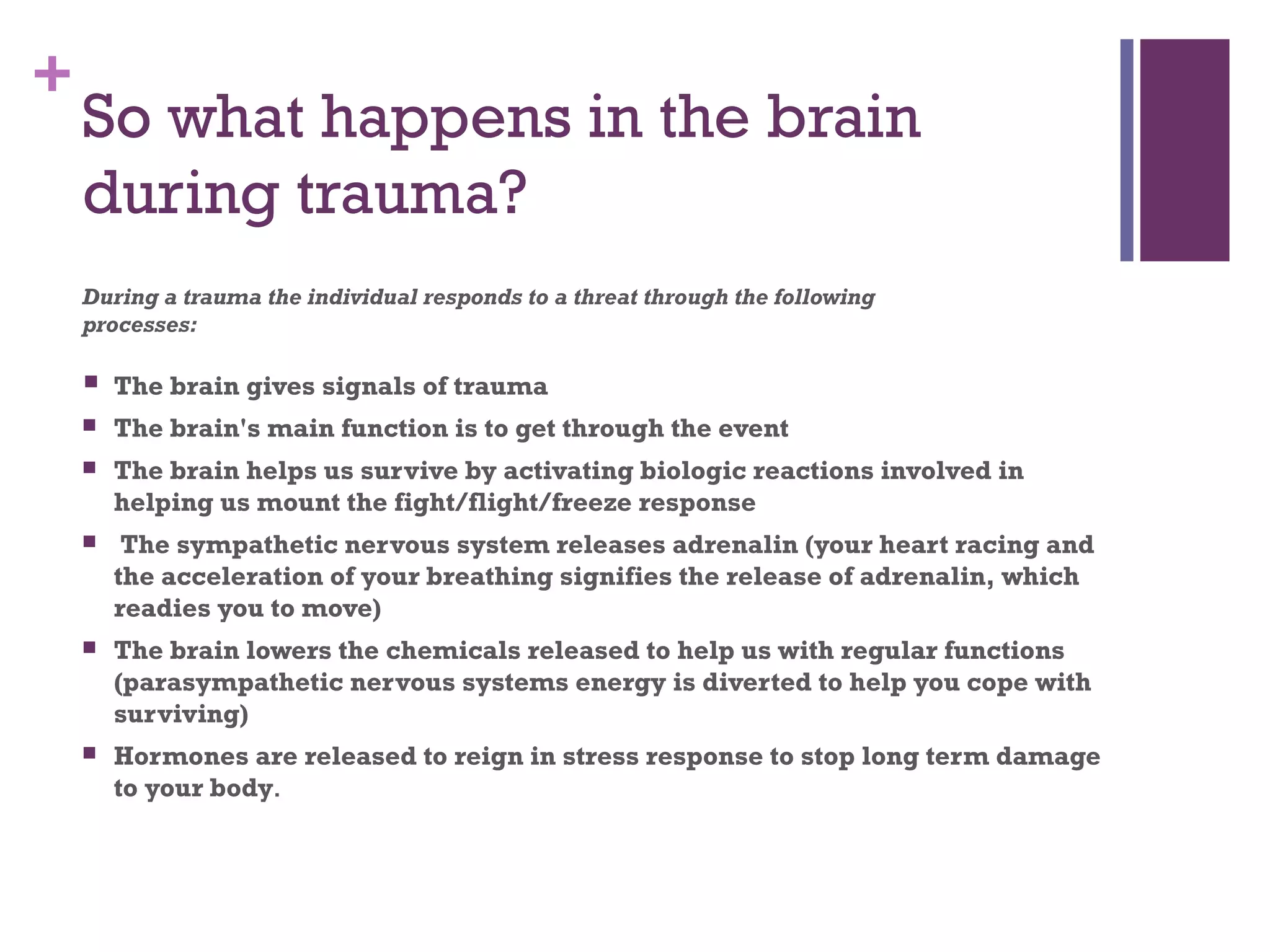
So what happens in the brain
during trauma?
During a trauma the individual responds to a threat through the following
processes:
 The brain gives signals of trauma
 The brain's main function is to get through the event
 The brain helps us survive by activating biologic reactions involved in
helping us mount the fight/flight/freeze response
 The sympathetic nervous system releases adrenalin (your heart racing and
the acceleration of your breathing signifies the release of adrenalin, which
readies you to move)
 The brain lowers the chemicals released to help us with regular functions
(parasympathetic nervous systems energy is diverted to help you cope with
surviving)
 Hormones are released to reign in stress response to stop long term damage
to your body.
+
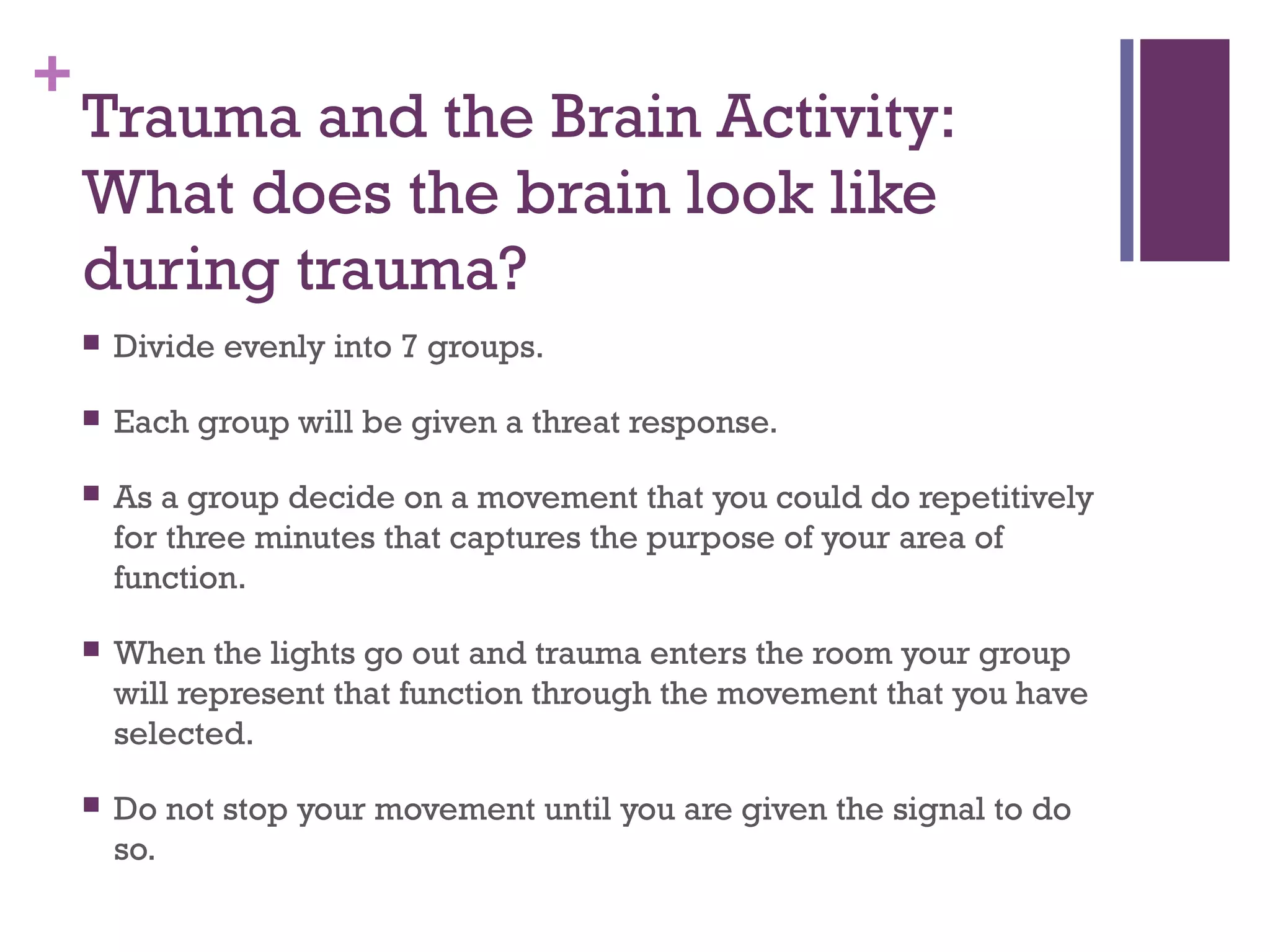
Trauma and the Brain Activity:
What does the brain look like
during trauma?
 Divide evenly into 7 groups.
 Each group will be given a threat response.
 As a group decide on a movement that you could do repetitively
for three minutes that captures the purpose of your area of
function.
 When the lights go out and trauma enters the room your group
will represent that function through the movement that you have
selected.
 Do not stop your movement until you are given the signal to do
so.
+
What happens after trauma?
 After trauma, not all brains reset themselves but they always
try to recalibrate.
 When things happen to us we don’t go back to the way we
were.
 After trauma, the brain’s job is to remember what happened
and develop survival skills for the future.
 The brain integrates the lesson of trauma; it re-calibrates to
do better next time.
+
So what hope do we have of
recovery?
 The good news is, if our brain can change in response to one
environment that is trauma it can change in response to treatment too.
 Our brains are capable of change!
 The good news is the brain is designed to be plastic.That is, it is
hardwired to rewire.
 Recent advances in scientific research all support the idea of
‘neuroplasticity’: "The brain’s ability to reorganize by forming new
neural connections throughout life.
 Neuroplasticity allows the neurons (nerve cells) in the brain to
compensate for injury and disease and to adjust their activities in
response to new situations or to changes in their environment."
(Medicine.net)
+
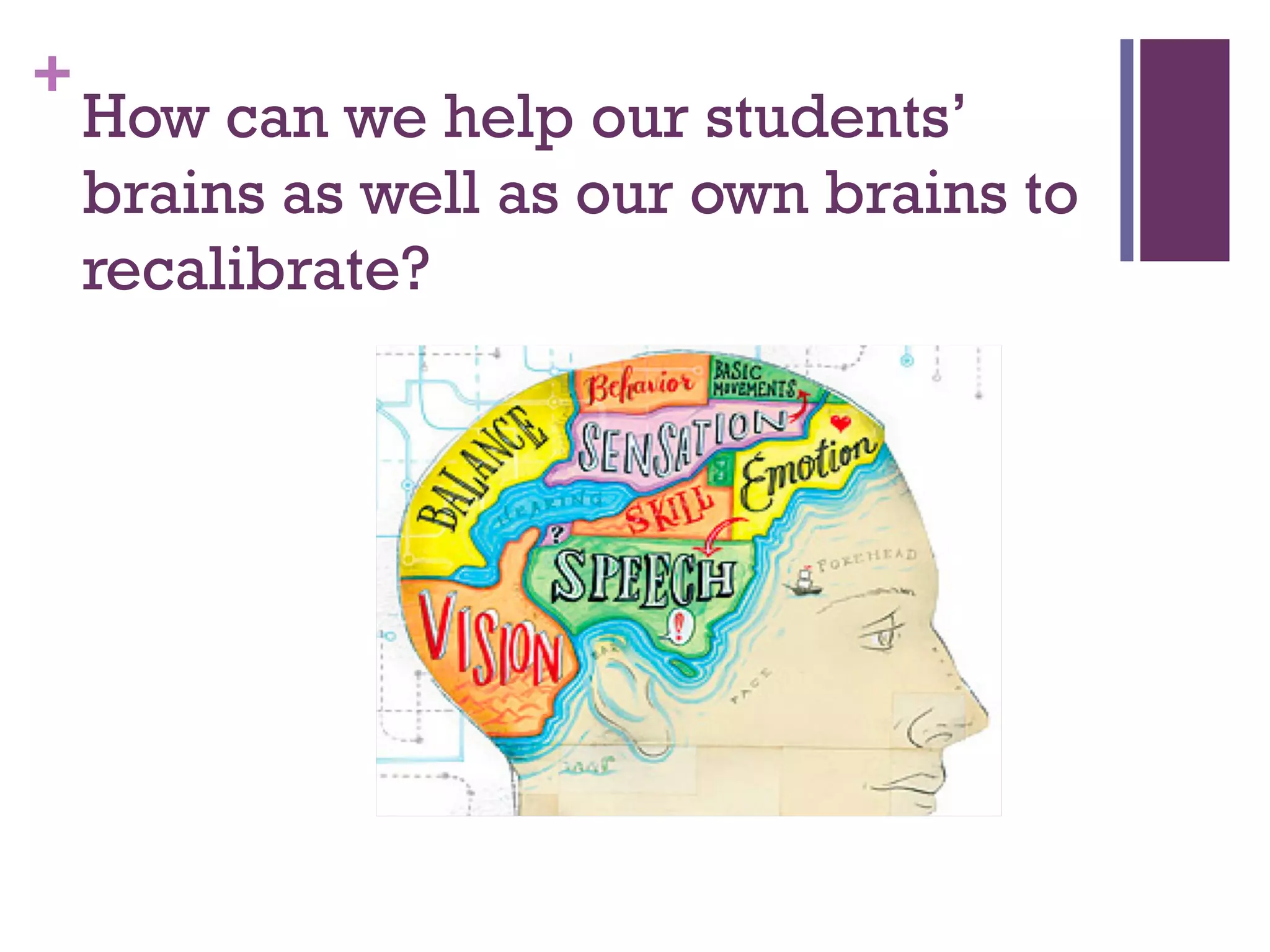
How can we help our students’
brains as well as our own brains to
recalibrate?
+
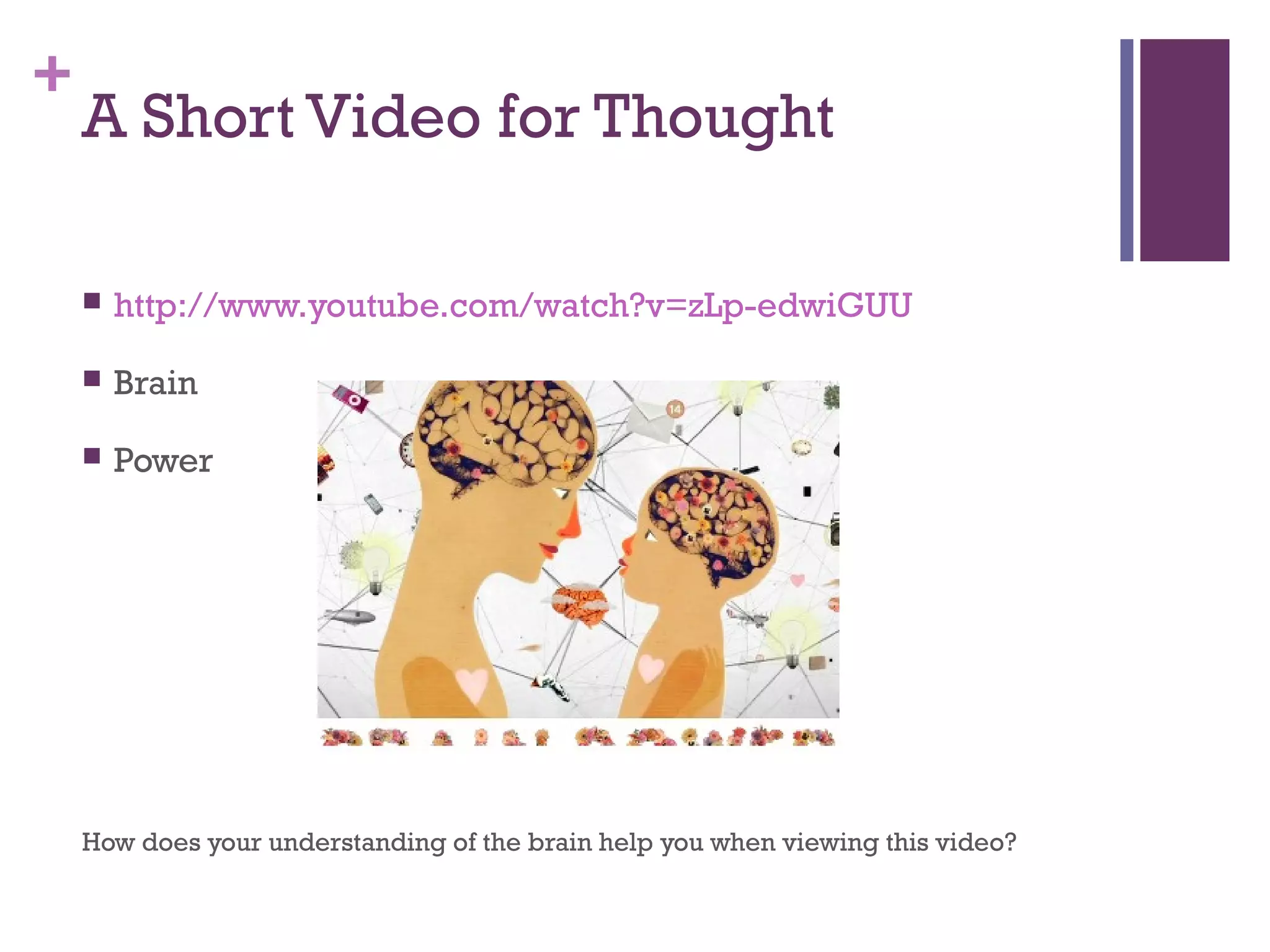
A Short Video for Thought
 http://www.youtube.com/watch?v=zLp-edwiGUU
 Brain
 Power
How does your understanding of the brain help you when viewing this video?
+
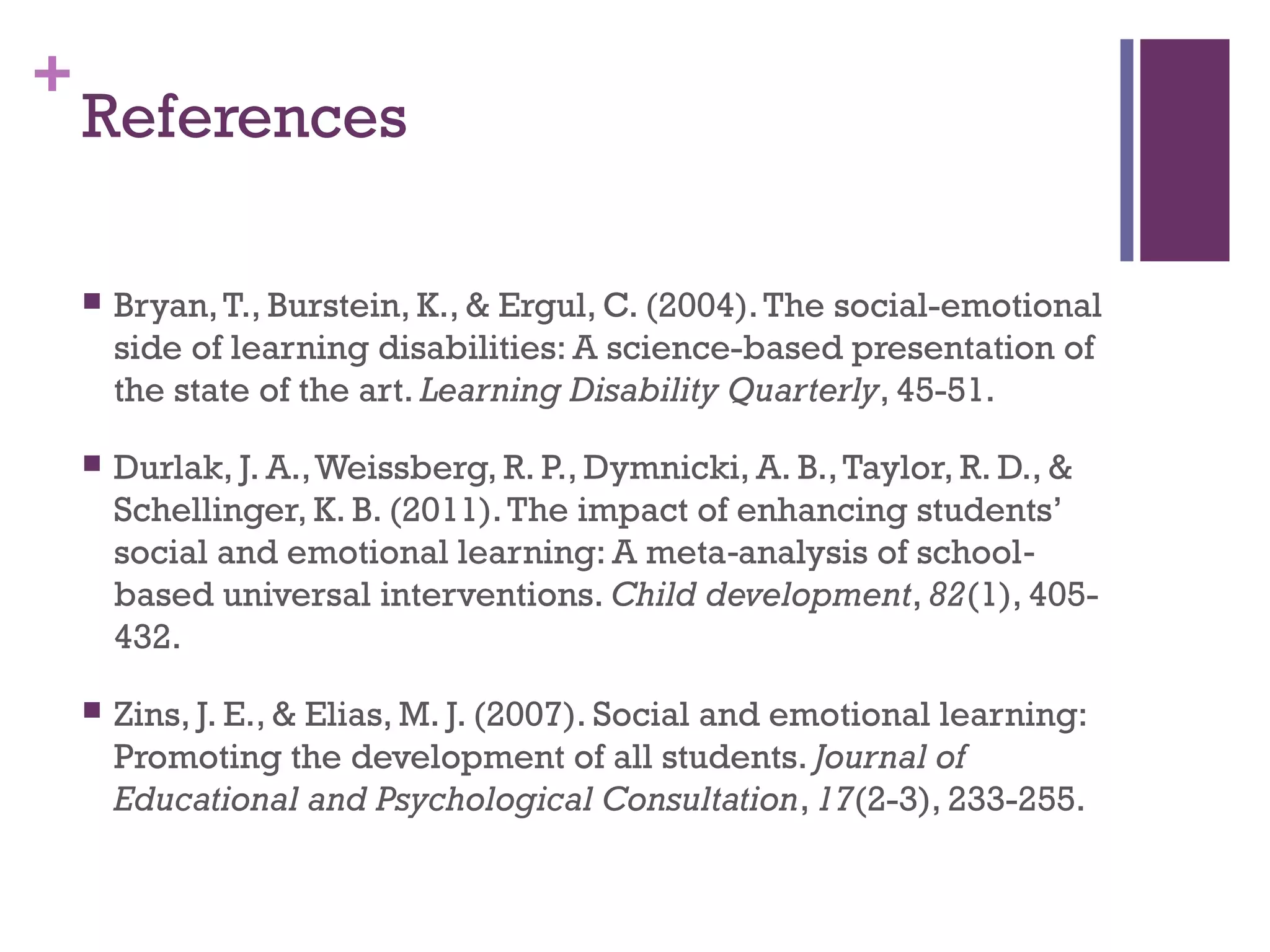
References
 Bryan,T., Burstein, K., & Ergul, C. (2004).The social-emotional
side of learning disabilities: A science-based presentation of
the state of the art. Learning Disability Quarterly, 45-51.
 Durlak, J. A.,Weissberg, R. P., Dymnicki, A. B.,Taylor, R. D., &
Schellinger, K. B. (2011).The impact of enhancing students’
social and emotional learning: A meta analysis of school‐ ‐
based universal interventions. Child development, 82(1), 405-
432.
 Zins, J. E., & Elias, M. J. (2007). Social and emotional learning:
Promoting the development of all students. Journal of
Educational and Psychological Consultation, 17(2-3), 233-255.

Teresa ppt pd 2.18.14 desktop

  • 1.
    + SHINE A LIGHT Thisproject intends to shine a light on the social/emotional issues that impact students with disabilities in and outside of the classroom.The project will help to build cultural awareness as it relates to the social and emotional issues that impact students with disabilities. By building awareness among teachers, the project intends to develop a more welcoming school community for students with disabilities and their families.
  • 2.
    + Supporting Research  Accordingto the Journal of Education and Psychological Consultation: In light of today’s world (from gun violence in the United States to world wide terrorism) children must face numerous situations that are negatively impacting their social emotional development and ultimately their happiness in life.  According to Learning Disability Quarterly, in an article that reflects on children with learning disabilities, its research shows that characteristics of students with LD reflected lower academic self-concepts than peers, showed deficits in social perceptions, and were more likely to experience negative affect/emotions when compared to students without LD (with feelings of loneliness ranging as high as 25% in children with disabilities).
  • 3.
  • 4.
    + Statement of Confidentiality This project will encourage us to explore the social emotional issues that children with disabilities face  In order to respect the privacy of all students and families involved we are asking that specific names of students in this exploration remain anonymous  At no time will we be discussing our social emotional findings regarding a student with other students or parents of other students  We will all be asked to sign a statement of confidentiality before beginning this project to ensure that the students and their families maintain their right to privacy
  • 5.
    + A Social EmotionalReality (factors related to social emotional issues)
  • 6.
    + Workshop Schedule andAgenda  Jan. 21, 2014-Looking at the Roots of Special Education (Special Education Overview and Project Opening)  Feb. 18, 2014-Trauma and the Brain; Select student for case study; Initial quick write  March 25, 2014-Signs, Signals, and Reactions of Trauma; Further explorations with case study  April 22, 2014-Psychological 1st Aid/Teacher Self-Care; LPCMT through role playing; Final quick write
  • 7.
    + Connecting Social Emotional Issuesand the Brain  In order to better understand the social emotional issues that impact students with disabilities we will start by trying to understand what role the brain plays when considering the social emotional issues that impact students with disabilities.  From there we can take this information about the brain to help support all students, family members, colleagues, and ourselves.
  • 8.
    + The Brain  Thehuman brain is an astonishing organ that takes care of each function and action of the body.  The brain acts as a center to receive, interpret and direct the information throughout the body.  It is divided into three main divisions called the forebrain, midbrain and hindbrain.  There are various areas and structures that make up these three division of the brain. Let us have a look at these areas and learn more about their functions.
  • 9.
    + The Central Core Thecentral core consists of the following five regions which are the central areas that regulate breathing, pulse, arousal, balance, sleep and early stages of processing sensory information.
  • 10.
    + The 5 Regionsof the Central Core  Thalamus: interprets the sensory information and helps determine what is good and bad. It then sends the message across the cerebral cortex to the region where further analysis of the information continues.  Pons: Is the area that helps you dream and wake up from your sleep is the pons.  Cerebellum: This region of the brain helps in balancing, movement, maintaining posture as well as muscle coordination.  Reticular formation: The signals sent to the cerebral cortex that helps in attending stimulation and remain alert while sleeping is taken care of by the reticular formation.  Medulla: Last but not the least, the medulla helps you breath, walk, sleep and signal the heart to continue beating.
  • 11.
  • 12.
    + Limbic System  Thelimbic system is present only in mammals and helps in the liaison between motivated behavior, emotional conditions and memory processes.
  • 13.
    + The 3 Regionsof the Limbic System  Hippocampus: This region is located deep within the brain and helps store memories for long-term. If this region was not present, people would be stuck with old memories and would never be able to develop or process new memories.  Amygdala:Takes care of aggression, emotions are perceived and reactions like anger and fear are analyzed, eating, drinking and the carnal instincts, that is, sexual urges are control. Recently, it was found to be associated with mental conditions such as autism as well as depression.The Amygdala is larger in size in males.  Hypothalamus: Looks after the blood glucose, salt, blood pressure, temperature of the body, hormones and controls the sensation of appetite and body weight. It regulates the body processes, as it is connected to both the central and autonomic nervous systems and the endocrine systems.
  • 14.
    + Cerebral Cortex This isthe region that makes humans as humans. It is the region of higher cognitive and emotional functions. It is divided into two symmetrical halves called the cerebral hemispheres.
  • 15.
    + The 5 Lobesof the Cerebral Cortex
  • 16.
    + The 4 Lobesof the Cerebral Cortex  The Frontal Lobe: The frontal lobe helps in organizing complex problems, helps plan steps to achieve an objective, connects the present to future, develops verbal skills, and is involved in decision-making, problem solving and planning.  Occipital Lobe: The visual images are passed to the parietal and temporal lobes through the occipital lobe.  Parietal Lobe: The sensory processes, spatial interpretation, attention and language comprehension is controlled by the parietal lobe.  Temporal Lobe: Lastly, the auditory perception, language comprehension and visual recognition is controlled by the temporal lobe.
  • 17.
    + Trauma  Did youknow that the experience of trauma can actually cause neurological changes in the structure of the brain?  Lets say you experienced a traumatic situation and for weeks or even years you may have been thinking you’re crazy, but there are often scientific reasons for much of your behavior, including increased, diminished and killed brain regions, functions and neurons.
  • 18.
    + Consider the following: Can’t find the words to express your thoughts? That’s because the prefrontal lobe (responsible for language) can be adversely affected by trauma, which gets in the way of linguistic function.  Can’t regulate your emotions? How could you when the amygdala (responsible for emotional regulation) is in such overdrive that in some PTSD survivors it actually enlarges.  Having problems with short-term memory loss? Of course you are: studies show that in some PTSD survivors the hippocampus (responsible for memory and experience assimilation) actually shrinks in volume.  Always feeling frightened no matter what you do? Understandable when your medial prefrontal cortex (responsible for regulating emotion and fear responses) doesn't regulate itself or function properly after trauma.
  • 19.
    + So what happensin the brain during trauma? During a trauma the individual responds to a threat through the following processes:  The brain gives signals of trauma  The brain's main function is to get through the event  The brain helps us survive by activating biologic reactions involved in helping us mount the fight/flight/freeze response  The sympathetic nervous system releases adrenalin (your heart racing and the acceleration of your breathing signifies the release of adrenalin, which readies you to move)  The brain lowers the chemicals released to help us with regular functions (parasympathetic nervous systems energy is diverted to help you cope with surviving)  Hormones are released to reign in stress response to stop long term damage to your body.
  • 20.
    + Trauma and theBrain Activity: What does the brain look like during trauma?  Divide evenly into 7 groups.  Each group will be given a threat response.  As a group decide on a movement that you could do repetitively for three minutes that captures the purpose of your area of function.  When the lights go out and trauma enters the room your group will represent that function through the movement that you have selected.  Do not stop your movement until you are given the signal to do so.
  • 21.
    + What happens aftertrauma?  After trauma, not all brains reset themselves but they always try to recalibrate.  When things happen to us we don’t go back to the way we were.  After trauma, the brain’s job is to remember what happened and develop survival skills for the future.  The brain integrates the lesson of trauma; it re-calibrates to do better next time.
  • 22.
    + So what hopedo we have of recovery?  The good news is, if our brain can change in response to one environment that is trauma it can change in response to treatment too.  Our brains are capable of change!  The good news is the brain is designed to be plastic.That is, it is hardwired to rewire.  Recent advances in scientific research all support the idea of ‘neuroplasticity’: "The brain’s ability to reorganize by forming new neural connections throughout life.  Neuroplasticity allows the neurons (nerve cells) in the brain to compensate for injury and disease and to adjust their activities in response to new situations or to changes in their environment." (Medicine.net)
  • 23.
    + How can wehelp our students’ brains as well as our own brains to recalibrate?
  • 24.
    + A Short Videofor Thought  http://www.youtube.com/watch?v=zLp-edwiGUU  Brain  Power How does your understanding of the brain help you when viewing this video?
  • 25.
    + References  Bryan,T., Burstein,K., & Ergul, C. (2004).The social-emotional side of learning disabilities: A science-based presentation of the state of the art. Learning Disability Quarterly, 45-51.  Durlak, J. A.,Weissberg, R. P., Dymnicki, A. B.,Taylor, R. D., & Schellinger, K. B. (2011).The impact of enhancing students’ social and emotional learning: A meta analysis of school‐ ‐ based universal interventions. Child development, 82(1), 405- 432.  Zins, J. E., & Elias, M. J. (2007). Social and emotional learning: Promoting the development of all students. Journal of Educational and Psychological Consultation, 17(2-3), 233-255.