
Beginner Delegate
Workshop
Made by: Arnav Mundkur
What is an MUN?
• Model United Nations
• United Nations: An organization of
independent states formed in 1945 to
promote international peace and security
• ARMUN, LMUNA, PAMUN, MUNISH
Committees
• General Assembly
• Security Council
• Human Rights Council
• Crisis Committee
• Environments Committee
What Are You?
A representative of a nation/country/NGO
i.e. “The delegat(e)/ion of (insert here)”
Research? What Research?
• Committee Issues
• Chair Reports
• Booklets
• Websites-
• United Nations Website
• CIA World Factbook
• Google it…
Policy Statement
A brief statement in your country’s point of view
on the issues in your committee’s agenda
• PI: Definition of Issue; Past events and experiences
relating to the topic, major treaties and UN action on the
topic, and any other relevant information on the topic.
• PII: Current circumstances concerning the topic and any
recent action taken by the UN, member states, NGOs,
etc.
• PIII: Outline how your country would like to resolve any
problems, concerns, or conflicts related to that topic.
*Find example in your booklets
• The foundation on which every UN action is based
• A statement made by a committee expressing their
desire to change a certain situation and prescribing
ways it can be done
• Your basis for discussion
• Can be submitted by a nation or NGO, or created
during AD HOC sessions in committees
• 3 Parts:
– Heading
– Perambulatory Clauses
– Operative Clauses
Resolution: In the Making
*Find example in your booklets
Heading
• Forum: (e.g. ECOSOC, Security Council, etc.)
• Question: (The issue the resolution is about)
• Submitter: (e.g. Your country)
• Co-Submitters: (Other countries supporting
you)
Perambulatory Clauses
• Introductory sentences basically describing
what the submitter considers the problem is
and mentions thoughts or assumption
concerning issue
• Take no action
• Not numbered
• Each clause must begin with a word from the
list of Perambulatory clause words.
*Find list in your booklets
Operative Clauses
• Focus of debate: Each clause addresses a particular
aspect of the issue
• Take action
• Numbered
• Stay concrete and rational: When calling for certain
action, explain briefly how it should be carried out
• Each clause must begin with a word from the list of
operative clause words.
• Each clause ends with semi-colon (;), though the last
clause ends with a full stop (.)
*Find list in your booklets
Debate Procedure
Do what the chair tells you to do!
1. Opening by chair (Introduction: Remember who they are!)
2. Roll Call (Say “Here” or “Present” when your country is
called )
3. Agenda (What you’re going to do for the day!)
4. Reading out operative clauses of chosen resolution and
speech by main submitter
5. Debate, speeches, questions, amendments, etc.
6. Voting
7. Repeat 4-6 for next resolution
8. Closing
*For further details, yes that’s right, look in your booklet
Amendments
• Submitted by delegations wishing to
change/add/strike clauses in resolutions
• When submitted and recognized by chair,
committee moves into mini-debate over
amendment (NOT the resolution)
• Can only be submitted on official amendment
paper
• These make up ¾ of debate in MUN’s
Note Passing
•Can only be written on official note passing
paper (Country specific)
•Suspended during voting procedures
•Censored by Admin
•Can be suspended indefinitely if chairs think it
is too distracting for delegates
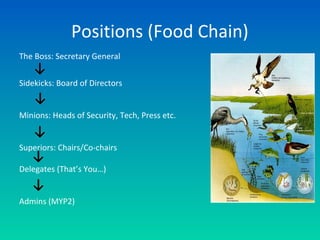
Positions (Food Chain)
The Boss: Secretary General
Sidekicks: Board of Directors
Minions: Heads of Security, Tech, Press etc.
Superiors: Chairs/Co-chairs
Delegates (That’s You…)
Admins (MYP2)
Points
A question
• Point of information
– Question addressed to speaker who has the floor
• Point of personal privilege
– Your own well being
• Point of order
– When you need an explanation on procedures
from the chair
Things to Remember
• There’s no “I” in delegate
– “I think”  “The delegation of… thinks”
– No personal pronouns!!!
• When starting a speech (you have the floor), you must
always address the chair and the house first!!!
– “Honorable chair, fellow delegates, …”
• Pay attention (The chair might suddenly decide to call
up non-volunteers…)
• Listen to the Chair and do what they tell you to do (If
that means doing push ups in a corner, then so be it!)
MUN Lingo
• Abstention
• Amendment
• Closed/Open debate
• Delegate
• Floor
• House
• Lobbying
• NGO
• Objection
• Operative Clause
• Perambulatory
• Placard
• Resolution
• Yield
• Motions (not
applicable in ARMUN)
I Hope You Learned Something
Any Questions?

Beginner delegate workshop ARMUN 2013

  • 1.
  • 2.
    What is anMUN? • Model United Nations • United Nations: An organization of independent states formed in 1945 to promote international peace and security • ARMUN, LMUNA, PAMUN, MUNISH
  • 3.
    Committees • General Assembly •Security Council • Human Rights Council • Crisis Committee • Environments Committee
  • 4.
    What Are You? Arepresentative of a nation/country/NGO i.e. “The delegat(e)/ion of (insert here)”
  • 5.
    Research? What Research? •Committee Issues • Chair Reports • Booklets • Websites- • United Nations Website • CIA World Factbook • Google it…
  • 6.
    Policy Statement A briefstatement in your country’s point of view on the issues in your committee’s agenda • PI: Definition of Issue; Past events and experiences relating to the topic, major treaties and UN action on the topic, and any other relevant information on the topic. • PII: Current circumstances concerning the topic and any recent action taken by the UN, member states, NGOs, etc. • PIII: Outline how your country would like to resolve any problems, concerns, or conflicts related to that topic. *Find example in your booklets
  • 7.
    • The foundationon which every UN action is based • A statement made by a committee expressing their desire to change a certain situation and prescribing ways it can be done • Your basis for discussion • Can be submitted by a nation or NGO, or created during AD HOC sessions in committees • 3 Parts: – Heading – Perambulatory Clauses – Operative Clauses Resolution: In the Making *Find example in your booklets
  • 8.
    Heading • Forum: (e.g.ECOSOC, Security Council, etc.) • Question: (The issue the resolution is about) • Submitter: (e.g. Your country) • Co-Submitters: (Other countries supporting you)
  • 9.
    Perambulatory Clauses • Introductorysentences basically describing what the submitter considers the problem is and mentions thoughts or assumption concerning issue • Take no action • Not numbered • Each clause must begin with a word from the list of Perambulatory clause words. *Find list in your booklets
  • 10.
    Operative Clauses • Focusof debate: Each clause addresses a particular aspect of the issue • Take action • Numbered • Stay concrete and rational: When calling for certain action, explain briefly how it should be carried out • Each clause must begin with a word from the list of operative clause words. • Each clause ends with semi-colon (;), though the last clause ends with a full stop (.) *Find list in your booklets
  • 11.
    Debate Procedure Do whatthe chair tells you to do! 1. Opening by chair (Introduction: Remember who they are!) 2. Roll Call (Say “Here” or “Present” when your country is called ) 3. Agenda (What you’re going to do for the day!) 4. Reading out operative clauses of chosen resolution and speech by main submitter 5. Debate, speeches, questions, amendments, etc. 6. Voting 7. Repeat 4-6 for next resolution 8. Closing *For further details, yes that’s right, look in your booklet
  • 12.
    Amendments • Submitted bydelegations wishing to change/add/strike clauses in resolutions • When submitted and recognized by chair, committee moves into mini-debate over amendment (NOT the resolution) • Can only be submitted on official amendment paper • These make up ¾ of debate in MUN’s
  • 13.
    Note Passing •Can onlybe written on official note passing paper (Country specific) •Suspended during voting procedures •Censored by Admin •Can be suspended indefinitely if chairs think it is too distracting for delegates
  • 14.
    Positions (Food Chain) TheBoss: Secretary General Sidekicks: Board of Directors Minions: Heads of Security, Tech, Press etc. Superiors: Chairs/Co-chairs Delegates (That’s You…) Admins (MYP2)
  • 15.
    Points A question • Pointof information – Question addressed to speaker who has the floor • Point of personal privilege – Your own well being • Point of order – When you need an explanation on procedures from the chair
  • 16.
    Things to Remember •There’s no “I” in delegate – “I think”  “The delegation of… thinks” – No personal pronouns!!! • When starting a speech (you have the floor), you must always address the chair and the house first!!! – “Honorable chair, fellow delegates, …” • Pay attention (The chair might suddenly decide to call up non-volunteers…) • Listen to the Chair and do what they tell you to do (If that means doing push ups in a corner, then so be it!)
  • 17.
    MUN Lingo • Abstention •Amendment • Closed/Open debate • Delegate • Floor • House • Lobbying • NGO • Objection • Operative Clause • Perambulatory • Placard • Resolution • Yield • Motions (not applicable in ARMUN)
  • 18.
    I Hope YouLearned Something Any Questions?