
Jon R. Hilden
IX564: Design of Learning Environments
December 10, 2013
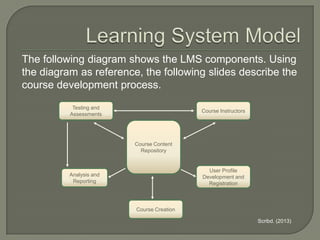
The following diagram shows the LMS components. Using
the diagram as reference, the following slides describe the
course development process.
Testing and
Assessments

Course Instructors

Course Content
Repository

User Profile
Development and
Registration

Analysis and
Reporting

Course Creation
Scribd. (2013)


Organizes a team of testers that consists of
administrators, instructors, students, and management



Thoroughly tests each part of the system by evaluating
menu items, text field entry points, checkboxes, radio
buttons, etc.



Corrects any issues prior to LMS use



Is a dynamic, ongoing process that interacts with LMS
instructors, analysis and reporting, and the course
content repository
Scribd. (2013)






Stores course content material for future
access, revision, and use
Courses are organized according to course prefixes
and/or course number
Organized by course unit, section, topic, instructor
name, or asset type (video, audio, document, or image)
Is a dynamic, ongoing process that interacts that
interacts with testing and assessments, analysis and
reporting, course creation, course instructors, and user
profile development and registration

Central Piedmont Community College (2013)
Our organization will use reporting and analysis in the
following manner:


Analysis: We will explore data and reports in order to
obtain meaningful information that will be used to
improve business performance.



Reporting: We will then organize the data obtained
during analysis to develop into information
summaries, which will help us monitor business
performance.



Is a dynamic, ongoing process that interacts with testing
and assessments, and the course content repository
Adobe Systems (2012)
The process for course creation is as follows:
 Review course completion due dates
 Submit course development proposals to training
department for approval
 Develop course objectives, unit objectives, and course
assessments
 Is a dynamic, ongoing process that interacts with course
content and repository

Columbia State Community College (2013)








Determine target audience through need assessment
Create user profiles (personas) based on needs
assessment. Personas aid in the understanding of how
users will interact with the LMS platform and design
Verify with the development team that the LMS applies
to the target audience
Develop complete set of registration screens, data
collection forms and profile pages used to acquire users
Is a dynamic process that interacts with the course
content repository
Hunt, J. (2011)
Janrain, Inc. (2013)
Learner tools will consist of the following:


Student interaction


Blogs



Discussion groups and forums



Instant messaging



Learner-centered functionality



Learner-centered student interaction



Learner-centered learning media


Web-embedded video and narration



PDF handouts
Scribd.

(2013)
Support tools assist instructors in the production of
classroom resources and materials and will aid in the
following:


Improved instructional efficiency and productivity



Improved product appearance



Increased accuracy and timeliness of information



Improved student interaction through content sharing



Improved test and survey delivery
Sankarsingh, C.
(2013)
Although some LMS functions may not work with some
browsers, the LMS is compatible with most web
browsers, including:




Internet Explorer 7 and 8 for PCs
Firefox 3 and later for PCs or Macs
Safari 3 or later for Macs

To help ensure proper LMS functionality, verify that the
computer systems meet the following requirements:




Pop-ups are enabled
Cookies are enabled
Java is installed, up-to-date, and enabled
University of Western Australia


Project Manager
Full Time
 $80,000




Instructional Designer
Full Time
 $60,000




Subject Matter Expert(s)





Contract
$40–60/hour

IT Professional
Part Time, Temporary
 $35,000




Online Trainers
Contract
 $60–80/hour

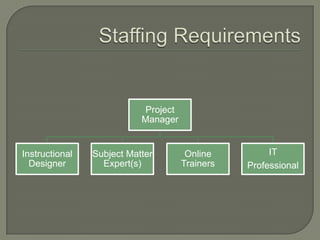
Project
Manager

Instructional
Designer

Subject Matter
Expert(s)

Online
Trainers

IT
Professional
Project Manager—Oversee the implementation of the
LMS and the process of hiring and recruiting online
trainers on an as-needed basis.
 Instructional Designer—Design the sessions within the
LMS.
 Subject Matter Expert(s)—Serve as experts on the
training subject areas.
 Online Trainers—Lead the training sessions online.
 IT Professional—Set up the LMS to be able to work
with internal systems. Help the IT department
understand how the systems are connected to be more
successful in the long-term.

Adobe Systems (2012). Reporting vs. analysis: What’s the difference? Retrieved from
http://blogs.adobe.com/digitalmarketing/analytics/reporting-vs-analysis-whats-the-difference/

All Business Info (2013). Revolution: State of-the-art in LMS software. Retrieved from
http://www.allbusinessinfo.com/revolution-state-of-the-art-in-lms-software-2015114
Central Piedmont Community College (2013). Course content repository. Retrieved from https://delta.cpcc.edu/courses
Columbia State Community College(2013). Checklist for Columbia State Community College’s course creation process.
Retrieved from http://www.columbiastate.edu/docs/default-source/fitt/checklist-for-columbia-state-community-college-930-2013.pdf?sfvrsn=0
Hunt, J. (2011). Personas: How creating user profiles can help inform design decisions. Retrieved from
http://link.highedweb.org/2011/09/personas-inform-design-decisions/
Janrain, Inc. (2013). User registration system. Retrieved from http://janrain.com/products/capture/registration/
Learning Solutions (2013). The six proven steps for successful LMS implementation. Retrieved from
http://www.learningsolutionsmag.com/articles/1217/
Sankarsingh, C. (2013). What are software support tools? Retrieved from http://www.slideshare.net/cvsankars/lecture5-intro-to-s
Scribd. (2013). LMS model. Retrieved from http://www.scribd.com/doc/48901762/Learning-management-system-LMSModules
University of Western Australia (n.d.). LMS system requirements. Retrieved from
http://www.lms.uwa.edu.au/pluginfile.php/101372/mod_label/intro/System%20Requirements_2.pdf

Unit 6 presentation

  • 1.
    Jon R. Hilden IX564:Design of Learning Environments December 10, 2013
  • 2.
    The following diagramshows the LMS components. Using the diagram as reference, the following slides describe the course development process. Testing and Assessments Course Instructors Course Content Repository User Profile Development and Registration Analysis and Reporting Course Creation Scribd. (2013)
  • 3.
     Organizes a teamof testers that consists of administrators, instructors, students, and management  Thoroughly tests each part of the system by evaluating menu items, text field entry points, checkboxes, radio buttons, etc.  Corrects any issues prior to LMS use  Is a dynamic, ongoing process that interacts with LMS instructors, analysis and reporting, and the course content repository Scribd. (2013)
  • 4.
        Stores course contentmaterial for future access, revision, and use Courses are organized according to course prefixes and/or course number Organized by course unit, section, topic, instructor name, or asset type (video, audio, document, or image) Is a dynamic, ongoing process that interacts that interacts with testing and assessments, analysis and reporting, course creation, course instructors, and user profile development and registration Central Piedmont Community College (2013)
  • 5.
    Our organization willuse reporting and analysis in the following manner:  Analysis: We will explore data and reports in order to obtain meaningful information that will be used to improve business performance.  Reporting: We will then organize the data obtained during analysis to develop into information summaries, which will help us monitor business performance.  Is a dynamic, ongoing process that interacts with testing and assessments, and the course content repository Adobe Systems (2012)
  • 6.
    The process forcourse creation is as follows:  Review course completion due dates  Submit course development proposals to training department for approval  Develop course objectives, unit objectives, and course assessments  Is a dynamic, ongoing process that interacts with course content and repository Columbia State Community College (2013)
  • 7.
         Determine target audiencethrough need assessment Create user profiles (personas) based on needs assessment. Personas aid in the understanding of how users will interact with the LMS platform and design Verify with the development team that the LMS applies to the target audience Develop complete set of registration screens, data collection forms and profile pages used to acquire users Is a dynamic process that interacts with the course content repository Hunt, J. (2011) Janrain, Inc. (2013)
  • 8.
    Learner tools willconsist of the following:  Student interaction  Blogs  Discussion groups and forums  Instant messaging  Learner-centered functionality  Learner-centered student interaction  Learner-centered learning media  Web-embedded video and narration  PDF handouts Scribd. (2013)
  • 9.
    Support tools assistinstructors in the production of classroom resources and materials and will aid in the following:  Improved instructional efficiency and productivity  Improved product appearance  Increased accuracy and timeliness of information  Improved student interaction through content sharing  Improved test and survey delivery Sankarsingh, C. (2013)
  • 10.
    Although some LMSfunctions may not work with some browsers, the LMS is compatible with most web browsers, including:    Internet Explorer 7 and 8 for PCs Firefox 3 and later for PCs or Macs Safari 3 or later for Macs To help ensure proper LMS functionality, verify that the computer systems meet the following requirements:    Pop-ups are enabled Cookies are enabled Java is installed, up-to-date, and enabled University of Western Australia
  • 11.
     Project Manager Full Time $80,000   Instructional Designer Full Time  $60,000   Subject Matter Expert(s)    Contract $40–60/hour IT Professional Part Time, Temporary  $35,000   Online Trainers Contract  $60–80/hour 
  • 12.
  • 13.
    Project Manager—Oversee theimplementation of the LMS and the process of hiring and recruiting online trainers on an as-needed basis.  Instructional Designer—Design the sessions within the LMS.  Subject Matter Expert(s)—Serve as experts on the training subject areas.  Online Trainers—Lead the training sessions online.  IT Professional—Set up the LMS to be able to work with internal systems. Help the IT department understand how the systems are connected to be more successful in the long-term. 
  • 14.
    Adobe Systems (2012).Reporting vs. analysis: What’s the difference? Retrieved from http://blogs.adobe.com/digitalmarketing/analytics/reporting-vs-analysis-whats-the-difference/ All Business Info (2013). Revolution: State of-the-art in LMS software. Retrieved from http://www.allbusinessinfo.com/revolution-state-of-the-art-in-lms-software-2015114 Central Piedmont Community College (2013). Course content repository. Retrieved from https://delta.cpcc.edu/courses Columbia State Community College(2013). Checklist for Columbia State Community College’s course creation process. Retrieved from http://www.columbiastate.edu/docs/default-source/fitt/checklist-for-columbia-state-community-college-930-2013.pdf?sfvrsn=0 Hunt, J. (2011). Personas: How creating user profiles can help inform design decisions. Retrieved from http://link.highedweb.org/2011/09/personas-inform-design-decisions/ Janrain, Inc. (2013). User registration system. Retrieved from http://janrain.com/products/capture/registration/ Learning Solutions (2013). The six proven steps for successful LMS implementation. Retrieved from http://www.learningsolutionsmag.com/articles/1217/ Sankarsingh, C. (2013). What are software support tools? Retrieved from http://www.slideshare.net/cvsankars/lecture5-intro-to-s Scribd. (2013). LMS model. Retrieved from http://www.scribd.com/doc/48901762/Learning-management-system-LMSModules University of Western Australia (n.d.). LMS system requirements. Retrieved from http://www.lms.uwa.edu.au/pluginfile.php/101372/mod_label/intro/System%20Requirements_2.pdf