Atomic Theory Materiale liberamente creato da http://www.visionlearning.com Raffaele Nardella
The Early Days  - Thomson Model of the  atom  like a billiard ball  In 1897, J. J. Thomson’s discovery of the  electron   The atom was not "indivisible" as  John Dalton   suggested  J. J. Thomson Raffaele Nardella
The Early Days  -  Cathode Ray Tube   An electric current, through a vacuum tube, creates a stream of glowing material bending toward a positively charged electric plate    The stream was made up of electrons carrying a negative charge   Cathode Ray Tube   Raffaele Nardella
The Early Days  -  Plum Pudding Model Thomson    Atoms like pieces of raisin bread Plum Pudding Model .  Raffaele Nardella
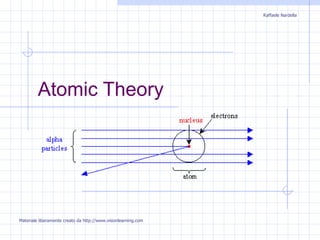
The Early Days  -  Ernest Rutherford   Experiments with radioactive alpha particles (1908) alpha particles gold foil   bouncing straight back positively charged dense core    nucleus tiny solar system   .  Raffaele Nardella
The Early Days  –  James Chadwick Discovering of a  subatomic particle : neutrons Reduction of the repulsion between protons  Stabilization of the atom's nucleus.  .  J. Chadwick   Raffaele Nardella
The Early Days  –  Size of an Atom Atoms are very very small: empty space spinning of electrons far from the nucleus (football field) atomic number (z) = number of protons atomic mass = number of protons and neutrons http://facstaff.gpc.edu/~pgore/PhysicalScience/Atoms.html Raffaele Nardella
Electron Shells – Niels Bohr   Modification to the atomic structure – Line Spectra matter heated    light  light bulb: electric current heats a metal filament    absorbing the electrical energy    exciting the electrons white light through a prism     a continuous spectrum of colors   light from an excited element through a prism    only specific lines (or wavelengths) of light, called  line spectra .   Continuous (white light) spectra   Raffaele Nardella
Electron Shells – Niels Bohr   Energy levels (electron shells) emitted light    the movement of electrons    electrons could not move continuously in the atom but only in precise steps electrons occupy specific  energy levels (electron shells)   atom excited    electrons can jump to higher levels electrons fall back to lower levels, precise quanta of energy are released as specific wavelengths (lines) of light   electron shells    concentric circles around the nucleus   Niels Bohr Raffaele Nardella
Electron Shells – Niels Bohr   Key to Bohr's theory    the electron could only "jump" and "fall" to precise energy levels, emitting a limited spectrum of light.   electrons in the  ground state , the lowest energy level possible (the electron shell closest to the nucleus).  electrons excited by adding  energy  to an atom (for example, when it is heated),  electrons absorb energy, " jump " to a higher energy level, and  spin  in the higher energy level after a short time, electrons " fall " back to a lower energy level, giving off a  quantum of light energy   levels have  limits to the number of electrons Raffaele Nardella

Atomic theory

  • 1.
    Atomic Theory Materialeliberamente creato da http://www.visionlearning.com Raffaele Nardella
  • 2.
    The Early Days - Thomson Model of the atom like a billiard ball In 1897, J. J. Thomson’s discovery of the electron The atom was not "indivisible" as John Dalton suggested J. J. Thomson Raffaele Nardella
  • 3.
    The Early Days - Cathode Ray Tube An electric current, through a vacuum tube, creates a stream of glowing material bending toward a positively charged electric plate  The stream was made up of electrons carrying a negative charge Cathode Ray Tube Raffaele Nardella
  • 4.
    The Early Days - Plum Pudding Model Thomson  Atoms like pieces of raisin bread Plum Pudding Model . Raffaele Nardella
  • 5.
    The Early Days - Ernest Rutherford Experiments with radioactive alpha particles (1908) alpha particles gold foil bouncing straight back positively charged dense core  nucleus tiny solar system . Raffaele Nardella
  • 6.
    The Early Days – James Chadwick Discovering of a subatomic particle : neutrons Reduction of the repulsion between protons Stabilization of the atom's nucleus. . J. Chadwick Raffaele Nardella
  • 7.
    The Early Days – Size of an Atom Atoms are very very small: empty space spinning of electrons far from the nucleus (football field) atomic number (z) = number of protons atomic mass = number of protons and neutrons http://facstaff.gpc.edu/~pgore/PhysicalScience/Atoms.html Raffaele Nardella
  • 8.
    Electron Shells –Niels Bohr Modification to the atomic structure – Line Spectra matter heated  light light bulb: electric current heats a metal filament  absorbing the electrical energy  exciting the electrons white light through a prism  a continuous spectrum of colors light from an excited element through a prism  only specific lines (or wavelengths) of light, called line spectra . Continuous (white light) spectra Raffaele Nardella
  • 9.
    Electron Shells –Niels Bohr Energy levels (electron shells) emitted light  the movement of electrons  electrons could not move continuously in the atom but only in precise steps electrons occupy specific energy levels (electron shells) atom excited  electrons can jump to higher levels electrons fall back to lower levels, precise quanta of energy are released as specific wavelengths (lines) of light electron shells  concentric circles around the nucleus Niels Bohr Raffaele Nardella
  • 10.
    Electron Shells –Niels Bohr Key to Bohr's theory  the electron could only "jump" and "fall" to precise energy levels, emitting a limited spectrum of light. electrons in the ground state , the lowest energy level possible (the electron shell closest to the nucleus). electrons excited by adding energy to an atom (for example, when it is heated), electrons absorb energy, " jump " to a higher energy level, and spin in the higher energy level after a short time, electrons " fall " back to a lower energy level, giving off a quantum of light energy levels have limits to the number of electrons Raffaele Nardella