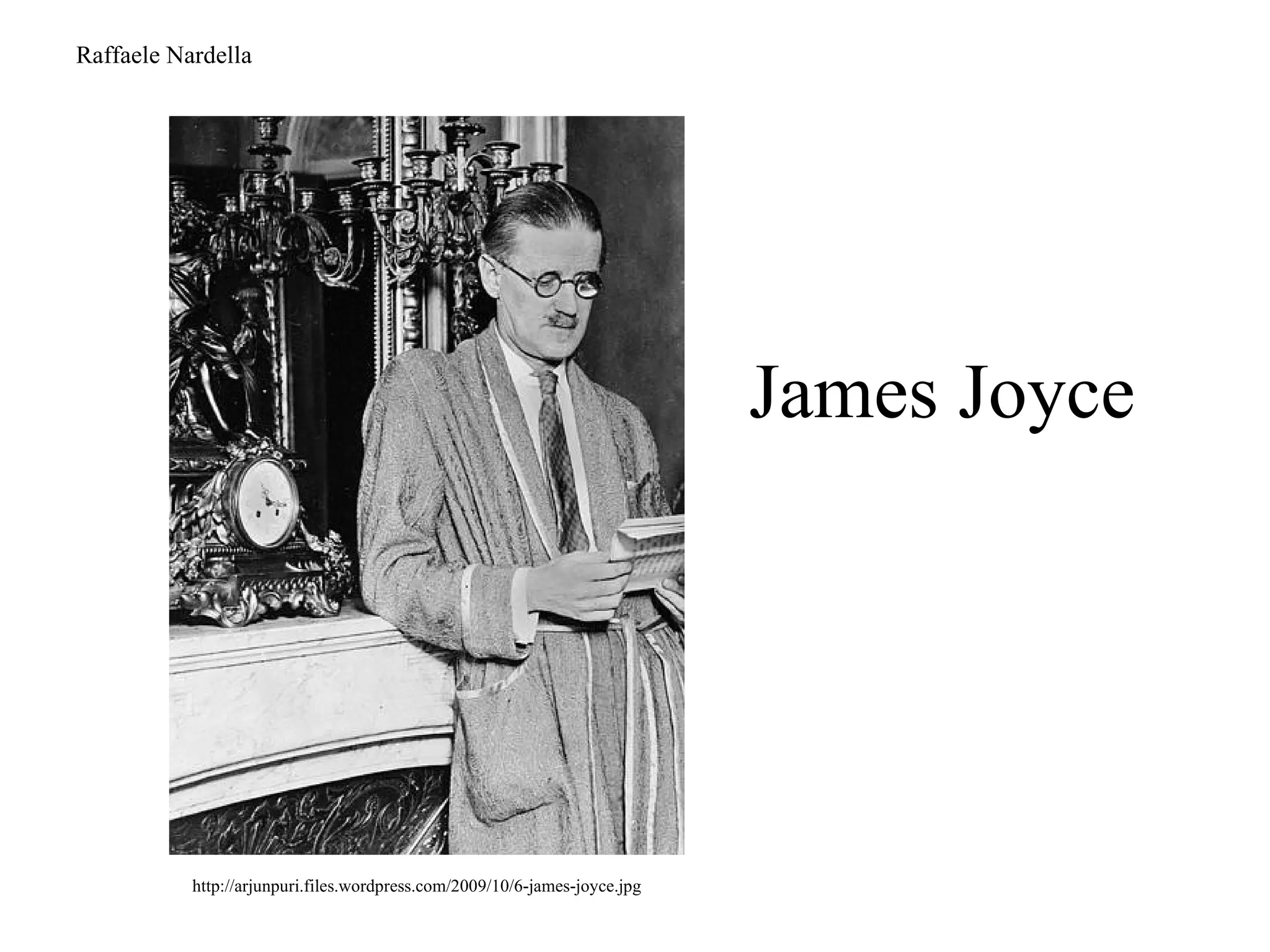
James Joyce Raffaele Nardella http://arjunpuri.files.wordpress.com/2009/10/6-james-joyce.jpg
James Joyce Impersonality of the Artist Raffaele Nardella Influence from Baudelaire, Flaubert Artist’s task:  Describing life objectively  ->  True image -> Detachment from society  ->  No writer’s point of view (p.o.v.) ->  Different p.o.v. and narrative techniques for the characters
James Joyce Impersonality of the Artist Raffaele Nardella Style – Technique – Language realism and disciplined prose exploration of characters’ impressions and p.o.v. free direct speech and epiphany interior monologue with 2 levels of narration succession of words with no punctuation, grammar rules
James Joyce Subjective perception of Time Raffaele Nardella modernist writer narrative more important than themes different p.o.v. simultaneously no omniscent narrator geographical and sociological details impressions and thoughts caused by an outer event opening “in media res” introspection rather than description time as subjective
James Joyce Ulysses - Plot Raffaele Nardella On Thursday June 16, 1904 (18 hours)  ->  fist date with Nora 3 characters:  Leopold Bloom: Jew adv canvasser, alienated common man, in the streets, funeral, meeting Dedalus Stephen Dedalus: alienated artist, saved from a brothel Molly Bloom: Leopold’s wife, singer, adultery
James Joyce Ulysses - Odyssey Raffaele Nardella Odyssey as structural framework for “Ulysses”: Leopold as Ulysses Stephen as Telemachus Molly as Penepole “ Ulysses” in 3 parts (as in the Odyssey) – 18 episodes: Telemachiad (ch. 1-3) Odyssey (ch. 4-15) Nostos (ch. 15-18) Homeric parallels  ->  important structural devices in the novel Episodes  ->  hour, colour, organ of the body, sense, symbol
James Joyce Ulysses - Setting Raffaele Nardella Climax of creativity Detailed account of ordinary life Like a play of chess Dublin as a character of the novel
James Joyce Ulysses – Mythical Method Raffaele Nardella Prose based on mythical method: Psychology Ethnology Anthropology Parallel with the Odyssey: symbolic meaning - another dimension - universal in the particular Modern epic in prose -> a new form of realism
James Joyce Ulysses – Human Nature Raffaele Nardella Leopold, Molly, Stephen -> 2 aspects of human nature Stephen : intellect, young looking for maturity Molly : flesh, sensual nature, fecundity Leopold : everybody, uniting the extremes Moral Theme (quest/journey) -> human life: Suffering Struggling to rise Looking for good
James Joyce Ulysses – Prose Raffaele Nardella Revolutionary Prose  ->  several methods for lots of matters: Stream of consciousness Cinematic technique Question and answer Dramatic dialogue Juxtaposition of events -> collage technique (cubist artists – a scene from all perspectives) Interior monologue -> 2 levels of narrration: External to character’s mind Internal to character’s mind Language: puns, images, contrasts, paradoxes, false clues, symbols, slang, nicknames, slogans, foreign words, literary quotations
James Joyce The Interior Monologue Raffaele Nardella William James -> stream of consciousness – inner process Introspection in the 18th century novels (Defoe) 20th century fiction -> subjective consciousness – difficulty to reproduce the human mind through traditional techniques – interior monologue to represent the unspoken activity of the mind Interior Monologue: verbal expression of a psychic phenomenon Stream of consciousness: psychic phenomenon
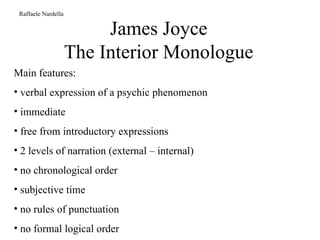
James Joyce The Interior Monologue Raffaele Nardella Main features: verbal expression of a psychic phenomenon immediate free from introductory expressions 2 levels of narration (external – internal) no chronological order subjective time no rules of punctuation no formal logical order

James Joyce

  • 1.
    James Joyce RaffaeleNardella http://arjunpuri.files.wordpress.com/2009/10/6-james-joyce.jpg
  • 2.
    James Joyce Impersonalityof the Artist Raffaele Nardella Influence from Baudelaire, Flaubert Artist’s task: Describing life objectively -> True image -> Detachment from society -> No writer’s point of view (p.o.v.) -> Different p.o.v. and narrative techniques for the characters
  • 3.
    James Joyce Impersonalityof the Artist Raffaele Nardella Style – Technique – Language realism and disciplined prose exploration of characters’ impressions and p.o.v. free direct speech and epiphany interior monologue with 2 levels of narration succession of words with no punctuation, grammar rules
  • 4.
    James Joyce Subjectiveperception of Time Raffaele Nardella modernist writer narrative more important than themes different p.o.v. simultaneously no omniscent narrator geographical and sociological details impressions and thoughts caused by an outer event opening “in media res” introspection rather than description time as subjective
  • 5.
    James Joyce Ulysses- Plot Raffaele Nardella On Thursday June 16, 1904 (18 hours) -> fist date with Nora 3 characters: Leopold Bloom: Jew adv canvasser, alienated common man, in the streets, funeral, meeting Dedalus Stephen Dedalus: alienated artist, saved from a brothel Molly Bloom: Leopold’s wife, singer, adultery
  • 6.
    James Joyce Ulysses- Odyssey Raffaele Nardella Odyssey as structural framework for “Ulysses”: Leopold as Ulysses Stephen as Telemachus Molly as Penepole “ Ulysses” in 3 parts (as in the Odyssey) – 18 episodes: Telemachiad (ch. 1-3) Odyssey (ch. 4-15) Nostos (ch. 15-18) Homeric parallels -> important structural devices in the novel Episodes -> hour, colour, organ of the body, sense, symbol
  • 7.
    James Joyce Ulysses- Setting Raffaele Nardella Climax of creativity Detailed account of ordinary life Like a play of chess Dublin as a character of the novel
  • 8.
    James Joyce Ulysses– Mythical Method Raffaele Nardella Prose based on mythical method: Psychology Ethnology Anthropology Parallel with the Odyssey: symbolic meaning - another dimension - universal in the particular Modern epic in prose -> a new form of realism
  • 9.
    James Joyce Ulysses– Human Nature Raffaele Nardella Leopold, Molly, Stephen -> 2 aspects of human nature Stephen : intellect, young looking for maturity Molly : flesh, sensual nature, fecundity Leopold : everybody, uniting the extremes Moral Theme (quest/journey) -> human life: Suffering Struggling to rise Looking for good
  • 10.
    James Joyce Ulysses– Prose Raffaele Nardella Revolutionary Prose -> several methods for lots of matters: Stream of consciousness Cinematic technique Question and answer Dramatic dialogue Juxtaposition of events -> collage technique (cubist artists – a scene from all perspectives) Interior monologue -> 2 levels of narrration: External to character’s mind Internal to character’s mind Language: puns, images, contrasts, paradoxes, false clues, symbols, slang, nicknames, slogans, foreign words, literary quotations
  • 11.
    James Joyce TheInterior Monologue Raffaele Nardella William James -> stream of consciousness – inner process Introspection in the 18th century novels (Defoe) 20th century fiction -> subjective consciousness – difficulty to reproduce the human mind through traditional techniques – interior monologue to represent the unspoken activity of the mind Interior Monologue: verbal expression of a psychic phenomenon Stream of consciousness: psychic phenomenon
  • 12.
    James Joyce TheInterior Monologue Raffaele Nardella Main features: verbal expression of a psychic phenomenon immediate free from introductory expressions 2 levels of narration (external – internal) no chronological order subjective time no rules of punctuation no formal logical order