Electron
Arrangement
Unit 4
4.1 Electromagnetic
Radiation
I will be able to…
• Define electromagnetic
radiation, wavelength,
frequency, electromagnetic
spectrum, and photon.
• Solve wave speed problems.
• Identify the seven types of
electromagnetic radiation.
• Explain the duality of light.
4.1 Electromagnetic Radiation
•Electromagnetic Radiation – energy
that exhibits wavelike qualities and
travels through space at the speed of
light.
4.1 Electromagnetic Radiation
•Wavelength – the distance between two
consecutive peaks/crests or troughs in a wave.
• Unit = m
•Frequency – the number of waves (cycles) per
second that pass a given point in space.
• Unit = 1/s = hertz = Hz
4.1 Electromagnetic Radiation
•The speed of electromagnetic waves is
the speed of light.
• Speed of light = c = 300,000,000 m/s.
4.1 Electromagnetic Radiation
Measurement Symbol Unit
speed 𝑣 m/s
frequency 𝑓 1/s = Hertz = Hz
wavelength  m
4.1 Electromagnetic Radiation
EXAMPLES
•A wave along a guitar string has a
frequency of 100.0 Hz and a wavelength
of 0.05 meters. Calculate the speed of
the wave.
4.1 Electromagnetic Radiation
EXAMPLES
•The speed of sound in air is about 340
m/s. What is the wavelength of sound
waves produced by a guitar string
vibrating at 550 Hz?
4.1 Electromagnetic Radiation
EXAMPLES
•The speed of light is 2.998 x 10⁸ m/s.
What is the frequency of microwaves
with a wavelength of 0.0100 meters?
4.1 Electromagnetic Radiation
•Electromagnetic Spectrum – all of the
frequencies or wavelengths of
electromagnetic radiation.
4.1 Electromagnetic Radiation
• Electromagnetic Spectrum
• Radio Waves
• Microwaves
• Infrared Rays
• Visible Light
• Ultraviolet Rays
• X-Rays
• Gamma Rays
4.1 Electromagnetic Radiation
4.1 Electromagnetic
Radiation
• Light (EM radiation) acts as
both a wave and a particle.
• Duality of Light
• Wave
• Travels through space and
carries energy like a wave.
• Particle
• When it interacts with
matter it behaves like a
stream of tiny particles of
energy.
4.1 Electromagnetic Radiation
•Photons – a particle/packet of
electromagnetic radiation.
• High frequency waves = high energy photons
• Low frequency waves = low energy photons
4.1 Assignments
•4.1 Electromagnetic Radiation WS
•Wave Calculations WS
•Wave WS A
•EM Spectrum and Visible Light WS
•EM Spectrum Project
4.1 Electromagnetic Radiation
4.2 Atoms and Energy
I will be able to…
• Define excited state, ground
state, quantized energy
levels, emission line
spectrum, and spectroscope.
• Describe how photons are
emitted from excited atoms.
4.2 Atoms and Energy
•When atoms receive energy, they become
excited and move to an excited state.
•Excited State – a state in which an atom
has more energy than it does in its ground
state.
4.2 Atoms and Energy
•When excited atoms lose energy, they
release energy and go to a lower energy
state.
• The energy is released as a photon.
•Ground State – the lowest energy state.
4.2 Atoms and Energy
• Energy Gained (Excited) = Energy Release (Photon)
4.2 Atoms and Energy
•Every time a hydrogen atom gets excited
and releases a photon the same things
happens.
• One of the following photons, with a
wavelength in the visible spectrum, is
released.
4.2 Atoms and Energy
•Quantized Energy Levels – energy levels
where only certain values are allowed.
4.2 Atoms and Energy
•Line Emission Spectrum – spectrum of
colors emitted when an excited atom
releases energy/photons.
4.2 Atoms and Energy
•Spectroscope – A device that splits light
into a spectrum.
• Can be used to determine what distant
stars are made of.
4.2 Atoms and Energy
4.2 Assignments
•4.2 Atoms and Energy WS
•Bunsen Burner WS
•Flame Test LAB
•Spectrum Tube LAB
•Star Emission Spectrum WS
4.3 Atomic Orbitals
I will be able to…
• Define principle energy levels
and sublevels.
• Identify where the s-block, p-
block, d-block, and f-block
are located on the periodic
table.
• Explain the Pauli exclusion
principle.
4.3 Atomic Orbitals
•Principle Energy Levels – distinct energy
levels where electrons can be found.
• Principle Energy Level = Quantum Number
•Sublevels – a subdivision of the principle
energy levels.
4.3 Atomic Orbitals
4.3 Atomic Orbitals
4.3 Atomic Orbitals
•Orbitals are regions of
the atom where
electrons are most
likely found.
•Sublevels
Sublevel Number of Orbitals Maximum Number of Electrons
s 1 2
p 3 6
d 5 10
f 7 14
4.3 Atomic Orbitals
•More Energy = Larger Orbitals
4.3 Atomic Orbitals
•Pauli Exclusion Principle
• Each orbital can hold a maximum of two
electrons.
• If an atom has an odd number of electrons one
orbital may contain only one electron.
• Each electron must also have opposite
spins.
• One spins up
• One spins down
4.3 Atomic Orbitals
4.3 Assignments
•4.3 Atomic Orbitals WS
4.4 Electron
Arrangements
I will be able to…
• Define electron configuration,
valence electrons, and core
electrons.
• Determine the electron
configuration, orbital diagram,
and noble gas notations for
given elements.
• Explain Hund’s rule and the
Aufbau principle.
• Differentiate between valence
electrons and core electrons.
4.4 Electron Arrangements
•Electron Configuration – the
arrangement of electrons in an atom.
4.4 Electron Arrangements
• 1 =
• 2 =
• 3 =
• 5 =
EXAMPLES
Electron Configuration Notation
• 8 =
• 13 =
• 16 =
• 18 =
4.4 Electron Arrangements
• 1 =
• 2 =
• 3 =
• 5 =
EXAMPLES
Orbital Diagram/Box Diagram Notation
• 8 =
• 13 =
• 16 =
• 18 =
4.4 Electron Arrangements
•Hund’s Rule
• each orbital in a
sublevel is filled with
one electron before a
second electron can be
added to an orbital.
• Electrons do not want
to “share rooms”
(orbital) if they do not
have to.
4.4 Electron Arrangements
•Aufbau Principle
• Lowest energy levels get filled first.
• Rooms on the lowest “floors” (orbitals)
get filled first.
4.4 Electron Arrangements
• 1 =
• 2 =
• 3 =
• 5 =
EXAMPLES
Noble Gas Notation
• 8 =
• 13 =
• 16 =
• 18 =
4.4 Electron Arrangements
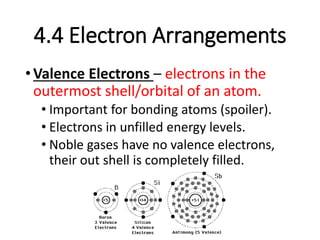
•Valence Electrons – electrons in the
outermost shell/orbital of an atom.
• Important for bonding atoms (spoiler).
• Electrons in unfilled energy levels.
• Noble gases have no valence electrons,
their out shell is completely filled.
4.4 Electron Arrangements
•Core Electrons – an inner electron in an
atom; not located in the outer shell/orbital.
• Electrons in filled energy levels.
4.4 Electron Arrangements
4.4 Assignments
• 4.4 Electron Arrangements WS
• Electron Configurations and Orbital
Notations WS
• Electron Configuration, Orbital and
Noble Gas Notations WS
• Periodic Table and Electron
Configurations WS
Unit 4: Electron Arrangement
Unit 4 Test Review ASSIGNMENT
•Unit 4 Test Review WS

Unit 4 - Electron Arrangement (2017/2018)

  • 1.
  • 2.
    4.1 Electromagnetic Radiation I willbe able to… • Define electromagnetic radiation, wavelength, frequency, electromagnetic spectrum, and photon. • Solve wave speed problems. • Identify the seven types of electromagnetic radiation. • Explain the duality of light.
  • 3.
    4.1 Electromagnetic Radiation •ElectromagneticRadiation – energy that exhibits wavelike qualities and travels through space at the speed of light.
  • 4.
    4.1 Electromagnetic Radiation •Wavelength– the distance between two consecutive peaks/crests or troughs in a wave. • Unit = m •Frequency – the number of waves (cycles) per second that pass a given point in space. • Unit = 1/s = hertz = Hz
  • 5.
    4.1 Electromagnetic Radiation •Thespeed of electromagnetic waves is the speed of light. • Speed of light = c = 300,000,000 m/s.
  • 6.
    4.1 Electromagnetic Radiation MeasurementSymbol Unit speed 𝑣 m/s frequency 𝑓 1/s = Hertz = Hz wavelength  m
  • 7.
    4.1 Electromagnetic Radiation EXAMPLES •Awave along a guitar string has a frequency of 100.0 Hz and a wavelength of 0.05 meters. Calculate the speed of the wave.
  • 8.
    4.1 Electromagnetic Radiation EXAMPLES •Thespeed of sound in air is about 340 m/s. What is the wavelength of sound waves produced by a guitar string vibrating at 550 Hz?
  • 9.
    4.1 Electromagnetic Radiation EXAMPLES •Thespeed of light is 2.998 x 10⁸ m/s. What is the frequency of microwaves with a wavelength of 0.0100 meters?
  • 10.
    4.1 Electromagnetic Radiation •ElectromagneticSpectrum – all of the frequencies or wavelengths of electromagnetic radiation.
  • 11.
  • 12.
    4.1 Electromagnetic Radiation •Electromagnetic Spectrum • Radio Waves • Microwaves • Infrared Rays • Visible Light • Ultraviolet Rays • X-Rays • Gamma Rays
  • 13.
  • 14.
    4.1 Electromagnetic Radiation • Light(EM radiation) acts as both a wave and a particle. • Duality of Light • Wave • Travels through space and carries energy like a wave. • Particle • When it interacts with matter it behaves like a stream of tiny particles of energy.
  • 15.
    4.1 Electromagnetic Radiation •Photons– a particle/packet of electromagnetic radiation. • High frequency waves = high energy photons • Low frequency waves = low energy photons
  • 16.
    4.1 Assignments •4.1 ElectromagneticRadiation WS •Wave Calculations WS •Wave WS A •EM Spectrum and Visible Light WS •EM Spectrum Project 4.1 Electromagnetic Radiation
  • 17.
    4.2 Atoms andEnergy I will be able to… • Define excited state, ground state, quantized energy levels, emission line spectrum, and spectroscope. • Describe how photons are emitted from excited atoms.
  • 18.
    4.2 Atoms andEnergy •When atoms receive energy, they become excited and move to an excited state. •Excited State – a state in which an atom has more energy than it does in its ground state.
  • 19.
    4.2 Atoms andEnergy •When excited atoms lose energy, they release energy and go to a lower energy state. • The energy is released as a photon. •Ground State – the lowest energy state.
  • 20.
  • 21.
  • 22.
  • 23.
    4.2 Atoms andEnergy • Energy Gained (Excited) = Energy Release (Photon)
  • 24.
  • 25.
    4.2 Atoms andEnergy •Every time a hydrogen atom gets excited and releases a photon the same things happens. • One of the following photons, with a wavelength in the visible spectrum, is released.
  • 26.
    4.2 Atoms andEnergy •Quantized Energy Levels – energy levels where only certain values are allowed.
  • 27.
    4.2 Atoms andEnergy •Line Emission Spectrum – spectrum of colors emitted when an excited atom releases energy/photons.
  • 28.
  • 29.
    4.2 Atoms andEnergy •Spectroscope – A device that splits light into a spectrum. • Can be used to determine what distant stars are made of.
  • 30.
    4.2 Atoms andEnergy 4.2 Assignments •4.2 Atoms and Energy WS •Bunsen Burner WS •Flame Test LAB •Spectrum Tube LAB •Star Emission Spectrum WS
  • 31.
    4.3 Atomic Orbitals Iwill be able to… • Define principle energy levels and sublevels. • Identify where the s-block, p- block, d-block, and f-block are located on the periodic table. • Explain the Pauli exclusion principle.
  • 32.
    4.3 Atomic Orbitals •PrincipleEnergy Levels – distinct energy levels where electrons can be found. • Principle Energy Level = Quantum Number •Sublevels – a subdivision of the principle energy levels.
  • 33.
  • 34.
  • 35.
    4.3 Atomic Orbitals •Orbitalsare regions of the atom where electrons are most likely found. •Sublevels Sublevel Number of Orbitals Maximum Number of Electrons s 1 2 p 3 6 d 5 10 f 7 14
  • 36.
    4.3 Atomic Orbitals •MoreEnergy = Larger Orbitals
  • 37.
    4.3 Atomic Orbitals •PauliExclusion Principle • Each orbital can hold a maximum of two electrons. • If an atom has an odd number of electrons one orbital may contain only one electron. • Each electron must also have opposite spins. • One spins up • One spins down
  • 38.
    4.3 Atomic Orbitals 4.3Assignments •4.3 Atomic Orbitals WS
  • 39.
    4.4 Electron Arrangements I willbe able to… • Define electron configuration, valence electrons, and core electrons. • Determine the electron configuration, orbital diagram, and noble gas notations for given elements. • Explain Hund’s rule and the Aufbau principle. • Differentiate between valence electrons and core electrons.
  • 40.
    4.4 Electron Arrangements •ElectronConfiguration – the arrangement of electrons in an atom.
  • 41.
    4.4 Electron Arrangements •1 = • 2 = • 3 = • 5 = EXAMPLES Electron Configuration Notation • 8 = • 13 = • 16 = • 18 =
  • 42.
    4.4 Electron Arrangements •1 = • 2 = • 3 = • 5 = EXAMPLES Orbital Diagram/Box Diagram Notation • 8 = • 13 = • 16 = • 18 =
  • 43.
    4.4 Electron Arrangements •Hund’sRule • each orbital in a sublevel is filled with one electron before a second electron can be added to an orbital. • Electrons do not want to “share rooms” (orbital) if they do not have to.
  • 44.
    4.4 Electron Arrangements •AufbauPrinciple • Lowest energy levels get filled first. • Rooms on the lowest “floors” (orbitals) get filled first.
  • 45.
  • 46.
    4.4 Electron Arrangements •1 = • 2 = • 3 = • 5 = EXAMPLES Noble Gas Notation • 8 = • 13 = • 16 = • 18 =
  • 47.
    4.4 Electron Arrangements •ValenceElectrons – electrons in the outermost shell/orbital of an atom. • Important for bonding atoms (spoiler). • Electrons in unfilled energy levels. • Noble gases have no valence electrons, their out shell is completely filled.
  • 48.
    4.4 Electron Arrangements •CoreElectrons – an inner electron in an atom; not located in the outer shell/orbital. • Electrons in filled energy levels.
  • 49.
  • 50.
    4.4 Electron Arrangements 4.4Assignments • 4.4 Electron Arrangements WS • Electron Configurations and Orbital Notations WS • Electron Configuration, Orbital and Noble Gas Notations WS • Periodic Table and Electron Configurations WS
  • 51.
    Unit 4: ElectronArrangement Unit 4 Test Review ASSIGNMENT •Unit 4 Test Review WS

Editor's Notes