Atomic structure
D.M K.M S.H Z.M I.S
Contents
Introduction: Learning Objectives
What is an Atom?
2
What is an element?
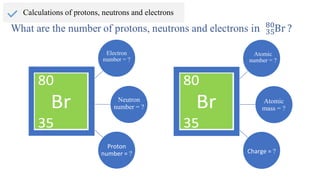
Calculations of protons, neutrons and electrons
Charge of ions
Examples and questions.
Introduction: Learning Objectives
2. Define atomic number and atomic mass
3. Calculate the number of protons, neutrons and
electrons
4. Deduce the charge of ions
1. Describe structure of an atom
What is an Atom?
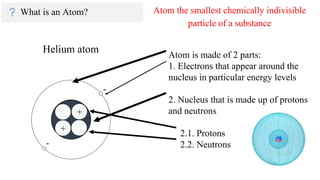
Atom is made of 2 parts:
1. Electrons that appear around the
nucleus in particular energy levels
2. Nucleus that is made up of protons
and neutrons
2.1. Protons
2.2. Neutrons
Helium atom
-
-
+
+
Atom the smallest chemically indivisible
particle of a substance
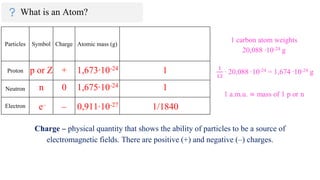
What is an Atom?
Particles Symbol Charge Atomic mass (g)
Proton
Neutron
Electron
p or Z
n
e–
1
0
–
1
1/1840
+ 1,673∙10-24
1,675∙10-24
0,911∙10-27
1 carbon atom weights
20,088 ∙10-24 g
Charge – physical quantity that shows the ability of particles to be a source of
electromagnetic fields. There are positive (+) and negative (–) charges.
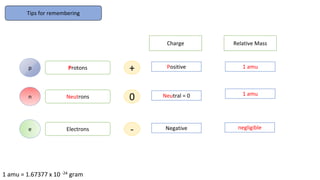
Tips for remembering
p Protons + Positive
n Neutrons 0 Neutral = 0
e Electrons - Negative
Relative Mass
1 amu
1 amu
negligible
1 amu = 1.67377 x 10 -24 gram
Charge
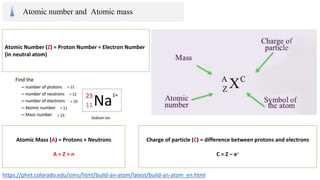
Atomic Number (Z) = Proton Number = Electron Number
(in neutral atom)
Atomic Mass (A) = Protons + Neutrons
A = Z + n
https://phet.colorado.edu/sims/html/build-an-atom/latest/build-an-atom_en.html
Atomic number and Atomic mass
Charge of particle (C) = difference between protons and electrons
C = Z – e–
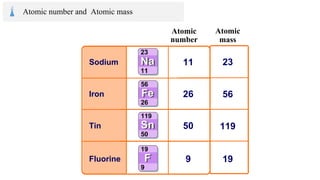
Atomic
number
Atomic
mass
11
26
50
9
Tin
Iron
Sodium
Fluorine
23
56
119
19
Atomic number and Atomic mass
Calculations of protons, neutrons and electrons
Electron
number = ?
Neutron
number = ?
Proton
number = ?
Atomic
number = ?
Atomic
mass = ?
Charge = ?
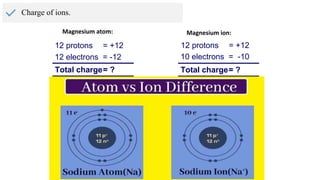
Charge of ions.
12 protons = +12
10 electrons = -10
Total charge= ?
+2
Magnesium ion:
Mg
12 protons = +12
12 electrons = -12
Total charge= ?
0
Mg
Magnesium atom:
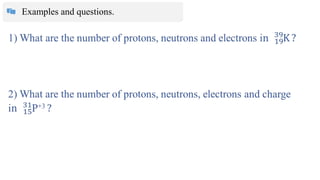
Examples and questions.
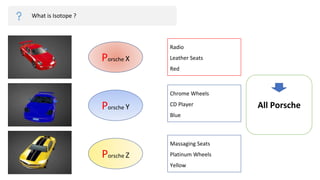
What is Isotope ?
Porsche X
Porsche Y
Porsche Z
Radio
Leather Seats
Red
Chrome Wheels
CD Player
Blue
Massaging Seats
Platinum Wheels
Yellow
All Porsche
Examples of Isotopes
+
0
+
+
+
+ +
0
0
0
0
0
-
-
-
-
-
-
ı
ıı
+ Proton Neutron
0 Electron (s)
- Electron (p)
-
Examples of Isotopes
+
0
+
+
+
+ +
0
0
0
0
0
-
-
-
-
-
-
ı
ıı
+ Proton Neutron
0 Electron (s)
- Electron (p)
-
0
Examples of Isotopes
+
0
+
+
+
+ +
0
0
0
0
0
-
-
-
-
-
-
ı
ıı
+ Proton Neutron
0 Electron (s)
- Electron (p)
-
0
0
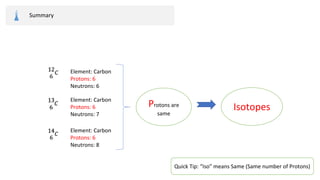
Summary
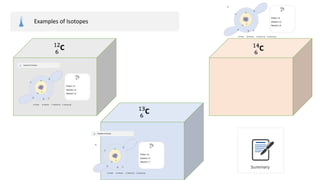
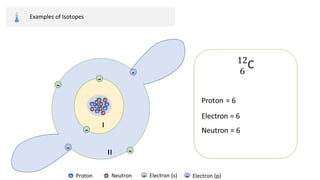
Element: Carbon
Protons: 6
Neutrons: 6
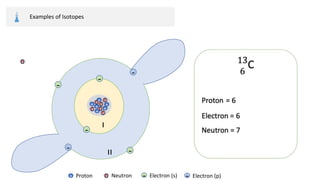
Element: Carbon
Protons: 6
Neutrons: 7
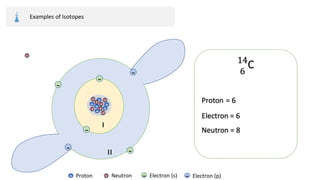
Element: Carbon
Protons: 6
Neutrons: 8
Protons are
same
Isotopes
Quick Tip: “Iso” means Same (Same number of Protons)
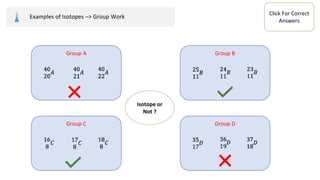
Examples of Isotopes –> Group Work
Click For Correct
Answers
Isotope or
Not ?
Group B
Group A
Group D
Group C
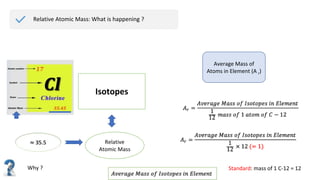
Relative Atomic Mass: What is happening ?
Why ?
Isotopes
Relative
Atomic Mass
Average Mass of
Atoms in Element (A r)
Standard: mass of 1 C-12 = 12
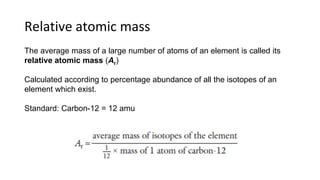
Relative atomic mass
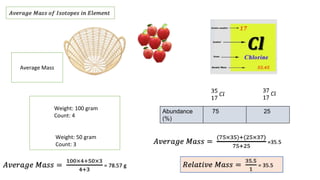
The average mass of a large number of atoms of an element is called its
relative atomic mass (Ar)
Calculated according to percentage abundance of all the isotopes of an
element which exist.
Standard: Carbon-12 = 12 amu
Average Mass
Weight: 100 gram
Count: 4
Weight: 50 gram
Count: 3
Abundance
(%)
75 25
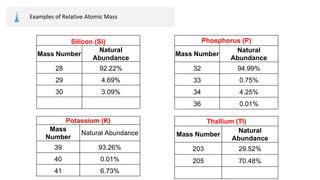
Examples of Relative Atomic Mass
Silicon (Si)
Mass Number
Natural
Abundance
28 92.22%
29 4.69%
30 3.09%
Phosphorus (P)
Mass Number
Natural
Abundance
32 94.99%
33 0.75%
34 4.25%
36 0.01%
Potassium (K)
Mass
Number
Natural Abundance
39 93.26%
40 0.01%
41 6.73%
Thallium (Tl)
Mass Number
Natural
Abundance
203 29.52%
205 70.48%
THANK YOU
Real atom: https://www.popularmechanics.com/science/a17804899/here-is-a-photo-of-a-single-atom/
References:

Atomic structure.KM

  • 1.
  • 2.
    Contents Introduction: Learning Objectives Whatis an Atom? 2 What is an element? Calculations of protons, neutrons and electrons Charge of ions Examples and questions.
  • 3.
    Introduction: Learning Objectives 2.Define atomic number and atomic mass 3. Calculate the number of protons, neutrons and electrons 4. Deduce the charge of ions 1. Describe structure of an atom
  • 4.
    What is anAtom? Atom is made of 2 parts: 1. Electrons that appear around the nucleus in particular energy levels 2. Nucleus that is made up of protons and neutrons 2.1. Protons 2.2. Neutrons Helium atom - - + + Atom the smallest chemically indivisible particle of a substance
  • 5.
    What is anAtom? Particles Symbol Charge Atomic mass (g) Proton Neutron Electron p or Z n e– 1 0 – 1 1/1840 + 1,673∙10-24 1,675∙10-24 0,911∙10-27 1 carbon atom weights 20,088 ∙10-24 g Charge – physical quantity that shows the ability of particles to be a source of electromagnetic fields. There are positive (+) and negative (–) charges.
  • 6.
    Tips for remembering pProtons + Positive n Neutrons 0 Neutral = 0 e Electrons - Negative Relative Mass 1 amu 1 amu negligible 1 amu = 1.67377 x 10 -24 gram Charge
  • 7.
    Atomic Number (Z)= Proton Number = Electron Number (in neutral atom) Atomic Mass (A) = Protons + Neutrons A = Z + n https://phet.colorado.edu/sims/html/build-an-atom/latest/build-an-atom_en.html Atomic number and Atomic mass Charge of particle (C) = difference between protons and electrons C = Z – e–
  • 8.
  • 9.
    Calculations of protons,neutrons and electrons Electron number = ? Neutron number = ? Proton number = ? Atomic number = ? Atomic mass = ? Charge = ?
  • 10.
    Charge of ions. 12protons = +12 10 electrons = -10 Total charge= ? +2 Magnesium ion: Mg 12 protons = +12 12 electrons = -12 Total charge= ? 0 Mg Magnesium atom:
  • 11.
  • 12.
    What is Isotope? Porsche X Porsche Y Porsche Z Radio Leather Seats Red Chrome Wheels CD Player Blue Massaging Seats Platinum Wheels Yellow All Porsche
  • 13.
  • 14.
    Examples of Isotopes + 0 + + + ++ 0 0 0 0 0 - - - - - - ı ıı + Proton Neutron 0 Electron (s) - Electron (p) -
  • 15.
    Examples of Isotopes + 0 + + + ++ 0 0 0 0 0 - - - - - - ı ıı + Proton Neutron 0 Electron (s) - Electron (p) - 0
  • 16.
    Examples of Isotopes + 0 + + + ++ 0 0 0 0 0 - - - - - - ı ıı + Proton Neutron 0 Electron (s) - Electron (p) - 0 0
  • 17.
    Summary Element: Carbon Protons: 6 Neutrons:6 Element: Carbon Protons: 6 Neutrons: 7 Element: Carbon Protons: 6 Neutrons: 8 Protons are same Isotopes Quick Tip: “Iso” means Same (Same number of Protons)
  • 18.
    Examples of Isotopes–> Group Work Click For Correct Answers Isotope or Not ? Group B Group A Group D Group C
  • 19.
    Relative Atomic Mass:What is happening ? Why ? Isotopes Relative Atomic Mass Average Mass of Atoms in Element (A r) Standard: mass of 1 C-12 = 12
  • 20.
    Relative atomic mass Theaverage mass of a large number of atoms of an element is called its relative atomic mass (Ar) Calculated according to percentage abundance of all the isotopes of an element which exist. Standard: Carbon-12 = 12 amu
  • 21.
    Average Mass Weight: 100gram Count: 4 Weight: 50 gram Count: 3 Abundance (%) 75 25
  • 22.
    Examples of RelativeAtomic Mass Silicon (Si) Mass Number Natural Abundance 28 92.22% 29 4.69% 30 3.09% Phosphorus (P) Mass Number Natural Abundance 32 94.99% 33 0.75% 34 4.25% 36 0.01% Potassium (K) Mass Number Natural Abundance 39 93.26% 40 0.01% 41 6.73% Thallium (Tl) Mass Number Natural Abundance 203 29.52% 205 70.48%
  • 23.
  • 24.