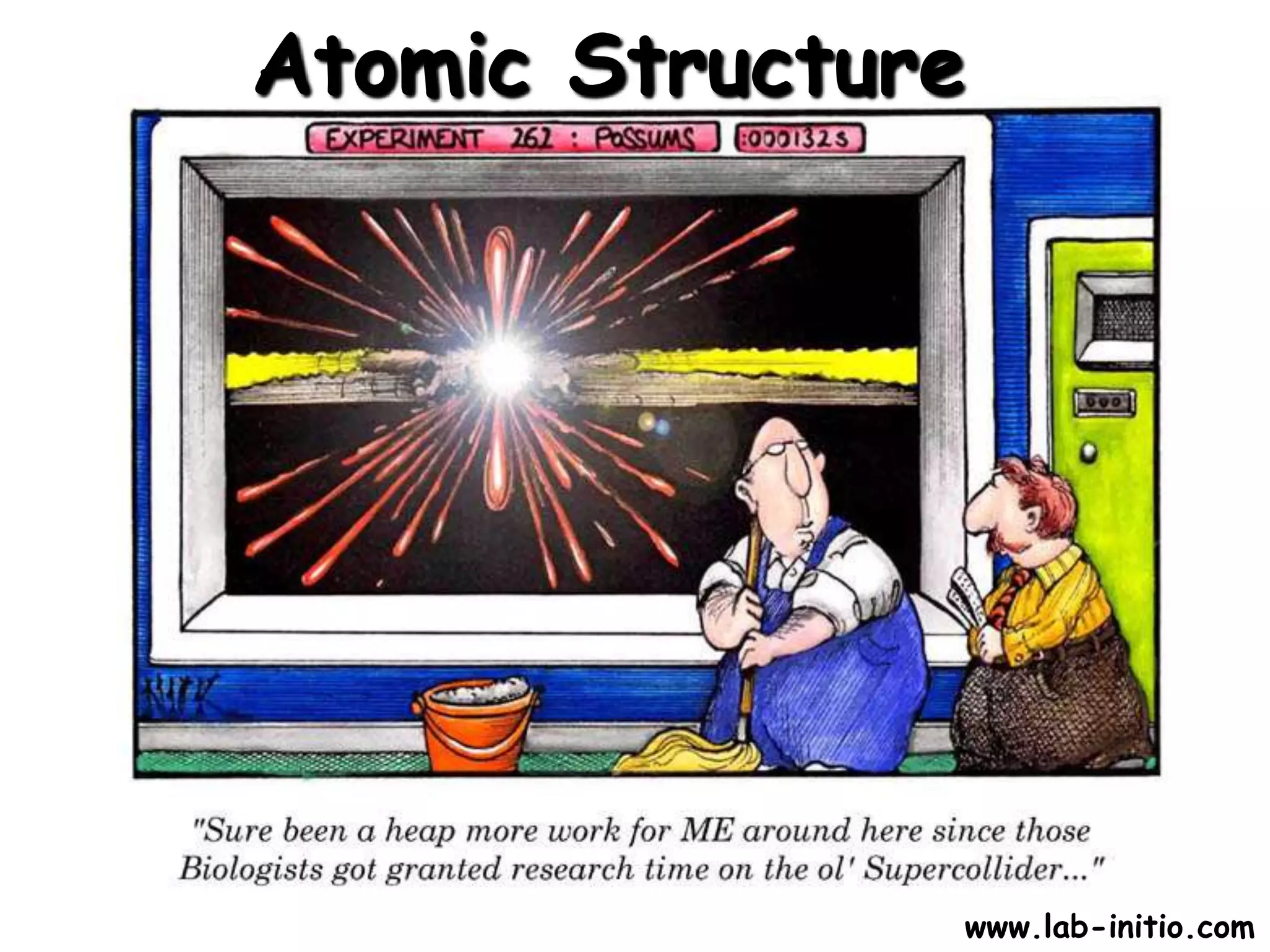
Atomic Structure


               www.lab-initio.com
CA Standards
Students know how to relate the position of
an element in the periodic table to its
atomic number and atomic mass.

Students know the nucleus of the atom is
much smaller than the atom yet contains
most of its mass.
Modern Atomic Theory
 All matter is composed of atoms
 Atoms cannot be subdivided, created, or
destroyed in ordinary chemical reactions.
However, these changes CAN occur in
nuclear reactions!
Atoms of an element have a characteristic
average mass which is unique to that
element.
Atoms of any one element differ in
properties from atoms of another element
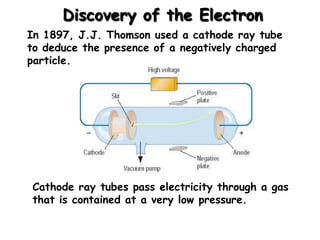
Discovery of the Electron
In 1897, J.J. Thomson used a cathode ray tube
to deduce the presence of a negatively charged
particle.


Cathode ray tubes pass electricity through a gas
that is contained at a very low pressure.
Conclusions from the
         Study of the Electron
 Cathode rays have identical properties
regardless of the element used to produce
them. All elements must contain identically
charged electrons.

Atoms are neutral, so there must be
positive particles in the atom to balance the
negative charge of the electrons

 Electrons have so little mass that atoms
must contain other particles that account
for most of the mass
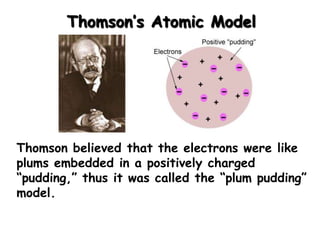
Thomson’s Atomic Model


Thomson believed that the electrons were like
plums embedded in a positively charged
“pudding,” thus it was called the “plum pudding”
model.
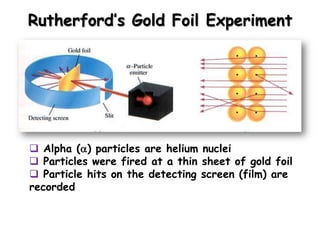
Rutherford’s Gold Foil Experiment


 Alpha () particles are helium nuclei
 Particles were fired at a thin sheet of gold foil
 Particle hits on the detecting screen (film) are
recorded
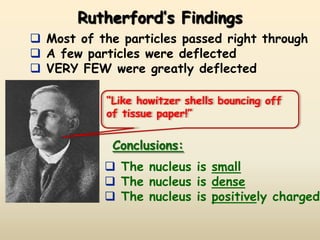
Rutherford’s Findings
 Most of the particles passed right through
 A few particles were deflected
 VERY FEW were greatly deflected

            “Like howitzer shells bouncing off
            of tissue paper!”


             Conclusions:
            The nucleus is small
            The nucleus is dense
            The nucleus is positively charged
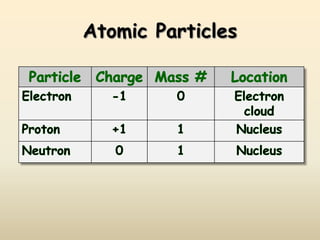
Atomic Particles
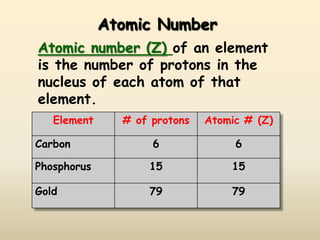
Atomic Number
Atomic number (Z) of an element
is the number of protons in the
nucleus of each atom of that
element.
   Element     # of protons   Atomic # (Z)

Carbon              6              6

Phosphorus         15             15

Gold               79             79
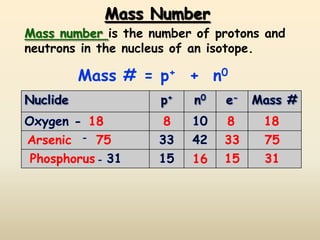
Mass Number
Mass number is the number of protons and
neutrons in the nucleus of an isotope.

          Mass # = p+ + n0

           18         8        8    18
Arsenic      75                33   75
Phosphorus                16   15   31
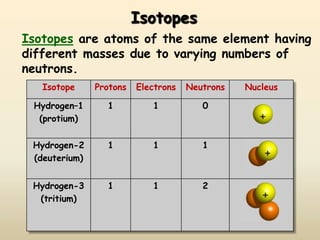
Isotopes
Isotopes are atoms of the same element having
different masses due to varying numbers of
neutrons.
   Isotope     Protons   Electrons   Neutrons   Nucleus

 Hydrogen–1      1          1           0
  (protium)

 Hydrogen-2      1          1           1
 (deuterium)


 Hydrogen-3      1          1           2
  (tritium)
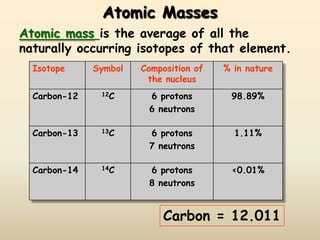
Atomic Masses
Atomic mass is the average of all the
naturally occurring isotopes of that element.
  Isotope     Symbol   Composition of   % in nature
                        the nucleus
  Carbon-12    12C      6 protons        98.89%
                        6 neutrons

  Carbon-13    13C      6 protons         1.11%
                        7 neutrons

  Carbon-14    14C      6 protons        <0.01%
                        8 neutrons


                            Carbon = 12.011

Atomic structure

  • 1.
    Atomic Structure www.lab-initio.com
  • 2.
    CA Standards Students knowhow to relate the position of an element in the periodic table to its atomic number and atomic mass. Students know the nucleus of the atom is much smaller than the atom yet contains most of its mass.
  • 3.
    Modern Atomic Theory All matter is composed of atoms  Atoms cannot be subdivided, created, or destroyed in ordinary chemical reactions. However, these changes CAN occur in nuclear reactions! Atoms of an element have a characteristic average mass which is unique to that element. Atoms of any one element differ in properties from atoms of another element
  • 4.
    Discovery of theElectron In 1897, J.J. Thomson used a cathode ray tube to deduce the presence of a negatively charged particle. Cathode ray tubes pass electricity through a gas that is contained at a very low pressure.
  • 5.
    Conclusions from the Study of the Electron  Cathode rays have identical properties regardless of the element used to produce them. All elements must contain identically charged electrons. Atoms are neutral, so there must be positive particles in the atom to balance the negative charge of the electrons  Electrons have so little mass that atoms must contain other particles that account for most of the mass
  • 6.
    Thomson’s Atomic Model Thomsonbelieved that the electrons were like plums embedded in a positively charged “pudding,” thus it was called the “plum pudding” model.
  • 7.
    Rutherford’s Gold FoilExperiment  Alpha () particles are helium nuclei  Particles were fired at a thin sheet of gold foil  Particle hits on the detecting screen (film) are recorded
  • 8.
    Rutherford’s Findings  Mostof the particles passed right through  A few particles were deflected  VERY FEW were greatly deflected “Like howitzer shells bouncing off of tissue paper!” Conclusions:  The nucleus is small  The nucleus is dense  The nucleus is positively charged
  • 9.
  • 10.
    Atomic Number Atomic number(Z) of an element is the number of protons in the nucleus of each atom of that element. Element # of protons Atomic # (Z) Carbon 6 6 Phosphorus 15 15 Gold 79 79
  • 11.
    Mass Number Mass numberis the number of protons and neutrons in the nucleus of an isotope. Mass # = p+ + n0 18 8 8 18 Arsenic 75 33 75 Phosphorus 16 15 31
  • 12.
    Isotopes Isotopes are atomsof the same element having different masses due to varying numbers of neutrons. Isotope Protons Electrons Neutrons Nucleus Hydrogen–1 1 1 0 (protium) Hydrogen-2 1 1 1 (deuterium) Hydrogen-3 1 1 2 (tritium)
  • 13.
    Atomic Masses Atomic massis the average of all the naturally occurring isotopes of that element. Isotope Symbol Composition of % in nature the nucleus Carbon-12 12C 6 protons 98.89% 6 neutrons Carbon-13 13C 6 protons 1.11% 7 neutrons Carbon-14 14C 6 protons <0.01% 8 neutrons Carbon = 12.011