“IT'S NOT
THE HEAT,
IT'S THE
HUMIDIT Y!"
I M R A N K H A N B A L O C H
HAVE YOU EVER HEARD SOMEONE SAY
THAT ON A WARM, MUGGY DAY?
As you'll see soon, there's a lot of truth in that statement.
On a warm,
Muggy day
TO UNDERSTAND HUMIDITY
you first have to realize that there's water in the air all around you.
THAT'S TRUE.
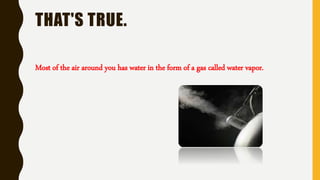
Most of the air around you has water in the form of a gas called water vapor.
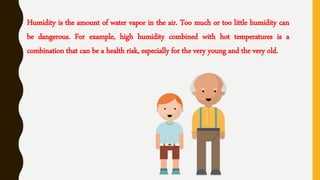
Humidity is the amount of water vapor in the air. Too much or too little humidity can
be dangerous. For example, high humidity combined with hot temperatures is a
combination that can be a health risk, especially for the very young and the very old.
• Humidity plays an important role in our daily weather
• Without water vapor in the air, our weather might be like the weather on Mars.
•Could you imagine life without
Cloud Rain Snow Thunder
ABSOLUTE HUMIDITY
AND
RELATIVE HUMIDITY.
• Absolute humidity is the amount of water vapor divided by the amount of dry air in a
certain volume of air at a particular temperature. The hotter the air is, the more water
vapor it can hold.
• Relative humidity is the ratio of the current absolute humidity to the highest possible
absolute humidity, which will depend upon the current air temperature. Relative
humidity is the term weather forecasters use most often.
A relative humidity of 100% means that the air can't hold any more water vapor. It's
totally saturated. When this occurs, it can rain. In fact, the relative humidity must be
100% where clouds are forming for it to rain. However, at ground level where the rain
lands, the relative humidity can be less than 100%.
SO HOW DOES HUMIDITY AFFECT US
ON A HOT DAY?
Humans are sensitive to changes in humidity, because our skin uses the air around us to get rid of
moisture in the form of sweat. If the relative humidity is very high, the air is already saturated with
water vapor and our sweat won't evaporate. When this happens, we feel hotter than the actual
temperature.
Likewise, very low humidity can make us feel cooler than the actual temperature. This
happens because the dry air helps sweat evaporate more quickly than usual.
If the temperature outside is 75° F, humidity can make it feel warmer or cooler. A relative humidity
of 0% would make it feel like it's only 69° F. On the other hand, a relative humidity of 100% would
make it feel like it's 80° F.
SO WHAT'S A COMFORTABLE
HUMIDITY LEVEL?
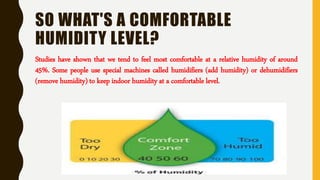
Studies have shown that we tend to feel most comfortable at a relative humidity of around
45%. Some people use special machines called humidifiers (add humidity) or dehumidifiers
(remove humidity) to keep indoor humidity at a comfortable level.

It's not the heat, it's the

  • 1.
    “IT'S NOT THE HEAT, IT'STHE HUMIDIT Y!" I M R A N K H A N B A L O C H
  • 2.
    HAVE YOU EVERHEARD SOMEONE SAY THAT ON A WARM, MUGGY DAY? As you'll see soon, there's a lot of truth in that statement. On a warm, Muggy day
  • 3.
    TO UNDERSTAND HUMIDITY youfirst have to realize that there's water in the air all around you.
  • 5.
    THAT'S TRUE. Most ofthe air around you has water in the form of a gas called water vapor.
  • 6.
    Humidity is theamount of water vapor in the air. Too much or too little humidity can be dangerous. For example, high humidity combined with hot temperatures is a combination that can be a health risk, especially for the very young and the very old.
  • 7.
    • Humidity playsan important role in our daily weather • Without water vapor in the air, our weather might be like the weather on Mars. •Could you imagine life without Cloud Rain Snow Thunder
  • 8.
  • 9.
    • Absolute humidityis the amount of water vapor divided by the amount of dry air in a certain volume of air at a particular temperature. The hotter the air is, the more water vapor it can hold.
  • 10.
    • Relative humidityis the ratio of the current absolute humidity to the highest possible absolute humidity, which will depend upon the current air temperature. Relative humidity is the term weather forecasters use most often.
  • 11.
    A relative humidityof 100% means that the air can't hold any more water vapor. It's totally saturated. When this occurs, it can rain. In fact, the relative humidity must be 100% where clouds are forming for it to rain. However, at ground level where the rain lands, the relative humidity can be less than 100%.
  • 12.
    SO HOW DOESHUMIDITY AFFECT US ON A HOT DAY? Humans are sensitive to changes in humidity, because our skin uses the air around us to get rid of moisture in the form of sweat. If the relative humidity is very high, the air is already saturated with water vapor and our sweat won't evaporate. When this happens, we feel hotter than the actual temperature. Likewise, very low humidity can make us feel cooler than the actual temperature. This happens because the dry air helps sweat evaporate more quickly than usual.
  • 13.
    If the temperatureoutside is 75° F, humidity can make it feel warmer or cooler. A relative humidity of 0% would make it feel like it's only 69° F. On the other hand, a relative humidity of 100% would make it feel like it's 80° F.
  • 14.
    SO WHAT'S ACOMFORTABLE HUMIDITY LEVEL? Studies have shown that we tend to feel most comfortable at a relative humidity of around 45%. Some people use special machines called humidifiers (add humidity) or dehumidifiers (remove humidity) to keep indoor humidity at a comfortable level.