Plant Responses To Relative Humidity Change
Group 3:
Atun, Lhilac T.
Carino, Jeomar S.
Pacoldo, Bernadeth J.
Learning Outcomes:
• Explain what is relative humidity.
• Explain the relationship between the relative humidity and
temperature.
• Determine the different physiological responses of plants to
relative humidity.
• Determine the different effects of relative humidity on plant
growth.
• Determine the three types of adaptations of plant related to
relative humidity.
What is Relative Humidity?
Humidity
• also known as “atmospheric moisture”
• amount of water vapor in the air
• an important factor of the environment for
plant growth and development
Main sources of water vapor in the
lower atmosphere:
• Evaporation
- the process in which a liquid or solid is converted into vapor.
• Transpiration
- the loss of water as vapor from plants at their surfaces,
primarily through stomata.
How do we measure humidity?
Three Types of Humidity
Absolute Humidity
• actual quantity of water
vapors (by weight) in a
given volume of air
• g of vapor/m3 of air
Specific Humidity
• weight of water vapors per
unit weight of air
• g of vapor/kg. of air
Three Types of Humidity
Relative Humidity
• the most well known as it’s the type used in weather
forecasting
• proportion of water vapors present in the air, in relation to
the maximum amount the air can hold at a particular
temperature
• in %
Relative Humidity and Temperature
Relationship
The relation between humidity and temperature formula
simply says they are inversely proportional. If temperature
increases it will lead to a decrease in relative humidity, thus the
air will become drier; whereas, when temperature decreases,
the air will become wet, which means the relative humidity will
increase (Cundiff, 2021).
Formula of Relative Humidity
𝑅𝐻 =
𝑎𝑐𝑡𝑢𝑎𝑙 𝑎𝑚𝑜𝑢𝑛𝑡 𝑜𝑓 𝑤𝑎𝑡𝑒𝑟 𝑣𝑎𝑝𝑜𝑟 𝑖𝑛 𝑡ℎ𝑒 𝑎𝑖𝑟 (
𝑔
𝑚3)
𝑚𝑎𝑥𝑖𝑚𝑢𝑚 𝑎𝑚𝑜𝑢𝑛𝑡 𝑜𝑓 𝑤𝑎𝑡𝑒𝑟 𝑣𝑎𝑝𝑜𝑟 𝑡ℎ𝑒 𝑎𝑖𝑟 𝑐𝑎𝑛 ℎ𝑜𝑙𝑑 (
𝑔
𝑚3)
× 100%
Physiological Response of Plants to
Relative Humidity
• Physiology – Branch of biology that deals with the functions
and mechanisms which work within a living system.
• Response – reaction to an event
• Physiological response of plants refers to changes in the plant
mechanism or metabolism due to the stimuli (light,
temperature, relative humidity….)
Physiological Activities of Plants:
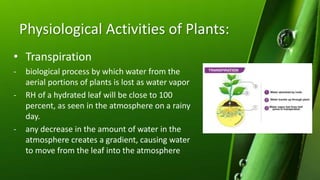
• Transpiration
- biological process by which water from the
aerial portions of plants is lost as water vapor
- RH of a hydrated leaf will be close to 100
percent, as seen in the atmosphere on a rainy
day.
- any decrease in the amount of water in the
atmosphere creates a gradient, causing water
to move from the leaf into the atmosphere
- When the RH is high, the atmosphere contains more moisture, reducing
the driving force for transpiration. Because warmer air can hold more
water, its relative humidity is less than the same air sample at a lower
temperature, or it is ‘drier air’.
Physiological Activities of Plants:
• Stomatal Regulation
- Relative humidity levels affect when and how
plants open the stomata on the undersides of
their leaves.
- Stomata - are the tiny openings present on the
epidermis of leaves.
- Plants use stomata to transpire, or “breathe.”
- Stomata close when the difference between the vapor pressure of the air
and the vapor pressure of the cells lining the substomatal chamber of the
leaf exceeds a critical level.
- When the weather is warm, a plant may close its stomata to reduce water
losses.
- When relative humidity levels are too high or there is a lack of air
circulation, a plant cannot make water evaporate or draw nutrients from
the soil.
Physiological Responses of the Plants as a
Result of Changes in Transpiration and
Stomatal Opening
• Plant Water Potential
- Shifts in plant water potential have been observed in plants growing under
different atmospheric moisture levels as a result of variations in
transpirational water loss from the plants.
- High humidity in the air pocket reduces the water potential gradient
between the leaf air spaces and the exterior, and therefore decreases the
rate of transpiration.
- As the relative humidity of the air surrounding the plant rises the
transpiration rate falls. It is easier for water to evaporate into dryer air
than into more saturated air.
• Photosynthesis
- Atmospheric moisture levels do not influence photosynthetic rates
unless vapor pressure difference levels are large and stomatal closure
has occurred.
- High relative humidity, of over 90%, decreases the photosynthesis rate
due to reduced stomata aperture.
- Under lower relative humidity conditions, the photosynthesis is apt to
decrease due to water stress induced by excess transpiration
• Nutrient Translocation
- Humidity levels have little influence upon nutrient translocation.
- Accumulation of certain nutrients in tissues, particularly in calcium and
boron, is controlled to a significant extent by transpiration rates.
• Plant Temperatures
- Moisture content of the air can alter the temperature of the plant by
transpirational cooling of the leaves.
- The effect of humidity upon leaf temperatures is more significant at
higher air temperatures.
• Moisture Condensation
- Condensation plays a part in protecting plant tissues from frost
damage.
- Condensation also can be detrimental to the plant because it
encourages the germination and penetration of infectious
microorganisms.
Effect of Relative Humidity on Plant Growth
1. High humidity enhances the growth of some saprophytic
and parasitic fungi, bacteria and pests, the growth of which
causes extensive damage to crop plants.
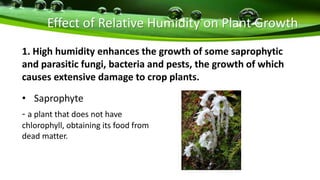
• Saprophyte
- a plant that does not have
chlorophyll, obtaining its food from
dead matter.
Effect of Relative Humidity on Plant Growth
• Parasitic Fungi
- Botrytis rots
- Downey mildews
- Anthracnose
- Fusarium rots
- Powdery mildews
Effect of Relative Humidity on Plant Growth
Anthracnose Downey mildews
Botrytis rots Fusarium rots
Effect of Relative Humidity on Plant Growth
• Plant Pest
- warm and humid conditions increase insect pest attack
Aphids Termites Roaches
Effect of Relative Humidity on Plant Growth
2. Impact on nutrient uptake
- The higher humidity will slow down transpiration and lower
humidity will speed it up. But if relative humidity is too low, or too
high, nutrient transport will slow down or stop completely.
Effect of Relative Humidity on Plant Growth
- When the RH level is low, more water is transpired and in
response stomata are closed and photosynthesis is
decreased.
- When the RH is high, the rate of transpiration is deceased.
As a result, less water taken from the soil and
photosynthesis is decreased.
3. Effect on Photosynthesis
Adaptations of Plant
Adaptation is the adjustment or changes in behavior, physiology
and structure of an organism to become more suited to an
environment.
3 types of adaptations found in organisms:
• Structural adaptation
• Physiological adaptation
• Behavioral adaptation
Adaptations of Plant
• Structural adaptation
-Adaptation to get water and nutrients
Example:
 Roots soak up water and nutrients from the soil
 Position of stomata
 Thickened cuticle
 Reduction of leaf size
 Rolling of leaves
Adaptations of Plant
• Physiological adaptation
- physiological functions are developed or modified in organisms to adapt
with environment.
Example:
 Flowers open at night when cooler
 Water-stress tolerance and water-use efficiency of plants
Adaptations of Plant
• Behavioral adaptation
- acts of organisms done naturally or by instinct
Example:
 Adaptations to get water and nutrients
- Desert flower can stay dormant for months, only coming
to life when it rains.
Conclusion:
• Humidity is an important factor of the environment for plant
growth and development.
• Relative humidity is a percentage measurement of water vapor
saturation relative to maximum saturation.
• Humidity and temperature are inversely proportional.
• Transpiration and stomatal regulation are two physiological
activities of plants that are directly regulated by humidity level.
• There are harmful effects of high and low humidity.
• It is safe to have a moderate relative humidity of above 40% for all
the crops.
THANK YOU!

GROUP 3 Relative Humidity Presentation.pptx

  • 1.
    Plant Responses ToRelative Humidity Change Group 3: Atun, Lhilac T. Carino, Jeomar S. Pacoldo, Bernadeth J.
  • 2.
    Learning Outcomes: • Explainwhat is relative humidity. • Explain the relationship between the relative humidity and temperature. • Determine the different physiological responses of plants to relative humidity. • Determine the different effects of relative humidity on plant growth. • Determine the three types of adaptations of plant related to relative humidity.
  • 3.
  • 4.
    Humidity • also knownas “atmospheric moisture” • amount of water vapor in the air • an important factor of the environment for plant growth and development
  • 5.
    Main sources ofwater vapor in the lower atmosphere: • Evaporation - the process in which a liquid or solid is converted into vapor. • Transpiration - the loss of water as vapor from plants at their surfaces, primarily through stomata.

  • 6.
    How do wemeasure humidity?
  • 7.
    Three Types ofHumidity Absolute Humidity • actual quantity of water vapors (by weight) in a given volume of air • g of vapor/m3 of air Specific Humidity • weight of water vapors per unit weight of air • g of vapor/kg. of air
  • 8.
    Three Types ofHumidity Relative Humidity • the most well known as it’s the type used in weather forecasting • proportion of water vapors present in the air, in relation to the maximum amount the air can hold at a particular temperature • in %
  • 9.
    Relative Humidity andTemperature Relationship
  • 10.
    The relation betweenhumidity and temperature formula simply says they are inversely proportional. If temperature increases it will lead to a decrease in relative humidity, thus the air will become drier; whereas, when temperature decreases, the air will become wet, which means the relative humidity will increase (Cundiff, 2021).
  • 11.
    Formula of RelativeHumidity 𝑅𝐻 = 𝑎𝑐𝑡𝑢𝑎𝑙 𝑎𝑚𝑜𝑢𝑛𝑡 𝑜𝑓 𝑤𝑎𝑡𝑒𝑟 𝑣𝑎𝑝𝑜𝑟 𝑖𝑛 𝑡ℎ𝑒 𝑎𝑖𝑟 ( 𝑔 𝑚3) 𝑚𝑎𝑥𝑖𝑚𝑢𝑚 𝑎𝑚𝑜𝑢𝑛𝑡 𝑜𝑓 𝑤𝑎𝑡𝑒𝑟 𝑣𝑎𝑝𝑜𝑟 𝑡ℎ𝑒 𝑎𝑖𝑟 𝑐𝑎𝑛 ℎ𝑜𝑙𝑑 ( 𝑔 𝑚3) × 100%
  • 12.
    Physiological Response ofPlants to Relative Humidity • Physiology – Branch of biology that deals with the functions and mechanisms which work within a living system. • Response – reaction to an event • Physiological response of plants refers to changes in the plant mechanism or metabolism due to the stimuli (light, temperature, relative humidity….)
  • 13.
    Physiological Activities ofPlants: • Transpiration - biological process by which water from the aerial portions of plants is lost as water vapor - RH of a hydrated leaf will be close to 100 percent, as seen in the atmosphere on a rainy day. - any decrease in the amount of water in the atmosphere creates a gradient, causing water to move from the leaf into the atmosphere
  • 14.
    - When theRH is high, the atmosphere contains more moisture, reducing the driving force for transpiration. Because warmer air can hold more water, its relative humidity is less than the same air sample at a lower temperature, or it is ‘drier air’.
  • 15.
    Physiological Activities ofPlants: • Stomatal Regulation - Relative humidity levels affect when and how plants open the stomata on the undersides of their leaves. - Stomata - are the tiny openings present on the epidermis of leaves. - Plants use stomata to transpire, or “breathe.”
  • 16.
    - Stomata closewhen the difference between the vapor pressure of the air and the vapor pressure of the cells lining the substomatal chamber of the leaf exceeds a critical level. - When the weather is warm, a plant may close its stomata to reduce water losses. - When relative humidity levels are too high or there is a lack of air circulation, a plant cannot make water evaporate or draw nutrients from the soil.
  • 17.
    Physiological Responses ofthe Plants as a Result of Changes in Transpiration and Stomatal Opening
  • 18.
    • Plant WaterPotential - Shifts in plant water potential have been observed in plants growing under different atmospheric moisture levels as a result of variations in transpirational water loss from the plants. - High humidity in the air pocket reduces the water potential gradient between the leaf air spaces and the exterior, and therefore decreases the rate of transpiration. - As the relative humidity of the air surrounding the plant rises the transpiration rate falls. It is easier for water to evaporate into dryer air than into more saturated air.
  • 19.
    • Photosynthesis - Atmosphericmoisture levels do not influence photosynthetic rates unless vapor pressure difference levels are large and stomatal closure has occurred. - High relative humidity, of over 90%, decreases the photosynthesis rate due to reduced stomata aperture. - Under lower relative humidity conditions, the photosynthesis is apt to decrease due to water stress induced by excess transpiration
  • 20.
    • Nutrient Translocation -Humidity levels have little influence upon nutrient translocation. - Accumulation of certain nutrients in tissues, particularly in calcium and boron, is controlled to a significant extent by transpiration rates.
  • 21.
    • Plant Temperatures -Moisture content of the air can alter the temperature of the plant by transpirational cooling of the leaves. - The effect of humidity upon leaf temperatures is more significant at higher air temperatures.
  • 22.
    • Moisture Condensation -Condensation plays a part in protecting plant tissues from frost damage. - Condensation also can be detrimental to the plant because it encourages the germination and penetration of infectious microorganisms.
  • 23.
    Effect of RelativeHumidity on Plant Growth 1. High humidity enhances the growth of some saprophytic and parasitic fungi, bacteria and pests, the growth of which causes extensive damage to crop plants. • Saprophyte - a plant that does not have chlorophyll, obtaining its food from dead matter.
  • 24.
    Effect of RelativeHumidity on Plant Growth • Parasitic Fungi - Botrytis rots - Downey mildews - Anthracnose - Fusarium rots - Powdery mildews
  • 25.
    Effect of RelativeHumidity on Plant Growth Anthracnose Downey mildews Botrytis rots Fusarium rots
  • 26.
    Effect of RelativeHumidity on Plant Growth • Plant Pest - warm and humid conditions increase insect pest attack Aphids Termites Roaches
  • 27.
    Effect of RelativeHumidity on Plant Growth 2. Impact on nutrient uptake - The higher humidity will slow down transpiration and lower humidity will speed it up. But if relative humidity is too low, or too high, nutrient transport will slow down or stop completely.
  • 28.
    Effect of RelativeHumidity on Plant Growth - When the RH level is low, more water is transpired and in response stomata are closed and photosynthesis is decreased. - When the RH is high, the rate of transpiration is deceased. As a result, less water taken from the soil and photosynthesis is decreased. 3. Effect on Photosynthesis
  • 29.
    Adaptations of Plant Adaptationis the adjustment or changes in behavior, physiology and structure of an organism to become more suited to an environment. 3 types of adaptations found in organisms: • Structural adaptation • Physiological adaptation • Behavioral adaptation
  • 30.
    Adaptations of Plant •Structural adaptation -Adaptation to get water and nutrients Example:  Roots soak up water and nutrients from the soil  Position of stomata  Thickened cuticle  Reduction of leaf size  Rolling of leaves
  • 31.
    Adaptations of Plant •Physiological adaptation - physiological functions are developed or modified in organisms to adapt with environment. Example:  Flowers open at night when cooler  Water-stress tolerance and water-use efficiency of plants
  • 32.
    Adaptations of Plant •Behavioral adaptation - acts of organisms done naturally or by instinct Example:  Adaptations to get water and nutrients - Desert flower can stay dormant for months, only coming to life when it rains.
  • 33.
    Conclusion: • Humidity isan important factor of the environment for plant growth and development. • Relative humidity is a percentage measurement of water vapor saturation relative to maximum saturation. • Humidity and temperature are inversely proportional. • Transpiration and stomatal regulation are two physiological activities of plants that are directly regulated by humidity level. • There are harmful effects of high and low humidity. • It is safe to have a moderate relative humidity of above 40% for all the crops.
  • 34.