Climatological Classification
Introduction
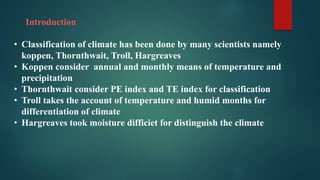
• Classification of climate has been done by many scientists namely
koppen, Thornthwait, Troll, Hargreaves
• Koppen consider annual and monthly means of temperature and
precipitation
• Thornthwait consider PE index and TE index for classification
• Troll takes the account of temperature and humid months for
differentiation of climate
• Hargreaves took moisture difficiet for distinguish the climate
KOPPEN’S CLASSIFICATION
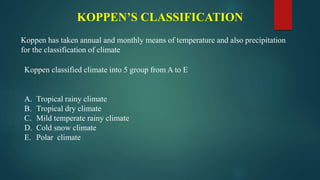
Koppen has taken annual and monthly means of temperature and also precipitation
for the classification of climate
Koppen classified climate into 5 group from A to E
A. Tropical rainy climate
B. Tropical dry climate
C. Mild temperate rainy climate
D. Cold snow climate
E. Polar climate
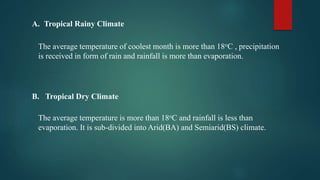
A. Tropical Rainy Climate
The average temperature of coolest month is more than 18oC , precipitation
is received in form of rain and rainfall is more than evaporation.
B. Tropical Dry Climate
The average temperature is more than 18oC and rainfall is less than
evaporation. It is sub-divided into Arid(BA) and Semiarid(BS) climate.
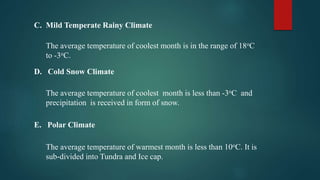
C. Mild Temperate Rainy Climate
The average temperature of coolest month is in the range of 18oC
to -3oC.
D. Cold Snow Climate
The average temperature of coolest month is less than -3oC and
precipitation is received in form of snow.
E. Polar Climate
The average temperature of warmest month is less than 10oC. It is
sub-divided into Tundra and Ice cap.
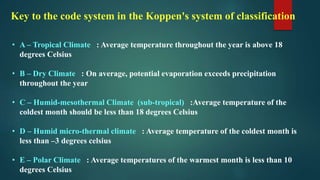
Key to the code system in the Koppen's system of classification
• A – Tropical Climate : Average temperature throughout the year is above 18
degrees Celsius
• B – Dry Climate : On average, potential evaporation exceeds precipitation
throughout the year
• C – Humid-mesothermal Climate (sub-tropical) :Average temperature of the
coldest month should be less than 18 degrees Celsius
• D – Humid micro-thermal climate : Average temperature of the coldest month is
less than –3 degrees celsius
• E – Polar Climate : Average temperatures of the warmest month is less than 10
degrees Celsius
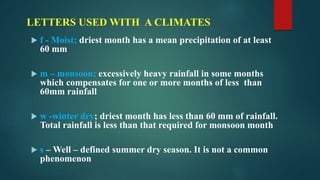
LETTERS USED WITH A CLIMATES
 f - Moist; driest month has a mean precipitation of at least
60 mm
 m – monsoon; excessively heavy rainfall in some months
which compensates for one or more months of less than
60mm rainfall
 w -winter dry; driest month has less than 60 mm of rainfall.
Total rainfall is less than that required for monsoon month
 s – Well – defined summer dry season. It is not a common
phenomenon
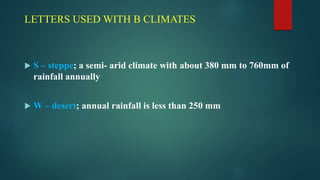
LETTERS USED WITH B CLIMATES
 S – steppe; a semi- arid climate with about 380 mm to 760mm of
rainfall annually
 W – desert; annual rainfall is less than 250 mm
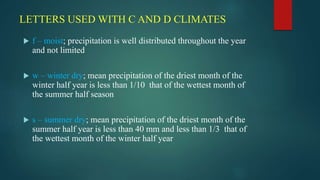
LETTERS USED WITH C AND D CLIMATES
 f – moist; precipitation is well distributed throughout the year
and not limited
 w – winter dry; mean precipitation of the driest month of the
winter half year is less than 1/10 that of the wettest month of
the summer half season
 s – summer dry; mean precipitation of the driest month of the
summer half year is less than 40 mm and less than 1/3 that of
the wettest month of the winter half year
LETTERS USED WITH B CLIMATES
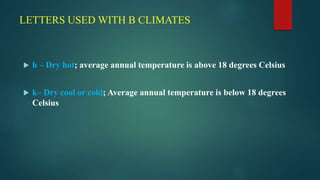
 h – Dry hot; average annual temperature is above 18 degrees Celsius
 k– Dry cool or cold; Average annual temperature is below 18 degrees
Celsius
LETTERS USED WITH C AND D CLIMATES
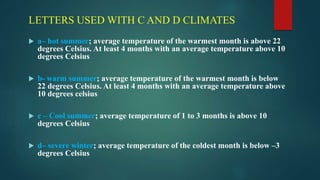
 a– hot summer; average temperature of the warmest month is above 22
degrees Celsius. At least 4 months with an average temperature above 10
degrees Celsius
 b- warm summer; average temperature of the warmest month is below
22 degrees Celsius. At least 4 months with an average temperature above
10 degrees celsius
 c – Cool summer; average temperature of 1 to 3 months is above 10
degrees Celsius
 d– severe winter; average temperature of the coldest month is below –3
degrees Celsius
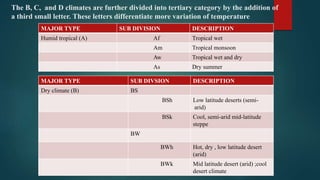
The B, C, and D climates are further divided into tertiary category by the addition of
a third small letter. These letters differentiate more variation of temperature
MAJOR TYPE SUB DIVISION DESCRIPTION
Humid tropical (A) Af Tropical wet
Am Tropical monsoon
Aw Tropical wet and dry
As Dry summer
MAJOR TYPE SUB DIVSION DESCRIPTION
Dry climate (B) BS
BSh Low latitude deserts (semi-
arid)
BSk Cool, semi-arid mid-latitude
steppe
BW
BWh Hot, dry , low latitude desert
(arid)
BWk Mid latitude desert (arid) ;cool
desert climate
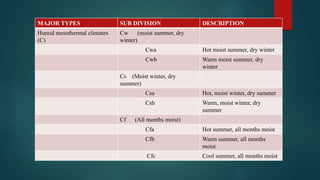
MAJOR TYPES SUB DIVISION DESCRIPTION
Humid mesothermal climates
(C)
Cw (moist summer, dry
winter)
Cwa Hot moist summer, dry winter
Cwb Warm moist summer, dry
winter
Cs (Moist winter, dry
summer)
Csa Hot, moist winter, dry summer
Csb Warm, moist winter, dry
summer
Cf (All months moist)
Cfa Hot summer, all months moist
Cfb Warm summer, all months
moist
Cfc Cool summer, all months moist
MAJOR TYPES SUB DIVISION DESCRIPTION
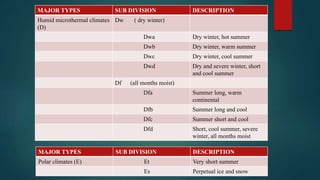
Humid microthermal climates
(D)
Dw ( dry winter)
Dwa Dry winter, hot summer
Dwb Dry winter, warm summer
Dwc Dry winter, cool summer
Dwd Dry and severe winter, short
and cool summer
Df (all months moist)
Dfa Summer long, warm
continental
Dfb Summer long and cool
Dfc Summer short and cool
Dfd Short, cool summer, severe
winter, all months moist
MAJOR TYPES SUB DIVISION DESCRIPTION
Polar climates (E) Et Very short summer
Es Perpetual ice and snow
Thornthwaite classification
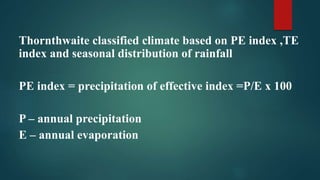
Thornthwaite classified climate based on PE index ,TE
index and seasonal distribution of rainfall
PE index = precipitation of effective index =P/E x 100
P – annual precipitation
E – annual evaporation
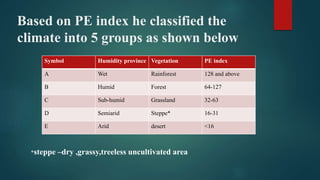
Based on PE index he classified the
climate into 5 groups as shown below
Symbol Humidity province Vegetation PE index
A Wet Rainforest 128 and above
B Humid Forest 64-127
C Sub-humid Grassland 32-63
D Semiarid Steppe* 16-31
E Arid desert <16
*steppe –dry ,grassy,treeless uncultivated area
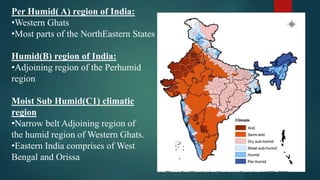
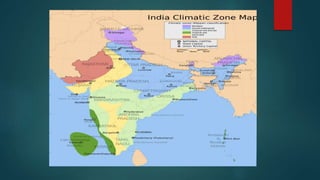
Per Humid( A) region of India:
•Western Ghats
•Most parts of the NorthEastern States
Humid(B) region of India:
•Adjoining region of the Perhumid
region
Moist Sub Humid(C1) climatic
region
•Narrow belt Adjoining region of
the humid region of Western Ghats.
•Eastern India comprises of West
Bengal and Orissa
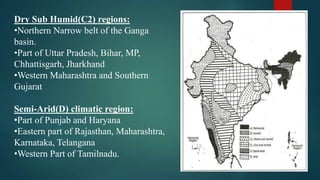
Dry Sub Humid(C2) regions:
•Northern Narrow belt of the Ganga
basin.
•Part of Uttar Pradesh, Bihar, MP,
Chhattisgarh, Jharkhand
•Western Maharashtra and Southern
Gujarat
Semi-Arid(D) climatic region:
•Part of Punjab and Haryana
•Eastern part of Rajasthan, Maharashtra,
Karnataka, Telangana
•Western Part of Tamilnadu.
Arid climatic( E) region of India:
•Western Rajasthan
•Western Himalaya
•Rainshadow zone of Western Ghats
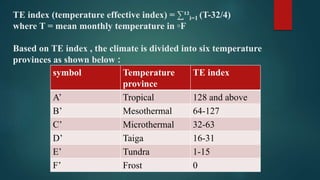
TE index (temperature effective index) = ∑¹²i=1 (T-32/4)
where T = mean monthly temperature in ◦F
Based on TE index , the climate is divided into six temperature
provinces as shown below :
symbol Temperature
province
TE index
A’ Tropical 128 and above
B’ Mesothermal 64-127
C’ Microthermal 32-63
D’ Taiga 16-31
E’ Tundra 1-15
F’ Frost 0
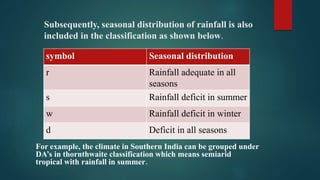
Subsequently, seasonal distribution of rainfall is also
included in the classification as shown below.
For example, the climate in Southern India can be grouped under
DA’s in thornthwaite classification which means semiarid
tropical with rainfall in summer.
symbol Seasonal distribution
r Rainfall adequate in all
seasons
s Rainfall deficit in summer
w Rainfall deficit in winter
d Deficit in all seasons
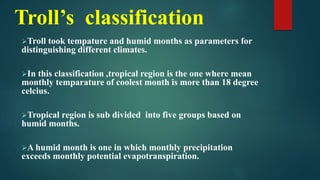
Troll’s classification
Troll took tempature and humid months as parameters for
distinguishing different climates.
In this classification ,tropical region is the one where mean
monthly temparature of coolest month is more than 18 degree
celcius.
Tropical region is sub divided into five groups based on
humid months.
A humid month is one in which monthly precipitation
exceeds monthly potential evapotranspiration.
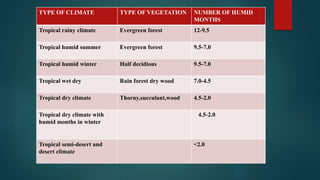
TYPE OF CLIMATE TYPE OF VEGETATION NUMBER OF HUMID
MONTHS
Tropical rainy climate Evergreen forest 12-9.5
Tropical humid summer Evergreen forest 9.5-7.0
Tropical humid winter Half decidious 9.5-7.0
Tropical wet dry Rain forest dry wood 7.0-4.5
Tropical dry climate Thorny,succulant,wood 4.5-2.0
Tropical dry climate with
humid months in winter
4.5-2.0
Tropical semi-desert and
desert climate
<2.0
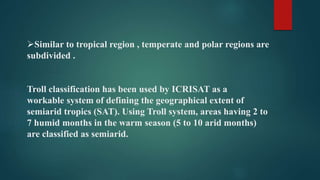
Similar to tropical region , temperate and polar regions are
subdivided .
Troll classification has been used by ICRISAT as a
workable system of defining the geographical extent of
semiarid tropics (SAT). Using Troll system, areas having 2 to
7 humid months in the warm season (5 to 10 arid months)
are classified as semiarid.
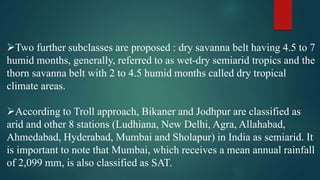
Two further subclasses are proposed : dry savanna belt having 4.5 to 7
humid months, generally, referred to as wet-dry semiarid tropics and the
thorn savanna belt with 2 to 4.5 humid months called dry tropical
climate areas.
According to Troll approach, Bikaner and Jodhpur are classified as
arid and other 8 stations (Ludhiana, New Delhi, Agra, Allahabad,
Ahmedabad, Hyderabad, Mumbai and Sholapur) in India as semiarid. It
is important to note that Mumbai, which receives a mean annual rainfall
of 2,099 mm, is also classified as SAT.
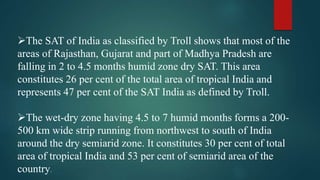
The SAT of India as classified by Troll shows that most of the
areas of Rajasthan, Gujarat and part of Madhya Pradesh are
falling in 2 to 4.5 months humid zone dry SAT. This area
constitutes 26 per cent of the total area of tropical India and
represents 47 per cent of the SAT India as defined by Troll.
The wet-dry zone having 4.5 to 7 humid months forms a 200-
500 km wide strip running from northwest to south of India
around the dry semiarid zone. It constitutes 30 per cent of total
area of tropical India and 53 per cent of semiarid area of the
country.
The total SAT area works out to be 56 per cent of the total
tropical India, a figure very close to the 54 per cent estimate made
by economic group. The IMD in 1967 published 30 year (1931-
60) normals for over 200 meteorological stations. Monthly PET
values were published in 1971.
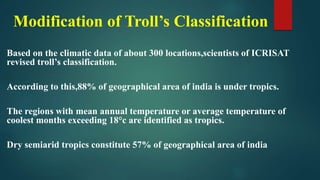
Modification of Troll’s Classification
Based on the climatic data of about 300 locations,scientists of ICRISAT
revised troll’s classification.
According to this,88% of geographical area of india is under tropics.
The regions with mean annual temperature or average temperature of
coolest months exceeding 18°c are identified as tropics.
Dry semiarid tropics constitute 57% of geographical area of india
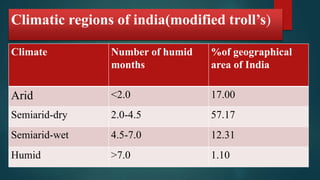
Climatic regions of india(modified troll’s)
Climate Number of humid
months
%of geographical
area of India
Arid <2.0 17.00
Semiarid-dry 2.0-4.5 57.17
Semiarid-wet 4.5-7.0 12.31
Humid >7.0 1.10
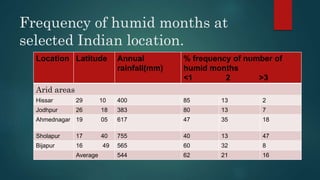
Frequency of humid months at
selected Indian location.
Location Latitude Annual
rainfall(mm)
% frequency of number of
humid months
<1 2 >3
Arid areas
Hissar 29 10 400 85 13 2
Jodhpur 26 18 383 80 13 7
Ahmednagar 19 05 617 47 35 18
Sholapur 17 40 755 40 13 47
Bijapur 16 49 565 60 32 8
Average 544 62 21 16
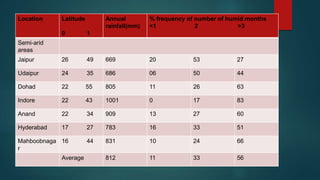
Location Latitude
0 1
Annual
rainfall(mm)
% frequency of number of humid months
<1 2 >3
Semi-arid
areas
Jaipur 26 49 669 20 53 27
Udaipur 24 35 686 06 50 44
Dohad 22 55 805 11 26 63
Indore 22 43 1001 0 17 83
Anand 22 34 909 13 27 60
Hyderabad 17 27 783 16 33 51
Mahboobnaga
r
16 44 831 10 24 66
Average 812 11 33 56
Moisture Deficit index
All India Coordinated Research Project on dryland agriculture of Indian Council
of Agricultural Research adopted classification based on moisture deficit index.
Moisture deficit index (MDI) :To determine the magnitude of water deficiency in
these regions ,the moisture deficit index has been evaluated for dryland stations
in India.
The MDI is usually determined on the basis of annual precipitation and annual
potential evapotranspiration.
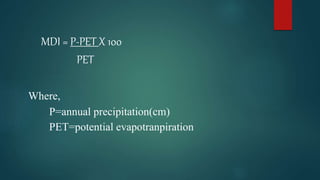
MDI = P-PET X 100
PET
Where,
P=annual precipitation(cm)
PET=potential evapotranpiration
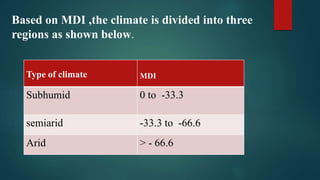
Based on MDI ,the climate is divided into three
regions as shown below.
T
Type of climate MDI
Subhumid 0 to -33.3
semiarid -33.3 to -66.6
Arid > - 66.6
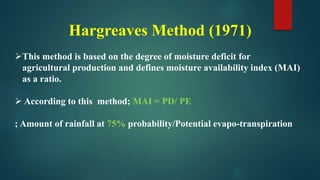
Hargreaves Method (1971)
This method is based on the degree of moisture deficit for
agricultural production and defines moisture availability index (MAI)
as a ratio.
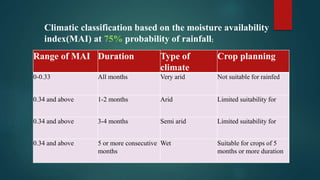
 According to this method; MAI = PD/ PE
; Amount of rainfall at 75% probability/Potential evapo-transpiration
Climatic classification based on the moisture availability
index(MAI) at 75% probability of rainfall;
Range of MAI Duration Type of
climate
Crop planning
0-0.33 All months Very arid Not suitable for rainfed
0.34 and above 1-2 months Arid Limited suitability for
0.34 and above 3-4 months Semi arid Limited suitability for
0.34 and above 5 or more consecutive
months
Wet Suitable for crops of 5
months or more duration
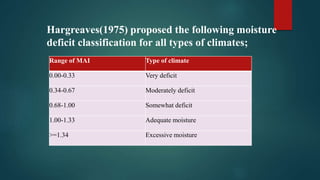
Hargreaves(1975) proposed the following moisture
deficit classification for all types of climates;
Range of MAI Type of climate
0.00-0.33 Very deficit
0.34-0.67 Moderately deficit
0.68-1.00 Somewhat deficit
1.00-1.33 Adequate moisture
>=1.34 Excessive moisture
Thank you

climatic classification.pptx

  • 1.
  • 2.
    Introduction • Classification ofclimate has been done by many scientists namely koppen, Thornthwait, Troll, Hargreaves • Koppen consider annual and monthly means of temperature and precipitation • Thornthwait consider PE index and TE index for classification • Troll takes the account of temperature and humid months for differentiation of climate • Hargreaves took moisture difficiet for distinguish the climate
  • 3.
    KOPPEN’S CLASSIFICATION Koppen hastaken annual and monthly means of temperature and also precipitation for the classification of climate Koppen classified climate into 5 group from A to E A. Tropical rainy climate B. Tropical dry climate C. Mild temperate rainy climate D. Cold snow climate E. Polar climate
  • 4.
    A. Tropical RainyClimate The average temperature of coolest month is more than 18oC , precipitation is received in form of rain and rainfall is more than evaporation. B. Tropical Dry Climate The average temperature is more than 18oC and rainfall is less than evaporation. It is sub-divided into Arid(BA) and Semiarid(BS) climate.
  • 5.
    C. Mild TemperateRainy Climate The average temperature of coolest month is in the range of 18oC to -3oC. D. Cold Snow Climate The average temperature of coolest month is less than -3oC and precipitation is received in form of snow. E. Polar Climate The average temperature of warmest month is less than 10oC. It is sub-divided into Tundra and Ice cap.
  • 6.
    Key to thecode system in the Koppen's system of classification • A – Tropical Climate : Average temperature throughout the year is above 18 degrees Celsius • B – Dry Climate : On average, potential evaporation exceeds precipitation throughout the year • C – Humid-mesothermal Climate (sub-tropical) :Average temperature of the coldest month should be less than 18 degrees Celsius • D – Humid micro-thermal climate : Average temperature of the coldest month is less than –3 degrees celsius • E – Polar Climate : Average temperatures of the warmest month is less than 10 degrees Celsius
  • 7.
    LETTERS USED WITHA CLIMATES  f - Moist; driest month has a mean precipitation of at least 60 mm  m – monsoon; excessively heavy rainfall in some months which compensates for one or more months of less than 60mm rainfall  w -winter dry; driest month has less than 60 mm of rainfall. Total rainfall is less than that required for monsoon month  s – Well – defined summer dry season. It is not a common phenomenon
  • 8.
    LETTERS USED WITHB CLIMATES  S – steppe; a semi- arid climate with about 380 mm to 760mm of rainfall annually  W – desert; annual rainfall is less than 250 mm
  • 9.
    LETTERS USED WITHC AND D CLIMATES  f – moist; precipitation is well distributed throughout the year and not limited  w – winter dry; mean precipitation of the driest month of the winter half year is less than 1/10 that of the wettest month of the summer half season  s – summer dry; mean precipitation of the driest month of the summer half year is less than 40 mm and less than 1/3 that of the wettest month of the winter half year
  • 10.
    LETTERS USED WITHB CLIMATES  h – Dry hot; average annual temperature is above 18 degrees Celsius  k– Dry cool or cold; Average annual temperature is below 18 degrees Celsius
  • 11.
    LETTERS USED WITHC AND D CLIMATES  a– hot summer; average temperature of the warmest month is above 22 degrees Celsius. At least 4 months with an average temperature above 10 degrees Celsius  b- warm summer; average temperature of the warmest month is below 22 degrees Celsius. At least 4 months with an average temperature above 10 degrees celsius  c – Cool summer; average temperature of 1 to 3 months is above 10 degrees Celsius  d– severe winter; average temperature of the coldest month is below –3 degrees Celsius
  • 12.
    The B, C,and D climates are further divided into tertiary category by the addition of a third small letter. These letters differentiate more variation of temperature MAJOR TYPE SUB DIVISION DESCRIPTION Humid tropical (A) Af Tropical wet Am Tropical monsoon Aw Tropical wet and dry As Dry summer MAJOR TYPE SUB DIVSION DESCRIPTION Dry climate (B) BS BSh Low latitude deserts (semi- arid) BSk Cool, semi-arid mid-latitude steppe BW BWh Hot, dry , low latitude desert (arid) BWk Mid latitude desert (arid) ;cool desert climate
  • 13.
    MAJOR TYPES SUBDIVISION DESCRIPTION Humid mesothermal climates (C) Cw (moist summer, dry winter) Cwa Hot moist summer, dry winter Cwb Warm moist summer, dry winter Cs (Moist winter, dry summer) Csa Hot, moist winter, dry summer Csb Warm, moist winter, dry summer Cf (All months moist) Cfa Hot summer, all months moist Cfb Warm summer, all months moist Cfc Cool summer, all months moist
  • 14.
    MAJOR TYPES SUBDIVISION DESCRIPTION Humid microthermal climates (D) Dw ( dry winter) Dwa Dry winter, hot summer Dwb Dry winter, warm summer Dwc Dry winter, cool summer Dwd Dry and severe winter, short and cool summer Df (all months moist) Dfa Summer long, warm continental Dfb Summer long and cool Dfc Summer short and cool Dfd Short, cool summer, severe winter, all months moist MAJOR TYPES SUB DIVISION DESCRIPTION Polar climates (E) Et Very short summer Es Perpetual ice and snow
  • 15.
  • 16.
    Thornthwaite classified climatebased on PE index ,TE index and seasonal distribution of rainfall PE index = precipitation of effective index =P/E x 100 P – annual precipitation E – annual evaporation
  • 17.
    Based on PEindex he classified the climate into 5 groups as shown below Symbol Humidity province Vegetation PE index A Wet Rainforest 128 and above B Humid Forest 64-127 C Sub-humid Grassland 32-63 D Semiarid Steppe* 16-31 E Arid desert <16 *steppe –dry ,grassy,treeless uncultivated area
  • 18.
    Per Humid( A)region of India: •Western Ghats •Most parts of the NorthEastern States Humid(B) region of India: •Adjoining region of the Perhumid region Moist Sub Humid(C1) climatic region •Narrow belt Adjoining region of the humid region of Western Ghats. •Eastern India comprises of West Bengal and Orissa
  • 19.
    Dry Sub Humid(C2)regions: •Northern Narrow belt of the Ganga basin. •Part of Uttar Pradesh, Bihar, MP, Chhattisgarh, Jharkhand •Western Maharashtra and Southern Gujarat Semi-Arid(D) climatic region: •Part of Punjab and Haryana •Eastern part of Rajasthan, Maharashtra, Karnataka, Telangana •Western Part of Tamilnadu.
  • 20.
    Arid climatic( E)region of India: •Western Rajasthan •Western Himalaya •Rainshadow zone of Western Ghats
  • 21.
    TE index (temperatureeffective index) = ∑¹²i=1 (T-32/4) where T = mean monthly temperature in ◦F Based on TE index , the climate is divided into six temperature provinces as shown below : symbol Temperature province TE index A’ Tropical 128 and above B’ Mesothermal 64-127 C’ Microthermal 32-63 D’ Taiga 16-31 E’ Tundra 1-15 F’ Frost 0
  • 22.
    Subsequently, seasonal distributionof rainfall is also included in the classification as shown below. For example, the climate in Southern India can be grouped under DA’s in thornthwaite classification which means semiarid tropical with rainfall in summer. symbol Seasonal distribution r Rainfall adequate in all seasons s Rainfall deficit in summer w Rainfall deficit in winter d Deficit in all seasons
  • 23.
    Troll’s classification Troll tooktempature and humid months as parameters for distinguishing different climates. In this classification ,tropical region is the one where mean monthly temparature of coolest month is more than 18 degree celcius. Tropical region is sub divided into five groups based on humid months. A humid month is one in which monthly precipitation exceeds monthly potential evapotranspiration.
  • 24.
    TYPE OF CLIMATETYPE OF VEGETATION NUMBER OF HUMID MONTHS Tropical rainy climate Evergreen forest 12-9.5 Tropical humid summer Evergreen forest 9.5-7.0 Tropical humid winter Half decidious 9.5-7.0 Tropical wet dry Rain forest dry wood 7.0-4.5 Tropical dry climate Thorny,succulant,wood 4.5-2.0 Tropical dry climate with humid months in winter 4.5-2.0 Tropical semi-desert and desert climate <2.0
  • 25.
    Similar to tropicalregion , temperate and polar regions are subdivided . Troll classification has been used by ICRISAT as a workable system of defining the geographical extent of semiarid tropics (SAT). Using Troll system, areas having 2 to 7 humid months in the warm season (5 to 10 arid months) are classified as semiarid.
  • 26.
    Two further subclassesare proposed : dry savanna belt having 4.5 to 7 humid months, generally, referred to as wet-dry semiarid tropics and the thorn savanna belt with 2 to 4.5 humid months called dry tropical climate areas. According to Troll approach, Bikaner and Jodhpur are classified as arid and other 8 stations (Ludhiana, New Delhi, Agra, Allahabad, Ahmedabad, Hyderabad, Mumbai and Sholapur) in India as semiarid. It is important to note that Mumbai, which receives a mean annual rainfall of 2,099 mm, is also classified as SAT.
  • 27.
    The SAT ofIndia as classified by Troll shows that most of the areas of Rajasthan, Gujarat and part of Madhya Pradesh are falling in 2 to 4.5 months humid zone dry SAT. This area constitutes 26 per cent of the total area of tropical India and represents 47 per cent of the SAT India as defined by Troll. The wet-dry zone having 4.5 to 7 humid months forms a 200- 500 km wide strip running from northwest to south of India around the dry semiarid zone. It constitutes 30 per cent of total area of tropical India and 53 per cent of semiarid area of the country.
  • 28.
    The total SATarea works out to be 56 per cent of the total tropical India, a figure very close to the 54 per cent estimate made by economic group. The IMD in 1967 published 30 year (1931- 60) normals for over 200 meteorological stations. Monthly PET values were published in 1971.
  • 29.
    Modification of Troll’sClassification Based on the climatic data of about 300 locations,scientists of ICRISAT revised troll’s classification. According to this,88% of geographical area of india is under tropics. The regions with mean annual temperature or average temperature of coolest months exceeding 18°c are identified as tropics. Dry semiarid tropics constitute 57% of geographical area of india
  • 30.
    Climatic regions ofindia(modified troll’s) Climate Number of humid months %of geographical area of India Arid <2.0 17.00 Semiarid-dry 2.0-4.5 57.17 Semiarid-wet 4.5-7.0 12.31 Humid >7.0 1.10
  • 31.
    Frequency of humidmonths at selected Indian location. Location Latitude Annual rainfall(mm) % frequency of number of humid months <1 2 >3 Arid areas Hissar 29 10 400 85 13 2 Jodhpur 26 18 383 80 13 7 Ahmednagar 19 05 617 47 35 18 Sholapur 17 40 755 40 13 47 Bijapur 16 49 565 60 32 8 Average 544 62 21 16
  • 32.
    Location Latitude 0 1 Annual rainfall(mm) %frequency of number of humid months <1 2 >3 Semi-arid areas Jaipur 26 49 669 20 53 27 Udaipur 24 35 686 06 50 44 Dohad 22 55 805 11 26 63 Indore 22 43 1001 0 17 83 Anand 22 34 909 13 27 60 Hyderabad 17 27 783 16 33 51 Mahboobnaga r 16 44 831 10 24 66 Average 812 11 33 56
  • 34.
    Moisture Deficit index AllIndia Coordinated Research Project on dryland agriculture of Indian Council of Agricultural Research adopted classification based on moisture deficit index. Moisture deficit index (MDI) :To determine the magnitude of water deficiency in these regions ,the moisture deficit index has been evaluated for dryland stations in India. The MDI is usually determined on the basis of annual precipitation and annual potential evapotranspiration.
  • 35.
    MDI = P-PETX 100 PET Where, P=annual precipitation(cm) PET=potential evapotranpiration
  • 36.
    Based on MDI,the climate is divided into three regions as shown below. T Type of climate MDI Subhumid 0 to -33.3 semiarid -33.3 to -66.6 Arid > - 66.6
  • 37.
    Hargreaves Method (1971) Thismethod is based on the degree of moisture deficit for agricultural production and defines moisture availability index (MAI) as a ratio.  According to this method; MAI = PD/ PE ; Amount of rainfall at 75% probability/Potential evapo-transpiration
  • 38.
    Climatic classification basedon the moisture availability index(MAI) at 75% probability of rainfall; Range of MAI Duration Type of climate Crop planning 0-0.33 All months Very arid Not suitable for rainfed 0.34 and above 1-2 months Arid Limited suitability for 0.34 and above 3-4 months Semi arid Limited suitability for 0.34 and above 5 or more consecutive months Wet Suitable for crops of 5 months or more duration
  • 39.
    Hargreaves(1975) proposed thefollowing moisture deficit classification for all types of climates; Range of MAI Type of climate 0.00-0.33 Very deficit 0.34-0.67 Moderately deficit 0.68-1.00 Somewhat deficit 1.00-1.33 Adequate moisture >=1.34 Excessive moisture
  • 40.