Parboiling of Rice
Introduction
 It is a hydrothermal treatment resulting partial cooking (gelatinization of starch) of paddy
(rough rice)
 During parboiling irreversible swelling and fusion of starch granules occurs and changes
starch from crystalline to amorphous form
 About 60% of total production of paddy is parboiled in India
 Parboiling reduce breakage and loss of minerals & vitamins
Advantages
 Overall increase in total rice recovery is about 6 %
 High nutrients compared to raw rice
 25% more oil in the bran compared to raw rice bran
 Dehusking is easier and costs less (Higher productivity of rubber rolls compared to raw
paddy de-hulling)
 Germination is no longer possible and the endo-sperm has a compact texture making it
resistant to attack by insect and microorganism
Disadvantages
 More difficult bran removal
 A great amount of water is absorbed during cooking causing the
rice to swell
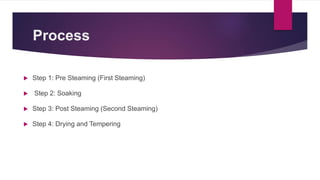
Process
 Step 1: Pre Steaming (First Steaming)
 Step 2: Soaking
 Step 3: Post Steaming (Second Steaming)
 Step 4: Drying and Tempering
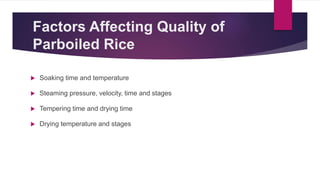
 Soaking time and temperature
 Steaming pressure, velocity, time and stages
 Tempering time and drying time
 Drying temperature and stages
Factors Affecting Quality of
Parboiled Rice
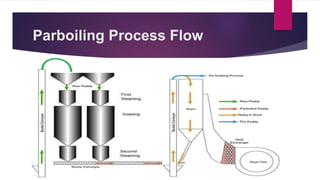
Parboiling Process Flow
Paddy Pre steaming (First
steaming) Strategy
 Pre steaming before soaking softens the paddy, to
achieve desired color of par-boiled rice
 Increases the temperature of the paddy and reduces
the soaking time of the paddy
 Increases the capacity of par-boiled rice to absorb
water during cooking
 Industrial practice of pre-steaming time is 2 to 4
minutes
 Steam temperature is 100 – 110 oC during the
first steaming
 Energy required in steaming 1000 Kg of paddy:
24.42 kWh (21,000 kcal)
 Use of Steam Flow Meters will improve energy
efficiency
 To get uniform quality and high efficiency
steaming to be automated
Paddy Soaking
 Soaking is a diffusion process
 The diffusion pressure of dry paddy is zero and porosity is about 48%
 Difference in vapor pressure between paddy and water results movement of water into Paddy during
soaking
 Step 1: Water molecules first adhere to the husk surface and then penetrate through microspores of husk
 Step 2: Water is retained in the voids of rice kernel due to capillary absorption
 Step 3: Water molecules will be absorbed in starch granules and held as water of hydration
Paddy Soaking
 Commonly practiced soaking paddy in hot water 6-10 h at 70 oC
 1.3 m3 of water is consumed per metric ton of paddy
 Moisture content of soaked paddy is about 30%-35%
 Energy required in soaking is used in raising the temperature of water from 25 °C–85 °C:
83.72 kWh Heat energy
 Soaking at elevated temperature prevents mycotoxins and also reduce the steaming time
Strategy for Efficient Paddy
Soaking
 Paddy grain size should be uniform
 Continuous recirculation, reheating coupled with aeration reduce the soaking time.
 Optimum time-temperature combination for single stage soaking: 6h-65 oC
 Accelerated can be achieved at soaking water pH (11)
 Two stage soaking (67% time reduction compared to single-stage soaking)
 Stage 1: Soaking at 80 °C/ 45 min and moisture content of 35.0% d.b.
 Stage 2: Soaking at 70°C/ 195 min and moisture content of 42.7% d.b.
 Heat from effluent after soaking can be used for preheating the fresh soaking water
Post Steaming (Second
Steaming) of paddy
 Steaming is carried out to gelatinize starch
 Saturated steam at a pressure of 1-5 kg/cm2 is
used for steaming of soaked paddy
 Splitting of husk is indication of completion of
steaming
 60 kg of steam is required to steam 1 ton of
paddy
 Moisture content of paddy increases to 38%
(w.b.) during steaming
 24.42 kWh (21,000 kcal) of energy required in steaming
1000 Kg of paddy
 Improves grain length and uniforms the color of Par-
boiled rice
 Steam temperature has a considerable effect on the
color of parboiled rice.
 The color of rice is due to pigments of husk, bran and
absorption of reducing sugar that react with amino acid
Post Steaming(Second Steaming)
Strategy
 Keeping steamed paddy in a heap on the drying floor is equivalent to prolonged
steaming and results in dark color of rice
 Steaming of paddy completes once steam emerges after for 1 to 2 min steaming of
the batch
 Steam at a pressure of 0.5 atm is used for the second steaming of paddy
 Timeof gelatinization can be shortened by increasing superficial superheated-steam
velocity
 Energy efficiency in steaming can be achieved by use of low pressure steam
Drying of paddy
 Drying of parboiled paddy from 45-50% (db) to 14-16% (db) needs to be done for proper milling
and storage
 The first drying period takes about three hours including dryer loading and unloading time. After
tempering, the second drying period takes about two hours.
 159.30 kWh of energy required in drying 1000 kg of Paddy at 80 °C and air flow of 50 m3/min for
drying 4 h
 One of the main reasons for rice kernel breakage is fissures which is developed due to Moisture
Content gradients occurred during drying
Drying Strategy
 Paddy to be dried slowly in two passes instead of continuous drying. In first pass, paddy moisture content
should be brought down to 18-20% and rest in second pass.
 Double-pass drying with tempering saves up to 45% of drying time compared to single stage drying
 Tempering of 120 min at 50 °C reduced fissuring by 32 to 50%
 Use of online moisture meters will help in quality control of rice
 The efficiency of dryer blowers should be studied
 Heat recovery from dryer condensate
 Pressure drop across the dryer to be avoided
Thank You
Tushar Bhardwaj
17/MFS/025
Ishwar Singh Tamwar
17/MFS/008

Parboiling of Rice

  • 1.
  • 2.
    Introduction  It isa hydrothermal treatment resulting partial cooking (gelatinization of starch) of paddy (rough rice)  During parboiling irreversible swelling and fusion of starch granules occurs and changes starch from crystalline to amorphous form  About 60% of total production of paddy is parboiled in India  Parboiling reduce breakage and loss of minerals & vitamins
  • 3.
    Advantages  Overall increasein total rice recovery is about 6 %  High nutrients compared to raw rice  25% more oil in the bran compared to raw rice bran  Dehusking is easier and costs less (Higher productivity of rubber rolls compared to raw paddy de-hulling)  Germination is no longer possible and the endo-sperm has a compact texture making it resistant to attack by insect and microorganism
  • 4.
    Disadvantages  More difficultbran removal  A great amount of water is absorbed during cooking causing the rice to swell
  • 5.
    Process  Step 1:Pre Steaming (First Steaming)  Step 2: Soaking  Step 3: Post Steaming (Second Steaming)  Step 4: Drying and Tempering
  • 6.
     Soaking timeand temperature  Steaming pressure, velocity, time and stages  Tempering time and drying time  Drying temperature and stages Factors Affecting Quality of Parboiled Rice
  • 7.
  • 8.
    Paddy Pre steaming(First steaming) Strategy  Pre steaming before soaking softens the paddy, to achieve desired color of par-boiled rice  Increases the temperature of the paddy and reduces the soaking time of the paddy  Increases the capacity of par-boiled rice to absorb water during cooking  Industrial practice of pre-steaming time is 2 to 4 minutes  Steam temperature is 100 – 110 oC during the first steaming  Energy required in steaming 1000 Kg of paddy: 24.42 kWh (21,000 kcal)  Use of Steam Flow Meters will improve energy efficiency  To get uniform quality and high efficiency steaming to be automated
  • 9.
    Paddy Soaking  Soakingis a diffusion process  The diffusion pressure of dry paddy is zero and porosity is about 48%  Difference in vapor pressure between paddy and water results movement of water into Paddy during soaking  Step 1: Water molecules first adhere to the husk surface and then penetrate through microspores of husk  Step 2: Water is retained in the voids of rice kernel due to capillary absorption  Step 3: Water molecules will be absorbed in starch granules and held as water of hydration
  • 10.
    Paddy Soaking  Commonlypracticed soaking paddy in hot water 6-10 h at 70 oC  1.3 m3 of water is consumed per metric ton of paddy  Moisture content of soaked paddy is about 30%-35%  Energy required in soaking is used in raising the temperature of water from 25 °C–85 °C: 83.72 kWh Heat energy  Soaking at elevated temperature prevents mycotoxins and also reduce the steaming time
  • 11.
    Strategy for EfficientPaddy Soaking  Paddy grain size should be uniform  Continuous recirculation, reheating coupled with aeration reduce the soaking time.  Optimum time-temperature combination for single stage soaking: 6h-65 oC  Accelerated can be achieved at soaking water pH (11)  Two stage soaking (67% time reduction compared to single-stage soaking)  Stage 1: Soaking at 80 °C/ 45 min and moisture content of 35.0% d.b.  Stage 2: Soaking at 70°C/ 195 min and moisture content of 42.7% d.b.  Heat from effluent after soaking can be used for preheating the fresh soaking water
  • 12.
    Post Steaming (Second Steaming)of paddy  Steaming is carried out to gelatinize starch  Saturated steam at a pressure of 1-5 kg/cm2 is used for steaming of soaked paddy  Splitting of husk is indication of completion of steaming  60 kg of steam is required to steam 1 ton of paddy  Moisture content of paddy increases to 38% (w.b.) during steaming  24.42 kWh (21,000 kcal) of energy required in steaming 1000 Kg of paddy  Improves grain length and uniforms the color of Par- boiled rice  Steam temperature has a considerable effect on the color of parboiled rice.  The color of rice is due to pigments of husk, bran and absorption of reducing sugar that react with amino acid
  • 13.
    Post Steaming(Second Steaming) Strategy Keeping steamed paddy in a heap on the drying floor is equivalent to prolonged steaming and results in dark color of rice  Steaming of paddy completes once steam emerges after for 1 to 2 min steaming of the batch  Steam at a pressure of 0.5 atm is used for the second steaming of paddy  Timeof gelatinization can be shortened by increasing superficial superheated-steam velocity  Energy efficiency in steaming can be achieved by use of low pressure steam
  • 14.
    Drying of paddy Drying of parboiled paddy from 45-50% (db) to 14-16% (db) needs to be done for proper milling and storage  The first drying period takes about three hours including dryer loading and unloading time. After tempering, the second drying period takes about two hours.  159.30 kWh of energy required in drying 1000 kg of Paddy at 80 °C and air flow of 50 m3/min for drying 4 h  One of the main reasons for rice kernel breakage is fissures which is developed due to Moisture Content gradients occurred during drying
  • 15.
    Drying Strategy  Paddyto be dried slowly in two passes instead of continuous drying. In first pass, paddy moisture content should be brought down to 18-20% and rest in second pass.  Double-pass drying with tempering saves up to 45% of drying time compared to single stage drying  Tempering of 120 min at 50 °C reduced fissuring by 32 to 50%  Use of online moisture meters will help in quality control of rice  The efficiency of dryer blowers should be studied  Heat recovery from dryer condensate  Pressure drop across the dryer to be avoided
  • 16.