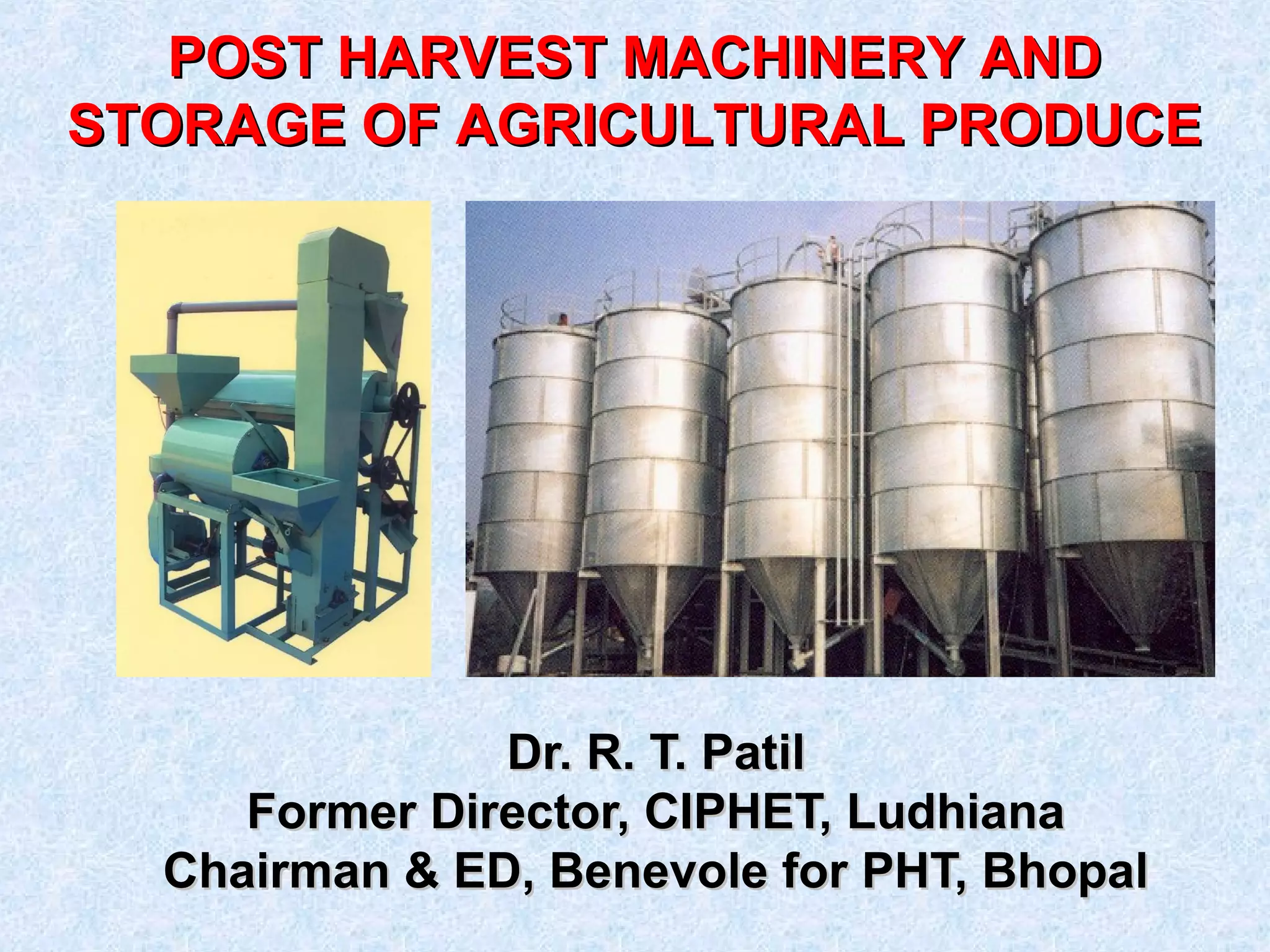

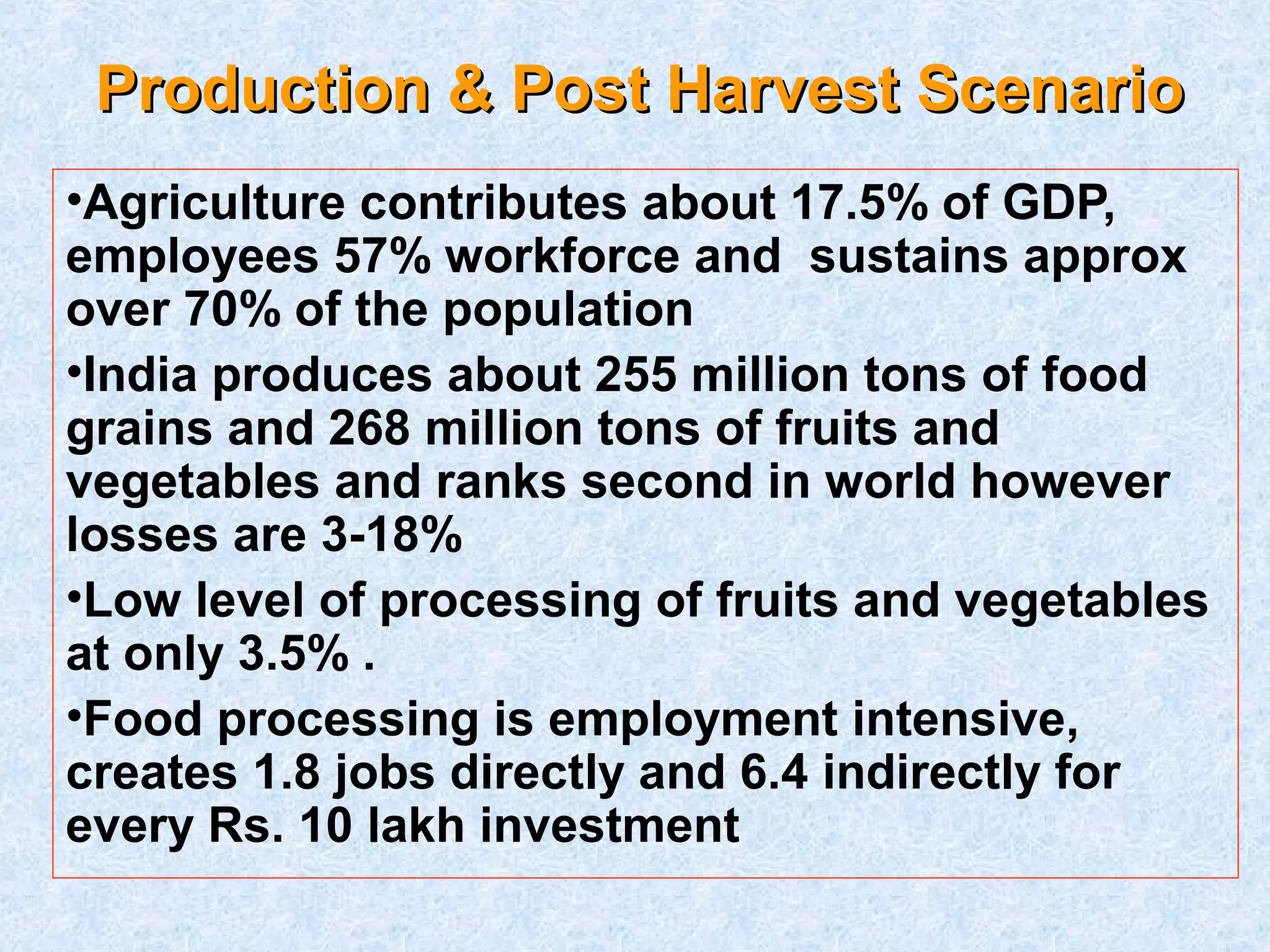
PPOOSSTT HHAARRVVEESSTT MMAACCHHIINNEERRYY AANNDD 
SSTTOORRAAGGEE OOFF AAGGRRIICCUULLTTUURRAALL PPRROODDUUCCEE 
DDrr.. RR.. TT.. PPaattiill 
FFoorrmmeerr DDiirreeccttoorr,, CCIIPPHHEETT,, LLuuddhhiiaannaa 
CChhaaiirrmmaann && EEDD,, BBeenneevvoollee ffoorr PPHHTT,, BBhhooppaall
Primary PPrroocceessssiinngg ooff HHoorrttiiccuullttuurraall 
PPrroodduuccee:: CCuurrrreenntt TTeecchhnnoollooggiieess 
aanndd FFuuttuurree PPootteennttiiaall 
DDrr.. RR..TT.. PPaattiill
PPrroodduuccttiioonn && PPoosstt HHaarrvveesstt SScceennaarriioo 
•Agriculture contributes about 17.5% of GDP, 
employees 57% workforce and sustains approx 
over 70% of the population 
•India produces about 255 million tons of food 
grains and 268 million tons of fruits and 
vegetables and ranks second in world however 
losses are 3-18% 
•Low level of processing of fruits and vegetables 
at only 3.5% . 
•Food processing is employment intensive, 
creates 1.8 jobs directly and 6.4 indirectly for 
every Rs. 10 lakh investment
AAggrroo PPrroocceessssiinngg 
1. Can provide processed food of highest quality at 
affordable cost to consumers 
2. Help environment by processing food in production 
catchment with least food miles 
3. Ensure traceability of raw materials used for 
processed product hence great for export and elite 
urban market. 
4. Help effective backward linkage with farmers for 
processing their raw produce 
5. Shorten the supply chain, increase the profitability of 
farmers and ultimately increase in GDP from 
agriculture and reduce poverty 
6. Reduce post harvest losses and increased 
availability of by products for animal feed.
AAggrroo EEnnttrreepprreenneeuurrsshhiipp
PPrriiccee DDiiffffeerreennccee 
Wheat - Rs 12/kg Wheat Flour Rs. 16-18/kg 
Fortified Flour Rs. 20-25/kg 
Oil seed – Rs 35/kg Oil Rs. 70/kg 
Paddy – Rs 12/kg Rice – Rs. 25/kg 
Mung- Rs. 20/kg Mung dal – Rs. 60/kg 
Maize-Rs.13/kg Maize flour-Rs. 16/kg 
Tomato-Rs. 5/kg Tomato ketchup-Rs 50-80/kg 
Fruit- Rs. 15-20/kg Fruits Bar-Rs. 200/kg 
Fruit Juice- Rs. 35/litre 
Coriander -Rs. 80/kg Coriander Powder-Rs. 200/kg 
Turmeric-Rs.65/kg Turmeric Powder –Rs. 200/kg 
Chili- Rs. 200/kg Chili Powder-Rs. 300/kg 
Black pepper-Rs. 100/kg B Pepper Powder- Rs.300/kg 
Chana Dal- Rs. 28/kg Chana Dal-Rs. 35/kg 
Besan- Rs. 40/kg
MMooddeerrnn RRiiccee MMiilllliinngg 
The major operations performed by 
modern rice mills are: storage, 
cleaning, husking, separation, 
whitening and grading. De-husking is 
done in rubber roll shellers while 
polishing is done in cone polishers or 
horizontal abrasive polishers. The 
rice mills can be of following 
capacity. 
(i) Composite rice milling machine-a 
single unit (capacity 250 kg/hr). 
(ii) Mini rice mills: Capacity of 250 
kg/hr. However, husking and 
polishing is done by separate 
machines. 
(iii) Modern rice mills of capacity 2-4 
t/hr.
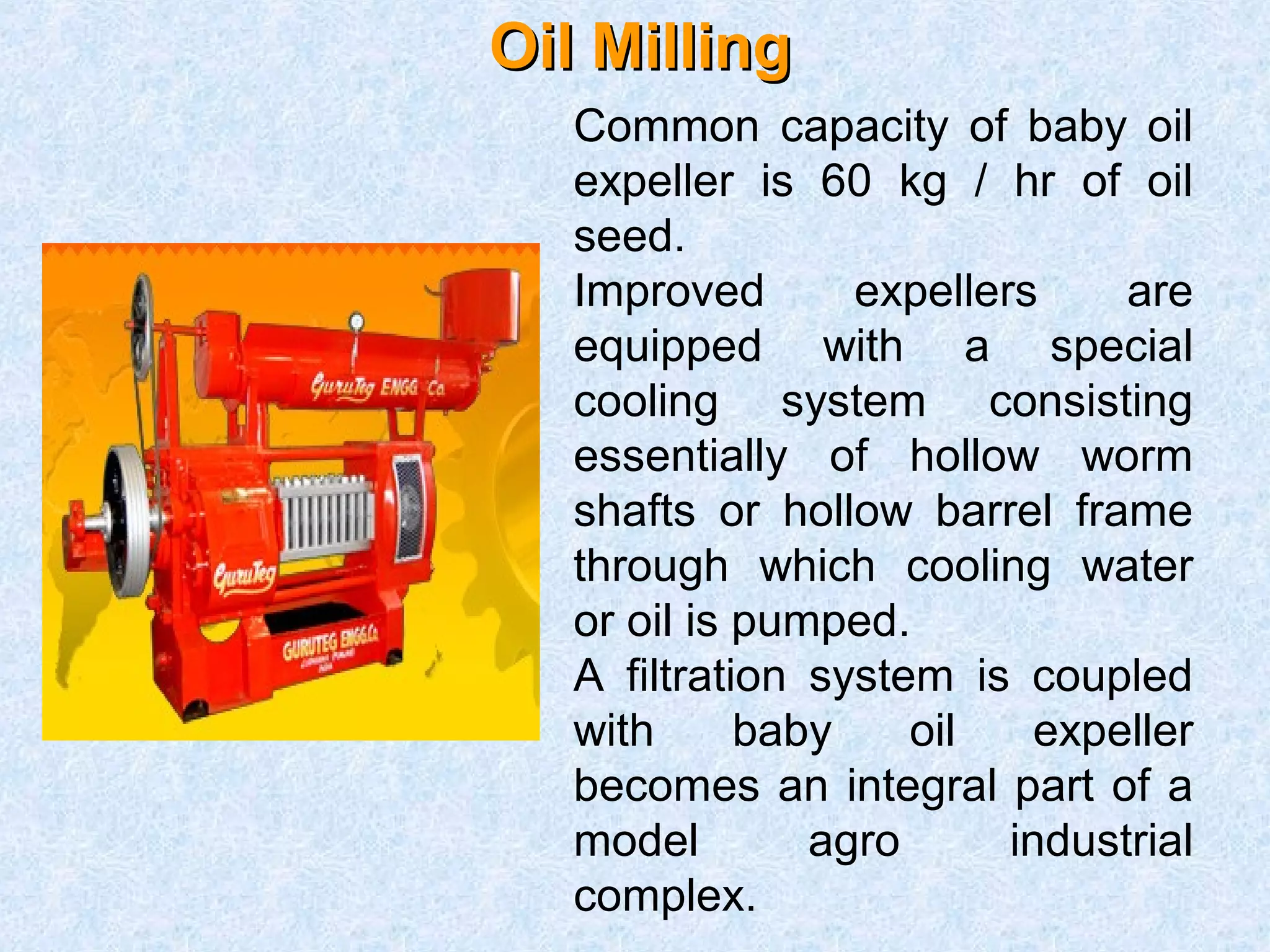
OOiill MMiilllliinngg 
Common capacity of baby oil 
expeller is 60 kg / hr of oil 
seed. 
Improved expellers are 
equipped with a special 
cooling system consisting 
essentially of hollow worm 
shafts or hollow barrel frame 
through which cooling water 
or oil is pumped. 
A filtration system is coupled 
with baby oil expeller 
becomes an integral part of a 
model agro industrial 
complex.
DDaall MMiilllliinngg 
Capacity 100-125 kg/h, 
Power required 3 hp 
Approx. Cost: Rs 60000 
Efficiency-82-85% 
Versatility of PKV dhal mill has 
been enhanced 
(i) for polishing mold-affected 
sorghum and also 
(ii) for cleaning wheat.
SSppiiccee MMiilllliinngg 
It comprises of two functions: 
grinding and grading such as in 
hammer mills or in pin mill 
which gives cool grinding in one 
direct operation. No dressing is 
needed to get fine grinding. The 
degree of fineness required can 
be achieved by changing 
screen. The hammer and 
hammer pins are hard heat-treated 
steel, interchangeable 
and reversible giving four times 
the life of ordinary hammer
TTeecchhnnoollooggyy PPaacckkaaggeess 
ffoorr HHoorrttiiccuullttuurraall CCrrooppss
MMiinniimmaall PPrroocceessssiinngg ooff VVeeggeettaabblleess
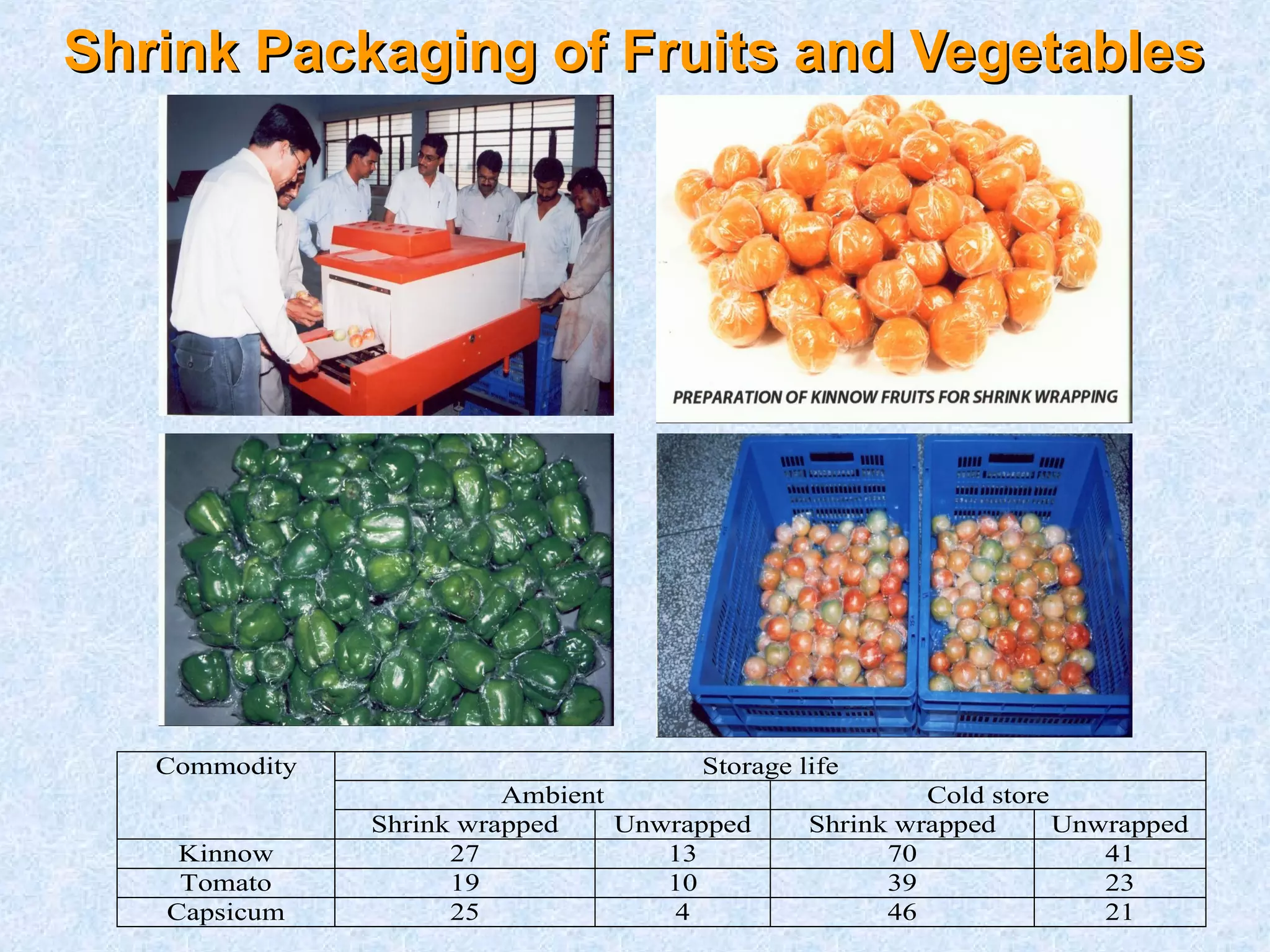
Shrink Packaging ooff FFrruuiittss aanndd VVeeggeettaabblleess 
Storage life 
Ambient Cold store 
Commodity 
Shrink wrapped Unwrapped Shrink wrapped Unwrapped 
Kinnow 27 13 70 41 
Tomato 19 10 39 23 
Capsicum 25 4 46 21
GGaarrlliicc PPrroocceessssiinngg MMaacchhiinneess 
Garlic Bulb Breaker Garlic Peeler Garlic Flaking Machine 
Capacity-800 kg/h 
Cost-US$300 
Capacity-400 kg/h 
Cost-US$300 
Capacity-40-50 kg/h 
Cost-US$1400
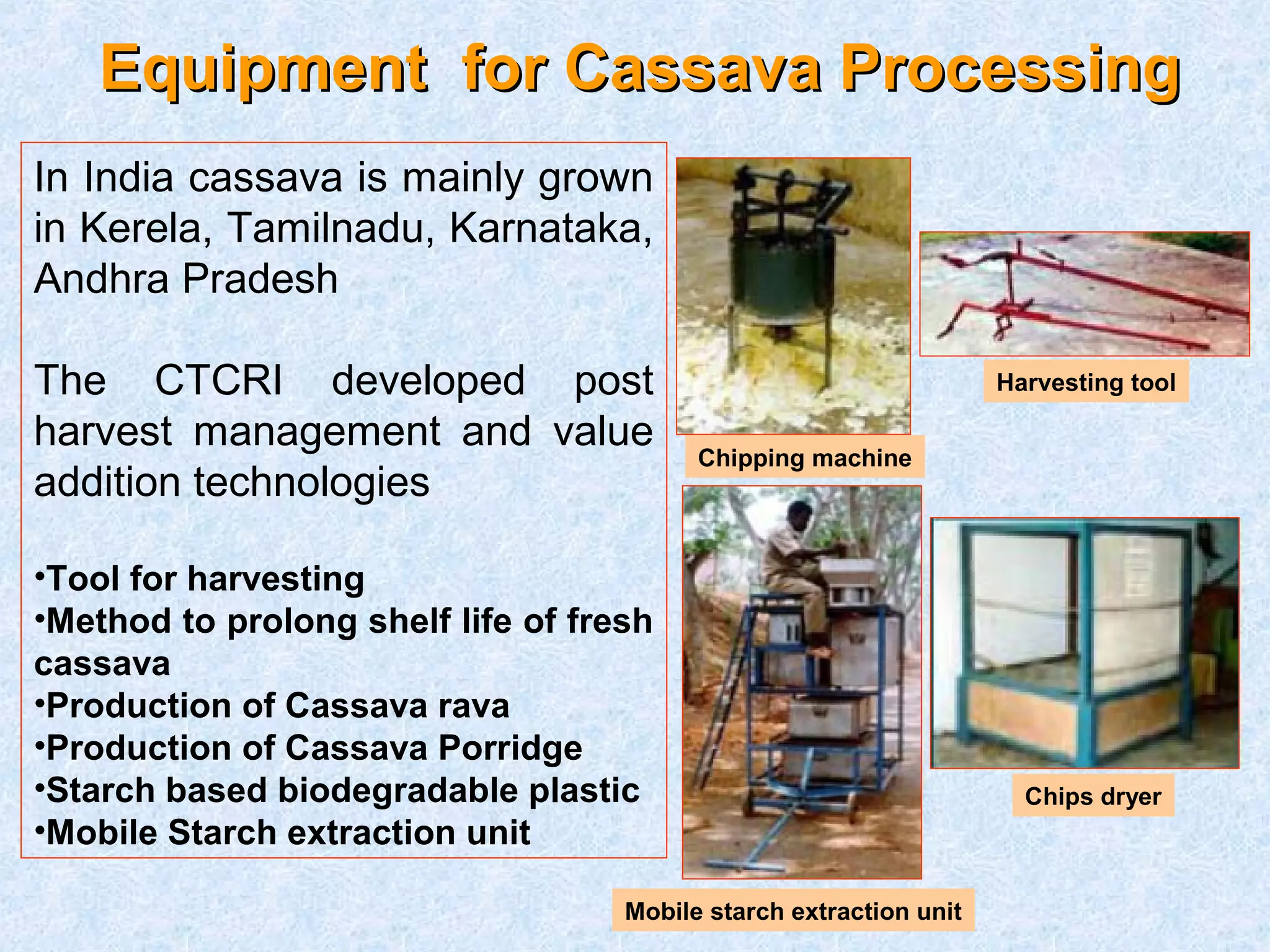
EEqquuiippmmeenntt ffoorr CCaassssaavvaa PPrroocceessssiinngg 
In India cassava is mainly grown 
in Kerela, Tamilnadu, Karnataka, 
Andhra Pradesh 
The CTCRI developed post 
harvest management and value 
addition technologies 
•Tool for harvesting 
•Method to prolong shelf life of fresh 
cassava 
•Production of Cassava rava 
•Production of Cassava Porridge 
•Starch based biodegradable plastic 
•Mobile Starch extraction unit 
Harvesting tool 
Chipping machine 
Chips dryer 
Mobile starch extraction unit
Mango Processing MMaacchhiinneerryy--IIIIHHRR 
Slices mango 4,6&8 pieces 
Capacity – 1 tonne/h 
Cost - US$4000 
Cubes the mango 
slices 
Capacity – 500 kg / h 
Cost – US$ 4000 
Raw mango peeler 
Peels raw mango 
Capacity – 200 kg /h 
Cost – US$4000 
Raw mango slicer Raw mango 
cube cutter
IImmpprroovveedd FFaarrmm LLeevveell TTuurrmmeerriicc BBooiilliinngg 
UUnniitt--TTNNAAUU 
•Capacity : About 200 kg 
per batch /40 quintals per 
day 
•Fuel requirement : 25–30 
kg per batch of 200 kg. 
•Three persons are required 
•No skilled labour is required 
•The unit can be fabricated 
to any capacity 
•Cost of the unit: Appox. 
Rs.15,000
Post harvest mechanization package for Banana central core 
2012-14
RReeccoommmmeennddaattiioonnss 
• Need to develop proper process protocols for primary 
processing and also develop crop specific machines 
• Processing of fruits and vegetables to the stage of 
dehy, puree or pulp is a primary processing industry 
and need to be established in production catchment. 
• There should be flexibility in operations – a 
combination of manual and mechanical systems but 
following proper sanitary and hygienic standards. 
• Need to develop standards for primary processed 
products which in turn will increase value addition 
and secondary agriculture activities
GGRRAAIINN SSTTOORRAAGGEE
GGrraaiinn QQuuaalliittyy iinn SSttoorraaggee 
•Optimum storage conditions-moisture less than 
12% and temperature less than 30°C will not 
deteriorate quality during storage over a season. 
Problems due to Higher temperatures: 
1)Development of hot-spots, 
2)Moisture migration from warmer to cooler grain 
causing caking, 
3)Mould development in over-moist grain 
4)Decrease in seed germination 
5)Decrease in malting quality of barley, 
6)Decrease in baking and milling quality of wheat, 
7)Colour deterioration of pulses and 
8)Rancidity in oilseeds
CCoonnddiittiioonnss iinn SSttoorraaggee 
•Grain entering a temporary storage structure should 
be cool and dry. 
•Temperatures of grain loads placed into storage 
should be within 5 to 10°C of each other to prevent 
moisture movement due to temperature gradients. 
•The grain should be placed in the storage at less than 
14% (w.b.) and preferably 13% for greater safety. 
•The average moisture content of the pile should be 
0.5 to 1% less than the safe storage moisture content. 
•Grain of poor quality should be dried 1% more than 
required for good quality grain.
GGrraaiinn SSttoorraaggee iinn IInnddiiaa 
•FCI and state agencies stored 23.08 lakh 
tonnes and 144.97 lakh tonnes, respectively 
in 2010 and the damaged grain in CAP was 
716 metric tonne in 2010 
•Storage gap (deficit) to the tune of 12-14 
MMT. 
•The efficient alternative to CAP is necessary 
to meet the growing demand for storage and 
reduction of storage losses
GGrraaiinn AAeerraattiioonn 
•Aeration is necessary, if more than 50 MT grain is 
stored for longer than 2 months. 
•Aeration rates of at least 0.04 m3 per minute per MT 
should be provided. 
•Provide two or three smaller fans and ducts to obtain 
proper air distribution in flat storage structures. 
•Aeration ducts of 30 cm or larger dia. corrugated drain 
pipes are used in temporary structures. 
•The drainpipe is covered with cloth to prevent grain 
from plugging the openings. 
•The number of fans and aeration ducts depends on the 
grain type and dimensions of the grain pile.
PPUUSSAA BBiinn 
For long duration storage a 
LDPE sandwitched PUSA bin 
has been found to be most 
suitable. he performance of the 
bin is similar to any other metal 
or concrete structures. In fact 
because of good insulation 
properties of mud brick, the 
problem of moisture migration is 
also negligible. About 9.5 million 
tonnes of food grains are stored 
in such bins in India. The 
capacity of such bins ranges 
from 0.5 to 4 t.
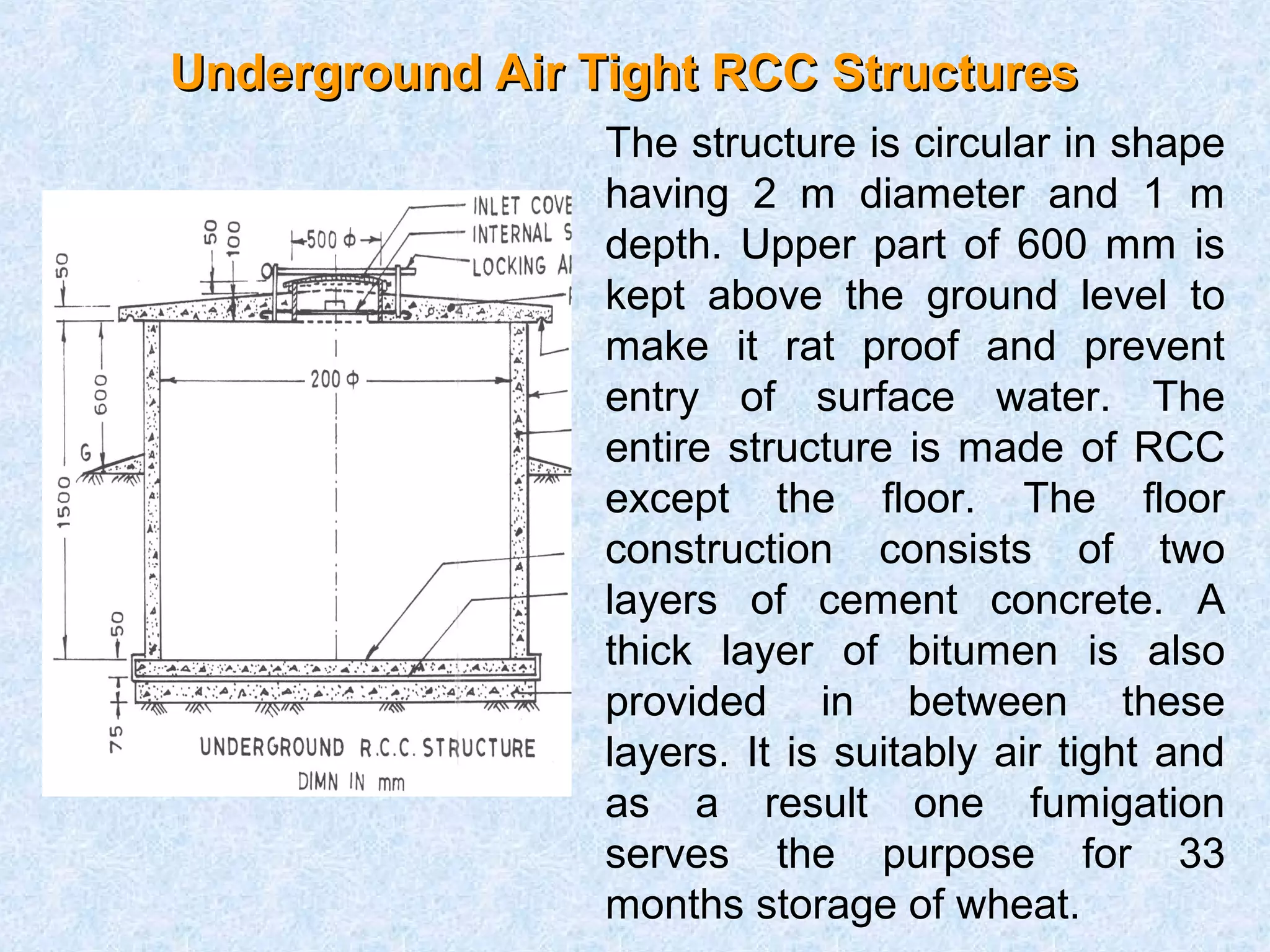
Underground AAiirr TTiigghhtt RRCCCC SSttrruuccttuurreess 
The structure is circular in shape 
having 2 m diameter and 1 m 
depth. Upper part of 600 mm is 
kept above the ground level to 
make it rat proof and prevent 
entry of surface water. The 
entire structure is made of RCC 
except the floor. The floor 
construction consists of two 
layers of cement concrete. A 
thick layer of bitumen is also 
provided in between these 
layers. It is suitably air tight and 
as a result one fumigation 
serves the purpose for 33 
months storage of wheat.
GGooddoowwnnss ((BBaagg SSttoorraaggee SSttrruuccttuurreess)) 
These are primarily meant for providing warehousing facilities to 
the farmers. The godowns, 100 t to 5000 t capacity, are owned 
by Govt. agencies. Twin span warehouse with structural trusses 
design was adopted in early sixties and constructed with brick 
or stone masonary. Asbestos or corrugated GI sheets 
supported by steel trusses are used for roofing. Due to provision 
of valley gutters, there is perennial problem of leakage resulting 
in damage of stored grain.
SSiillooss 
Metal silos are cheaper than 
concrete silos by 15-20% 
depending on their size. 
Generally Silo system is equipped 
with other preparatory units like 
cleaning and drying equipment. 
Initially silos are 50% more 
expensive but this additional cost 
is recovered within 2-4 years. The 
loss of grain in such system is 
only 0.2% compared to 1% in 
godown and warehousing 
systems. The loss caused by 
rodents, insects, fungi and 
handling is about 0.2% compared 
to 8% in godown system.
Storage SSttrruuccttuurreess uusseedd WWoorrllddwwiiddee 
•The CAP storage 
•Grain Storage Rings 
•Flexible silos 
•Prefabricated relocatable warehouses 
•Cocoons 
•Large Plastic Membrane Bags
CCoovveerr aanndd PPlliinntthh SSttoorraaggee 
•In CAP 50 kg capacity jute bags 
are used 
•The most commonly 
constructed size is for 1500 
tonnes with 3000 bags of 50 kg 
•CAP storage are with the length 
and breadth of 8.55 and 6.30 m, 
respectively. 
•The sides and ridge heights are 
4.50 and 6.00 m, respectively. 
•Regular opening of covers is 
necessary to allow some 
aeration. 
•The advantage of CAP is its low 
establishment cost, which is only 
25% the cost of godown storage
Effect ooff CCoolloorr ooff CCoovveerr oonn QQuuaalliittyy 
• Thermal model has been developed based 
on solar energy for predicting the wheat 
grain temperature while stored in CAP. 
• The model showed around 10 to 12°C rise in 
grain temperature from the mean monthly 
ambient temperature during the year with 
black cover. 
• A white colour plastic cover simulated result 
showed reduction in the grain temperature 
by 6-8oC compared to black sheet.
GGrraaiinn SSttoorraaggee RRiinnggss 
•Corrugated galvanised 
panels are rolled and 
crimped on a line 
•This deep corrugation 
are made in 22 SWG. 
•The industrial gasket is 
also provided on the top 
edge of the ring for the 
entire diameter 
protecting the tarp from 
the sharp edges of the 
steel panels.
FFlleexxiibbllee ssiillooss 
•Early types employed butyl rubber 
sheeting as the membrane and had 
capacities of up to 1,000 tonnes. 
• Currently available silos use PVC-coated 
polyester fabric & have 500 tonne 
capacity. 
•The silos require little site preparation, 
are easy to erect and are relocatable. 
•The silos require no mechanical 
equipment
PPrreeffaabbrriiccaatteedd RReellooccaattaabbllee 
WWaarreehhoouusseess 
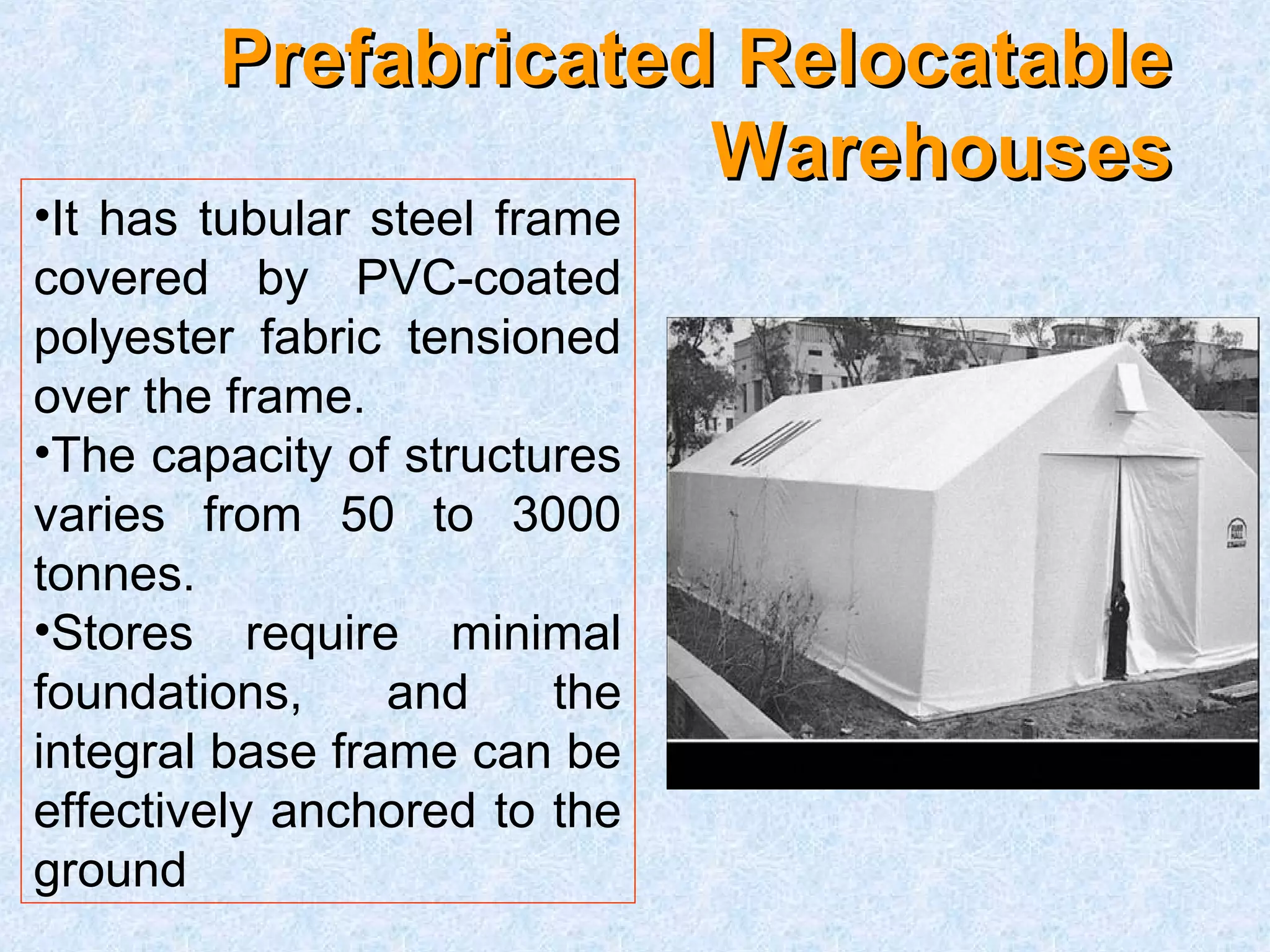
•It has tubular steel frame 
covered by PVC-coated 
polyester fabric tensioned 
over the frame. 
•The capacity of structures 
varies from 50 to 3000 
tonnes. 
•Stores require minimal 
foundations, and the 
integral base frame can be 
effectively anchored to the 
ground
CCooccoooonnss 
•These are tough but flexible 
UV-resistant PVC enclosures 
sealed with zip fasteners. 
•Light in weight when empty 
and can be delivered easily to 
site. 
•Capacity ranges from 5–50 
tonnes. 
•They prevent insect, water 
and water vapour penetration 
into the contents. 
•The cocoons are modular, 
fabricated in 5, 10, 20 and 50 
tonnes capacity.
LLaarrggee PPllaassttiicc MMeemmbbrraannee BBaaggss 
•The system is very cost 
competitive in 
comparison to other 
storage options. 
•This system of storage 
offers a low investment 
storage system that can 
be quite effective on farm 
in several scenarios. 
• The polymer bag is 
described as a hermetic 
type of storage system.
MMaajjoorr RReeccoommmmeennddaattiioonnss 
•The color of the polyethylene used in 
traditional CAP storage should be changed to 
white. 
•The prefabricated relocatable warehouses 
may be installed on the railway platforms 
where the grain need to kept for transit 
•In grain mandies the harvest bags and rings 
may be explored to avoid the damage to the 
grain due to sudden rain during harvest 
season. 
•Investigations may be undertaken to test the 
suitability of structures for Indian conditions
Modern Technologies for Food Processing and 
Storage are essential for reducing the post 
harvest losses and increasing the profitability of 
farmers 
The GDP growth in Agriculture is three times 
more effective to reduce the poverty compared 
to GDP growth from other sources

Cfmtti 2014

  • 1.
    PPOOSSTT HHAARRVVEESSTT MMAACCHHIINNEERRYYAANNDD SSTTOORRAAGGEE OOFF AAGGRRIICCUULLTTUURRAALL PPRROODDUUCCEE DDrr.. RR.. TT.. PPaattiill FFoorrmmeerr DDiirreeccttoorr,, CCIIPPHHEETT,, LLuuddhhiiaannaa CChhaaiirrmmaann && EEDD,, BBeenneevvoollee ffoorr PPHHTT,, BBhhooppaall
  • 2.
    Primary PPrroocceessssiinngg ooffHHoorrttiiccuullttuurraall PPrroodduuccee:: CCuurrrreenntt TTeecchhnnoollooggiieess aanndd FFuuttuurree PPootteennttiiaall DDrr.. RR..TT.. PPaattiill
  • 3.
    PPrroodduuccttiioonn && PPoossttHHaarrvveesstt SScceennaarriioo •Agriculture contributes about 17.5% of GDP, employees 57% workforce and sustains approx over 70% of the population •India produces about 255 million tons of food grains and 268 million tons of fruits and vegetables and ranks second in world however losses are 3-18% •Low level of processing of fruits and vegetables at only 3.5% . •Food processing is employment intensive, creates 1.8 jobs directly and 6.4 indirectly for every Rs. 10 lakh investment
  • 4.
    AAggrroo PPrroocceessssiinngg 1.Can provide processed food of highest quality at affordable cost to consumers 2. Help environment by processing food in production catchment with least food miles 3. Ensure traceability of raw materials used for processed product hence great for export and elite urban market. 4. Help effective backward linkage with farmers for processing their raw produce 5. Shorten the supply chain, increase the profitability of farmers and ultimately increase in GDP from agriculture and reduce poverty 6. Reduce post harvest losses and increased availability of by products for animal feed.
  • 5.
  • 6.
  • 7.
    PPrriiccee DDiiffffeerreennccee Wheat- Rs 12/kg Wheat Flour Rs. 16-18/kg Fortified Flour Rs. 20-25/kg Oil seed – Rs 35/kg Oil Rs. 70/kg Paddy – Rs 12/kg Rice – Rs. 25/kg Mung- Rs. 20/kg Mung dal – Rs. 60/kg Maize-Rs.13/kg Maize flour-Rs. 16/kg Tomato-Rs. 5/kg Tomato ketchup-Rs 50-80/kg Fruit- Rs. 15-20/kg Fruits Bar-Rs. 200/kg Fruit Juice- Rs. 35/litre Coriander -Rs. 80/kg Coriander Powder-Rs. 200/kg Turmeric-Rs.65/kg Turmeric Powder –Rs. 200/kg Chili- Rs. 200/kg Chili Powder-Rs. 300/kg Black pepper-Rs. 100/kg B Pepper Powder- Rs.300/kg Chana Dal- Rs. 28/kg Chana Dal-Rs. 35/kg Besan- Rs. 40/kg
  • 8.
    MMooddeerrnn RRiiccee MMiilllliinngg The major operations performed by modern rice mills are: storage, cleaning, husking, separation, whitening and grading. De-husking is done in rubber roll shellers while polishing is done in cone polishers or horizontal abrasive polishers. The rice mills can be of following capacity. (i) Composite rice milling machine-a single unit (capacity 250 kg/hr). (ii) Mini rice mills: Capacity of 250 kg/hr. However, husking and polishing is done by separate machines. (iii) Modern rice mills of capacity 2-4 t/hr.
  • 9.
    OOiill MMiilllliinngg Commoncapacity of baby oil expeller is 60 kg / hr of oil seed. Improved expellers are equipped with a special cooling system consisting essentially of hollow worm shafts or hollow barrel frame through which cooling water or oil is pumped. A filtration system is coupled with baby oil expeller becomes an integral part of a model agro industrial complex.
  • 10.
    DDaall MMiilllliinngg Capacity100-125 kg/h, Power required 3 hp Approx. Cost: Rs 60000 Efficiency-82-85% Versatility of PKV dhal mill has been enhanced (i) for polishing mold-affected sorghum and also (ii) for cleaning wheat.
  • 11.
    SSppiiccee MMiilllliinngg Itcomprises of two functions: grinding and grading such as in hammer mills or in pin mill which gives cool grinding in one direct operation. No dressing is needed to get fine grinding. The degree of fineness required can be achieved by changing screen. The hammer and hammer pins are hard heat-treated steel, interchangeable and reversible giving four times the life of ordinary hammer
  • 12.
    TTeecchhnnoollooggyy PPaacckkaaggeess ffoorrHHoorrttiiccuullttuurraall CCrrooppss
  • 13.
  • 14.
    Shrink Packaging ooffFFrruuiittss aanndd VVeeggeettaabblleess Storage life Ambient Cold store Commodity Shrink wrapped Unwrapped Shrink wrapped Unwrapped Kinnow 27 13 70 41 Tomato 19 10 39 23 Capsicum 25 4 46 21
  • 15.
    GGaarrlliicc PPrroocceessssiinngg MMaacchhiinneess Garlic Bulb Breaker Garlic Peeler Garlic Flaking Machine Capacity-800 kg/h Cost-US$300 Capacity-400 kg/h Cost-US$300 Capacity-40-50 kg/h Cost-US$1400
  • 16.
    EEqquuiippmmeenntt ffoorr CCaassssaavvaaPPrroocceessssiinngg In India cassava is mainly grown in Kerela, Tamilnadu, Karnataka, Andhra Pradesh The CTCRI developed post harvest management and value addition technologies •Tool for harvesting •Method to prolong shelf life of fresh cassava •Production of Cassava rava •Production of Cassava Porridge •Starch based biodegradable plastic •Mobile Starch extraction unit Harvesting tool Chipping machine Chips dryer Mobile starch extraction unit
  • 17.
    Mango Processing MMaacchhiinneerryy--IIIIHHRR Slices mango 4,6&8 pieces Capacity – 1 tonne/h Cost - US$4000 Cubes the mango slices Capacity – 500 kg / h Cost – US$ 4000 Raw mango peeler Peels raw mango Capacity – 200 kg /h Cost – US$4000 Raw mango slicer Raw mango cube cutter
  • 18.
    IImmpprroovveedd FFaarrmm LLeevveellTTuurrmmeerriicc BBooiilliinngg UUnniitt--TTNNAAUU •Capacity : About 200 kg per batch /40 quintals per day •Fuel requirement : 25–30 kg per batch of 200 kg. •Three persons are required •No skilled labour is required •The unit can be fabricated to any capacity •Cost of the unit: Appox. Rs.15,000
  • 19.
    Post harvest mechanizationpackage for Banana central core 2012-14
  • 20.
    RReeccoommmmeennddaattiioonnss • Needto develop proper process protocols for primary processing and also develop crop specific machines • Processing of fruits and vegetables to the stage of dehy, puree or pulp is a primary processing industry and need to be established in production catchment. • There should be flexibility in operations – a combination of manual and mechanical systems but following proper sanitary and hygienic standards. • Need to develop standards for primary processed products which in turn will increase value addition and secondary agriculture activities
  • 21.
  • 22.
    GGrraaiinn QQuuaalliittyy iinnSSttoorraaggee •Optimum storage conditions-moisture less than 12% and temperature less than 30°C will not deteriorate quality during storage over a season. Problems due to Higher temperatures: 1)Development of hot-spots, 2)Moisture migration from warmer to cooler grain causing caking, 3)Mould development in over-moist grain 4)Decrease in seed germination 5)Decrease in malting quality of barley, 6)Decrease in baking and milling quality of wheat, 7)Colour deterioration of pulses and 8)Rancidity in oilseeds
  • 23.
    CCoonnddiittiioonnss iinn SSttoorraaggee •Grain entering a temporary storage structure should be cool and dry. •Temperatures of grain loads placed into storage should be within 5 to 10°C of each other to prevent moisture movement due to temperature gradients. •The grain should be placed in the storage at less than 14% (w.b.) and preferably 13% for greater safety. •The average moisture content of the pile should be 0.5 to 1% less than the safe storage moisture content. •Grain of poor quality should be dried 1% more than required for good quality grain.
  • 24.
    GGrraaiinn SSttoorraaggee iinnIInnddiiaa •FCI and state agencies stored 23.08 lakh tonnes and 144.97 lakh tonnes, respectively in 2010 and the damaged grain in CAP was 716 metric tonne in 2010 •Storage gap (deficit) to the tune of 12-14 MMT. •The efficient alternative to CAP is necessary to meet the growing demand for storage and reduction of storage losses
  • 25.
    GGrraaiinn AAeerraattiioonn •Aerationis necessary, if more than 50 MT grain is stored for longer than 2 months. •Aeration rates of at least 0.04 m3 per minute per MT should be provided. •Provide two or three smaller fans and ducts to obtain proper air distribution in flat storage structures. •Aeration ducts of 30 cm or larger dia. corrugated drain pipes are used in temporary structures. •The drainpipe is covered with cloth to prevent grain from plugging the openings. •The number of fans and aeration ducts depends on the grain type and dimensions of the grain pile.
  • 26.
    PPUUSSAA BBiinn Forlong duration storage a LDPE sandwitched PUSA bin has been found to be most suitable. he performance of the bin is similar to any other metal or concrete structures. In fact because of good insulation properties of mud brick, the problem of moisture migration is also negligible. About 9.5 million tonnes of food grains are stored in such bins in India. The capacity of such bins ranges from 0.5 to 4 t.
  • 27.
    Underground AAiirr TTiigghhttRRCCCC SSttrruuccttuurreess The structure is circular in shape having 2 m diameter and 1 m depth. Upper part of 600 mm is kept above the ground level to make it rat proof and prevent entry of surface water. The entire structure is made of RCC except the floor. The floor construction consists of two layers of cement concrete. A thick layer of bitumen is also provided in between these layers. It is suitably air tight and as a result one fumigation serves the purpose for 33 months storage of wheat.
  • 28.
    GGooddoowwnnss ((BBaagg SSttoorraaggeeSSttrruuccttuurreess)) These are primarily meant for providing warehousing facilities to the farmers. The godowns, 100 t to 5000 t capacity, are owned by Govt. agencies. Twin span warehouse with structural trusses design was adopted in early sixties and constructed with brick or stone masonary. Asbestos or corrugated GI sheets supported by steel trusses are used for roofing. Due to provision of valley gutters, there is perennial problem of leakage resulting in damage of stored grain.
  • 29.
    SSiillooss Metal silosare cheaper than concrete silos by 15-20% depending on their size. Generally Silo system is equipped with other preparatory units like cleaning and drying equipment. Initially silos are 50% more expensive but this additional cost is recovered within 2-4 years. The loss of grain in such system is only 0.2% compared to 1% in godown and warehousing systems. The loss caused by rodents, insects, fungi and handling is about 0.2% compared to 8% in godown system.
  • 30.
    Storage SSttrruuccttuurreess uusseeddWWoorrllddwwiiddee •The CAP storage •Grain Storage Rings •Flexible silos •Prefabricated relocatable warehouses •Cocoons •Large Plastic Membrane Bags
  • 31.
    CCoovveerr aanndd PPlliinntthhSSttoorraaggee •In CAP 50 kg capacity jute bags are used •The most commonly constructed size is for 1500 tonnes with 3000 bags of 50 kg •CAP storage are with the length and breadth of 8.55 and 6.30 m, respectively. •The sides and ridge heights are 4.50 and 6.00 m, respectively. •Regular opening of covers is necessary to allow some aeration. •The advantage of CAP is its low establishment cost, which is only 25% the cost of godown storage
  • 32.
    Effect ooff CCoolloorrooff CCoovveerr oonn QQuuaalliittyy • Thermal model has been developed based on solar energy for predicting the wheat grain temperature while stored in CAP. • The model showed around 10 to 12°C rise in grain temperature from the mean monthly ambient temperature during the year with black cover. • A white colour plastic cover simulated result showed reduction in the grain temperature by 6-8oC compared to black sheet.
  • 33.
    GGrraaiinn SSttoorraaggee RRiinnggss •Corrugated galvanised panels are rolled and crimped on a line •This deep corrugation are made in 22 SWG. •The industrial gasket is also provided on the top edge of the ring for the entire diameter protecting the tarp from the sharp edges of the steel panels.
  • 34.
    FFlleexxiibbllee ssiillooss •Earlytypes employed butyl rubber sheeting as the membrane and had capacities of up to 1,000 tonnes. • Currently available silos use PVC-coated polyester fabric & have 500 tonne capacity. •The silos require little site preparation, are easy to erect and are relocatable. •The silos require no mechanical equipment
  • 35.
    PPrreeffaabbrriiccaatteedd RReellooccaattaabbllee WWaarreehhoouusseess •It has tubular steel frame covered by PVC-coated polyester fabric tensioned over the frame. •The capacity of structures varies from 50 to 3000 tonnes. •Stores require minimal foundations, and the integral base frame can be effectively anchored to the ground
  • 36.
    CCooccoooonnss •These aretough but flexible UV-resistant PVC enclosures sealed with zip fasteners. •Light in weight when empty and can be delivered easily to site. •Capacity ranges from 5–50 tonnes. •They prevent insect, water and water vapour penetration into the contents. •The cocoons are modular, fabricated in 5, 10, 20 and 50 tonnes capacity.
  • 37.
    LLaarrggee PPllaassttiicc MMeemmbbrraanneeBBaaggss •The system is very cost competitive in comparison to other storage options. •This system of storage offers a low investment storage system that can be quite effective on farm in several scenarios. • The polymer bag is described as a hermetic type of storage system.
  • 38.
    MMaajjoorr RReeccoommmmeennddaattiioonnss •Thecolor of the polyethylene used in traditional CAP storage should be changed to white. •The prefabricated relocatable warehouses may be installed on the railway platforms where the grain need to kept for transit •In grain mandies the harvest bags and rings may be explored to avoid the damage to the grain due to sudden rain during harvest season. •Investigations may be undertaken to test the suitability of structures for Indian conditions
  • 39.
    Modern Technologies forFood Processing and Storage are essential for reducing the post harvest losses and increasing the profitability of farmers The GDP growth in Agriculture is three times more effective to reduce the poverty compared to GDP growth from other sources