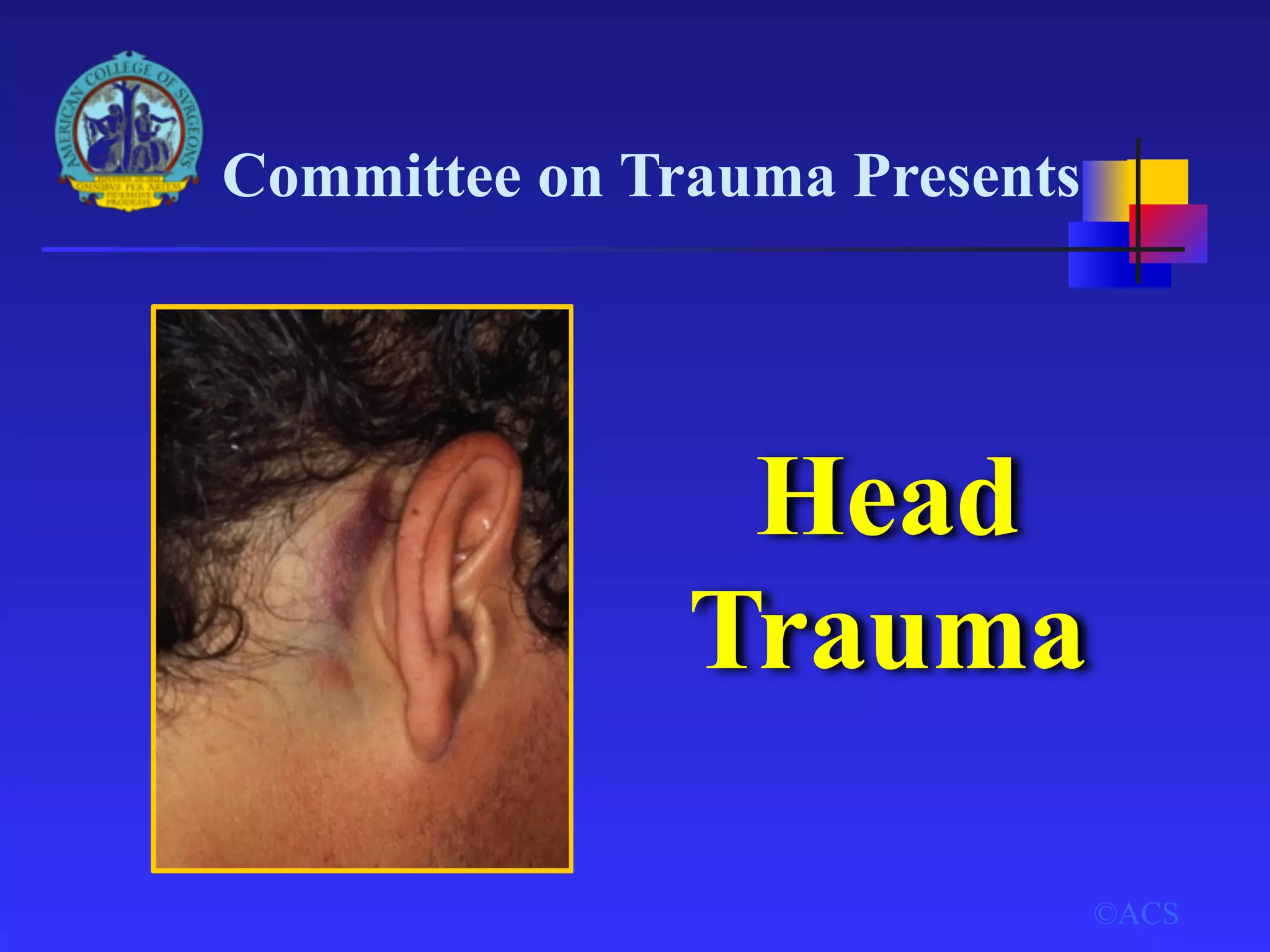
Committee on Trauma Presents
©ACS
Head
Trauma
Objectives
➢ Describe basic intracranial physiology.
➢ Recognize the importance of limiting
secondary brain injury.
➢ Perform a focused neurologic exam.
➢ Stabilize and arrange for definitive care.
©ACS
➢ Rigid, nonexpansile skull filled with
brain, CSF, and blood
➢ CBF autoregulation
➢ Autoregulatory compensation
disrupted by brain injury
➢ Mass effect of intracranial hemorrhage
©ACS
Anatomy and physiology effects?
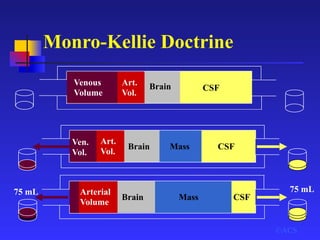
Monro-Kellie Doctrine
©ACS
Ven.
Vol.
Art.
Vol.
Brain CSFMass
Arterial
Volume
Brain CSF
75 mL
Mass
75 mL
Venous
Volume
Art.
Vol.
Brain CSF
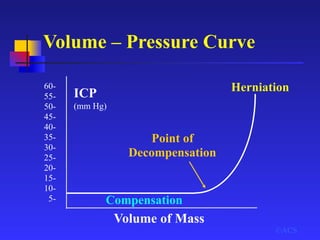
Volume – Pressure Curve
©ACS
Volume of Mass
60-
55-
50-
45-
40-
35-
30-
25-
20-
15-
10-
5-
ICP
(mm Hg)
Compensation
Herniation
Point of
Decompensation
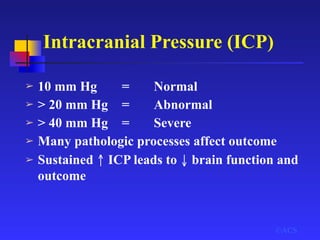
Intracranial Pressure (ICP)
➢ 10 mm Hg = Normal
➢ > 20 mm Hg = Abnormal
➢ > 40 mm Hg = Severe
➢ Many pathologic processes affect outcome
➢ Sustained ↑ ICP leads to ↓ brain function and
outcome
©ACS
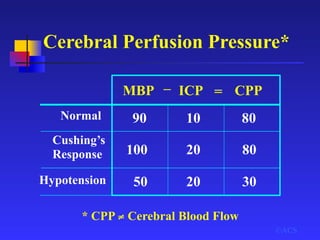
Cerebral Perfusion Pressure*
©ACS
* CPP ≠ Cerebral Blood Flow
MBP ICP CPP
Normal
Cushing’s
Response
Hypotension
– =
30
90
100
50
10 80
20
20
80
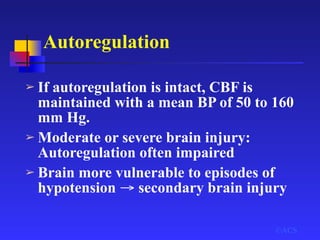
Autoregulation
➢ If autoregulation is intact, CBF is
maintained with a mean BP of 50 to 160
mm Hg.
➢ Moderate or severe brain injury:
Autoregulation often impaired
➢ Brain more vulnerable to episodes of
hypotension → secondary brain injury
©ACS
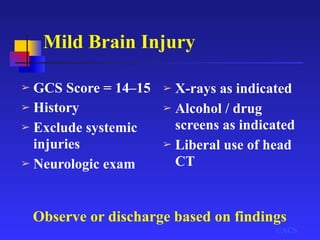
Mild Brain Injury
©ACS
➢ GCS Score = 14–15
➢ History
➢ Exclude systemic
injuries
➢ Neurologic exam
➢ X-rays as indicated
➢ Alcohol / drug
screens as indicated
➢ Liberal use of head
CT
Observe or discharge based on findings
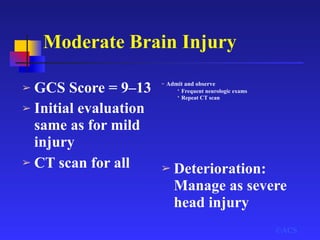
Moderate Brain Injury
©ACS
➢ GCS Score = 9–13
➢ Initial evaluation
same as for mild
injury
➢ CT scan for all
➢ Admit and observe
• Frequent neurologic exams
• Repeat CT scan
➢ Deterioration:
Manage as severe
head injury
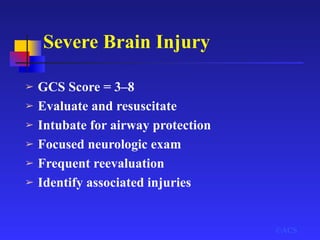
Severe Brain Injury
➢ GCS Score = 3–8
➢ Evaluate and resuscitate
➢ Intubate for airway protection
➢ Focused neurologic exam
➢ Frequent reevaluation
➢ Identify associated injuries
©ACS
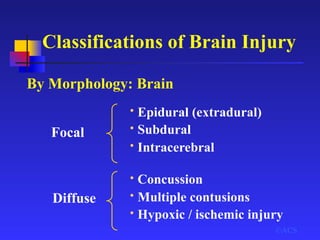
Classifications of Brain Injury
©ACS
By Morphology: Brain
Focal
Diffuse
• Epidural (extradural)
• Subdural
• Intracerebral
• Concussion
• Multiple contusions
• Hypoxic / ischemic injury
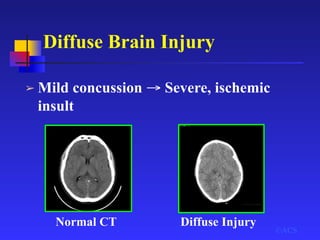
Diffuse Brain Injury
➢ Mild concussion → Severe, ischemic
insult
©ACS
Normal CT Diffuse Injury
Contusion / Hematoma
➢ Coup / contracoup injuries
➢ Most common: Frontal / temporal lobes
➢ CT changes usually progressive
➢ Most conscious patients: No operation
©ACS
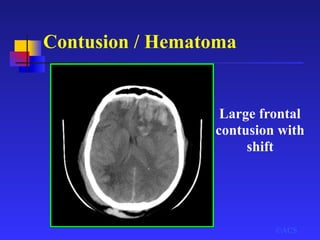
Contusion / Hematoma
©ACS
Large frontal
contusion with
shift
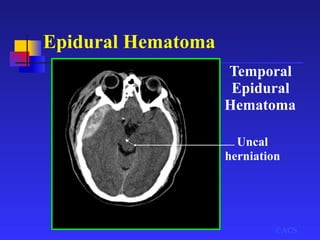
Epidural Hematoma
➢ Associated with skull fracture
➢ Classic: Middle meningeal artery tear
➢ Lenticular / biconvex
➢ Lucid interval
➢ Can be rapidly fatal
➢ Early evacuation essential
©ACS
Epidural Hematoma
Uncal
herniation
Temporal
Epidural
Hematoma
©ACS
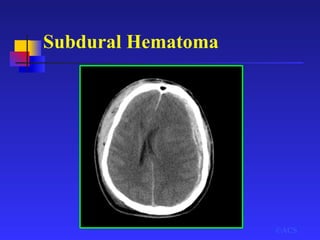
Subdural Hematoma
➢ Venous tear / brain laceration
➢ Covers cerebral surface
➢ Morbidity / mortality due to underlying
brain injury
➢ Rapid surgical evacuation
recommended, especially if > 5 mm
shift of midline
©ACS
Subdural Hematoma
©ACS
Priorities
➢ ABCDE
©ACS
➢ Minimize secondary brain injury
• Administer O2
• Maintain blood pressure
(systolic > 90 mm Hg)
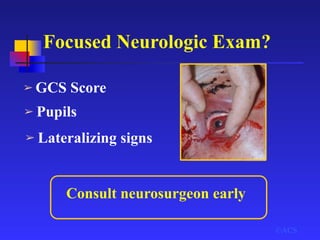
Focused Neurologic Exam?
➢ GCS Score
©ACS
Consult neurosurgeon early
➢ Pupils
➢ Lateralizing signs
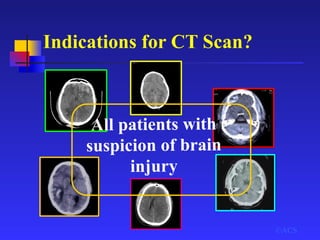
Indications for CT Scan?
©ACS
All patients with
suspicion of brain
injury
Medical Management
➢ Controlled ventilation
©ACS
➢ Intravenous fluids
• Euvolemia
• Isotonic
• Goal: Paco2 at 35 mm Hg
Medical Management
©ACS
➢ Mannitol
• Use with signs of tentorial herniation
• Dose: 1.0 g / kg IV bolus
• Consult with neurosurgeon first
Medical Management
➢ Other medications
©ACS
• Anticonvulsants
• Sedation
• Paralytics
Surgical Management
©ACS
Scalp Injuries
➢ Possible site of major blood loss
➢ Direct pressure to control bleeding
➢ Occasional temporary closure
Surgical Management
©ACS
Intracranial Mass Lesion
➢ May be life-threatening if expanding
rapidly
➢ Immediate neurosurgical consult
➢ Hyperventilation / Mannitol
➢ Damage control craniotomy: Transfer
to neurosurgeon (rural / austere areas)
©ACS
?
Summary: What should I do?
➢ Maintain mean BP > 90 mm Hg
➢ Maintain Paco2 near / at 35 mm Hg
➢ Use isotonic solution for euvolemia
➢ Frequent neurologic exams
➢ Liberal use of CT scans
➢ Early neurosurgical consult
©ACS
Summary: What should I not do?
➢ Allow patient to become hypotensive
➢ Over-aggressively hyperventilate
➢ Use hypotonic IV fluids
➢ Use long-acting paralytics
➢ Paralyze before performing complete exam
➢ Depend on clinical exam alone
©ACS

Atls head trauma modified pdf

  • 1.
    Committee on TraumaPresents ©ACS Head Trauma
  • 2.
    Objectives ➢ Describe basicintracranial physiology. ➢ Recognize the importance of limiting secondary brain injury. ➢ Perform a focused neurologic exam. ➢ Stabilize and arrange for definitive care. ©ACS
  • 3.
    ➢ Rigid, nonexpansileskull filled with brain, CSF, and blood ➢ CBF autoregulation ➢ Autoregulatory compensation disrupted by brain injury ➢ Mass effect of intracranial hemorrhage ©ACS Anatomy and physiology effects?
  • 4.
  • 5.
    Volume – PressureCurve ©ACS Volume of Mass 60- 55- 50- 45- 40- 35- 30- 25- 20- 15- 10- 5- ICP (mm Hg) Compensation Herniation Point of Decompensation
  • 6.
    Intracranial Pressure (ICP) ➢10 mm Hg = Normal ➢ > 20 mm Hg = Abnormal ➢ > 40 mm Hg = Severe ➢ Many pathologic processes affect outcome ➢ Sustained ↑ ICP leads to ↓ brain function and outcome ©ACS
  • 7.
    Cerebral Perfusion Pressure* ©ACS *CPP ≠ Cerebral Blood Flow MBP ICP CPP Normal Cushing’s Response Hypotension – = 30 90 100 50 10 80 20 20 80
  • 8.
    Autoregulation ➢ If autoregulationis intact, CBF is maintained with a mean BP of 50 to 160 mm Hg. ➢ Moderate or severe brain injury: Autoregulation often impaired ➢ Brain more vulnerable to episodes of hypotension → secondary brain injury ©ACS
  • 9.
    Mild Brain Injury ©ACS ➢GCS Score = 14–15 ➢ History ➢ Exclude systemic injuries ➢ Neurologic exam ➢ X-rays as indicated ➢ Alcohol / drug screens as indicated ➢ Liberal use of head CT Observe or discharge based on findings
  • 10.
    Moderate Brain Injury ©ACS ➢GCS Score = 9–13 ➢ Initial evaluation same as for mild injury ➢ CT scan for all ➢ Admit and observe • Frequent neurologic exams • Repeat CT scan ➢ Deterioration: Manage as severe head injury
  • 11.
    Severe Brain Injury ➢GCS Score = 3–8 ➢ Evaluate and resuscitate ➢ Intubate for airway protection ➢ Focused neurologic exam ➢ Frequent reevaluation ➢ Identify associated injuries ©ACS
  • 12.
    Classifications of BrainInjury ©ACS By Morphology: Brain Focal Diffuse • Epidural (extradural) • Subdural • Intracerebral • Concussion • Multiple contusions • Hypoxic / ischemic injury
  • 13.
    Diffuse Brain Injury ➢Mild concussion → Severe, ischemic insult ©ACS Normal CT Diffuse Injury
  • 14.
    Contusion / Hematoma ➢Coup / contracoup injuries ➢ Most common: Frontal / temporal lobes ➢ CT changes usually progressive ➢ Most conscious patients: No operation ©ACS
  • 15.
    Contusion / Hematoma ©ACS Largefrontal contusion with shift
  • 16.
    Epidural Hematoma ➢ Associatedwith skull fracture ➢ Classic: Middle meningeal artery tear ➢ Lenticular / biconvex ➢ Lucid interval ➢ Can be rapidly fatal ➢ Early evacuation essential ©ACS
  • 17.
  • 18.
    Subdural Hematoma ➢ Venoustear / brain laceration ➢ Covers cerebral surface ➢ Morbidity / mortality due to underlying brain injury ➢ Rapid surgical evacuation recommended, especially if > 5 mm shift of midline ©ACS
  • 19.
  • 20.
    Priorities ➢ ABCDE ©ACS ➢ Minimizesecondary brain injury • Administer O2 • Maintain blood pressure (systolic > 90 mm Hg)
  • 21.
    Focused Neurologic Exam? ➢GCS Score ©ACS Consult neurosurgeon early ➢ Pupils ➢ Lateralizing signs
  • 22.
    Indications for CTScan? ©ACS All patients with suspicion of brain injury
  • 23.
    Medical Management ➢ Controlledventilation ©ACS ➢ Intravenous fluids • Euvolemia • Isotonic • Goal: Paco2 at 35 mm Hg
  • 24.
    Medical Management ©ACS ➢ Mannitol •Use with signs of tentorial herniation • Dose: 1.0 g / kg IV bolus • Consult with neurosurgeon first
  • 25.
    Medical Management ➢ Othermedications ©ACS • Anticonvulsants • Sedation • Paralytics
  • 26.
    Surgical Management ©ACS Scalp Injuries ➢Possible site of major blood loss ➢ Direct pressure to control bleeding ➢ Occasional temporary closure
  • 27.
    Surgical Management ©ACS Intracranial MassLesion ➢ May be life-threatening if expanding rapidly ➢ Immediate neurosurgical consult ➢ Hyperventilation / Mannitol ➢ Damage control craniotomy: Transfer to neurosurgeon (rural / austere areas)
  • 28.
  • 29.
    Summary: What shouldI do? ➢ Maintain mean BP > 90 mm Hg ➢ Maintain Paco2 near / at 35 mm Hg ➢ Use isotonic solution for euvolemia ➢ Frequent neurologic exams ➢ Liberal use of CT scans ➢ Early neurosurgical consult ©ACS
  • 30.
    Summary: What shouldI not do? ➢ Allow patient to become hypotensive ➢ Over-aggressively hyperventilate ➢ Use hypotonic IV fluids ➢ Use long-acting paralytics ➢ Paralyze before performing complete exam ➢ Depend on clinical exam alone ©ACS