Spine Fractures
By: Radhika Chintamani
Ref: Vaccaro. A. Fractures of Cervical Thoracic and Lumbar Spine.
Fractures occurring at the spine, or any part of the spine, i.e. cervical, thoracic, lumbar, sacral
and coccyx is called so.
Cervical Spine #:
FUNCTIONALSPINAL ANATOMY:
The cervical spine consists of seven vertebrae with unique morphometry aligned normally in
lordosis. The cervical spine may be divided into an upper cervical region, the
occipitoatlantoaxial region (occiput-C1–C2), and a lower cervical region, the subaxial region
(C3–C7). The occipitoatlantoaxial complex serves as a transitional zone between the cranium
and the spine. It is one of the most complex articulations in the body. The unique anatomy of the
first and second vertebrae contribute to the versatile flexibility of the occipitoatlantoaxial
complex.
The first cervical vertebra, atlas or C1, is a modified ring of bone. By virtue of embryological
development, C1 has no central body, and has a thin posterior neural arch just posterior to the
facet joints (3). This thin area of the ring is a frequent area for fractures.
The second cervical vertebra, the axis or C2, more typically resembles the other cervical
vertebrae. Posteriorly, the axis contains a bifid spinous process and anteriorly, the odontoid
process or dens. The dens projects vertically from the superior aspect of the body of the axis and
articulates with the posterior aspect of the anterior arch of the atlas.
No intervertebral disk is present between the occiput and C1, nor between C1 and C2, in normal
circumstances, stability is maintained in part by the ligaments of the cruciate complex.
Anteriorly, the atlanto-occipital ligament or membrane, appearing as a continuation of the
anterior longitudinal ligament, attaches to the anterior aspect of the body of C2. The anterior
longitudinal ligament is stronger at C1-C2 than at any other level in the spine (11). Posteriorly,
the posterior atlanto-occipital ligament connects the posterior ring of C1 to the posterior aspect
of the foramen magnum.
In the lower cervical spine (C3–C7), the subaxial vertebrae have a similar appearance. Dorsal
lateral superior projections of the vertebral body, called the uncinate processes, help prevent
lateral displacement (14). The facet joints in the lower cervical spine arise from the superior and
inferior aspects of the pedicle. The facets tilt upward approximately 45 degrees from the
horizontal. This characteristic inclination allows for flexion/extension and for lateral bending.
Lateral bending is coupled with rotation (15). Any rotation of the lower cervical spine is
accompanied by lateral bending in the same direction (16–18).
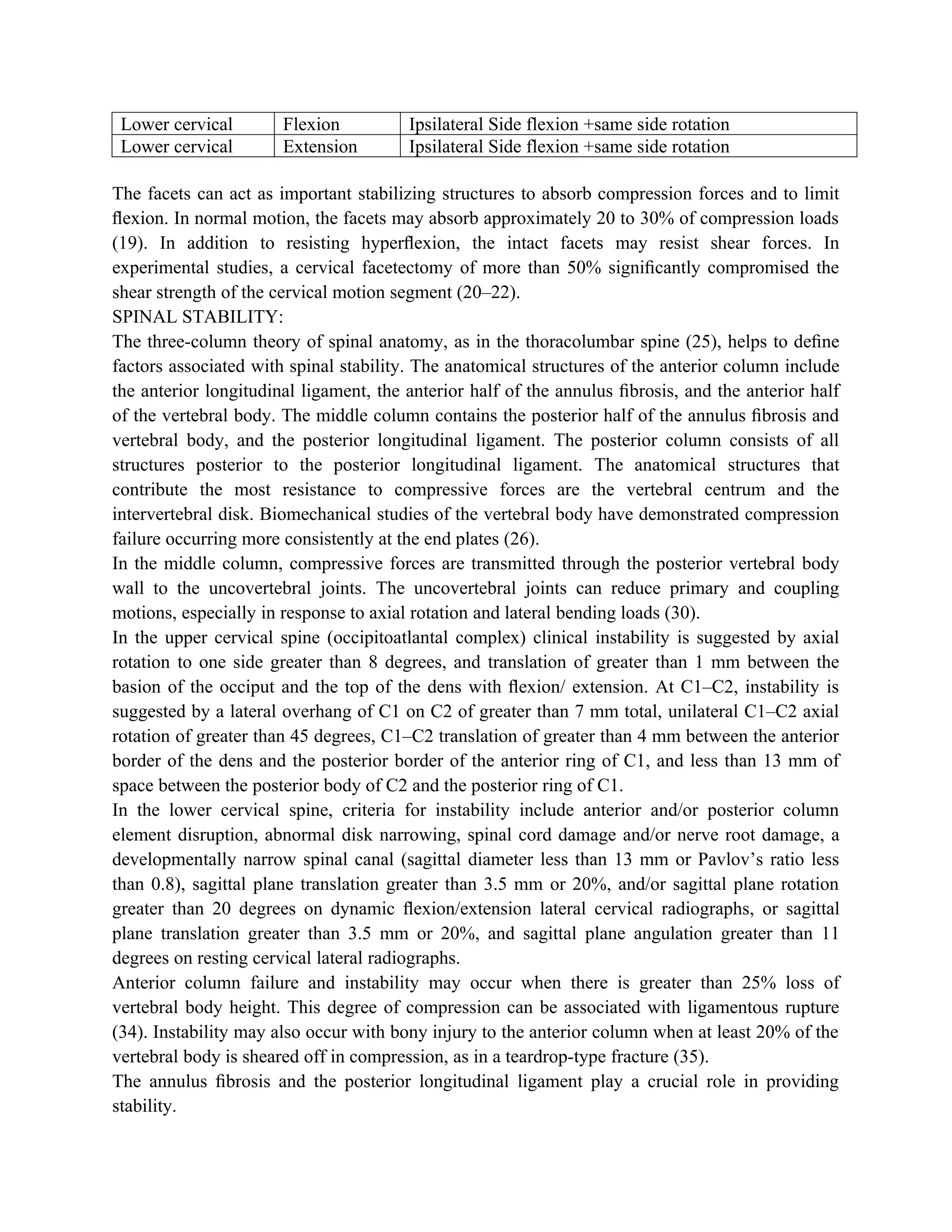
Combined movement pattern of the cervical spine:
Upper cervical Flexion Ipsilateral Side flexion + opposite side rotation
Upper cervical Extension Ipsilateral Side flexion+ opposite side rotation
Lower cervical Flexion Ipsilateral Side flexion +same side rotation
Lower cervical Extension Ipsilateral Side flexion +same side rotation
The facets can act as important stabilizing structures to absorb compression forces and to limit
flexion. In normal motion, the facets may absorb approximately 20 to 30% of compression loads
(19). In addition to resisting hyperflexion, the intact facets may resist shear forces. In
experimental studies, a cervical facetectomy of more than 50% significantly compromised the
shear strength of the cervical motion segment (20–22).
SPINAL STABILITY:
The three-column theory of spinal anatomy, as in the thoracolumbar spine (25), helps to define
factors associated with spinal stability. The anatomical structures of the anterior column include
the anterior longitudinal ligament, the anterior half of the annulus fibrosis, and the anterior half
of the vertebral body. The middle column contains the posterior half of the annulus fibrosis and
vertebral body, and the posterior longitudinal ligament. The posterior column consists of all
structures posterior to the posterior longitudinal ligament. The anatomical structures that
contribute the most resistance to compressive forces are the vertebral centrum and the
intervertebral disk. Biomechanical studies of the vertebral body have demonstrated compression
failure occurring more consistently at the end plates (26).
In the middle column, compressive forces are transmitted through the posterior vertebral body
wall to the uncovertebral joints. The uncovertebral joints can reduce primary and coupling
motions, especially in response to axial rotation and lateral bending loads (30).
In the upper cervical spine (occipitoatlantal complex) clinical instability is suggested by axial
rotation to one side greater than 8 degrees, and translation of greater than 1 mm between the
basion of the occiput and the top of the dens with flexion/ extension. At C1–C2, instability is
suggested by a lateral overhang of C1 on C2 of greater than 7 mm total, unilateral C1–C2 axial
rotation of greater than 45 degrees, C1–C2 translation of greater than 4 mm between the anterior
border of the dens and the posterior border of the anterior ring of C1, and less than 13 mm of
space between the posterior body of C2 and the posterior ring of C1.
In the lower cervical spine, criteria for instability include anterior and/or posterior column
element disruption, abnormal disk narrowing, spinal cord damage and/or nerve root damage, a
developmentally narrow spinal canal (sagittal diameter less than 13 mm or Pavlov’s ratio less
than 0.8), sagittal plane translation greater than 3.5 mm or 20%, and/or sagittal plane rotation
greater than 20 degrees on dynamic flexion/extension lateral cervical radiographs, or sagittal
plane translation greater than 3.5 mm or 20%, and sagittal plane angulation greater than 11
degrees on resting cervical lateral radiographs.
Anterior column failure and instability may occur when there is greater than 25% loss of
vertebral body height. This degree of compression can be associated with ligamentous rupture
(34). Instability may also occur with bony injury to the anterior column when at least 20% of the
vertebral body is sheared off in compression, as in a teardrop-type fracture (35).
The annulus fibrosis and the posterior longitudinal ligament play a crucial role in providing
stability.
CLINICAL BIOMECHANICSOF SPECIFIC CERVICAL SPINE INJURIES:
A. Flexion Injuries:
caused by a predominant force vector exerted axially primarily in the region of the
anterior elements. Forward translation and/or rotation of the cervical vertebrae may occur
in the sagittal plane. Simultaneous compression of the anterior column and distraction of
the posterior column of the spine occur.
B. Anterior Subluxation (Ligamentous Hyperflexion Strain):
Hyperflexion and simultaneous distractive forces during rapid head acceleration or
deceleration can cause tensile failure of the posterior osseous-ligamentous structures.
Progressive ligamentous injury can occur from posterior to anterior and can contribute up
to a 30 to 50% incidence of delayed instability (52). Minor sprains may be painful but
have minimal long-term consequence. Major ligamentous injuries are highly unstable;
their diagnosis may be initially missed or frequently delayed, because initial radiographs
are interpreted as negative. Plain radiographs may show only subtle signs of instability:
local kyphosis, angulation of adjacent endplates at a single level, or interspinous
widening. A supine cross-table lateral x-ray may not reveal injury, because the supine
position places the neck in extension which may reduce the deformity. Dynamic
flexion/extension radiographs should be avoided, as they may cause dislocation and
spinal cord injury. CT with sagittal reconstruction and MRI with fat suppression
techniques may be useful in identifying posterior ligamentous injuries.
C. Flexion Distraction Injury:
Flexion-distraction injuries represent a continuum of ligamentous injuries. They range
from sprains or minor tears of the interspinous ligaments and the facet capsules, to more
severe, unstable injuries that involve complete disruption of the ligamentous structures
and disk and result in subluxations, dislocations, and fracture/dislocations of the facets
and posterior elements.
Bilateral
Facet
Subluxation
Results from flexion distraction force, usually without a rotational
component;
From a sprain of the posterior cervical ligaments, partial disruption of the
interspinous ligaments as well as a of the facet capsules.
Widening between the spinous processes locally may be detected on a
flexion radiograph.
The facet joints may be subluxated superiorly and anteriorly, and may
result in slight kyphosis of less than 10 degrees on a lateral radiograph.
Bilateral
Perched
facet
This injury represents a progression of the previous flexion-distraction
mechanism.
The inferior articular process translates superiorly and anteriorly until the
inferior tip of the facet comes to rest on the top of the superior facet
below.
A local segmental kyphosis results, a complete rupture of the facet
capsules and the interspinous ligaments occurs, and there may be partial
disruption of the ligamentum flavum and posterior annulus.
Bilateral
facet
dislocation
Due to terminal progression of the predominant hyperflexion force vector.
Considerable tensile loading of the posterior elements causes significant
ligamentous disruption all through the functional spinal unit.
This causes the facets to ride up and be displaced superiorly and
anteriorly.
In approximately 30 to 50% of these cases, an associated traumatic disk
herniation develops (61,62). The disk disruption creates an anterior
column flexion instability
D. Flexion Rotation Injury:
Leads to unilateral ligamentous injuries that are less common than bilateral ligamentous
hyperflexion distraction-type injuries. They differ from their bilateral counterparts since a
rotational force vector is present. The degree of rotational deformity increases
proportionately with the amount of disruption and translation of the facet. That is, with
less rotational force, subluxation results rather than a unilateral dislocation.
E. Simple Wedge Compression Fracture:
A hyperflexion force sufficient to cause impaction of one vertebra against an adjacent
vertebra may cause this type of fracture. Minimal deformations suggest a midline, axially
directed force of low magnitude (48). A compression fracture with central depression
probably results from a greater force in which the intervertebral disk, as a wedge, is
driven through the end plate into the vertebral body (49). During axial compression
testing, 88% of the applied load passed through the disk, and maximum intradiskal
pressure occurred in flexion with axial compression.
F. Clay Shoveler’s Fracture:
A clay-shoveler’s fracture is an avulsion fracture of the spinous process. It occurs most
commonly at C7 (51). This fracture develops when the head and upper cervical spine are
forced into flexion and overcome the opposing action of the interspinous ligament.
G. Tear Drop Fracture:
The major injury forces in the teardrop fracture appear to be acute flexion and
compression with the spine in an attitude of flexion (54–58). In contradistinction, strong
vertical forces applied to the neck in a straightened position create burst-type fractures.
Shearing forces across the intervertebral disk and retrolisthesis of the vertebral body into
the spinal canal can occur (59). Tensile failure of the posterior osseousligamentous
structures can cause interspinous separation and fracturing of the lamina and spinous
processes. The posterior longitudinal ligament usually is preserved and it may guide
realignment during fracture reduction.
Stages:
Stages Description
I Consist of blunting of the anterior superior vertebral margin of the vertebral
body with no evidence of failure of the posterior ligaments.
II I+ wedging of the anterior vertebral body and loss of height of the anterior
centrum. A ‘‘beak’’appearance of the anterior inferior vertebral body results.
III I+II+ the beak is fractured, and a fracture line passes obliquely from the
anterior surface of the vertebral body through the inferior subchondral
endplate.
IV I+II+III+ less than 3 mm of displacement of the posteroinferior margin into
the spinal canal.
V I+II+III+ there is evidence of posterior ligament disruption and more
significant retropulsion into the spinal canal.
H. Unilateral Facet Farcture:
Superior Facet Fracture Inferior Facet Fracture Fracture separation of the
lateral mass
The mechanism of injury is
predominantly rotation in
slight flexion.
The capsule of the injured
facet is usually intact and,
as a result, may carry a
displaced fragment into the
neural foramen.
Disruption of the posterior
superior corner of the
intervertebral disk may also
occur.
The capsule of the
contralateral noninjured
facet remains intact, and
there may be stretching of
the interspinous ligaments.
A flexion-rotation injury.
The involved facet capsule
is usually disrupted, and a
posterior greenstick fracture
of the facet develops.
The resulting instability is
predominantly rotational
with a minimal flexion
component.
An extension-rotation.
The predominant injury
force is rotational.
The rotational movement
can produce instability at
more than one level.
Most of the instability
occurs at the level of the
fracture or at the level
below the fracture
separation.
A pedicle fracture, and a
vertical laminar fracture
with associated injury to the
facet capsules develop.
A true dislocation at one
level or at two levels may
result.
I. Unilateral Facet Disclocation:
Exaggerated flexion +lateral bending +axial rotation.
Combination of simultaneous flexion-distraction and rotational forces.
J. Hyperextension Injury:
Forced hyperextension is the common mechanism of injury. The predominant injury
force vector is usually a direct frontal blow to the head, or through an
acceleration/deceleration mechanism. During hyperextension, the posterior spinal
elements experience compressive forces. Distractive tensile forces coupled with shearing
forces cause disruption of the anterior longitudinal ligament, separation of the
intervertebral disc at the vertebral end-plate junction, disruption of the posterior
longitudinal ligament, fracture or dislocation of the facets, and posterior displacement of
the vertebral centrum.
K. Hyperextension Teardrop Fracture:
Radiographically, a small bony fragment appears displaced from the anterior vertebral
body endplate. The avulsion is thought to occur through the fibrous attachments of the
annulus to the end plate. Associated posterior element fractures may occur, but the
midsagittal body fracture of the flexion teardrop fracture is absent.
L. Axis Fracture(Hangman’sFracture):
The pathogenesis of traumatic spondylolisthesis of the axis, a fracture through the C2
pars interarticularis, has been studied extensively. During injury, tensile forces through
the anterior longitudinal ligament, the intervertebral disk, and the posterior longitudinal
ligament are balanced by compression forces through the posterior elements. When the
hyperextension and axial loading forces overcome this balance, shearing forces produce
fractures through the C2 pars interarticularis, the weakest and most susceptible region to
fatigue failure in this instance.
M. Whiplash:
Whiplash injuries, or acceleration-deceleration injuries of the cervical spine, represent a
syndrome of various clinical circumstances and abnormalities that may not be obvious at
initial or follow-up examinations. Classically, the clinical history is of a rear-end
vehicular accident. The exact mechanism of whiplash injury is not clear and numerous
factors influence the extent of injury (78). At impact, it appears that the head moves first
into flexion and then, within 0.2 s, into extension. Mechanism: During impact, the
cervical spine and the remainder of the body are accelerated forward while the head
remains behind, held in its resting position by its own inertia (81). The sudden forward
pull by the trunk creates shear forces through the neck and the lower cranium
‘‘whipping’’ the head forcefully backward and causing extension of the cervical spine.
N. Compression Burst Fracture:
A burst fracture of the ring of C1 results from forceful axial compression, usually a direct
blow to the head (107). The caudally driven occipital condyles act like a wedge to
compress the ring of C1 between the condyles and the ring of C2. Although classically
described as a four-part Jefferson fracture, a two-part or three-part fracture occurs more
frequently (91,108) (Fig. 1). On open-mouth radiographs, splaying and bilateral lateral
displacement of the lateral masses of the ring of C1 in relation to C2 may be observed. A
total of 7 mm of displacement indicates instability.
Thoracic and Lumbar Fractures:
By White and Panjabi. Compressive forces cause compression and burst fractures (type A);
tensile forces produce transverse disruption injuries (type B); and axial torque creates rotational
injuries (type C).
Type A: Vertebral Body Compression Fractures:
A1= Impaction # A2= Split # A3= Burst #
Endplate impaction Sagittal Split # Incomplete Burst #
Wedge Compression # Coronal Split # Burst Split #
Vertebral Body Collapse Pincer Split # Complete Burst #
Type B: Anterior and Posterior Element Injuries With Distraction:
B1= Posterior Disruption
Predominantly ligamentous
(Flexion Distraction injury)
B2= Posterior disruption
predominantly osseous
(Flexion Distraction Injury)
B3= Anterior disruption
through disk
(Hyperextension Shear Injury)
With transverse disruption of
disk
Transverse bicolumn # Hyperextension subluxation
With type A # of vertebral
body
With transverse disruption of
disk
Hyperextension spondylolysis
With transverse type A # of
vertebral body
Posterior dislocation
Type C: Anterior and Posterior Element Injuries With Rotation:
C1= Type A injuries with
rotation
C2= Type B injuries with
rotation
C3= Injuries with rotational
shear injuries
Rotational Wedge # B1 injuries with rotation
(flexion distraction with
rotation)
Slice #
Rotational Split # B2 injuries with rotation
(flexion distraction with
rotation)
Oblique #
Rotational Burst # B3 injuries with rotation
(Hyperextension shear injuries
with rotation)
Denis classification of spine # for instability:
Comprehensive classification of lower lumbar vertebrae:
Zones of sacrum by Denis et al:

Spine fractures _c-t-l-s-c_

  • 1.
    Spine Fractures By: RadhikaChintamani Ref: Vaccaro. A. Fractures of Cervical Thoracic and Lumbar Spine. Fractures occurring at the spine, or any part of the spine, i.e. cervical, thoracic, lumbar, sacral and coccyx is called so. Cervical Spine #: FUNCTIONALSPINAL ANATOMY: The cervical spine consists of seven vertebrae with unique morphometry aligned normally in lordosis. The cervical spine may be divided into an upper cervical region, the occipitoatlantoaxial region (occiput-C1–C2), and a lower cervical region, the subaxial region (C3–C7). The occipitoatlantoaxial complex serves as a transitional zone between the cranium and the spine. It is one of the most complex articulations in the body. The unique anatomy of the first and second vertebrae contribute to the versatile flexibility of the occipitoatlantoaxial complex. The first cervical vertebra, atlas or C1, is a modified ring of bone. By virtue of embryological development, C1 has no central body, and has a thin posterior neural arch just posterior to the facet joints (3). This thin area of the ring is a frequent area for fractures. The second cervical vertebra, the axis or C2, more typically resembles the other cervical vertebrae. Posteriorly, the axis contains a bifid spinous process and anteriorly, the odontoid process or dens. The dens projects vertically from the superior aspect of the body of the axis and articulates with the posterior aspect of the anterior arch of the atlas. No intervertebral disk is present between the occiput and C1, nor between C1 and C2, in normal circumstances, stability is maintained in part by the ligaments of the cruciate complex. Anteriorly, the atlanto-occipital ligament or membrane, appearing as a continuation of the anterior longitudinal ligament, attaches to the anterior aspect of the body of C2. The anterior longitudinal ligament is stronger at C1-C2 than at any other level in the spine (11). Posteriorly, the posterior atlanto-occipital ligament connects the posterior ring of C1 to the posterior aspect of the foramen magnum. In the lower cervical spine (C3–C7), the subaxial vertebrae have a similar appearance. Dorsal lateral superior projections of the vertebral body, called the uncinate processes, help prevent lateral displacement (14). The facet joints in the lower cervical spine arise from the superior and inferior aspects of the pedicle. The facets tilt upward approximately 45 degrees from the horizontal. This characteristic inclination allows for flexion/extension and for lateral bending. Lateral bending is coupled with rotation (15). Any rotation of the lower cervical spine is accompanied by lateral bending in the same direction (16–18). Combined movement pattern of the cervical spine: Upper cervical Flexion Ipsilateral Side flexion + opposite side rotation Upper cervical Extension Ipsilateral Side flexion+ opposite side rotation
  • 2.
    Lower cervical FlexionIpsilateral Side flexion +same side rotation Lower cervical Extension Ipsilateral Side flexion +same side rotation The facets can act as important stabilizing structures to absorb compression forces and to limit flexion. In normal motion, the facets may absorb approximately 20 to 30% of compression loads (19). In addition to resisting hyperflexion, the intact facets may resist shear forces. In experimental studies, a cervical facetectomy of more than 50% significantly compromised the shear strength of the cervical motion segment (20–22). SPINAL STABILITY: The three-column theory of spinal anatomy, as in the thoracolumbar spine (25), helps to define factors associated with spinal stability. The anatomical structures of the anterior column include the anterior longitudinal ligament, the anterior half of the annulus fibrosis, and the anterior half of the vertebral body. The middle column contains the posterior half of the annulus fibrosis and vertebral body, and the posterior longitudinal ligament. The posterior column consists of all structures posterior to the posterior longitudinal ligament. The anatomical structures that contribute the most resistance to compressive forces are the vertebral centrum and the intervertebral disk. Biomechanical studies of the vertebral body have demonstrated compression failure occurring more consistently at the end plates (26). In the middle column, compressive forces are transmitted through the posterior vertebral body wall to the uncovertebral joints. The uncovertebral joints can reduce primary and coupling motions, especially in response to axial rotation and lateral bending loads (30). In the upper cervical spine (occipitoatlantal complex) clinical instability is suggested by axial rotation to one side greater than 8 degrees, and translation of greater than 1 mm between the basion of the occiput and the top of the dens with flexion/ extension. At C1–C2, instability is suggested by a lateral overhang of C1 on C2 of greater than 7 mm total, unilateral C1–C2 axial rotation of greater than 45 degrees, C1–C2 translation of greater than 4 mm between the anterior border of the dens and the posterior border of the anterior ring of C1, and less than 13 mm of space between the posterior body of C2 and the posterior ring of C1. In the lower cervical spine, criteria for instability include anterior and/or posterior column element disruption, abnormal disk narrowing, spinal cord damage and/or nerve root damage, a developmentally narrow spinal canal (sagittal diameter less than 13 mm or Pavlov’s ratio less than 0.8), sagittal plane translation greater than 3.5 mm or 20%, and/or sagittal plane rotation greater than 20 degrees on dynamic flexion/extension lateral cervical radiographs, or sagittal plane translation greater than 3.5 mm or 20%, and sagittal plane angulation greater than 11 degrees on resting cervical lateral radiographs. Anterior column failure and instability may occur when there is greater than 25% loss of vertebral body height. This degree of compression can be associated with ligamentous rupture (34). Instability may also occur with bony injury to the anterior column when at least 20% of the vertebral body is sheared off in compression, as in a teardrop-type fracture (35). The annulus fibrosis and the posterior longitudinal ligament play a crucial role in providing stability.
  • 3.
    CLINICAL BIOMECHANICSOF SPECIFICCERVICAL SPINE INJURIES: A. Flexion Injuries: caused by a predominant force vector exerted axially primarily in the region of the anterior elements. Forward translation and/or rotation of the cervical vertebrae may occur in the sagittal plane. Simultaneous compression of the anterior column and distraction of the posterior column of the spine occur. B. Anterior Subluxation (Ligamentous Hyperflexion Strain): Hyperflexion and simultaneous distractive forces during rapid head acceleration or deceleration can cause tensile failure of the posterior osseous-ligamentous structures. Progressive ligamentous injury can occur from posterior to anterior and can contribute up to a 30 to 50% incidence of delayed instability (52). Minor sprains may be painful but have minimal long-term consequence. Major ligamentous injuries are highly unstable; their diagnosis may be initially missed or frequently delayed, because initial radiographs are interpreted as negative. Plain radiographs may show only subtle signs of instability: local kyphosis, angulation of adjacent endplates at a single level, or interspinous widening. A supine cross-table lateral x-ray may not reveal injury, because the supine position places the neck in extension which may reduce the deformity. Dynamic flexion/extension radiographs should be avoided, as they may cause dislocation and spinal cord injury. CT with sagittal reconstruction and MRI with fat suppression techniques may be useful in identifying posterior ligamentous injuries. C. Flexion Distraction Injury: Flexion-distraction injuries represent a continuum of ligamentous injuries. They range from sprains or minor tears of the interspinous ligaments and the facet capsules, to more severe, unstable injuries that involve complete disruption of the ligamentous structures and disk and result in subluxations, dislocations, and fracture/dislocations of the facets and posterior elements. Bilateral Facet Subluxation Results from flexion distraction force, usually without a rotational component; From a sprain of the posterior cervical ligaments, partial disruption of the interspinous ligaments as well as a of the facet capsules. Widening between the spinous processes locally may be detected on a flexion radiograph. The facet joints may be subluxated superiorly and anteriorly, and may result in slight kyphosis of less than 10 degrees on a lateral radiograph. Bilateral Perched facet This injury represents a progression of the previous flexion-distraction mechanism. The inferior articular process translates superiorly and anteriorly until the inferior tip of the facet comes to rest on the top of the superior facet below. A local segmental kyphosis results, a complete rupture of the facet
  • 4.
    capsules and theinterspinous ligaments occurs, and there may be partial disruption of the ligamentum flavum and posterior annulus. Bilateral facet dislocation Due to terminal progression of the predominant hyperflexion force vector. Considerable tensile loading of the posterior elements causes significant ligamentous disruption all through the functional spinal unit. This causes the facets to ride up and be displaced superiorly and anteriorly. In approximately 30 to 50% of these cases, an associated traumatic disk herniation develops (61,62). The disk disruption creates an anterior column flexion instability D. Flexion Rotation Injury: Leads to unilateral ligamentous injuries that are less common than bilateral ligamentous hyperflexion distraction-type injuries. They differ from their bilateral counterparts since a rotational force vector is present. The degree of rotational deformity increases proportionately with the amount of disruption and translation of the facet. That is, with less rotational force, subluxation results rather than a unilateral dislocation. E. Simple Wedge Compression Fracture: A hyperflexion force sufficient to cause impaction of one vertebra against an adjacent vertebra may cause this type of fracture. Minimal deformations suggest a midline, axially directed force of low magnitude (48). A compression fracture with central depression probably results from a greater force in which the intervertebral disk, as a wedge, is driven through the end plate into the vertebral body (49). During axial compression testing, 88% of the applied load passed through the disk, and maximum intradiskal pressure occurred in flexion with axial compression. F. Clay Shoveler’s Fracture: A clay-shoveler’s fracture is an avulsion fracture of the spinous process. It occurs most commonly at C7 (51). This fracture develops when the head and upper cervical spine are forced into flexion and overcome the opposing action of the interspinous ligament. G. Tear Drop Fracture: The major injury forces in the teardrop fracture appear to be acute flexion and compression with the spine in an attitude of flexion (54–58). In contradistinction, strong vertical forces applied to the neck in a straightened position create burst-type fractures. Shearing forces across the intervertebral disk and retrolisthesis of the vertebral body into the spinal canal can occur (59). Tensile failure of the posterior osseousligamentous structures can cause interspinous separation and fracturing of the lamina and spinous processes. The posterior longitudinal ligament usually is preserved and it may guide realignment during fracture reduction. Stages: Stages Description I Consist of blunting of the anterior superior vertebral margin of the vertebral body with no evidence of failure of the posterior ligaments. II I+ wedging of the anterior vertebral body and loss of height of the anterior
  • 5.
    centrum. A ‘‘beak’’appearanceof the anterior inferior vertebral body results. III I+II+ the beak is fractured, and a fracture line passes obliquely from the anterior surface of the vertebral body through the inferior subchondral endplate. IV I+II+III+ less than 3 mm of displacement of the posteroinferior margin into the spinal canal. V I+II+III+ there is evidence of posterior ligament disruption and more significant retropulsion into the spinal canal. H. Unilateral Facet Farcture: Superior Facet Fracture Inferior Facet Fracture Fracture separation of the lateral mass The mechanism of injury is predominantly rotation in slight flexion. The capsule of the injured facet is usually intact and, as a result, may carry a displaced fragment into the neural foramen. Disruption of the posterior superior corner of the intervertebral disk may also occur. The capsule of the contralateral noninjured facet remains intact, and there may be stretching of the interspinous ligaments. A flexion-rotation injury. The involved facet capsule is usually disrupted, and a posterior greenstick fracture of the facet develops. The resulting instability is predominantly rotational with a minimal flexion component. An extension-rotation. The predominant injury force is rotational. The rotational movement can produce instability at more than one level. Most of the instability occurs at the level of the fracture or at the level below the fracture separation. A pedicle fracture, and a vertical laminar fracture with associated injury to the facet capsules develop. A true dislocation at one level or at two levels may result. I. Unilateral Facet Disclocation: Exaggerated flexion +lateral bending +axial rotation. Combination of simultaneous flexion-distraction and rotational forces. J. Hyperextension Injury: Forced hyperextension is the common mechanism of injury. The predominant injury force vector is usually a direct frontal blow to the head, or through an acceleration/deceleration mechanism. During hyperextension, the posterior spinal elements experience compressive forces. Distractive tensile forces coupled with shearing forces cause disruption of the anterior longitudinal ligament, separation of the intervertebral disc at the vertebral end-plate junction, disruption of the posterior longitudinal ligament, fracture or dislocation of the facets, and posterior displacement of the vertebral centrum. K. Hyperextension Teardrop Fracture:
  • 6.
    Radiographically, a smallbony fragment appears displaced from the anterior vertebral body endplate. The avulsion is thought to occur through the fibrous attachments of the annulus to the end plate. Associated posterior element fractures may occur, but the midsagittal body fracture of the flexion teardrop fracture is absent. L. Axis Fracture(Hangman’sFracture): The pathogenesis of traumatic spondylolisthesis of the axis, a fracture through the C2 pars interarticularis, has been studied extensively. During injury, tensile forces through the anterior longitudinal ligament, the intervertebral disk, and the posterior longitudinal ligament are balanced by compression forces through the posterior elements. When the hyperextension and axial loading forces overcome this balance, shearing forces produce fractures through the C2 pars interarticularis, the weakest and most susceptible region to fatigue failure in this instance. M. Whiplash: Whiplash injuries, or acceleration-deceleration injuries of the cervical spine, represent a syndrome of various clinical circumstances and abnormalities that may not be obvious at initial or follow-up examinations. Classically, the clinical history is of a rear-end vehicular accident. The exact mechanism of whiplash injury is not clear and numerous factors influence the extent of injury (78). At impact, it appears that the head moves first into flexion and then, within 0.2 s, into extension. Mechanism: During impact, the cervical spine and the remainder of the body are accelerated forward while the head remains behind, held in its resting position by its own inertia (81). The sudden forward pull by the trunk creates shear forces through the neck and the lower cranium ‘‘whipping’’ the head forcefully backward and causing extension of the cervical spine. N. Compression Burst Fracture: A burst fracture of the ring of C1 results from forceful axial compression, usually a direct blow to the head (107). The caudally driven occipital condyles act like a wedge to compress the ring of C1 between the condyles and the ring of C2. Although classically described as a four-part Jefferson fracture, a two-part or three-part fracture occurs more frequently (91,108) (Fig. 1). On open-mouth radiographs, splaying and bilateral lateral displacement of the lateral masses of the ring of C1 in relation to C2 may be observed. A total of 7 mm of displacement indicates instability.
  • 7.
    Thoracic and LumbarFractures: By White and Panjabi. Compressive forces cause compression and burst fractures (type A); tensile forces produce transverse disruption injuries (type B); and axial torque creates rotational injuries (type C). Type A: Vertebral Body Compression Fractures: A1= Impaction # A2= Split # A3= Burst # Endplate impaction Sagittal Split # Incomplete Burst # Wedge Compression # Coronal Split # Burst Split # Vertebral Body Collapse Pincer Split # Complete Burst # Type B: Anterior and Posterior Element Injuries With Distraction: B1= Posterior Disruption Predominantly ligamentous (Flexion Distraction injury) B2= Posterior disruption predominantly osseous (Flexion Distraction Injury) B3= Anterior disruption through disk (Hyperextension Shear Injury) With transverse disruption of disk Transverse bicolumn # Hyperextension subluxation With type A # of vertebral body With transverse disruption of disk Hyperextension spondylolysis With transverse type A # of vertebral body Posterior dislocation Type C: Anterior and Posterior Element Injuries With Rotation: C1= Type A injuries with rotation C2= Type B injuries with rotation C3= Injuries with rotational shear injuries Rotational Wedge # B1 injuries with rotation (flexion distraction with rotation) Slice # Rotational Split # B2 injuries with rotation (flexion distraction with rotation) Oblique # Rotational Burst # B3 injuries with rotation (Hyperextension shear injuries with rotation)
  • 8.
    Denis classification ofspine # for instability: Comprehensive classification of lower lumbar vertebrae:
  • 9.
    Zones of sacrumby Denis et al: