ATLANTO-OCCIPITAL JOINT
&
ATLANTO-AXIAL JOINT
SHUBHAM SINGH
TOPIC TO BE PRESENTED
 Introduction to cervical vertebrae.
 Characteristic of cervical vertebrae.
 Atlanto-occipital joint.
 Introduction to atlas and occipit.
 Introduction to axis
 Atlanto-axial joint.
Clinical anatomy
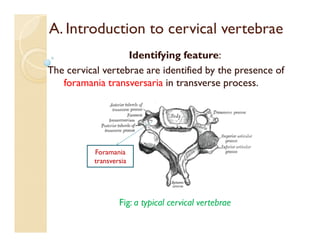
A. Introduction to cervical vertebrae
Identifying feature:
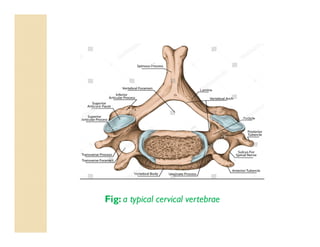
The cervical vertebrae are identified by the presence of
foramania transversaria in transverse process.
Fig: a typical cervical vertebrae
Foramania
transversia
Characteristic
 These are 7 in no. of which 3rd to 6th are typical
while1st, 2nd and 7th are atypical.
 Small body.
 Transverse process is relatively short.
 Pedicles are long and directed backward and laterally.
 Lamina is long and narrow.
 Short spinous process.
 Vertebral foramen is larger than the body and
triangular in shape.
 Flat articular facets.
Fig: a typical cervical vertebrae
THE JOINT
A. Atlanto - Occipital Joint
+
=
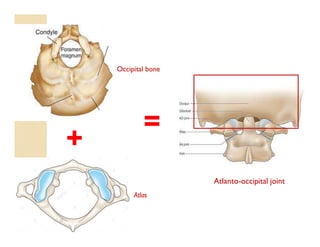
Atlanto-occipital joint
Occipital bone
Atlas
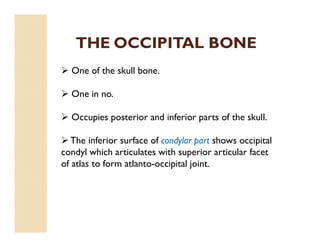
THE OCCIPITAL BONE
 One of the skull bone.
 One in no.
 Occupies posterior and inferior parts of the skull.
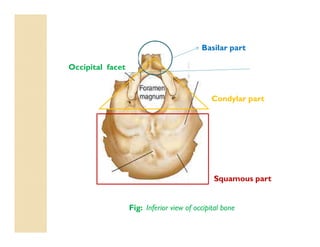
 The inferior surface of condylar part shows occipital
condyl which articulates with superior articular facet
of atlas to form atlanto-occipital joint.
Fig: Inferior view of occipital bone
Basilar part
Occipital facet
Condylar part
Squamous part
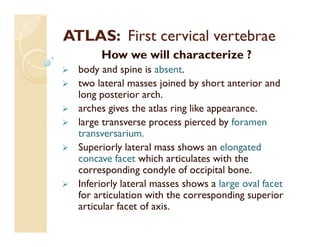
ATLAS: First cervical vertebrae
How we will characterize ?
 body and spine is absent.
 two lateral masses joined by short anterior and
long posterior arch.
 arches gives the atlas ring like appearance.
 large transverse process pierced by foramen
transversarium.
 Superiorly lateral mass shows an elongated
concave facet which articulates with the
corresponding condyle of occipital bone.
 Inferiorly lateral masses shows a large oval facet
for articulation with the corresponding superior
articular facet of axis.
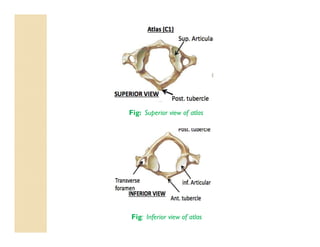
Fig: Superior view of atlas
Fig: Inferior view of atlas
A. Atlanto - Occipital joint
Articular surface:
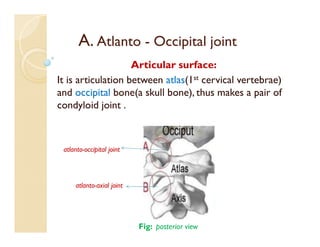
It is articulation between atlas(1st cervical vertebrae)
and occipital bone(a skull bone), thus makes a pair of
condyloid joint .
atlanto-occipital joint
atlanto-axial joint
Fig: posterior view
Membrane/Capsule
Posterior
atlanto occipital membrane
Anterior
atlanto-occipital membrane
 Extends from anterior
arch of atlas to anterior
margin of foramen magnum.
 Extends from posterior
arch of atlas to posterior
margin of foramen magnum.
Capsule:
The capsule of the atlanto-occipital joint are attached
along the margin of the corresponding facet.
Type:
Synovial socket type joint i.e. ellipsoid.
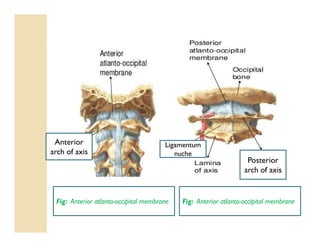
Fig: Anterior atlanto-occipital membrane Fig: Anterior atlanto-occipital membrane
Posterior
arch of axis
Anterior
arch of axis
Ligamentum
nuche
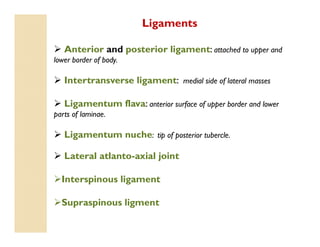
Ligaments
 Anterior and posterior ligament: attached to upper and
lower border of body.
 Intertransverse ligament: medial side of lateral masses
 Ligamentum flava: anterior surface of upper border and lower
parts of laminae.
 Ligamentum nuche: tip of posterior tubercle.
 Lateral atlanto-axial joint
Interspinous ligament
Supraspinous ligment
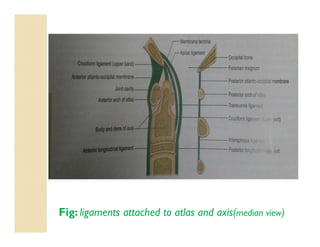
Fig: ligaments attached to atlas and axis(median view)
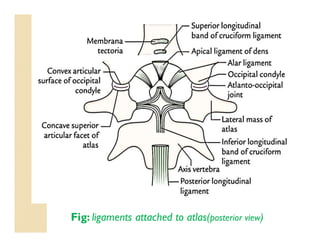
Fig: ligaments attached to atlas(posterior view)
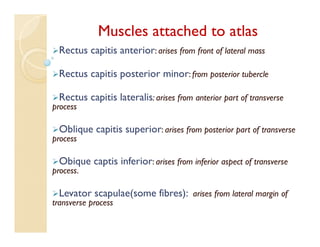
Muscles attached to atlas
Rectus capitis anterior: arises from front of lateral mass
Rectus capitis posterior minor: from posterior tubercle
Rectus capitis lateralis: arises from anterior part of transverse
process
Oblique capitis superior: arises from posterior part of transverse
process
Obique captis inferior: arises from inferior aspect of transverse
process.
Levator scapulae(some fibres): arises from lateral margin of
transverse process
Movements
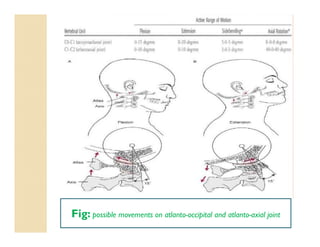
 Flexion: 0 to 15 degree.
Muscle involved: longus capitis and rectus capitis anterior.
 Extension: 0 to 20 degree.
Muscle involved: rectus capitis posterior major, rectus
capitis posterior minor, obliqus captis superior and upper part of
trapezius
 Side bending: 5 degree on either side.
Muscle involved: rectus capitis lateralis, semispinalis
capitis, sternocleidomastoid and trapezius.
 Axial rotation: very less(8 degree on either side).
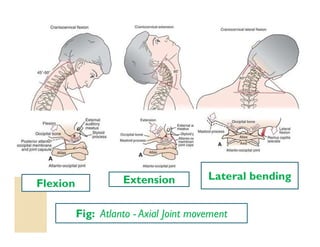
Lateral bending
Flexion Extension
Fig: Atlanto - Axial Joint movement
Fig: possible movements on atlanto-occipital and atlanto-axial joint
CLINICAL ANATOMY: ATLANTO-OCCIPITAL JOINT
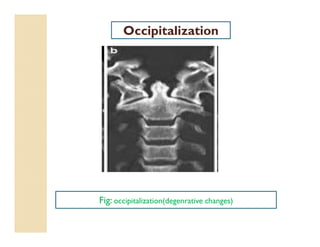
 Occipitalization of atlas:
- atlas fuses with occipit
 Decalcification of atlas:
- caused by pharyngeal and retropharyngeal
inflamation.
 Prolapse of intervertebral disc:
- most often traumatic(usually 6th and 7th cervical
and upper lumbar prolase occurs).
 Oesteophyte formation in ‘luschka’s joint’:
- cervical nerve root compression.
- may cause distortion of vertebral artery
i.e vertebrobasilar insufficency .
Fig: occipitalization(degenrative changes)
Occipitalization
B. Atlanto - Axial Joint
AXIS: Second cervical vertebrae
How we will characterize
Presence of tooth like process projecting upward from the
body called “dense or odontoid”.
The dense represent the body of the atlas.
Small transverse process.
Superior surface of body is fused with dense.
Superior articular facet is large, flat and circular directed
upward and laterally
Inferior surface has a prominent downward projecting
anterior margin.
Inferior articular facet lies posterior to the transverse
process.
Deep and wide inferior vertebral notch inferiorly.
Thick and strong spine.
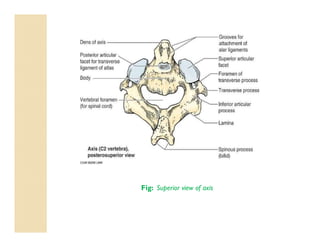
Fig: Superior view of axis
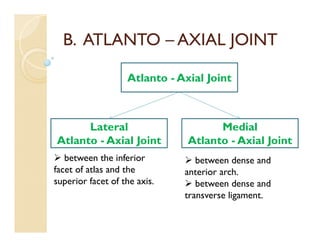
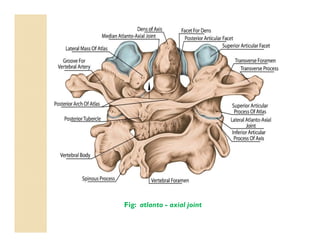
B. ATLANTO – AXIAL JOINT
Atlanto - Axial Joint
Medial
Atlanto - Axial Joint
Lateral
Atlanto - Axial Joint
 between the inferior
facet of atlas and the
superior facet of the axis.
 between dense and
anterior arch.
 between dense and
transverse ligament.
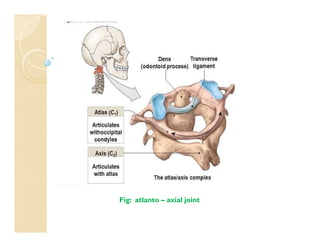
Fig: atlanto – axial joint
Fig: atlanto - axial joint
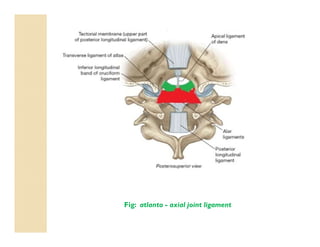
Ligaments
Capsular ligament:
- supports lateral lateral atlanto-axial joint
Anterior longitudnal ligament:
- lateral fibres supports lateral atlanto-axial joint.
Ligamentum flavum:
- supports lateral atlanto-axial joint.
Loose capsular ligament:
- supports medial atlanto-axial joint.
Transverse ligament:
- supports medial atlanto-axial joint.
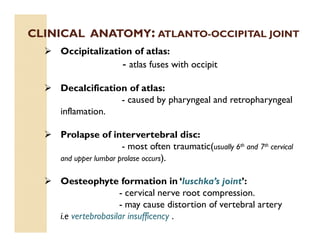
Fig: atlanto - axial joint ligament
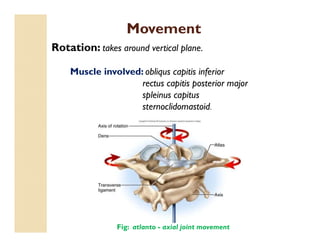
Movement
Rotation: takes around vertical plane.
Muscle involved: obliqus capitis inferior
rectus capitis posterior major
spleinus capitus
sternoclidomastoid.
Fig: atlanto - axial joint movement
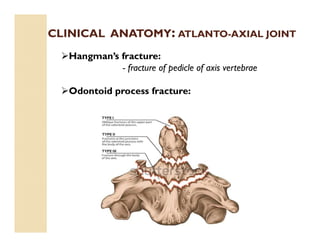
CLINICAL ANATOMY: ATLANTO-AXIAL JOINT
Hangman’s fracture:
- fracture of pedicle of axis vertebrae
Odontoid process fracture:
YOUR QUERIES
PLEASE ?
HOPE……
YOU UTILISEDYOUR TIME AT RIGHT PLACE.
THANKYOU
FOR YOUR
ACTIVE PARTICIPATION
AND
KIND COLLABORATION.
- SHUBHAM SINGH

Atlanto occipital and atlanto axial joint

  • 1.
  • 2.
    TOPIC TO BEPRESENTED  Introduction to cervical vertebrae.  Characteristic of cervical vertebrae.  Atlanto-occipital joint.  Introduction to atlas and occipit.  Introduction to axis  Atlanto-axial joint. Clinical anatomy
  • 3.
    A. Introduction tocervical vertebrae Identifying feature: The cervical vertebrae are identified by the presence of foramania transversaria in transverse process. Fig: a typical cervical vertebrae Foramania transversia
  • 4.
    Characteristic  These are7 in no. of which 3rd to 6th are typical while1st, 2nd and 7th are atypical.  Small body.  Transverse process is relatively short.  Pedicles are long and directed backward and laterally.  Lamina is long and narrow.  Short spinous process.  Vertebral foramen is larger than the body and triangular in shape.  Flat articular facets.
  • 5.
    Fig: a typicalcervical vertebrae
  • 6.
    THE JOINT A. Atlanto- Occipital Joint
  • 7.
  • 8.
    THE OCCIPITAL BONE One of the skull bone.  One in no.  Occupies posterior and inferior parts of the skull.  The inferior surface of condylar part shows occipital condyl which articulates with superior articular facet of atlas to form atlanto-occipital joint.
  • 9.
    Fig: Inferior viewof occipital bone Basilar part Occipital facet Condylar part Squamous part
  • 10.
    ATLAS: First cervicalvertebrae How we will characterize ?  body and spine is absent.  two lateral masses joined by short anterior and long posterior arch.  arches gives the atlas ring like appearance.  large transverse process pierced by foramen transversarium.  Superiorly lateral mass shows an elongated concave facet which articulates with the corresponding condyle of occipital bone.  Inferiorly lateral masses shows a large oval facet for articulation with the corresponding superior articular facet of axis.
  • 11.
    Fig: Superior viewof atlas Fig: Inferior view of atlas
  • 12.
    A. Atlanto -Occipital joint Articular surface: It is articulation between atlas(1st cervical vertebrae) and occipital bone(a skull bone), thus makes a pair of condyloid joint . atlanto-occipital joint atlanto-axial joint Fig: posterior view
  • 13.
    Membrane/Capsule Posterior atlanto occipital membrane Anterior atlanto-occipitalmembrane  Extends from anterior arch of atlas to anterior margin of foramen magnum.  Extends from posterior arch of atlas to posterior margin of foramen magnum. Capsule: The capsule of the atlanto-occipital joint are attached along the margin of the corresponding facet. Type: Synovial socket type joint i.e. ellipsoid.
  • 14.
    Fig: Anterior atlanto-occipitalmembrane Fig: Anterior atlanto-occipital membrane Posterior arch of axis Anterior arch of axis Ligamentum nuche
  • 15.
    Ligaments  Anterior andposterior ligament: attached to upper and lower border of body.  Intertransverse ligament: medial side of lateral masses  Ligamentum flava: anterior surface of upper border and lower parts of laminae.  Ligamentum nuche: tip of posterior tubercle.  Lateral atlanto-axial joint Interspinous ligament Supraspinous ligment
  • 16.
    Fig: ligaments attachedto atlas and axis(median view)
  • 17.
    Fig: ligaments attachedto atlas(posterior view)
  • 18.
    Muscles attached toatlas Rectus capitis anterior: arises from front of lateral mass Rectus capitis posterior minor: from posterior tubercle Rectus capitis lateralis: arises from anterior part of transverse process Oblique capitis superior: arises from posterior part of transverse process Obique captis inferior: arises from inferior aspect of transverse process. Levator scapulae(some fibres): arises from lateral margin of transverse process
  • 19.
    Movements  Flexion: 0to 15 degree. Muscle involved: longus capitis and rectus capitis anterior.  Extension: 0 to 20 degree. Muscle involved: rectus capitis posterior major, rectus capitis posterior minor, obliqus captis superior and upper part of trapezius  Side bending: 5 degree on either side. Muscle involved: rectus capitis lateralis, semispinalis capitis, sternocleidomastoid and trapezius.  Axial rotation: very less(8 degree on either side).
  • 20.
    Lateral bending Flexion Extension Fig:Atlanto - Axial Joint movement
  • 21.
    Fig: possible movementson atlanto-occipital and atlanto-axial joint
  • 22.
    CLINICAL ANATOMY: ATLANTO-OCCIPITALJOINT  Occipitalization of atlas: - atlas fuses with occipit  Decalcification of atlas: - caused by pharyngeal and retropharyngeal inflamation.  Prolapse of intervertebral disc: - most often traumatic(usually 6th and 7th cervical and upper lumbar prolase occurs).  Oesteophyte formation in ‘luschka’s joint’: - cervical nerve root compression. - may cause distortion of vertebral artery i.e vertebrobasilar insufficency .
  • 23.
  • 25.
    B. Atlanto -Axial Joint
  • 26.
    AXIS: Second cervicalvertebrae How we will characterize Presence of tooth like process projecting upward from the body called “dense or odontoid”. The dense represent the body of the atlas. Small transverse process. Superior surface of body is fused with dense. Superior articular facet is large, flat and circular directed upward and laterally Inferior surface has a prominent downward projecting anterior margin. Inferior articular facet lies posterior to the transverse process. Deep and wide inferior vertebral notch inferiorly. Thick and strong spine.
  • 27.
  • 28.
    B. ATLANTO –AXIAL JOINT Atlanto - Axial Joint Medial Atlanto - Axial Joint Lateral Atlanto - Axial Joint  between the inferior facet of atlas and the superior facet of the axis.  between dense and anterior arch.  between dense and transverse ligament.
  • 29.
    Fig: atlanto –axial joint
  • 30.
    Fig: atlanto -axial joint
  • 31.
    Ligaments Capsular ligament: - supportslateral lateral atlanto-axial joint Anterior longitudnal ligament: - lateral fibres supports lateral atlanto-axial joint. Ligamentum flavum: - supports lateral atlanto-axial joint. Loose capsular ligament: - supports medial atlanto-axial joint. Transverse ligament: - supports medial atlanto-axial joint.
  • 32.
    Fig: atlanto -axial joint ligament
  • 33.
    Movement Rotation: takes aroundvertical plane. Muscle involved: obliqus capitis inferior rectus capitis posterior major spleinus capitus sternoclidomastoid. Fig: atlanto - axial joint movement
  • 35.
    CLINICAL ANATOMY: ATLANTO-AXIALJOINT Hangman’s fracture: - fracture of pedicle of axis vertebrae Odontoid process fracture:
  • 36.
  • 37.
  • 38.