Dr. Chandan Verma(PT)
(BPT,MPT,YICC,PhD pursuing)
Assistant pofessor
(Mahatma Gandhi Physiotherapy College, Jaipur)
 the cervical column is divided into two distinct
regions: the upper cervical spine (craniovertebral
region), and the lower cervical spine
 The craniovertebral region includes the occipital
condyles and the first two cervical vertebrae, C1
and C2, or, respectively, the atlas and axis.
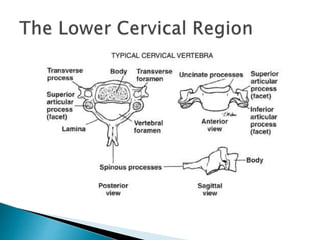
 The lower cervical spine includes the vertebrae of
C3 to C7.
 The atlas, axis, and C7 exhibit unique
characteristics and are considered the atypical
cervical vertebrae. All of the cervical vertebrae have
the unique feature of a foramen (transverse
foramen) on the transverse process, which serves
as passage for the vertebral artery.
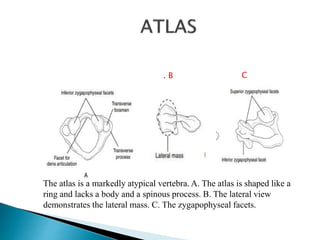
The atlas is a markedly atypical vertebra. A. The atlas is shaped like a
ring and lacks a body and a spinous process. B. The lateral view
demonstrates the lateral mass. C. The zygapophyseal facets.
. B C
 washer sitting between the occipital condyles
and the axis.
 it has no vertebral body or spinous process
and it is shaped like a ring.
 The transverse processes also contain a
foramen for the passage of the vertebral
artery
 The functions of the atlas are to cradle the
occiput and to transmit forces from the
occiput to the lower cervical vertebrae
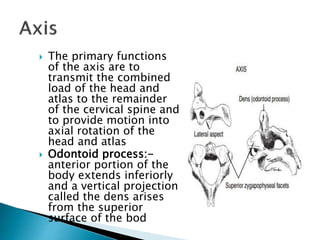
 The primary functions
of the axis are to
transmit the combined
load of the head and
atlas to the remainder
of the cervical spine and
to provide motion into
axial rotation of the
head and atlas
 Odontoid process:-
anterior portion of the
body extends inferiorly
and a vertical projection
called the dens arises
from the superior
surface of the bod
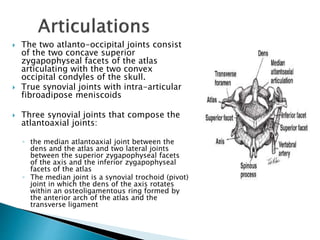
 The two atlanto-occipital joints consist
of the two concave superior
zygapophyseal facets of the atlas
articulating with the two convex
occipital condyles of the skull.
 True synovial joints with intra-articular
fibroadipose meniscoids
 Three synovial joints that compose the
atlantoaxial joints:
◦ the median atlantoaxial joint between the
dens and the atlas and two lateral joints
between the superior zygapophyseal facets
of the axis and the inferior zygapophyseal
facets of the atlas
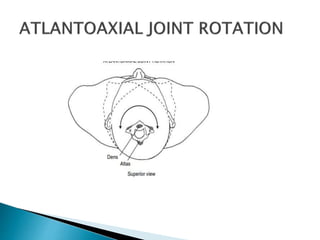
◦ The median joint is a synovial trochoid (pivot)
joint in which the dens of the axis rotates
within an osteoligamentous ring formed by
the anterior arch of the atlas and the
transverse ligament
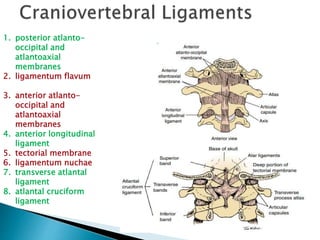
1. posterior atlanto-
occipital and
atlantoaxial
membranes
2. ligamentum flavum
3. anterior atlanto-
occipital and
atlantoaxial
membranes
4. anterior longitudinal
ligament
5. tectorial membrane
6. ligamentum nuchae
7. transverse atlantal
ligament
8. atlantal cruciform
ligament
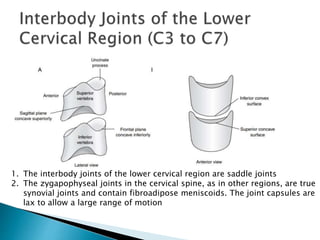
1. The interbody joints of the lower cervical region are saddle joints
2. The zygapophyseal joints in the cervical spine, as in other regions, are true
synovial joints and contain fibroadipose meniscoids. The joint capsules are
lax to allow a large range of motion
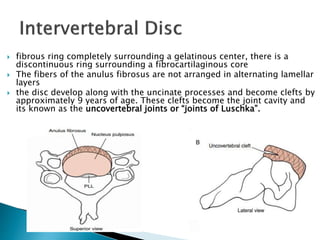
 fibrous ring completely surrounding a gelatinous center, there is a
discontinuous ring surrounding a fibrocartilaginous core
 The fibers of the anulus fibrosus are not arranged in alternating lamellar
layers
 the disc develop along with the uncinate processes and become clefts by
approximately 9 years of age. These clefts become the joint cavity and
its known as the uncovertebral joints or “joints of Luschka”.
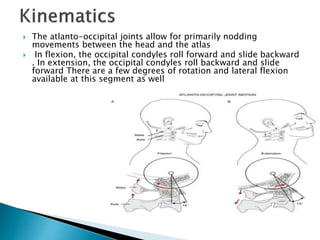
 The atlanto-occipital joints allow for primarily nodding
movements between the head and the atlas
 In flexion, the occipital condyles roll forward and slide backward
. In extension, the occipital condyles roll backward and slide
forward There are a few degrees of rotation and lateral flexion
available at this segment as well
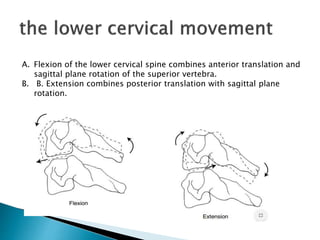
A. Flexion of the lower cervical spine combines anterior translation and
sagittal plane rotation of the superior vertebra.
B. B. Extension combines posterior translation with sagittal plane
rotation.

Cervical region biomechanics

  • 1.
    Dr. Chandan Verma(PT) (BPT,MPT,YICC,PhDpursuing) Assistant pofessor (Mahatma Gandhi Physiotherapy College, Jaipur)
  • 2.
     the cervicalcolumn is divided into two distinct regions: the upper cervical spine (craniovertebral region), and the lower cervical spine  The craniovertebral region includes the occipital condyles and the first two cervical vertebrae, C1 and C2, or, respectively, the atlas and axis.  The lower cervical spine includes the vertebrae of C3 to C7.  The atlas, axis, and C7 exhibit unique characteristics and are considered the atypical cervical vertebrae. All of the cervical vertebrae have the unique feature of a foramen (transverse foramen) on the transverse process, which serves as passage for the vertebral artery.
  • 3.
    The atlas isa markedly atypical vertebra. A. The atlas is shaped like a ring and lacks a body and a spinous process. B. The lateral view demonstrates the lateral mass. C. The zygapophyseal facets. . B C
  • 4.
     washer sittingbetween the occipital condyles and the axis.  it has no vertebral body or spinous process and it is shaped like a ring.  The transverse processes also contain a foramen for the passage of the vertebral artery  The functions of the atlas are to cradle the occiput and to transmit forces from the occiput to the lower cervical vertebrae
  • 5.
     The primaryfunctions of the axis are to transmit the combined load of the head and atlas to the remainder of the cervical spine and to provide motion into axial rotation of the head and atlas  Odontoid process:- anterior portion of the body extends inferiorly and a vertical projection called the dens arises from the superior surface of the bod
  • 6.
     The twoatlanto-occipital joints consist of the two concave superior zygapophyseal facets of the atlas articulating with the two convex occipital condyles of the skull.  True synovial joints with intra-articular fibroadipose meniscoids  Three synovial joints that compose the atlantoaxial joints: ◦ the median atlantoaxial joint between the dens and the atlas and two lateral joints between the superior zygapophyseal facets of the axis and the inferior zygapophyseal facets of the atlas ◦ The median joint is a synovial trochoid (pivot) joint in which the dens of the axis rotates within an osteoligamentous ring formed by the anterior arch of the atlas and the transverse ligament
  • 7.
    1. posterior atlanto- occipitaland atlantoaxial membranes 2. ligamentum flavum 3. anterior atlanto- occipital and atlantoaxial membranes 4. anterior longitudinal ligament 5. tectorial membrane 6. ligamentum nuchae 7. transverse atlantal ligament 8. atlantal cruciform ligament
  • 9.
    1. The interbodyjoints of the lower cervical region are saddle joints 2. The zygapophyseal joints in the cervical spine, as in other regions, are true synovial joints and contain fibroadipose meniscoids. The joint capsules are lax to allow a large range of motion
  • 10.
     fibrous ringcompletely surrounding a gelatinous center, there is a discontinuous ring surrounding a fibrocartilaginous core  The fibers of the anulus fibrosus are not arranged in alternating lamellar layers  the disc develop along with the uncinate processes and become clefts by approximately 9 years of age. These clefts become the joint cavity and its known as the uncovertebral joints or “joints of Luschka”.
  • 11.
     The atlanto-occipitaljoints allow for primarily nodding movements between the head and the atlas  In flexion, the occipital condyles roll forward and slide backward . In extension, the occipital condyles roll backward and slide forward There are a few degrees of rotation and lateral flexion available at this segment as well
  • 13.
    A. Flexion ofthe lower cervical spine combines anterior translation and sagittal plane rotation of the superior vertebra. B. B. Extension combines posterior translation with sagittal plane rotation.