SPACE RADIATION AND ITS EFFECTS ON SPACE SYSTEMS
           AND ASTRONAUTS


                                        Instructor:
                                     V.L. Pisacane


ATI Course Schedule: http://www.ATIcourses.com/schedule.htm
Single
                                                                                          Particle
                                                                                          Motion


                   SPACE RADIATION AND ITS EFFECTS ON SPACE
                          SYSTEMS AND ASTRONAUTS

                                                    Single Particle Motion


                                                                         by
                                                                  V. L. Pisacane


Space Radiation and its Effects on Space Systems and Astronauts       5─ 1         ©VLPisacane,2012
Single
                                                                  TOPICS          Particle
                                                                                  Motion


                                                  Introduction
                                                  Equation of Motion
                                                  Gyration Motion
                                                  Guiding Center Motion
                                                  Mirror Points
                                                  Summary


Space Radiation and its Effects on Space Systems and Astronauts    5─ 2    ©VLPisacane,2012
INTRODUCTION                                                 Single
                                                                                                                              Particle
                                                                    Background                                                Motion

    Trapping of particles by magnetic fields was first
       studied by Kristian Birkeland in Norway in ~1895
       – He aimed beams of electrons at a magnet inside a
          vacuum chamber and noted that they seemed to
          be channeled towards its near magnetic pole
    Birkeland interested Poincaré who analyzed the
       motion of charged particles in a magnetic field and
       showed that they spiraled around field lines and
       were repelled from regions of strong field
    Birkeland also interested Carl Stormer who carried
       out more detailed analyzes
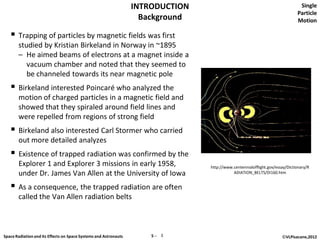
    Existence of trapped radiation was confirmed by the
       Explorer 1 and Explorer 3 missions in early 1958,                         http://www.centennialofflight.gov/essay/Dictionary/R
       under Dr. James Van Allen at the University of Iowa                                  ADIATION_BELTS/DI160.htm


    As a consequence, the trapped radiation are often
       called the Van Allen radiation belts


Space Radiation and its Effects on Space Systems and Astronauts       5─ 3                                            ©VLPisacane,2012
INTRODUCTION                    Single
                                                                                                  Particle
                                                                  Summary Motion                  Motion

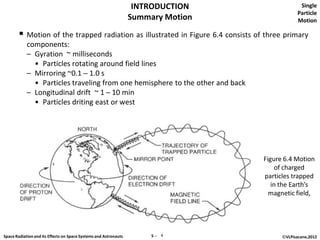
         Motion of the trapped radiation as illustrated in Figure 6.4 consists of three primary
            components:
            – Gyration ~ milliseconds
              • Particles rotating around field lines
            – Mirroring ~0.1 ─ 1.0 s
              • Particles traveling from one hemisphere to the other and back
            – Longitudinal drift ~ 1 ─ 10 min
              • Particles driting east or west


                                                                                     Figure 6.4 Motion
                                                                                          of charged
                                                                                     particles trapped
                                                                              5– 4      in the Earth’s
                                                                                       magnetic field,


Space Radiation and its Effects on Space Systems and Astronauts        5─ 4                ©VLPisacane,2012
EQUATION OF MOTION                          Single
                                                                                                      Particle
                                                               Introduction                           Motion


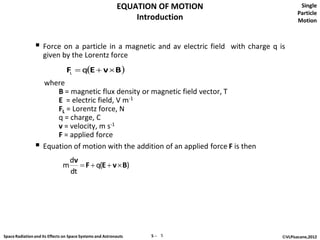
                 Force on a particle in a magnetic and av electric field       with charge q is
                    given by the Lorentz force
                                 FL  qE  v  B 
                    where
                        B = magnetic flux density or magnetic field vector, T
                        E = electric field, V m-1
                        FL = Lorentz force, N
                        q = charge, C
                        v = velocity, m s-1
                        F = applied force
                   Equation of motion with the addition of an applied force F is then
                                   dv
                               m       F  q(E  v  B)
                                   dt


Space Radiation and its Effects on Space Systems and Astronauts   5─ 5                         ©VLPisacane,2012
GYRATION MOTION                             Single
                                                                                                             Particle
                                                                     Introduction                            Motion


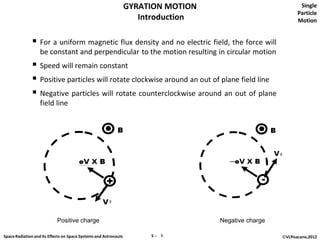
                For a uniform magnetic flux density and no electric field, the force will
                   be constant and perpendicular to the motion resulting in circular motion
                Speed will remain constant
                Positive particles will rotate clockwise around an out of plane field line
                Negative particles will rotate counterclockwise around an out of plane
                   field line


                                                                                                      g


                                                       g


                            Positive charge                                         Negative charge

Space Radiation and its Effects on Space Systems and Astronauts        5─ 6                           ©VLPisacane,2012
GYRATION MOTION                                                     Single
                                                                                                                          Particle
                                                Gyro-Frequency and Larmor Radius                                          Motion
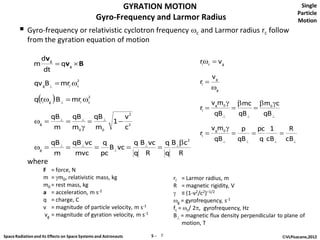
         Gyro-frequency or relativistic cyclotron frequency wc and Larmor radius rc follow
            from the gyration equation of motion

                   dv g                                                            rlwc  v g
               m         qv g  B
                   dt
                                                                                          vg
                qv gB   mrl w       2
                                                                                   rl 
                                      c
                                                                                          wg
                qrlwg  B   mrl w2
                                    c                                                     v gm0 g  mc  m0 gc
                                                                                   rl                 
                     qB  qB  qB    v2                                                   qB     qB    qB 
                wg               1 2
                      m    m0 g m0    c                                                   v gm0 g    p    pc 1   R
                                                                                   rl                       
                                                                                           qB      qB  q cB cB
                     qB  qB  vc q         q B  vc q B  c2
                wg              B  vc          
                      m    mvc    pc        q R       q R
            where
                    F = force, N
                    m = gm0, relativistic mass, kg                       rl = Larmor radius, m
                    m0 = rest mass, kg                                   R = magnetic rigidity, V
                    a = acceleration, m s-2                              g ≡ (1-v2/c2)─1/2
                    q = charge, C                                        wg = gyrofrequency, s-1
                    v = magnitude of particle velocity, m s-1            fc = wc/ 2p, gyrofrequency, Hz
                    vg = magnitude of gyration velocity, m s-1           B = magnetic flux density perpendicular to plane of
                                                                             motion, T

Space Radiation and its Effects on Space Systems and Astronauts   5─ 7                                             ©VLPisacane,2012
GYRATION MOTION                                     Single
                                                                                                       Particle
                                          Gyro-Frequency for Electrons and Protons                     Motion

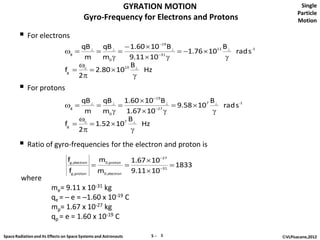
         For electrons
                                     qB  qB   1.60  10 19 B                 B
                                wg                                1.76  1011  rad s -1
                                      m    m0 g     9.11  10 31 g                g
                                    w               B
                                fg  c  2.80  1010  Hz
                                    2p               g
         For protons
                                     qB  qB  1.60  10 19 B              B
                                wg                             9.58  107  rad s -1
                                      m    m0 g 1.67  10 27 g               g
                                    w              B
                                fg  c  1.52  107  Hz
                                    2p              g

         Ratio of gyro-frequencies for the electron and proton is
                                 fg ,electron   m0 ,proton 1.67  10 27
                                                                        1833
                                  fg ,proton m0 ,electron 9.11  10 31
         where
                         me= 9.11 x 10⁻³¹ kg
                         qe = ─ e = ─1.60 x 10⁻¹⁹ C
                         mp= 1.67 x 10⁻²⁷ kg
                         qp = e = 1.60 x 10⁻¹⁹ C

Space Radiation and its Effects on Space Systems and Astronauts   5─ 8                          ©VLPisacane,2012
GYRATION MOTION                                   Single
                                                                                                         Particle
                                                Larmor Radii for Electrons and Protons                   Motion

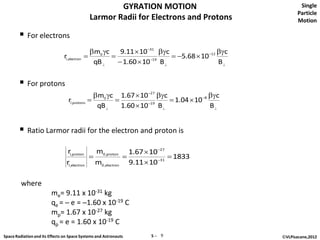
         For electrons
                                                m0 gc 9.11  10 31 gc                    gc
                               rl ,electron                               5.68  10 12
                                                 qB     1.60  10 19 B                  B

         For protons
                                                m0 gc 1.67  10 27 gc                gc
                                  rl ,protons                           1.04  10 8
                                                 qB    1.60  10 19 B                B


         Ratio Larmor radii for the electron and proton is
                                  rl ,proton   m0 ,proton 1.67  10 27
                                                                        1833
                                 rl ,electron m0 ,electron 9.11  10 31

         where
                         me= 9.11 x 10⁻³¹ kg
                         qe = ─ e = ─1.60 x 10⁻¹⁹ C
                         mp= 1.67 x 10⁻²⁷ kg
                         qp = e = 1.60 x 10⁻¹⁹ C
Space Radiation and its Effects on Space Systems and Astronauts      5─ 9                         ©VLPisacane,2012
GYRATION MOTION                                                                             Single
                                                                                                                                     Particle
                      Larmor Radii and Gyro-frequency in Terms of Magnetic rigidity                                                  Motion

         Examples of Larmor radii                      and gyro-frequency for any charged particle with a given
            rigidity at
                Sun
                near Earth
                surface of the Earth
                                                                                      Larmor Radius, Re = Earth radii
            Magnetic            Kinetic           Speed
            Rigidity            Energy           [% of c]          Corona              Interplanetary                Earth
                                                                   (10 mT)               1 AU (5 nT)            Surface (30 μT)
                1 GV           0.43 GeV            73%             330 m          6.6x10⁸ m ≈ 100 Re         1.1x10⁵ m ≈ 0.017 Re
                5 GV            4.1 GeV            98%            1.65 km         3.3x10⁹ m ≈ 520 Re         5.5x10⁵ m ≈ 0.086 Re
               20 GV           19.1 GeV           99.8%           6.60 km        1.3x10¹⁰ m ≈ 2100 Re        2.2x10⁶ m ≈ 0.340 Re

                                                                                             Gyro-frequency
            Magnetic            Kinetic           Speed
            Rigidity            Energy           [% of c]          Corona              Interplanetary                Earth
                                                                   (10 mT)               1 AU (5 nT)            Surface (30 μT)
                1 GV           0.43 GeV            73%            105.6 kHz               0.053 Hz                 316.9 Hz
                5 GV            4.1 GeV            98%            28.4 kHz                0.142 Hz                 85.1 Hz
               20 GV           19.1 GeV           99.8%            7.2 kHz                0.004 Hz                 21.7 Hz

Space Radiation and its Effects on Space Systems and Astronauts              5 ─ 10                                           ©VLPisacane,2012
GYRATION MOTION                                         Single
                                                                                                       Particle
                                       Summary Motion in Uniform Magnetic Field                        Motion


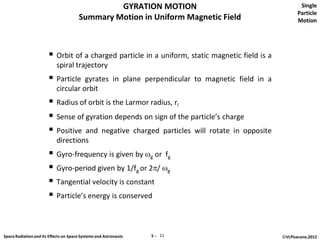
                        Orbit of a charged particle in a uniform, static magnetic field is a
                           spiral trajectory
                        Particle    gyrates in plane perpendicular to magnetic field in a
                           circular orbit
                        Radius of orbit is the Larmor radius, rl
                        Sense of gyration depends on sign of the particle’s charge
                        Positive and negative charged particles will rotate in opposite
                           directions
                        Gyro-frequency is given by wg or fg
                        Gyro-period given by 1/fg or 2p/ wg
                        Tangential velocity is constant
                        Particle’s energy is conserved


Space Radiation and its Effects on Space Systems and Astronauts   5 ─ 11                        ©VLPisacane,2012
GUIDING CENTER MOTION                        Single
                                                                                                    Particle
                                                              Introduction                          Motion

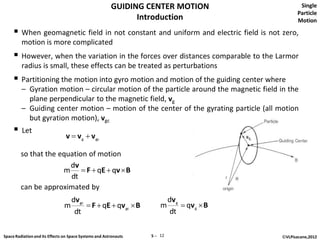
      When geomagnetic field in not constant and uniform and electric field is not zero,
         motion is more complicated
      However, when the variation in the forces over distances comparable to the Larmor
         radius is small, these effects can be treated as perturbations
      Partitioning the motion into gyro motion and motion of the guiding center where
         – Gyration motion – circular motion of the particle around the magnetic field in the
           plane perpendicular to the magnetic field, vg
         – Guiding center motion – motion of the center of the gyrating particle (all motion
           but gyration motion), vgc
        Let
                                v  v g  v gc

         so that the equation of motion
                        dv
                      m  F  qE  qv  B
                        dt
         can be approximated by
                                    dv gc                                  dv g
                                m          F  qE  qv gc  B        m          qv g  B
                                     dt                                    dt

Space Radiation and its Effects on Space Systems and Astronauts   5 ─ 12                     ©VLPisacane,2012
GUIDING CENTER MOTION                       Single
                                                                                                   Particle
                                                        Guiding Center Equations                   Motion
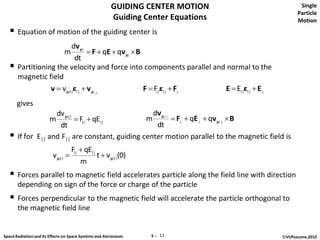
    Equation of motion of the guiding center is
                           dv gc
                                m  F  qE  qv gc  B
                             dt
      Partitioning the velocity and force into components parallel and normal to the
       magnetic field
                  v  v gc||ε||  v gc                F  F ε||  F
                                                            ||         E  E||ε||  E
       gives
                     dv gc||                       dv gc
                   m          F||  qE||        m         F  qE  qv gc  B
                      dt                            dt
      If for E|| and F|| are constant, guiding center motion parallel to the magnetic field is
                                     F||  qE||
                          v gc||               t  v gc||(0)
                                         m
    Forces parallel to magnetic field accelerates particle along the field line with direction
       depending on sign of the force or charge of the particle
    Forces perpendicular to the magnetic field will accelerate the particle orthogonal to
       the magnetic field line


Space Radiation and its Effects on Space Systems and Astronauts   5 ─ 13                    ©VLPisacane,2012
GUIDING CENTER MOTION                                Single
                                                                                                       Particle
                                                 Motion in Uniform Magnetic Field                      Motion

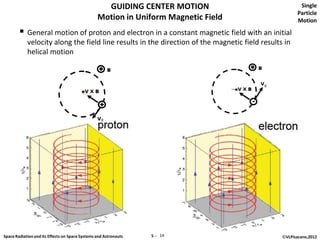
         General motion of proton and electron in a constant magnetic field with an initial
            velocity along the field line results in the direction of the magnetic field results in
            helical motion


                                                                                          g


                                                   g


Space Radiation and its Effects on Space Systems and Astronauts   5 ─ 14                        ©VLPisacane,2012
GUIDING CENTER MOTION                                                                    Single
                                                                                                                                   Particle
                               Orthogonal Drift Velocities of the Guiding Center 1/2                                               Motion

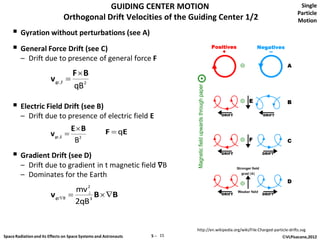
     Gyration without perturbations (see A)
     General Force Drift (see C)
        – Drift due to presence of general force F
                                    FB
                        v gc ,F 
                                    qB 2

     Electric Field Drift (see B)
        – Drift due to presence of electric field E
                                    EB              F  qE
                        v gc ,E 
                                     B2
     Gradient Drift (see D)
        – Drift due to gradient in t magnetic field ∇B
        – Dominates for the Earth                                                                        B


                                    mv 2
                        v gcB        
                                        3
                                          B  B
                                    2qB


                                                                           http://en.wikipedia.org/wiki/File:Charged-particle-drifts.svg
Space Radiation and its Effects on Space Systems and Astronauts   5 ─ 15                                                  ©VLPisacane,2012
GUIDING CENTER MOTION                                                    Single
                                                                                                                   Particle
                               Orthogonal Drift Velocities of the Guiding Center 2/2                               Motion

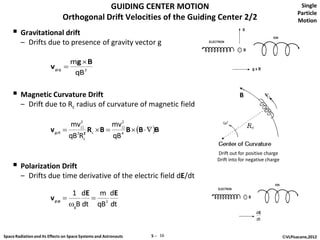
     Gravitational drift
        – Drifts due to presence of gravity vector g

                                   mg  B
                        v gcg 
                                    qB 2

     Magnetic Curvature Drift                                                       B            ||

        – Drift due to Rc radius of curvature of magnetic field

                                  2            2
                               mv||         mv||
                        v gcR  2 2 Rc  B  4 B  B   B
                               qB Rc        qB

                                                                           Drift out for positive charge
                                                                           Drift into for negative charge
     Polarization Drift
        – Drifts due time derivative of the electric field dE/dt

                                   1 dE m dE
                        v gcp           2
                                  wgB dt qB dt
                                                                                             dE
                                                                                             dt


Space Radiation and its Effects on Space Systems and Astronauts   5 ─ 16                                    ©VLPisacane,2012
MIRRORS POINTS                                                      Single
                                                                                                                                     Particle
                                                                    Introduction                                                     Motion
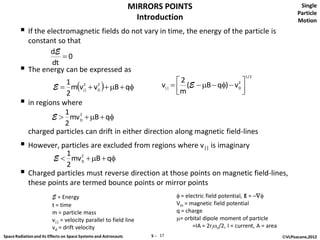
         If the electromagnetic fields do not vary in time, the energy of the particle is
            constant so that
                  dE
                      0
                   dt
           The energy can be expressed as
                                                                                                             1/2

                                                                           v||   (E  B  q)  vD 
                                                                                   2
                    E  mv||  vD   B  q
                        1    2   2
                                                                                                    2
                                                                                 m
                                                                                                     
                                                                                                      
                        2
           in regions where
                        1 2
                    E  mv D  B  q
                        2
            charged particles can drift in either direction along magnetic field-lines
         However, particles are excluded from regions where v|| is imaginary
                        1 2
                   E  mv D  B  q
                        2
           Charged particles must reverse direction at those points on magnetic field-lines,
            these points are termed bounce points or mirror points
                         E = Energy                                              = electric field potential, E = ─
                         t = time                                               Vm = magnetic field potential
                         m = particle mass                                      q = charge
                         v|| = velocity parallel to field line                  = orbital dipole moment of particle
                         vd = drift velocity                                           =IA = 2riwc/2, I = current, A = area
Space Radiation and its Effects on Space Systems and Astronauts        5 ─ 17                                                 ©VLPisacane,2012
MIRRORS POINTS                                                                          Single
                                                                                                                                                                             Particle
                                                                                  Mirror Points in Dipole Field                                                              Motion
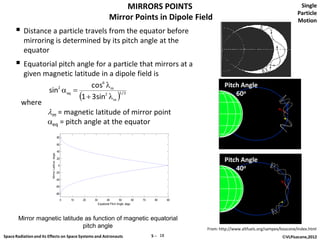
       Distance a particle travels from the equator before
          mirroring is determined by its pitch angle at the
          equator
       Equatorial pitch angle for a particle that mirrors at a
         given magnetic latitude in a dipole field is
                                cos6 lm                                                                                                Pitch Angle
                sin a eq 
                   2

                           1  3sin2 lm 1 / 2                                                                                            60o
         where
                lm = magnetic latitude of mirror point
                aeq = pitch angle at the equator
                                                80

                                                60

                                                40
                         Mirror Latitue, degs


                                                20
                                                                                                                                       Pitch Angle
                                                 0

                                                -20
                                                                                                                                           40o
                                                -40

                                                -60                                                                   6 – 18
                                                -80

                                                      0   10   20   30          40         50         60   70    80      90
                                                                         Equatorial Pitch Angle, degs


       Mirror magnetic latitude as function of magnetic equatorial
                               pitch angle                                                                                     From: http://www.altfuels.org/sampex/losscone/index.html
Space Radiation and its Effects on Space Systems and Astronauts                                                 5 ─ 18                                               ©VLPisacane,2012
MIRRORS POINTS                                                       Single
                                                                                                                               Particle
                                                       Mirror Points in Dipole Field                                           Motion


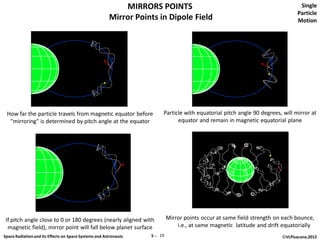
 How far the particle travels from magnetic equator before             Particle with equatorial pitch angle 90 degrees, will mirror at
  "mirroring" is determined by pitch angle at the equator                    equator and remain in magnetic equatorial plane


 If pitch angle close to 0 or 180 degrees (nearly aligned with             Mirror points occur at same field strength on each bounce,
  magnetic field), mirror point will fall below planet surface                 i.e., at same magnetic latitude and drift equatorially
Space Radiation and its Effects on Space Systems and Astronauts   5 ─ 19                                                ©VLPisacane,2012
MIRRORS POINTS                                                        Single
                                                                                                                                       Particle
                                                                 Equatorial Loss Cone                                                  Motion
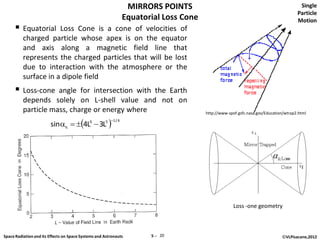
      Equatorial     Loss Cone is a cone of velocities of
          charged particle whose apex is on the equator
          and axis along a magnetic field line that
          represents the charged particles that will be lost
          due to interaction with the atmosphere or the
          surface in a dipole field
      Loss-cone     angle for intersection with the Earth
          depends solely on L-shell value and not on
          particle mass, charge or energy where                                         http://www-spof.gsfc.nasa.gov/Education/wtrap2.html

                        sin alc  4L6  3L5 
                                                        1 / 4


                                                                                                                         a lc


                                                                                                      Loss -one geometry


Space Radiation and its Effects on Space Systems and Astronauts         5 ─ 20                                                  ©VLPisacane,2012
MIRRORS POINTS                                                        Single
                                                                                                                           Particle
                                            Mirror Points of Trapped Radiation 1/2                                         Motion

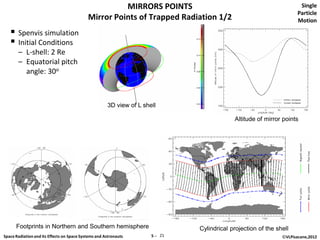
    Spenvis simulation
    Initial Conditions
       – L-shell: 2 Re
       – Equatorial pitch
         angle: 30o


                                                      3D view of L shell

                                                                                                 Altitude of mirror points


                                                                           6 – 21


      Footprints in Northern and Southern hemisphere                                Cylindrical projection of the shell
Space Radiation and its Effects on Space Systems and Astronauts       5 ─ 21                                        ©VLPisacane,2012
MIRRORS POINTS                                                      Single
                                                                                                                         Particle
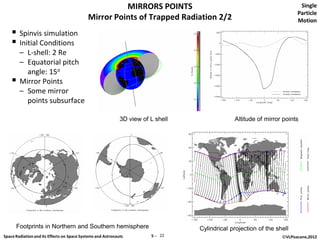
                                            Mirror Points of Trapped Radiation 2/2                                       Motion

     Spinvis simulation
     Initial Conditions
        – L-shell: 2 Re
        – Equatorial pitch
          angle: 15o
       Mirror Points
        – Some mirror
          points subsurface

                                                             3D view of L shell                Altitude of mirror points


      Footprints in Northern and Southern hemisphere                              Cylindrical projection of the shell
Space Radiation and its Effects on Space Systems and Astronauts         5 ─ 22                                    ©VLPisacane,2012
SUMMARY                                               Single
                                                                                                                    Particle
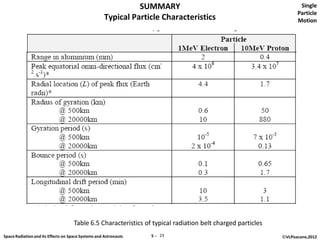
                                                     Typical Particle Characteristics                               Motion


                                                                       6 – 23


                                     Table 6.5 Characteristics of typical radiation belt charged particles
Space Radiation and its Effects on Space Systems and Astronauts   5 ─ 23                                     ©VLPisacane,2012
SUMMARY                                    Single
                                                                                                     Particle
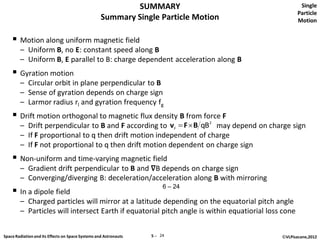
                                                   Summary Single Particle Motion                    Motion


     Motion along uniform magnetic field
        – Uniform B, no E: constant speed along B
        – Uniform B, E parallel to B: charge dependent acceleration along B
     Gyration motion
        – Circular orbit in plane perpendicular to B
        – Sense of gyration depends on charge sign
        – Larmor radius rl and gyration frequency fg
     Drift motion orthogonal to magnetic flux density B from force F
        – Drift perpendicular to B and F according to vF  F  B qB2 may depend on charge sign
        – If F proportional to q then drift motion independent of charge
        – If F not proportional to q then drift motion dependent on charge sign
     Non-uniform and time-varying magnetic field
        – Gradient drift perpendicular to B and ∇B depends on charge sign
        – Converging/diverging B: deceleration/acceleration along B with mirroring
                                                                       6 – 24
     In a dipole field
        – Charged particles will mirror at a latitude depending on the equatorial pitch angle
        – Particles will intersect Earth if equatorial pitch angle is within equatiorial loss cone


Space Radiation and its Effects on Space Systems and Astronauts   5 ─ 24                     ©VLPisacane,2012
Single
                                                                                      Particle
                                                                                      Motion


                                                                  DISCUSSION


Space Radiation and its Effects on Space Systems and Astronauts      5 ─ 25    ©VLPisacane,2012

Space Radiation & It's Effects On Space Systems & Astronauts Course Sampler

  • 1.
    SPACE RADIATION ANDITS EFFECTS ON SPACE SYSTEMS AND ASTRONAUTS Instructor: V.L. Pisacane ATI Course Schedule: http://www.ATIcourses.com/schedule.htm
  • 2.
    Single Particle Motion SPACE RADIATION AND ITS EFFECTS ON SPACE SYSTEMS AND ASTRONAUTS Single Particle Motion by V. L. Pisacane Space Radiation and its Effects on Space Systems and Astronauts 5─ 1 ©VLPisacane,2012
  • 3.
    Single TOPICS Particle Motion  Introduction  Equation of Motion  Gyration Motion  Guiding Center Motion  Mirror Points  Summary Space Radiation and its Effects on Space Systems and Astronauts 5─ 2 ©VLPisacane,2012
  • 4.
    INTRODUCTION Single Particle Background Motion  Trapping of particles by magnetic fields was first studied by Kristian Birkeland in Norway in ~1895 – He aimed beams of electrons at a magnet inside a vacuum chamber and noted that they seemed to be channeled towards its near magnetic pole  Birkeland interested Poincaré who analyzed the motion of charged particles in a magnetic field and showed that they spiraled around field lines and were repelled from regions of strong field  Birkeland also interested Carl Stormer who carried out more detailed analyzes  Existence of trapped radiation was confirmed by the Explorer 1 and Explorer 3 missions in early 1958, http://www.centennialofflight.gov/essay/Dictionary/R under Dr. James Van Allen at the University of Iowa ADIATION_BELTS/DI160.htm  As a consequence, the trapped radiation are often called the Van Allen radiation belts Space Radiation and its Effects on Space Systems and Astronauts 5─ 3 ©VLPisacane,2012
  • 5.
    INTRODUCTION Single Particle Summary Motion Motion  Motion of the trapped radiation as illustrated in Figure 6.4 consists of three primary components: – Gyration ~ milliseconds • Particles rotating around field lines – Mirroring ~0.1 ─ 1.0 s • Particles traveling from one hemisphere to the other and back – Longitudinal drift ~ 1 ─ 10 min • Particles driting east or west Figure 6.4 Motion of charged particles trapped 5– 4 in the Earth’s magnetic field, Space Radiation and its Effects on Space Systems and Astronauts 5─ 4 ©VLPisacane,2012
  • 6.
    EQUATION OF MOTION Single Particle Introduction Motion  Force on a particle in a magnetic and av electric field with charge q is given by the Lorentz force FL  qE  v  B  where B = magnetic flux density or magnetic field vector, T E = electric field, V m-1 FL = Lorentz force, N q = charge, C v = velocity, m s-1 F = applied force  Equation of motion with the addition of an applied force F is then dv m  F  q(E  v  B) dt Space Radiation and its Effects on Space Systems and Astronauts 5─ 5 ©VLPisacane,2012
  • 7.
    GYRATION MOTION Single Particle Introduction Motion  For a uniform magnetic flux density and no electric field, the force will be constant and perpendicular to the motion resulting in circular motion  Speed will remain constant  Positive particles will rotate clockwise around an out of plane field line  Negative particles will rotate counterclockwise around an out of plane field line g g Positive charge Negative charge Space Radiation and its Effects on Space Systems and Astronauts 5─ 6 ©VLPisacane,2012
  • 8.
    GYRATION MOTION Single Particle Gyro-Frequency and Larmor Radius Motion  Gyro-frequency or relativistic cyclotron frequency wc and Larmor radius rc follow from the gyration equation of motion dv g rlwc  v g m  qv g  B dt vg qv gB   mrl w 2 rl  c wg qrlwg  B   mrl w2 c v gm0 g  mc  m0 gc rl    qB  qB  qB  v2 qB  qB  qB  wg    1 2 m m0 g m0 c v gm0 g p pc 1 R rl     qB  qB  q cB cB qB  qB  vc q q B  vc q B  c2 wg    B  vc   m mvc pc q R q R where F = force, N m = gm0, relativistic mass, kg rl = Larmor radius, m m0 = rest mass, kg R = magnetic rigidity, V a = acceleration, m s-2 g ≡ (1-v2/c2)─1/2 q = charge, C wg = gyrofrequency, s-1 v = magnitude of particle velocity, m s-1 fc = wc/ 2p, gyrofrequency, Hz vg = magnitude of gyration velocity, m s-1 B = magnetic flux density perpendicular to plane of motion, T Space Radiation and its Effects on Space Systems and Astronauts 5─ 7 ©VLPisacane,2012
  • 9.
    GYRATION MOTION Single Particle Gyro-Frequency for Electrons and Protons Motion  For electrons qB  qB   1.60  10 19 B  B wg     1.76  1011  rad s -1 m m0 g 9.11  10 31 g g w B fg  c  2.80  1010  Hz 2p g  For protons qB  qB  1.60  10 19 B  B wg     9.58  107  rad s -1 m m0 g 1.67  10 27 g g w B fg  c  1.52  107  Hz 2p g  Ratio of gyro-frequencies for the electron and proton is fg ,electron m0 ,proton 1.67  10 27    1833 fg ,proton m0 ,electron 9.11  10 31 where me= 9.11 x 10⁻³¹ kg qe = ─ e = ─1.60 x 10⁻¹⁹ C mp= 1.67 x 10⁻²⁷ kg qp = e = 1.60 x 10⁻¹⁹ C Space Radiation and its Effects on Space Systems and Astronauts 5─ 8 ©VLPisacane,2012
  • 10.
    GYRATION MOTION Single Particle Larmor Radii for Electrons and Protons Motion  For electrons m0 gc 9.11  10 31 gc gc rl ,electron    5.68  10 12 qB   1.60  10 19 B B  For protons m0 gc 1.67  10 27 gc gc rl ,protons    1.04  10 8 qB  1.60  10 19 B B  Ratio Larmor radii for the electron and proton is rl ,proton m0 ,proton 1.67  10 27    1833 rl ,electron m0 ,electron 9.11  10 31 where me= 9.11 x 10⁻³¹ kg qe = ─ e = ─1.60 x 10⁻¹⁹ C mp= 1.67 x 10⁻²⁷ kg qp = e = 1.60 x 10⁻¹⁹ C Space Radiation and its Effects on Space Systems and Astronauts 5─ 9 ©VLPisacane,2012
  • 11.
    GYRATION MOTION Single Particle Larmor Radii and Gyro-frequency in Terms of Magnetic rigidity Motion  Examples of Larmor radii and gyro-frequency for any charged particle with a given rigidity at  Sun  near Earth  surface of the Earth Larmor Radius, Re = Earth radii Magnetic Kinetic Speed Rigidity Energy [% of c] Corona Interplanetary Earth (10 mT) 1 AU (5 nT) Surface (30 μT) 1 GV 0.43 GeV 73% 330 m 6.6x10⁸ m ≈ 100 Re 1.1x10⁵ m ≈ 0.017 Re 5 GV 4.1 GeV 98% 1.65 km 3.3x10⁹ m ≈ 520 Re 5.5x10⁵ m ≈ 0.086 Re 20 GV 19.1 GeV 99.8% 6.60 km 1.3x10¹⁰ m ≈ 2100 Re 2.2x10⁶ m ≈ 0.340 Re Gyro-frequency Magnetic Kinetic Speed Rigidity Energy [% of c] Corona Interplanetary Earth (10 mT) 1 AU (5 nT) Surface (30 μT) 1 GV 0.43 GeV 73% 105.6 kHz 0.053 Hz 316.9 Hz 5 GV 4.1 GeV 98% 28.4 kHz 0.142 Hz 85.1 Hz 20 GV 19.1 GeV 99.8% 7.2 kHz 0.004 Hz 21.7 Hz Space Radiation and its Effects on Space Systems and Astronauts 5 ─ 10 ©VLPisacane,2012
  • 12.
    GYRATION MOTION Single Particle Summary Motion in Uniform Magnetic Field Motion  Orbit of a charged particle in a uniform, static magnetic field is a spiral trajectory  Particle gyrates in plane perpendicular to magnetic field in a circular orbit  Radius of orbit is the Larmor radius, rl  Sense of gyration depends on sign of the particle’s charge  Positive and negative charged particles will rotate in opposite directions  Gyro-frequency is given by wg or fg  Gyro-period given by 1/fg or 2p/ wg  Tangential velocity is constant  Particle’s energy is conserved Space Radiation and its Effects on Space Systems and Astronauts 5 ─ 11 ©VLPisacane,2012
  • 13.
    GUIDING CENTER MOTION Single Particle Introduction Motion  When geomagnetic field in not constant and uniform and electric field is not zero, motion is more complicated  However, when the variation in the forces over distances comparable to the Larmor radius is small, these effects can be treated as perturbations  Partitioning the motion into gyro motion and motion of the guiding center where – Gyration motion – circular motion of the particle around the magnetic field in the plane perpendicular to the magnetic field, vg – Guiding center motion – motion of the center of the gyrating particle (all motion but gyration motion), vgc  Let v  v g  v gc so that the equation of motion dv m  F  qE  qv  B dt can be approximated by dv gc dv g m  F  qE  qv gc  B m  qv g  B dt dt Space Radiation and its Effects on Space Systems and Astronauts 5 ─ 12 ©VLPisacane,2012
  • 14.
    GUIDING CENTER MOTION Single Particle Guiding Center Equations Motion  Equation of motion of the guiding center is dv gc m  F  qE  qv gc  B dt  Partitioning the velocity and force into components parallel and normal to the magnetic field v  v gc||ε||  v gc  F  F ε||  F || E  E||ε||  E gives dv gc|| dv gc m  F||  qE|| m  F  qE  qv gc  B dt dt  If for E|| and F|| are constant, guiding center motion parallel to the magnetic field is F||  qE|| v gc||  t  v gc||(0) m  Forces parallel to magnetic field accelerates particle along the field line with direction depending on sign of the force or charge of the particle  Forces perpendicular to the magnetic field will accelerate the particle orthogonal to the magnetic field line Space Radiation and its Effects on Space Systems and Astronauts 5 ─ 13 ©VLPisacane,2012
  • 15.
    GUIDING CENTER MOTION Single Particle Motion in Uniform Magnetic Field Motion  General motion of proton and electron in a constant magnetic field with an initial velocity along the field line results in the direction of the magnetic field results in helical motion g g Space Radiation and its Effects on Space Systems and Astronauts 5 ─ 14 ©VLPisacane,2012
  • 16.
    GUIDING CENTER MOTION Single Particle Orthogonal Drift Velocities of the Guiding Center 1/2 Motion  Gyration without perturbations (see A)  General Force Drift (see C) – Drift due to presence of general force F FB v gc ,F  qB 2  Electric Field Drift (see B) – Drift due to presence of electric field E EB F  qE v gc ,E  B2  Gradient Drift (see D) – Drift due to gradient in t magnetic field ∇B – Dominates for the Earth B mv 2 v gcB   3 B  B 2qB http://en.wikipedia.org/wiki/File:Charged-particle-drifts.svg Space Radiation and its Effects on Space Systems and Astronauts 5 ─ 15 ©VLPisacane,2012
  • 17.
    GUIDING CENTER MOTION Single Particle Orthogonal Drift Velocities of the Guiding Center 2/2 Motion  Gravitational drift – Drifts due to presence of gravity vector g mg  B v gcg  qB 2  Magnetic Curvature Drift B || – Drift due to Rc radius of curvature of magnetic field 2 2 mv|| mv|| v gcR  2 2 Rc  B  4 B  B   B qB Rc qB Drift out for positive charge Drift into for negative charge  Polarization Drift – Drifts due time derivative of the electric field dE/dt 1 dE m dE v gcp   2 wgB dt qB dt dE dt Space Radiation and its Effects on Space Systems and Astronauts 5 ─ 16 ©VLPisacane,2012
  • 18.
    MIRRORS POINTS Single Particle Introduction Motion  If the electromagnetic fields do not vary in time, the energy of the particle is constant so that dE 0 dt  The energy can be expressed as 1/2 v||   (E  B  q)  vD  2 E  mv||  vD   B  q 1 2 2 2 m    2  in regions where 1 2 E  mv D  B  q 2 charged particles can drift in either direction along magnetic field-lines  However, particles are excluded from regions where v|| is imaginary 1 2 E  mv D  B  q 2  Charged particles must reverse direction at those points on magnetic field-lines, these points are termed bounce points or mirror points E = Energy  = electric field potential, E = ─ t = time Vm = magnetic field potential m = particle mass q = charge v|| = velocity parallel to field line = orbital dipole moment of particle vd = drift velocity =IA = 2riwc/2, I = current, A = area Space Radiation and its Effects on Space Systems and Astronauts 5 ─ 17 ©VLPisacane,2012
  • 19.
    MIRRORS POINTS Single Particle Mirror Points in Dipole Field Motion  Distance a particle travels from the equator before mirroring is determined by its pitch angle at the equator  Equatorial pitch angle for a particle that mirrors at a given magnetic latitude in a dipole field is cos6 lm Pitch Angle sin a eq  2 1  3sin2 lm 1 / 2 60o where lm = magnetic latitude of mirror point aeq = pitch angle at the equator 80 60 40 Mirror Latitue, degs 20 Pitch Angle 0 -20 40o -40 -60 6 – 18 -80 0 10 20 30 40 50 60 70 80 90 Equatorial Pitch Angle, degs Mirror magnetic latitude as function of magnetic equatorial pitch angle From: http://www.altfuels.org/sampex/losscone/index.html Space Radiation and its Effects on Space Systems and Astronauts 5 ─ 18 ©VLPisacane,2012
  • 20.
    MIRRORS POINTS Single Particle Mirror Points in Dipole Field Motion How far the particle travels from magnetic equator before Particle with equatorial pitch angle 90 degrees, will mirror at "mirroring" is determined by pitch angle at the equator equator and remain in magnetic equatorial plane If pitch angle close to 0 or 180 degrees (nearly aligned with Mirror points occur at same field strength on each bounce, magnetic field), mirror point will fall below planet surface i.e., at same magnetic latitude and drift equatorially Space Radiation and its Effects on Space Systems and Astronauts 5 ─ 19 ©VLPisacane,2012
  • 21.
    MIRRORS POINTS Single Particle Equatorial Loss Cone Motion  Equatorial Loss Cone is a cone of velocities of charged particle whose apex is on the equator and axis along a magnetic field line that represents the charged particles that will be lost due to interaction with the atmosphere or the surface in a dipole field  Loss-cone angle for intersection with the Earth depends solely on L-shell value and not on particle mass, charge or energy where http://www-spof.gsfc.nasa.gov/Education/wtrap2.html sin alc  4L6  3L5  1 / 4 a lc Loss -one geometry Space Radiation and its Effects on Space Systems and Astronauts 5 ─ 20 ©VLPisacane,2012
  • 22.
    MIRRORS POINTS Single Particle Mirror Points of Trapped Radiation 1/2 Motion  Spenvis simulation  Initial Conditions – L-shell: 2 Re – Equatorial pitch angle: 30o 3D view of L shell Altitude of mirror points 6 – 21 Footprints in Northern and Southern hemisphere Cylindrical projection of the shell Space Radiation and its Effects on Space Systems and Astronauts 5 ─ 21 ©VLPisacane,2012
  • 23.
    MIRRORS POINTS Single Particle Mirror Points of Trapped Radiation 2/2 Motion  Spinvis simulation  Initial Conditions – L-shell: 2 Re – Equatorial pitch angle: 15o  Mirror Points – Some mirror points subsurface 3D view of L shell Altitude of mirror points Footprints in Northern and Southern hemisphere Cylindrical projection of the shell Space Radiation and its Effects on Space Systems and Astronauts 5 ─ 22 ©VLPisacane,2012
  • 24.
    SUMMARY Single Particle Typical Particle Characteristics Motion 6 – 23 Table 6.5 Characteristics of typical radiation belt charged particles Space Radiation and its Effects on Space Systems and Astronauts 5 ─ 23 ©VLPisacane,2012
  • 25.
    SUMMARY Single Particle Summary Single Particle Motion Motion  Motion along uniform magnetic field – Uniform B, no E: constant speed along B – Uniform B, E parallel to B: charge dependent acceleration along B  Gyration motion – Circular orbit in plane perpendicular to B – Sense of gyration depends on charge sign – Larmor radius rl and gyration frequency fg  Drift motion orthogonal to magnetic flux density B from force F – Drift perpendicular to B and F according to vF  F  B qB2 may depend on charge sign – If F proportional to q then drift motion independent of charge – If F not proportional to q then drift motion dependent on charge sign  Non-uniform and time-varying magnetic field – Gradient drift perpendicular to B and ∇B depends on charge sign – Converging/diverging B: deceleration/acceleration along B with mirroring 6 – 24  In a dipole field – Charged particles will mirror at a latitude depending on the equatorial pitch angle – Particles will intersect Earth if equatorial pitch angle is within equatiorial loss cone Space Radiation and its Effects on Space Systems and Astronauts 5 ─ 24 ©VLPisacane,2012
  • 26.
    Single Particle Motion DISCUSSION Space Radiation and its Effects on Space Systems and Astronauts 5 ─ 25 ©VLPisacane,2012