Features
• Compatible with MCS-51™ Products
• 8K Bytes of In-System Reprogrammable Flash Memory
•
•
•
•
•
•
•
•

– Endurance: 1,000 Write/Erase Cycles
Fully Static Operation: 0 Hz to 24 MHz
Three-Level Program Memory Lock
256 x 8-Bit Internal RAM
32 Programmable I/O Lines
Three 16-Bit Timer/Counters
Eight Interrupt Sources
Programmable Serial Channel
Low Power Idle and Power Down Modes

Description
The AT89C52 is a low-power, high-performance CMOS 8-bit microcomputer with 8K
bytes of Flash programmable and erasable read only memory (PEROM). The device
is manufactured using Atmel’s high density nonvolatile memory technology and is
compatible with the industry standard 80C51 and 80C52 instruction set and pinout.
The on-chip Flash allows the program memory to be reprogrammed in-system or by a
conventional nonvolatile memory programmer. By combining a versatile 8-bit CPU
with Flash on a monolithic chip, the Atmel AT89C52 is a powerful microcomputer
which provides a highly flexible and cost effective solution to many embedded control
applications.
(continued)

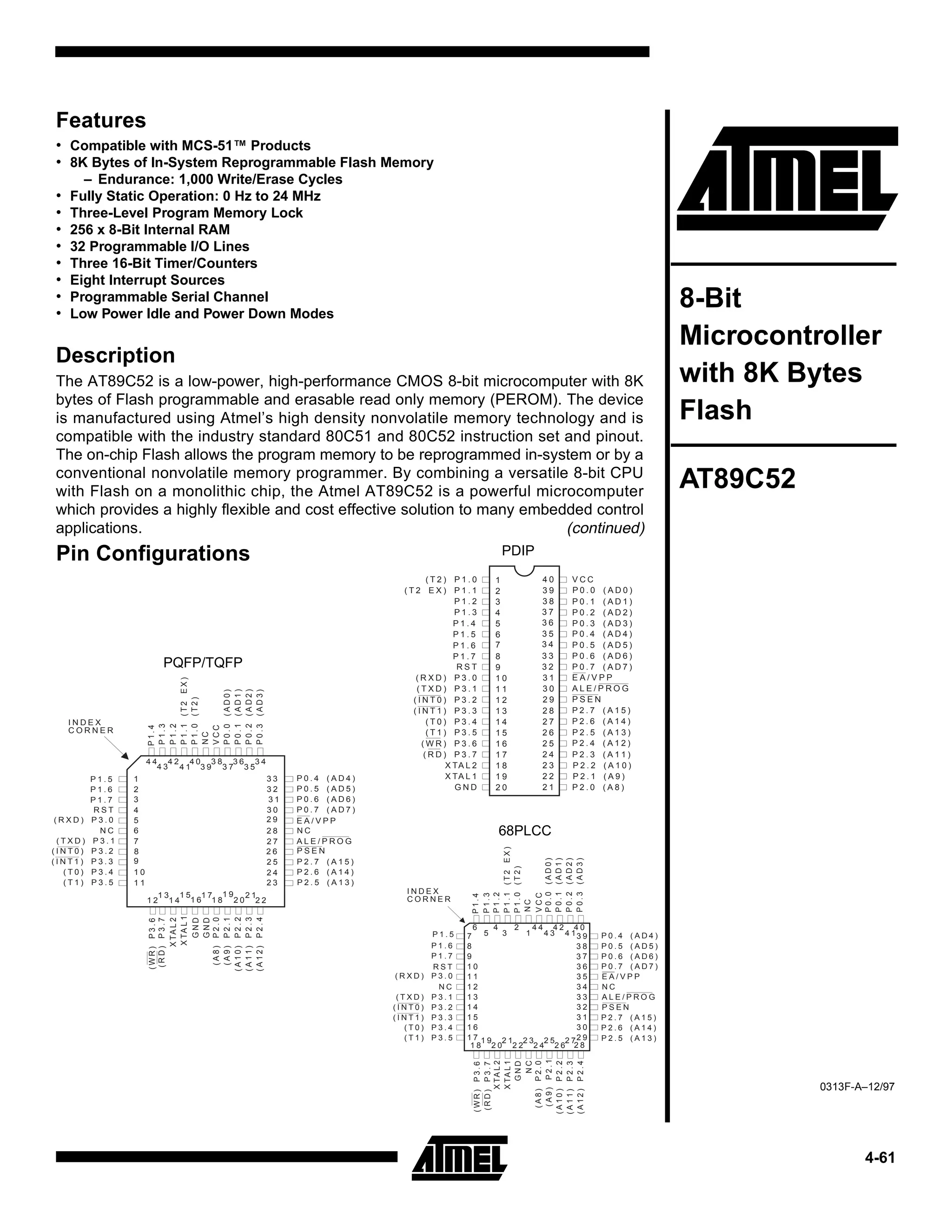
Pin Configurations

13 15 17 19 21
12 14 16 18 20 22

1
2
3
4
5
6
7
8
9
10
11
12
13
14
15
16
17
18
19
20

40
39
38
37
36
35
34
33
32
31
30
29
28
27
26
25
24
23
22
21

VCC
P0.0 (AD0)
P0.1 (AD1)
P0.2 (AD2)
P0.3 (AD3)
P0.4 (AD4)
P0.5 (AD5)
P0.6 (AD6)
P0.7 (AD7)
EA/VPP
ALE/PROG
PSEN
P2.7 (A15)
P2.6 (A14)
P2.5 (A13)
P2.4 (A12)
P2.3 (A11)
P2.2 (A10)
P2.1 (A9)
P2.0 (A8)

INDEX
CORNER

(RXD)
(TXD)
(INT0)
(INT1)
(T0)
(T1)

P1.5
P1.6
P1.7
RST
P3.0
NC
P3.1
P3.2
P3.3
P3.4
P3.5

(AD0)
(AD1)
(AD2)
(AD3)

(T2 EX)
(T2)

68PLCC

P1.4
P1.3
P1.2
P1.1
P1.0
NC
VCC
P0.0
P0.1
P0.2
P0.3

(TXD)
(INT0)
(INT1)
(T0)
(T1)

P0.4 (AD4)
P0.5 (AD5)
P0.6 (AD6)
P0.7 (AD7)
EA/VPP
NC
ALE/PROG
PSEN
P2.7 (A15)
P2.6 (A14)
P2.5 (A13)

(WR) P3.6
(RD) P3.7
X TA L 2
X TA L 1
GND
GND
(A8) P2.0
(A9) P2.1
(A10) P2.2
(A11) P2.3
(A12) P2.4

(RXD)

33
32
31
30
29
28
27
26
25
24
23

1
2
3
4
5
6
7
8
9
10
11

(T2) P1.0
(T2 EX) P1.1
P1.2
P1.3
P1.4
P1.5
P1.6
P1.7
RST
(RXD) P3.0
(TXD) P3.1
(INT0) P3.2
(INT1) P3.3
(T0) P3.4
(T1) P3.5
(WR) P3.6
(RD) P3.7
X TA L 2
X TA L 1
GND

6
4
2
44 42 40
1
5
3
4 3 4 13 9
7
8
38
9
37
10
36
11
35
12
34
13
33
14
32
15
31
16
30
1 7 1 9 2 1 2 3 2 5 2 72 9
18 20 22 24 26 28

(WR) P3.6
(RD) P3.7
X TA L 2
X TA L 1
GND
NC
(A8) P2.0
(A9) P2.1
(A10) P2.2
(A11) P2.3
(A12) P2.4

(AD0)
(AD1)
(AD2)
(AD3)

(T2 EX)
(T2)

P1.4
P1.3
P1.2
P1.1
P1.0
NC
VCC
P0.0
P0.1
P0.2
P0.3
44 42 40 38 36 34
43 41 39 37 35

P1.5
P1.6
P1.7
RST
P3.0
NC
P3.1
P3.2
P3.3
P3.4
P3.5

AT89C52

PDIP

PQFP/TQFP

INDEX
CORNER

8-Bit
Microcontroller
with 8K Bytes
Flash

P0.4 (AD4)
P0.5 (AD5)
P0.6 (AD6)
P0.7 (AD7)
EA/VPP
NC
ALE/PROG
PSEN
P2.7 (A15)
P2.6 (A14)
P2.5 (A13)

0313F-A–12/97

4-61
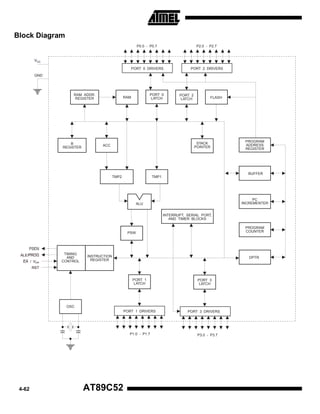
Block Diagram
P0.0 - P0.7

P2.0 - P2.7

PORT 0 DRIVERS

PORT 2 DRIVERS

VCC

GND

RAM ADDR.
REGISTER

B
REGISTER

PORT 0
LATCH

RAM

PORT 2
LATCH

FLASH

STACK
POINTER

ACC

BUFFER

TMP1

TMP2

PROGRAM
ADDRESS
REGISTER

PC
INCREMENTER

ALU
INTERRUPT, SERIAL PORT,
AND TIMER BLOCKS

PROGRAM
COUNTER

PSW

PSEN
ALE/PROG
EA / VPP

TIMING
AND
CONTROL

INSTRUCTION
REGISTER

DPTR

RST
PORT 1
LATCH

PORT 3
LATCH

PORT 1 DRIVERS

PORT 3 DRIVERS

OSC

P1.0 - P1.7

4-62

AT89C52

P3.0 - P3.7
AT89C52
The AT89C52 provides the following standard features: 8K
bytes of Flash, 256 bytes of RAM, 32 I/O lines, three 16-bit
timer/counters, a six-vector two-level interrupt architecture,
a full duplex serial port, on-chip oscillator, and clock circuitry. In addition, the AT89C52 is designed with static logic
for operation down to zero frequency and supports two
software selectable power saving modes. The Idle Mode
stops the CPU while allowing the RAM, timer/counters,
serial port, and interrupt system to continue functioning.
The Power Down Mode saves the RAM contents but
freezes the oscillator, disabling all other chip functions until
the next hardware reset.

Pin Description
VCC
Supply voltage.
GND
Ground.
Port 0
Port 0 is an 8-bit open drain bidirectional I/O port. As an
output port, each pin can sink eight TTL inputs. When 1s
are written to port 0 pins, the pins can be used as highimpedance inputs.
Port 0 can also be configured to be the multiplexed loworder address/data bus during accesses to external program and data memory. In this mode, P0 has internal pullups.
Port 0 also receives the code bytes during Flash programming and outputs the code bytes during program verification. External pullups are required during program verification.
Port 1
Port 1 is an 8-bit bidirectional I/O port with internal pullups.
The Port 1 output buffers can sink/source four TTL inputs.
When 1s are written to Port 1 pins, they are pulled high by
the internal pullups and can be used as inputs. As inputs,
Port 1 pins that are externally being pulled low will source
current (IIL) because of the internal pullups.
In addition, P1.0 and P1.1 can be configured to be the
timer/counter 2 external count input (P1.0/T2) and the
timer/counter 2 trigger input (P1.1/T2EX), respectively, as
shown in the following table.
Port 1 also receives the low-order address bytes during
Flash programming and verification.
Port Pin

Alternate Functions

P1.0

T2 (external count input to Timer/Counter 2),
clock-out

P1.1

T2EX (Timer/Counter 2 capture/reload trigger
and direction control)

Port 2
Port 2 is an 8-bit bidirectional I/O port with internal pullups.
The Port 2 output buffers can sink/source four TTL inputs.
When 1s are written to Port 2 pins, they are pulled high by
the internal pullups and can be used as inputs. As inputs,
Port 2 pins that are externally being pulled low will source
current (IIL) because of the internal pullups.
Port 2 emits the high-order address byte during fetches
from external program memory and during accesses to
external data memory that use 16-bit addresses (MOVX @
DPTR). In this application, Port 2 uses strong internal pullups when emitting 1s. During accesses to external data
memory that use 8-bit addresses (MOVX @ RI), Port 2
emits the contents of the P2 Special Function Register.
Port 2 also receives the high-order address bits and some
control signals during Flash programming and verification.
Port 3
Port 3 is an 8-bit bidirectional I/O port with internal pullups.
The Port 3 output buffers can sink/source four TTL inputs.
When 1s are written to Port 3 pins, they are pulled high by
the internal pullups and can be used as inputs. As inputs,
Port 3 pins that are externally being pulled low will source
current (IIL) because of the pullups.
Port 3 also serves the functions of various special features
of the AT89C51, as shown in the following table.
Port 3 also receives some control signals for Flash programming and verification.
Port Pin

Alternate Functions

P3.0

RXD (serial input port)

P3.1

TXD (serial output port)

P3.2

INT0 (external interrupt 0)

P3.3

INT1 (external interrupt 1)

P3.4

T0 (timer 0 external input)

P3.5

T1 (timer 1 external input)

P3.6

WR (external data memory write strobe)

P3.7

RD (external data memory read strobe)

RST
Reset input. A high on this pin for two machine cycles while
the oscillator is running resets the device.
ALE/PROG
Address Latch Enable is an output pulse for latching the
low byte of the address during accesses to external memory. This pin is also the program pulse input (PROG) during
Flash programming.
In normal operation, ALE is emitted at a constant rate of 1/6
the oscillator frequency and may be used for external timing or clocking purposes. Note, however, that one ALE

4-63
pulse is skipped during each access to external data memory.
If desired, ALE operation can be disabled by setting bit 0 of
SFR location 8EH. With the bit set, ALE is active only during a MOVX or MOVC instruction. Otherwise, the pin is
weakly pulled high. Setting the ALE-disable bit has no
effect if the microcontroller is in external execution mode.
PSEN
Program Store Enable is the read strobe to external program memory.
When the AT89C52 is executing code from external program memory, PSEN is activated twice each machine
cycle, except that two PSEN activations are skipped during
each access to external data memory.

EA/VPP
External Access Enable. EA must be strapped to GND in
order to enable the device to fetch code from external program memory locations starting at 0000H up to FFFFH.
Note, however, that if lock bit 1 is programmed, EA will be
internally latched on reset.
EA should be strapped to VCC for internal program executions.
This pin also receives the 12-volt programming enable voltage (V PP ) during Flash programming when 12-volt programming is selected.
XTAL1
Input to the inverting oscillator amplifier and input to the
internal clock operating circuit.
XTAL2
Output from the inverting oscillator amplifier.

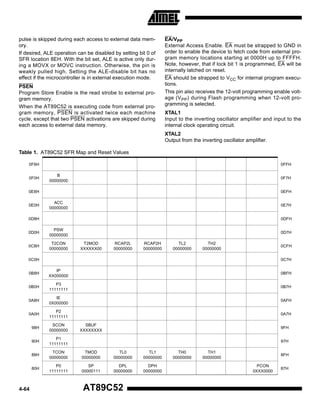
Table 1. AT89C52 SFR Map and Reset Values
0F8H
0F0H

0FFH
B
00000000

0F7H

0E8H
0E0H

0EFH
ACC
00000000

0E7H

0D8H

0DFH

0D0H

PSW
00000000

0C8H

T2CON
00000000

0D7H
T2MOD
XXXXXX00

RCAP2L
00000000

RCAP2H
00000000

TL2
00000000

TH2
00000000

0CFH

0C0H

0C7H

0B8H

IP
XX000000

0BFH

0B0H

P3
11111111

0B7H

0A8H

IE
0X000000

0AFH

0A0H

P2
11111111

0A7H

98H

SCON
00000000

90H

P1
11111111

88H

TCON
00000000

TMOD
00000000

TL0
00000000

TL1
00000000

80H

P0
11111111

SP
00000111

DPL
00000000

DPH
00000000

4-64

SBUF
XXXXXXXX

9FH
97H

AT89C52

TH0
00000000

TH1
00000000

8FH
PCON
0XXX0000

87H
AT89C52
Special Function Registers
A map of the on-chip memory area called the Special Function Register (SFR) space is shown in Table 1.
Note that not all of the addresses are occupied, and unoccupied addresses may not be implemented on the chip.
Read accesses to these addresses will in general return
random data, and write accesses will have an indeterminate effect.
User software should not write 1s to these unlisted locations, since they may be used in future products to invoke

new features. In that case, the reset or inactive values of
the new bits will always be 0.
Timer 2 Registers: Control and status bits are contained
in registers T2CON (shown in Table 2) and T2MOD (shown
in Table 4) for Timer 2. The register pair (RCAP2H,
RCAP2L) are the Capture/Reload registers for Timer 2 in
16-bit capture mode or 16-bit auto-reload mode.
Interrupt Registers: The individual interrupt enable bits
are in the IE register. Two priorities can be set for each of
the six interrupt sources in the IP register.

Table 2. T2CON—Timer/Counter 2 Control Register
T2CON Address = 0C8H

Reset Value = 0000 0000B

Bit Addressable
Bit

TF2

EXF2

RCLK

TCLK

EXEN2

TR2

C/T2

CP/RL2

7

6

5

4

3

2

1

0

Symbol

Function

TF2

Timer 2 overflow flag set by a Timer 2 overflow and must be cleared by software. TF2 will not be set when either
RCLK = 1 or TCLK = 1.

EXF2

Timer 2 external flag set when either a capture or reload is caused by a negative transition on T2EX and EXEN2 =
1. When Timer 2 interrupt is enabled, EXF2 = 1 will cause the CPU to vector to the Timer 2 interrupt routine. EXF2
must be cleared by software. EXF2 does not cause an interrupt in up/down counter mode (DCEN = 1).

RCLK

Receive clock enable. When set, causes the serial port to use Timer 2 overflow pulses for its receive clock in serial
port Modes 1 and 3. RCLK = 0 causes Timer 1 overflow to be used for the receive clock.

TCLK

Transmit clock enable. When set, causes the serial port to use Timer 2 overflow pulses for its transmit clock in serial
port Modes 1 and 3. TCLK = 0 causes Timer 1 overflows to be used for the transmit clock.

EXEN2

Timer 2 external enable. When set, allows a capture or reload to occur as a result of a negative transition on T2EX
if Timer 2 is not being used to clock the serial port. EXEN2 = 0 causes Timer 2 to ignore events at T2EX.

TR2

Start/Stop control for Timer 2. TR2 = 1 starts the timer.

C/T2

Timer or counter select for Timer 2. C/T2 = 0 for timer function. C/T2 = 1 for external event counter (falling edge
triggered).

CP/RL2

Capture/Reload select. CP/RL2 = 1 causes captures to occur on negative transitions at T2EX if EXEN2 = 1. CP/RL2
= 0 causes automatic reloads to occur when Timer 2 overflows or negative transitions occur at T2EX when EXEN2
= 1. When either RCLK or TCLK = 1, this bit is ignored and the timer is forced to auto-reload on Timer 2 overflow.

Data Memory
The AT89C52 implements 256 bytes of on-chip RAM. The
upper 128 bytes occupy a parallel address space to the
Special Function Registers. That means the upper 128
bytes have the same addresses as the SFR space but are
physically separate from SFR space.
When an instruction accesses an internal location above
address 7FH, the address mode used in the instruction
specifies whether the CPU accesses the upper 128 bytes
of RAM or the SFR space. Instructions that use direct
addressing access SFR space.

For example, the following direct addressing instruction
accesses the SFR at location 0A0H (which is P2).
MOV 0A0H, #data

Instructions that use indirect addressing access the upper
128 bytes of RAM. For example, the following indirect
addressing instruction, where R0 contains 0A0H, accesses
the data byte at address 0A0H, rather than P2 (whose
address is 0A0H).
MOV @R0, #data

Note that stack operations are examples of indirect
addressing, so the upper 128 bytes of data RAM are available as stack space.
4-65
Timer 0 and 1
Timer 0 and Timer 1 in the AT89C52 operate the same way
as Timer 0 and Timer 1 in the AT89C51.

Timer 2
Timer 2 is a 16-bit Timer/Counter that can operate as either
a timer or an event counter. The type of operation is
selected by bit C/T2 in the SFR T2CON (shown in Table 2).
Timer 2 has three operating modes: capture, auto-reload
(up or down counting), and baud rate generator. The
modes are selected by bits in T2CON, as shown in Table 3.
Timer 2 consists of two 8-bit registers, TH2 and TL2. In the
Timer function, the TL2 register is incremented every
machine cycle. Since a machine cycle consists of 12 oscillator periods, the count rate is 1/12 of the oscillator frequency.

show a high in one cycle and a low in the next cycle, the
count is incremented. The new count value appears in the
register during S3P1 of the cycle following the one in which
the transition was detected. Since two machine cycles (24
oscillator periods) are required to recognize a 1-to-0 transition, the maximum count rate is 1/24 of the oscillator frequency. To ensure that a given level is sampled at least
once before it changes, the level should be held for at least
one full machine cycle.

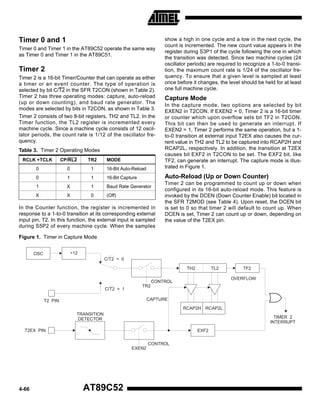
Capture Mode

RCLK +TCLK

CP/RL2

TR2

0

0

1

16-Bit Auto-Reload

In the capture mode, two options are selected by bit
EXEN2 in T2CON. If EXEN2 = 0, Timer 2 is a 16-bit timer
or counter which upon overflow sets bit TF2 in T2CON.
This bit can then be used to generate an interrupt. If
EXEN2 = 1, Timer 2 performs the same operation, but a 1to-0 transition at external input T2EX also causes the current value in TH2 and TL2 to be captured into RCAP2H and
RCAP2L, respectively. In addition, the transition at T2EX
causes bit EXF2 in T2CON to be set. The EXF2 bit, like
TF2, can generate an interrupt. The capture mode is illustrated in Figure 1.

0

1

1

16-Bit Capture

Auto-Reload (Up or Down Counter)

1

X

1

Baud Rate Generator

X

X

0

(Off)

Table 3. Timer 2 Operating Modes
MODE

In the Counter function, the register is incremented in
response to a 1-to-0 transition at its corresponding external
input pin, T2. In this function, the external input is sampled
during S5P2 of every machine cycle. When the samples

Timer 2 can be programmed to count up or down when
configured in its 16-bit auto-reload mode. This feature is
invoked by the DCEN (Down Counter Enable) bit located in
the SFR T2MOD (see Table 4). Upon reset, the DCEN bit
is set to 0 so that timer 2 will default to count up. When
DCEN is set, Timer 2 can count up or down, depending on
the value of the T2EX pin.

Figure 1. Timer in Capture Mode
÷12

OSC

C/T2 = 0
TH2

TL2

OVERFLOW

CONTROL
C/T2 = 1

TF2

TR2
CAPTURE

T2 PIN

RCAP2H RCAP2L
TRANSITION
DETECTOR

TIMER 2
INTERRUPT

T2EX PIN

EXF2
CONTROL
EXEN2

4-66

AT89C52
AT89C52
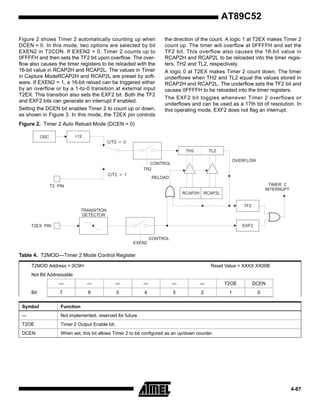
Figure 2 shows Timer 2 automatically counting up when
DCEN = 0. In this mode, two options are selected by bit
EXEN2 in T2CON. If EXEN2 = 0, Timer 2 counts up to
0FFFFH and then sets the TF2 bit upon overflow. The overflow also causes the timer registers to be reloaded with the
16-bit value in RCAP2H and RCAP2L. The values in Timer
in Capture ModeRCAP2H and RCAP2L are preset by software. If EXEN2 = 1, a 16-bit reload can be triggered either
by an overflow or by a 1-to-0 transition at external input
T2EX. This transition also sets the EXF2 bit. Both the TF2
and EXF2 bits can generate an interrupt if enabled.
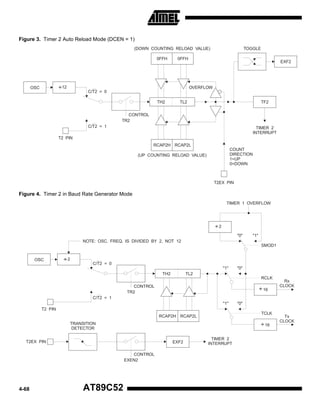
Setting the DCEN bit enables Timer 2 to count up or down,
as shown in Figure 3. In this mode, the T2EX pin controls

the direction of the count. A logic 1 at T2EX makes Timer 2
count up. The timer will overflow at 0FFFFH and set the
TF2 bit. This overflow also causes the 16-bit value in
RCAP2H and RCAP2L to be reloaded into the timer registers, TH2 and TL2, respectively.
A logic 0 at T2EX makes Timer 2 count down. The timer
underflows when TH2 and TL2 equal the values stored in
RCAP2H and RCAP2L. The underflow sets the TF2 bit and
causes 0FFFFH to be reloaded into the timer registers.
The EXF2 bit toggles whenever Timer 2 overflows or
underflows and can be used as a 17th bit of resolution. In
this operating mode, EXF2 does not flag an interrupt.

Figure 2. Timer 2 Auto Reload Mode (DCEN = 0)
÷12

OSC

C/T2 = 0
TH2

TL2
OVERFLOW

CONTROL
TR2
C/T2 = 1

RELOAD
TIMER 2
INTERRUPT

T2 PIN
RCAP2H RCAP2L
TF2
TRANSITION
DETECTOR
EXF2

T2EX PIN
CONTROL
EXEN2

Table 4. T2MOD—Timer 2 Mode Control Register
T2MOD Address = 0C9H

Reset Value = XXXX XX00B

Not Bit Addressable
—
Bit

—

—

—

—

—

T2OE

DCEN

7

6

5

4

3

2

1

0

Symbol

Function

—

Not implemented, reserved for future

T2OE

Timer 2 Output Enable bit.

DCEN

When set, this bit allows Timer 2 to be configured as an up/down counter.

4-67
Figure 3. Timer 2 Auto Reload Mode (DCEN = 1)
(DOWN COUNTING RELOAD VALUE)
0FFH

÷12

OSC

TOGGLE

0FFH

EXF2

OVERFLOW
C/T2 = 0
TH2

TL2

TF2

CONTROL
TR2
C/T2 = 1

TIMER 2
INTERRUPT

T2 PIN
RCAP2H RCAP2L
COUNT
DIRECTION
1=UP
0=DOWN

(UP COUNTING RELOAD VALUE)

T2EX PIN

Figure 4. Timer 2 in Baud Rate Generator Mode
TIMER 1 OVERFLOW

÷2
"0"

"1"

NOTE: OSC. FREQ. IS DIVIDED BY 2, NOT 12
SMOD1
OSC

÷2

C/T2 = 0
"1"
TH2

"0"

TL2
RCLK

CONTROL
TR2

÷ 16

Rx
CLOCK

C/T2 = 1
"1"

"0"

T2 PIN
TCLK

RCAP2H RCAP2L
TRANSITION
DETECTOR

÷ 16

T2EX PIN

EXF2
CONTROL
EXEN2

4-68

AT89C52

TIMER 2
INTERRUPT

Tx
CLOCK
AT89C52
Baud Rate Generator
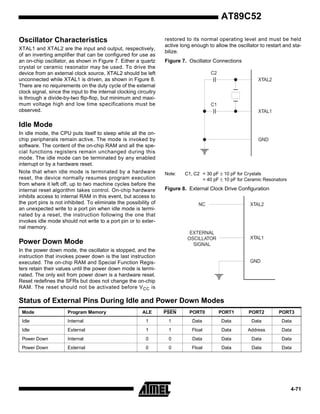
Timer 2 is selected as the baud rate generator by setting
TCLK and/or RCLK in T2CON (Table 2). Note that the baud
rates for transmit and receive can be different if Timer 2 is
used for the receiver or transmitter and Timer 1 is used for
the other function. Setting RCLK and/or TCLK puts Timer 2
into its baud rate generator mode, as shown in Figure 4.
The baud rate generator mode is similar to the auto-reload
mode, in that a rollover in TH2 causes the Timer 2 registers
to be reloaded with the 16-bit value in registers RCAP2H
and RCAP2L, which are preset by software.
The baud rates in Modes 1 and 3 are determined by Timer
2’s overflow rate according to the following equation.
Timer 2 Overflow Rate
Modes 1 and 3 Baud Rates = ----------------------------------------------------------16

The Timer can be configured for either timer or counter
operation. In most applications, it is configured for timer
operation (CP/T2 = 0). The timer operation is different for
Timer 2 when it is used as a baud rate generator. Normally,
as a timer, it increments every machine cycle (at 1/12 the
oscillator frequency). As a baud rate generator, however, it

increments every state time (at 1/2 the oscillator frequency). The baud rate formula is given below.
Oscillator Frequency
Modes 1 and 3
-------------------------------------- = --------------------------------------------------------------------------------------------32 × [ 65536 – (RCAP2H,RCAP2L) ]
Baud Rate

where (RCAP2H, RCAP2L) is the content of RCAP2H and
RCAP2L taken as a 16-bit unsigned integer.
Timer 2 as a baud rate generator is shown in Figure 4. This
figure is valid only if RCLK or TCLK = 1 in T2CON. Note
that a rollover in TH2 does not set TF2 and will not generate an interrupt. Note too, that if EXEN2 is set, a 1-to-0
transition in T2EX will set EXF2 but will not cause a reload
from (RCAP2H, RCAP2L) to (TH2, TL2). Thus when Timer
2 is in use as a baud rate generator, T2EX can be used as
an extra external interrupt.
Note that when Timer 2 is running (TR2 = 1) as a timer in
the baud rate generator mode, TH2 or TL2 should not be
read from or written to. Under these conditions, the Timer is
incremented every state time, and the results of a read or
write may not be accurate. The RCAP2 registers may be
read but should not be written to, because a write might
overlap a reload and cause write and/or reload errors. The
timer should be turned off (clear TR2) before accessing the
Timer 2 or RCAP2 registers.

Figure 5. Timer 2 in Clock-Out Mode
TL2
(8-BITS)

÷2

TH2
(8-BITS)

RCAP2L

OSC

RCAP2H

TR2

C/T2 BIT

P1.0
(T2)

÷2

T2OE (T2MOD.1)
TRANSITION
DETECTOR
P1.1
(T2EX)

EXF2

TIMER 2
INTERRUPT

EXEN2

4-69
Programmable Clock Out
A 50% duty cycle clock can be programmed to come out on
P1.0, as shown in Figure 5. This pin, besides being a regular I/O pin, has two alternate functions. It can be programmed to input the external clock for Timer/Counter 2 or
to output a 50% duty cycle clock ranging from 61 Hz to 4
MHz at a 16 MHz operating frequency.
To configure the Timer/Counter 2 as a clock generator, bit
C/T2 (T2CON.1) must be cleared and bit T2OE (T2MOD.1)
must be set. Bit TR2 (T2CON.2) starts and stops the timer.
The clock-out frequency depends on the oscillator frequency and the reload value of Timer 2 capture registers
(RCAP2H, RCAP2L), as shown in the following equation.

Table 5. Interrupt Enable (IE) Register
(MSB)
EA

(LSB)
—

ET2

ES

ET1

EX1

ET0

EX0

Enable Bit = 1 enables the interrupt.
Enable Bit = 0 disables the interrupt.

In the clock-out mode, Timer 2 roll-overs will not generate
an interrupt. This behavior is similar to when Timer 2 is
used as a baud-rate generator. It is possible to use Timer 2
as a baud-rate generator and a clock generator simultaneously. Note, however, that the baud-rate and clock-out
frequencies cannot be determined independently from one
another since they both use RCAP2H and RCAP2L.

UART
The UART in the AT89C52 operates the same way as the
UART in the AT89C51.

Position

Function

EA

IE.7

Disables all interrupts. If EA = 0,
no interrupt is acknowledged. If
EA = 1, each interrupt source is
individually enabled or disabled
by setting or clearing its enable
bit.

—

IE.6

Reserved.

ET2

IE.5

Timer 2 interrupt enable bit.

ES

IE.4

Serial Port interrupt enable bit.

ET1

IE.3

Timer 1 interrupt enable bit.

EX1

IE.2

External interrupt 1 enable bit.

ET0

IE.1

Timer 0 interrupt enable bit.

EX0

Oscillator Fequency
Clock-Out Frequency = ----------------------------------------------------------------------------------------4 × [ 65536 – (RCAP2H,RCAP2L) ]

Symbol

IE.0

External interrupt 0 enable bit.

User software should never write 1s to unimplemented bits,
because they may be used in future AT89 products.

Figure 6. Interrupt Sources

Interrupts
The AT89C52 has a total of six interrupt vectors: two external interrupts (INT0 and INT1), three timer interrupts (Timers 0, 1, and 2), and the serial port interrupt. These interrupts are all shown in Figure 6.
Each of these interrupt sources can be individually enabled
or disabled by setting or clearing a bit in Special Function
Register IE. IE also contains a global disable bit, EA, which
disables all interrupts at once.
Note that Table 5 shows that bit position IE.6 is unimplemented. In the AT89C51, bit position IE.5 is also unimplemented. User software should not write 1s to these bit positions, since they may be used in future AT89 products.
Timer 2 interrupt is generated by the logical OR of bits TF2
and EXF2 in register T2CON. Neither of these flags is
cleared by hardware when the service routine is vectored
to. In fact, the service routine may have to determine
whether it was TF2 or EXF2 that generated the interrupt,
and that bit will have to be cleared in software.
The Timer 0 and Timer 1 flags, TF0 and TF1, are set at
S5P2 of the cycle in which the timers overflow. The values
are then polled by the circuitry in the next cycle. However,
the Timer 2 flag, TF2, is set at S2P2 and is polled in the
same cycle in which the timer overflows.
4-70

AT89C52

0
INT0

IE0
1

TF0

0
INT1

IE1
1

TF1
TI
RI
TF2
EXF2
AT89C52
Oscillator Characteristics
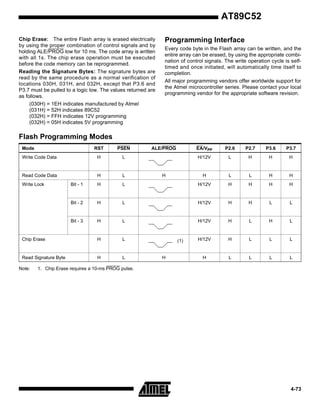
XTAL1 and XTAL2 are the input and output, respectively,
of an inverting amplifier that can be configured for use as
an on-chip oscillator, as shown in Figure 7. Either a quartz
crystal or ceramic resonator may be used. To drive the
device from an external clock source, XTAL2 should be left
unconnected while XTAL1 is driven, as shown in Figure 8.
There are no requirements on the duty cycle of the external
clock signal, since the input to the internal clocking circuitry
is through a divide-by-two flip-flop, but minimum and maximum voltage high and low time specifications must be
observed.

restored to its normal operating level and must be held
active long enough to allow the oscillator to restart and stabilize.
Figure 7. Oscillator Connections
C2
XTAL2

C1
XTAL1

Idle Mode
In idle mode, the CPU puts itself to sleep while all the onchip peripherals remain active. The mode is invoked by
software. The content of the on-chip RAM and all the special functions registers remain unchanged during this
mode. The idle mode can be terminated by any enabled
interrupt or by a hardware reset.
Note that when idle mode is terminated by a hardware
reset, the device normally resumes program execution
from where it left off, up to two machine cycles before the
internal reset algorithm takes control. On-chip hardware
inhibits access to internal RAM in this event, but access to
the port pins is not inhibited. To eliminate the possibility of
an unexpected write to a port pin when idle mode is terminated by a reset, the instruction following the one that
invokes idle mode should not write to a port pin or to external memory.

GND

Note:

C1, C2 = 30 pF ± 10 pF for Crystals
= 40 pF ± 10 pF for Ceramic Resonators

Figure 8. External Clock Drive Configuration
NC

EXTERNAL
OSCILLATOR
SIGNAL

Power Down Mode

XTAL2

XTAL1

In the power down mode, the oscillator is stopped, and the
instruction that invokes power down is the last instruction
executed. The on-chip RAM and Special Function Registers retain their values until the power down mode is terminated. The only exit from power down is a hardware reset.
Reset redefines the SFRs but does not change the on-chip
RAM. The reset should not be activated before V CC is

GND

Status of External Pins During Idle and Power Down Modes
Mode

Program Memory

ALE

PSEN

PORT0

PORT1

PORT2

PORT3

Idle

Internal

1

1

Data

Data

Data

Data

Idle

External

1

1

Float

Data

Address

Data

Power Down

Internal

0

0

Data

Data

Data

Data

Power Down

External

0

0

Float

Data

Data

Data

4-71
Program Memory Lock Bits
The AT89C52 has three lock bits that can be left unprogrammed (U) or can be programmed (P) to obtain the additional features listed in the following table.

Lock Bit Protection Modes
Program Lock Bits
LB1

LB2

LB3

Protection Type

1

U

U

U

No program lock features.

2

P

U

U

MOVC instructions executed
from external program
memory are disabled from
fetching code bytes from
internal memory, EA is
sampled and latched on reset,
and further programming of
the Flash memory is disabled.

3

P

P

U

Same as mode 2, but verify is
also disabled.

4

P

P

P

Same as mode 3, but external
execution is also disabled.

When lock bit 1 is programmed, the logic level at the EA pin
is sampled and latched during reset. If the device is powered up without a reset, the latch initializes to a random
value and holds that value until reset is activated. The
latched value of EA must agree with the current logic level
at that pin in order for the device to function properly.

Programming the Flash
The AT89C52 is normally shipped with the on-chip Flash
memory array in the erased state (that is, contents = FFH)
and ready to be programmed. The programming interface
accepts either a high-voltage (12-volt) or a low-voltage
(V CC) program enable signal. The low voltage programming mode provides a convenient way to program the
AT89C52 inside the user’s system, while the high-voltage
programming mode is compatible with conventional thirdparty Flash or EPROM programmers.
The AT89C52 is shipped with either the high-voltage or
low-voltage programming mode enabled. The respective
top-side marking and device signature codes are listed in
the following table.

4-72

AT89C52

VPP = 12V

VPP = 5V

Top-Side Mark

AT89C52
xxxx
yyww

AT89C52
xxxx-5
yyww

Signature

(030H)=1EH
(031H)=52H
(032H)=FFH

(030H)=1EH
(031H)=52H
(032H)=05H

The AT89C52 code memory array is programmed byte-bybyte in either programming mode. To program any nonblank byte in the on-chip Flash Memory, the entire memory
must be erased using the Chip Erase Mode.
Programming Algorithm: Before programming the
AT89C52, the address, data and control signals should be
set up according to the Flash programming mode table and
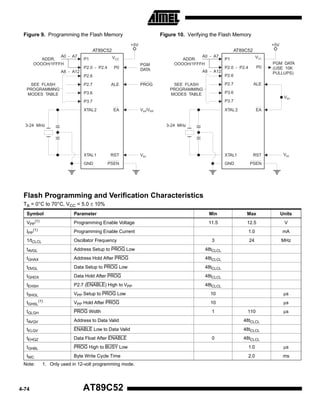
Figures 9 and 10. To program the AT89C52, take the following steps.
1. Input the desired memory location on the address
lines.
2. Input the appropriate data byte on the data lines.
3. Activate the correct combination of control signals.
4. Raise EA/VPP to 12V for the high-voltage programming
mode.
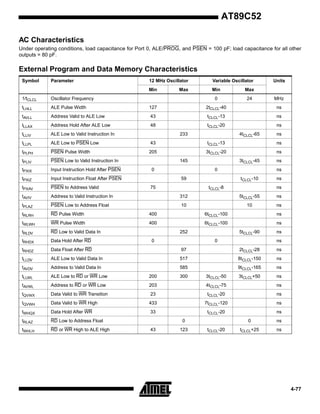
5. Pulse ALE/PROG once to program a byte in the Flash
array or the lock bits. The byte-write cycle is self-timed
and typically takes no more than 1.5 ms. Repeat steps
1 through 5, changing the address and data for the
entire array or until the end of the object file is reached.
Data Polling: The AT89C52 features Data Polling to indicate the end of a write cycle. During a write cycle, an
attempted read of the last byte written will result in the complement of the written data on PO.7. Once the write cycle
has been completed, true data is valid on all outputs, and
the next cycle may begin. Data Polling may begin any time
after a write cycle has been initiated.
Ready/Busy: The progress of byte programming can also
be monitored by the RDY/BSY output signal. P3.4 is pulled
low after ALE goes high during programming to indicate
BUSY. P3.4 is pulled high again when programming is
done to indicate READY.
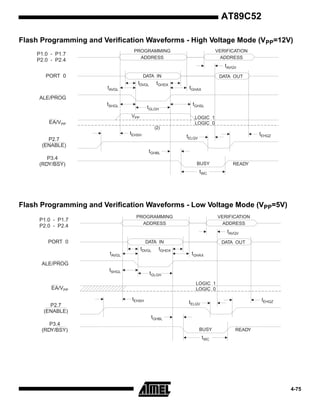
Program Verify: If lock bits LB1 and LB2 have not been
programmed, the programmed code data can be read back
via the address and data lines for verification. The lock bits
cannot be verified directly. Verification of the lock bits is
achieved by observing that their features are enabled.
AT89C52
Chip Erase: The entire Flash array is erased electrically
by using the proper combination of control signals and by
holding ALE/PROG low for 10 ms. The code array is written
with all 1s. The chip erase operation must be executed
before the code memory can be reprogrammed.
Reading the Signature Bytes: The signature bytes are
read by the same procedure as a normal verification of
locations 030H, 031H, and 032H, except that P3.6 and
P3.7 must be pulled to a logic low. The values returned are
as follows.
(030H) = 1EH indicates manufactured by Atmel
(031H) = 52H indicates 89C52
(032H) = FFH indicates 12V programming
(032H) = 05H indicates 5V programming

Programming Interface
Every code byte in the Flash array can be written, and the
entire array can be erased, by using the appropriate combination of control signals. The write operation cycle is selftimed and once initiated, will automatically time itself to
completion.
All major programming vendors offer worldwide support for
the Atmel microcontroller series. Please contact your local
programming vendor for the appropriate software revision.

Flash Programming Modes
EA/VPP

P2.6

P2.7

P3.6

P3.7

H/12V

L

H

H

H

H

L

L

H

H

L

H/12V

H

H

H

H

H

L

H/12V

H

H

L

L

H

L

H/12V

H

L

H

L

Chip Erase

H

L

H/12V

H

L

L

L

Read Signature Byte

H

L

H

L

L

L

L

Mode

RST

PSEN

Write Code Data

H

L

Read Code Data

H

L

Bit - 1

H

Bit - 2

Bit - 3

ALE/PROG

Write Lock

Note:

H

(1)

H

1. Chip Erase requires a 10-ms PROG pulse.

4-73
Figure 9. Programming the Flash Memory

Figure 10. Verifying the Flash Memory
+5V

+5V

AT89C52
A0 - A7
ADDR.
OOOOH/1FFFH

P1
P2.0 - P2.4

AT89C52
VCC
P0

A8 - A12

PGM
DATA

A0 - A7
ADDR.
OOOOH/1FFFH
A8 - A12

P2.7

ALE

PROG

P3.6

P2.0 - P2.4

P0

P2.7

SEE FLASH
PROGRAMMING
MODES TABLE

ALE
VIH

P3.7
EA

VIH/VPP

3-24 MHz

PGM DATA
(USE 10K
PULLUPS)

P3.6

P3.7
XTAL2

VCC

P2.6

P2.6
SEE FLASH
PROGRAMMING
MODES TABLE

P1

XTAL 2

EA

XTAL1

RST

3-24 MHz

XTAL1
GND

RST

VIH

PSEN

GND

VIH

PSEN

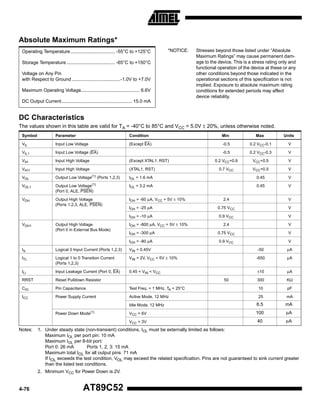
Flash Programming and Verification Characteristics
TA = 0°C to 70°C, VCC = 5.0 ± 10%
Symbol

Parameter

Min

Max

Units

VPP(1)

Programming Enable Voltage

11.5

12.5

V

IPP(1)

Programming Enable Current

1.0

mA

1/tCLCL

Oscillator Frequency

24

MHz

tAVGL

Address Setup to PROG Low

48tCLCL

tGHAX

Address Hold After PROG

48tCLCL

tDVGL

Data Setup to PROG Low

48tCLCL

tGHDX

Data Hold After PROG

48tCLCL

tEHSH

P2.7 (ENABLE) High to VPP

48tCLCL

tSHGL

VPP Setup to PROG Low

10

µs

VPP Hold After PROG

10

µs

tGLGH

PROG Width

1

tAVQV

Address to Data Valid

48tCLCL

tELQV

ENABLE Low to Data Valid

48tCLCL

tEHQZ

Data Float After ENABLE

tGHBL

PROG High to BUSY Low

1.0

µs

tWC

Byte Write Cycle Time

2.0

ms

tGHSL

Note:

4-74

(1)

1. Only used in 12-volt programming mode.

AT89C52

3

0

110

µs

48tCLCL
AT89C52
Flash Programming and Verification Waveforms - High Voltage Mode (VPP=12V)
PROGRAMMING
ADDRESS

P1.0 - P1.7
P2.0 - P2.4

VERIFICATION
ADDRESS

tAVQV
PORT 0

DATA IN

tAVGL

tDVGL

tGHDX

DATA OUT

tGHAX

ALE/PROG
tSHGL

tGLGH
VPP

tGHSL
LOGIC 1
LOGIC 0

EA/VPP
(2)

tEHSH

tEHQZ

tELQV

P2.7
(ENABLE)
tGHBL
P3.4
(RDY/BSY)

BUSY

READY

tWC

Flash Programming and Verification Waveforms - Low Voltage Mode (VPP=5V)
PROGRAMMING
ADDRESS

P1.0 - P1.7
P2.0 - P2.4

VERIFICATION
ADDRESS

tAVQV
PORT 0

DATA IN

tAVGL

tDVGL

tGHDX

DATA OUT

tGHAX

ALE/PROG
tSHGL

tGLGH
LOGIC 1
LOGIC 0

EA/VPP
tEHSH

tEHQZ

tELQV

P2.7
(ENABLE)
tGHBL
P3.4
(RDY/BSY)

BUSY

READY

tWC

4-75
Absolute Maximum Ratings*
Operating Temperature .................................. -55°C to +125°C

*NOTICE:

Storage Temperature ..................................... -65°C to +150°C
Voltage on Any Pin
with Respect to Ground .....................................-1.0V to +7.0V
Maximum Operating Voltage............................................. 6.6V

Stresses beyond those listed under “Absolute
Maximum Ratings” may cause permanent damage to the device. This is a stress rating only and
functional operation of the device at these or any
other conditions beyond those indicated in the
operational sections of this specification is not
implied. Exposure to absolute maximum rating
conditions for extended periods may affect
device reliability.

DC Output Current...................................................... 15.0 mA

DC Characteristics
The values shown in this table are valid for TA = -40°C to 85°C and VCC = 5.0V ± 20%, unless otherwise noted.
Symbol

Parameter

Condition

Min

Max

Units

VIL

Input Low Voltage

(Except EA)

-0.5

0.2 VCC-0.1

V

VIL1

Input Low Voltage (EA)

-0.5

0.2 VCC-0.3

V

VIH

Input High Voltage

0.2 VCC+0.9

VCC+0.5

V

VIH1

Input High Voltage

0.7 VCC

VCC+0.5

V

IOL = 1.6 mA

0.45

V

0.45

V

VOL

(Except XTAL1, RST)
(XTAL1, RST)

Output Low Voltage

(1)

(Ports 1,2,3)

Voltage(1)

VOL1

Output Low
(Port 0, ALE, PSEN)

IOL = 3.2 mA

VOH

Output High Voltage
(Ports 1,2,3, ALE, PSEN)

IOH = -60 µA, VCC = 5V ± 10%
IOH = -25 µA

0.75 VCC

V

0.9 VCC

V

2.4

V

IOH = -300 µA

0.75 VCC

V

IOH = -80 µA

Output High Voltage
(Port 0 in External Bus Mode)

V

IOH = -10 µA
VOH1

2.4

0.9 VCC

V

IOH = -800 µA, VCC = 5V ± 10%

IIL

Logical 0 Input Current (Ports 1,2,3)

VIN = 0.45V

-50

µA

ITL

Logical 1 to 0 Transition Current
(Ports 1,2,3)

VIN = 2V, VCC = 5V ± 10%

-650

µA

ILI

Input Leakage Current (Port 0, EA)

0.45 < VIN < VCC

±10

µA

RRST

Reset Pulldown Resistor

300

KΩ

CIO

Pin Capacitance

Test Freq. = 1 MHz, TA = 25°C

10

pF

ICC

Power Supply Current

Active Mode, 12 MHz

25

mA

Idle Mode, 12 MHz

6.5

mA

VCC = 6V

100

µA

VCC = 3V

40

µA

Power Down Mode

Notes:

(1)

1. Under steady state (non-transient) conditions, IOL must be externally limited as follows:
Maximum IOL per port pin: 10 mA
Maximum IOL per 8-bit port:
Port 0: 26 mA
Ports 1, 2, 3: 15 mA
Maximum total IOL for all output pins: 71 mA
If IOL exceeds the test condition, VOL may exceed the related specification. Pins are not guaranteed to sink current greater
than the listed test conditions.
2. Minimum VCC for Power Down is 2V.

4-76

50

AT89C52
AT89C52
AC Characteristics
Under operating conditions, load capacitance for Port 0, ALE/PROG, and PSEN = 100 pF; load capacitance for all other
outputs = 80 pF.

External Program and Data Memory Characteristics
Symbol

Parameter

12 MHz Oscillator

Variable Oscillator

Min

Min

Max

0

24

Max

Units

1/tCLCL

Oscillator Frequency

tLHLL

ALE Pulse Width

127

2tCLCL-40

ns

tAVLL

Address Valid to ALE Low

43

tCLCL-13

ns

tLLAX

Address Hold After ALE Low

48

tCLCL-20

ns

tLLIV

ALE Low to Valid Instruction In

tLLPL

ALE Low to PSEN Low

43

tCLCL-13

ns

tPLPH

PSEN Pulse Width

205

3tCLCL-20

ns

tPLIV

PSEN Low to Valid Instruction In

tPXIX

Input Instruction Hold After PSEN

tPXIZ

Input Instruction Float After PSEN

tPXAV

PSEN to Address Valid

tAVIV

Address to Valid Instruction In

312

5tCLCL-55

ns

tPLAZ

PSEN Low to Address Float

10

10

ns

tRLRH

RD Pulse Width

400

6tCLCL-100

ns

tWLWH

WR Pulse Width

400

6tCLCL-100

ns

tRLDV

RD Low to Valid Data In

tRHDX

Data Hold After RD

tRHDZ

Data Float After RD

97

2tCLCL-28

ns

tLLDV

ALE Low to Valid Data In

517

8tCLCL-150

ns

tAVDV

Address to Valid Data In

585

9tCLCL-165

ns

tLLWL

ALE Low to RD or WR Low

200

3tCLCL+50

ns

tAVWL

Address to RD or WR Low

203

4tCLCL-75

ns

tQVWX

Data Valid to WR Transition

23

tCLCL-20

ns

tQVWH

Data Valid to WR High

433

7tCLCL-120

ns

tWHQX

Data Hold After WR

33

tCLCL-20

ns

tRLAZ

RD Low to Address Float

tWHLH

RD or WR High to ALE High

233

4tCLCL-65

145
0

3tCLCL-45
0

59
75

tCLCL-8

0

5tCLCL-90

3tCLCL-50

0
43

123

ns

ns
ns

0

300

ns

ns
tCLCL-10

252

MHz

ns
ns

0
tCLCL-20

ns

tCLCL+25

ns

4-77
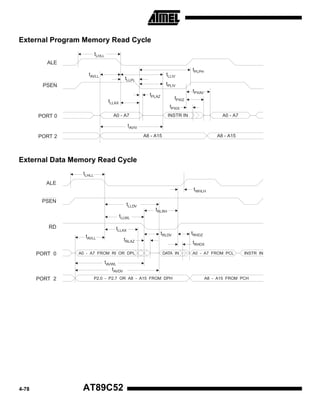
External Program Memory Read Cycle
tLHLL
ALE
tAVLL

tLLIV

tLLPL

tPLIV

PSEN

tPXAV

tPLAZ

tPXIZ

tLLAX

tPXIX

A0 - A7

PORT 0

tPLPH

INSTR IN

A0 - A7

tAVIV
A8 - A15

PORT 2

A8 - A15

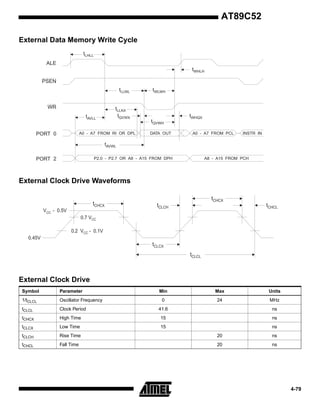
External Data Memory Read Cycle
tLHLL
ALE
tWHLH
PSEN

tLLDV

tRLRH

tLLWL
RD

tLLAX
tAVLL

PORT 0

tRLDV

tRLAZ

A0 - A7 FROM RI OR DPL

tRHDZ
tRHDX

DATA IN

A0 - A7 FROM PCL

INSTR IN

tAVWL
tAVDV
PORT 2

4-78

P2.0 - P2.7 OR A8 - A15 FROM DPH

AT89C52

A8 - A15 FROM PCH
AT89C52
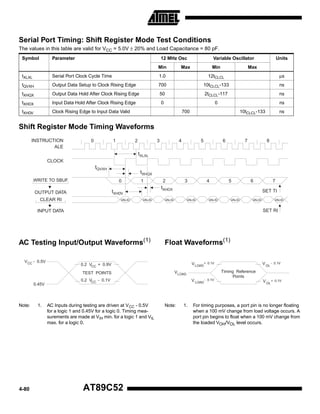
External Data Memory Write Cycle
tLHLL
ALE
tWHLH
PSEN
tLLWL
WR
tAVLL

tLLAX
tQVWX

A0 - A7 FROM RI OR DPL

PORT 0

tWLWH

tQVWH
DATA OUT

tWHQX
A0 - A7 FROM PCL

INSTR IN

tAVWL
PORT 2

P2.0 - P2.7 OR A8 - A15 FROM DPH

A8 - A15 FROM PCH

External Clock Drive Waveforms
tCHCX
VCC - 0.5V

tCHCX
tCLCH

tCHCL

0.7 VCC
0.2 VCC - 0.1V
0.45V

tCLCX
tCLCL

External Clock Drive
Symbol

Parameter

1/tCLCL

Oscillator Frequency

tCLCL

Clock Period

tCHCX

Min

Max

Units

0

24

MHz

41.6

ns

High Time

15

ns

tCLCX

Low Time

15

ns

tCLCH

Rise Time

20

ns

tCHCL

Fall Time

20

ns

4-79
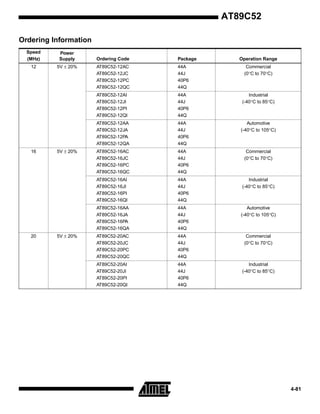
Serial Port Timing: Shift Register Mode Test Conditions
The values in this table are valid for VCC = 5.0V ± 20% and Load Capacitance = 80 pF.
Symbol

Parameter

12 MHz Osc
Min

Variable Oscillator

Max

Min

Units

Max

tXLXL

Serial Port Clock Cycle Time

1.0

12tCLCL

µs

tQVXH

Output Data Setup to Clock Rising Edge

700

10tCLCL-133

ns

tXHQX

Output Data Hold After Clock Rising Edge

50

2tCLCL-117

ns

tXHDX

Input Data Hold After Clock Rising Edge

0

0

ns

tXHDV

Clock Rising Edge to Input Data Valid

700

10tCLCL-133

ns

Shift Register Mode Timing Waveforms
INSTRUCTION
ALE

0

1

2

3

4

5

6

7

8

tXLXL
CLOCK

tQVXH
WRITE TO SBUF

tXHQX
0

1

tXHDV

OUTPUT DATA
CLEAR RI

VALID

2

3

4

5

6

tXHDX
VALID

SET TI

VALID

VALID

VALID

VALID

VALID

AC Testing Input/Output Waveforms(1)

Note:

4-80

1.

Float Waveforms(1)
V LOAD+

0.2 VCC + 0.9V
TEST POINTS

0.45V

VALID

SET RI

INPUT DATA

VCC - 0.5V

7

AC Inputs during testing are driven at V CC - 0.5V
for a logic 1 and 0.45V for a logic 0. Timing measurements are made at VIH min. for a logic 1 and VIL
max. for a logic 0.

AT89C52

V LOAD -

Note:

1.

0.1V

V OL +

0.1V

Timing Reference
Points

V LOAD

0.2 VCC - 0.1V

V OL -

0.1V

0.1V

For timing purposes, a port pin is no longer floating
when a 100 mV change from load voltage occurs. A
port pin begins to float when a 100 mV change from
the loaded VOH/VOL level occurs.
AT89C52
Ordering Information
Speed
(MHz)

Power
Supply

12

5V ± 20%

Commercial
(0°C to 70°C)

44A
44J
40P6
44Q

Industrial
(-40°C to 85°C)

44A
44J
40P6
44Q

Automotive
(-40°C to 105°C)

AT89C52-16AC
AT89C52-16JC
AT89C52-16PC
AT89C52-16QC

44A
44J
40P6
44Q

Commercial
(0°C to 70°C)

44A
44J
40P6
44Q

Industrial
(-40°C to 85°C)

AT89C52-16AA
AT89C52-16JA
AT89C52-16PA
AT89C52-16QA
5V ± 20%

44A
44J
40P6
44Q

AT89C52-16AI
AT89C52-16JI
AT89C52-16PI
AT89C52-16QI

20

AT89C52-12AC
AT89C52-12JC
AT89C52-12PC
AT89C52-12QC

AT89C52-12AA
AT89C52-12JA
AT89C52-12PA
AT89C52-12QA
5V ± 20%

Package

AT89C52-12AI
AT89C52-12JI
AT89C52-12PI
AT89C52-12QI

16

Ordering Code

Operation Range

44A
44J
40P6
44Q

Automotive
(-40°C to 105°C)

AT89C52-20AC
AT89C52-20JC
AT89C52-20PC
AT89C52-20QC

44A
44J
40P6
44Q

Commercial
(0°C to 70°C)

AT89C52-20AI
AT89C52-20JI
AT89C52-20PI
AT89C52-20QI

44A
44J
40P6
44Q

Industrial
(-40°C to 85°C)

4-81
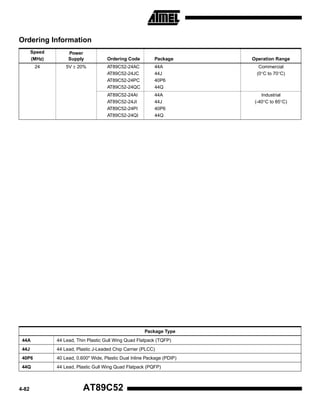
Ordering Information
Speed
(MHz)

Power
Supply

24

5V ± 20%

Ordering Code

Package

AT89C52-24AC
AT89C52-24JC
AT89C52-24PC
AT89C52-24QC

44A
44J
40P6
44Q

Commercial
(0°C to 70°C)

AT89C52-24AI
AT89C52-24JI
AT89C52-24PI
AT89C52-24QI

44A
44J
40P6
44Q

Industrial
(-40°C to 85°C)

Package Type
44A

44 Lead, Thin Plastic Gull Wing Quad Flatpack (TQFP)

44J

44 Lead, Plastic J-Leaded Chip Carrier (PLCC)

40P6

40 Lead, 0.600" Wide, Plastic Dual Inline Package (PDIP)

44Q

44 Lead, Plastic Gull Wing Quad Flatpack (PQFP)

4-82

AT89C52

Operation Range

AT89C52 Data sheet

  • 1.
    Features • Compatible withMCS-51™ Products • 8K Bytes of In-System Reprogrammable Flash Memory • • • • • • • • – Endurance: 1,000 Write/Erase Cycles Fully Static Operation: 0 Hz to 24 MHz Three-Level Program Memory Lock 256 x 8-Bit Internal RAM 32 Programmable I/O Lines Three 16-Bit Timer/Counters Eight Interrupt Sources Programmable Serial Channel Low Power Idle and Power Down Modes Description The AT89C52 is a low-power, high-performance CMOS 8-bit microcomputer with 8K bytes of Flash programmable and erasable read only memory (PEROM). The device is manufactured using Atmel’s high density nonvolatile memory technology and is compatible with the industry standard 80C51 and 80C52 instruction set and pinout. The on-chip Flash allows the program memory to be reprogrammed in-system or by a conventional nonvolatile memory programmer. By combining a versatile 8-bit CPU with Flash on a monolithic chip, the Atmel AT89C52 is a powerful microcomputer which provides a highly flexible and cost effective solution to many embedded control applications. (continued) Pin Configurations 13 15 17 19 21 12 14 16 18 20 22 1 2 3 4 5 6 7 8 9 10 11 12 13 14 15 16 17 18 19 20 40 39 38 37 36 35 34 33 32 31 30 29 28 27 26 25 24 23 22 21 VCC P0.0 (AD0) P0.1 (AD1) P0.2 (AD2) P0.3 (AD3) P0.4 (AD4) P0.5 (AD5) P0.6 (AD6) P0.7 (AD7) EA/VPP ALE/PROG PSEN P2.7 (A15) P2.6 (A14) P2.5 (A13) P2.4 (A12) P2.3 (A11) P2.2 (A10) P2.1 (A9) P2.0 (A8) INDEX CORNER (RXD) (TXD) (INT0) (INT1) (T0) (T1) P1.5 P1.6 P1.7 RST P3.0 NC P3.1 P3.2 P3.3 P3.4 P3.5 (AD0) (AD1) (AD2) (AD3) (T2 EX) (T2) 68PLCC P1.4 P1.3 P1.2 P1.1 P1.0 NC VCC P0.0 P0.1 P0.2 P0.3 (TXD) (INT0) (INT1) (T0) (T1) P0.4 (AD4) P0.5 (AD5) P0.6 (AD6) P0.7 (AD7) EA/VPP NC ALE/PROG PSEN P2.7 (A15) P2.6 (A14) P2.5 (A13) (WR) P3.6 (RD) P3.7 X TA L 2 X TA L 1 GND GND (A8) P2.0 (A9) P2.1 (A10) P2.2 (A11) P2.3 (A12) P2.4 (RXD) 33 32 31 30 29 28 27 26 25 24 23 1 2 3 4 5 6 7 8 9 10 11 (T2) P1.0 (T2 EX) P1.1 P1.2 P1.3 P1.4 P1.5 P1.6 P1.7 RST (RXD) P3.0 (TXD) P3.1 (INT0) P3.2 (INT1) P3.3 (T0) P3.4 (T1) P3.5 (WR) P3.6 (RD) P3.7 X TA L 2 X TA L 1 GND 6 4 2 44 42 40 1 5 3 4 3 4 13 9 7 8 38 9 37 10 36 11 35 12 34 13 33 14 32 15 31 16 30 1 7 1 9 2 1 2 3 2 5 2 72 9 18 20 22 24 26 28 (WR) P3.6 (RD) P3.7 X TA L 2 X TA L 1 GND NC (A8) P2.0 (A9) P2.1 (A10) P2.2 (A11) P2.3 (A12) P2.4 (AD0) (AD1) (AD2) (AD3) (T2 EX) (T2) P1.4 P1.3 P1.2 P1.1 P1.0 NC VCC P0.0 P0.1 P0.2 P0.3 44 42 40 38 36 34 43 41 39 37 35 P1.5 P1.6 P1.7 RST P3.0 NC P3.1 P3.2 P3.3 P3.4 P3.5 AT89C52 PDIP PQFP/TQFP INDEX CORNER 8-Bit Microcontroller with 8K Bytes Flash P0.4 (AD4) P0.5 (AD5) P0.6 (AD6) P0.7 (AD7) EA/VPP NC ALE/PROG PSEN P2.7 (A15) P2.6 (A14) P2.5 (A13) 0313F-A–12/97 4-61
  • 2.
    Block Diagram P0.0 -P0.7 P2.0 - P2.7 PORT 0 DRIVERS PORT 2 DRIVERS VCC GND RAM ADDR. REGISTER B REGISTER PORT 0 LATCH RAM PORT 2 LATCH FLASH STACK POINTER ACC BUFFER TMP1 TMP2 PROGRAM ADDRESS REGISTER PC INCREMENTER ALU INTERRUPT, SERIAL PORT, AND TIMER BLOCKS PROGRAM COUNTER PSW PSEN ALE/PROG EA / VPP TIMING AND CONTROL INSTRUCTION REGISTER DPTR RST PORT 1 LATCH PORT 3 LATCH PORT 1 DRIVERS PORT 3 DRIVERS OSC P1.0 - P1.7 4-62 AT89C52 P3.0 - P3.7
  • 3.
    AT89C52 The AT89C52 providesthe following standard features: 8K bytes of Flash, 256 bytes of RAM, 32 I/O lines, three 16-bit timer/counters, a six-vector two-level interrupt architecture, a full duplex serial port, on-chip oscillator, and clock circuitry. In addition, the AT89C52 is designed with static logic for operation down to zero frequency and supports two software selectable power saving modes. The Idle Mode stops the CPU while allowing the RAM, timer/counters, serial port, and interrupt system to continue functioning. The Power Down Mode saves the RAM contents but freezes the oscillator, disabling all other chip functions until the next hardware reset. Pin Description VCC Supply voltage. GND Ground. Port 0 Port 0 is an 8-bit open drain bidirectional I/O port. As an output port, each pin can sink eight TTL inputs. When 1s are written to port 0 pins, the pins can be used as highimpedance inputs. Port 0 can also be configured to be the multiplexed loworder address/data bus during accesses to external program and data memory. In this mode, P0 has internal pullups. Port 0 also receives the code bytes during Flash programming and outputs the code bytes during program verification. External pullups are required during program verification. Port 1 Port 1 is an 8-bit bidirectional I/O port with internal pullups. The Port 1 output buffers can sink/source four TTL inputs. When 1s are written to Port 1 pins, they are pulled high by the internal pullups and can be used as inputs. As inputs, Port 1 pins that are externally being pulled low will source current (IIL) because of the internal pullups. In addition, P1.0 and P1.1 can be configured to be the timer/counter 2 external count input (P1.0/T2) and the timer/counter 2 trigger input (P1.1/T2EX), respectively, as shown in the following table. Port 1 also receives the low-order address bytes during Flash programming and verification. Port Pin Alternate Functions P1.0 T2 (external count input to Timer/Counter 2), clock-out P1.1 T2EX (Timer/Counter 2 capture/reload trigger and direction control) Port 2 Port 2 is an 8-bit bidirectional I/O port with internal pullups. The Port 2 output buffers can sink/source four TTL inputs. When 1s are written to Port 2 pins, they are pulled high by the internal pullups and can be used as inputs. As inputs, Port 2 pins that are externally being pulled low will source current (IIL) because of the internal pullups. Port 2 emits the high-order address byte during fetches from external program memory and during accesses to external data memory that use 16-bit addresses (MOVX @ DPTR). In this application, Port 2 uses strong internal pullups when emitting 1s. During accesses to external data memory that use 8-bit addresses (MOVX @ RI), Port 2 emits the contents of the P2 Special Function Register. Port 2 also receives the high-order address bits and some control signals during Flash programming and verification. Port 3 Port 3 is an 8-bit bidirectional I/O port with internal pullups. The Port 3 output buffers can sink/source four TTL inputs. When 1s are written to Port 3 pins, they are pulled high by the internal pullups and can be used as inputs. As inputs, Port 3 pins that are externally being pulled low will source current (IIL) because of the pullups. Port 3 also serves the functions of various special features of the AT89C51, as shown in the following table. Port 3 also receives some control signals for Flash programming and verification. Port Pin Alternate Functions P3.0 RXD (serial input port) P3.1 TXD (serial output port) P3.2 INT0 (external interrupt 0) P3.3 INT1 (external interrupt 1) P3.4 T0 (timer 0 external input) P3.5 T1 (timer 1 external input) P3.6 WR (external data memory write strobe) P3.7 RD (external data memory read strobe) RST Reset input. A high on this pin for two machine cycles while the oscillator is running resets the device. ALE/PROG Address Latch Enable is an output pulse for latching the low byte of the address during accesses to external memory. This pin is also the program pulse input (PROG) during Flash programming. In normal operation, ALE is emitted at a constant rate of 1/6 the oscillator frequency and may be used for external timing or clocking purposes. Note, however, that one ALE 4-63
  • 4.
    pulse is skippedduring each access to external data memory. If desired, ALE operation can be disabled by setting bit 0 of SFR location 8EH. With the bit set, ALE is active only during a MOVX or MOVC instruction. Otherwise, the pin is weakly pulled high. Setting the ALE-disable bit has no effect if the microcontroller is in external execution mode. PSEN Program Store Enable is the read strobe to external program memory. When the AT89C52 is executing code from external program memory, PSEN is activated twice each machine cycle, except that two PSEN activations are skipped during each access to external data memory. EA/VPP External Access Enable. EA must be strapped to GND in order to enable the device to fetch code from external program memory locations starting at 0000H up to FFFFH. Note, however, that if lock bit 1 is programmed, EA will be internally latched on reset. EA should be strapped to VCC for internal program executions. This pin also receives the 12-volt programming enable voltage (V PP ) during Flash programming when 12-volt programming is selected. XTAL1 Input to the inverting oscillator amplifier and input to the internal clock operating circuit. XTAL2 Output from the inverting oscillator amplifier. Table 1. AT89C52 SFR Map and Reset Values 0F8H 0F0H 0FFH B 00000000 0F7H 0E8H 0E0H 0EFH ACC 00000000 0E7H 0D8H 0DFH 0D0H PSW 00000000 0C8H T2CON 00000000 0D7H T2MOD XXXXXX00 RCAP2L 00000000 RCAP2H 00000000 TL2 00000000 TH2 00000000 0CFH 0C0H 0C7H 0B8H IP XX000000 0BFH 0B0H P3 11111111 0B7H 0A8H IE 0X000000 0AFH 0A0H P2 11111111 0A7H 98H SCON 00000000 90H P1 11111111 88H TCON 00000000 TMOD 00000000 TL0 00000000 TL1 00000000 80H P0 11111111 SP 00000111 DPL 00000000 DPH 00000000 4-64 SBUF XXXXXXXX 9FH 97H AT89C52 TH0 00000000 TH1 00000000 8FH PCON 0XXX0000 87H
  • 5.
    AT89C52 Special Function Registers Amap of the on-chip memory area called the Special Function Register (SFR) space is shown in Table 1. Note that not all of the addresses are occupied, and unoccupied addresses may not be implemented on the chip. Read accesses to these addresses will in general return random data, and write accesses will have an indeterminate effect. User software should not write 1s to these unlisted locations, since they may be used in future products to invoke new features. In that case, the reset or inactive values of the new bits will always be 0. Timer 2 Registers: Control and status bits are contained in registers T2CON (shown in Table 2) and T2MOD (shown in Table 4) for Timer 2. The register pair (RCAP2H, RCAP2L) are the Capture/Reload registers for Timer 2 in 16-bit capture mode or 16-bit auto-reload mode. Interrupt Registers: The individual interrupt enable bits are in the IE register. Two priorities can be set for each of the six interrupt sources in the IP register. Table 2. T2CON—Timer/Counter 2 Control Register T2CON Address = 0C8H Reset Value = 0000 0000B Bit Addressable Bit TF2 EXF2 RCLK TCLK EXEN2 TR2 C/T2 CP/RL2 7 6 5 4 3 2 1 0 Symbol Function TF2 Timer 2 overflow flag set by a Timer 2 overflow and must be cleared by software. TF2 will not be set when either RCLK = 1 or TCLK = 1. EXF2 Timer 2 external flag set when either a capture or reload is caused by a negative transition on T2EX and EXEN2 = 1. When Timer 2 interrupt is enabled, EXF2 = 1 will cause the CPU to vector to the Timer 2 interrupt routine. EXF2 must be cleared by software. EXF2 does not cause an interrupt in up/down counter mode (DCEN = 1). RCLK Receive clock enable. When set, causes the serial port to use Timer 2 overflow pulses for its receive clock in serial port Modes 1 and 3. RCLK = 0 causes Timer 1 overflow to be used for the receive clock. TCLK Transmit clock enable. When set, causes the serial port to use Timer 2 overflow pulses for its transmit clock in serial port Modes 1 and 3. TCLK = 0 causes Timer 1 overflows to be used for the transmit clock. EXEN2 Timer 2 external enable. When set, allows a capture or reload to occur as a result of a negative transition on T2EX if Timer 2 is not being used to clock the serial port. EXEN2 = 0 causes Timer 2 to ignore events at T2EX. TR2 Start/Stop control for Timer 2. TR2 = 1 starts the timer. C/T2 Timer or counter select for Timer 2. C/T2 = 0 for timer function. C/T2 = 1 for external event counter (falling edge triggered). CP/RL2 Capture/Reload select. CP/RL2 = 1 causes captures to occur on negative transitions at T2EX if EXEN2 = 1. CP/RL2 = 0 causes automatic reloads to occur when Timer 2 overflows or negative transitions occur at T2EX when EXEN2 = 1. When either RCLK or TCLK = 1, this bit is ignored and the timer is forced to auto-reload on Timer 2 overflow. Data Memory The AT89C52 implements 256 bytes of on-chip RAM. The upper 128 bytes occupy a parallel address space to the Special Function Registers. That means the upper 128 bytes have the same addresses as the SFR space but are physically separate from SFR space. When an instruction accesses an internal location above address 7FH, the address mode used in the instruction specifies whether the CPU accesses the upper 128 bytes of RAM or the SFR space. Instructions that use direct addressing access SFR space. For example, the following direct addressing instruction accesses the SFR at location 0A0H (which is P2). MOV 0A0H, #data Instructions that use indirect addressing access the upper 128 bytes of RAM. For example, the following indirect addressing instruction, where R0 contains 0A0H, accesses the data byte at address 0A0H, rather than P2 (whose address is 0A0H). MOV @R0, #data Note that stack operations are examples of indirect addressing, so the upper 128 bytes of data RAM are available as stack space. 4-65
  • 6.
    Timer 0 and1 Timer 0 and Timer 1 in the AT89C52 operate the same way as Timer 0 and Timer 1 in the AT89C51. Timer 2 Timer 2 is a 16-bit Timer/Counter that can operate as either a timer or an event counter. The type of operation is selected by bit C/T2 in the SFR T2CON (shown in Table 2). Timer 2 has three operating modes: capture, auto-reload (up or down counting), and baud rate generator. The modes are selected by bits in T2CON, as shown in Table 3. Timer 2 consists of two 8-bit registers, TH2 and TL2. In the Timer function, the TL2 register is incremented every machine cycle. Since a machine cycle consists of 12 oscillator periods, the count rate is 1/12 of the oscillator frequency. show a high in one cycle and a low in the next cycle, the count is incremented. The new count value appears in the register during S3P1 of the cycle following the one in which the transition was detected. Since two machine cycles (24 oscillator periods) are required to recognize a 1-to-0 transition, the maximum count rate is 1/24 of the oscillator frequency. To ensure that a given level is sampled at least once before it changes, the level should be held for at least one full machine cycle. Capture Mode RCLK +TCLK CP/RL2 TR2 0 0 1 16-Bit Auto-Reload In the capture mode, two options are selected by bit EXEN2 in T2CON. If EXEN2 = 0, Timer 2 is a 16-bit timer or counter which upon overflow sets bit TF2 in T2CON. This bit can then be used to generate an interrupt. If EXEN2 = 1, Timer 2 performs the same operation, but a 1to-0 transition at external input T2EX also causes the current value in TH2 and TL2 to be captured into RCAP2H and RCAP2L, respectively. In addition, the transition at T2EX causes bit EXF2 in T2CON to be set. The EXF2 bit, like TF2, can generate an interrupt. The capture mode is illustrated in Figure 1. 0 1 1 16-Bit Capture Auto-Reload (Up or Down Counter) 1 X 1 Baud Rate Generator X X 0 (Off) Table 3. Timer 2 Operating Modes MODE In the Counter function, the register is incremented in response to a 1-to-0 transition at its corresponding external input pin, T2. In this function, the external input is sampled during S5P2 of every machine cycle. When the samples Timer 2 can be programmed to count up or down when configured in its 16-bit auto-reload mode. This feature is invoked by the DCEN (Down Counter Enable) bit located in the SFR T2MOD (see Table 4). Upon reset, the DCEN bit is set to 0 so that timer 2 will default to count up. When DCEN is set, Timer 2 can count up or down, depending on the value of the T2EX pin. Figure 1. Timer in Capture Mode ÷12 OSC C/T2 = 0 TH2 TL2 OVERFLOW CONTROL C/T2 = 1 TF2 TR2 CAPTURE T2 PIN RCAP2H RCAP2L TRANSITION DETECTOR TIMER 2 INTERRUPT T2EX PIN EXF2 CONTROL EXEN2 4-66 AT89C52
  • 7.
    AT89C52 Figure 2 showsTimer 2 automatically counting up when DCEN = 0. In this mode, two options are selected by bit EXEN2 in T2CON. If EXEN2 = 0, Timer 2 counts up to 0FFFFH and then sets the TF2 bit upon overflow. The overflow also causes the timer registers to be reloaded with the 16-bit value in RCAP2H and RCAP2L. The values in Timer in Capture ModeRCAP2H and RCAP2L are preset by software. If EXEN2 = 1, a 16-bit reload can be triggered either by an overflow or by a 1-to-0 transition at external input T2EX. This transition also sets the EXF2 bit. Both the TF2 and EXF2 bits can generate an interrupt if enabled. Setting the DCEN bit enables Timer 2 to count up or down, as shown in Figure 3. In this mode, the T2EX pin controls the direction of the count. A logic 1 at T2EX makes Timer 2 count up. The timer will overflow at 0FFFFH and set the TF2 bit. This overflow also causes the 16-bit value in RCAP2H and RCAP2L to be reloaded into the timer registers, TH2 and TL2, respectively. A logic 0 at T2EX makes Timer 2 count down. The timer underflows when TH2 and TL2 equal the values stored in RCAP2H and RCAP2L. The underflow sets the TF2 bit and causes 0FFFFH to be reloaded into the timer registers. The EXF2 bit toggles whenever Timer 2 overflows or underflows and can be used as a 17th bit of resolution. In this operating mode, EXF2 does not flag an interrupt. Figure 2. Timer 2 Auto Reload Mode (DCEN = 0) ÷12 OSC C/T2 = 0 TH2 TL2 OVERFLOW CONTROL TR2 C/T2 = 1 RELOAD TIMER 2 INTERRUPT T2 PIN RCAP2H RCAP2L TF2 TRANSITION DETECTOR EXF2 T2EX PIN CONTROL EXEN2 Table 4. T2MOD—Timer 2 Mode Control Register T2MOD Address = 0C9H Reset Value = XXXX XX00B Not Bit Addressable — Bit — — — — — T2OE DCEN 7 6 5 4 3 2 1 0 Symbol Function — Not implemented, reserved for future T2OE Timer 2 Output Enable bit. DCEN When set, this bit allows Timer 2 to be configured as an up/down counter. 4-67
  • 8.
    Figure 3. Timer2 Auto Reload Mode (DCEN = 1) (DOWN COUNTING RELOAD VALUE) 0FFH ÷12 OSC TOGGLE 0FFH EXF2 OVERFLOW C/T2 = 0 TH2 TL2 TF2 CONTROL TR2 C/T2 = 1 TIMER 2 INTERRUPT T2 PIN RCAP2H RCAP2L COUNT DIRECTION 1=UP 0=DOWN (UP COUNTING RELOAD VALUE) T2EX PIN Figure 4. Timer 2 in Baud Rate Generator Mode TIMER 1 OVERFLOW ÷2 "0" "1" NOTE: OSC. FREQ. IS DIVIDED BY 2, NOT 12 SMOD1 OSC ÷2 C/T2 = 0 "1" TH2 "0" TL2 RCLK CONTROL TR2 ÷ 16 Rx CLOCK C/T2 = 1 "1" "0" T2 PIN TCLK RCAP2H RCAP2L TRANSITION DETECTOR ÷ 16 T2EX PIN EXF2 CONTROL EXEN2 4-68 AT89C52 TIMER 2 INTERRUPT Tx CLOCK
  • 9.
    AT89C52 Baud Rate Generator Timer2 is selected as the baud rate generator by setting TCLK and/or RCLK in T2CON (Table 2). Note that the baud rates for transmit and receive can be different if Timer 2 is used for the receiver or transmitter and Timer 1 is used for the other function. Setting RCLK and/or TCLK puts Timer 2 into its baud rate generator mode, as shown in Figure 4. The baud rate generator mode is similar to the auto-reload mode, in that a rollover in TH2 causes the Timer 2 registers to be reloaded with the 16-bit value in registers RCAP2H and RCAP2L, which are preset by software. The baud rates in Modes 1 and 3 are determined by Timer 2’s overflow rate according to the following equation. Timer 2 Overflow Rate Modes 1 and 3 Baud Rates = ----------------------------------------------------------16 The Timer can be configured for either timer or counter operation. In most applications, it is configured for timer operation (CP/T2 = 0). The timer operation is different for Timer 2 when it is used as a baud rate generator. Normally, as a timer, it increments every machine cycle (at 1/12 the oscillator frequency). As a baud rate generator, however, it increments every state time (at 1/2 the oscillator frequency). The baud rate formula is given below. Oscillator Frequency Modes 1 and 3 -------------------------------------- = --------------------------------------------------------------------------------------------32 × [ 65536 – (RCAP2H,RCAP2L) ] Baud Rate where (RCAP2H, RCAP2L) is the content of RCAP2H and RCAP2L taken as a 16-bit unsigned integer. Timer 2 as a baud rate generator is shown in Figure 4. This figure is valid only if RCLK or TCLK = 1 in T2CON. Note that a rollover in TH2 does not set TF2 and will not generate an interrupt. Note too, that if EXEN2 is set, a 1-to-0 transition in T2EX will set EXF2 but will not cause a reload from (RCAP2H, RCAP2L) to (TH2, TL2). Thus when Timer 2 is in use as a baud rate generator, T2EX can be used as an extra external interrupt. Note that when Timer 2 is running (TR2 = 1) as a timer in the baud rate generator mode, TH2 or TL2 should not be read from or written to. Under these conditions, the Timer is incremented every state time, and the results of a read or write may not be accurate. The RCAP2 registers may be read but should not be written to, because a write might overlap a reload and cause write and/or reload errors. The timer should be turned off (clear TR2) before accessing the Timer 2 or RCAP2 registers. Figure 5. Timer 2 in Clock-Out Mode TL2 (8-BITS) ÷2 TH2 (8-BITS) RCAP2L OSC RCAP2H TR2 C/T2 BIT P1.0 (T2) ÷2 T2OE (T2MOD.1) TRANSITION DETECTOR P1.1 (T2EX) EXF2 TIMER 2 INTERRUPT EXEN2 4-69
  • 10.
    Programmable Clock Out A50% duty cycle clock can be programmed to come out on P1.0, as shown in Figure 5. This pin, besides being a regular I/O pin, has two alternate functions. It can be programmed to input the external clock for Timer/Counter 2 or to output a 50% duty cycle clock ranging from 61 Hz to 4 MHz at a 16 MHz operating frequency. To configure the Timer/Counter 2 as a clock generator, bit C/T2 (T2CON.1) must be cleared and bit T2OE (T2MOD.1) must be set. Bit TR2 (T2CON.2) starts and stops the timer. The clock-out frequency depends on the oscillator frequency and the reload value of Timer 2 capture registers (RCAP2H, RCAP2L), as shown in the following equation. Table 5. Interrupt Enable (IE) Register (MSB) EA (LSB) — ET2 ES ET1 EX1 ET0 EX0 Enable Bit = 1 enables the interrupt. Enable Bit = 0 disables the interrupt. In the clock-out mode, Timer 2 roll-overs will not generate an interrupt. This behavior is similar to when Timer 2 is used as a baud-rate generator. It is possible to use Timer 2 as a baud-rate generator and a clock generator simultaneously. Note, however, that the baud-rate and clock-out frequencies cannot be determined independently from one another since they both use RCAP2H and RCAP2L. UART The UART in the AT89C52 operates the same way as the UART in the AT89C51. Position Function EA IE.7 Disables all interrupts. If EA = 0, no interrupt is acknowledged. If EA = 1, each interrupt source is individually enabled or disabled by setting or clearing its enable bit. — IE.6 Reserved. ET2 IE.5 Timer 2 interrupt enable bit. ES IE.4 Serial Port interrupt enable bit. ET1 IE.3 Timer 1 interrupt enable bit. EX1 IE.2 External interrupt 1 enable bit. ET0 IE.1 Timer 0 interrupt enable bit. EX0 Oscillator Fequency Clock-Out Frequency = ----------------------------------------------------------------------------------------4 × [ 65536 – (RCAP2H,RCAP2L) ] Symbol IE.0 External interrupt 0 enable bit. User software should never write 1s to unimplemented bits, because they may be used in future AT89 products. Figure 6. Interrupt Sources Interrupts The AT89C52 has a total of six interrupt vectors: two external interrupts (INT0 and INT1), three timer interrupts (Timers 0, 1, and 2), and the serial port interrupt. These interrupts are all shown in Figure 6. Each of these interrupt sources can be individually enabled or disabled by setting or clearing a bit in Special Function Register IE. IE also contains a global disable bit, EA, which disables all interrupts at once. Note that Table 5 shows that bit position IE.6 is unimplemented. In the AT89C51, bit position IE.5 is also unimplemented. User software should not write 1s to these bit positions, since they may be used in future AT89 products. Timer 2 interrupt is generated by the logical OR of bits TF2 and EXF2 in register T2CON. Neither of these flags is cleared by hardware when the service routine is vectored to. In fact, the service routine may have to determine whether it was TF2 or EXF2 that generated the interrupt, and that bit will have to be cleared in software. The Timer 0 and Timer 1 flags, TF0 and TF1, are set at S5P2 of the cycle in which the timers overflow. The values are then polled by the circuitry in the next cycle. However, the Timer 2 flag, TF2, is set at S2P2 and is polled in the same cycle in which the timer overflows. 4-70 AT89C52 0 INT0 IE0 1 TF0 0 INT1 IE1 1 TF1 TI RI TF2 EXF2
  • 11.
    AT89C52 Oscillator Characteristics XTAL1 andXTAL2 are the input and output, respectively, of an inverting amplifier that can be configured for use as an on-chip oscillator, as shown in Figure 7. Either a quartz crystal or ceramic resonator may be used. To drive the device from an external clock source, XTAL2 should be left unconnected while XTAL1 is driven, as shown in Figure 8. There are no requirements on the duty cycle of the external clock signal, since the input to the internal clocking circuitry is through a divide-by-two flip-flop, but minimum and maximum voltage high and low time specifications must be observed. restored to its normal operating level and must be held active long enough to allow the oscillator to restart and stabilize. Figure 7. Oscillator Connections C2 XTAL2 C1 XTAL1 Idle Mode In idle mode, the CPU puts itself to sleep while all the onchip peripherals remain active. The mode is invoked by software. The content of the on-chip RAM and all the special functions registers remain unchanged during this mode. The idle mode can be terminated by any enabled interrupt or by a hardware reset. Note that when idle mode is terminated by a hardware reset, the device normally resumes program execution from where it left off, up to two machine cycles before the internal reset algorithm takes control. On-chip hardware inhibits access to internal RAM in this event, but access to the port pins is not inhibited. To eliminate the possibility of an unexpected write to a port pin when idle mode is terminated by a reset, the instruction following the one that invokes idle mode should not write to a port pin or to external memory. GND Note: C1, C2 = 30 pF ± 10 pF for Crystals = 40 pF ± 10 pF for Ceramic Resonators Figure 8. External Clock Drive Configuration NC EXTERNAL OSCILLATOR SIGNAL Power Down Mode XTAL2 XTAL1 In the power down mode, the oscillator is stopped, and the instruction that invokes power down is the last instruction executed. The on-chip RAM and Special Function Registers retain their values until the power down mode is terminated. The only exit from power down is a hardware reset. Reset redefines the SFRs but does not change the on-chip RAM. The reset should not be activated before V CC is GND Status of External Pins During Idle and Power Down Modes Mode Program Memory ALE PSEN PORT0 PORT1 PORT2 PORT3 Idle Internal 1 1 Data Data Data Data Idle External 1 1 Float Data Address Data Power Down Internal 0 0 Data Data Data Data Power Down External 0 0 Float Data Data Data 4-71
  • 12.
    Program Memory LockBits The AT89C52 has three lock bits that can be left unprogrammed (U) or can be programmed (P) to obtain the additional features listed in the following table. Lock Bit Protection Modes Program Lock Bits LB1 LB2 LB3 Protection Type 1 U U U No program lock features. 2 P U U MOVC instructions executed from external program memory are disabled from fetching code bytes from internal memory, EA is sampled and latched on reset, and further programming of the Flash memory is disabled. 3 P P U Same as mode 2, but verify is also disabled. 4 P P P Same as mode 3, but external execution is also disabled. When lock bit 1 is programmed, the logic level at the EA pin is sampled and latched during reset. If the device is powered up without a reset, the latch initializes to a random value and holds that value until reset is activated. The latched value of EA must agree with the current logic level at that pin in order for the device to function properly. Programming the Flash The AT89C52 is normally shipped with the on-chip Flash memory array in the erased state (that is, contents = FFH) and ready to be programmed. The programming interface accepts either a high-voltage (12-volt) or a low-voltage (V CC) program enable signal. The low voltage programming mode provides a convenient way to program the AT89C52 inside the user’s system, while the high-voltage programming mode is compatible with conventional thirdparty Flash or EPROM programmers. The AT89C52 is shipped with either the high-voltage or low-voltage programming mode enabled. The respective top-side marking and device signature codes are listed in the following table. 4-72 AT89C52 VPP = 12V VPP = 5V Top-Side Mark AT89C52 xxxx yyww AT89C52 xxxx-5 yyww Signature (030H)=1EH (031H)=52H (032H)=FFH (030H)=1EH (031H)=52H (032H)=05H The AT89C52 code memory array is programmed byte-bybyte in either programming mode. To program any nonblank byte in the on-chip Flash Memory, the entire memory must be erased using the Chip Erase Mode. Programming Algorithm: Before programming the AT89C52, the address, data and control signals should be set up according to the Flash programming mode table and Figures 9 and 10. To program the AT89C52, take the following steps. 1. Input the desired memory location on the address lines. 2. Input the appropriate data byte on the data lines. 3. Activate the correct combination of control signals. 4. Raise EA/VPP to 12V for the high-voltage programming mode. 5. Pulse ALE/PROG once to program a byte in the Flash array or the lock bits. The byte-write cycle is self-timed and typically takes no more than 1.5 ms. Repeat steps 1 through 5, changing the address and data for the entire array or until the end of the object file is reached. Data Polling: The AT89C52 features Data Polling to indicate the end of a write cycle. During a write cycle, an attempted read of the last byte written will result in the complement of the written data on PO.7. Once the write cycle has been completed, true data is valid on all outputs, and the next cycle may begin. Data Polling may begin any time after a write cycle has been initiated. Ready/Busy: The progress of byte programming can also be monitored by the RDY/BSY output signal. P3.4 is pulled low after ALE goes high during programming to indicate BUSY. P3.4 is pulled high again when programming is done to indicate READY. Program Verify: If lock bits LB1 and LB2 have not been programmed, the programmed code data can be read back via the address and data lines for verification. The lock bits cannot be verified directly. Verification of the lock bits is achieved by observing that their features are enabled.
  • 13.
    AT89C52 Chip Erase: Theentire Flash array is erased electrically by using the proper combination of control signals and by holding ALE/PROG low for 10 ms. The code array is written with all 1s. The chip erase operation must be executed before the code memory can be reprogrammed. Reading the Signature Bytes: The signature bytes are read by the same procedure as a normal verification of locations 030H, 031H, and 032H, except that P3.6 and P3.7 must be pulled to a logic low. The values returned are as follows. (030H) = 1EH indicates manufactured by Atmel (031H) = 52H indicates 89C52 (032H) = FFH indicates 12V programming (032H) = 05H indicates 5V programming Programming Interface Every code byte in the Flash array can be written, and the entire array can be erased, by using the appropriate combination of control signals. The write operation cycle is selftimed and once initiated, will automatically time itself to completion. All major programming vendors offer worldwide support for the Atmel microcontroller series. Please contact your local programming vendor for the appropriate software revision. Flash Programming Modes EA/VPP P2.6 P2.7 P3.6 P3.7 H/12V L H H H H L L H H L H/12V H H H H H L H/12V H H L L H L H/12V H L H L Chip Erase H L H/12V H L L L Read Signature Byte H L H L L L L Mode RST PSEN Write Code Data H L Read Code Data H L Bit - 1 H Bit - 2 Bit - 3 ALE/PROG Write Lock Note: H (1) H 1. Chip Erase requires a 10-ms PROG pulse. 4-73
  • 14.
    Figure 9. Programmingthe Flash Memory Figure 10. Verifying the Flash Memory +5V +5V AT89C52 A0 - A7 ADDR. OOOOH/1FFFH P1 P2.0 - P2.4 AT89C52 VCC P0 A8 - A12 PGM DATA A0 - A7 ADDR. OOOOH/1FFFH A8 - A12 P2.7 ALE PROG P3.6 P2.0 - P2.4 P0 P2.7 SEE FLASH PROGRAMMING MODES TABLE ALE VIH P3.7 EA VIH/VPP 3-24 MHz PGM DATA (USE 10K PULLUPS) P3.6 P3.7 XTAL2 VCC P2.6 P2.6 SEE FLASH PROGRAMMING MODES TABLE P1 XTAL 2 EA XTAL1 RST 3-24 MHz XTAL1 GND RST VIH PSEN GND VIH PSEN Flash Programming and Verification Characteristics TA = 0°C to 70°C, VCC = 5.0 ± 10% Symbol Parameter Min Max Units VPP(1) Programming Enable Voltage 11.5 12.5 V IPP(1) Programming Enable Current 1.0 mA 1/tCLCL Oscillator Frequency 24 MHz tAVGL Address Setup to PROG Low 48tCLCL tGHAX Address Hold After PROG 48tCLCL tDVGL Data Setup to PROG Low 48tCLCL tGHDX Data Hold After PROG 48tCLCL tEHSH P2.7 (ENABLE) High to VPP 48tCLCL tSHGL VPP Setup to PROG Low 10 µs VPP Hold After PROG 10 µs tGLGH PROG Width 1 tAVQV Address to Data Valid 48tCLCL tELQV ENABLE Low to Data Valid 48tCLCL tEHQZ Data Float After ENABLE tGHBL PROG High to BUSY Low 1.0 µs tWC Byte Write Cycle Time 2.0 ms tGHSL Note: 4-74 (1) 1. Only used in 12-volt programming mode. AT89C52 3 0 110 µs 48tCLCL
  • 15.
    AT89C52 Flash Programming andVerification Waveforms - High Voltage Mode (VPP=12V) PROGRAMMING ADDRESS P1.0 - P1.7 P2.0 - P2.4 VERIFICATION ADDRESS tAVQV PORT 0 DATA IN tAVGL tDVGL tGHDX DATA OUT tGHAX ALE/PROG tSHGL tGLGH VPP tGHSL LOGIC 1 LOGIC 0 EA/VPP (2) tEHSH tEHQZ tELQV P2.7 (ENABLE) tGHBL P3.4 (RDY/BSY) BUSY READY tWC Flash Programming and Verification Waveforms - Low Voltage Mode (VPP=5V) PROGRAMMING ADDRESS P1.0 - P1.7 P2.0 - P2.4 VERIFICATION ADDRESS tAVQV PORT 0 DATA IN tAVGL tDVGL tGHDX DATA OUT tGHAX ALE/PROG tSHGL tGLGH LOGIC 1 LOGIC 0 EA/VPP tEHSH tEHQZ tELQV P2.7 (ENABLE) tGHBL P3.4 (RDY/BSY) BUSY READY tWC 4-75
  • 16.
    Absolute Maximum Ratings* OperatingTemperature .................................. -55°C to +125°C *NOTICE: Storage Temperature ..................................... -65°C to +150°C Voltage on Any Pin with Respect to Ground .....................................-1.0V to +7.0V Maximum Operating Voltage............................................. 6.6V Stresses beyond those listed under “Absolute Maximum Ratings” may cause permanent damage to the device. This is a stress rating only and functional operation of the device at these or any other conditions beyond those indicated in the operational sections of this specification is not implied. Exposure to absolute maximum rating conditions for extended periods may affect device reliability. DC Output Current...................................................... 15.0 mA DC Characteristics The values shown in this table are valid for TA = -40°C to 85°C and VCC = 5.0V ± 20%, unless otherwise noted. Symbol Parameter Condition Min Max Units VIL Input Low Voltage (Except EA) -0.5 0.2 VCC-0.1 V VIL1 Input Low Voltage (EA) -0.5 0.2 VCC-0.3 V VIH Input High Voltage 0.2 VCC+0.9 VCC+0.5 V VIH1 Input High Voltage 0.7 VCC VCC+0.5 V IOL = 1.6 mA 0.45 V 0.45 V VOL (Except XTAL1, RST) (XTAL1, RST) Output Low Voltage (1) (Ports 1,2,3) Voltage(1) VOL1 Output Low (Port 0, ALE, PSEN) IOL = 3.2 mA VOH Output High Voltage (Ports 1,2,3, ALE, PSEN) IOH = -60 µA, VCC = 5V ± 10% IOH = -25 µA 0.75 VCC V 0.9 VCC V 2.4 V IOH = -300 µA 0.75 VCC V IOH = -80 µA Output High Voltage (Port 0 in External Bus Mode) V IOH = -10 µA VOH1 2.4 0.9 VCC V IOH = -800 µA, VCC = 5V ± 10% IIL Logical 0 Input Current (Ports 1,2,3) VIN = 0.45V -50 µA ITL Logical 1 to 0 Transition Current (Ports 1,2,3) VIN = 2V, VCC = 5V ± 10% -650 µA ILI Input Leakage Current (Port 0, EA) 0.45 < VIN < VCC ±10 µA RRST Reset Pulldown Resistor 300 KΩ CIO Pin Capacitance Test Freq. = 1 MHz, TA = 25°C 10 pF ICC Power Supply Current Active Mode, 12 MHz 25 mA Idle Mode, 12 MHz 6.5 mA VCC = 6V 100 µA VCC = 3V 40 µA Power Down Mode Notes: (1) 1. Under steady state (non-transient) conditions, IOL must be externally limited as follows: Maximum IOL per port pin: 10 mA Maximum IOL per 8-bit port: Port 0: 26 mA Ports 1, 2, 3: 15 mA Maximum total IOL for all output pins: 71 mA If IOL exceeds the test condition, VOL may exceed the related specification. Pins are not guaranteed to sink current greater than the listed test conditions. 2. Minimum VCC for Power Down is 2V. 4-76 50 AT89C52
  • 17.
    AT89C52 AC Characteristics Under operatingconditions, load capacitance for Port 0, ALE/PROG, and PSEN = 100 pF; load capacitance for all other outputs = 80 pF. External Program and Data Memory Characteristics Symbol Parameter 12 MHz Oscillator Variable Oscillator Min Min Max 0 24 Max Units 1/tCLCL Oscillator Frequency tLHLL ALE Pulse Width 127 2tCLCL-40 ns tAVLL Address Valid to ALE Low 43 tCLCL-13 ns tLLAX Address Hold After ALE Low 48 tCLCL-20 ns tLLIV ALE Low to Valid Instruction In tLLPL ALE Low to PSEN Low 43 tCLCL-13 ns tPLPH PSEN Pulse Width 205 3tCLCL-20 ns tPLIV PSEN Low to Valid Instruction In tPXIX Input Instruction Hold After PSEN tPXIZ Input Instruction Float After PSEN tPXAV PSEN to Address Valid tAVIV Address to Valid Instruction In 312 5tCLCL-55 ns tPLAZ PSEN Low to Address Float 10 10 ns tRLRH RD Pulse Width 400 6tCLCL-100 ns tWLWH WR Pulse Width 400 6tCLCL-100 ns tRLDV RD Low to Valid Data In tRHDX Data Hold After RD tRHDZ Data Float After RD 97 2tCLCL-28 ns tLLDV ALE Low to Valid Data In 517 8tCLCL-150 ns tAVDV Address to Valid Data In 585 9tCLCL-165 ns tLLWL ALE Low to RD or WR Low 200 3tCLCL+50 ns tAVWL Address to RD or WR Low 203 4tCLCL-75 ns tQVWX Data Valid to WR Transition 23 tCLCL-20 ns tQVWH Data Valid to WR High 433 7tCLCL-120 ns tWHQX Data Hold After WR 33 tCLCL-20 ns tRLAZ RD Low to Address Float tWHLH RD or WR High to ALE High 233 4tCLCL-65 145 0 3tCLCL-45 0 59 75 tCLCL-8 0 5tCLCL-90 3tCLCL-50 0 43 123 ns ns ns 0 300 ns ns tCLCL-10 252 MHz ns ns 0 tCLCL-20 ns tCLCL+25 ns 4-77
  • 18.
    External Program MemoryRead Cycle tLHLL ALE tAVLL tLLIV tLLPL tPLIV PSEN tPXAV tPLAZ tPXIZ tLLAX tPXIX A0 - A7 PORT 0 tPLPH INSTR IN A0 - A7 tAVIV A8 - A15 PORT 2 A8 - A15 External Data Memory Read Cycle tLHLL ALE tWHLH PSEN tLLDV tRLRH tLLWL RD tLLAX tAVLL PORT 0 tRLDV tRLAZ A0 - A7 FROM RI OR DPL tRHDZ tRHDX DATA IN A0 - A7 FROM PCL INSTR IN tAVWL tAVDV PORT 2 4-78 P2.0 - P2.7 OR A8 - A15 FROM DPH AT89C52 A8 - A15 FROM PCH
  • 19.
    AT89C52 External Data MemoryWrite Cycle tLHLL ALE tWHLH PSEN tLLWL WR tAVLL tLLAX tQVWX A0 - A7 FROM RI OR DPL PORT 0 tWLWH tQVWH DATA OUT tWHQX A0 - A7 FROM PCL INSTR IN tAVWL PORT 2 P2.0 - P2.7 OR A8 - A15 FROM DPH A8 - A15 FROM PCH External Clock Drive Waveforms tCHCX VCC - 0.5V tCHCX tCLCH tCHCL 0.7 VCC 0.2 VCC - 0.1V 0.45V tCLCX tCLCL External Clock Drive Symbol Parameter 1/tCLCL Oscillator Frequency tCLCL Clock Period tCHCX Min Max Units 0 24 MHz 41.6 ns High Time 15 ns tCLCX Low Time 15 ns tCLCH Rise Time 20 ns tCHCL Fall Time 20 ns 4-79
  • 20.
    Serial Port Timing:Shift Register Mode Test Conditions The values in this table are valid for VCC = 5.0V ± 20% and Load Capacitance = 80 pF. Symbol Parameter 12 MHz Osc Min Variable Oscillator Max Min Units Max tXLXL Serial Port Clock Cycle Time 1.0 12tCLCL µs tQVXH Output Data Setup to Clock Rising Edge 700 10tCLCL-133 ns tXHQX Output Data Hold After Clock Rising Edge 50 2tCLCL-117 ns tXHDX Input Data Hold After Clock Rising Edge 0 0 ns tXHDV Clock Rising Edge to Input Data Valid 700 10tCLCL-133 ns Shift Register Mode Timing Waveforms INSTRUCTION ALE 0 1 2 3 4 5 6 7 8 tXLXL CLOCK tQVXH WRITE TO SBUF tXHQX 0 1 tXHDV OUTPUT DATA CLEAR RI VALID 2 3 4 5 6 tXHDX VALID SET TI VALID VALID VALID VALID VALID AC Testing Input/Output Waveforms(1) Note: 4-80 1. Float Waveforms(1) V LOAD+ 0.2 VCC + 0.9V TEST POINTS 0.45V VALID SET RI INPUT DATA VCC - 0.5V 7 AC Inputs during testing are driven at V CC - 0.5V for a logic 1 and 0.45V for a logic 0. Timing measurements are made at VIH min. for a logic 1 and VIL max. for a logic 0. AT89C52 V LOAD - Note: 1. 0.1V V OL + 0.1V Timing Reference Points V LOAD 0.2 VCC - 0.1V V OL - 0.1V 0.1V For timing purposes, a port pin is no longer floating when a 100 mV change from load voltage occurs. A port pin begins to float when a 100 mV change from the loaded VOH/VOL level occurs.
  • 21.
    AT89C52 Ordering Information Speed (MHz) Power Supply 12 5V ±20% Commercial (0°C to 70°C) 44A 44J 40P6 44Q Industrial (-40°C to 85°C) 44A 44J 40P6 44Q Automotive (-40°C to 105°C) AT89C52-16AC AT89C52-16JC AT89C52-16PC AT89C52-16QC 44A 44J 40P6 44Q Commercial (0°C to 70°C) 44A 44J 40P6 44Q Industrial (-40°C to 85°C) AT89C52-16AA AT89C52-16JA AT89C52-16PA AT89C52-16QA 5V ± 20% 44A 44J 40P6 44Q AT89C52-16AI AT89C52-16JI AT89C52-16PI AT89C52-16QI 20 AT89C52-12AC AT89C52-12JC AT89C52-12PC AT89C52-12QC AT89C52-12AA AT89C52-12JA AT89C52-12PA AT89C52-12QA 5V ± 20% Package AT89C52-12AI AT89C52-12JI AT89C52-12PI AT89C52-12QI 16 Ordering Code Operation Range 44A 44J 40P6 44Q Automotive (-40°C to 105°C) AT89C52-20AC AT89C52-20JC AT89C52-20PC AT89C52-20QC 44A 44J 40P6 44Q Commercial (0°C to 70°C) AT89C52-20AI AT89C52-20JI AT89C52-20PI AT89C52-20QI 44A 44J 40P6 44Q Industrial (-40°C to 85°C) 4-81
  • 22.
    Ordering Information Speed (MHz) Power Supply 24 5V ±20% Ordering Code Package AT89C52-24AC AT89C52-24JC AT89C52-24PC AT89C52-24QC 44A 44J 40P6 44Q Commercial (0°C to 70°C) AT89C52-24AI AT89C52-24JI AT89C52-24PI AT89C52-24QI 44A 44J 40P6 44Q Industrial (-40°C to 85°C) Package Type 44A 44 Lead, Thin Plastic Gull Wing Quad Flatpack (TQFP) 44J 44 Lead, Plastic J-Leaded Chip Carrier (PLCC) 40P6 40 Lead, 0.600" Wide, Plastic Dual Inline Package (PDIP) 44Q 44 Lead, Plastic Gull Wing Quad Flatpack (PQFP) 4-82 AT89C52 Operation Range