Microprocessor
Dr.S.Ganeshan
Assistant Professor of Physics
Vivekananda College
Tiruvedakam West, Madurai
Content of the Presentation
• Introduction
• Evolution of Microprocessor
• Features
• Components
• Bus
• Pin Configuration
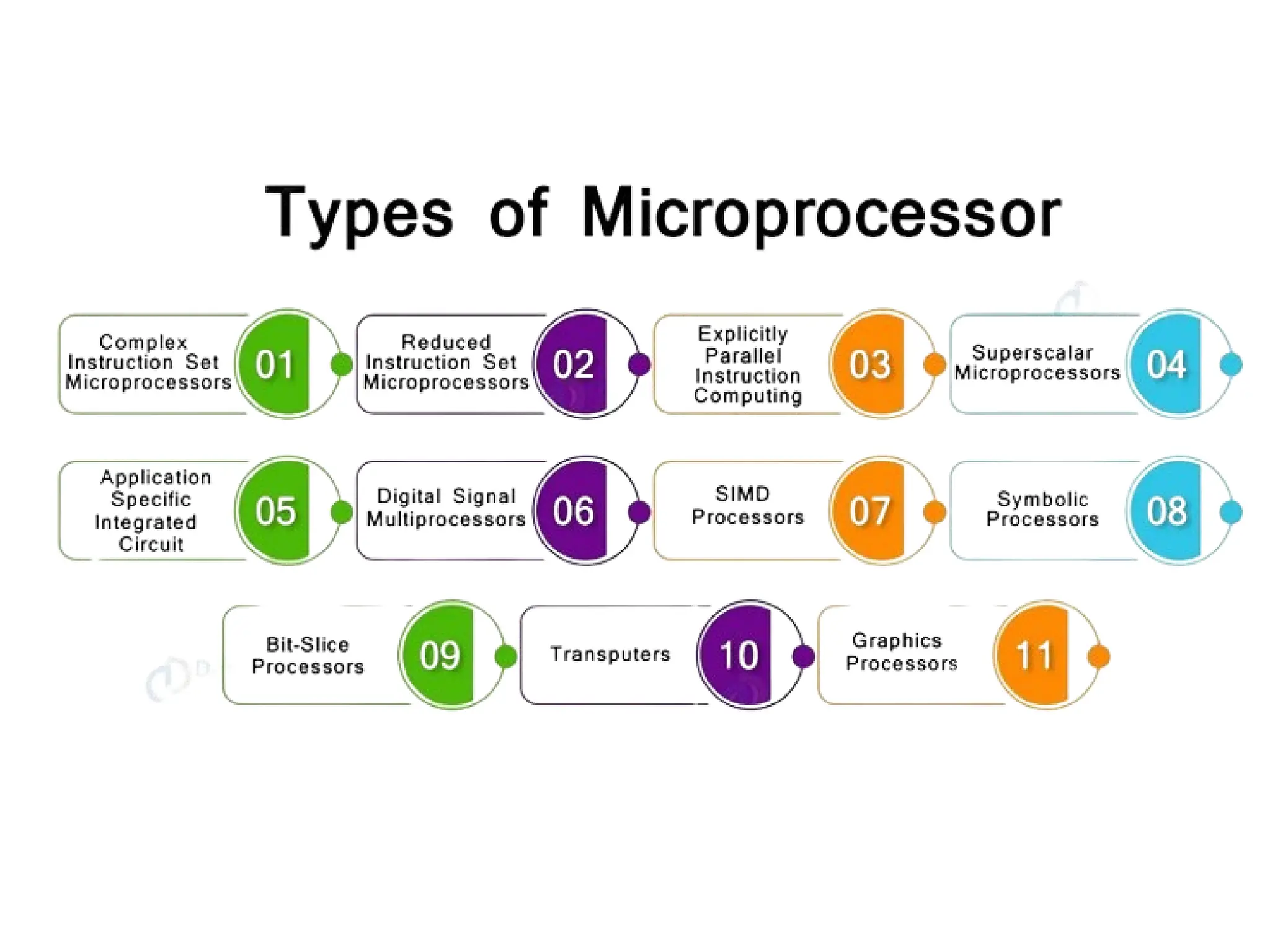
• Types of Microprocessor
• Interfacing Techniques
• Microcontroller
Introduction
• The Microprocessor is the single chip CPU (Central Processing Unit)
in all the microcomputers.
• Microprocessor – manufacture by either LSI and VLSI techniques.
• Advanced Semiconductor technology have made it possible that the
entire CPU is available in single IC (Integrated Circuit) as a
microprocessor.
• Microprocessor is a multipurpose programmable logic device that
reads binary instructions from the storage device memory and accept
binary data as input and processes the instruction for execution.
• Memory is one of the most important factor in the
microprocessor.
• It is used to store the data or information in a binary
format.
• Modern desktop computers use microprocessors: complex
integrated circuits containing millions of transistors and
other electronic components. The microprocessor is
mounted in a socket or slot on the motherboard so that it
can be connected to other components.
Evolution of Microprocessor
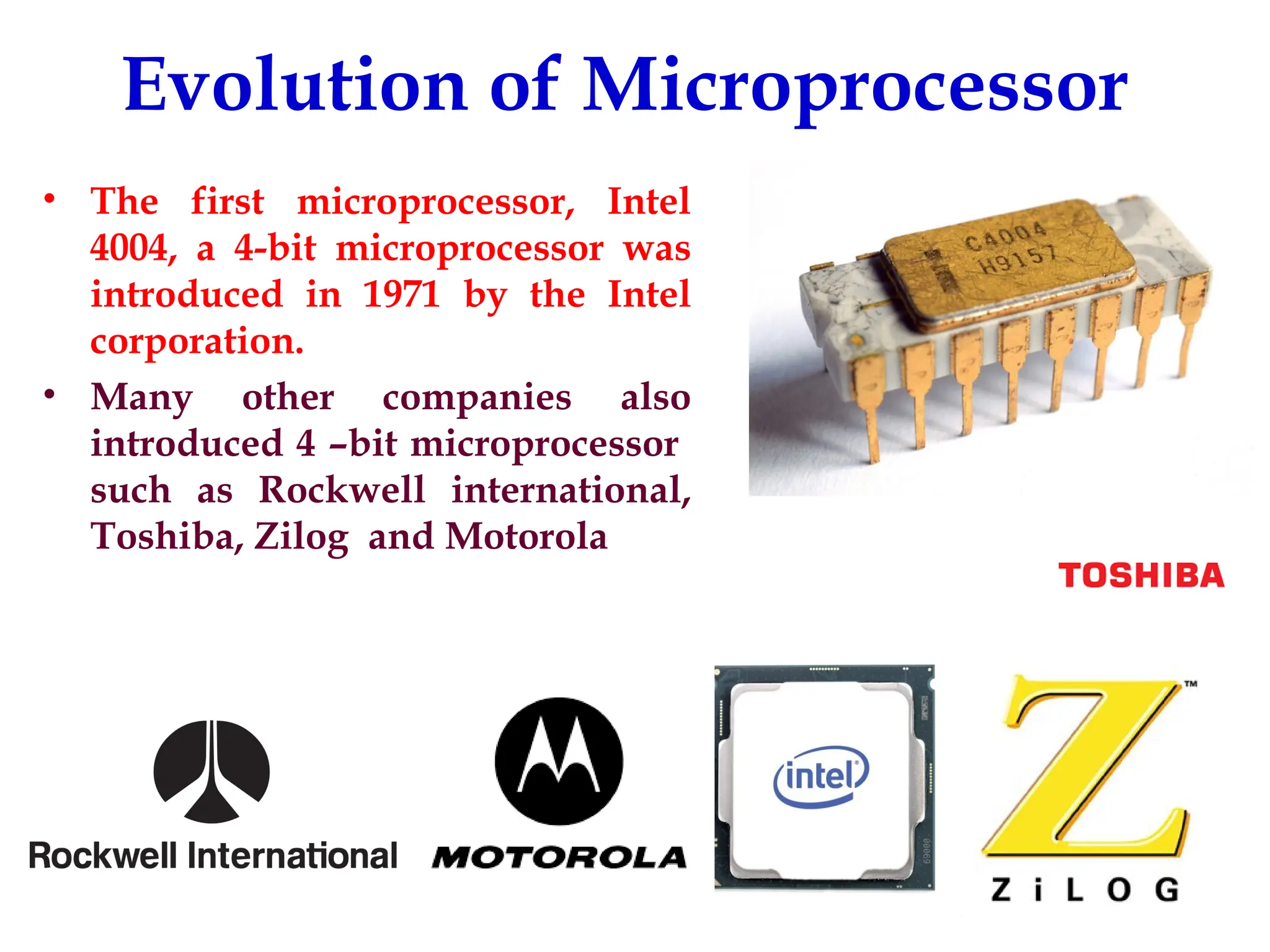
• The first microprocessor, Intel
4004, a 4-bit microprocessor was
introduced in 1971 by the Intel
corporation.
• Many other companies also
introduced 4 –bit microprocessor
such as Rockwell international,
Toshiba, Zilog and Motorola
• In 1972, Intel introduced the first 8-bit
microprocessor, Intel 8008.
• In 1973, Intel Introduced a more powerful 8-bit
microprocessor, Intel 8080.
• In 1975, Intel introduced an improved 8-bit
microprocessor, Intel 8085 (requires +5V supply).
• 8085 is an enhanced version of Intel 8080 which
become very popular and is still used in the
laboratory for students training.
• 8-bit microprocessor were soon followed by
16-bit microprocessor. In 1978, Intel introduced
a 16-bit microprocessor Intel 8086.
• In 1980s , many 32-bit microprocessor and
64-bit microprocessor have been introduced
• Intel 80386 (1986) Pentium iii ( 1999)
• Intel 80486 (1989) Pentium iv (2002)
• Pentium (1991) Intel i9 Processor (latest)
• Pentium Pro (1995)
• Pentium ii (1997)
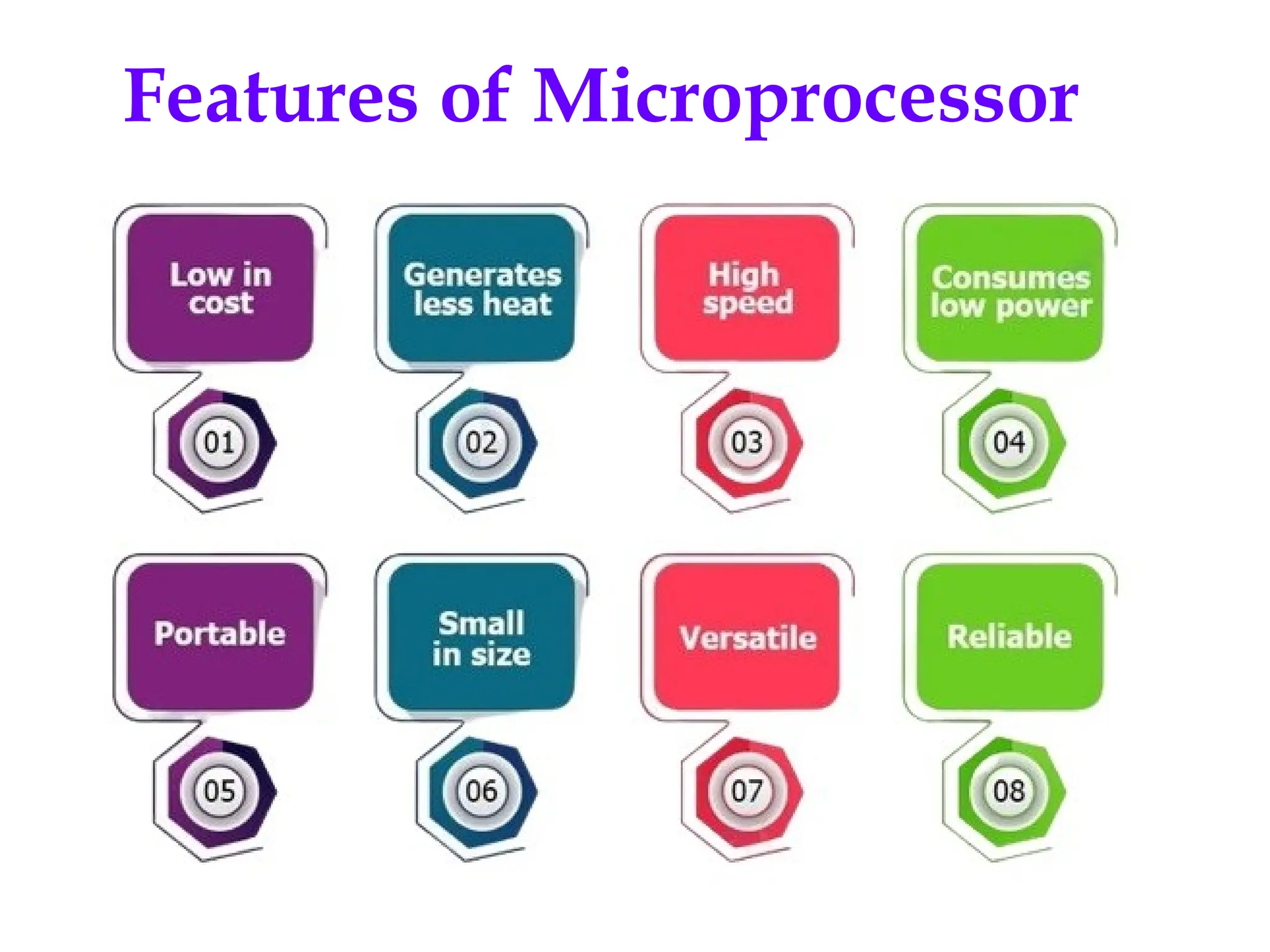
Features of Microprocessor
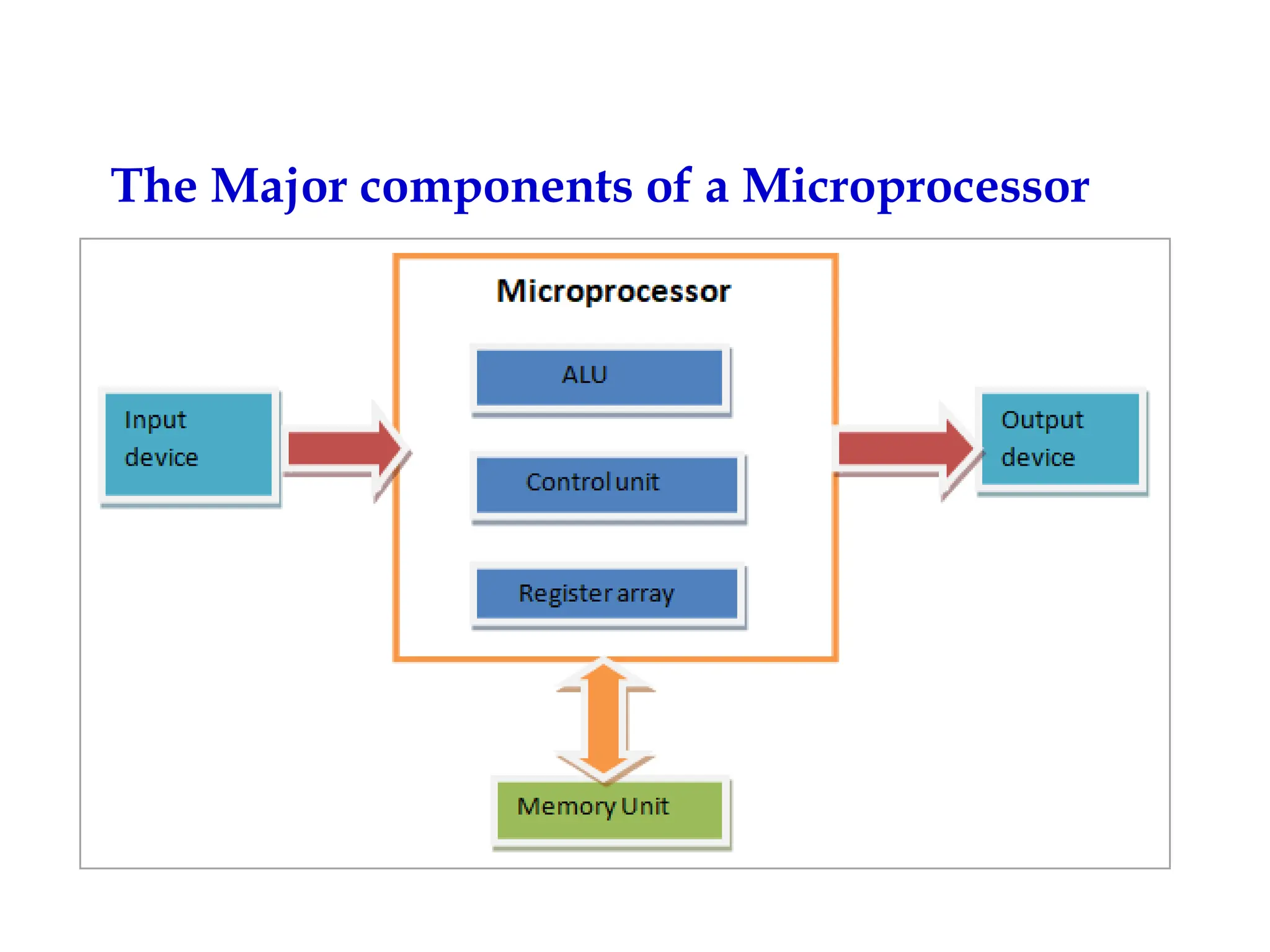
The Major components of a Microprocessor
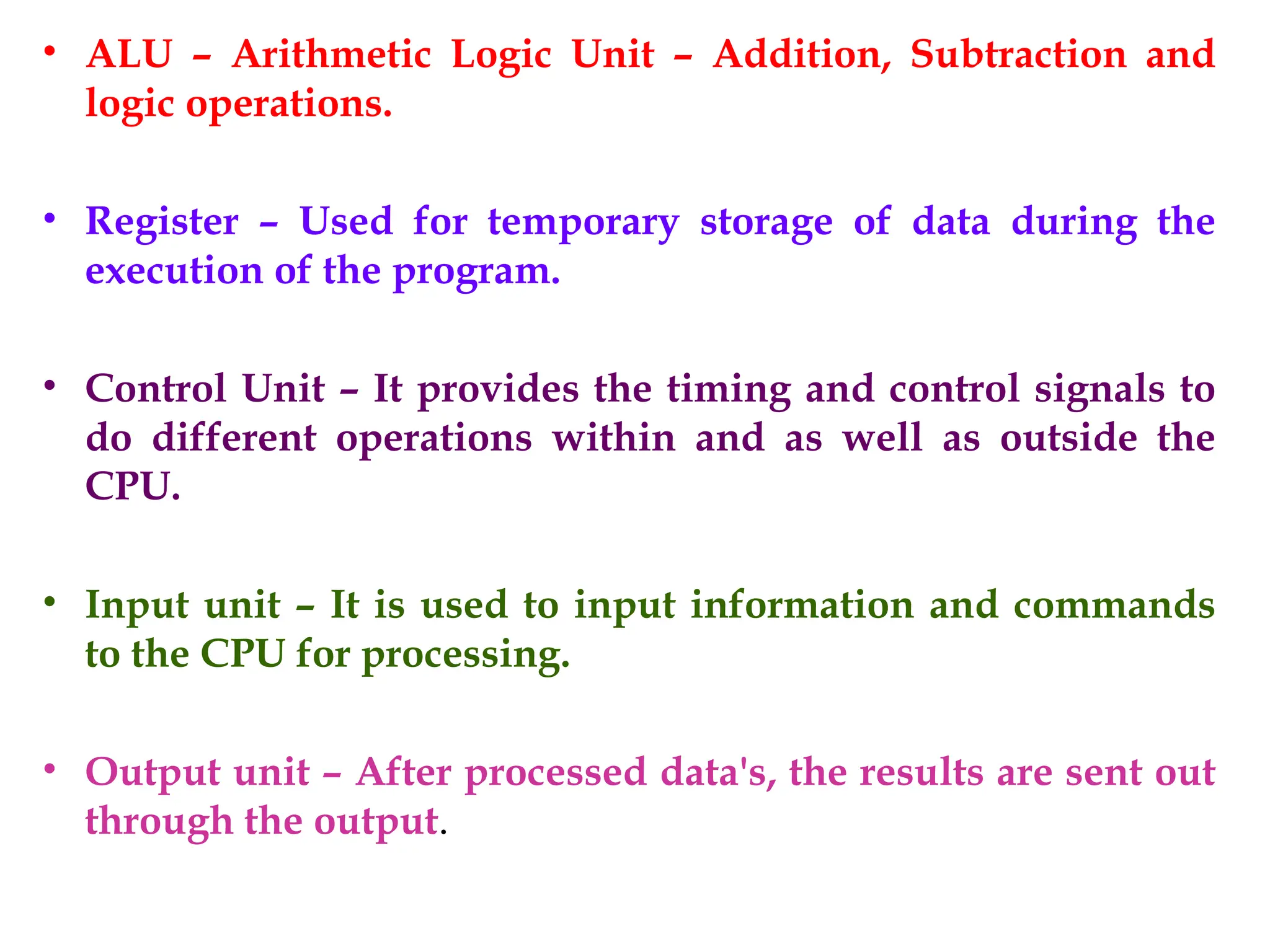
• ALU – Arithmetic Logic Unit – Addition, Subtraction and
logic operations.
• Register – Used for temporary storage of data during the
execution of the program.
• Control Unit – It provides the timing and control signals to
do different operations within and as well as outside the
CPU.
• Input unit – It is used to input information and commands
to the CPU for processing.
• Output unit – After processed data's, the results are sent out
through the output.
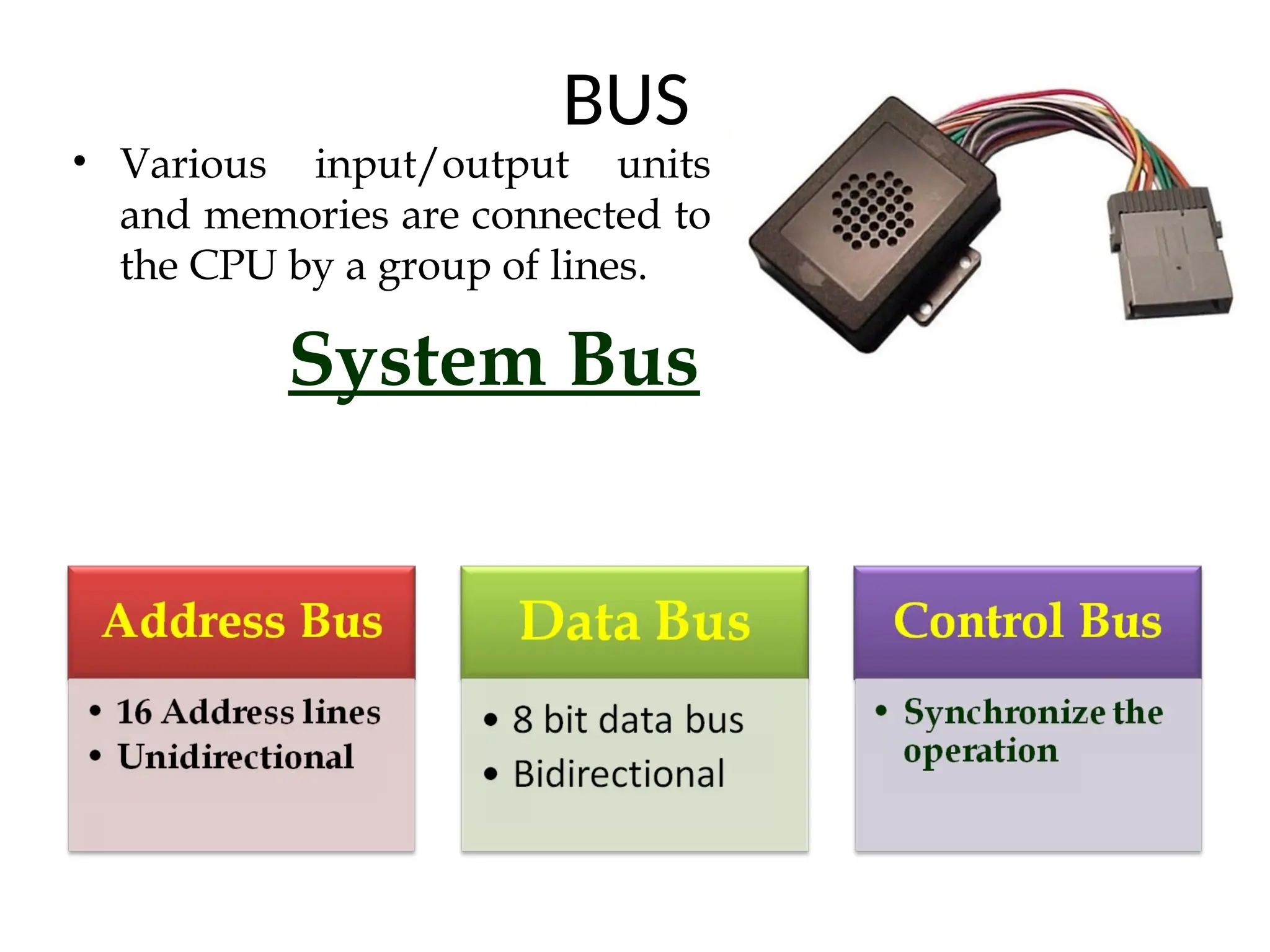
BUS
• Various input/output units
and memories are connected to
the CPU by a group of lines.
System Bus
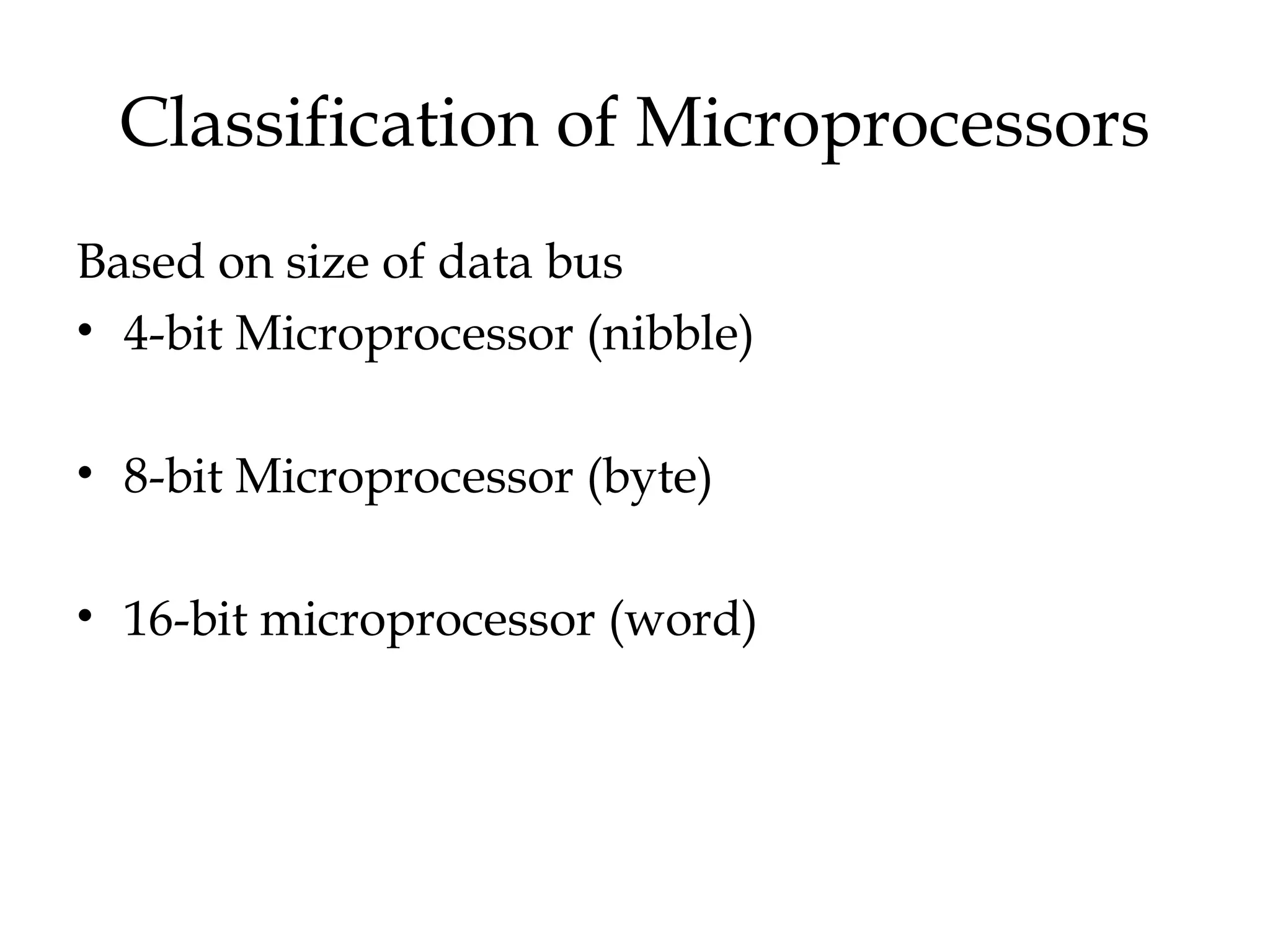
Classification of Microprocessors
Based on size of data bus
• 4-bit Microprocessor (nibble)
• 8-bit Microprocessor (byte)
• 16-bit microprocessor (word)
Pin Configuration
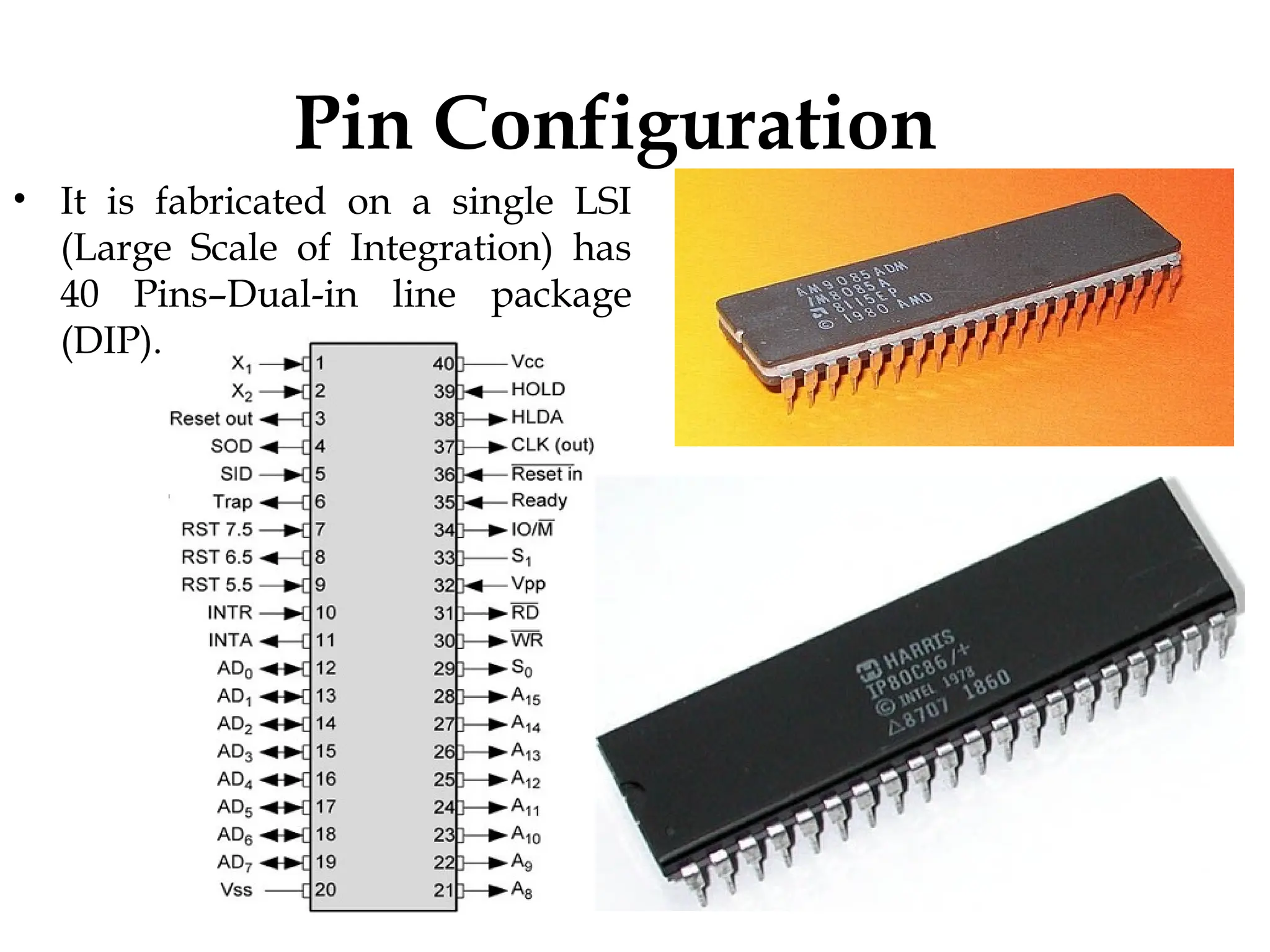
• It is fabricated on a single LSI
(Large Scale of Integration) has
40 Pins–Dual-in line package
(DIP).
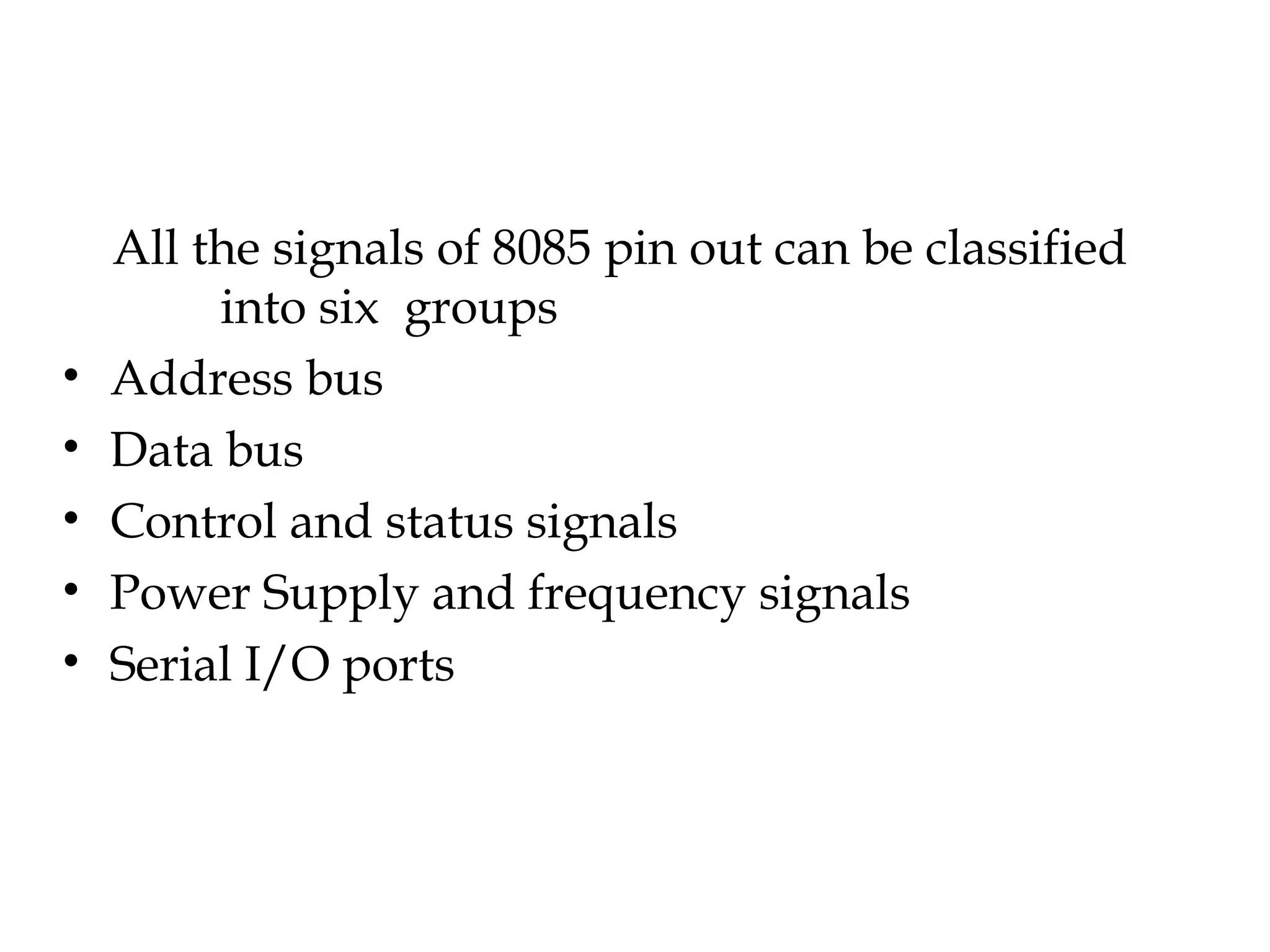
All the signals of 8085 pin out can be classified
into six groups
• Address bus
• Data bus
• Control and status signals
• Power Supply and frequency signals
• Serial I/O ports
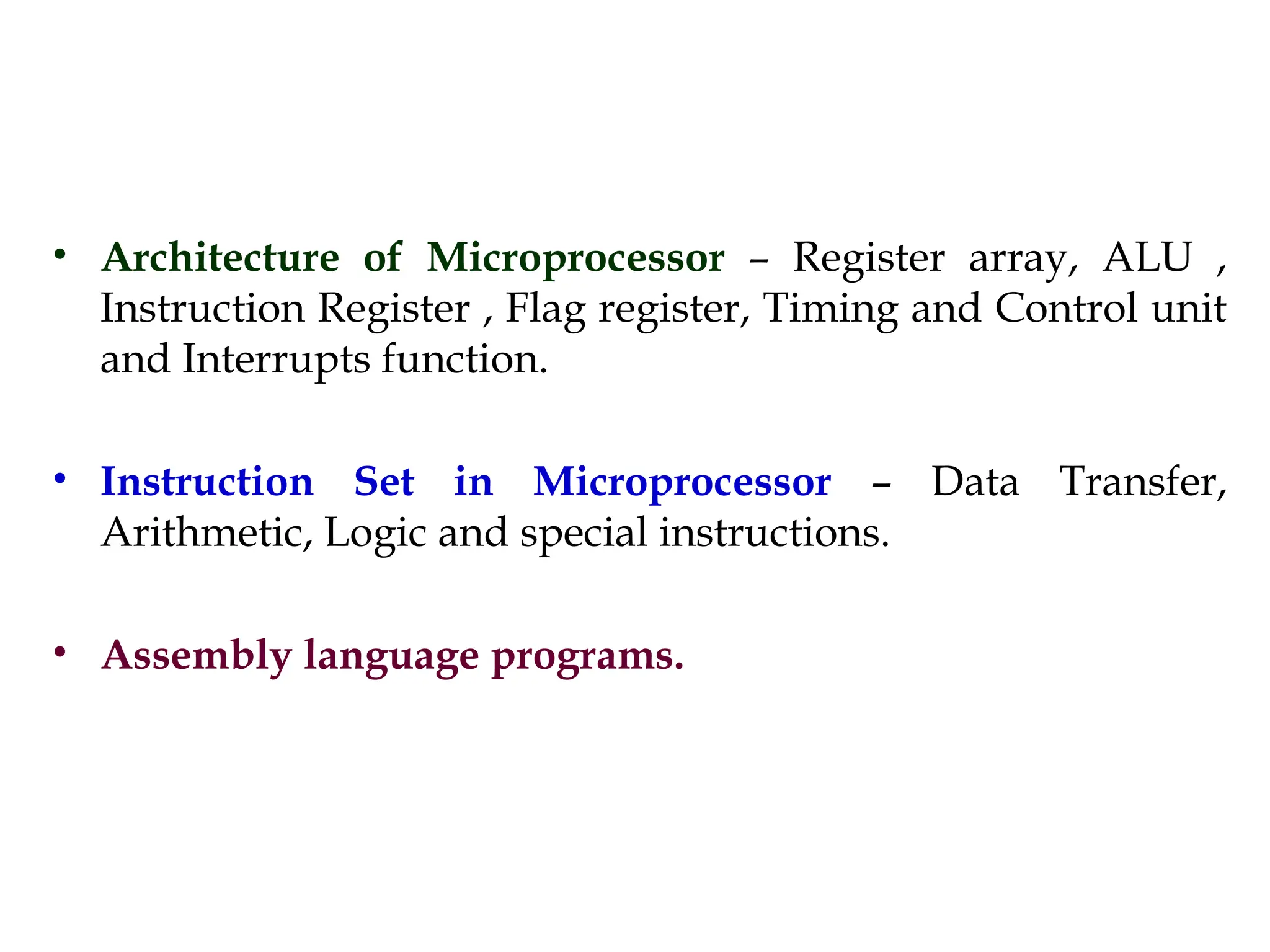
• Architecture of Microprocessor – Register array, ALU ,
Instruction Register , Flag register, Timing and Control unit
and Interrupts function.
• Instruction Set in Microprocessor – Data Transfer,
Arithmetic, Logic and special instructions.
• Assembly language programs.
Microprocessor Interfacing
• Interface is the path for communication
between two components.
Interfacing is of two types,
• Memory interfacing
• I/O interfacing.
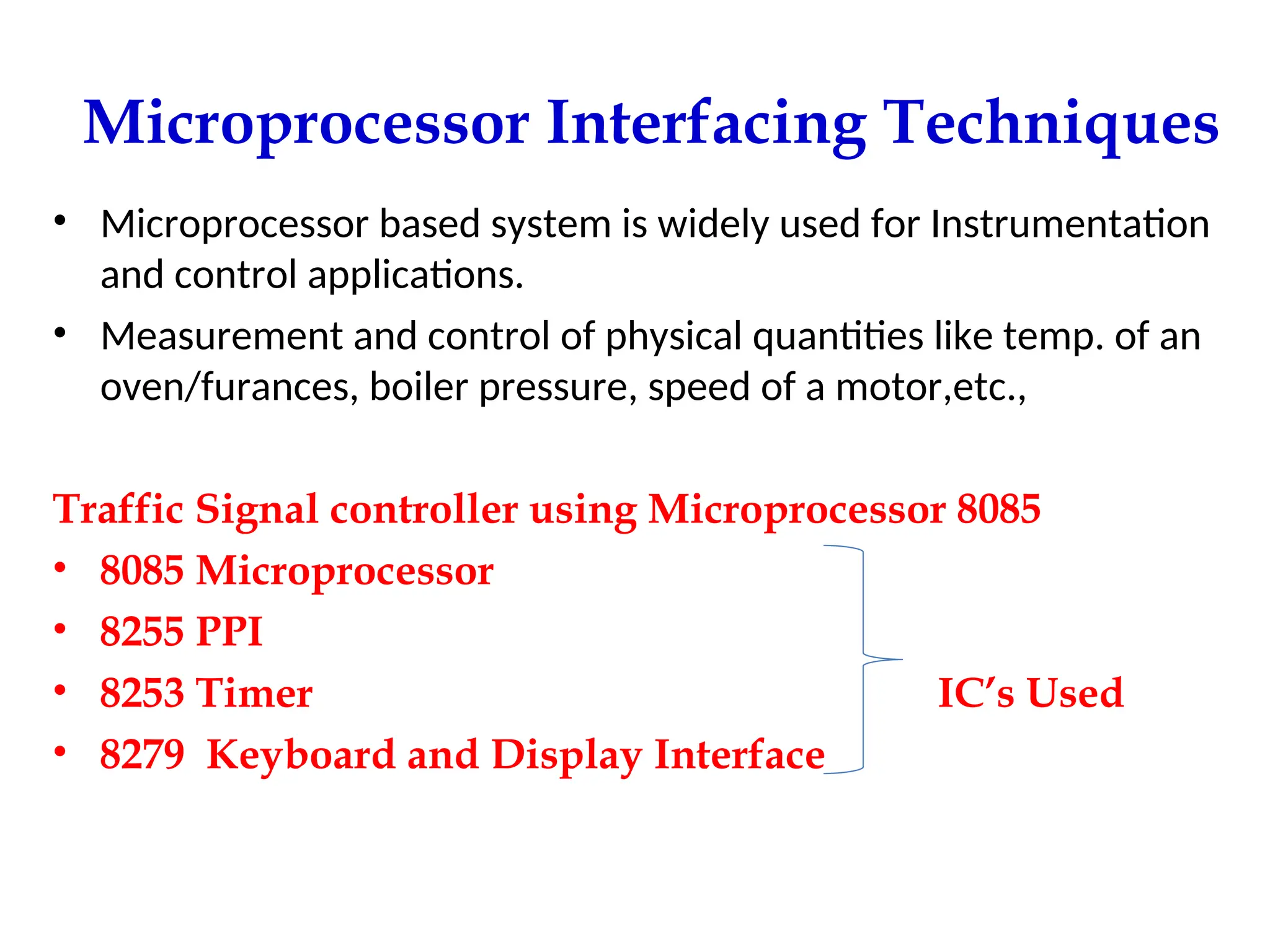
Microprocessor Interfacing Techniques
• Microprocessor based system is widely used for Instrumentation
and control applications.
• Measurement and control of physical quantities like temp. of an
oven/furances, boiler pressure, speed of a motor,etc.,
Traffic Signal controller using Microprocessor 8085
• 8085 Microprocessor
• 8255 PPI
• 8253 Timer IC’s Used
• 8279 Keyboard and Display Interface
Microcontroller
• A self contained system in which a processor, support,
memory and I/O are all contained in a single package.
• A highly integrated chip that contains all the components
comprising a controller.
• A small computer system on a single IC.
• First microcontroller used in 1975 (Intel 8048)
• It has interrupt capability and external memory interface
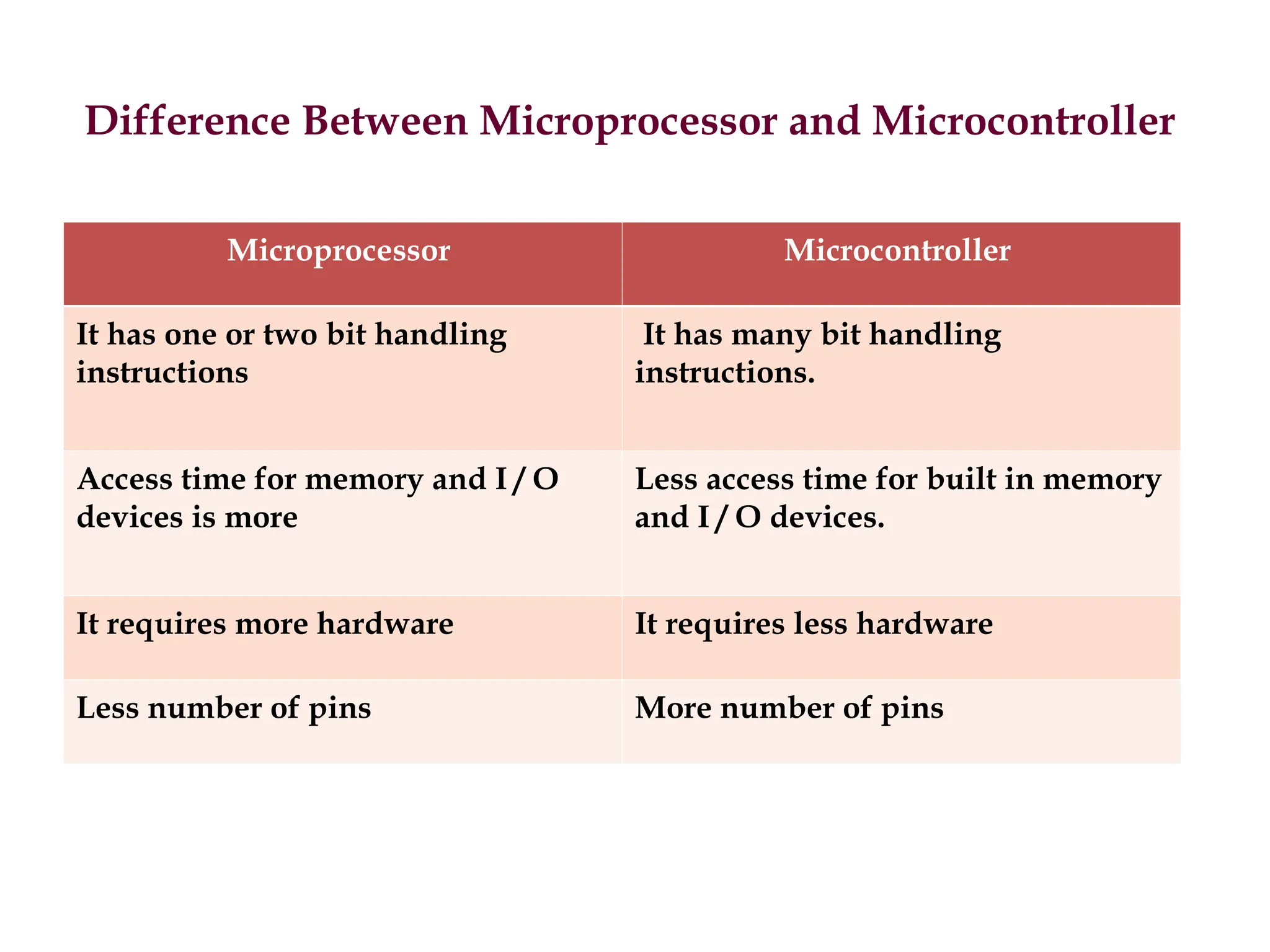
Difference Between Microprocessor and Microcontroller
Microprocessor Microcontroller
It has one or two bit handling
instructions
It has many bit handling
instructions.
Access time for memory and I / O
devices is more
Less access time for built in memory
and I / O devices.
It requires more hardware It requires less hardware
Less number of pins More number of pins
References
• Microprocessor Architecture, programming and applications with the 8085
Ramesh S. Gaonkar (Fourth Edition), 2006
• Fundamentals of Microprocessor and Microcomputers – B. Ram
(6th
Revised and Enlarged Edition) Dhanpat Rai Publications Pvt. Ltd, New
Delhi.
• Microprocessors and Interfacing – Programming and Hardware by Douglas
V. Hall, McGraw Hill.
• Fundamentals of Microprocessor- 8085 – Architecture, Programming &
Interfacing – V.Vijayendran – S.Viswanathan (Printers and Publishers)
Pvt.Ltd.
Overview of Microprocessor and its Evolution

Overview of Microprocessor and its Evolution

  • 1.
    Microprocessor Dr.S.Ganeshan Assistant Professor ofPhysics Vivekananda College Tiruvedakam West, Madurai
  • 2.
    Content of thePresentation • Introduction • Evolution of Microprocessor • Features • Components • Bus • Pin Configuration • Types of Microprocessor • Interfacing Techniques • Microcontroller
  • 3.
    Introduction • The Microprocessoris the single chip CPU (Central Processing Unit) in all the microcomputers. • Microprocessor – manufacture by either LSI and VLSI techniques. • Advanced Semiconductor technology have made it possible that the entire CPU is available in single IC (Integrated Circuit) as a microprocessor. • Microprocessor is a multipurpose programmable logic device that reads binary instructions from the storage device memory and accept binary data as input and processes the instruction for execution.
  • 4.
    • Memory isone of the most important factor in the microprocessor. • It is used to store the data or information in a binary format. • Modern desktop computers use microprocessors: complex integrated circuits containing millions of transistors and other electronic components. The microprocessor is mounted in a socket or slot on the motherboard so that it can be connected to other components.
  • 5.
    Evolution of Microprocessor •The first microprocessor, Intel 4004, a 4-bit microprocessor was introduced in 1971 by the Intel corporation. • Many other companies also introduced 4 –bit microprocessor such as Rockwell international, Toshiba, Zilog and Motorola
  • 6.
    • In 1972,Intel introduced the first 8-bit microprocessor, Intel 8008. • In 1973, Intel Introduced a more powerful 8-bit microprocessor, Intel 8080. • In 1975, Intel introduced an improved 8-bit microprocessor, Intel 8085 (requires +5V supply). • 8085 is an enhanced version of Intel 8080 which become very popular and is still used in the laboratory for students training.
  • 7.
    • 8-bit microprocessorwere soon followed by 16-bit microprocessor. In 1978, Intel introduced a 16-bit microprocessor Intel 8086. • In 1980s , many 32-bit microprocessor and 64-bit microprocessor have been introduced • Intel 80386 (1986) Pentium iii ( 1999) • Intel 80486 (1989) Pentium iv (2002) • Pentium (1991) Intel i9 Processor (latest) • Pentium Pro (1995) • Pentium ii (1997)
  • 8.
  • 9.
    The Major componentsof a Microprocessor
  • 10.
    • ALU –Arithmetic Logic Unit – Addition, Subtraction and logic operations. • Register – Used for temporary storage of data during the execution of the program. • Control Unit – It provides the timing and control signals to do different operations within and as well as outside the CPU. • Input unit – It is used to input information and commands to the CPU for processing. • Output unit – After processed data's, the results are sent out through the output.
  • 11.
    BUS • Various input/outputunits and memories are connected to the CPU by a group of lines. System Bus
  • 12.
    Classification of Microprocessors Basedon size of data bus • 4-bit Microprocessor (nibble) • 8-bit Microprocessor (byte) • 16-bit microprocessor (word)
  • 13.
    Pin Configuration • Itis fabricated on a single LSI (Large Scale of Integration) has 40 Pins–Dual-in line package (DIP).
  • 14.
    All the signalsof 8085 pin out can be classified into six groups • Address bus • Data bus • Control and status signals • Power Supply and frequency signals • Serial I/O ports
  • 15.
    • Architecture ofMicroprocessor – Register array, ALU , Instruction Register , Flag register, Timing and Control unit and Interrupts function. • Instruction Set in Microprocessor – Data Transfer, Arithmetic, Logic and special instructions. • Assembly language programs.
  • 17.
    Microprocessor Interfacing • Interfaceis the path for communication between two components. Interfacing is of two types, • Memory interfacing • I/O interfacing.
  • 18.
    Microprocessor Interfacing Techniques •Microprocessor based system is widely used for Instrumentation and control applications. • Measurement and control of physical quantities like temp. of an oven/furances, boiler pressure, speed of a motor,etc., Traffic Signal controller using Microprocessor 8085 • 8085 Microprocessor • 8255 PPI • 8253 Timer IC’s Used • 8279 Keyboard and Display Interface
  • 19.
    Microcontroller • A selfcontained system in which a processor, support, memory and I/O are all contained in a single package. • A highly integrated chip that contains all the components comprising a controller. • A small computer system on a single IC. • First microcontroller used in 1975 (Intel 8048) • It has interrupt capability and external memory interface
  • 20.
    Difference Between Microprocessorand Microcontroller Microprocessor Microcontroller It has one or two bit handling instructions It has many bit handling instructions. Access time for memory and I / O devices is more Less access time for built in memory and I / O devices. It requires more hardware It requires less hardware Less number of pins More number of pins
  • 21.
    References • Microprocessor Architecture,programming and applications with the 8085 Ramesh S. Gaonkar (Fourth Edition), 2006 • Fundamentals of Microprocessor and Microcomputers – B. Ram (6th Revised and Enlarged Edition) Dhanpat Rai Publications Pvt. Ltd, New Delhi. • Microprocessors and Interfacing – Programming and Hardware by Douglas V. Hall, McGraw Hill. • Fundamentals of Microprocessor- 8085 – Architecture, Programming & Interfacing – V.Vijayendran – S.Viswanathan (Printers and Publishers) Pvt.Ltd.