Synchronous
and
Asynchronous
Learning Tools
O Learning can occur in or out of the
classroom. It can be self-paced,
asynchronous learning or may be
instructor-led, synchronous learning.
O It is suited to distance learning and in
conjunction with face-to-face teaching,
which is termed blended learning.
O Virtual Classroom can be used by learners
and educators in homes, schools (both K-
12 and higher education), businesses, and
other settings for effective online
collaboration.
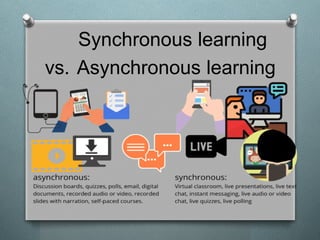
SYNCHRONOUS
O Synchronous Learning takes place in real
time (Same time) while the trainer and learner
are physically separated from each other
(place shift).
O Examples:
O Audio/video conferencing
O Online chat
O Instant Messaging
O Live Webcasting
ASYNCHRONOUS
O In Asynchronous Learning the Facilitator prepares the
courseware materials before the course takes place.
O The learner is free to decide when he wants to study
the courseware.
O Examples:
O Email
O Threaded Discussion boards
O Web-based Training
O DVD
Synchronous learning
vs. Asynchronous learning
Advantages &
Disadvantages of
Synchronous and
Asynchronous Learning
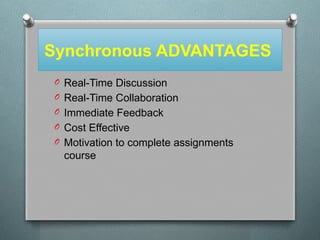
Synchronous ADVANTAGES
O Real-Time Discussion
O Real-Time Collaboration
O Immediate Feedback
O Cost Effective
O Motivation to complete assignments
course
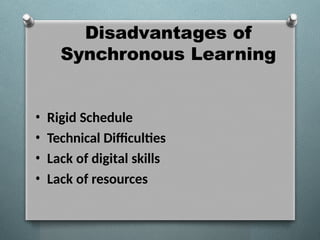
Disadvantages of
Synchronous Learning
• Rigid Schedule
• Technical Difficulties
• Lack of digital skills
• Lack of resources
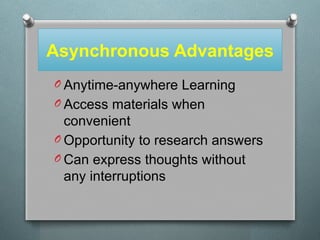
Asynchronous Advantages
O Anytime-anywhere Learning
O Access materials when
convenient
O Opportunity to research answers
O Can express thoughts without
any interruptions
Disadvantages of
Asynchronous
Learning
• Isolation
• Risk of Apathy
Prepared By:
VIVIAN FE L. ARABES

ASYNCHRONOUS AND SYNCHRONOUS TOOLS 1.pptx