THE SUN, MOON,
AND EARTH
HOW FAR AWAY ARE THEY?
CAN THEY SUPPORT LIFE?
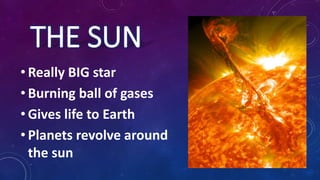
THE SUN
• Really BIG star
• Burning ball of gases
• Gives life to Earth
• Planets revolve around
the sun
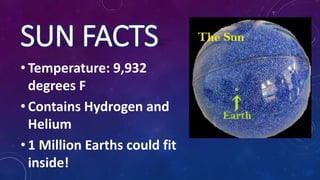
SUN FACTS
• Temperature: 9,932
degrees F
• Contains Hydrogen and
Helium
• 1 Million Earths could fit
inside!
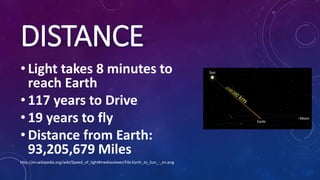
DISTANCE
• Light takes 8 minutes to
reach Earth
• 117 years to Drive
• 19 years to fly
• Distance from Earth:
93,205,679 Miles
http://en.wikipedia.org/wiki/Speed_of_light#mediaviewer/File:Earth_to_Sun_-_en.png
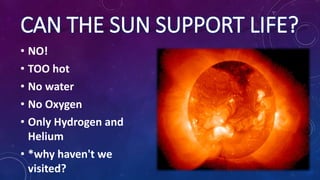
CAN THE SUN SUPPORT LIFE?
• NO!
• TOO hot
• No water
• No Oxygen
• Only Hydrogen and
Helium
• *why haven't we
visited?
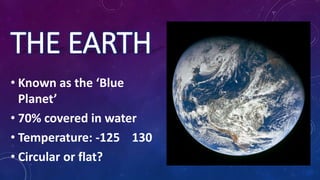
THE EARTH
• Known as the ‘Blue
Planet’
• 70% covered in water
• Temperature: -125 130
• Circular or flat?
ORBIT AND ROTATION
•1 year to “orbit” the
sun
•1 day is created by
rotation
http://www.nasa.gov/audience/forstudents/k-4/stories/ames-big-blue-marble-storybook-text_prt.htm
EARTH FACTS
• Temperature: 61 F
• Contains oxygen
• Earths speed: 67,000
mph
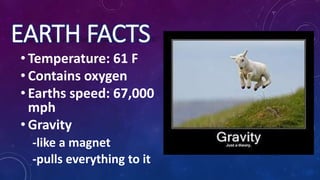
• Gravity
-like a magnet
-pulls everything to it
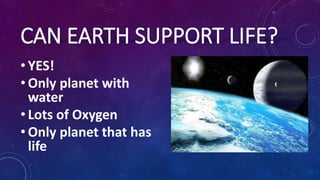
CAN EARTH SUPPORT LIFE?
• YES!
• Only planet with
water
• Lots of Oxygen
• Only planet that has
life
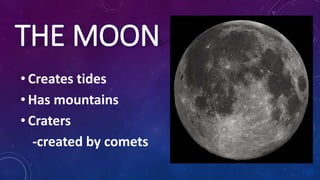
THE MOON
• Creates tides
• Has mountains
• Craters
-created by comets
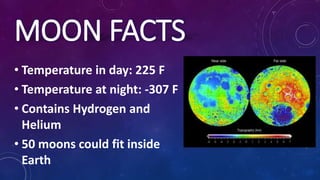
MOON FACTS
• Temperature in day: 225 F
• Temperature at night: -307 F
• Contains Hydrogen and
Helium
• 50 moons could fit inside
Earth
DISTANCE
•The moon is 250,000 miles away
•1 year to drive
•3-weeks to fly
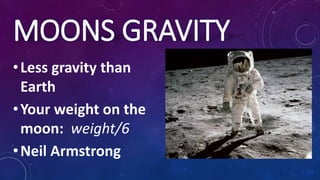
MOONS GRAVITY
•Less gravity than
Earth
•Your weight on the
moon: weight/6
•Neil Armstrong
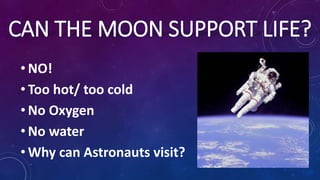
CAN THE MOON SUPPORT LIFE?
• NO!
• Too hot/ too cold
• No Oxygen
• No water
• Why can Astronauts visit?
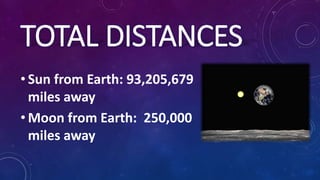
TOTAL DISTANCES
• Sun from Earth: 93,205,679
miles away
• Moon from Earth: 250,000
miles away
BIG DIFFERENCES
•Temperature
•Gasses in the air
•Contains water?
SOURCES
• NASA, “Magnificent CME Erupts on the Sun” August 31, 2012 via Wikipedia, Creative
Commons Attribution.
• LucasVB, “Illustration, to scale, of Earth’s Distance to the Sun” August 3, 2012 via Wikimedia
Commons, Public Domain.
• Arnomane, “The Sun is a Natural Fusion Reactor” February 25, 2015 via Wikipedia, Public
Domain.
• NASA, “Earth Viewed by Apollo 8” November 27, 2008 via Earth Observatory, Public Domain.
• NASA, “It Takes the Earth One Year to go Around the Sun” April 9, 2009 via NASA, Public
Domain.
• Richard Peters, “The Mad Scientist” June 1, 2008 via Flickr, Creative Commons Attribution.
SOURCES
• Luciano Mendez, “Rendering of a Hypothetical Large Extrasolar Moon with Surface Liquid-Water
Oceans” February 11, 2011 via Wikipedia, Creative Commons Attribution-Share Alike.
• Gregory H. Revera, “Full Moon” October 22, 2010 via Wikipedia, Creative Commons Attribution-Share
Alike.
• Mark A. Wieczorek, “Topography of the Moon” August 7, 2010 via Wikipedia, Creative Commons
Attribution.
• NASA, “Apollo 11” August 5, 2011 via NASA, Public Domain.
• NASA, “U.S. Astronaut Bruce McCandless Uses a Manned Maneuvering Unit” February 7, 1984 via
Wikipedia, Public Domain.
• Maissa Azab “The Apparent Sizes of the Sun and the Earth in the Sky of the Moon” March 29, 2006 via
Bibalex, Public Domain.
SOURCES
• Jones, Chris, and Carolyn Collins Petersen. "Sun Facts." Space Facts. Marines,
2015. Web. 25 Feb. 2015.
• Jones, Chris, and Carolyn Collins Peterson. "Moon Facts." Space Facts.
Marines, 2015. Web. 25 Feb. 2015. <http://space-facts.com/the-moon/>.

The Sun, Moon, and Earth

  • 1.
    THE SUN, MOON, ANDEARTH HOW FAR AWAY ARE THEY? CAN THEY SUPPORT LIFE?
  • 2.
    THE SUN • ReallyBIG star • Burning ball of gases • Gives life to Earth • Planets revolve around the sun
  • 3.
    SUN FACTS • Temperature:9,932 degrees F • Contains Hydrogen and Helium • 1 Million Earths could fit inside!
  • 4.
    DISTANCE • Light takes8 minutes to reach Earth • 117 years to Drive • 19 years to fly • Distance from Earth: 93,205,679 Miles http://en.wikipedia.org/wiki/Speed_of_light#mediaviewer/File:Earth_to_Sun_-_en.png
  • 5.
    CAN THE SUNSUPPORT LIFE? • NO! • TOO hot • No water • No Oxygen • Only Hydrogen and Helium • *why haven't we visited?
  • 6.
    THE EARTH • Knownas the ‘Blue Planet’ • 70% covered in water • Temperature: -125 130 • Circular or flat?
  • 7.
    ORBIT AND ROTATION •1year to “orbit” the sun •1 day is created by rotation http://www.nasa.gov/audience/forstudents/k-4/stories/ames-big-blue-marble-storybook-text_prt.htm
  • 8.
    EARTH FACTS • Temperature:61 F • Contains oxygen • Earths speed: 67,000 mph • Gravity -like a magnet -pulls everything to it
  • 9.
    CAN EARTH SUPPORTLIFE? • YES! • Only planet with water • Lots of Oxygen • Only planet that has life
  • 10.
    THE MOON • Createstides • Has mountains • Craters -created by comets
  • 11.
    MOON FACTS • Temperaturein day: 225 F • Temperature at night: -307 F • Contains Hydrogen and Helium • 50 moons could fit inside Earth
  • 12.
    DISTANCE •The moon is250,000 miles away •1 year to drive •3-weeks to fly
  • 13.
    MOONS GRAVITY •Less gravitythan Earth •Your weight on the moon: weight/6 •Neil Armstrong
  • 14.
    CAN THE MOONSUPPORT LIFE? • NO! • Too hot/ too cold • No Oxygen • No water • Why can Astronauts visit?
  • 15.
    TOTAL DISTANCES • Sunfrom Earth: 93,205,679 miles away • Moon from Earth: 250,000 miles away
  • 16.
  • 17.
    SOURCES • NASA, “MagnificentCME Erupts on the Sun” August 31, 2012 via Wikipedia, Creative Commons Attribution. • LucasVB, “Illustration, to scale, of Earth’s Distance to the Sun” August 3, 2012 via Wikimedia Commons, Public Domain. • Arnomane, “The Sun is a Natural Fusion Reactor” February 25, 2015 via Wikipedia, Public Domain. • NASA, “Earth Viewed by Apollo 8” November 27, 2008 via Earth Observatory, Public Domain. • NASA, “It Takes the Earth One Year to go Around the Sun” April 9, 2009 via NASA, Public Domain. • Richard Peters, “The Mad Scientist” June 1, 2008 via Flickr, Creative Commons Attribution.
  • 18.
    SOURCES • Luciano Mendez,“Rendering of a Hypothetical Large Extrasolar Moon with Surface Liquid-Water Oceans” February 11, 2011 via Wikipedia, Creative Commons Attribution-Share Alike. • Gregory H. Revera, “Full Moon” October 22, 2010 via Wikipedia, Creative Commons Attribution-Share Alike. • Mark A. Wieczorek, “Topography of the Moon” August 7, 2010 via Wikipedia, Creative Commons Attribution. • NASA, “Apollo 11” August 5, 2011 via NASA, Public Domain. • NASA, “U.S. Astronaut Bruce McCandless Uses a Manned Maneuvering Unit” February 7, 1984 via Wikipedia, Public Domain. • Maissa Azab “The Apparent Sizes of the Sun and the Earth in the Sky of the Moon” March 29, 2006 via Bibalex, Public Domain.
  • 19.
    SOURCES • Jones, Chris,and Carolyn Collins Petersen. "Sun Facts." Space Facts. Marines, 2015. Web. 25 Feb. 2015. • Jones, Chris, and Carolyn Collins Peterson. "Moon Facts." Space Facts. Marines, 2015. Web. 25 Feb. 2015. <http://space-facts.com/the-moon/>.