Astronomy
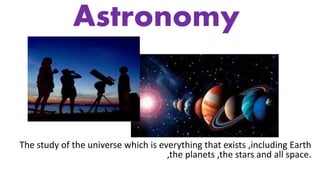
The study of the universe which is everything that exists ,including Earth
,the planets ,the stars and all space.
Telescope
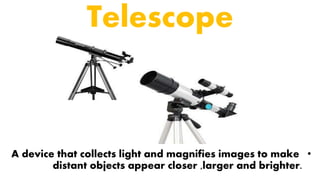
•A device that collects light and magnifies images to make
distant objects appear closer ,larger and brighter.
Types of Telescopes
Using invisible light
Any light frequency in
electromagnetic
spectrum that people
cant see
Using visible light
The light that you can see
and detect with your eye
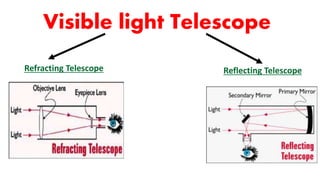
Visible light Telescope
Refracting Telescope Reflecting Telescope
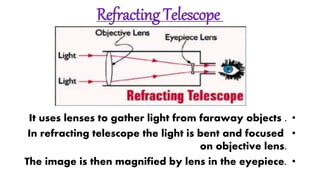
Refracting Telescope
•It uses lenses to gather light from faraway objects .
•In refracting telescope the light is bent and focused
on objective lens.
•The image is then magnified by lens in the eyepiece.
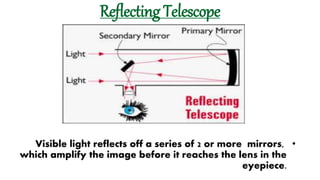
Reflecting Telescope
0
•Visible light reflects off a series of 2 or more mirrors,
which amplify the image before it reaches the lens in the
eyepiece.
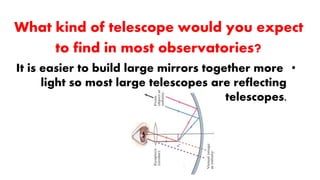
What kind of telescope would you expect
to find in most observatories?
•It is easier to build large mirrors together more
light so most large telescopes are reflecting
telescopes.
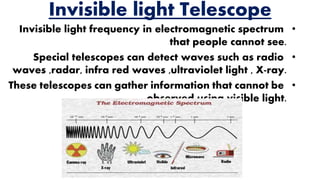
Invisible light Telescope
•Invisible light frequency in electromagnetic spectrum
that people cannot see.
•Special telescopes can detect waves such as radio
waves ,radar, infra red waves ,ultraviolet light , X-ray.
•These telescopes can gather information that cannot be
observed using visible light.
Why might astronomers study
objects in space with an infrared
telescope?
To gather information not obtainable with
visible light ,like X-rays.
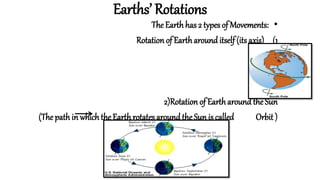
Earths’ Rotations
•The Earth has 2 types of Movements:
(1Rotation of Eartharound itself (its axis)
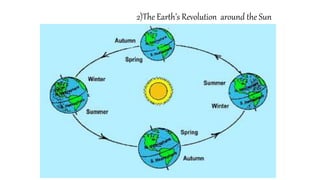
2)Rotation of Eartharound the Sun
(The path in which the Earthrotates aroundthe Sun is called Orbit )
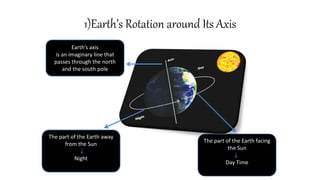
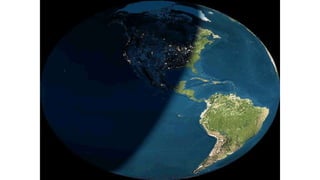
1)Earth’s Rotation around Its Axis
Earth’s axis
is an imaginary line that
passes through the north
and the south pole
The part of the Earth away
from the Sun
Night
The part of the Earth facing
the Sun
Day Time
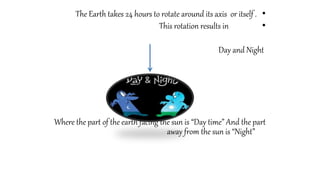
•The Earth takes 24 hours to rotate around its axis or itself .
•This rotation results in
Day and Night
Where the part of the earth facing the sun is “Day time” And the part
away from the sun is “Night”
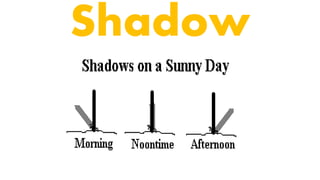
Shadow
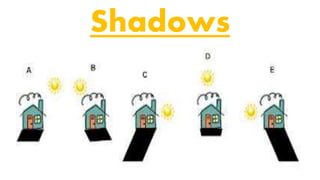
Shadows
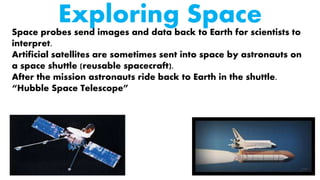
Exploring SpaceSpace probes send images and data back to Earth for scientists to
interpret.
Artificial satellites are sometimes sent into space by astronauts on
a space shuttle (reusable spacecraft).
After the mission astronauts ride back to Earth in the shuttle.
“Hubble Space Telescope”
What is the difference between
planetary images taken from Earth
and those taken from space?
•Images taken from Earth would have
less sharpness and detail than those
taken from a satellite or a probe
because Earth’s atmosphere would
interfere with the quality of photos
2)The Earth’s Revolution around the Sun
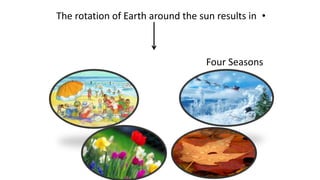
•The rotation of Earth around the sun results in
Four Seasons

Astronomy lesson

  • 2.
    Astronomy The study ofthe universe which is everything that exists ,including Earth ,the planets ,the stars and all space.
  • 3.
    Telescope •A device thatcollects light and magnifies images to make distant objects appear closer ,larger and brighter.
  • 4.
    Types of Telescopes Usinginvisible light Any light frequency in electromagnetic spectrum that people cant see Using visible light The light that you can see and detect with your eye
  • 5.
    Visible light Telescope RefractingTelescope Reflecting Telescope
  • 6.
    Refracting Telescope •It useslenses to gather light from faraway objects . •In refracting telescope the light is bent and focused on objective lens. •The image is then magnified by lens in the eyepiece.
  • 7.
    Reflecting Telescope 0 •Visible lightreflects off a series of 2 or more mirrors, which amplify the image before it reaches the lens in the eyepiece.
  • 8.
    What kind oftelescope would you expect to find in most observatories? •It is easier to build large mirrors together more light so most large telescopes are reflecting telescopes.
  • 9.
    Invisible light Telescope •Invisiblelight frequency in electromagnetic spectrum that people cannot see. •Special telescopes can detect waves such as radio waves ,radar, infra red waves ,ultraviolet light , X-ray. •These telescopes can gather information that cannot be observed using visible light.
  • 10.
    Why might astronomersstudy objects in space with an infrared telescope? To gather information not obtainable with visible light ,like X-rays.
  • 11.
    Earths’ Rotations •The Earthhas 2 types of Movements: (1Rotation of Eartharound itself (its axis) 2)Rotation of Eartharound the Sun (The path in which the Earthrotates aroundthe Sun is called Orbit )
  • 12.
    1)Earth’s Rotation aroundIts Axis Earth’s axis is an imaginary line that passes through the north and the south pole The part of the Earth away from the Sun Night The part of the Earth facing the Sun Day Time
  • 14.
    •The Earth takes24 hours to rotate around its axis or itself . •This rotation results in Day and Night Where the part of the earth facing the sun is “Day time” And the part away from the sun is “Night”
  • 15.
  • 16.
  • 17.
    Exploring SpaceSpace probessend images and data back to Earth for scientists to interpret. Artificial satellites are sometimes sent into space by astronauts on a space shuttle (reusable spacecraft). After the mission astronauts ride back to Earth in the shuttle. “Hubble Space Telescope”
  • 18.
    What is thedifference between planetary images taken from Earth and those taken from space? •Images taken from Earth would have less sharpness and detail than those taken from a satellite or a probe because Earth’s atmosphere would interfere with the quality of photos
  • 19.
  • 20.
    •The rotation ofEarth around the sun results in Four Seasons