Title
Waxing:  When the moon seems to grow in size. Waning:  When the moon seems to decrease in size. Gibbous:  Having the illuminated part greater than a semicircle and less than a circle.   Patch:  A small area with a different color or otherwise distinct from the rest. Equinox:  When day and night are of equal length.  Harvesters:  People who gather the crop.  Crop:  A plant cultivated on a large scale for food. or other use, especially a cereal, fruit, or vegetable. Bulge:  A rounded raised quantity of water.
The Moon is the Earth’s natural and only satellite. It has circled around the Earth for at least 4 billion years.
It is a rocky ball about a quarter of the Earth’s size and is held in its orbit by mutual gravitational attraction.
 
The moon’s seas are those dark patches on the moon’s surface. The ‘seas’ are huge plains formed by lava flowing form inside the Moon.
The phases are named after how much of the moon we can see, and whether the amount visible is increasing, or decreasing each day.
When the sunlight is blocked off because of the Moon’s shadow right in front  of the Earth.
 
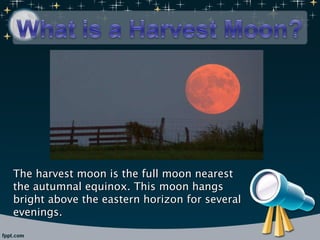
The harvest moon is the full moon nearest the autumnal equinox. This moon hangs bright above the eastern horizon for several evenings.
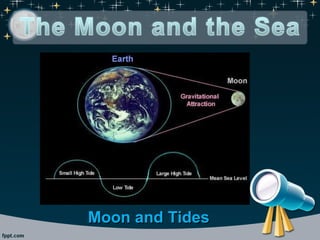
Moon and Tides
The average time between successive new or full moons, equal to 29 days, 12 hours, 44 minutes. Also called  synodic month .
 
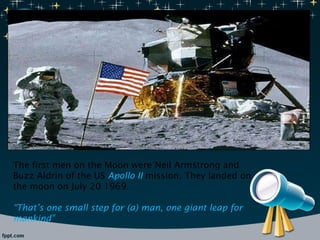
The first men on the Moon were Neil Armstrong and Buzz Aldrin of the US  Apollo II  mission. They landed on the moon on July 20 1969. “ That’s one small step for (a) man, one giant leap for mankind”
Why some people thought that the Moon was made of cheese? What are the Moon seas made of? What is a lunar eclipse? What is a harvest moon? How long is a month ? Who were the first men on the Moon?
 

The moon

  • 1.
  • 2.
    Waxing: Whenthe moon seems to grow in size. Waning: When the moon seems to decrease in size. Gibbous: Having the illuminated part greater than a semicircle and less than a circle.   Patch: A small area with a different color or otherwise distinct from the rest. Equinox: When day and night are of equal length. Harvesters: People who gather the crop. Crop: A plant cultivated on a large scale for food. or other use, especially a cereal, fruit, or vegetable. Bulge: A rounded raised quantity of water.
  • 3.
    The Moon isthe Earth’s natural and only satellite. It has circled around the Earth for at least 4 billion years.
  • 4.
    It is arocky ball about a quarter of the Earth’s size and is held in its orbit by mutual gravitational attraction.
  • 5.
  • 6.
    The moon’s seasare those dark patches on the moon’s surface. The ‘seas’ are huge plains formed by lava flowing form inside the Moon.
  • 7.
    The phases arenamed after how much of the moon we can see, and whether the amount visible is increasing, or decreasing each day.
  • 8.
    When the sunlightis blocked off because of the Moon’s shadow right in front of the Earth.
  • 9.
  • 10.
    The harvest moonis the full moon nearest the autumnal equinox. This moon hangs bright above the eastern horizon for several evenings.
  • 11.
  • 12.
    The average timebetween successive new or full moons, equal to 29 days, 12 hours, 44 minutes. Also called  synodic month .
  • 13.
  • 14.
    The first menon the Moon were Neil Armstrong and Buzz Aldrin of the US Apollo II mission. They landed on the moon on July 20 1969. “ That’s one small step for (a) man, one giant leap for mankind”
  • 15.
    Why some peoplethought that the Moon was made of cheese? What are the Moon seas made of? What is a lunar eclipse? What is a harvest moon? How long is a month ? Who were the first men on the Moon?
  • 16.