ASSOCIATION AND CAUSATION
         KESHAVA PAVAN K


                1
INTRODUCTION


 Association is the concurrence of two variables more
  often than would be expected by chance.
 Events are said to be associated when they occur
  more frequently together than one would expect by
  chance


                          2
TYPES


 Spurious
 Indirect
 Direct
     One-to-one
     multifactorial


                         3
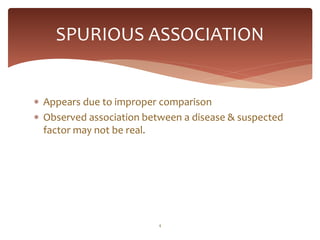
SPURIOUS ASSOCIATION


 Appears due to improper comparison
 Observed association between a disease & suspected
  factor may not be real.


                          4
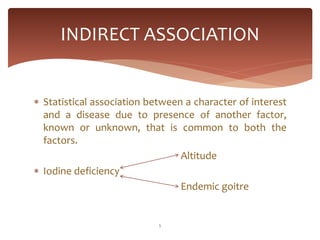
INDIRECT ASSOCIATION


 Statistical association between a character of interest
  and a disease due to presence of another factor,
  known or unknown, that is common to both the
  factors.
                                 Altitude
 Iodine deficiency
                                 Endemic goitre


                            5
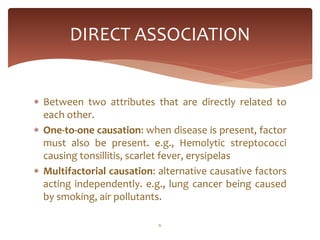
DIRECT ASSOCIATION


 Between two attributes that are directly related to
  each other.
 One-to-one causation: when disease is present, factor
  must also be present. e.g., Hemolytic streptococci
  causing tonsillitis, scarlet fever, erysipelas
 Multifactorial causation: alternative causative factors
  acting independently. e.g., lung cancer being caused
  by smoking, air pollutants.

                            6
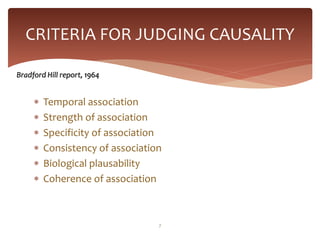
CRITERIA FOR JUDGING CAUSALITY

Bradford Hill report, 1964


        Temporal association
        Strength of association
        Specificity of association
        Consistency of association
        Biological plausability
        Coherence of association


                                  7
TEMPORAL ASSOCIATION


 Causal attribute must precede the disease or
  unfavourable outcome
 Exposure to factor must have occurred before the
  disease developed


                        8
STRENGTH OF ASSOCIATION


 If the association is strong or weak
 With increased level of exposure to risk factor,
  incidence of disease increases.


                            9
SPECIFICITY OF ASSOCIATION


 One to one relation between cause and effect
 Weakest of the criteria


                          10
CONSISTENCY OF ASSOCIATION


 Occurrence of association at some other time & place
  repeatedly.
 If a relationship is causal, findings should be
  consistent with other data.


                          11
BIOLOGICAL PLAUSABILITY


 Association must be consistent with other knowledge
  like mechanism of action, evidence from animal
  experiments etc.


                          12
COHERENCE OF ASSOCIATION


 Causal significance of an association is its unity with
  known facts that are thought to be related.


                             13
THANK YOU


 THANK YOU for reading my presentation.
 If you have any doubts or interesting cases in any subject of
  medicine, I will be delighted if you share at
                   keshavapavan533@gmail.com


                                14

Association and causation

  • 1.
    ASSOCIATION AND CAUSATION KESHAVA PAVAN K 1
  • 2.
    INTRODUCTION  Association isthe concurrence of two variables more often than would be expected by chance.  Events are said to be associated when they occur more frequently together than one would expect by chance 2
  • 3.
    TYPES  Spurious  Indirect Direct  One-to-one  multifactorial 3
  • 4.
    SPURIOUS ASSOCIATION  Appearsdue to improper comparison  Observed association between a disease & suspected factor may not be real. 4
  • 5.
    INDIRECT ASSOCIATION  Statisticalassociation between a character of interest and a disease due to presence of another factor, known or unknown, that is common to both the factors. Altitude  Iodine deficiency Endemic goitre 5
  • 6.
    DIRECT ASSOCIATION  Betweentwo attributes that are directly related to each other.  One-to-one causation: when disease is present, factor must also be present. e.g., Hemolytic streptococci causing tonsillitis, scarlet fever, erysipelas  Multifactorial causation: alternative causative factors acting independently. e.g., lung cancer being caused by smoking, air pollutants. 6
  • 7.
    CRITERIA FOR JUDGINGCAUSALITY Bradford Hill report, 1964  Temporal association  Strength of association  Specificity of association  Consistency of association  Biological plausability  Coherence of association 7
  • 8.
    TEMPORAL ASSOCIATION  Causalattribute must precede the disease or unfavourable outcome  Exposure to factor must have occurred before the disease developed 8
  • 9.
    STRENGTH OF ASSOCIATION If the association is strong or weak  With increased level of exposure to risk factor, incidence of disease increases. 9
  • 10.
    SPECIFICITY OF ASSOCIATION One to one relation between cause and effect  Weakest of the criteria 10
  • 11.
    CONSISTENCY OF ASSOCIATION Occurrence of association at some other time & place repeatedly.  If a relationship is causal, findings should be consistent with other data. 11
  • 12.
    BIOLOGICAL PLAUSABILITY  Associationmust be consistent with other knowledge like mechanism of action, evidence from animal experiments etc. 12
  • 13.
    COHERENCE OF ASSOCIATION Causal significance of an association is its unity with known facts that are thought to be related. 13
  • 14.
    THANK YOU  THANKYOU for reading my presentation.  If you have any doubts or interesting cases in any subject of medicine, I will be delighted if you share at keshavapavan533@gmail.com 14