From association to causation
deriving inference from
epidemiological studies
Sima Naderi, 2th year of MPH−department of epidemiology &
biostatistics, Kabul university of medical science
Presentation outline
• Introduction
• Approaches for studying disease etiology
• Type of Association
• Causal relationship
• Type of causal relationship
• Guidelines to asses causality
• Causal inference and conclusion
• Reference
2/27/2020 2
Why to know cause of events/disease
• As human being, Enable each of us to navigate our complex world
• As a doctor, why to know cause of disease?
• As a researcher?
• As an academic org member?
2/27/2020 3
Introduction
• Ascertainment of cause and effect relationships is one of the central
and most difficult tasks of all scientific activities
• Epidemiological principles stand on 2 basic assumption:
• Human disease does not occur at random.
• The disease and its cause as well as preventive factors can be identified by a
thorough investigation of population.
• Identification of relation (association, causation) between disease and
suspected risk factors forms major part of epidemiological research.
2/27/2020 4
Historical theories of disease causation
• Supernatural cause of “ and Karma
• Theory of humors (humor means fluid)
• The miasmatic theory of disease
• Theory of contagion
• Germ theory
• Koch`s postulations
2/27/2020 5
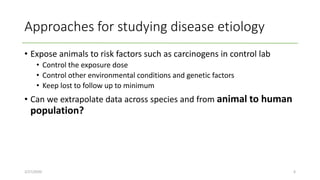
Approaches for studying disease etiology
• Expose animals to risk factors such as carcinogens in control lab
• Control the exposure dose
• Control other environmental conditions and genetic factors
• Keep lost to follow up to minimum
• Can we extrapolate data across species and from animal to human
population?
2/27/2020 6
Approaches for studying disease etiology
• Epidemiology build on unplanned or natural
experiments
• People exposes to risk factor for non- study purposes
• E.g. exposure to atomic bomb radiation in Hiroshima and
Nagasaki 1945
2/27/2020 7
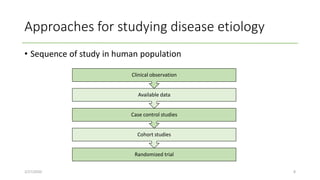
Approaches for studying disease etiology
• Sequence of study in human population
2/27/2020 8
Randomized trial
Cohort studies
Case control studies
Available data
Clinical observation
Approaches for studying disease etiology
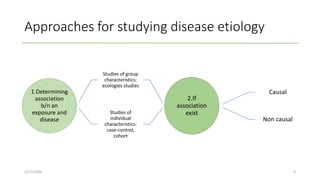
1.Determining
association
b/n an
exposure and
disease
Studies of group
characteristics:
ecologies studies
Studies of
individual
characteristics:
case-control,
cohort
2.If
association
exist
Causal
Non causal
2/27/2020 9
Association
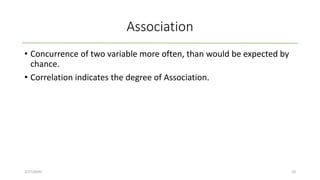
• Concurrence of two variable more often, than would be expected by
chance.
• Correlation indicates the degree of Association.
2/27/2020 10
Type of association
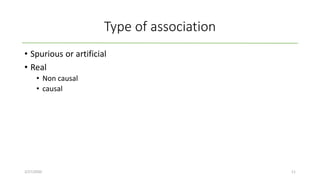
• Spurious or artificial
• Real
• Non causal
• causal
2/27/2020 11
Spurious association
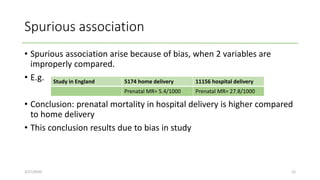
• Spurious association arise because of bias, when 2 variables are
improperly compared.
• E.g.
• Conclusion: prenatal mortality in hospital delivery is higher compared
to home delivery
• This conclusion results due to bias in study
2/27/2020 12
Study in England 5174 home delivery 11156 hospital delivery
Prenatal MR= 5.4/1000 Prenatal MR= 27.8/1000
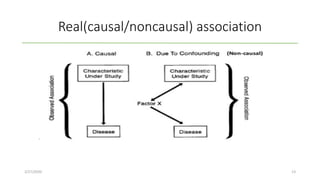
Real(causal/noncausal) association
.
2/27/2020 13
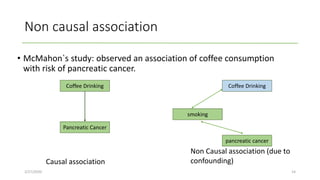
Non causal association
• McMahon`s study: observed an association of coffee consumption
with risk of pancreatic cancer.
Causal association
2/27/2020 14
Coffee Drinking
Pancreatic Cancer
Coffee Drinking
smoking
pancreatic cancer
Non Causal association (due to
confounding)
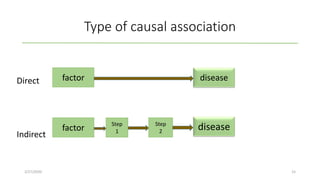
Type of causal association
Direct
Indirect
2/27/2020 15
factor disease
factor diseaseStep
2
Step
1
Evidence for causal relationship
• Infectious disease: Henle assumptions 1840 which was expanded by
Koch in 1880s:
• The organism is always found with the disease
• The organism is not found with any other disease
• The organism, isolated from one who has the disease, and cultured through
several generations, produces the disease( in experimental animals)
• NCDs, no organism to detect and culture causal relationship more
complex
2/27/2020 16
Type of causal association
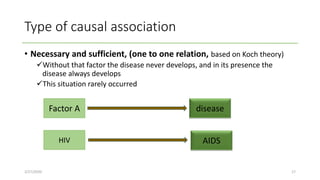
• Necessary and sufficient, (one to one relation, based on Koch theory)
Without that factor the disease never develops, and in its presence the
disease always develops
This situation rarely occurred
2/27/2020 17
Factor A disease
HIV AIDS
Type of causal association
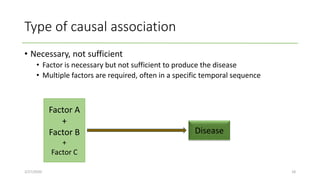
• Necessary, not sufficient
• Factor is necessary but not sufficient to produce the disease
• Multiple factors are required, often in a specific temporal sequence
2/27/2020 18
Factor A
+
Factor B
+
Factor C
Disease
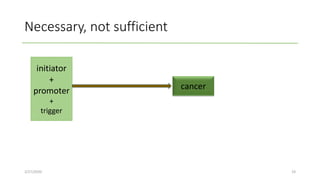
Necessary, not sufficient
2/27/2020 19
initiator
+
promoter
+
trigger
cancer
Type of causal association
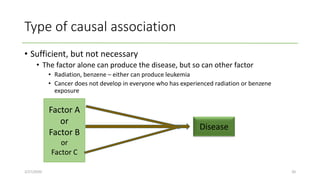
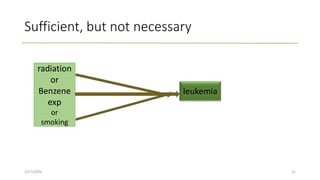
• Sufficient, but not necessary
• The factor alone can produce the disease, but so can other factor
• Radiation, benzene – either can produce leukemia
• Cancer does not develop in everyone who has experienced radiation or benzene
exposure
2/27/2020 20
Factor A
or
Factor B
or
Factor C
Disease
Sufficient, but not necessary
2/27/2020 21
radiation
or
Benzene
exp
or
smoking
leukemia
Type of causal association
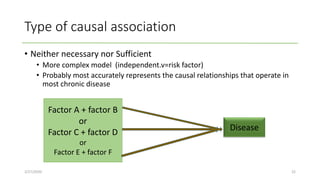
• Neither necessary nor Sufficient
• More complex model (independent.v=risk factor)
• Probably most accurately represents the causal relationships that operate in
most chronic disease
2/27/2020 22
Factor A + factor B
or
Factor C + factor D
or
Factor E + factor F
Disease
.
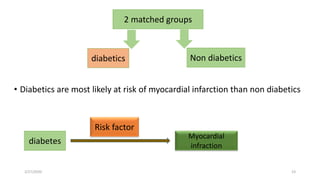
• Diabetics are most likely at risk of myocardial infarction than non diabetics
2/27/2020 23
2 matched groups
Myocardial
infraction
Risk factor
Non diabeticsdiabetics
diabetes
Guidelines for judging whether an association
is causal
2/27/2020 24
.
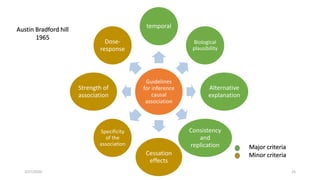
Guidelines
for inference
causal
association
temporal
Biological
plausibility
Alternative
explanation
Consistency
and
replication
Cessation
effects
Specificity
of the
association
Strength of
association
Dose-
response
2/27/2020 25
Major criteria
Minor criteria
Austin Bradford hill
1965
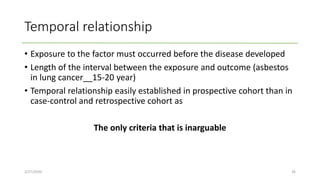
Temporal relationship
• Exposure to the factor must occurred before the disease developed
• Length of the interval between the exposure and outcome (asbestos
in lung cancer__15-20 year)
• Temporal relationship easily established in prospective cohort than in
case-control and retrospective cohort as
The only criteria that is inarguable
2/27/2020 26
Temporal relationship
2/27/2020 27
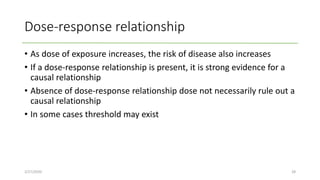
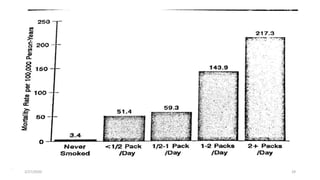
Dose-response relationship
• As dose of exposure increases, the risk of disease also increases
• If a dose-response relationship is present, it is strong evidence for a
causal relationship
• Absence of dose-response relationship dose not necessarily rule out a
causal relationship
• In some cases threshold may exist
2/27/2020 28
2/27/2020 29
Strength of association
• Measured by
• OR
• RR
• The stronger association the more likely it is that the relation is causal
2/27/2020 30
Biological plausibility
• Coherence with the current body of biologic knowledge
• Sometimes, epidemiological observation preceded biologic
knowledge (mechanism of action, evidence from animal experiment)
• E.g. Gregg`s observation on rubella and congenital cataracts preceded any
knowledge of teratogenic viruses
• If epidemiological findings are not consistent with the existing
knowledge-interpreting the meaning of observed association might
be difficult
2/27/2020 31
Consideration of alternate explanation
• Explanations of relationship as a causal or due to confounding
• The extent to which the investigators have taken other possible
explanation into account and the extent to which they ruled out such
explanation are important considerations
2/27/2020 32
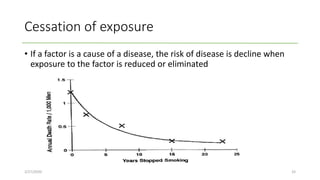
Cessation of exposure
• If a factor is a cause of a disease, the risk of disease is decline when
exposure to the factor is reduced or eliminated
2/27/2020 33
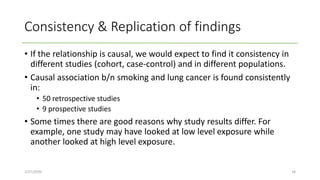
Consistency & Replication of findings
• If the relationship is causal, we would expect to find it consistency in
different studies (cohort, case-control) and in different populations.
• Causal association b/n smoking and lung cancer is found consistently
in:
• 50 retrospective studies
• 9 prospective studies
• Some times there are good reasons why study results differ. For
example, one study may have looked at low level exposure while
another looked at high level exposure.
2/27/2020 34
Specificity of the association
• Specificity implies a one to one relationship between the exposure
and outcome (weakest criteria).
• Not everyone who smokes develop lung cancer
• Not everyone who develops cancer has smoked
• Lack of specificity does not negate causation
2/27/2020 35
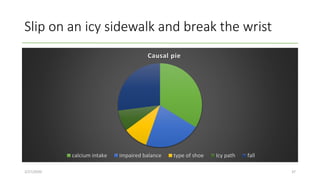
Additional model for causality
• Kennet rothman`s component cause theory: describe the
circumstances leading to a health outcome as being parts of one pie
chart, or a “causal pie”. without each component in place, the disease
or health outcome would not have occurred at that specific point in
time
2/27/2020 36
Slip on an icy sidewalk and break the wrist
2/27/2020 37
Causal pie
calcium intake impaired balance type of shoe Icy path fall
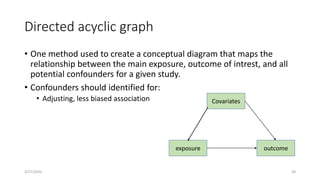
Directed acyclic graph
• One method used to create a conceptual diagram that maps the
relationship between the main exposure, outcome of intrest, and all
potential confounders for a given study.
• Confounders should identified for:
• Adjusting, less biased association
2/27/2020 38
Covariates
exposure outcome
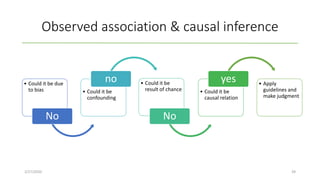
Observed association & causal inference
• Could it be due
to bias
No
• Could it be
confounding
no • Could it be
result of chance
No
• Could it be
causal relation
yes • Apply
guidelines and
make judgment
2/27/2020 39
conclusion
• The causal inference resulted from the epidemiological studies are
very important to public health and provide inputs for political and
judicial decisions.
• E.g. the causal association b/n smoking and lung cancer has resulted
in labeling of cigarette packets and increased campaign ads.
2/27/2020 40
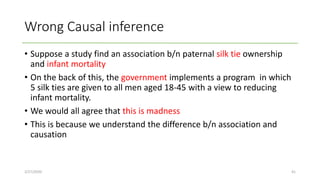
Wrong Causal inference
• Suppose a study find an association b/n paternal silk tie ownership
and infant mortality
• On the back of this, the government implements a program in which
5 silk ties are given to all men aged 18-45 with a view to reducing
infant mortality.
• We would all agree that this is madness
• This is because we understand the difference b/n association and
causation
2/27/2020 41
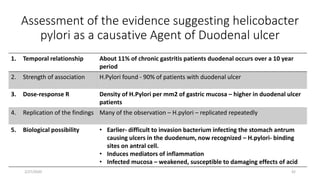
Assessment of the evidence suggesting helicobacter
pylori as a causative Agent of Duodenal ulcer
1. Temporal relationship About 11% of chronic gastritis patients duodenal occurs over a 10 year
period
2. Strength of association H.Pylori found - 90% of patients with duodenal ulcer
3. Dose-response R Density of H.Pylori per mm2 of gastric mucosa – higher in duodenal ulcer
patients
4. Replication of the findings Many of the observation – H.pylori – replicated repeatedly
5. Biological possibility • Earlier- difficult to invasion bacterium infecting the stomach antrum
causing ulcers in the duodenum, now recognized – H.pylori- binding
sites on antral cell.
• Induces mediators of inflammation
• Infected mucosa – weakened, susceptible to damaging effects of acid
2/27/2020 42
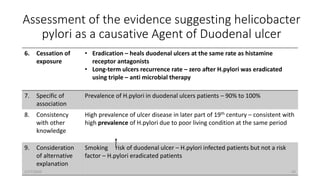
Assessment of the evidence suggesting helicobacter
pylori as a causative Agent of Duodenal ulcer
6. Cessation of
exposure
• Eradication – heals duodenal ulcers at the same rate as histamine
receptor antagonists
• Long-term ulcers recurrence rate – zero after H.pylori was eradicated
using triple – anti microbial therapy
7. Specific of
association
Prevalence of H.pylori in duodenal ulcers patients – 90% to 100%
8. Consistency
with other
knowledge
High prevalence of ulcer disease in later part of 19th century – consistent with
high prevalence of H.pylori due to poor living condition at the same period
9. Consideration
of alternative
explanation
Smoking risk of duodenal ulcer – H.pylori infected patients but not a risk
factor – H.pylori eradicated patients
2/27/2020 43
Reference
• Gordis leon. Textbook of epidemiology, 5th edition, chp 14, P243-260
2/27/2020 44
Thanks for attention
?
!
2/27/2020 45

Association and causation

  • 1.
    From association tocausation deriving inference from epidemiological studies Sima Naderi, 2th year of MPH−department of epidemiology & biostatistics, Kabul university of medical science
  • 2.
    Presentation outline • Introduction •Approaches for studying disease etiology • Type of Association • Causal relationship • Type of causal relationship • Guidelines to asses causality • Causal inference and conclusion • Reference 2/27/2020 2
  • 3.
    Why to knowcause of events/disease • As human being, Enable each of us to navigate our complex world • As a doctor, why to know cause of disease? • As a researcher? • As an academic org member? 2/27/2020 3
  • 4.
    Introduction • Ascertainment ofcause and effect relationships is one of the central and most difficult tasks of all scientific activities • Epidemiological principles stand on 2 basic assumption: • Human disease does not occur at random. • The disease and its cause as well as preventive factors can be identified by a thorough investigation of population. • Identification of relation (association, causation) between disease and suspected risk factors forms major part of epidemiological research. 2/27/2020 4
  • 5.
    Historical theories ofdisease causation • Supernatural cause of “ and Karma • Theory of humors (humor means fluid) • The miasmatic theory of disease • Theory of contagion • Germ theory • Koch`s postulations 2/27/2020 5
  • 6.
    Approaches for studyingdisease etiology • Expose animals to risk factors such as carcinogens in control lab • Control the exposure dose • Control other environmental conditions and genetic factors • Keep lost to follow up to minimum • Can we extrapolate data across species and from animal to human population? 2/27/2020 6
  • 7.
    Approaches for studyingdisease etiology • Epidemiology build on unplanned or natural experiments • People exposes to risk factor for non- study purposes • E.g. exposure to atomic bomb radiation in Hiroshima and Nagasaki 1945 2/27/2020 7
  • 8.
    Approaches for studyingdisease etiology • Sequence of study in human population 2/27/2020 8 Randomized trial Cohort studies Case control studies Available data Clinical observation
  • 9.
    Approaches for studyingdisease etiology 1.Determining association b/n an exposure and disease Studies of group characteristics: ecologies studies Studies of individual characteristics: case-control, cohort 2.If association exist Causal Non causal 2/27/2020 9
  • 10.
    Association • Concurrence oftwo variable more often, than would be expected by chance. • Correlation indicates the degree of Association. 2/27/2020 10
  • 11.
    Type of association •Spurious or artificial • Real • Non causal • causal 2/27/2020 11
  • 12.
    Spurious association • Spuriousassociation arise because of bias, when 2 variables are improperly compared. • E.g. • Conclusion: prenatal mortality in hospital delivery is higher compared to home delivery • This conclusion results due to bias in study 2/27/2020 12 Study in England 5174 home delivery 11156 hospital delivery Prenatal MR= 5.4/1000 Prenatal MR= 27.8/1000
  • 13.
  • 14.
    Non causal association •McMahon`s study: observed an association of coffee consumption with risk of pancreatic cancer. Causal association 2/27/2020 14 Coffee Drinking Pancreatic Cancer Coffee Drinking smoking pancreatic cancer Non Causal association (due to confounding)
  • 15.
    Type of causalassociation Direct Indirect 2/27/2020 15 factor disease factor diseaseStep 2 Step 1
  • 16.
    Evidence for causalrelationship • Infectious disease: Henle assumptions 1840 which was expanded by Koch in 1880s: • The organism is always found with the disease • The organism is not found with any other disease • The organism, isolated from one who has the disease, and cultured through several generations, produces the disease( in experimental animals) • NCDs, no organism to detect and culture causal relationship more complex 2/27/2020 16
  • 17.
    Type of causalassociation • Necessary and sufficient, (one to one relation, based on Koch theory) Without that factor the disease never develops, and in its presence the disease always develops This situation rarely occurred 2/27/2020 17 Factor A disease HIV AIDS
  • 18.
    Type of causalassociation • Necessary, not sufficient • Factor is necessary but not sufficient to produce the disease • Multiple factors are required, often in a specific temporal sequence 2/27/2020 18 Factor A + Factor B + Factor C Disease
  • 19.
    Necessary, not sufficient 2/27/202019 initiator + promoter + trigger cancer
  • 20.
    Type of causalassociation • Sufficient, but not necessary • The factor alone can produce the disease, but so can other factor • Radiation, benzene – either can produce leukemia • Cancer does not develop in everyone who has experienced radiation or benzene exposure 2/27/2020 20 Factor A or Factor B or Factor C Disease
  • 21.
    Sufficient, but notnecessary 2/27/2020 21 radiation or Benzene exp or smoking leukemia
  • 22.
    Type of causalassociation • Neither necessary nor Sufficient • More complex model (independent.v=risk factor) • Probably most accurately represents the causal relationships that operate in most chronic disease 2/27/2020 22 Factor A + factor B or Factor C + factor D or Factor E + factor F Disease
  • 23.
    . • Diabetics aremost likely at risk of myocardial infarction than non diabetics 2/27/2020 23 2 matched groups Myocardial infraction Risk factor Non diabeticsdiabetics diabetes
  • 24.
    Guidelines for judgingwhether an association is causal 2/27/2020 24
  • 25.
  • 26.
    Temporal relationship • Exposureto the factor must occurred before the disease developed • Length of the interval between the exposure and outcome (asbestos in lung cancer__15-20 year) • Temporal relationship easily established in prospective cohort than in case-control and retrospective cohort as The only criteria that is inarguable 2/27/2020 26
  • 27.
  • 28.
    Dose-response relationship • Asdose of exposure increases, the risk of disease also increases • If a dose-response relationship is present, it is strong evidence for a causal relationship • Absence of dose-response relationship dose not necessarily rule out a causal relationship • In some cases threshold may exist 2/27/2020 28
  • 29.
  • 30.
    Strength of association •Measured by • OR • RR • The stronger association the more likely it is that the relation is causal 2/27/2020 30
  • 31.
    Biological plausibility • Coherencewith the current body of biologic knowledge • Sometimes, epidemiological observation preceded biologic knowledge (mechanism of action, evidence from animal experiment) • E.g. Gregg`s observation on rubella and congenital cataracts preceded any knowledge of teratogenic viruses • If epidemiological findings are not consistent with the existing knowledge-interpreting the meaning of observed association might be difficult 2/27/2020 31
  • 32.
    Consideration of alternateexplanation • Explanations of relationship as a causal or due to confounding • The extent to which the investigators have taken other possible explanation into account and the extent to which they ruled out such explanation are important considerations 2/27/2020 32
  • 33.
    Cessation of exposure •If a factor is a cause of a disease, the risk of disease is decline when exposure to the factor is reduced or eliminated 2/27/2020 33
  • 34.
    Consistency & Replicationof findings • If the relationship is causal, we would expect to find it consistency in different studies (cohort, case-control) and in different populations. • Causal association b/n smoking and lung cancer is found consistently in: • 50 retrospective studies • 9 prospective studies • Some times there are good reasons why study results differ. For example, one study may have looked at low level exposure while another looked at high level exposure. 2/27/2020 34
  • 35.
    Specificity of theassociation • Specificity implies a one to one relationship between the exposure and outcome (weakest criteria). • Not everyone who smokes develop lung cancer • Not everyone who develops cancer has smoked • Lack of specificity does not negate causation 2/27/2020 35
  • 36.
    Additional model forcausality • Kennet rothman`s component cause theory: describe the circumstances leading to a health outcome as being parts of one pie chart, or a “causal pie”. without each component in place, the disease or health outcome would not have occurred at that specific point in time 2/27/2020 36
  • 37.
    Slip on anicy sidewalk and break the wrist 2/27/2020 37 Causal pie calcium intake impaired balance type of shoe Icy path fall
  • 38.
    Directed acyclic graph •One method used to create a conceptual diagram that maps the relationship between the main exposure, outcome of intrest, and all potential confounders for a given study. • Confounders should identified for: • Adjusting, less biased association 2/27/2020 38 Covariates exposure outcome
  • 39.
    Observed association &causal inference • Could it be due to bias No • Could it be confounding no • Could it be result of chance No • Could it be causal relation yes • Apply guidelines and make judgment 2/27/2020 39
  • 40.
    conclusion • The causalinference resulted from the epidemiological studies are very important to public health and provide inputs for political and judicial decisions. • E.g. the causal association b/n smoking and lung cancer has resulted in labeling of cigarette packets and increased campaign ads. 2/27/2020 40
  • 41.
    Wrong Causal inference •Suppose a study find an association b/n paternal silk tie ownership and infant mortality • On the back of this, the government implements a program in which 5 silk ties are given to all men aged 18-45 with a view to reducing infant mortality. • We would all agree that this is madness • This is because we understand the difference b/n association and causation 2/27/2020 41
  • 42.
    Assessment of theevidence suggesting helicobacter pylori as a causative Agent of Duodenal ulcer 1. Temporal relationship About 11% of chronic gastritis patients duodenal occurs over a 10 year period 2. Strength of association H.Pylori found - 90% of patients with duodenal ulcer 3. Dose-response R Density of H.Pylori per mm2 of gastric mucosa – higher in duodenal ulcer patients 4. Replication of the findings Many of the observation – H.pylori – replicated repeatedly 5. Biological possibility • Earlier- difficult to invasion bacterium infecting the stomach antrum causing ulcers in the duodenum, now recognized – H.pylori- binding sites on antral cell. • Induces mediators of inflammation • Infected mucosa – weakened, susceptible to damaging effects of acid 2/27/2020 42
  • 43.
    Assessment of theevidence suggesting helicobacter pylori as a causative Agent of Duodenal ulcer 6. Cessation of exposure • Eradication – heals duodenal ulcers at the same rate as histamine receptor antagonists • Long-term ulcers recurrence rate – zero after H.pylori was eradicated using triple – anti microbial therapy 7. Specific of association Prevalence of H.pylori in duodenal ulcers patients – 90% to 100% 8. Consistency with other knowledge High prevalence of ulcer disease in later part of 19th century – consistent with high prevalence of H.pylori due to poor living condition at the same period 9. Consideration of alternative explanation Smoking risk of duodenal ulcer – H.pylori infected patients but not a risk factor – H.pylori eradicated patients 2/27/2020 43
  • 44.
    Reference • Gordis leon.Textbook of epidemiology, 5th edition, chp 14, P243-260 2/27/2020 44
  • 45.

Editor's Notes

  • #10 Conceptually, a tow step process is followed in carrying out studies and evaluation evidence:
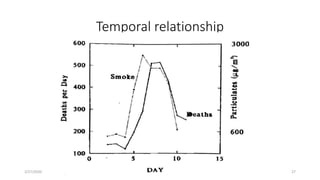
  • #28 Air pollution and daily mortality: A review and meta analysis, (increase in mortality being due to increase in air pollution) london