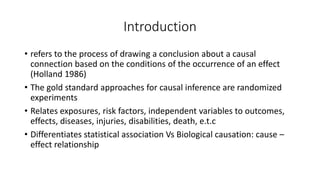
- Causal inference refers to determining if an exposure caused an outcome based on evidence, rather than just an observed association. Establishing causation requires considering factors like temporality, strength of association, consistency of findings, and biological plausibility.
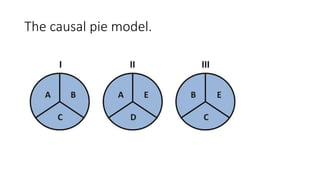
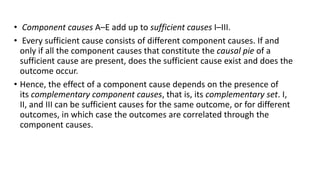
- Hill's criteria and Rothman's causal pies model provide frameworks for systematically evaluating the weight of evidence supporting or refuting a causal relationship. Necessary causes must always be present to produce the outcome, while sufficient causes can single-handedly cause the outcome.
- Distinguishing causal relationships from risk factors is important, as risk factors are not necessarily direct causes but may indicate underlying causal mechanisms. Experimental evidence can strengthen causal inferences but is often lacking for ethical or practical reasons