Association and causation
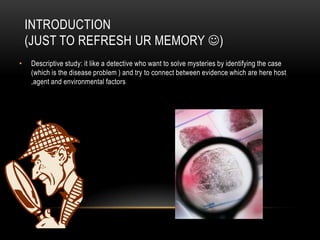
INTRODUCTION
    (JUST TO REFRESH UR MEMORY )
•   Descriptive study: it like a detective who want to solve mysteries by identifying the case
    (which is the disease problem ) and try to connect between evidence which are here host
    ,agent and environmental factors
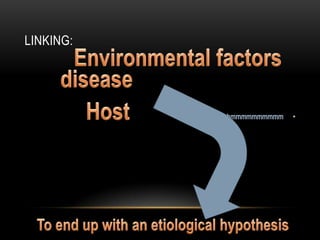
LINKING:
ANALYTICAL AND EXPERIMENTAL STUDY
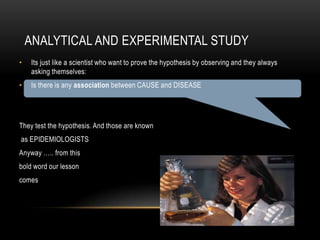
•   Its just like a scientist who want to prove the hypothesis by observing and they always
    asking themselves:
•   Is there is any association between CAUSE and DISEASE


They test the hypothesis. And those are known
as EPIDEMIOLOGISTS
Anyway ….. from this
bold word our lesson
comes
•   In this world many diseases has more than 1 etiology either cause or risk factor i.e.
    Multifactorial and this makes it difficult to relate the cause with the disease. U CANT POINT
    FINGER on a cause and say THAT’S IT.
•   The more association between causes and disease, the more investigation we need, to find
    the cause
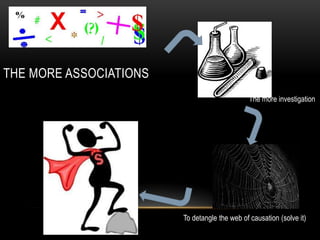
THE MORE ASSOCIATIONS
                                               The more investigation


                        To detangle the web of causation (solve it)
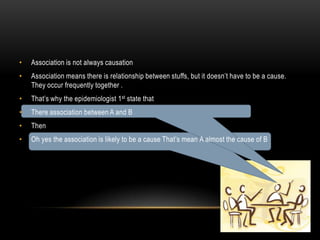
•   Association is not always causation
•   Association means there is relationship between stuffs, but it doesn’t have to be a cause.
    They occur frequently together .
•   That’s why the epidemiologist 1st state that
•   There association between A and B
•   Then
•   Oh yes the association is likely to be a cause That’s mean A almost the cause of B
BUT…. HOW TO KNOW WHICH ONE IS MORE
ASSOCIATED THAN THE OTHER???
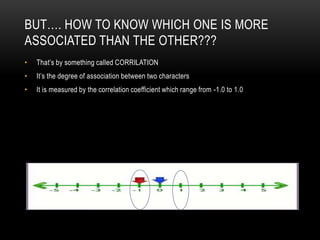
•   That’s by something called CORRILATION
•   It’s the degree of association between two characters
•   It is measured by the correlation coefficient which range from -1.0 to 1.0
correlation   •
      risks          -                                                    -           •
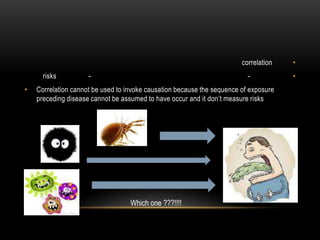
•   Correlation cannot be used to invoke causation because the sequence of exposure
    preceding disease cannot be assumed to have occur and it don’t measure risks


                                   Which one ???!!!!
IMPORTANT SENTENCE
•   Causation implies Correlation BUT correlation does not imply causation.
                                                                              •
TYPES OF ASSOCIATION:

• A- spurious association:
•   Spurious= not real
•   That’s mean the association between disease and cause is not real.
•   This is due to selection bias
•   Eg: more perinatal mortality in mothers that give birth at hospital than at home
• B- indirect association :
•   Simple example: Sahar is a friend with Salma, and Salma is Hanaa, so Hanaa is Sahar’s
    friend too but indirectly. The common friend is Salma.
•   So the association is due to the presence of another factor which is common to both,
    known as CONFOUNDING factor.
•   E.g. of confounding factors:
•   Age, sex, social class
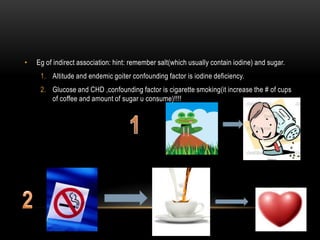
•   Eg of indirect association: hint: remember salt(which usually contain iodine) and sugar.
     1. Altitude and endemic goiter confounding factor is iodine deficiency.
     2. Glucose and CHD ,confounding factor is cigarette smoking(it increase the # of cups
        of coffee and amount of sugar u consume)!!!!
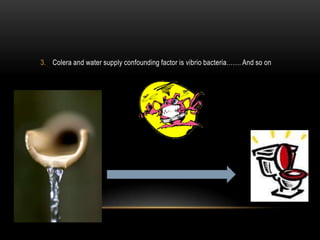
3. Colera and water supply confounding factor is vibrio bacteria……. And so on
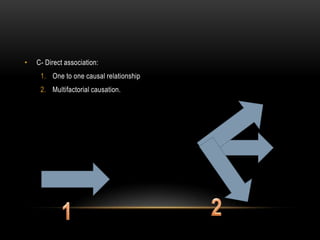
•   C- Direct association:
     1. One to one causal relationship
     2. Multifactorial causation.
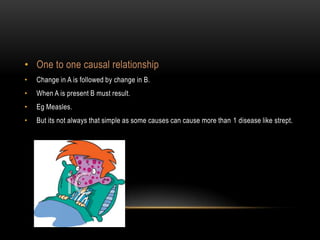
• One to one causal relationship
•   Change in A is followed by change in B.
•   When A is present B must result.
•   Eg Measles.
•   But its not always that simple as some causes can cause more than 1 disease like strept.
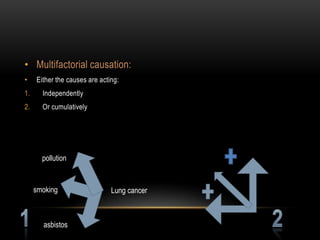
• Multifactorial causation:
•    Either the causes are acting:
1.     Independently
2.     Or cumulatively


       pollution


     smoking                   Lung cancer


       asbistos
WHEN WE CAN SAY THAT THIS ASSOCIATION IS
LIKELY TO BE CAUSATION??
•   We have certain criteria that should be present:
     • Temporal association (                )
     • Strength of association
     • Specificity of association
     • Consistency of association(               )
     • Biological plausibility(          )
     • Coherence of association
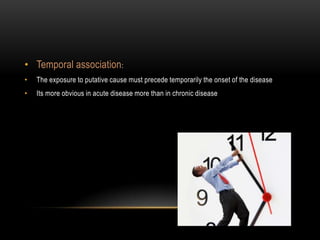
• Temporal association :
•   The exposure to putative cause must precede temporarily the onset of the disease
•   Its more obvious in acute disease more than in chronic disease
• Strength of association:
•   Remember we have experimental data and analytical data
•   When there is no experimental data the strength of association will depend on
     • relative risk,
     •   dose response relationship,
     •   duration and response relationship
•   Otherwise by cessation experiment
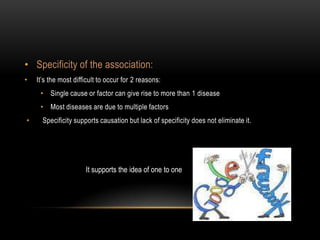
• Specificity of the association:
•   It’s the most difficult to occur for 2 reasons:
     • Single cause or factor can give rise to more than 1 disease
     • Most diseases are due to multiple factors
•     Specificity supports causation but lack of specificity does not eliminate it.


                      It supports the idea of one to one
•   An example of this: in the same manner of the previous slide:
     • Not everyone who smokes develops cancer
     • Not every one who develop cancer has smoke
• Consistency of the association : means that if u did the experiment or the
   research 10000000000000 times u will get the same result even if u did it each time by
   different method
• Biological plausibility:
                             association   •
• Coherence of the association:
•
•

                     •


• Walaa Yousif Ali

Association and causation

  • 1.
  • 2.
    INTRODUCTION (JUST TO REFRESH UR MEMORY ) • Descriptive study: it like a detective who want to solve mysteries by identifying the case (which is the disease problem ) and try to connect between evidence which are here host ,agent and environmental factors
  • 3.
  • 4.
    ANALYTICAL AND EXPERIMENTALSTUDY • Its just like a scientist who want to prove the hypothesis by observing and they always asking themselves: • Is there is any association between CAUSE and DISEASE They test the hypothesis. And those are known as EPIDEMIOLOGISTS Anyway ….. from this bold word our lesson comes
  • 5.
    In this world many diseases has more than 1 etiology either cause or risk factor i.e. Multifactorial and this makes it difficult to relate the cause with the disease. U CANT POINT FINGER on a cause and say THAT’S IT. • The more association between causes and disease, the more investigation we need, to find the cause
  • 6.
    THE MORE ASSOCIATIONS The more investigation To detangle the web of causation (solve it)
  • 7.
    Association is not always causation • Association means there is relationship between stuffs, but it doesn’t have to be a cause. They occur frequently together . • That’s why the epidemiologist 1st state that • There association between A and B • Then • Oh yes the association is likely to be a cause That’s mean A almost the cause of B
  • 8.
    BUT…. HOW TOKNOW WHICH ONE IS MORE ASSOCIATED THAN THE OTHER??? • That’s by something called CORRILATION • It’s the degree of association between two characters • It is measured by the correlation coefficient which range from -1.0 to 1.0
  • 9.
    correlation • risks - - • • Correlation cannot be used to invoke causation because the sequence of exposure preceding disease cannot be assumed to have occur and it don’t measure risks Which one ???!!!!
  • 10.
    IMPORTANT SENTENCE • Causation implies Correlation BUT correlation does not imply causation. •
  • 11.
    TYPES OF ASSOCIATION: •A- spurious association: • Spurious= not real • That’s mean the association between disease and cause is not real. • This is due to selection bias • Eg: more perinatal mortality in mothers that give birth at hospital than at home
  • 12.
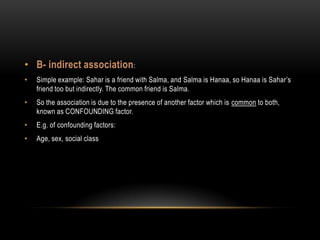
    • B- indirectassociation : • Simple example: Sahar is a friend with Salma, and Salma is Hanaa, so Hanaa is Sahar’s friend too but indirectly. The common friend is Salma. • So the association is due to the presence of another factor which is common to both, known as CONFOUNDING factor. • E.g. of confounding factors: • Age, sex, social class
  • 13.
    Eg of indirect association: hint: remember salt(which usually contain iodine) and sugar. 1. Altitude and endemic goiter confounding factor is iodine deficiency. 2. Glucose and CHD ,confounding factor is cigarette smoking(it increase the # of cups of coffee and amount of sugar u consume)!!!!
  • 14.
    3. Colera andwater supply confounding factor is vibrio bacteria……. And so on
  • 15.
    C- Direct association: 1. One to one causal relationship 2. Multifactorial causation.
  • 16.
    • One toone causal relationship • Change in A is followed by change in B. • When A is present B must result. • Eg Measles. • But its not always that simple as some causes can cause more than 1 disease like strept.
  • 17.
    • Multifactorial causation: • Either the causes are acting: 1. Independently 2. Or cumulatively pollution smoking Lung cancer asbistos
  • 18.
    WHEN WE CANSAY THAT THIS ASSOCIATION IS LIKELY TO BE CAUSATION?? • We have certain criteria that should be present: • Temporal association ( ) • Strength of association • Specificity of association • Consistency of association( ) • Biological plausibility( ) • Coherence of association
  • 19.
    • Temporal association: • The exposure to putative cause must precede temporarily the onset of the disease • Its more obvious in acute disease more than in chronic disease
  • 20.
    • Strength ofassociation: • Remember we have experimental data and analytical data • When there is no experimental data the strength of association will depend on • relative risk, • dose response relationship, • duration and response relationship • Otherwise by cessation experiment
  • 21.
    • Specificity ofthe association: • It’s the most difficult to occur for 2 reasons: • Single cause or factor can give rise to more than 1 disease • Most diseases are due to multiple factors • Specificity supports causation but lack of specificity does not eliminate it. It supports the idea of one to one
  • 22.
    An example of this: in the same manner of the previous slide: • Not everyone who smokes develops cancer • Not every one who develop cancer has smoke
  • 23.
    • Consistency ofthe association : means that if u did the experiment or the research 10000000000000 times u will get the same result even if u did it each time by different method
  • 24.
  • 25.
    • Coherence ofthe association: •
  • 26.
    • • Walaa Yousif Ali