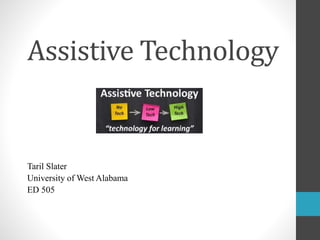
Assistive Technology
Taril Slater
University of West Alabama
ED 505
• Assistive technology is any device or service that overcomes
the challenges teachers have with students with disabilities in
the traditional classroom.
• Assistive technology helps a student with a disability to meet
his or her individualized education program (IEP) goals and to
participate in the general education setting to the greatest
possible extent.
• Assistive technology improves the functional performance of
an individual with a disability.
Students can utilize assistive technologyto communicate,perform
academic tasks, participatein social and extracurricular activities, move
or travelaround the school,use proper seatingand positioning, and
access materials.
Assistive technologyhas the potentialto improve both the quality of
education and life for many students with disabilities however access is
limited.
Assistive technologycan come in the form of devices and services and
can be very successful when havingthe devices and services neededuse
it effectively.
The Law in regard to
Assistive Technology
The Assistive Technology Act of 2004 defines an
assistive technology device in the following way:
…any item, piece of equipment, or product system,
whether acquired commercially, modified, or
customized, that is used to increase, maintain, or
improve functional capabilities of individuals with
disabilities. (29 U.S.C. Sec 2202(2))
The Law in regard to
Assistive Technology
Assistive Technology devices can be “low tech,” “medium tech,” or “high tech”
• power and manual wheelchairs, scooters, canes, walkers, and standing devices
• augmentative communication devices (speech generating devices), voice amplifiers,and speech recognition devices
• durable medical equipment and medical supplies, such as patient lifts and incontinence supplies
• orthotics and prosthetics, such as hearing aids and electric larynxes
• accessibility adaptations to the home, workplace, schools, group homes, nursing facilities, ICF/MRs, and other places
(e.g., ramps, stair glides, lifts, grab bars, flashing smoke detectors, lever doorknobs, and environmental controls)
• special equipment to help people work, study, and engage in recreation, such as enlarged computer keyboards, reachers,
amplified telephones, magnifiers, voice recognition software, and adaptive sports equipment
• accessibility modifications in the community, such as audio systems on public transportation, talking ATMs, and voting
machines for the blind (Disability Rights Network of Pennsylvania, 2008)
The Law in regard to
Assistive Technology
An assistive technology service is defined as:
…any service that directly assists an individual with a disability in the selection,
acquisition, or use of an assistive technology device.
Examples of Assistive Technology services–taken from the law itself–include:
• An evaluation of the AT needs of an individual, including a functional evaluation of
how AT would help the individual
• Purchasing, leasing, or otherwise providing an AT device
• Selecting, designing, fitting, customizing, adapting, applying, maintaining, repairing,
replacing, or donating an AT device
• Coordinating and using therapies, such as occupational therapy or physical therapy,
with AT devices under an educational plan or rehabilitative plan
• Training or technical assistance for an individual with a disability, or his or her
family members, guardians, advocates, or authorized representatives
• Training or technical assistance for educational or rehabilitation professionals,
manufacturers of AT devices, employers, providers of training and employment
services, and others who help individuals with disabilities
• A service that expands access to technology, including email and Internet, to persons
with disabilities
Assistive Technology that can aid a student with
Hearing Impairments
Hearing aids, Closed
captioning and
American Sign
Language can assist
hearing impaired
students to better
interpret and
understand
information.
Assistive Technology for Seeing Impairments
There are multiple assistive technology devices for seeing impaired student that include increased contrast,
enlarged images, use of tactile and auditory materials, use of a seeing eye dog, books on tape, eye glasses,
magnifiers, large print books, screen magnifiers, screen magnification software, electronic magnifier (sometimes
called a CCTV), screen reader, braille keyboard or notetaker, braille translator software, braille printer/embosser,
brailled materials, scanners, tactile image enhancers, optical character readers and reading machines.
Assistive Technology that can aid a student with
Learning Disability
The term "assistive technology" has usually
been applied to computer hardware and
software and electronic devices. However,
many assistive technology tools are now
available on the Internet. Assistive
technology tools that support kids with
Learning Disability include: Alternative
keyboards, Audio books and publications,
Electronic math work sheets, Freeform
database software, Graphic organizers and
outlining, Information/data managers,
Optical character recognition, Personal FM
listening systems, Portable word
processors, Proofreading programs,
Speech-recognition programs, Speech
synthesizers/screen readers, Talking
calculators, Talking spell checkers and
electronic dictionaries, Variable-speed tape
recorders, and Word-prediction programs
Assistive Technology that can aid a student with
Physical Disability
Student with physical disabilities can use assistive
technology to control electronic appliances within
the school and home. These devices allow the
student to use an alternate input device such as a
switch to control one or more electronic
appliances such as lights, televisions, and
electronically controlled doors. Students with
physical disabilities often need access to mobility
aids to provide them with a means of moving
about their environments. These mobility aids are
usually recommended by physical and
occupational therapists and include canes,
crutches, walkers, scooters, and wheelchairs.
Some students with physical disabilities require
low assistive technology such as game
adaptations, book adaptations, switch adapted
toys, and environmental control access for
televisions, videos, tape players, CD players and
MP3 players in order to participate more fully in
appropriate recreation and leisure activities.
Adaptive seating and positioning systems
determined by the physical and occupational
therapist include seat inserts for wheelchairs, side
liers, prone standers, and adaptive chairs as an
alternative to the standard classroom seating
systems.
References
Disability Rights Network of Pennsylvania. (2008). Assistive technology for persons with disabilities: An overview. Retrieved March 24, 2015 from:
http://drnpa.org/File/publications/assistive-technology-for-persons-with-disabilities—an-overview.pdf
Georgia Department of Education. (2014) Assistive technology devices. Retrieved on March 24, 2015 from http://www.gpat.org/Georgia-Project-for-
Assistive-Technology/Pages/Assistive-Technology-Devices.aspx
Heckendorf, S. (2009). Assistive technology for individuals who are deal or hard of hearing. Assessing students’ needs for assistive technology , Retrieved
from http://www.wati.org/content/supports/free/pdf/Ch13-Hearing.pdf
Stanberry, K. & Raskind, M. (2009). Assistive technology for kids with learning disabilities: An overview. Reading Rockets, Retrieved from
http://www.readingrockets.org/article/assistive-technology-kids-learning-disabilities-overview
The IRIS Center for Training Enhancements. (2010). Assistive Technology: An Overview. Retrieved on March 24, 2015 from
http://iris.peabody.vanderbilt.edu/module/at/

Assistive Technology

  • 1.
  • 2.
    • Assistive technologyis any device or service that overcomes the challenges teachers have with students with disabilities in the traditional classroom. • Assistive technology helps a student with a disability to meet his or her individualized education program (IEP) goals and to participate in the general education setting to the greatest possible extent. • Assistive technology improves the functional performance of an individual with a disability.
  • 3.
    Students can utilizeassistive technologyto communicate,perform academic tasks, participatein social and extracurricular activities, move or travelaround the school,use proper seatingand positioning, and access materials. Assistive technologyhas the potentialto improve both the quality of education and life for many students with disabilities however access is limited. Assistive technologycan come in the form of devices and services and can be very successful when havingthe devices and services neededuse it effectively.
  • 4.
    The Law inregard to Assistive Technology The Assistive Technology Act of 2004 defines an assistive technology device in the following way: …any item, piece of equipment, or product system, whether acquired commercially, modified, or customized, that is used to increase, maintain, or improve functional capabilities of individuals with disabilities. (29 U.S.C. Sec 2202(2))
  • 5.
    The Law inregard to Assistive Technology Assistive Technology devices can be “low tech,” “medium tech,” or “high tech” • power and manual wheelchairs, scooters, canes, walkers, and standing devices • augmentative communication devices (speech generating devices), voice amplifiers,and speech recognition devices • durable medical equipment and medical supplies, such as patient lifts and incontinence supplies • orthotics and prosthetics, such as hearing aids and electric larynxes • accessibility adaptations to the home, workplace, schools, group homes, nursing facilities, ICF/MRs, and other places (e.g., ramps, stair glides, lifts, grab bars, flashing smoke detectors, lever doorknobs, and environmental controls) • special equipment to help people work, study, and engage in recreation, such as enlarged computer keyboards, reachers, amplified telephones, magnifiers, voice recognition software, and adaptive sports equipment • accessibility modifications in the community, such as audio systems on public transportation, talking ATMs, and voting machines for the blind (Disability Rights Network of Pennsylvania, 2008)
  • 6.
    The Law inregard to Assistive Technology An assistive technology service is defined as: …any service that directly assists an individual with a disability in the selection, acquisition, or use of an assistive technology device. Examples of Assistive Technology services–taken from the law itself–include: • An evaluation of the AT needs of an individual, including a functional evaluation of how AT would help the individual • Purchasing, leasing, or otherwise providing an AT device • Selecting, designing, fitting, customizing, adapting, applying, maintaining, repairing, replacing, or donating an AT device • Coordinating and using therapies, such as occupational therapy or physical therapy, with AT devices under an educational plan or rehabilitative plan • Training or technical assistance for an individual with a disability, or his or her family members, guardians, advocates, or authorized representatives • Training or technical assistance for educational or rehabilitation professionals, manufacturers of AT devices, employers, providers of training and employment services, and others who help individuals with disabilities • A service that expands access to technology, including email and Internet, to persons with disabilities
  • 7.
    Assistive Technology thatcan aid a student with Hearing Impairments Hearing aids, Closed captioning and American Sign Language can assist hearing impaired students to better interpret and understand information.
  • 8.
    Assistive Technology forSeeing Impairments There are multiple assistive technology devices for seeing impaired student that include increased contrast, enlarged images, use of tactile and auditory materials, use of a seeing eye dog, books on tape, eye glasses, magnifiers, large print books, screen magnifiers, screen magnification software, electronic magnifier (sometimes called a CCTV), screen reader, braille keyboard or notetaker, braille translator software, braille printer/embosser, brailled materials, scanners, tactile image enhancers, optical character readers and reading machines.
  • 9.
    Assistive Technology thatcan aid a student with Learning Disability The term "assistive technology" has usually been applied to computer hardware and software and electronic devices. However, many assistive technology tools are now available on the Internet. Assistive technology tools that support kids with Learning Disability include: Alternative keyboards, Audio books and publications, Electronic math work sheets, Freeform database software, Graphic organizers and outlining, Information/data managers, Optical character recognition, Personal FM listening systems, Portable word processors, Proofreading programs, Speech-recognition programs, Speech synthesizers/screen readers, Talking calculators, Talking spell checkers and electronic dictionaries, Variable-speed tape recorders, and Word-prediction programs
  • 10.
    Assistive Technology thatcan aid a student with Physical Disability Student with physical disabilities can use assistive technology to control electronic appliances within the school and home. These devices allow the student to use an alternate input device such as a switch to control one or more electronic appliances such as lights, televisions, and electronically controlled doors. Students with physical disabilities often need access to mobility aids to provide them with a means of moving about their environments. These mobility aids are usually recommended by physical and occupational therapists and include canes, crutches, walkers, scooters, and wheelchairs. Some students with physical disabilities require low assistive technology such as game adaptations, book adaptations, switch adapted toys, and environmental control access for televisions, videos, tape players, CD players and MP3 players in order to participate more fully in appropriate recreation and leisure activities. Adaptive seating and positioning systems determined by the physical and occupational therapist include seat inserts for wheelchairs, side liers, prone standers, and adaptive chairs as an alternative to the standard classroom seating systems.
  • 11.
    References Disability Rights Networkof Pennsylvania. (2008). Assistive technology for persons with disabilities: An overview. Retrieved March 24, 2015 from: http://drnpa.org/File/publications/assistive-technology-for-persons-with-disabilities—an-overview.pdf Georgia Department of Education. (2014) Assistive technology devices. Retrieved on March 24, 2015 from http://www.gpat.org/Georgia-Project-for- Assistive-Technology/Pages/Assistive-Technology-Devices.aspx Heckendorf, S. (2009). Assistive technology for individuals who are deal or hard of hearing. Assessing students’ needs for assistive technology , Retrieved from http://www.wati.org/content/supports/free/pdf/Ch13-Hearing.pdf Stanberry, K. & Raskind, M. (2009). Assistive technology for kids with learning disabilities: An overview. Reading Rockets, Retrieved from http://www.readingrockets.org/article/assistive-technology-kids-learning-disabilities-overview The IRIS Center for Training Enhancements. (2010). Assistive Technology: An Overview. Retrieved on March 24, 2015 from http://iris.peabody.vanderbilt.edu/module/at/