ASSISTIVE
TECHNOLOGY
Jade Johnson
ED 505
What is assistive technology?
◦ Assistive technology refers to a wide variety of
different learning and teaching aids which allow
students with disabilities to leverage their
strengths and complete daily tasks (An overview
of assistive technology, n.d.)
◦ Assistive technology does not just refer to high
tech gadgets but can be any tool which helps a
student work around his or her disability (An
overview of assistive technology, n.d.)
◦ Assistive technology helps students become
more independent, more accurate and speedy in
their classwork, helps them fit in better with the
routines in class, and helps reinforce and
strengthen skills (An overview of assistive
technology, n.d.)
◦ Examples of assistive technology include:
◦ Highlighters
◦ Books on tape
◦ Inclined writing surfaces
◦ Calculators
◦ Text to speech computer programs
◦ Computer programs which translate oral
speech into written text
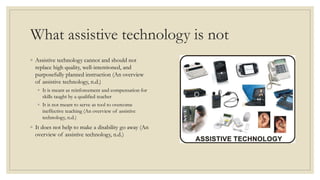
What assistive technology is not
◦ Assistive technology cannot and should not
replace high quality, well-intentioned, and
purposefully planned instruction (An overview
of assistive technology, n.d.)
◦ It is meant as reinforcement and compensation for
skills taught by a qualified teacher
◦ It is not meant to serve as tool to overcome
ineffective teaching (An overview of assistive
technology, n.d.)
◦ It does not help to make a disability go away (An
overview of assistive technology, n.d.)
Laws concerning Assistive Technology
◦ Technology Related Assistance for Individuals
with Disabilities Act of 1988 (Tech Act)
◦ This act provided federal funds to develop training
and delivery systems for assistive technologies
◦ This act defined assistive technology and wanted to
make it widely available to adults and children
◦ Assistive Technology Act of 1998
◦ This amendment extended the funding of assistive
technology to all 50 states
◦ It helped create comprehensive statewide programs
of technology related assistance
◦ Individuals with Disabilities Education Act of 1990 and 1997 and
2004 (IDEA)
◦ 1990
◦ This act outlined school districts’ responsibility to provide assistive technologies
to students with disabilities
◦ Assistive technology must be provided to students as part of a free, appropriate
public education (FAPE)
◦ IEP teams are to determine what technology, if any, is needed
◦ 1997
◦ IEP teams need to consider assistive technologies to extend FAPE and access
beyond the classroom
◦ Consideration means that IEP team members understand assistive technology
well enough that they can make recommendations for use
◦ 2004
◦ Amendments authorized formula grants for assistive technology as well as
discretionary grants for research technology and training
◦ IEP teams need maximize accessibility to assistive technology for students with
disabilities
◦ (Assistive technology, n.d.)
(Assistive technology legislation, n.d.)
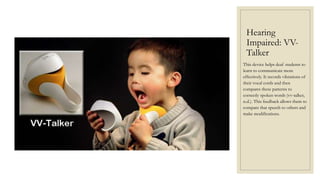
Hearing
Impaired: VV-
Talker
This device helps deaf students to
learn to communicate more
effectively. It records vibrations of
their vocal cords and then
compares these patterns to
correctly spoken words (vv-talker,
n.d.). This feedback allows them to
compare that speech to others and
make modifications.
Seeing
Impaired:
Tactile Image
Enhancer
This technology helps seeing
impaired students to feel diagrams,
charts, graphs, and the like. Images
are printed on a special type of
paper and then fed through a
printer which raises the ink
(Hardware overview: tactile image
enhancer, n.d.). This gives a seeing
impaired student the opportunity
to remember and understand
information tactilely and spatially.
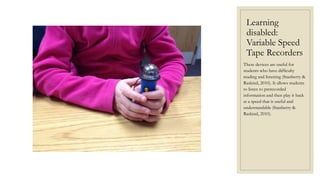
Learning
disabled:
Variable Speed
Tape Recorders
These devices are useful for
students who have difficulty
reading and listening (Stanberry &
Raskind, 2010). It allows students
to listen to prerecorded
information and then play it back
at a speed that is useful and
understandable (Stanberry &
Raskind, 2010).
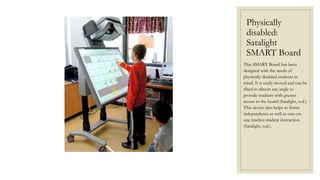
Physically
disabled:
Satalight
SMART Board
This SMART Board has been
designed with the needs of
physically disabled students in
mind. It is easily moved and can be
tilted to almost any angle to
provide students with greater
access to the board (Satalight, n.d.).
This device also helps to foster
independence as well as one-on-
one teacher-student interaction
(Satalight, n.d.).
References
◦ An Overview of Assistive Technology . (n.d.). National Center for Learning Disabilities. Retrieved June 9, 2014,
from http://www.ncld.org/students-disabilities/assistive-technology-education/overview-assistive-
technology
◦ Assistive Technology. (n.d.). Assistive Technology - Wrightslaw. Retrieved June 9, 2014, from
http://www.wrightslaw.com/info/atech.index.htm
◦ Assistive Technology Legislation . (n.d.). . Retrieved June 9, 2014, from
http://atto.buffalo.edu/registered/ATBasics/Foundation/Laws/atlegislation.php
◦ Hardware Overview: Tactile Image Enhancer. (n.d.). - Tactile Image Enhancer. Retrieved June 9, 2014, from
http://www.indiana.edu/~iuadapts/technology/hardware/tactile/
◦ Satalight. (n.d.). Advanced Education. Retrieved June 9, 2014, from http://www.advanced-
education.com/educators/products/smart-board/satalight/
◦ Stanberry, K., & Raskind, M. (2010). Variable Speed Tape Recorder. Retrieved June 9, 2014, from
http://www.greatschools.org/special-education/assistive-technology/947-variable-speed-tape-recorders.gs
◦ vv-talker. (n.d.). Industrial Designers Society of America. Retrieved June 9, 2014, from http://www.idsa.org/vv-
talker

Assistive Technology

  • 1.
  • 2.
    What is assistivetechnology? ◦ Assistive technology refers to a wide variety of different learning and teaching aids which allow students with disabilities to leverage their strengths and complete daily tasks (An overview of assistive technology, n.d.) ◦ Assistive technology does not just refer to high tech gadgets but can be any tool which helps a student work around his or her disability (An overview of assistive technology, n.d.) ◦ Assistive technology helps students become more independent, more accurate and speedy in their classwork, helps them fit in better with the routines in class, and helps reinforce and strengthen skills (An overview of assistive technology, n.d.) ◦ Examples of assistive technology include: ◦ Highlighters ◦ Books on tape ◦ Inclined writing surfaces ◦ Calculators ◦ Text to speech computer programs ◦ Computer programs which translate oral speech into written text
  • 3.
    What assistive technologyis not ◦ Assistive technology cannot and should not replace high quality, well-intentioned, and purposefully planned instruction (An overview of assistive technology, n.d.) ◦ It is meant as reinforcement and compensation for skills taught by a qualified teacher ◦ It is not meant to serve as tool to overcome ineffective teaching (An overview of assistive technology, n.d.) ◦ It does not help to make a disability go away (An overview of assistive technology, n.d.)
  • 4.
    Laws concerning AssistiveTechnology ◦ Technology Related Assistance for Individuals with Disabilities Act of 1988 (Tech Act) ◦ This act provided federal funds to develop training and delivery systems for assistive technologies ◦ This act defined assistive technology and wanted to make it widely available to adults and children ◦ Assistive Technology Act of 1998 ◦ This amendment extended the funding of assistive technology to all 50 states ◦ It helped create comprehensive statewide programs of technology related assistance ◦ Individuals with Disabilities Education Act of 1990 and 1997 and 2004 (IDEA) ◦ 1990 ◦ This act outlined school districts’ responsibility to provide assistive technologies to students with disabilities ◦ Assistive technology must be provided to students as part of a free, appropriate public education (FAPE) ◦ IEP teams are to determine what technology, if any, is needed ◦ 1997 ◦ IEP teams need to consider assistive technologies to extend FAPE and access beyond the classroom ◦ Consideration means that IEP team members understand assistive technology well enough that they can make recommendations for use ◦ 2004 ◦ Amendments authorized formula grants for assistive technology as well as discretionary grants for research technology and training ◦ IEP teams need maximize accessibility to assistive technology for students with disabilities ◦ (Assistive technology, n.d.) (Assistive technology legislation, n.d.)
  • 5.
    Hearing Impaired: VV- Talker This devicehelps deaf students to learn to communicate more effectively. It records vibrations of their vocal cords and then compares these patterns to correctly spoken words (vv-talker, n.d.). This feedback allows them to compare that speech to others and make modifications.
  • 6.
    Seeing Impaired: Tactile Image Enhancer This technologyhelps seeing impaired students to feel diagrams, charts, graphs, and the like. Images are printed on a special type of paper and then fed through a printer which raises the ink (Hardware overview: tactile image enhancer, n.d.). This gives a seeing impaired student the opportunity to remember and understand information tactilely and spatially.
  • 7.
    Learning disabled: Variable Speed Tape Recorders Thesedevices are useful for students who have difficulty reading and listening (Stanberry & Raskind, 2010). It allows students to listen to prerecorded information and then play it back at a speed that is useful and understandable (Stanberry & Raskind, 2010).
  • 8.
    Physically disabled: Satalight SMART Board This SMARTBoard has been designed with the needs of physically disabled students in mind. It is easily moved and can be tilted to almost any angle to provide students with greater access to the board (Satalight, n.d.). This device also helps to foster independence as well as one-on- one teacher-student interaction (Satalight, n.d.).
  • 9.
    References ◦ An Overviewof Assistive Technology . (n.d.). National Center for Learning Disabilities. Retrieved June 9, 2014, from http://www.ncld.org/students-disabilities/assistive-technology-education/overview-assistive- technology ◦ Assistive Technology. (n.d.). Assistive Technology - Wrightslaw. Retrieved June 9, 2014, from http://www.wrightslaw.com/info/atech.index.htm ◦ Assistive Technology Legislation . (n.d.). . Retrieved June 9, 2014, from http://atto.buffalo.edu/registered/ATBasics/Foundation/Laws/atlegislation.php ◦ Hardware Overview: Tactile Image Enhancer. (n.d.). - Tactile Image Enhancer. Retrieved June 9, 2014, from http://www.indiana.edu/~iuadapts/technology/hardware/tactile/ ◦ Satalight. (n.d.). Advanced Education. Retrieved June 9, 2014, from http://www.advanced- education.com/educators/products/smart-board/satalight/ ◦ Stanberry, K., & Raskind, M. (2010). Variable Speed Tape Recorder. Retrieved June 9, 2014, from http://www.greatschools.org/special-education/assistive-technology/947-variable-speed-tape-recorders.gs ◦ vv-talker. (n.d.). Industrial Designers Society of America. Retrieved June 9, 2014, from http://www.idsa.org/vv- talker