AssistiveTechnology
Shatara Johnson
What is AssistiveTechnology?
“Assistive technology applied to education is extremely broad, encompassing "any item, piece of
equipment, or product system whether acquired commercially off the shelf, modified, or
customized, that is used to increase, maintain, or improve functional capabilities of individuals
with disabilities.“
http://www.edutopia.org/assistive-technology-young-children-special-education
AssistiveTechnology and the Law
• The law regarding assistive technology has improved substantially over the last decade to assist students with disabilities of all ages.
• Technology-RelatedAssistance for Individuals with DisabilitiesAct (P.L. 100-407) was signed into law by President Reagan on August 19, 1988.This
law provides funding to develop statewide, consumer-responsive information and training programs designed to meet the assistive technology (AT)
needs of individuals with disabilities of all ages.ThisACT is often called theTechAct.
• TheACT’s purpose is to provide individuals with disabilities with assistive devices, promote awareness that there are resources available
• Under the law, each U.S. state and territory receives a grant to fund an AssistiveTechnologyAct Project (ATAP).These projects provide services to
persons with disabilities for their entire life span, as well as to their families or guardians, service providers, and agencies and other entities that are
involved in providing services such as education and employment to persons with disabilities
Assistive technology for the hearing impaired
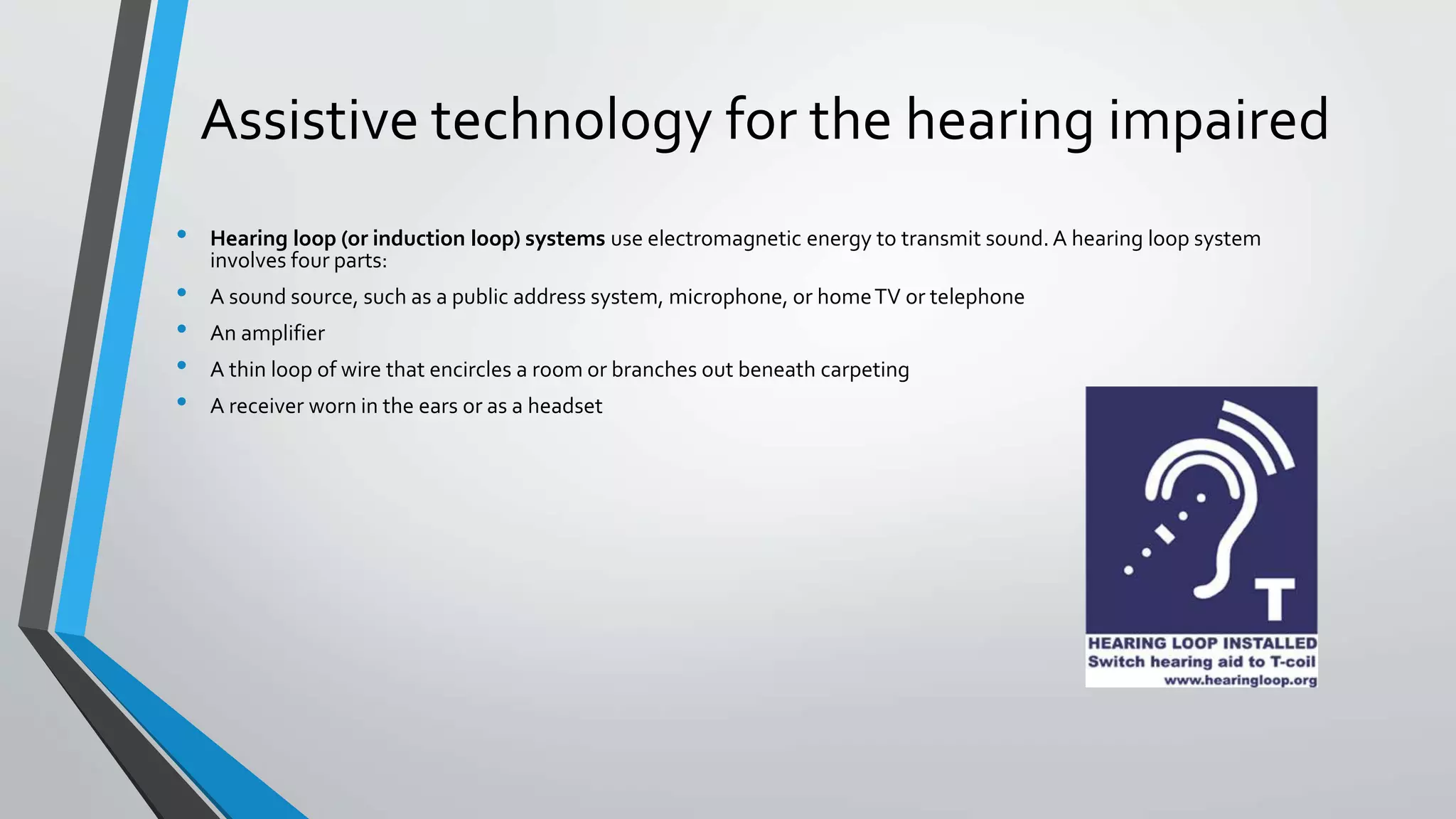
• Hearing loop (or induction loop) systems use electromagnetic energy to transmit sound. A hearing loop system
involves four parts:
• A sound source, such as a public address system, microphone, or homeTV or telephone
• An amplifier
• A thin loop of wire that encircles a room or branches out beneath carpeting
• A receiver worn in the ears or as a headset
AssistiveTechnology for the visually impaired
Thanks to advances in technology students that are visually impaired can complete classwork just as there sighted peers. Advances in visual technology
includes:
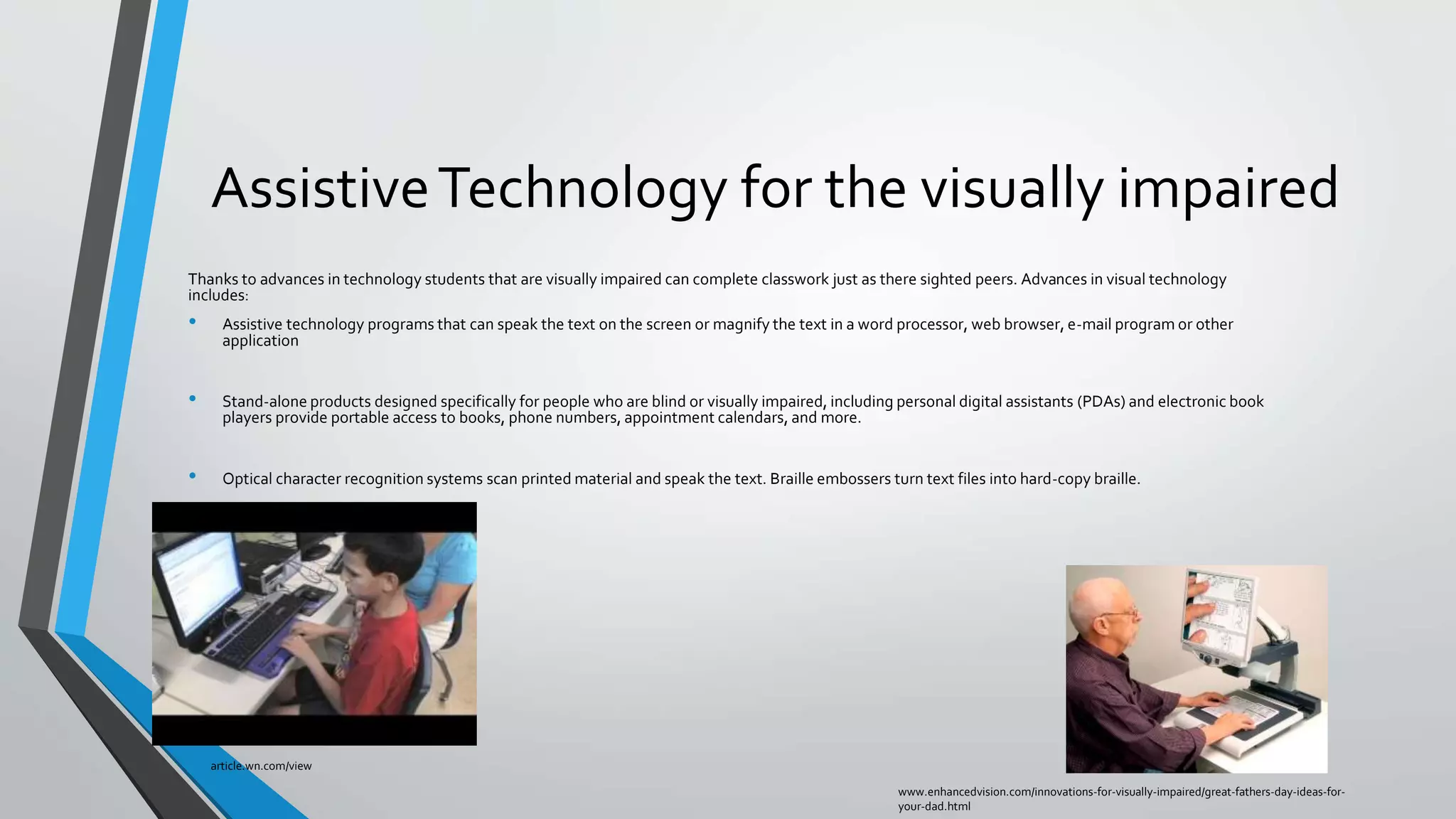
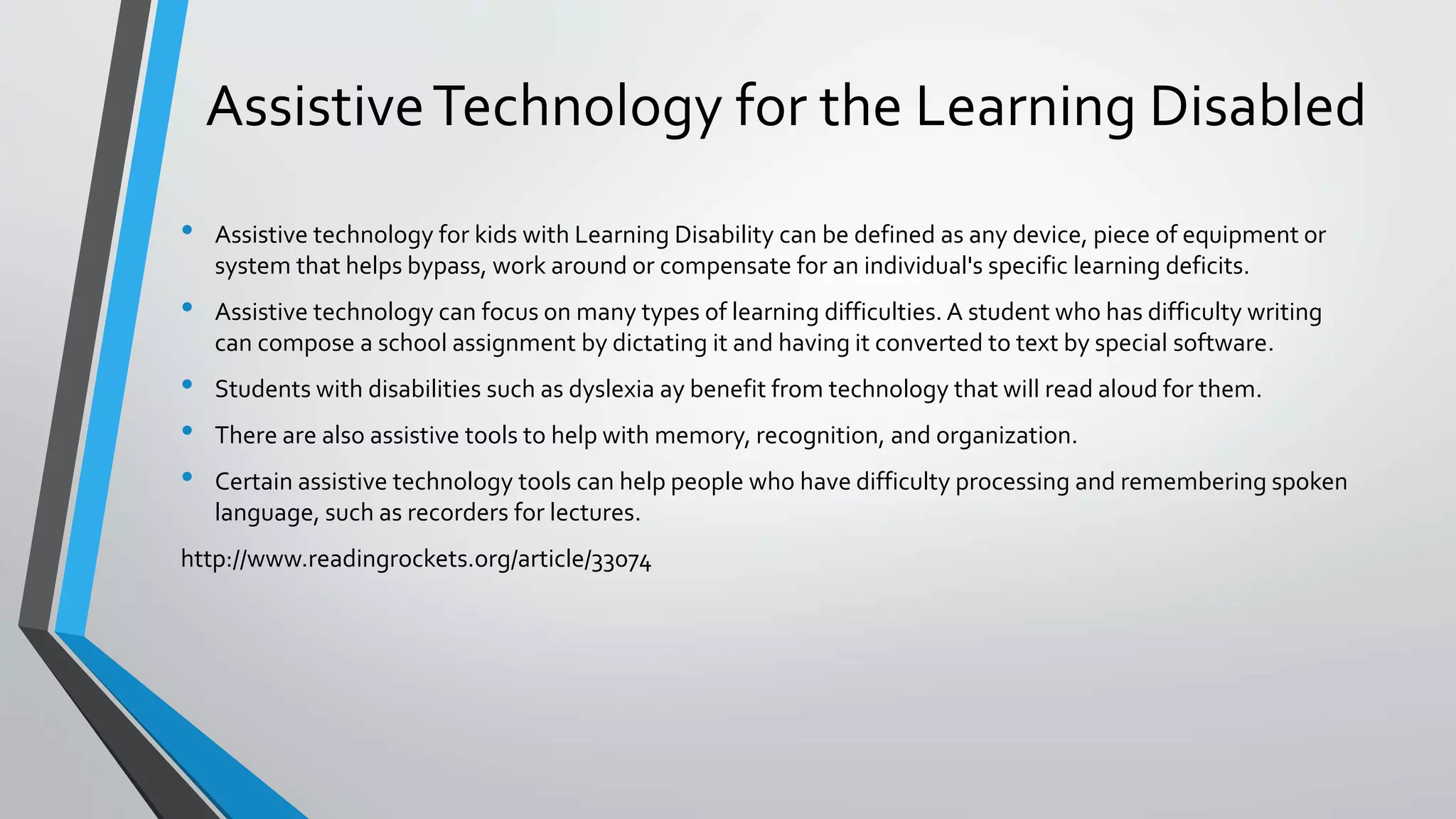
• Assistive technology programs that can speak the text on the screen or magnify the text in a word processor, web browser, e-mail program or other
application
• Stand-alone products designed specifically for people who are blind or visually impaired, including personal digital assistants (PDAs) and electronic book
players provide portable access to books, phone numbers, appointment calendars, and more.
• Optical character recognition systems scan printed material and speak the text. Braille embossers turn text files into hard-copy braille.
www.enhancedvision.com/innovations-for-visually-impaired/great-fathers-day-ideas-for-
your-dad.html
article.wn.com/view
AssistiveTechnology for the Learning Disabled
• Assistive technology for kids with Learning Disability can be defined as any device, piece of equipment or
system that helps bypass, work around or compensate for an individual's specific learning deficits.
• Assistive technology can focus on many types of learning difficulties. A student who has difficulty writing
can compose a school assignment by dictating it and having it converted to text by special software.
• Students with disabilities such as dyslexia ay benefit from technology that will read aloud for them.
• There are also assistive tools to help with memory, recognition, and organization.
• Certain assistive technology tools can help people who have difficulty processing and remembering spoken
language, such as recorders for lectures.
http://www.readingrockets.org/article/33074
AssistiveTechnology for Physical Disabilities
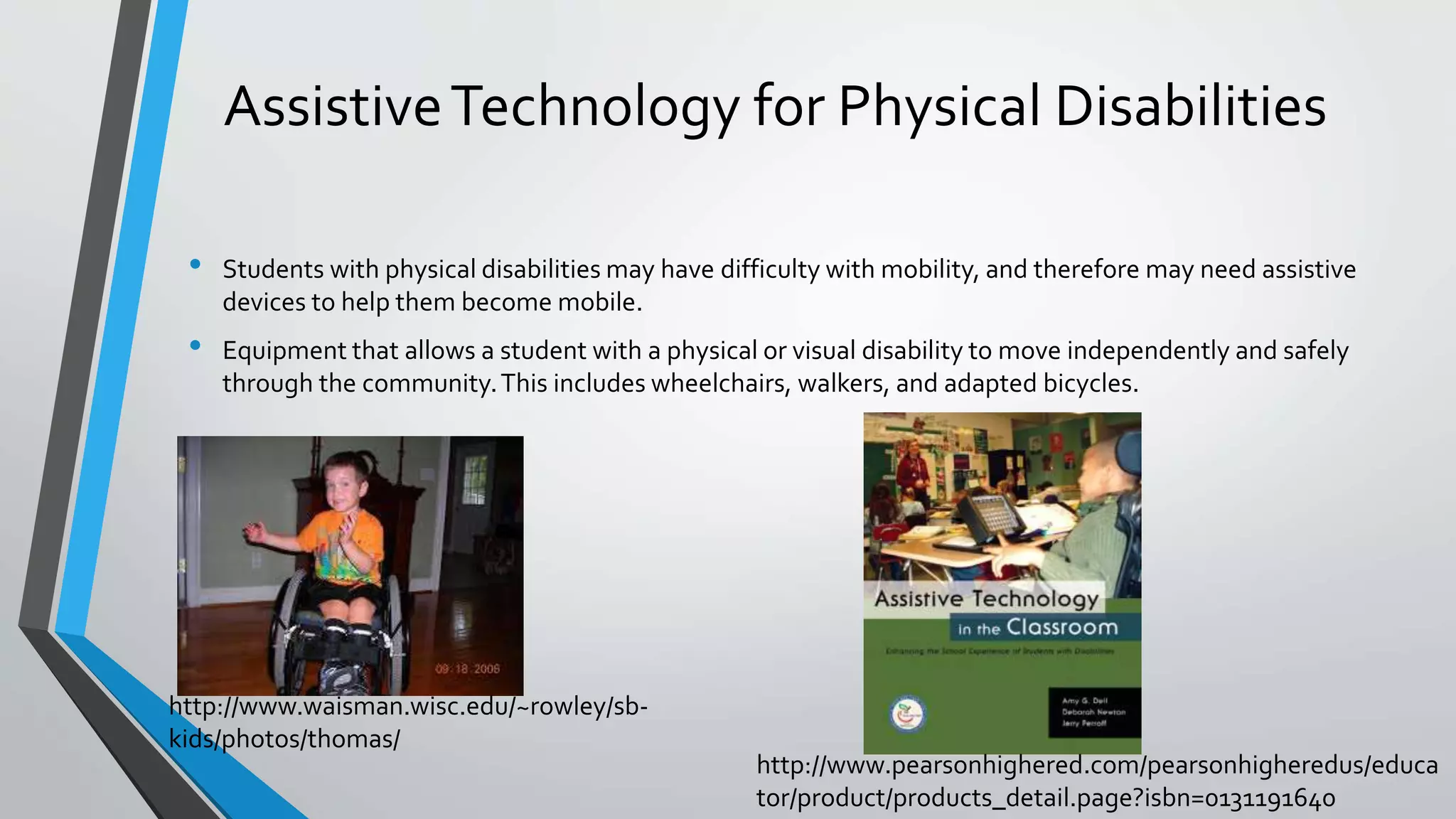
• Students with physical disabilities may have difficulty with mobility, and therefore may need assistive
devices to help them become mobile.
• Equipment that allows a student with a physical or visual disability to move independently and safely
through the community.This includes wheelchairs, walkers, and adapted bicycles.
http://www.waisman.wisc.edu/~rowley/sb-
kids/photos/thomas/
http://www.pearsonhighered.com/pearsonhigheredus/educa
tor/product/products_detail.page?isbn=0131191640
References
• http://www.edutopia.org/assistive-technology-young-children-special-education
• AssistiveTechnology Act, December 2009, http://nichcy.org/laws/ata
• www.enhancedvision.com/innovations-for-visually-impaired/great-fathers-day-ideas-for-your-
dad.html
• http://www.readingrockets.org/article/33074
• http://www.waisman.wisc.edu/~rowley/sb-kids/photos/thomas/
• http://www.pearsonhighered.com/pearsonhigheredus/educator/product/products_detail.page?i
sbn=0131191640

Assistive technology presentation ed-505

  • 1.
  • 2.
    What is AssistiveTechnology? “Assistivetechnology applied to education is extremely broad, encompassing "any item, piece of equipment, or product system whether acquired commercially off the shelf, modified, or customized, that is used to increase, maintain, or improve functional capabilities of individuals with disabilities.“ http://www.edutopia.org/assistive-technology-young-children-special-education
  • 3.
    AssistiveTechnology and theLaw • The law regarding assistive technology has improved substantially over the last decade to assist students with disabilities of all ages. • Technology-RelatedAssistance for Individuals with DisabilitiesAct (P.L. 100-407) was signed into law by President Reagan on August 19, 1988.This law provides funding to develop statewide, consumer-responsive information and training programs designed to meet the assistive technology (AT) needs of individuals with disabilities of all ages.ThisACT is often called theTechAct. • TheACT’s purpose is to provide individuals with disabilities with assistive devices, promote awareness that there are resources available • Under the law, each U.S. state and territory receives a grant to fund an AssistiveTechnologyAct Project (ATAP).These projects provide services to persons with disabilities for their entire life span, as well as to their families or guardians, service providers, and agencies and other entities that are involved in providing services such as education and employment to persons with disabilities
  • 4.
    Assistive technology forthe hearing impaired • Hearing loop (or induction loop) systems use electromagnetic energy to transmit sound. A hearing loop system involves four parts: • A sound source, such as a public address system, microphone, or homeTV or telephone • An amplifier • A thin loop of wire that encircles a room or branches out beneath carpeting • A receiver worn in the ears or as a headset
  • 5.
    AssistiveTechnology for thevisually impaired Thanks to advances in technology students that are visually impaired can complete classwork just as there sighted peers. Advances in visual technology includes: • Assistive technology programs that can speak the text on the screen or magnify the text in a word processor, web browser, e-mail program or other application • Stand-alone products designed specifically for people who are blind or visually impaired, including personal digital assistants (PDAs) and electronic book players provide portable access to books, phone numbers, appointment calendars, and more. • Optical character recognition systems scan printed material and speak the text. Braille embossers turn text files into hard-copy braille. www.enhancedvision.com/innovations-for-visually-impaired/great-fathers-day-ideas-for- your-dad.html article.wn.com/view
  • 6.
    AssistiveTechnology for theLearning Disabled • Assistive technology for kids with Learning Disability can be defined as any device, piece of equipment or system that helps bypass, work around or compensate for an individual's specific learning deficits. • Assistive technology can focus on many types of learning difficulties. A student who has difficulty writing can compose a school assignment by dictating it and having it converted to text by special software. • Students with disabilities such as dyslexia ay benefit from technology that will read aloud for them. • There are also assistive tools to help with memory, recognition, and organization. • Certain assistive technology tools can help people who have difficulty processing and remembering spoken language, such as recorders for lectures. http://www.readingrockets.org/article/33074
  • 7.
    AssistiveTechnology for PhysicalDisabilities • Students with physical disabilities may have difficulty with mobility, and therefore may need assistive devices to help them become mobile. • Equipment that allows a student with a physical or visual disability to move independently and safely through the community.This includes wheelchairs, walkers, and adapted bicycles. http://www.waisman.wisc.edu/~rowley/sb- kids/photos/thomas/ http://www.pearsonhighered.com/pearsonhigheredus/educa tor/product/products_detail.page?isbn=0131191640
  • 8.
    References • http://www.edutopia.org/assistive-technology-young-children-special-education • AssistiveTechnologyAct, December 2009, http://nichcy.org/laws/ata • www.enhancedvision.com/innovations-for-visually-impaired/great-fathers-day-ideas-for-your- dad.html • http://www.readingrockets.org/article/33074 • http://www.waisman.wisc.edu/~rowley/sb-kids/photos/thomas/ • http://www.pearsonhighered.com/pearsonhigheredus/educator/product/products_detail.page?i sbn=0131191640