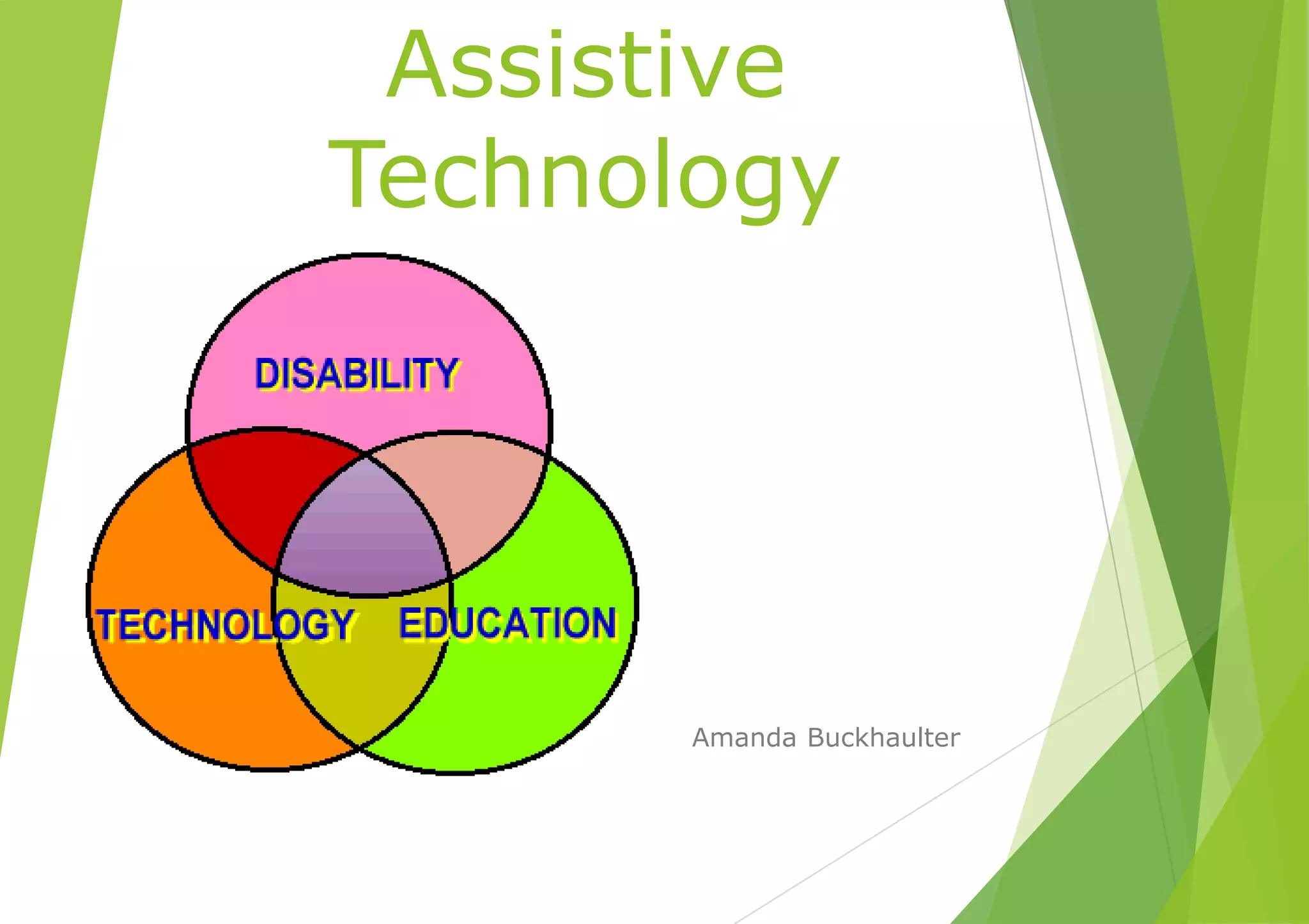
Assistive
Technology
Amanda Buckhaulter
Assistive Technology
 Assistive technology is any piece of
equipment, tool, device, or material
that can be used to help a person with
a disability complete a task.
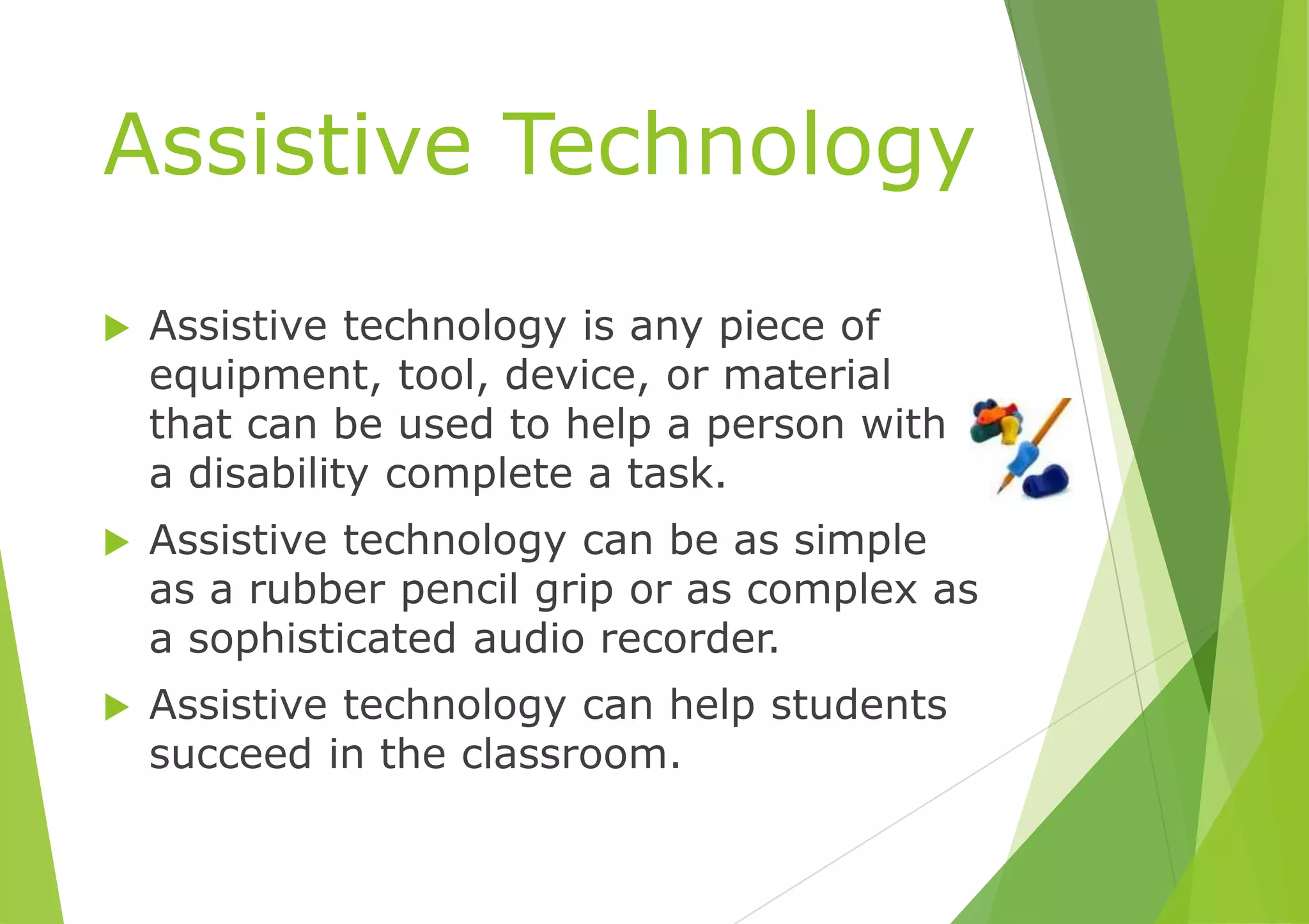
 Assistive technology can be as simple
as a rubber pencil grip or as complex as
a sophisticated audio recorder.
 Assistive technology can help students
succeed in the classroom.
Individuals with
Disabilities Act
 IDEA defines assistive
technology as any item, piece of
equipment, or product system,
whether acquired commercially
off the shelf, modified, or
customized, that is used to
increase, maintain, or improve
functional capabilities of a child
with a disability. (IDEA Sec.
602(1))
Laws on Assistive
Technology
 The Technology-Related Assistance Act for
Individuals with Disabilities (Public Law 100-407),
provides funding so that devices and services will
be provided to individuals with disabilities.
 The federal government acknowledged the
importance of assistive technology by revising the
individuals with Disabilities Act (IDEA) in 1997 and
in 2004. IDEA states that school districts must
consider assistive technology for any child in
special education.
Individualized Education
Plans
 IEP’s are written plans that meet
the unique educational needs of
a child with a disability.
 It is imperative to consider
assistive technology when
planning the IEP.
Impairments that Require
Assistive Technology
Hearing Impaired
Visually Impaired
Learning Disabled
Physically Disabled
Hearing Impaired
 FM amplification system
 The microphone picks up the teacher’s
voice, and the transmitter sends it directly
to the child’s receiver for amplification in
the hearing aids. This allows students to
focus on understanding what is being said.
Visually Impaired
• Braille Lite allows
teachers to convert
classroom handouts
to braille.
• Students are able to
type and then
convert their notes
to braille.
Learning Disabled
 IPAD
 Students with learning disabilities can use
an IPAD to play games targeted at their
learning level.
Physically Disabled
A wheelchair
accommodates
students with
minimum or no
movement by
enhancing their
ability to move to
their destination.
“Many say
technologies make
things easier, for
people with
disabilities
technologies make
things possible.”
Knut Ellingsen, Vice President of the European Federation of Hard of
Hearing (EFHOH)
References
Assistive technology basics. (n.d). Retrieved June 8, 2015 from
https://www.understood.org/en/school-learning/assistive-technology/assistive-technologies-basics
GARI. Retrieved June 10, 2015 from http://blog.mobileaccessibility.info/2014/03/many-say-technologies-make-things.html
The Individuals with Disabilities Act. Retrieved June 9, 2015 from http://idea.ed.gov
The IRIS Center. Retrieved June 8, 2015 from: http://iris.peabody.vanderbilt.edu/module/at/
Oticon People First. Retrieved June 9, 2015 from
http://www.oticon.com/products/wireless-accessories/amigo-fm/about-amigo.aspx
Roblyer, M., & Doering, A. H. (2013). Integrating Educational Technology Into Teaching. Upper Saddle River: Pearson
Education, Inc.

Assistive technology powerpoint

  • 1.
  • 2.
    Assistive Technology  Assistivetechnology is any piece of equipment, tool, device, or material that can be used to help a person with a disability complete a task.  Assistive technology can be as simple as a rubber pencil grip or as complex as a sophisticated audio recorder.  Assistive technology can help students succeed in the classroom.
  • 3.
    Individuals with Disabilities Act IDEA defines assistive technology as any item, piece of equipment, or product system, whether acquired commercially off the shelf, modified, or customized, that is used to increase, maintain, or improve functional capabilities of a child with a disability. (IDEA Sec. 602(1))
  • 4.
    Laws on Assistive Technology The Technology-Related Assistance Act for Individuals with Disabilities (Public Law 100-407), provides funding so that devices and services will be provided to individuals with disabilities.  The federal government acknowledged the importance of assistive technology by revising the individuals with Disabilities Act (IDEA) in 1997 and in 2004. IDEA states that school districts must consider assistive technology for any child in special education.
  • 5.
    Individualized Education Plans  IEP’sare written plans that meet the unique educational needs of a child with a disability.  It is imperative to consider assistive technology when planning the IEP.
  • 6.
    Impairments that Require AssistiveTechnology Hearing Impaired Visually Impaired Learning Disabled Physically Disabled
  • 7.
    Hearing Impaired  FMamplification system  The microphone picks up the teacher’s voice, and the transmitter sends it directly to the child’s receiver for amplification in the hearing aids. This allows students to focus on understanding what is being said.
  • 8.
    Visually Impaired • BrailleLite allows teachers to convert classroom handouts to braille. • Students are able to type and then convert their notes to braille.
  • 9.
    Learning Disabled  IPAD Students with learning disabilities can use an IPAD to play games targeted at their learning level.
  • 10.
    Physically Disabled A wheelchair accommodates studentswith minimum or no movement by enhancing their ability to move to their destination.
  • 11.
    “Many say technologies make thingseasier, for people with disabilities technologies make things possible.” Knut Ellingsen, Vice President of the European Federation of Hard of Hearing (EFHOH)
  • 12.
    References Assistive technology basics.(n.d). Retrieved June 8, 2015 from https://www.understood.org/en/school-learning/assistive-technology/assistive-technologies-basics GARI. Retrieved June 10, 2015 from http://blog.mobileaccessibility.info/2014/03/many-say-technologies-make-things.html The Individuals with Disabilities Act. Retrieved June 9, 2015 from http://idea.ed.gov The IRIS Center. Retrieved June 8, 2015 from: http://iris.peabody.vanderbilt.edu/module/at/ Oticon People First. Retrieved June 9, 2015 from http://www.oticon.com/products/wireless-accessories/amigo-fm/about-amigo.aspx Roblyer, M., & Doering, A. H. (2013). Integrating Educational Technology Into Teaching. Upper Saddle River: Pearson Education, Inc.