C H A N E L L E A R R I N G T O N
E D 5 0 5
J A N U A R Y 2 4 , 2 0 1 5
Assistive Technology
Explanation of Assistive Technology?
Assistive Technology (AT) can be defined as any item,
piece of equipment, or product system, whether
acquired commercially off the shelf, modified, or
customized, that is used to increase, maintain, or
improve the functional capabilities of individuals
with disabilities. ( 29 U.S.C Sec 2202 (2)).
The Federal Law divides assistive technology into two
parts:
1. Assistive Devices 2. Assistive Services
Assistive Technology and the Law
 The Technology-Related Assistance for Individuals with Disabilities Act of 1988, “Tech Act of 1988”
This law provided funding for states to develop consumer information and training programs that were designed to
meet the needs of individuals with disabilities. This law defined “assistive technology services” and “assistive technology
devices.” It provided grants to states to support systems change and advocacy activities related to statewide programs of
technology-related assistance for individuals with disabilities.

Telecommunications Act of 1996
This act provided provisions for all classrooms and libraries to connections to the information superhighway by the year
2000. This act and its guidelines provided a foundation for ensuring that technology become accessible to all students.

Carl D. Perkins Vocational and Technical Education Act of 1998, “Perkins Act”
Provided individuals with academic and technical skills for success in a knowledge and skills economy. Activities
supported by this act include access to career and technical education for students with disabilities and the purchase of
equipment to ensure access to the latest technology. Funds provided are allocated to both secondary and postsecondary
schools.

Assistive Technology Act of 1998
The Tech act of 1988 was replaced by this act whose purpose was to support programs and grants to states to help them
address the technology needs of individuals with disabilities. This law offered grants to provide assistance to states in
maintaining statewide technology-related assistance programs. It also provided for research that incorporated assistive
technology use with the Universal Design for Learning.
Assistive Technology and the Law
 Assistive Technology Act of 2004
This act provided direct aid to individuals with disabilities. It redefined the purpose of the Assistive
Technology Act of 1988 to focus on the delivery rather than the development of Assistive Technologies. This
act also required states to continually evaluate the effectiveness of their programs.

Education for All Handicapped Children Act of 1975 (EHA)
This act ensured that all students with disabilities had access to a Free Appropriate Public Education (FAPE),
meaning all children with disabilities have available special education and related services to meet their
unique needs. This act was reauthorized in 1986 and now included infants and toddlers, and families, as
eligible for services.

Individuals with Disabilities Education Act of 1990
The EHA was again reauthorized in 1990 and its name was changed to the Individuals with Disabilities
Education Act (IDEA). Amendments added autism and traumatic brain injury as disability categories. IEP’s
now included transition plans for each student in which assistive technology devices were considered as part of
the student’s success as a learner.

Individuals with Disabilities Education Act of 1997
This reauthorization of IDEA stressed Positive Behavioral Intervention Supports (PBIS) to address issues of
student behavior and how behavior is related to learning. IDEA also addressed the participation of students
with disabilities in district and state testing and the general education curriculum.
Assistive Technology and the Law
 Individuals with Disabilities Education Improvement Act of
2004
IDEA was reauthorized in 2004. The term Universal Design for Learning (UDL) was introduced
which is a philosophy for designing and delivering products and services with the widest ranges
of functional capabilities. Both the use of assistive technology and the concept of UDL must be
considerations addressed in a student’s IEP.

Section 504 of the Rehabilitation Act of 1973
This section required that reasonable access be required for individuals with disabilities. It
guaranteed public access to all public buildings including schools. Section 504 extends access to
all individuals with disabilities, instead of just school-aged children.

Americans with Disabilities Act of 1990 (ADA)
This act prohibited discrimination in employment and in transportation, and provided access
for public accommodations and telecommunications. ADA required that relay services are
offered for the deaf and the speech impaired so that they can use telecommunication services.

No Child Left Behind Act of 2001
This act has four major principles: accountability, options for parents, local control and
flexibility in the use of federal funds, and emphasis on best practices. Because students with
disabilities are expected to become proficient in subject matter, assistive technology will
provide access for them to be successful learners in the general education classroom.
Types of Assistive Technology
There are various devices and services used to assist
students with the following disabilities:
 Hearing Impaired
 Seeing Impaired
 Learning Disabled
 Physically Disabled
Assistive Technology for the Hearing Impaired
Hearing Aids - The hearing aid is probably the simplest
assistive listening device that can be placed on the ear of the
hearing-impaired students.
The typical hearing aid, which is shaped to comfortably fit the ear,
is an electronic device with three parts: microphone, amplifier,
and receiver. The capacity of the hearing aid can be augmented
by a personal FM unit.
https://www.google.com/search?q=Assistive+Technology+devices+used+in+the+classroom&rlz
Assistive Technology for the Seeing Impaired
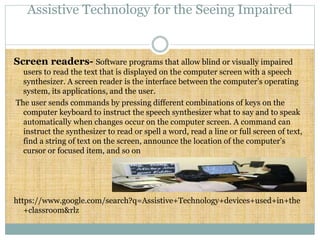
Screen readers- Software programs that allow blind or visually impaired
users to read the text that is displayed on the computer screen with a speech
synthesizer. A screen reader is the interface between the computer’s operating
system, its applications, and the user.
The user sends commands by pressing different combinations of keys on the
computer keyboard to instruct the speech synthesizer what to say and to speak
automatically when changes occur on the computer screen. A command can
instruct the synthesizer to read or spell a word, read a line or full screen of text,
find a string of text on the screen, announce the location of the computer’s
cursor or focused item, and so on
https://www.google.com/search?q=Assistive+Technology+devices+used+in+the
+classroom&rlz
Assistive Technology for the Learning Disabled
Talking Calculator has a built-in speech synthesizer
that reads aloud each number, symbol, or operation key a user
presses; it also vocalizes the answer to the problem.
This auditory feedback may help a student who is learning disables
check the accuracy of the keys he presses and verify the answer
before he transfers it to paper.
https://www.google.com/search?q=Assistive+Technology+devices+used+in+the
+classroom&rlz
Assistive Technology for the Physically Disabled
Mobility Aids- Devices designed to assist walking or
otherwise improve the mobility of people with a mobility
impairment.
People with physical disabilities that affect movement can use
mobility aids, such as wheelchairs, scooters, walkers, canes,
crutches, prosthetic devices, and orthotic devices, to enhance
their mobility.
https://www.google.com/search?q=Assistive+Technology+devices+used+in+the+classroom&rlz
References
Beard, L, Carpenter, L. & Johnston, L. (2011). Assistive technology: Access for all
students, 2nd ed. Pearson Education.
Bugaj, C. & Norton-Darr, S. (2010). The practical (and fun) guide to assistive
technology in public schools: Building and improving your district’s AT team.
Eugene, OR: International Association of Technology in Education.
Individuals with Disabilities Education Act. (2011). Retrieved November 1, 2014, from
http://en.wikipedia.org/wiki/Individuals_with_Disabilities_Education_Act

Assistive technology project

  • 1.
    C H AN E L L E A R R I N G T O N E D 5 0 5 J A N U A R Y 2 4 , 2 0 1 5 Assistive Technology
  • 2.
    Explanation of AssistiveTechnology? Assistive Technology (AT) can be defined as any item, piece of equipment, or product system, whether acquired commercially off the shelf, modified, or customized, that is used to increase, maintain, or improve the functional capabilities of individuals with disabilities. ( 29 U.S.C Sec 2202 (2)). The Federal Law divides assistive technology into two parts: 1. Assistive Devices 2. Assistive Services
  • 3.
    Assistive Technology andthe Law  The Technology-Related Assistance for Individuals with Disabilities Act of 1988, “Tech Act of 1988” This law provided funding for states to develop consumer information and training programs that were designed to meet the needs of individuals with disabilities. This law defined “assistive technology services” and “assistive technology devices.” It provided grants to states to support systems change and advocacy activities related to statewide programs of technology-related assistance for individuals with disabilities.  Telecommunications Act of 1996 This act provided provisions for all classrooms and libraries to connections to the information superhighway by the year 2000. This act and its guidelines provided a foundation for ensuring that technology become accessible to all students.  Carl D. Perkins Vocational and Technical Education Act of 1998, “Perkins Act” Provided individuals with academic and technical skills for success in a knowledge and skills economy. Activities supported by this act include access to career and technical education for students with disabilities and the purchase of equipment to ensure access to the latest technology. Funds provided are allocated to both secondary and postsecondary schools.  Assistive Technology Act of 1998 The Tech act of 1988 was replaced by this act whose purpose was to support programs and grants to states to help them address the technology needs of individuals with disabilities. This law offered grants to provide assistance to states in maintaining statewide technology-related assistance programs. It also provided for research that incorporated assistive technology use with the Universal Design for Learning.
  • 4.
    Assistive Technology andthe Law  Assistive Technology Act of 2004 This act provided direct aid to individuals with disabilities. It redefined the purpose of the Assistive Technology Act of 1988 to focus on the delivery rather than the development of Assistive Technologies. This act also required states to continually evaluate the effectiveness of their programs.  Education for All Handicapped Children Act of 1975 (EHA) This act ensured that all students with disabilities had access to a Free Appropriate Public Education (FAPE), meaning all children with disabilities have available special education and related services to meet their unique needs. This act was reauthorized in 1986 and now included infants and toddlers, and families, as eligible for services.  Individuals with Disabilities Education Act of 1990 The EHA was again reauthorized in 1990 and its name was changed to the Individuals with Disabilities Education Act (IDEA). Amendments added autism and traumatic brain injury as disability categories. IEP’s now included transition plans for each student in which assistive technology devices were considered as part of the student’s success as a learner.  Individuals with Disabilities Education Act of 1997 This reauthorization of IDEA stressed Positive Behavioral Intervention Supports (PBIS) to address issues of student behavior and how behavior is related to learning. IDEA also addressed the participation of students with disabilities in district and state testing and the general education curriculum.
  • 5.
    Assistive Technology andthe Law  Individuals with Disabilities Education Improvement Act of 2004 IDEA was reauthorized in 2004. The term Universal Design for Learning (UDL) was introduced which is a philosophy for designing and delivering products and services with the widest ranges of functional capabilities. Both the use of assistive technology and the concept of UDL must be considerations addressed in a student’s IEP.  Section 504 of the Rehabilitation Act of 1973 This section required that reasonable access be required for individuals with disabilities. It guaranteed public access to all public buildings including schools. Section 504 extends access to all individuals with disabilities, instead of just school-aged children.  Americans with Disabilities Act of 1990 (ADA) This act prohibited discrimination in employment and in transportation, and provided access for public accommodations and telecommunications. ADA required that relay services are offered for the deaf and the speech impaired so that they can use telecommunication services.  No Child Left Behind Act of 2001 This act has four major principles: accountability, options for parents, local control and flexibility in the use of federal funds, and emphasis on best practices. Because students with disabilities are expected to become proficient in subject matter, assistive technology will provide access for them to be successful learners in the general education classroom.
  • 6.
    Types of AssistiveTechnology There are various devices and services used to assist students with the following disabilities:  Hearing Impaired  Seeing Impaired  Learning Disabled  Physically Disabled
  • 7.
    Assistive Technology forthe Hearing Impaired Hearing Aids - The hearing aid is probably the simplest assistive listening device that can be placed on the ear of the hearing-impaired students. The typical hearing aid, which is shaped to comfortably fit the ear, is an electronic device with three parts: microphone, amplifier, and receiver. The capacity of the hearing aid can be augmented by a personal FM unit. https://www.google.com/search?q=Assistive+Technology+devices+used+in+the+classroom&rlz
  • 8.
    Assistive Technology forthe Seeing Impaired Screen readers- Software programs that allow blind or visually impaired users to read the text that is displayed on the computer screen with a speech synthesizer. A screen reader is the interface between the computer’s operating system, its applications, and the user. The user sends commands by pressing different combinations of keys on the computer keyboard to instruct the speech synthesizer what to say and to speak automatically when changes occur on the computer screen. A command can instruct the synthesizer to read or spell a word, read a line or full screen of text, find a string of text on the screen, announce the location of the computer’s cursor or focused item, and so on https://www.google.com/search?q=Assistive+Technology+devices+used+in+the +classroom&rlz
  • 9.
    Assistive Technology forthe Learning Disabled Talking Calculator has a built-in speech synthesizer that reads aloud each number, symbol, or operation key a user presses; it also vocalizes the answer to the problem. This auditory feedback may help a student who is learning disables check the accuracy of the keys he presses and verify the answer before he transfers it to paper. https://www.google.com/search?q=Assistive+Technology+devices+used+in+the +classroom&rlz
  • 10.
    Assistive Technology forthe Physically Disabled Mobility Aids- Devices designed to assist walking or otherwise improve the mobility of people with a mobility impairment. People with physical disabilities that affect movement can use mobility aids, such as wheelchairs, scooters, walkers, canes, crutches, prosthetic devices, and orthotic devices, to enhance their mobility. https://www.google.com/search?q=Assistive+Technology+devices+used+in+the+classroom&rlz
  • 11.
    References Beard, L, Carpenter,L. & Johnston, L. (2011). Assistive technology: Access for all students, 2nd ed. Pearson Education. Bugaj, C. & Norton-Darr, S. (2010). The practical (and fun) guide to assistive technology in public schools: Building and improving your district’s AT team. Eugene, OR: International Association of Technology in Education. Individuals with Disabilities Education Act. (2011). Retrieved November 1, 2014, from http://en.wikipedia.org/wiki/Individuals_with_Disabilities_Education_Act