SCHOOL OF ARCHITECTURE· BUILDING· DESIGN
Centre for Modern Architecture Studies in Southeast Asia
EDUCATION VISIT TO NIRO GRANITE
(27 APRIL 2018)
MEASUREMENT 2 (QSB60204)
NAME : _________Kuek Sze Ting________________
: _____________________________________
: _____________________________________
: _____________________________________
: _____________________________________
TASKS:
Please complete the enclosed pages of the kit in as much detail as you can, focusing on what YOU find
interesting about the visited sites.
YOUR EXPECTATIONS OF THIS TRIP (PLEASE FILL IN BEFORE DAY 1 OF TRIP)
My expectation for this trip is to learn as much as I can about the building materials used in
construction. I hope that through this trip, I can have a better understanding on the uses of
materials. Besides that, I would like to learn to identify on the selections of materials and its
application.
Prepared by Habizah
THE SHOWROOM/ GALLERY BUILDING
Take photographs of the building of the showroom. Identify the common materials used for the construction. Try
to investigate whether the materials obtained locally or imported from other countries. What do you see the
method of construction used, type of materials for floor, wall and ceiling (if any) finishes, available sizes of
materials found and detailing of installation including skirtings, drops etc. Please make your observations:
The common materials used for the construction are ceramic and porcelain tiles. It can both
used as floor tiles as well as wall tiles. The main material is clay which obtained from Johor
Malaysia locally. Materials such as color pigments are usually imported from India, Japan,
and so on. Sizes of tiles are 30*30, 30*60, 45*90. Sizes of wood planks available are
1000*1000, 1200*600. Ceramics tiles are not recommend to be used on floor because it is too
thin up to 5mm and it is lighter, although it is more affordable. It also has higher absorption
rate which make it easier to break. It can be in matte or polished surface. It is preferred to be
used on the wall. On the other hand, Porcelain tiles are made out of finer material. It has
lower water absorption rate, 0.5% or lower. It has more colour and designs. Porcelain tiles
can be glazed and polished in order to reduce its porosity and absorption rate of water. It has
different types of tiles that showcase in the showroom which include the full body tiles,
which define as the color of the tile runs uniformly from the surface and throughout the
thickness of the tile. There are also porcelain double charge, porcelain coloured body,
homogeneous and porcelain non-coloured body. There are very limited homogeneous tiles in
Niro because porcelain tiles are more demanding. For each production batch of porcelain
tiles, it may be different in shade. There are 4 shading concept from V1 to V4. V1 is where
the range of colours and tones are uniform from tile to tile. Example of V1 is homogeneous
tiles. V2 is is slightly noticeable from tile to tile. V3 is where there are clearly distinguishable
differences in design or pattern. Lastly, V4 is where the range of colours and tones within the
same shade is distinctly different from tile to tile. To install the tiles, the surface must be
clean, smooth, dry and free of wax and grease. Areas that are damaged or uneven must be
patched and levelled. Layout marks the centre point of all four walls. First of all, layout the
tiles to minimize the number of cut tiles. When laying tiles, bear in mind that variation of
shade is an inherent characteristic of porcelain tiles, mixing well between several cartons and
giving a total blend and random effect. It is advised to use the same calibre when tiling on the
same area. Use tile spacers for each tile setting, to leave equal joint between tiles. We
recommend a tiling gap of 3mm.The settling time will vary from a few hours to few days and
depending on the type of material or adhesive used for installation. During grouting, remove
the tile spacer and spread grout on the tile surface using a rubber grout float or squeegee. It is
important for you to refer to the adhesive package for specific instructions or precautions.
Remove excess grout from surface immediately after grouting. Wait for a couple of minutes,
depending of the specific instructions and then remove the excess grout from surface with
damp sponge, clean grout residue and smooth the grout joints.
Prepared by Habizah
PHOTOS
Different types of tiles with different surfaces.
This picture shows the differences of full body tiles and double body tiles.
PHOTOS
Prepared by Habizah
Designs with different texture porcelain tiles
Prepared by Habizah
Showcase of combination of different tiles on wall as well as floor.
THE EDUCATION TOUR
Name two types of floor tiles that you found in the showroom that really attract your attention. State the reasons
(Please indicate the size if possible and attach a photo each):
Prepared by Habizah
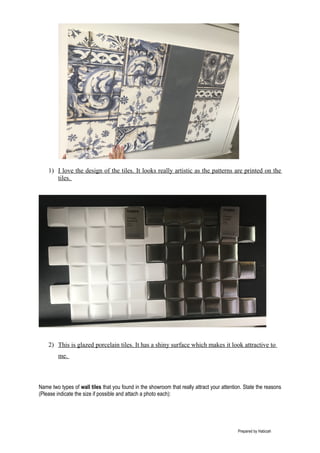
1) I love the design of the tiles. It looks really artistic as the patterns are printed on the
tiles.
2) This is glazed porcelain tiles. It has a shiny surface which makes it look attractive to
me.
Name two types of wall tiles that you found in the showroom that really attract your attention. State the reasons
(Please indicate the size if possible and attach a photo each):
Prepared by Habizah
1) I like its craftsmanship and stylistic of highly refined design. It is custom-made which
make it with great artistic value.
2) This is called Cementous. I like its industrial design trend. It features a seemingly
unfinished. Size available include 60*120cm, 60*60cm, and 30*60cm.
SHOWROOM TOUR
Prepared by Habizah
Conclude your observation on the products shown in the gallery (What are the popular or common products
produced by NIro and their usage in the construction and why?)
In Niro, they promote on porcelain products more than ceramics. Reason being is because the
advantages of porcelain outweighed the advantages of ceramic. In the long run, porcelain
tiles require less maintenance and it is more durable. Ceramics tiles tend to break as they are
brittle. Some popular series of porcelain tiles in Niro are Portino, Antique, Muse, Travertine
marbles and so on. These tiles can be used as internal finishes and external finishes. These
tiles are implemented in technical services & support, commercial, housing and other usages.
They also offer different price range of products for the consumers to choose. They will also
provide recommendations on which tiles are more affordable and fit to the use of
applications.
POST MORTEM
Describe of what have you learnt from this visit. Do you appreciate the VISIT?
I learned that it is important to choose the right floor tiles for different applications. Each tiles
has its best used applications, Of course, there are a lot of factors to be considered such as its
costing, durability, aesthetics and so on. I really appreciate this visit to Niro. It was an eye-
opening experience for me. Indeed, I gained a lot of knowledge from this visit.
THANK YOU
Prepared by Habizah

Assignment for niro visit mar 2018

  • 1.
    SCHOOL OF ARCHITECTURE·BUILDING· DESIGN Centre for Modern Architecture Studies in Southeast Asia EDUCATION VISIT TO NIRO GRANITE (27 APRIL 2018) MEASUREMENT 2 (QSB60204) NAME : _________Kuek Sze Ting________________ : _____________________________________ : _____________________________________ : _____________________________________ : _____________________________________ TASKS: Please complete the enclosed pages of the kit in as much detail as you can, focusing on what YOU find interesting about the visited sites. YOUR EXPECTATIONS OF THIS TRIP (PLEASE FILL IN BEFORE DAY 1 OF TRIP) My expectation for this trip is to learn as much as I can about the building materials used in construction. I hope that through this trip, I can have a better understanding on the uses of materials. Besides that, I would like to learn to identify on the selections of materials and its application. Prepared by Habizah
  • 2.
    THE SHOWROOM/ GALLERYBUILDING Take photographs of the building of the showroom. Identify the common materials used for the construction. Try to investigate whether the materials obtained locally or imported from other countries. What do you see the method of construction used, type of materials for floor, wall and ceiling (if any) finishes, available sizes of materials found and detailing of installation including skirtings, drops etc. Please make your observations: The common materials used for the construction are ceramic and porcelain tiles. It can both used as floor tiles as well as wall tiles. The main material is clay which obtained from Johor Malaysia locally. Materials such as color pigments are usually imported from India, Japan, and so on. Sizes of tiles are 30*30, 30*60, 45*90. Sizes of wood planks available are 1000*1000, 1200*600. Ceramics tiles are not recommend to be used on floor because it is too thin up to 5mm and it is lighter, although it is more affordable. It also has higher absorption rate which make it easier to break. It can be in matte or polished surface. It is preferred to be used on the wall. On the other hand, Porcelain tiles are made out of finer material. It has lower water absorption rate, 0.5% or lower. It has more colour and designs. Porcelain tiles can be glazed and polished in order to reduce its porosity and absorption rate of water. It has different types of tiles that showcase in the showroom which include the full body tiles, which define as the color of the tile runs uniformly from the surface and throughout the thickness of the tile. There are also porcelain double charge, porcelain coloured body, homogeneous and porcelain non-coloured body. There are very limited homogeneous tiles in Niro because porcelain tiles are more demanding. For each production batch of porcelain tiles, it may be different in shade. There are 4 shading concept from V1 to V4. V1 is where the range of colours and tones are uniform from tile to tile. Example of V1 is homogeneous tiles. V2 is is slightly noticeable from tile to tile. V3 is where there are clearly distinguishable differences in design or pattern. Lastly, V4 is where the range of colours and tones within the same shade is distinctly different from tile to tile. To install the tiles, the surface must be clean, smooth, dry and free of wax and grease. Areas that are damaged or uneven must be patched and levelled. Layout marks the centre point of all four walls. First of all, layout the tiles to minimize the number of cut tiles. When laying tiles, bear in mind that variation of shade is an inherent characteristic of porcelain tiles, mixing well between several cartons and giving a total blend and random effect. It is advised to use the same calibre when tiling on the same area. Use tile spacers for each tile setting, to leave equal joint between tiles. We recommend a tiling gap of 3mm.The settling time will vary from a few hours to few days and depending on the type of material or adhesive used for installation. During grouting, remove the tile spacer and spread grout on the tile surface using a rubber grout float or squeegee. It is important for you to refer to the adhesive package for specific instructions or precautions. Remove excess grout from surface immediately after grouting. Wait for a couple of minutes, depending of the specific instructions and then remove the excess grout from surface with damp sponge, clean grout residue and smooth the grout joints. Prepared by Habizah
  • 3.
    PHOTOS Different types oftiles with different surfaces. This picture shows the differences of full body tiles and double body tiles. PHOTOS Prepared by Habizah
  • 4.
    Designs with differenttexture porcelain tiles Prepared by Habizah
  • 5.
    Showcase of combinationof different tiles on wall as well as floor. THE EDUCATION TOUR Name two types of floor tiles that you found in the showroom that really attract your attention. State the reasons (Please indicate the size if possible and attach a photo each): Prepared by Habizah
  • 6.
    1) I lovethe design of the tiles. It looks really artistic as the patterns are printed on the tiles. 2) This is glazed porcelain tiles. It has a shiny surface which makes it look attractive to me. Name two types of wall tiles that you found in the showroom that really attract your attention. State the reasons (Please indicate the size if possible and attach a photo each): Prepared by Habizah
  • 7.
    1) I likeits craftsmanship and stylistic of highly refined design. It is custom-made which make it with great artistic value. 2) This is called Cementous. I like its industrial design trend. It features a seemingly unfinished. Size available include 60*120cm, 60*60cm, and 30*60cm. SHOWROOM TOUR Prepared by Habizah
  • 8.
    Conclude your observationon the products shown in the gallery (What are the popular or common products produced by NIro and their usage in the construction and why?) In Niro, they promote on porcelain products more than ceramics. Reason being is because the advantages of porcelain outweighed the advantages of ceramic. In the long run, porcelain tiles require less maintenance and it is more durable. Ceramics tiles tend to break as they are brittle. Some popular series of porcelain tiles in Niro are Portino, Antique, Muse, Travertine marbles and so on. These tiles can be used as internal finishes and external finishes. These tiles are implemented in technical services & support, commercial, housing and other usages. They also offer different price range of products for the consumers to choose. They will also provide recommendations on which tiles are more affordable and fit to the use of applications. POST MORTEM Describe of what have you learnt from this visit. Do you appreciate the VISIT? I learned that it is important to choose the right floor tiles for different applications. Each tiles has its best used applications, Of course, there are a lot of factors to be considered such as its costing, durability, aesthetics and so on. I really appreciate this visit to Niro. It was an eye- opening experience for me. Indeed, I gained a lot of knowledge from this visit. THANK YOU Prepared by Habizah