a. Definition
There aretwo words for assessment in English, namely assessment and evaluation. The meaning of
the two languages is different, we can examine this difference in the field of education.
• Educational Assessment
Educational assessment is the process of documenting, usually in measurable terms, knowledge, skill,
attitudes, and beliefs. Which means that educational assessment is the process of documenting,
usually in terms of measurability, knowledge, skills, attitudes, and beliefs. Assessments are usually
designed to measure a specific part of learning — for example, the level of knowledge that students
already have the concepts or skills the teacher plans to teach or the ability to understand and
analyze different types of texts and readings. Assessment is also used to identify individual learners'
weaknesses and strengths so that educators can provide special support for these learning,
educational programs, or social services. In addition, assessments are developed by diverse groups
and individuals, including teachers, district administrators, universities, private companies, state
departments of education, and groups that include a combination of individuals and institutions.
2
3.
B.
Function
Assessment is avery important activity in learning. This activity is one of the four main
tasks of the teacher. The four tasks are planning, assessing planning, and providing
guidance. To all components of the learning process activities make a significant
contribution. In connection with this, in the Education Unit Level (KTSP) curriculum, the
function is used as a reference for improving learning process activities, a reference for
determining class progress and graduation, a tool for selecting, a tool for placement, and
a tool to motivate students to learn.
According to Nana Sudjana (in Jihad, 2008: 56) the function of assessment is as:
(a) a tool to determine whether or not instructional goals have been achieved;
(b) feedback for the improvement of the learning process;
(c) the basis for preparing student progress reports to their parents.
Thus the assessment functions as a performance monitor for the learning components to
achieve the expected goals.
4.
In the Depdikbudassessment guidelines (1994), the objective of the assessment is to
determine the learning progress of students, to improve and increase the learning activities of
students and to provide feedback for the improvement of the implementation of learning
activities. Systematic and continuous assessment to: (1) assess the learning outcomes of
students in schools (2) to account for the provision of education to the community; and (3)
determine the quality of education in schools (Kep. Mendiknas No. 012 / U / 2001)
Assessment has very important objectives in learning:
- Grading
- Selection
- Knowing the level of competency mastery
- Diagnostic guidance
- Prediction.
✗
4
C. Purpose
5.
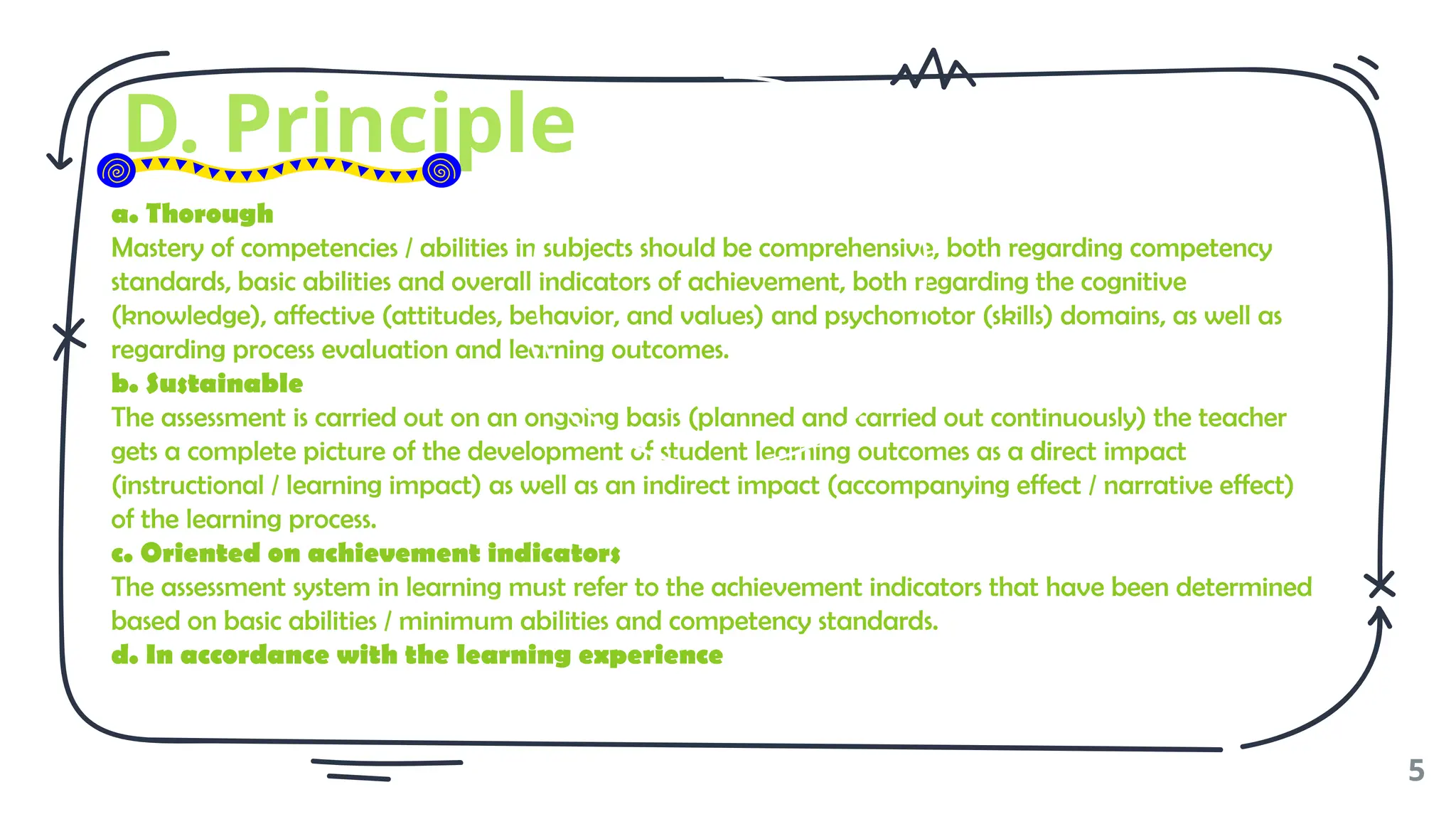
a. Thorough
Mastery ofcompetencies / abilities in subjects should be comprehensive, both regarding competency
standards, basic abilities and overall indicators of achievement, both regarding the cognitive
(knowledge), affective (attitudes, behavior, and values) and psychomotor (skills) domains, as well as
regarding process evaluation and learning outcomes.
b. Sustainable
The assessment is carried out on an ongoing basis (planned and carried out continuously) the teacher
gets a complete picture of the development of student learning outcomes as a direct impact
(instructional / learning impact) as well as an indirect impact (accompanying effect / narrative effect)
of the learning process.
c. Oriented on achievement indicators
The assessment system in learning must refer to the achievement indicators that have been determined
based on basic abilities / minimum abilities and competency standards.
d. In accordance with the learning experience
5
D. Principle
6.
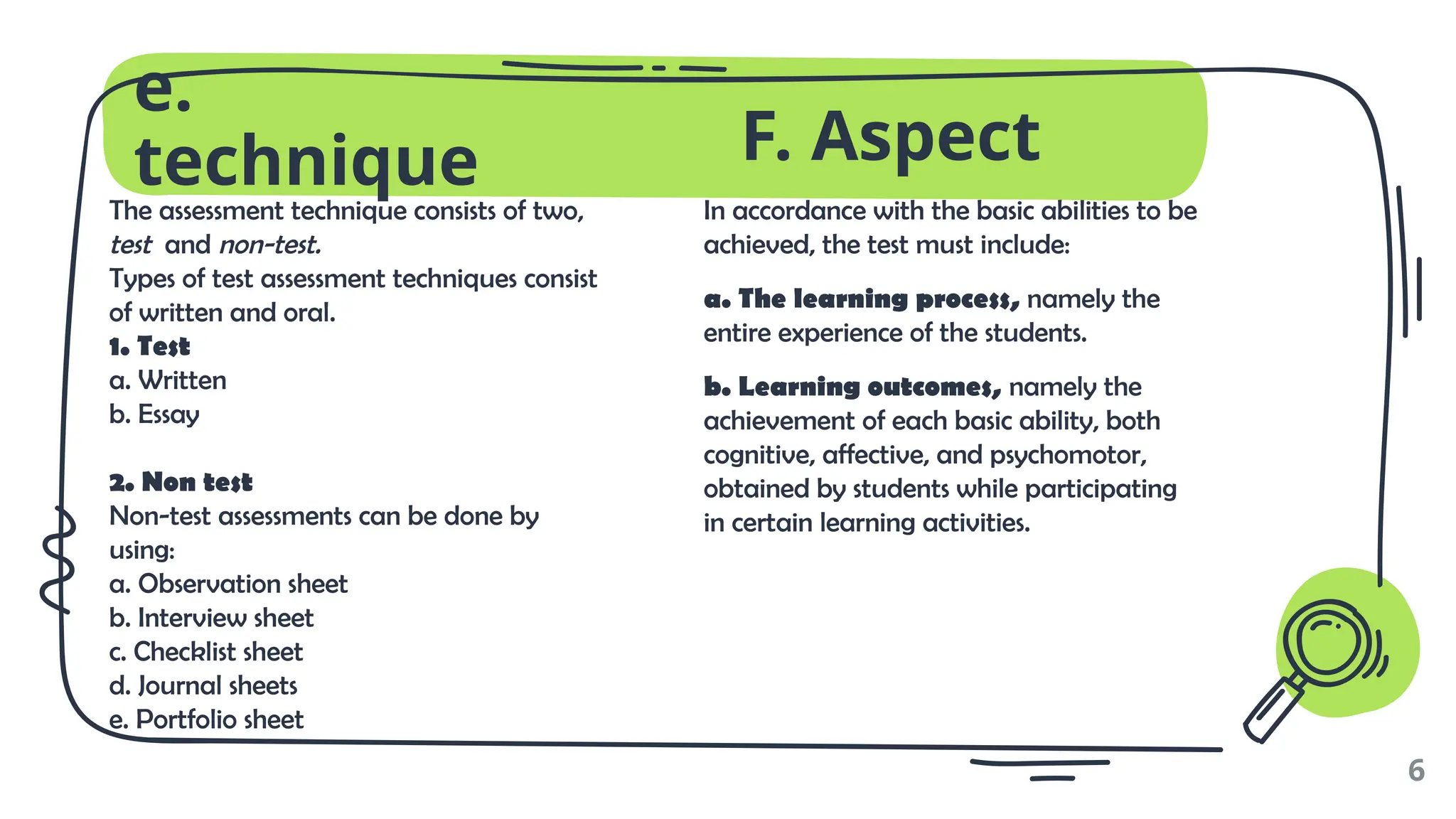
e.
technique
The assessment techniqueconsists of two,
test and non-test.
Types of test assessment techniques consist
of written and oral.
1. Test
a. Written
b. Essay
2. Non test
Non-test assessments can be done by
using:
a. Observation sheet
b. Interview sheet
c. Checklist sheet
d. Journal sheets
e. Portfolio sheet
6
F. Aspect
In accordance with the basic abilities to be
achieved, the test must include:
a. The learning process, namely the
entire experience of the students.
b. Learning outcomes, namely the
achievement of each basic ability, both
cognitive, affective, and psychomotor,
obtained by students while participating
in certain learning activities.
7.
Instructions for use
EDITIN GOOGLE SLIDES
Click on the button under the
presentation preview that says "Use as
Google Slides Theme".
You will get a copy of this document on
your Google Drive and will be able to edit,
add or delete slides.
You have to be signed in to your
Google account.
7