Mattu University
College of Education and Behavioral Sciences
Department of Early Childhood Care and Education
Course Title: Assessment and Evaluation in ECCE
By: Biya Sheahmed (MA)
February, 2023
Mattu, Ethiopia
Content Outline
Definition of terms
 Assessment
 Evaluation,
Measurement and
Test
Assessment and evaluation in early years
Importance of Assessment
Types of Assessment
Approaches to Assessment
Evaluation
Activity
• What is the term assessment ?
• What is the term evaluation ?
• What is the tem measurement ?
• What is the term test ?
• Their Similarity and difference?
Assessment and Evaluation
• Evaluation: is the process of passing decisions or making value
judgments based on assessment results.
• Assessment: is the process of collecting or gathering information/data
about teaching learning process and its effects through various
instruments/tools to make decision/value judgment.
• Measurement: is the process of quantifying students learning
behaviors (describing it in terms of quantity).
• Test: is one of the tools of assessment which could be the collection
of activities or questions.
Assessment and Evaluation in early years
• Early childhood intervention (a.k.a. early intervention) is a very
important part of the special education process.
• The goal of early intervention is to derive information to facilitate
decision making with respect to that individual.
• One problem is that many teachers have limited, if any, training of
how to assess the students at ECCE.
• Even the concepts of assessment and other related issues such as
evaluation, measurement and test are also highly confusing so that
needs to be clarified further.
Cont’d…
According to the Webster Dictionary (2017), assessment means
appraisal, evaluation is estimation or determining the value of
something.
According to Brown, (1990) assessment refers to a related series of
measures used to determine a complex attribute of an individual or
group of individuals. This involves gathering and interpreting
information about student level of attainment of learning goals.
Cont’d…
•Assessment is a process that includes four basic components:
1) Measuring improvement over time.
2) Motivating students to study.
3) Evaluating the teaching methods.
4) Ranking the students' capabilities in relation to the whole group
evaluation.
Importance of Assessment
• First and foremost, assessment is important because it drives students
learning (Brown 1990).
• Whether we like it or not, most students tend to focus their energies
on the best or most expeditious way to pass their ‘tests.’ Based on this
knowledge, we can use our assessment strategies to manipulate the kinds
of learning that takes place.
• For example, assessment strategies that focus predominantly on recall
of knowledge will likely promote superficial learning.
Cont’d…
• On the other hand, if we choose assessment strategies that demand
critical thinking or creative problem solving, we are likely to realize a
higher level of student performance or achievement.
• In addition, good assessment can help students become more
effective self-directed learners (Darling Hammond 2006).
• As indicated above, motivating and directing learning is only one
purpose of assessment.
• Well-designed assessment strategies also play a critical role in
educational decision-making and are a vital component of ongoing
quality improvement processes at the lesson, course and/or curriculum
level.
Types of Assessment
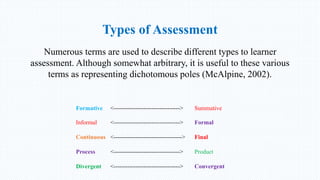
Numerous terms are used to describe different types to learner
assessment. Although somewhat arbitrary, it is useful to these various
terms as representing dichotomous poles (McAlpine, 2002).
Formative <---------------------------------> Summative
Informal <---------------------------------> Formal
Continuous <----------------------------------> Final
Process <---------------------------------> Product
Divergent <---------------------------------> Convergent
1. Formative vs. Summative Assessment
Formative assessment
• is designed to assist the learning process by providing
feedback to the learner, which can be used to identify strengths
and weakness and hence improve future performance.
• It is most appropriate where the results are to be used
internally by those involved in the learning process (students,
teachers, curriculum developers).
Summative assessment
• is used primarily to make decisions for grading or determine
readiness for progression.
• Typically it occurs at the end of an educational activity and is
designed to judge the learner’s overall performance.
• In addition to providing the basis for grade assignment, it is used to
communicate students’ abilities to external stakeholders, e.g.,
administrators and employers (Darling-Hammond, 2006).
2. Informal vs. Formal Assessment
Informal Assessment
• With informal assessment, the judgments are integrated with other
tasks, e.g., lecturer feedback on the answer to a question or preceptor
feedback provided while performing a bedside procedure.
• It is most often used to provide formative feedback. As such, it tends
to be less threatening and thus less stressful to the student. However,
informal feedback is prone to high subjectivity or bias.
Formal assessment
• it occurs when students are aware that the task that they are doing is for
assessment purposes, e.g., a written examination.
• Most formal assessments also are summative in nature and thus tend to
have greater motivation impact and are associated with increased stress.
• Given their role in decision-making, formal assessments should be
held to higher standards of reliability and validity than informal
assessments (McAlpine 2002).
3. Continuous vs. Final Assessment
Continuous Assessment
• it occurs throughout a learning experience (intermittent is
probably a more realistic term).
• it is most appropriate when student and/or instructor knowledge
of progress or achievement is needed to determine the subsequent
progression or sequence of activities (McAlpine 2002).
• it provides both students and teachers with the information
needed to improve teaching and learning in process.
• Obviously, continuous assessment involves increased effort for
both teacher and student
Final Assessment
• . Final (or terminal) assessment is that which takes place only at
the end of a learning activity.
• It is most appropriate when learning can only be assessed as a
complete whole rather than as constituent parts.
• Typically, final assessment is used for summative decision-
making.
• Obviously, due to its timing, final assessment cannot be used for
formative purposes (McAlpine 2002).
4. Process vs. Product Assessment
Process assessment
• it focuses on the steps or procedures underlying a particular ability or
task, i.e., the cognitive steps in performing a mathematical operation or
the procedure involved in analyzing a blood sample.
• Because it provides more detailed information, process assessment is
most useful when a student is learning a new skill and for providing
formative feedback to assist in improving performance (McAlpine 2002).
Product assessment
• It focuses on evaluating the result or outcome of a process.
• Using the above examples, we would focus on the answer to the
math computation or the accuracy of the blood test results.
• Product assessment is most appropriate for documenting
proficiency or competency in a given skill, i.e., for summative
purposes.
• In general, product assessments are easier to create than product
assessments, requiring only a specification of the attributes of the
final product (McAlpine 2002).
5. Divergent vs. Convergent Assessment
Divergent assessments
• are those for which a range of answers or solutions might be
considered correct. Examples include essay tests.
• It tend to be more authentic and most appropriate in evaluating
higher cognitive skills.
• However, these types of assessment are often time consuming to
evaluate and the resulting judgments often exhibit poor reliability.
Convergent Assessment
• A convergent assessment has only one correct response (per item).
Objective test items are the best example and demonstrate the value of this
approach in assessing knowledge.
• Obviously, convergent assessments are easier to evaluate or score than
divergent assessments. Unfortunately, this “ease of use” often leads to their
widespread application of this approach even when contrary to good
assessment practices.
• Specifically, the familiarity and ease with which convergent assessment
tools can be applied leads to two common evaluation fallacies:
• The Fallacy of False Quantification (the tendency to focus on what’s
easiest to measure) and the Law of the Instrument Fallacy (molding the
evaluation problem to fit the tool) (McAlpine 2002).
Approaches to Assessment
• In approaches to assessment, two central tendencies emerge which are
relevant to language as subject.
• One places emphasis on the assessment of learning where reliable,
objective measures are a high priority.
• The focus here is on making summative judgments which in practice is
likely to involve more formal examinations and tests with marks schemes to
ensure that the process is sound (McAlpine 2002).
• An alternative approach is to change the emphasis from assessment of
learning to assessment for learning, implying a more formative approach
where there is much more emphasis on feedback to improve performance.
• The approach here might be through course work and portfolio
assessment in which diverse information can be gathered which reflects the
true broad nature of the subject (McAlpine 2002).
Evaluation
• Evaluation is determining the value of something.
• So, more specifically, in the field of education, evaluation means
measuring or observing the process to judge it or to determine it for its
value by comparing it to others or some kind of a standard (Weir &
Roberts, 1994).
• The focus of the evaluation is on grades. It is rather a final process that is
determined to understand the quality of the process. The quality of the
process is mostly determined by grades
• It is comparing a student's achievement with other students or with a set of
standards (Howard & Donaghue 2015).
Cont’d…
•
• It refers to consideration of evidence in the light of value
standards and in terms of the particular situations and the goals,
which the group or individuals are striving to attain.
• Evaluation designates more comprehensive concept of
measurement than is implied in conventional tests and
examination.
• The emphasis of evaluation is based upon broad personality
change and the major objectives in the educational program
(Howard & Donaghue 2015).
Cont’d…
• Evaluation can, and should, however, be used as an ongoing
management and learning tool to improve learning, including five basic
components according to Kizlik (2010):
1) Articulating the purpose of the educational system.
2) Identifying and collecting relevant information.
3) Having ideas that are valuable and useful to learners in their lives and
professions.
4) Analyzing and interpreting information for learners.
5) Classroom management or classroom decision making.
Cont’d…
• Well-run classes and effective programs are those that can
demonstrate the achievement of results. Results are derived from good
management.
• Good management is based on good decision making.
• Good decision making depends on good information.
• Good information requires good data and careful analysis of the data.
• These are all critical elements of evaluation.
Six Standards of Assessment Materials for
Use with Young Children
1. Authenticity
2. Convergence
3. Collaboration
4. Equity
5. Sensitivity
6. Congruence
The Challenge of Early Childhood Assessment
Development
• Developmental- having to do with the steps or stages in the growth of
a child
• Factors that can influence a child’s early developmental course:
• Quality of mother’s or father’s verbalization
• The toys or variety of activities available in the environment
• The restrictiveness of discipline
• Freedom from danger
Eight Fundamental Goals
1. Determine the eligibility for services and the appropriateness
of alternative environments
2. Identify developmentally appropriate and functional
intervention goals
3. Identify the unique styles, strengths, and coping strategies of
each child
4. Identify parents’ goals for their children and their needs for
themselves
Eight Fundamental Goals
5. Build and reinforce parents’ sense of competence
and worth
6. Develop a shared and integrated perspective on
child and family needs and resources
7. Create a shared commitment to intervention goals
8. Evaluate the effectiveness of services for children
and families
FIVE STAGES
1. Casefinding/child find
2. Screening
3. Assessment for diagnosis and determination of
eligibility
4. Program planning
5. Program evaluation
IFSP
•Individualized
•Family
•Service
•Plan
SERVICE MODELS
•Home and community-based visits
•Facility or center-based visits
•Parent-child groups
•Family support groups
•Group development intervention
Working with the Family in Early Childhood
Assessment
Interview the parents/caregivers- often done during a
home visit.
10 Practical suggestions for ECCE teachers
when conducting parent interviews in early
intervention.
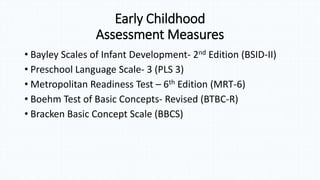
Early Childhood
Assessment Measures
• Bayley Scales of Infant Development- 2nd Edition (BSID-II)
• Preschool Language Scale- 3 (PLS 3)
• Metropolitan Readiness Test – 6th Edition (MRT-6)
• Boehm Test of Basic Concepts- Revised (BTBC-R)
• Bracken Basic Concept Scale (BBCS)
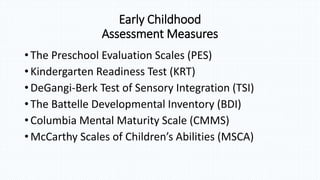
• The Preschool Evaluation Scales (PES)
• Kindergarten Readiness Test (KRT)
• DeGangi-Berk Test of Sensory Integration (TSI)
• The Battelle Developmental Inventory (BDI)
• Columbia Mental Maturity Scale (CMMS)
• McCarthy Scales of Children’s Abilities (MSCA)
Early Childhood
Assessment Measures

ASSESSMENT AND EVALUATION SLIDE.pptx

  • 1.
    Mattu University College ofEducation and Behavioral Sciences Department of Early Childhood Care and Education Course Title: Assessment and Evaluation in ECCE By: Biya Sheahmed (MA) February, 2023 Mattu, Ethiopia
  • 2.
    Content Outline Definition ofterms  Assessment  Evaluation, Measurement and Test Assessment and evaluation in early years Importance of Assessment Types of Assessment Approaches to Assessment Evaluation
  • 3.
    Activity • What isthe term assessment ? • What is the term evaluation ? • What is the tem measurement ? • What is the term test ? • Their Similarity and difference?
  • 4.
    Assessment and Evaluation •Evaluation: is the process of passing decisions or making value judgments based on assessment results. • Assessment: is the process of collecting or gathering information/data about teaching learning process and its effects through various instruments/tools to make decision/value judgment. • Measurement: is the process of quantifying students learning behaviors (describing it in terms of quantity). • Test: is one of the tools of assessment which could be the collection of activities or questions.
  • 5.
    Assessment and Evaluationin early years • Early childhood intervention (a.k.a. early intervention) is a very important part of the special education process. • The goal of early intervention is to derive information to facilitate decision making with respect to that individual. • One problem is that many teachers have limited, if any, training of how to assess the students at ECCE. • Even the concepts of assessment and other related issues such as evaluation, measurement and test are also highly confusing so that needs to be clarified further.
  • 6.
    Cont’d… According to theWebster Dictionary (2017), assessment means appraisal, evaluation is estimation or determining the value of something. According to Brown, (1990) assessment refers to a related series of measures used to determine a complex attribute of an individual or group of individuals. This involves gathering and interpreting information about student level of attainment of learning goals.
  • 7.
    Cont’d… •Assessment is aprocess that includes four basic components: 1) Measuring improvement over time. 2) Motivating students to study. 3) Evaluating the teaching methods. 4) Ranking the students' capabilities in relation to the whole group evaluation.
  • 8.
    Importance of Assessment •First and foremost, assessment is important because it drives students learning (Brown 1990). • Whether we like it or not, most students tend to focus their energies on the best or most expeditious way to pass their ‘tests.’ Based on this knowledge, we can use our assessment strategies to manipulate the kinds of learning that takes place. • For example, assessment strategies that focus predominantly on recall of knowledge will likely promote superficial learning.
  • 9.
    Cont’d… • On theother hand, if we choose assessment strategies that demand critical thinking or creative problem solving, we are likely to realize a higher level of student performance or achievement. • In addition, good assessment can help students become more effective self-directed learners (Darling Hammond 2006). • As indicated above, motivating and directing learning is only one purpose of assessment. • Well-designed assessment strategies also play a critical role in educational decision-making and are a vital component of ongoing quality improvement processes at the lesson, course and/or curriculum level.
  • 10.
    Types of Assessment Numerousterms are used to describe different types to learner assessment. Although somewhat arbitrary, it is useful to these various terms as representing dichotomous poles (McAlpine, 2002). Formative <---------------------------------> Summative Informal <---------------------------------> Formal Continuous <----------------------------------> Final Process <---------------------------------> Product Divergent <---------------------------------> Convergent
  • 11.
    1. Formative vs.Summative Assessment Formative assessment • is designed to assist the learning process by providing feedback to the learner, which can be used to identify strengths and weakness and hence improve future performance. • It is most appropriate where the results are to be used internally by those involved in the learning process (students, teachers, curriculum developers).
  • 12.
    Summative assessment • isused primarily to make decisions for grading or determine readiness for progression. • Typically it occurs at the end of an educational activity and is designed to judge the learner’s overall performance. • In addition to providing the basis for grade assignment, it is used to communicate students’ abilities to external stakeholders, e.g., administrators and employers (Darling-Hammond, 2006).
  • 13.
    2. Informal vs.Formal Assessment Informal Assessment • With informal assessment, the judgments are integrated with other tasks, e.g., lecturer feedback on the answer to a question or preceptor feedback provided while performing a bedside procedure. • It is most often used to provide formative feedback. As such, it tends to be less threatening and thus less stressful to the student. However, informal feedback is prone to high subjectivity or bias.
  • 14.
    Formal assessment • itoccurs when students are aware that the task that they are doing is for assessment purposes, e.g., a written examination. • Most formal assessments also are summative in nature and thus tend to have greater motivation impact and are associated with increased stress. • Given their role in decision-making, formal assessments should be held to higher standards of reliability and validity than informal assessments (McAlpine 2002).
  • 15.
    3. Continuous vs.Final Assessment Continuous Assessment • it occurs throughout a learning experience (intermittent is probably a more realistic term). • it is most appropriate when student and/or instructor knowledge of progress or achievement is needed to determine the subsequent progression or sequence of activities (McAlpine 2002). • it provides both students and teachers with the information needed to improve teaching and learning in process. • Obviously, continuous assessment involves increased effort for both teacher and student
  • 16.
    Final Assessment • .Final (or terminal) assessment is that which takes place only at the end of a learning activity. • It is most appropriate when learning can only be assessed as a complete whole rather than as constituent parts. • Typically, final assessment is used for summative decision- making. • Obviously, due to its timing, final assessment cannot be used for formative purposes (McAlpine 2002).
  • 17.
    4. Process vs.Product Assessment Process assessment • it focuses on the steps or procedures underlying a particular ability or task, i.e., the cognitive steps in performing a mathematical operation or the procedure involved in analyzing a blood sample. • Because it provides more detailed information, process assessment is most useful when a student is learning a new skill and for providing formative feedback to assist in improving performance (McAlpine 2002).
  • 18.
    Product assessment • Itfocuses on evaluating the result or outcome of a process. • Using the above examples, we would focus on the answer to the math computation or the accuracy of the blood test results. • Product assessment is most appropriate for documenting proficiency or competency in a given skill, i.e., for summative purposes. • In general, product assessments are easier to create than product assessments, requiring only a specification of the attributes of the final product (McAlpine 2002).
  • 19.
    5. Divergent vs.Convergent Assessment Divergent assessments • are those for which a range of answers or solutions might be considered correct. Examples include essay tests. • It tend to be more authentic and most appropriate in evaluating higher cognitive skills. • However, these types of assessment are often time consuming to evaluate and the resulting judgments often exhibit poor reliability.
  • 20.
    Convergent Assessment • Aconvergent assessment has only one correct response (per item). Objective test items are the best example and demonstrate the value of this approach in assessing knowledge. • Obviously, convergent assessments are easier to evaluate or score than divergent assessments. Unfortunately, this “ease of use” often leads to their widespread application of this approach even when contrary to good assessment practices. • Specifically, the familiarity and ease with which convergent assessment tools can be applied leads to two common evaluation fallacies: • The Fallacy of False Quantification (the tendency to focus on what’s easiest to measure) and the Law of the Instrument Fallacy (molding the evaluation problem to fit the tool) (McAlpine 2002).
  • 21.
    Approaches to Assessment •In approaches to assessment, two central tendencies emerge which are relevant to language as subject. • One places emphasis on the assessment of learning where reliable, objective measures are a high priority. • The focus here is on making summative judgments which in practice is likely to involve more formal examinations and tests with marks schemes to ensure that the process is sound (McAlpine 2002). • An alternative approach is to change the emphasis from assessment of learning to assessment for learning, implying a more formative approach where there is much more emphasis on feedback to improve performance. • The approach here might be through course work and portfolio assessment in which diverse information can be gathered which reflects the true broad nature of the subject (McAlpine 2002).
  • 22.
    Evaluation • Evaluation isdetermining the value of something. • So, more specifically, in the field of education, evaluation means measuring or observing the process to judge it or to determine it for its value by comparing it to others or some kind of a standard (Weir & Roberts, 1994). • The focus of the evaluation is on grades. It is rather a final process that is determined to understand the quality of the process. The quality of the process is mostly determined by grades • It is comparing a student's achievement with other students or with a set of standards (Howard & Donaghue 2015).
  • 23.
    Cont’d… • • It refersto consideration of evidence in the light of value standards and in terms of the particular situations and the goals, which the group or individuals are striving to attain. • Evaluation designates more comprehensive concept of measurement than is implied in conventional tests and examination. • The emphasis of evaluation is based upon broad personality change and the major objectives in the educational program (Howard & Donaghue 2015).
  • 24.
    Cont’d… • Evaluation can,and should, however, be used as an ongoing management and learning tool to improve learning, including five basic components according to Kizlik (2010): 1) Articulating the purpose of the educational system. 2) Identifying and collecting relevant information. 3) Having ideas that are valuable and useful to learners in their lives and professions. 4) Analyzing and interpreting information for learners. 5) Classroom management or classroom decision making.
  • 25.
    Cont’d… • Well-run classesand effective programs are those that can demonstrate the achievement of results. Results are derived from good management. • Good management is based on good decision making. • Good decision making depends on good information. • Good information requires good data and careful analysis of the data. • These are all critical elements of evaluation.
  • 28.
    Six Standards ofAssessment Materials for Use with Young Children 1. Authenticity 2. Convergence 3. Collaboration 4. Equity 5. Sensitivity 6. Congruence
  • 29.
    The Challenge ofEarly Childhood Assessment
  • 30.
    Development • Developmental- havingto do with the steps or stages in the growth of a child • Factors that can influence a child’s early developmental course: • Quality of mother’s or father’s verbalization • The toys or variety of activities available in the environment • The restrictiveness of discipline • Freedom from danger
  • 31.
    Eight Fundamental Goals 1.Determine the eligibility for services and the appropriateness of alternative environments 2. Identify developmentally appropriate and functional intervention goals 3. Identify the unique styles, strengths, and coping strategies of each child 4. Identify parents’ goals for their children and their needs for themselves
  • 32.
    Eight Fundamental Goals 5.Build and reinforce parents’ sense of competence and worth 6. Develop a shared and integrated perspective on child and family needs and resources 7. Create a shared commitment to intervention goals 8. Evaluate the effectiveness of services for children and families
  • 33.
    FIVE STAGES 1. Casefinding/childfind 2. Screening 3. Assessment for diagnosis and determination of eligibility 4. Program planning 5. Program evaluation
  • 34.
  • 35.
    SERVICE MODELS •Home andcommunity-based visits •Facility or center-based visits •Parent-child groups •Family support groups •Group development intervention
  • 36.
    Working with theFamily in Early Childhood Assessment Interview the parents/caregivers- often done during a home visit. 10 Practical suggestions for ECCE teachers when conducting parent interviews in early intervention.
  • 37.
    Early Childhood Assessment Measures •Bayley Scales of Infant Development- 2nd Edition (BSID-II) • Preschool Language Scale- 3 (PLS 3) • Metropolitan Readiness Test – 6th Edition (MRT-6) • Boehm Test of Basic Concepts- Revised (BTBC-R) • Bracken Basic Concept Scale (BBCS)
  • 38.
    • The PreschoolEvaluation Scales (PES) • Kindergarten Readiness Test (KRT) • DeGangi-Berk Test of Sensory Integration (TSI) • The Battelle Developmental Inventory (BDI) • Columbia Mental Maturity Scale (CMMS) • McCarthy Scales of Children’s Abilities (MSCA) Early Childhood Assessment Measures