By
Lisa MacLeod
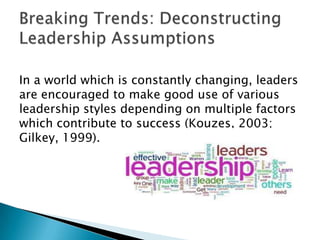
In a world which is constantly changing, leaders
are encouraged to make good use of various
leadership styles depending on multiple factors
which contribute to success (Kouzes, 2003;
Gilkey, 1999).
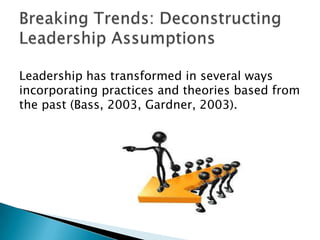
Leadership has transformed in several ways
incorporating practices and theories based from
the past (Bass, 2003, Gardner, 2003).
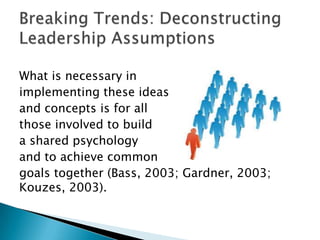
What is necessary in
implementing these ideas
and concepts is for all
those involved to build
a shared psychology
and to achieve common
goals together (Bass, 2003; Gardner, 2003;
Kouzes, 2003).
This presentation will identify three leadership
concepts that have been considered important
and after a deconstruction of these concepts,
recreated premises will be outlined that are
intended to facilitate and improve relations
within personal and professional settings.
 Evokes a sense of partnership, of community, and of
working together for a common good
 Incorporates a participatory or consultative decision-
making process
 Opens the decision-making processing without separating
responsibilities that are required for making sure that
team goals and objectives are met as a result of decisions
being made.
 Emphasizes that tasks and activities are carried out by
all those involved within the team
 Instills a sense of commitment to accountability, diversity,
and excellence
 Ensures team members will not only have a common
understanding of the shared vision but will also focus on
the same final product
(Underwood, 2006; Raelin, 2006)
 Guides people along in the direction which is
intended, there are two elements required when
incorporating this method
◦ The first is to be able to ask questions
◦ The second is the knowledge and comprehension of
where and in which direction one would like to guide the
team Facilitates teams to go into the same direction
while experiencing new ideas and developing new
concepts which in return produces a more effective and
innovative professional environment
 Develops the team’s leadership method together
within a productive and successful atmosphere
(Schwarze & Lape, 2001; Patnode, 2002).
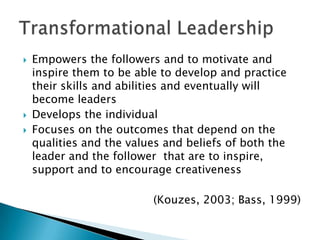
 Empowers the followers and to motivate and
inspire them to be able to develop and practice
their skills and abilities and eventually will
become leaders
 Develops the individual
 Focuses on the outcomes that depend on the
qualities and the values and beliefs of both the
leader and the follower that are to inspire,
support and to encourage creativeness
(Kouzes, 2003; Bass, 1999)
Comments and stories are all welcome, please
share your ideas to tsi-dubai@tsi-mena.com
and we will make sure these are distributes to
all our followers!
Together we lead forward!
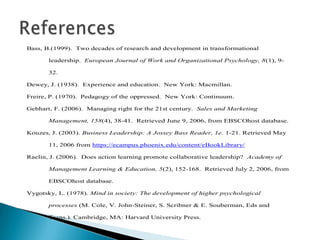
Bass, B.(1999). Two decades of research and development in transformational
leadership. European Journal of Work and Organizational Psychology, 8(1), 9-
32.
Dewey, J. (1938). Experience and education. New York: Macmillan.
Freire, P. (1970). Pedagogy of the oppressed. New York: Continuum.
Gebhart, F. (2006). Managing right for the 21st century. Sales and Marketing
Management, 158(4), 38-41. Retrieved June 9, 2006, from EBSCOhost database.
Kouzes, J. (2003). Business Leadership: A Jossey Bass Reader, 1e. 1-21. Retrieved May
11, 2006 from https://ecampus.phoenix.edu/content/eBookLibrary/
Raelin, J. (2006). Does action learning promote collaborative leadership? Academy of
Management Learning & Education, 5(2), 152-168. Retrieved July 2, 2006, from
EBSCOhost database.
Vygotsky, L. (1978). Mind in society: The development of higher psychological
processes (M. Cole, V. John-Steiner, S. Scribner & E. Souberman, Eds and
Trans.). Cambridge, MA: Harvard University Press.

Breaking trends: Deconstructing Leadership Assumptions

  • 1.
  • 2.
    In a worldwhich is constantly changing, leaders are encouraged to make good use of various leadership styles depending on multiple factors which contribute to success (Kouzes, 2003; Gilkey, 1999).
  • 3.
    Leadership has transformedin several ways incorporating practices and theories based from the past (Bass, 2003, Gardner, 2003).
  • 4.
    What is necessaryin implementing these ideas and concepts is for all those involved to build a shared psychology and to achieve common goals together (Bass, 2003; Gardner, 2003; Kouzes, 2003).
  • 5.
    This presentation willidentify three leadership concepts that have been considered important and after a deconstruction of these concepts, recreated premises will be outlined that are intended to facilitate and improve relations within personal and professional settings.
  • 6.
     Evokes asense of partnership, of community, and of working together for a common good  Incorporates a participatory or consultative decision- making process  Opens the decision-making processing without separating responsibilities that are required for making sure that team goals and objectives are met as a result of decisions being made.  Emphasizes that tasks and activities are carried out by all those involved within the team  Instills a sense of commitment to accountability, diversity, and excellence  Ensures team members will not only have a common understanding of the shared vision but will also focus on the same final product (Underwood, 2006; Raelin, 2006)
  • 7.
     Guides peoplealong in the direction which is intended, there are two elements required when incorporating this method ◦ The first is to be able to ask questions ◦ The second is the knowledge and comprehension of where and in which direction one would like to guide the team Facilitates teams to go into the same direction while experiencing new ideas and developing new concepts which in return produces a more effective and innovative professional environment  Develops the team’s leadership method together within a productive and successful atmosphere (Schwarze & Lape, 2001; Patnode, 2002).
  • 8.
     Empowers thefollowers and to motivate and inspire them to be able to develop and practice their skills and abilities and eventually will become leaders  Develops the individual  Focuses on the outcomes that depend on the qualities and the values and beliefs of both the leader and the follower that are to inspire, support and to encourage creativeness (Kouzes, 2003; Bass, 1999)
  • 9.
    Comments and storiesare all welcome, please share your ideas to tsi-dubai@tsi-mena.com and we will make sure these are distributes to all our followers! Together we lead forward!
  • 10.
    Bass, B.(1999). Twodecades of research and development in transformational leadership. European Journal of Work and Organizational Psychology, 8(1), 9- 32. Dewey, J. (1938). Experience and education. New York: Macmillan. Freire, P. (1970). Pedagogy of the oppressed. New York: Continuum. Gebhart, F. (2006). Managing right for the 21st century. Sales and Marketing Management, 158(4), 38-41. Retrieved June 9, 2006, from EBSCOhost database. Kouzes, J. (2003). Business Leadership: A Jossey Bass Reader, 1e. 1-21. Retrieved May 11, 2006 from https://ecampus.phoenix.edu/content/eBookLibrary/ Raelin, J. (2006). Does action learning promote collaborative leadership? Academy of Management Learning & Education, 5(2), 152-168. Retrieved July 2, 2006, from EBSCOhost database. Vygotsky, L. (1978). Mind in society: The development of higher psychological processes (M. Cole, V. John-Steiner, S. Scribner & E. Souberman, Eds and Trans.). Cambridge, MA: Harvard University Press.