


All rights reserved. No portion of this publication may be reproduced by any means,
including duplicating, photocopying, electronic, mechanical, recording, the World
Wide Web, e-mail, or otherwise, without written permission from the publisher.

Copyright © 2007, 2010 by All About Learning Press

All About Learning Press
2038 E. Anvil Lake Road
Eagle River, WI 54521
715.477.1976
www.AllAboutLearningPress.com

ISBN 978-1-935197-13-3


Cover Design and Page Layout: David LaTulippe
You are about to learn my top tips for taking the
struggle out of spelling. Every one of these tips
is designed to accelerate your student’s learning
and to help him or her retain more of what you
teach.

Some of these tips may surprise you, and you
will probably find some ideas that you have
never considered as being related to the teaching
of spelling. You may want to print out this
report, grab a highlighter, and make notes in the
margins.

And please—feel free to contact me with any
questions you may have. I’m here to help.


                 ...taking the struggle out of spelling
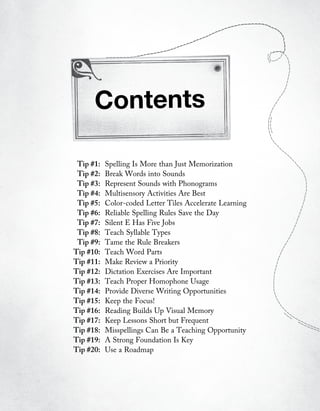
Contents

 Tip #1:   Spelling Is More than Just Memorization
 Tip #2:   Break Words into Sounds
 Tip #3:   Represent Sounds with Phonograms
 Tip #4:   Multisensory Activities Are Best
 Tip #5:   Color-coded Letter Tiles Accelerate Learning
 Tip #6:   Reliable Spelling Rules Save the Day
 Tip #7:   Silent E Has Five Jobs
 Tip #8:   Teach Syllable Types
 Tip #9:   Tame the Rule Breakers
Tip #10:   Teach Word Parts
Tip #11:   Make Review a Priority
Tip #12:   Dictation Exercises Are Important
Tip #13:   Teach Proper Homophone Usage
Tip #14:   Provide Diverse Writing Opportunities
Tip #15:   Keep the Focus!
Tip #16:   Reading Builds Up Visual Memory
Tip #17:   Keep Lessons Short but Frequent
Tip #18:   Misspellings Can Be a Teaching Opportunity
Tip #19:   A Strong Foundation Is Key
Tip #20:   Use a Roadmap
Tip #1: Spelling Is More
     than Just Memorization


Most spelling programs are a variation of the “list-on-Monday, test-on-Friday”
approach. This approach has the students look at the word, cover it up, and then try
to remember the order of the letters. Such programs teach spelling as if words were
made up of a random string of letters.

Memorizing long strings of letters doesn’t work for many kids. The “look, cover, write,
repeat” method fails them. The mammoth task of having to learn thousands of words
this way—and then remembering them past the spelling test on Friday—becomes
overwhelming. Some children simply shut down and give up.

For new spellers, and for those who struggle with spelling, there is a much better way!
Instead of memorizing the spelling of thousands of different words, they can learn just
72 phonograms and a handful of useful spelling rules. This method is much more
manageable for them.

Approximately 97% of the 17,000 most common words can be spelled using just these
phonograms and a small number of reliable spelling rules.


                                                                                          7
Tip #2: Break Words
                                       into Sounds


    When we speak, we blend sounds together to make a word. For example, when we say
    the word ham, we are blending the sounds /h/–/a/–/m/ together quickly.
                                                  ˘

    When we spell, we can take those individual sounds apart. That process is called
    segmenting.

    A quick way to know if your student can segment words is to ask, “What sounds do
    you hear in the word pan?”

    If your student isn’t able to easily identify the three individual sounds (/p/–/a /–/n/),
                                                                                        ˘
    teach him how to segment words. This is an important skill that will make learning to
    spell so much easier for your student. After the child learns to hear the individual sounds,
    he can represent each sound with the corresponding letter or letter combination.

    And that leads us to Tip #3...


8
Tip #3: Rep
                                                     res                   ent
                                                Sounds wit
                                                          h
                                                Phonogram
                                                          s

*   What is a phonogram?
    A phonogram is a letter or letter combination that represents a sound.
    There are 72 common phonograms. For example:
    	      ck is a phonogram that says /k/ as in clock.
    	      s is a phonogram that says /s/ as in sat or /z/ as in present.
    	      oy is a phonogram that says /oi/ as in oyster.

*   Why are phonograms important?
    Each sound in a word can be represented by a phonogram. Let’s take the word past.
    If you pronounce the word slowly to hear the individual sounds, you will hear four
    different sounds: /p/–/ă/–/s/–/t/. For each sound, we write down a phonogram: p-a-
    s-t.

    When students know the phonograms and which sounds they represent, spelling is so
    much easier. If they know that the sound of /j/ at the end of a word is spelled with dge,
    spelling the word bridge becomes simple. They do not need to remember b-r-i-d-g-e
    as a string of letters. Instead, each sound is simply represented by a phonogram.

    Memorizing words as strings of unrelated letters usually results in frustration. Children
    who are taught to spell using the phonograms, on the other hand, see spelling as a
    doable task.

*   How do I teach the phonograms?
    I have found that the quickest way to teach the phonograms is by using flashcards.
    Introduce four phonograms at a time, adding more as the child masters them. Ready-
    to-use flashcards are included in the All About Spelling program.


                                                                                                9
Tip #4: Multisensory
                                           Activities Are Best


*    Why are multisensory activities important?
     Children learn best when they can use all of their senses. When they can see something
     as it is explained, and hear about it, and then do it with hands-on activities, they are
     much more likely to retain the new information.

*    How do I use multisensory activities?
     Visual activities can include demonstrating spelling rules with color-coded letter tiles.
     With the letter tiles, you can demonstrate rules and patterns and how they apply to
     various words. The child can see a concept—and it makes sense to him.
     	
     Another good visual activity is to use Word Banks. Word Banks are lists of words
     all following the same spelling rule or spelling pattern. Children are able to grasp the
     similarities between these words when they see them all grouped together.

     Auditory activities can include discussing new spelling rules and concepts. When a
     new letter combination is introduced, such as au, children can learn it quickly by saying
     the sound as they write it. Oral review is an important auditory activity as well.

     Kinesthetic activities include hands-on activities such as manipulating letter tiles to
     test out spelling rules, feeling the shape of the letters and letter combinations as they
     write them and say them, and compiling personalized word lists.

     Children learn more quickly when they are taught through their strongest mode of
     learning, and they learn even more when all three pathways are involved. The All
     About Spelling program includes all of the materials you need for these important
     multisensory activities.


10
Tip #5: Color-coded
                                          Letter Tiles
                                       Accelerate Learning

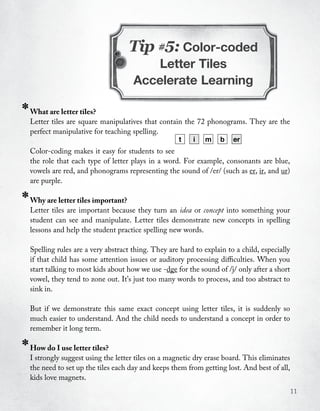
*   What are letter tiles?
    Letter tiles are square manipulatives that contain the 72 phonograms. They are the
    perfect manipulative for teaching spelling.
                                                      t    i   m     b   er
    Color-coding makes it easy for students to see
    the role that each type of letter plays in a word. For example, consonants are blue,
    vowels are red, and phonograms representing the sound of /er/ (such as er, ir, and ur)
    are purple.

*   Why are letter tiles important?
    Letter tiles are important because they turn an idea or concept into something your
    student can see and manipulate. Letter tiles demonstrate new concepts in spelling
    lessons and help the student practice spelling new words.

    Spelling rules are a very abstract thing. They are hard to explain to a child, especially
    if that child has some attention issues or auditory processing difficulties. When you
    start talking to most kids about how we use -dge for the sound of /j/ only after a short
    vowel, they tend to zone out. It’s just too many words to process, and too abstract to
    sink in.

    But if we demonstrate this same exact concept using letter tiles, it is suddenly so
    much easier to understand. And the child needs to understand a concept in order to
    remember it long term.

*   How do I use letter tiles?
    I strongly suggest using the letter tiles on a magnetic dry erase board. This eliminates
    the need to set up the tiles each day and keeps them from getting lost. And best of all,
    kids love magnets.
                                                                                                11
Tip #6: Reliable Spelling
              Rules Save the Day


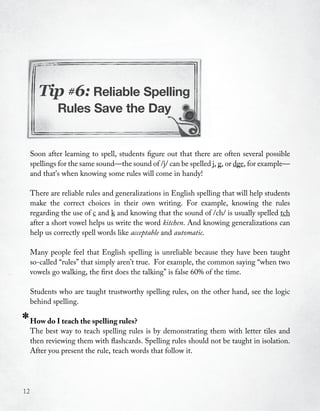
     Soon after learning to spell, students figure out that there are often several possible
     spellings for the same sound—the sound of /j/ can be spelled j, g, or dge, for example—
     and that’s when knowing some rules will come in handy!

     There are reliable rules and generalizations in English spelling that will help students
     make the correct choices in their own writing. For example, knowing the rules
     regarding the use of c and k and knowing that the sound of /ch/ is usually spelled tch
     after a short vowel helps us write the word kitchen. And knowing generalizations can
     help us correctly spell words like acceptable and automatic.

     Many people feel that English spelling is unreliable because they have been taught
     so-called “rules” that simply aren’t true. For example, the common saying “when two
     vowels go walking, the first does the talking” is false 60% of the time.

     Students who are taught trustworthy spelling rules, on the other hand, see the logic
     behind spelling.

*    How do I teach the spelling rules?
     The best way to teach spelling rules is by demonstrating them with letter tiles and
     then reviewing them with flashcards. Spelling rules should not be taught in isolation.
     After you present the rule, teach words that follow it.


12
Tip #7: Silent E Ha
                                                   s
                                            Five Jobs


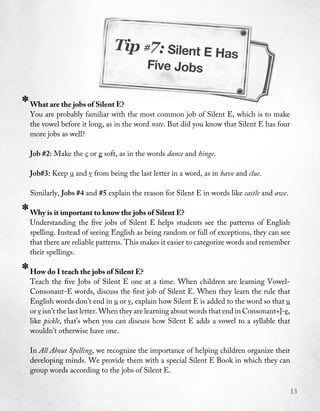
*   What are the jobs of Silent E?
    You are probably familiar with the most common job of Silent E, which is to make
    the vowel before it long, as in the word note. But did you know that Silent E has four
    more jobs as well?

    Job #2: Make the c or g soft, as in the words dance and hinge.

    Job#3: Keep u and v from being the last letter in a word, as in have and clue.

    Similarly, Jobs #4 and #5 explain the reason for Silent E in words like castle and awe.

*   Why is it important to know the jobs of Silent E?
    Understanding the five jobs of Silent E helps students see the patterns of English
    spelling. Instead of seeing English as being random or full of exceptions, they can see
    that there are reliable patterns. This makes it easier to categorize words and remember
    their spellings.

*   How do I teach the jobs of Silent E?
    Teach the five Jobs of Silent E one at a time. When children are learning Vowel-
    Consonant-E words, discuss the first job of Silent E. When they learn the rule that
    English words don’t end in u or v, explain how Silent E is added to the word so that u
    or v isn’t the last letter. When they are learning about words that end in Consonant+l-e,
    like pickle, that’s when you can discuss how Silent E adds a vowel to a syllable that
    wouldn’t otherwise have one.

    In All About Spelling, we recognize the importance of helping children organize their
    developing minds. We provide them with a special Silent E Book in which they can
    group words according to the jobs of Silent E.

                                                                                                13
Tip #8: Teach
                                                  Syllable Types


*    What are syllable types?
     There are six basic syllable types in English.

     First, we teach Closed Syllables. A closed syllable ends in a consonant. The vowel has
     a short vowel sound, as in the word bat.

     Next, we teach Open Syllables. An open syllable ends in a vowel. The vowel has a long
     vowel sound, as in the first syllable of apron.

     As the student masters each syllable type and the related spelling words, we continue
     on until all six syllable types have been taught.

*    Why are the syllable types important?
     With the knowledge gained through labeling syllable types, students can answer
     spelling questions for themselves, such as:
         Why do we double the p in stepping but not in weeping?
         Why do we need a double consonant in little but not in maple?

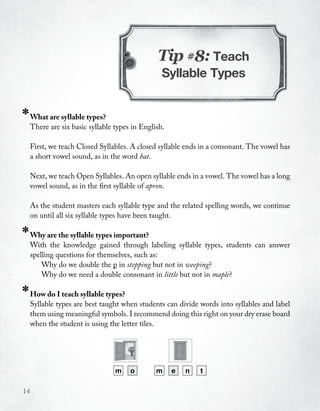
*    How do I teach syllable types?
     Syllable types are best taught when students can divide words into syllables and label
     them using meaningful symbols. I recommend doing this right on your dry erase board
     when the student is using the letter tiles.


                                  m    o        m     e   n   t

14
Tip #9: Tame the
                                                 Rule Breakers


*   What are Rule Breakers?
    Rule breakers are those words that do not follow the spelling rules. Have a procedure
    in place to help students memorize these tricky words.

*   How do I teach the Rule Breakers?
    Here are some practical ideas for you:

    1. Ask your student which part of the word doesn’t follow the rules. Have your
       student circle that portion of the word to draw attention to it. In All About Spelling,
       we actually throw these words (“bad guys”) into Jail. This helps the concept stick
       in the student’s mind.

    2. Use tactile methods such as having the student write the word with his finger on
       carpet or on the table to help cement the unusual pattern. Here are more ideas for
       tactile surfaces:
       http://www.all-about-spelling.com/tactile-ways-to-practice-spelling.html

    3. Teach similar troublesome words together, such as one and once, and would, could,
       and should.

    4. For words in which a sound is muffled, encourage the student to “pronounce for
       spelling.” For example, when we say the word cabin, it often sounds like “cabun.”
       To pronounce for spelling, we would emphasize the last syllable: cab-IN.


                                                                                                 15
Tip #10: Teach
                     Word Parts


     Thousands of words can be made with prefixes, suffixes, and root words. Knowing
     these word parts enables students to spell words such as neurologist, multitude, and
     chiropractic. For example, recognizing the Greek root graph gives students a clue as to
     how to correctly spell words like geography, graphic, and graphite.

     It’s also important to know how to add prefixes and suffixes to base words. There are
     some simple rules that will help your child correctly form longer words with ease. All
     About Spelling presents these rules in an easy-to-remember way.


16
Tip #11: Make
                         Review a Priority


Consistent review is the key to getting spelling facts and spelling words to “stick.”
Teaching something once or twice does not mean our children have actually mastered
it. Mastery takes time and practice. However, achieving mastery doesn’t have to be
boring.

Have your students practice spelling concepts with the letter tiles and flashcards and
through dictation. Use a variety of techniques to ensure that your students retain the
knowledge they need to become successful spellers. A few minutes of review every day
can go a long way.

Here are six strategies for spelling review that will help you get information into your
student’s long-term memory:
http://www.all-about-spelling.com/spelling-review.html

Review is built right into the All About Spelling lesson plans, helping your students
achieve mastery.


                                                                                           17
Tip #12: Dictation
                                   Exercises Are
                                     Important


     Dictation exercises are great practice and allow your students to use their spelling
     words in context. Start out with short dictated phrases and then move on to sentences
     and, eventually, paragraphs. In the dictation exercises, remember to include only words
     that have already been taught.

     I suggest ending every lesson with dictation exercises. This provides “real world”
     practice for students without the stress of generating new ideas. Dictation is a bridge
     between spelling and writing that can increase writing skills and confidence. It also
     helps increase children’s working memory as they practice holding more words in their
     minds at one time. A good working memory is important for all areas of learning.


18
Tip #13: Teach Proper
                            Homophone Usage


*   What are homophones?
    Homophones are words that sound alike but are spelled differently. Here’s an example
    of homophones being used incorrectly: Eye wood like ewe two meat my hoarse.

    This is an extreme example, of course, but students are faced with the choice between
    these sound-alike words every time they write. Do I use their or there? What about led
    or lead ?

*   How do I teach homophones?
    I recommend teaching the word with the most common usage first and introducing
    the other homophone later. Remember to explain the meaning of the homophone
    when teaching your student how to spell it. Include homophone pairs in dictation
    exercises so that students can practice choosing the correct word for the sentence.

    Here are several articles on homophones, including worksheets, games, and a
    “Homophone Machine” to tickle your funny bone:
    http://www.all-about-homophones.com/articles


                                                                                             19
Tip #14: Provide Diverse
            Writing Opportunities


     To build your students’ spelling ability and confidence, it is important to provide as
     many writing opportunities as possible—no matter what subject you are teaching.
     There is an infinite number of ways to incorporate writing into every type of lesson, so
     use your imagination to create engaging cross-curricular writing activities.

     Examples include writing out math word problems, writing step-by-step instructions
     for a science experiment, writing a favorite lunch menu, writing out a shopping list,
     writing a story about a pet, writing a poem about a historical figure, writing letters
     to pen pals, and creating a class newsletter or magazine. The possibilities are truly
     endless!


20
Tip #15: Keep the
                    Focus!


Spelling skills are used in “real life” as often as math skills are, so it is extremely
important to stay focused on spelling lessons. That’s easier said than done when a
child is struggling with spelling!

Here are some ideas to help you keep focused on spelling:


  * Have a predictable schedule and stick with it.
  * Don’t allow interruptions to the spelling lesson.
  * Eliminate background noise: turn off the radio, the television, and the ringer on
    the phone.


  * If you find the first subject of the day. aside in favor of other subjects, teach
    spelling as
                 that spelling is getting pushed


  * Chart your child’s parents!) can All Aboutfar they’vewe provide progress charts so
    that students (and
                       progress. At
                                     see how
                                               Spelling,
                                                         come.


  * Visualize how much easier your child’s life will be in the future when he is able
    to spell with ease.


                                                                                          21
Tip #16: Reading Builds
               Up Visual Memory


     Read, read, read! Set aside time for reading books and magazines, word banks, and the
     students’ personal spelling lists.

     The words for beginning spellers are fairly regular, but intermediate students will be
     faced with words that aren’t as straightforward. For example, a student may wonder if
     /rān/ is spelled rane or rain. A student who reads on a regular basis can draw upon his
     visual memory of the word in order to spell it correctly.

     Reading is so important that each level in the All About Spelling series has corresponding
     short story collections. As children read and enjoy these beautifully illustrated stories,
     they form a visual memory of how the words should look.


22
Tip #17: Keep Lessons
         Short but Frequent


Short, frequent lessons are much better than longer, sporadic lessons.

In a short lesson, your child’s attention is less likely to wander, and you’ll find that you
can accomplish more. Keep the lessons upbeat and fast-paced and use teaching tools
and activities that engage the child’s interest.

For most students, I recommend fifteen to twenty minutes per day, five times a week.
You can adjust the length of the lesson up or down according to your individual child’s
attention span and specific needs.


                                                                                               23
Tip #18: Misspellings
                Can Be a Teaching
                   Opportunity

     When your student makes a spelling mistake, take a look at what caused the error. Is
     there a spelling rule or concept that needs to be reviewed? Is the student pronouncing
     the word correctly? Are letters being transposed? If you tackle the cause of the
     misspelling, you will help your student grow in spelling ability more quickly.

     Here are ideas for handling spelling errors in your child’s writing:


       * Separate the task of writingword spacing, of editing. punctuation, capitalization,
         on at once—handwriting,
                                      from the task
                                                    grammar,
                                                               Students have a lot to focus

           spelling, plus trying to think up original ideas and how to present them in a
           logical and interesting manner. Write on one day and edit the next day.
       *   If they don’t find all of their own spelling errors, you can either point them out
           directly, or put a light X next to each line where there is an error. Then ask them
           to read it one more time to see if they can find the error.
       *   Once the student finds the spelling error, determine if it is a phonetic error or
           a rule error. If it is a phonetic error, have him pronounce the word exactly as he
           wrote it. If it is a rule-based error, ask him if there is a rule that applies to the
           word he wrote. If the word can only be determined visually, ask if he knows any
           other letters or letter teams that can stand for the same sound.
       *   Make note of the misspelled words so you can be sure to review them in the next
           spelling lesson.
       *   Only hold your students accountable for words and patterns they have already
           studied.
       *   Keep corrections light and positive; remember, this is hard work for your
           children!


24
Tip #19: A Strong
                                Foundation Is K
                                               ey


Very often, the reason children struggle with spelling is that they are missing some
basic yet important information.

For example, most struggling students switch letters or leave out letters entirely. They
do so because they don’t know how to hear each sound in the word. They often
spell words in nonstandard ways because they don’t know the phonograms or reliable
spelling rules. They can’t identify syllables or the reasons for adding Silent E.

Without these basic skills, spelling can be very difficult.

The solution is to help students build a strong foundation. Teach them clearly and
simply, adding just one new skill at a time. Bring clarity, instead of confusion.

When working with older children, start at the beginning, briefly review the concepts
they do know, and concentrate on the concepts they don’t know. Help them quickly
build that strong foundation, and then move on. Your child will be a much stronger
speller by doing this, and you’ll both be much less frustrated.

We designed the All About Spelling program to be relevant for all ages, whether your
students are 6 or 66. The program can be used by children and adults to build a strong
foundation for literacy.


                                                                                           25
Tip #20: Use a
                       Roadmap


     When you’re driving to an unknown destination, it’s a lot easier to get where you are
     going when you have a detailed map in front of you. Teaching spelling is the same way.
     If you want your students to reach their destination, you’ll need some well-planned
     lessons to guide you. Lesson plans help you keep your eyes on the road—that is, your
     attention on your students—instead of on trying to figure out what to teach next.

     Teaching without a lesson plan means that concepts may be presented in a disjointed
     manner, which will only confuse your children. When lessons are planned ahead of
     time, however, you’ll be confident knowing that you’re not missing any important
     components or forgetting to cover a crucial concept. You’ll be able to keep the lesson
     moving and keep your students engaged.

     Keep in mind the following guidelines when planning your spelling lessons or when
     evaluating prepared lesson plans:


       * Lessons shouldfoundation for the next. lesson building upon the previous one
         and laying the
                         be sequential, with each


       * Lessons should each child.
         customizable for
                          include daily   review, use multisensory techniques, and be


26
I hope you have found this report helpful for both
you and your student.

If you would like to take a look inside a program
that incorporates all of the tips and suggestions
in this report, I invite you to visit my website at
www.AllAboutSpelling.com


                ...taking the struggle out of spelling
References
Farkus, R.D. (2003). Effects of traditional versus learning-styles instructional methods on
middle school students. The Journal of Educational Research, 97, no. 1.

Gillingham, A. and Stillman, B. W. (1997). The Gillingham manual: Remedial
training for students with specific disability in reading, spelling, and penmanship (8th ed.).
Cambridge: Educators Publishing Service.

Hanna, P.R. and others (1966). Phoneme-grapheme correspondences as cues to spelling
improvement. Washington: U.S. Office of Education Cooperative Research.

Rippel, M. (2006). All About Spelling Level 1. Eagle River, WI: All About Learning
Press.
Fichas ingles

Fichas ingles

  • 2.
    All rights reserved.No portion of this publication may be reproduced by any means, including duplicating, photocopying, electronic, mechanical, recording, the World Wide Web, e-mail, or otherwise, without written permission from the publisher. Copyright © 2007, 2010 by All About Learning Press All About Learning Press 2038 E. Anvil Lake Road Eagle River, WI 54521 715.477.1976 www.AllAboutLearningPress.com ISBN 978-1-935197-13-3 Cover Design and Page Layout: David LaTulippe
  • 3.
    You are aboutto learn my top tips for taking the struggle out of spelling. Every one of these tips is designed to accelerate your student’s learning and to help him or her retain more of what you teach. Some of these tips may surprise you, and you will probably find some ideas that you have never considered as being related to the teaching of spelling. You may want to print out this report, grab a highlighter, and make notes in the margins. And please—feel free to contact me with any questions you may have. I’m here to help. ...taking the struggle out of spelling
  • 5.
    Contents Tip #1: Spelling Is More than Just Memorization Tip #2: Break Words into Sounds Tip #3: Represent Sounds with Phonograms Tip #4: Multisensory Activities Are Best Tip #5: Color-coded Letter Tiles Accelerate Learning Tip #6: Reliable Spelling Rules Save the Day Tip #7: Silent E Has Five Jobs Tip #8: Teach Syllable Types Tip #9: Tame the Rule Breakers Tip #10: Teach Word Parts Tip #11: Make Review a Priority Tip #12: Dictation Exercises Are Important Tip #13: Teach Proper Homophone Usage Tip #14: Provide Diverse Writing Opportunities Tip #15: Keep the Focus! Tip #16: Reading Builds Up Visual Memory Tip #17: Keep Lessons Short but Frequent Tip #18: Misspellings Can Be a Teaching Opportunity Tip #19: A Strong Foundation Is Key Tip #20: Use a Roadmap
  • 7.
    Tip #1: SpellingIs More than Just Memorization Most spelling programs are a variation of the “list-on-Monday, test-on-Friday” approach. This approach has the students look at the word, cover it up, and then try to remember the order of the letters. Such programs teach spelling as if words were made up of a random string of letters. Memorizing long strings of letters doesn’t work for many kids. The “look, cover, write, repeat” method fails them. The mammoth task of having to learn thousands of words this way—and then remembering them past the spelling test on Friday—becomes overwhelming. Some children simply shut down and give up. For new spellers, and for those who struggle with spelling, there is a much better way! Instead of memorizing the spelling of thousands of different words, they can learn just 72 phonograms and a handful of useful spelling rules. This method is much more manageable for them. Approximately 97% of the 17,000 most common words can be spelled using just these phonograms and a small number of reliable spelling rules. 7
  • 8.
    Tip #2: BreakWords into Sounds When we speak, we blend sounds together to make a word. For example, when we say the word ham, we are blending the sounds /h/–/a/–/m/ together quickly. ˘ When we spell, we can take those individual sounds apart. That process is called segmenting. A quick way to know if your student can segment words is to ask, “What sounds do you hear in the word pan?” If your student isn’t able to easily identify the three individual sounds (/p/–/a /–/n/), ˘ teach him how to segment words. This is an important skill that will make learning to spell so much easier for your student. After the child learns to hear the individual sounds, he can represent each sound with the corresponding letter or letter combination. And that leads us to Tip #3... 8
  • 9.
    Tip #3: Rep res ent Sounds wit h Phonogram s * What is a phonogram? A phonogram is a letter or letter combination that represents a sound. There are 72 common phonograms. For example: ck is a phonogram that says /k/ as in clock. s is a phonogram that says /s/ as in sat or /z/ as in present. oy is a phonogram that says /oi/ as in oyster. * Why are phonograms important? Each sound in a word can be represented by a phonogram. Let’s take the word past. If you pronounce the word slowly to hear the individual sounds, you will hear four different sounds: /p/–/ă/–/s/–/t/. For each sound, we write down a phonogram: p-a- s-t. When students know the phonograms and which sounds they represent, spelling is so much easier. If they know that the sound of /j/ at the end of a word is spelled with dge, spelling the word bridge becomes simple. They do not need to remember b-r-i-d-g-e as a string of letters. Instead, each sound is simply represented by a phonogram. Memorizing words as strings of unrelated letters usually results in frustration. Children who are taught to spell using the phonograms, on the other hand, see spelling as a doable task. * How do I teach the phonograms? I have found that the quickest way to teach the phonograms is by using flashcards. Introduce four phonograms at a time, adding more as the child masters them. Ready- to-use flashcards are included in the All About Spelling program. 9
  • 10.
    Tip #4: Multisensory Activities Are Best * Why are multisensory activities important? Children learn best when they can use all of their senses. When they can see something as it is explained, and hear about it, and then do it with hands-on activities, they are much more likely to retain the new information. * How do I use multisensory activities? Visual activities can include demonstrating spelling rules with color-coded letter tiles. With the letter tiles, you can demonstrate rules and patterns and how they apply to various words. The child can see a concept—and it makes sense to him. Another good visual activity is to use Word Banks. Word Banks are lists of words all following the same spelling rule or spelling pattern. Children are able to grasp the similarities between these words when they see them all grouped together. Auditory activities can include discussing new spelling rules and concepts. When a new letter combination is introduced, such as au, children can learn it quickly by saying the sound as they write it. Oral review is an important auditory activity as well. Kinesthetic activities include hands-on activities such as manipulating letter tiles to test out spelling rules, feeling the shape of the letters and letter combinations as they write them and say them, and compiling personalized word lists. Children learn more quickly when they are taught through their strongest mode of learning, and they learn even more when all three pathways are involved. The All About Spelling program includes all of the materials you need for these important multisensory activities. 10
  • 11.
    Tip #5: Color-coded Letter Tiles Accelerate Learning * What are letter tiles? Letter tiles are square manipulatives that contain the 72 phonograms. They are the perfect manipulative for teaching spelling. t i m b er Color-coding makes it easy for students to see the role that each type of letter plays in a word. For example, consonants are blue, vowels are red, and phonograms representing the sound of /er/ (such as er, ir, and ur) are purple. * Why are letter tiles important? Letter tiles are important because they turn an idea or concept into something your student can see and manipulate. Letter tiles demonstrate new concepts in spelling lessons and help the student practice spelling new words. Spelling rules are a very abstract thing. They are hard to explain to a child, especially if that child has some attention issues or auditory processing difficulties. When you start talking to most kids about how we use -dge for the sound of /j/ only after a short vowel, they tend to zone out. It’s just too many words to process, and too abstract to sink in. But if we demonstrate this same exact concept using letter tiles, it is suddenly so much easier to understand. And the child needs to understand a concept in order to remember it long term. * How do I use letter tiles? I strongly suggest using the letter tiles on a magnetic dry erase board. This eliminates the need to set up the tiles each day and keeps them from getting lost. And best of all, kids love magnets. 11
  • 12.
    Tip #6: ReliableSpelling Rules Save the Day Soon after learning to spell, students figure out that there are often several possible spellings for the same sound—the sound of /j/ can be spelled j, g, or dge, for example— and that’s when knowing some rules will come in handy! There are reliable rules and generalizations in English spelling that will help students make the correct choices in their own writing. For example, knowing the rules regarding the use of c and k and knowing that the sound of /ch/ is usually spelled tch after a short vowel helps us write the word kitchen. And knowing generalizations can help us correctly spell words like acceptable and automatic. Many people feel that English spelling is unreliable because they have been taught so-called “rules” that simply aren’t true. For example, the common saying “when two vowels go walking, the first does the talking” is false 60% of the time. Students who are taught trustworthy spelling rules, on the other hand, see the logic behind spelling. * How do I teach the spelling rules? The best way to teach spelling rules is by demonstrating them with letter tiles and then reviewing them with flashcards. Spelling rules should not be taught in isolation. After you present the rule, teach words that follow it. 12
  • 13.
    Tip #7: SilentE Ha s Five Jobs * What are the jobs of Silent E? You are probably familiar with the most common job of Silent E, which is to make the vowel before it long, as in the word note. But did you know that Silent E has four more jobs as well? Job #2: Make the c or g soft, as in the words dance and hinge. Job#3: Keep u and v from being the last letter in a word, as in have and clue. Similarly, Jobs #4 and #5 explain the reason for Silent E in words like castle and awe. * Why is it important to know the jobs of Silent E? Understanding the five jobs of Silent E helps students see the patterns of English spelling. Instead of seeing English as being random or full of exceptions, they can see that there are reliable patterns. This makes it easier to categorize words and remember their spellings. * How do I teach the jobs of Silent E? Teach the five Jobs of Silent E one at a time. When children are learning Vowel- Consonant-E words, discuss the first job of Silent E. When they learn the rule that English words don’t end in u or v, explain how Silent E is added to the word so that u or v isn’t the last letter. When they are learning about words that end in Consonant+l-e, like pickle, that’s when you can discuss how Silent E adds a vowel to a syllable that wouldn’t otherwise have one. In All About Spelling, we recognize the importance of helping children organize their developing minds. We provide them with a special Silent E Book in which they can group words according to the jobs of Silent E. 13
  • 14.
    Tip #8: Teach Syllable Types * What are syllable types? There are six basic syllable types in English. First, we teach Closed Syllables. A closed syllable ends in a consonant. The vowel has a short vowel sound, as in the word bat. Next, we teach Open Syllables. An open syllable ends in a vowel. The vowel has a long vowel sound, as in the first syllable of apron. As the student masters each syllable type and the related spelling words, we continue on until all six syllable types have been taught. * Why are the syllable types important? With the knowledge gained through labeling syllable types, students can answer spelling questions for themselves, such as: Why do we double the p in stepping but not in weeping? Why do we need a double consonant in little but not in maple? * How do I teach syllable types? Syllable types are best taught when students can divide words into syllables and label them using meaningful symbols. I recommend doing this right on your dry erase board when the student is using the letter tiles. m o m e n t 14
  • 15.
    Tip #9: Tamethe Rule Breakers * What are Rule Breakers? Rule breakers are those words that do not follow the spelling rules. Have a procedure in place to help students memorize these tricky words. * How do I teach the Rule Breakers? Here are some practical ideas for you: 1. Ask your student which part of the word doesn’t follow the rules. Have your student circle that portion of the word to draw attention to it. In All About Spelling, we actually throw these words (“bad guys”) into Jail. This helps the concept stick in the student’s mind. 2. Use tactile methods such as having the student write the word with his finger on carpet or on the table to help cement the unusual pattern. Here are more ideas for tactile surfaces: http://www.all-about-spelling.com/tactile-ways-to-practice-spelling.html 3. Teach similar troublesome words together, such as one and once, and would, could, and should. 4. For words in which a sound is muffled, encourage the student to “pronounce for spelling.” For example, when we say the word cabin, it often sounds like “cabun.” To pronounce for spelling, we would emphasize the last syllable: cab-IN. 15
  • 16.
    Tip #10: Teach Word Parts Thousands of words can be made with prefixes, suffixes, and root words. Knowing these word parts enables students to spell words such as neurologist, multitude, and chiropractic. For example, recognizing the Greek root graph gives students a clue as to how to correctly spell words like geography, graphic, and graphite. It’s also important to know how to add prefixes and suffixes to base words. There are some simple rules that will help your child correctly form longer words with ease. All About Spelling presents these rules in an easy-to-remember way. 16
  • 17.
    Tip #11: Make Review a Priority Consistent review is the key to getting spelling facts and spelling words to “stick.” Teaching something once or twice does not mean our children have actually mastered it. Mastery takes time and practice. However, achieving mastery doesn’t have to be boring. Have your students practice spelling concepts with the letter tiles and flashcards and through dictation. Use a variety of techniques to ensure that your students retain the knowledge they need to become successful spellers. A few minutes of review every day can go a long way. Here are six strategies for spelling review that will help you get information into your student’s long-term memory: http://www.all-about-spelling.com/spelling-review.html Review is built right into the All About Spelling lesson plans, helping your students achieve mastery. 17
  • 18.
    Tip #12: Dictation Exercises Are Important Dictation exercises are great practice and allow your students to use their spelling words in context. Start out with short dictated phrases and then move on to sentences and, eventually, paragraphs. In the dictation exercises, remember to include only words that have already been taught. I suggest ending every lesson with dictation exercises. This provides “real world” practice for students without the stress of generating new ideas. Dictation is a bridge between spelling and writing that can increase writing skills and confidence. It also helps increase children’s working memory as they practice holding more words in their minds at one time. A good working memory is important for all areas of learning. 18
  • 19.
    Tip #13: TeachProper Homophone Usage * What are homophones? Homophones are words that sound alike but are spelled differently. Here’s an example of homophones being used incorrectly: Eye wood like ewe two meat my hoarse. This is an extreme example, of course, but students are faced with the choice between these sound-alike words every time they write. Do I use their or there? What about led or lead ? * How do I teach homophones? I recommend teaching the word with the most common usage first and introducing the other homophone later. Remember to explain the meaning of the homophone when teaching your student how to spell it. Include homophone pairs in dictation exercises so that students can practice choosing the correct word for the sentence. Here are several articles on homophones, including worksheets, games, and a “Homophone Machine” to tickle your funny bone: http://www.all-about-homophones.com/articles 19
  • 20.
    Tip #14: ProvideDiverse Writing Opportunities To build your students’ spelling ability and confidence, it is important to provide as many writing opportunities as possible—no matter what subject you are teaching. There is an infinite number of ways to incorporate writing into every type of lesson, so use your imagination to create engaging cross-curricular writing activities. Examples include writing out math word problems, writing step-by-step instructions for a science experiment, writing a favorite lunch menu, writing out a shopping list, writing a story about a pet, writing a poem about a historical figure, writing letters to pen pals, and creating a class newsletter or magazine. The possibilities are truly endless! 20
  • 21.
    Tip #15: Keepthe Focus! Spelling skills are used in “real life” as often as math skills are, so it is extremely important to stay focused on spelling lessons. That’s easier said than done when a child is struggling with spelling! Here are some ideas to help you keep focused on spelling: * Have a predictable schedule and stick with it. * Don’t allow interruptions to the spelling lesson. * Eliminate background noise: turn off the radio, the television, and the ringer on the phone. * If you find the first subject of the day. aside in favor of other subjects, teach spelling as that spelling is getting pushed * Chart your child’s parents!) can All Aboutfar they’vewe provide progress charts so that students (and progress. At see how Spelling, come. * Visualize how much easier your child’s life will be in the future when he is able to spell with ease. 21
  • 22.
    Tip #16: ReadingBuilds Up Visual Memory Read, read, read! Set aside time for reading books and magazines, word banks, and the students’ personal spelling lists. The words for beginning spellers are fairly regular, but intermediate students will be faced with words that aren’t as straightforward. For example, a student may wonder if /rān/ is spelled rane or rain. A student who reads on a regular basis can draw upon his visual memory of the word in order to spell it correctly. Reading is so important that each level in the All About Spelling series has corresponding short story collections. As children read and enjoy these beautifully illustrated stories, they form a visual memory of how the words should look. 22
  • 23.
    Tip #17: KeepLessons Short but Frequent Short, frequent lessons are much better than longer, sporadic lessons. In a short lesson, your child’s attention is less likely to wander, and you’ll find that you can accomplish more. Keep the lessons upbeat and fast-paced and use teaching tools and activities that engage the child’s interest. For most students, I recommend fifteen to twenty minutes per day, five times a week. You can adjust the length of the lesson up or down according to your individual child’s attention span and specific needs. 23
  • 24.
    Tip #18: Misspellings Can Be a Teaching Opportunity When your student makes a spelling mistake, take a look at what caused the error. Is there a spelling rule or concept that needs to be reviewed? Is the student pronouncing the word correctly? Are letters being transposed? If you tackle the cause of the misspelling, you will help your student grow in spelling ability more quickly. Here are ideas for handling spelling errors in your child’s writing: * Separate the task of writingword spacing, of editing. punctuation, capitalization, on at once—handwriting, from the task grammar, Students have a lot to focus spelling, plus trying to think up original ideas and how to present them in a logical and interesting manner. Write on one day and edit the next day. * If they don’t find all of their own spelling errors, you can either point them out directly, or put a light X next to each line where there is an error. Then ask them to read it one more time to see if they can find the error. * Once the student finds the spelling error, determine if it is a phonetic error or a rule error. If it is a phonetic error, have him pronounce the word exactly as he wrote it. If it is a rule-based error, ask him if there is a rule that applies to the word he wrote. If the word can only be determined visually, ask if he knows any other letters or letter teams that can stand for the same sound. * Make note of the misspelled words so you can be sure to review them in the next spelling lesson. * Only hold your students accountable for words and patterns they have already studied. * Keep corrections light and positive; remember, this is hard work for your children! 24
  • 25.
    Tip #19: AStrong Foundation Is K ey Very often, the reason children struggle with spelling is that they are missing some basic yet important information. For example, most struggling students switch letters or leave out letters entirely. They do so because they don’t know how to hear each sound in the word. They often spell words in nonstandard ways because they don’t know the phonograms or reliable spelling rules. They can’t identify syllables or the reasons for adding Silent E. Without these basic skills, spelling can be very difficult. The solution is to help students build a strong foundation. Teach them clearly and simply, adding just one new skill at a time. Bring clarity, instead of confusion. When working with older children, start at the beginning, briefly review the concepts they do know, and concentrate on the concepts they don’t know. Help them quickly build that strong foundation, and then move on. Your child will be a much stronger speller by doing this, and you’ll both be much less frustrated. We designed the All About Spelling program to be relevant for all ages, whether your students are 6 or 66. The program can be used by children and adults to build a strong foundation for literacy. 25
  • 26.
    Tip #20: Usea Roadmap When you’re driving to an unknown destination, it’s a lot easier to get where you are going when you have a detailed map in front of you. Teaching spelling is the same way. If you want your students to reach their destination, you’ll need some well-planned lessons to guide you. Lesson plans help you keep your eyes on the road—that is, your attention on your students—instead of on trying to figure out what to teach next. Teaching without a lesson plan means that concepts may be presented in a disjointed manner, which will only confuse your children. When lessons are planned ahead of time, however, you’ll be confident knowing that you’re not missing any important components or forgetting to cover a crucial concept. You’ll be able to keep the lesson moving and keep your students engaged. Keep in mind the following guidelines when planning your spelling lessons or when evaluating prepared lesson plans: * Lessons shouldfoundation for the next. lesson building upon the previous one and laying the be sequential, with each * Lessons should each child. customizable for include daily review, use multisensory techniques, and be 26
  • 27.
    I hope youhave found this report helpful for both you and your student. If you would like to take a look inside a program that incorporates all of the tips and suggestions in this report, I invite you to visit my website at www.AllAboutSpelling.com ...taking the struggle out of spelling
  • 28.
    References Farkus, R.D. (2003).Effects of traditional versus learning-styles instructional methods on middle school students. The Journal of Educational Research, 97, no. 1. Gillingham, A. and Stillman, B. W. (1997). The Gillingham manual: Remedial training for students with specific disability in reading, spelling, and penmanship (8th ed.). Cambridge: Educators Publishing Service. Hanna, P.R. and others (1966). Phoneme-grapheme correspondences as cues to spelling improvement. Washington: U.S. Office of Education Cooperative Research. Rippel, M. (2006). All About Spelling Level 1. Eagle River, WI: All About Learning Press.