Words Their Way
             Developed by
   Donald R. Bear, Shane Templeton
  Marcia Invernizzi, Francine Johnston

         Presented by Heidi Adams
What is Word Study?
   Method for examining words
   Active process
   Students categorize words and pictures
   Students learn about words which
    improves their reading and writing
Layers of Information in
English Spelling
1.   Alphabetic – letters describe sounds
     left-to-right
2.   Pattern – groupings of letters
     representing sounds
3.   Meaning – letter groups can directly
     represent meaning
Stages of Spelling
1.   Preliterate
2.   Early Letter Name
3.   Middle and Late Letter Name
4.   Within Word Pattern
5.   Syllable Juncture
6.   Derivational Constancy
Preliterate Spelling
   Corresponds to emergent reading
   Scribble, letter-like forms
   Spelling ranges from random marks to
    legitimate letters without sound-symbol
    correspondence
Early Letter Name Spelling
   Corresponds to learning predictable
    pattern books and rhymes, beginning
    readers
   Apply alphabetic principal primarily with
    consonants
   Often omit vowels
Middle and Late Letter Name
Spelling
   Corresponds to reading disfluently,
    word-by-word, and inexpressively
   Focus on regular vowels, initial
    consonant blends and digraphs
Within Word Pattern Spelling
   Corresponds to phrasal reading fluency
   Experimentation with long vowel
    patterns
Syllable Juncture Spelling
   Corresponds to automatic word
    recognition
   Use of affixes
   Correct initial and final consonants
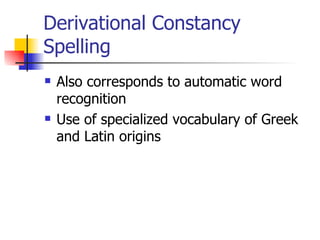
Sequence of Study at Syllable
Juncture Stage
1.   Plural endings
2.   Compound words
3.   Open and closed syllables: simple inflectional
     endings
4.   Homophones
5.   Open and closed syllables: VCCV and VCV patterns
6.   Changing final y to i
7.   Accent
8.   Spelling pattern for /cher/ sound, / r/ sound, and
     the / l/ sound at the end of words
9.   Simple prefixes and base words
Derivational Constancy
Spelling
   Also corresponds to automatic word
    recognition
   Use of specialized vocabulary of Greek
    and Latin origins
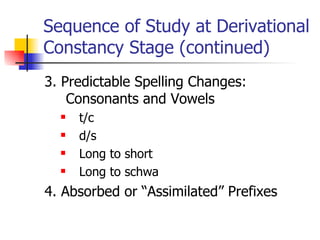
Sequence of Study at
Derivational Constancy Stage
1.        Spelling/Meaning Connection
     1.      Consonant Alternations
                Silent/sounded
                /t/ to /sh/
                /k/ to /sh/
     2.      Vowel Alternation Patterns
            1.   Long to short
            2.   Long to schwa
            3.   Schwa to short
2.        Greek and Latin Word Elements
     1.      Greek Prefixes
     2.      Greek roots
     3.      Latin roots
Sequence of Study at Derivational
Constancy Stage (continued)
3. Predictable Spelling Changes:
    Consonants and Vowels
     t/c
     d/s
     Long to short
     Long to schwa
4. Absorbed or “Assimilated” Prefixes
Implementation
1.   Assess current level
2.   Determine groups
3.   Set up schedule
4.   Develop a weekly routine
Assessing Current Level
1.       Collect a spelling sample
          Daily writing
          Spelling inventory
        Analyze sample
        Monitor growth
        Plan instruction
Determine Groups
   Base on level
   3 groups recommended
       Circle work with teacher
       Seat work
       Center work
Schedule
   Time for small group work
       Short directed lessons
   Time to sort independently and with
    partners
   Include activities to recognize, recall,
    judge, and apply targeted concept
Recognize
   Present particular feature
   Guide through word comparison
   Generate a word list and post
Recall
   Recall examples of feature
   Word Hunt
Word Hunts
   Bridge between word study and
    students’ reading and writing
   Hunt through reading and writing for
    words that are examples of the featured
    pattern
Judge
   Look through words for those that
    match studied feature
   Word hunt in familiar readings
   Closed sort
Word Sorts
   Closed Sorts
       Teacher defined categories
       Guided
       Gradual student control
       Independent practice
   Open Sorts
       Student defined categories of known words
Word Sorts (continued)
   Blind Sorts
       Teacher determines categories
       Teacher or student calls out words
       Students determine which category
   Writing Sorts
       Teacher determines categories
       Teacher calls out words
       Student writes words in appropriate category
   Speed Sorts
       For speed
       Use only when accuracy is guaranteed
Apply
   Apply learned skill to create something
    new
   Open sort
   Word Hunt
   Games
Games
   Card games
       Rummy
       Memory
   Board games
       Stressbusters
       Jeopardy
Weekly Routine Example
   Monday – introduce sort
   Tuesday – practice sort and write it
   Wednesday – blind sorts and writing
    sorts
   Thursday – word hunts or games
   Friday - assessment
Assessment
   Traditional spelling test
       Spellingcity.com
   Include definitions for derivational
    relations spellers
Ten Principles of Word Study
Instruction
1.   Look for what students use but
     confuse.
2.   A step backward is a step forward
3.   Use words students can read
4.   Compare words “that do” with words
     “that don’t.”
5.   Sort by sight AND sound
Ten Principles of Word Study
Instruction (continued)
6. Begin with obvious contrasts first
7. Don’t hide exceptions.
8. Avoid rules.
9. Work for automaticity.
10. Return to meaningful texts.
One Golden Rule
   Teaching is not telling.
Sources
   Words Their Way: Word Study for
    Phonics, Vocabulary, and Spelling
    Instruction
   Word Sorts for Derivational Relations
    Spellers
Questions
   ?

Words Their Way

  • 1.
    Words Their Way Developed by Donald R. Bear, Shane Templeton Marcia Invernizzi, Francine Johnston Presented by Heidi Adams
  • 2.
    What is WordStudy?  Method for examining words  Active process  Students categorize words and pictures  Students learn about words which improves their reading and writing
  • 3.
    Layers of Informationin English Spelling 1. Alphabetic – letters describe sounds left-to-right 2. Pattern – groupings of letters representing sounds 3. Meaning – letter groups can directly represent meaning
  • 4.
    Stages of Spelling 1. Preliterate 2. Early Letter Name 3. Middle and Late Letter Name 4. Within Word Pattern 5. Syllable Juncture 6. Derivational Constancy
  • 5.
    Preliterate Spelling  Corresponds to emergent reading  Scribble, letter-like forms  Spelling ranges from random marks to legitimate letters without sound-symbol correspondence
  • 6.
    Early Letter NameSpelling  Corresponds to learning predictable pattern books and rhymes, beginning readers  Apply alphabetic principal primarily with consonants  Often omit vowels
  • 7.
    Middle and LateLetter Name Spelling  Corresponds to reading disfluently, word-by-word, and inexpressively  Focus on regular vowels, initial consonant blends and digraphs
  • 8.
    Within Word PatternSpelling  Corresponds to phrasal reading fluency  Experimentation with long vowel patterns
  • 9.
    Syllable Juncture Spelling  Corresponds to automatic word recognition  Use of affixes  Correct initial and final consonants
  • 10.
    Sequence of Studyat Syllable Juncture Stage 1. Plural endings 2. Compound words 3. Open and closed syllables: simple inflectional endings 4. Homophones 5. Open and closed syllables: VCCV and VCV patterns 6. Changing final y to i 7. Accent 8. Spelling pattern for /cher/ sound, / r/ sound, and the / l/ sound at the end of words 9. Simple prefixes and base words
  • 11.
    Derivational Constancy Spelling  Also corresponds to automatic word recognition  Use of specialized vocabulary of Greek and Latin origins
  • 12.
    Sequence of Studyat Derivational Constancy Stage 1. Spelling/Meaning Connection 1. Consonant Alternations  Silent/sounded  /t/ to /sh/  /k/ to /sh/ 2. Vowel Alternation Patterns 1. Long to short 2. Long to schwa 3. Schwa to short 2. Greek and Latin Word Elements 1. Greek Prefixes 2. Greek roots 3. Latin roots
  • 13.
    Sequence of Studyat Derivational Constancy Stage (continued) 3. Predictable Spelling Changes: Consonants and Vowels  t/c  d/s  Long to short  Long to schwa 4. Absorbed or “Assimilated” Prefixes
  • 14.
    Implementation 1. Assess current level 2. Determine groups 3. Set up schedule 4. Develop a weekly routine
  • 15.
    Assessing Current Level 1. Collect a spelling sample  Daily writing  Spelling inventory  Analyze sample  Monitor growth  Plan instruction
  • 16.
    Determine Groups  Base on level  3 groups recommended  Circle work with teacher  Seat work  Center work
  • 17.
    Schedule  Time for small group work  Short directed lessons  Time to sort independently and with partners  Include activities to recognize, recall, judge, and apply targeted concept
  • 18.
    Recognize  Present particular feature  Guide through word comparison  Generate a word list and post
  • 19.
    Recall  Recall examples of feature  Word Hunt
  • 20.
    Word Hunts  Bridge between word study and students’ reading and writing  Hunt through reading and writing for words that are examples of the featured pattern
  • 21.
    Judge  Look through words for those that match studied feature  Word hunt in familiar readings  Closed sort
  • 22.
    Word Sorts  Closed Sorts  Teacher defined categories  Guided  Gradual student control  Independent practice  Open Sorts  Student defined categories of known words
  • 23.
    Word Sorts (continued)  Blind Sorts  Teacher determines categories  Teacher or student calls out words  Students determine which category  Writing Sorts  Teacher determines categories  Teacher calls out words  Student writes words in appropriate category  Speed Sorts  For speed  Use only when accuracy is guaranteed
  • 24.
    Apply  Apply learned skill to create something new  Open sort  Word Hunt  Games
  • 25.
    Games  Card games  Rummy  Memory  Board games  Stressbusters  Jeopardy
  • 26.
    Weekly Routine Example  Monday – introduce sort  Tuesday – practice sort and write it  Wednesday – blind sorts and writing sorts  Thursday – word hunts or games  Friday - assessment
  • 27.
    Assessment  Traditional spelling test  Spellingcity.com  Include definitions for derivational relations spellers
  • 28.
    Ten Principles ofWord Study Instruction 1. Look for what students use but confuse. 2. A step backward is a step forward 3. Use words students can read 4. Compare words “that do” with words “that don’t.” 5. Sort by sight AND sound
  • 29.
    Ten Principles ofWord Study Instruction (continued) 6. Begin with obvious contrasts first 7. Don’t hide exceptions. 8. Avoid rules. 9. Work for automaticity. 10. Return to meaningful texts.
  • 30.
    One Golden Rule  Teaching is not telling.
  • 31.
    Sources  Words Their Way: Word Study for Phonics, Vocabulary, and Spelling Instruction  Word Sorts for Derivational Relations Spellers
  • 32.

Editor's Notes

  • #11 3. ed, s, ing 7. Contract 8. lecture, puncture, 8. winter, motor, lunar 8. able, cancel
  • #13 1.1.1 sign/signal 1.1.2. connect/connection 1.1.3. music/musician 1.2.1 please/pleasant 1.2.2. compete/competition 1.2.3 locality/local
  • #14 3.1 silent/silence 3.2 explode/explosion 3.3 vain/vanity 3.4 explain/explanation 4. In + mobile = immobile
  • #16 1.2 example
  • #29 2. Build scaffold 3. From any source 4. Contrasts are essential
  • #30 6. m/s – not m/n 7. Put irregular words into misc category 8. “patterns” instead 9. Move from hesitancy to fluency
  • #31 Teachers “stack the deck,” but allow students to discover.