English spelling course
Done by:
Shareefa Al-Harrasi
Huda Al-Belushi
Dalal Al-Hajri
Out line
O Rationale
O Needs analysis: questionnaire & interview
O Goalsobjectives
O Types of syllabus
O Content
O Assessment and evaluation
O Challenges
Rational:
O We have noticed that 10 grade students lack the skills of
spelling English words correctly. This problem in spelling
has become one of the major reasons for misunderstanding
of many words or mixing up the meaning of words which
differ in one or two letters. Most of the students have
difficulty memorizing the spelling of words in the right way.
Therefore, it will affect their reading and writing skills
negatively. They ;also, do not have the courage to write
anything without checking a dictionary.
O Gradually, this course will improve students spelling
abilities. In addition, it will teach them how to avoid
misspellings by using spelling strategies and tips and by
recognizing spelling errors quickly. Moreover it will provide
them with synonyms, antonyms, homonyms, suffixes and
prefixes.
Need Analysis:
 Questionnaire :grade 10
 2parts:
1. spelling exercise : eight multiple choice questions,
to test the students' skills in spelling English vocabulary.
• almost all the students did well in the
first part.
• our questions were very easy
compared to their levels or maybe the
students use a dictionary or ask for
help while answering.
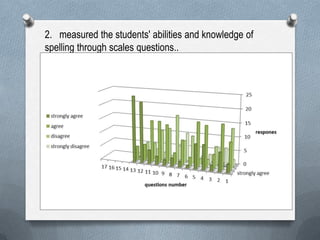
2. measured the students' abilities and knowledge of
spelling through scales questions..
Results of the 2nd part :
 almost 55.1% were not good spellers.
 Some students were not familiar with affixes, silent letters
 not many students use effective strategies to memorize words
such as dividing the word into syllables, or link it with sounds
that they already familiar with.
 Some students tended to spell the words according to their
pronunciation, but they have difficulties with vowels, silent
letters .
 The majority of students prefer to use a dictionary while
writing.
By the end of the course students will:
• Develop their spelling abilities in
English language.
• Develop their English language.
• Build more vocabulary.
• Develop their writing skills.
• Develop their pronunciation skills.
• Know the basic rules of spelling.
• Apply spelling strategies and tips to
memorize words.
Goals:
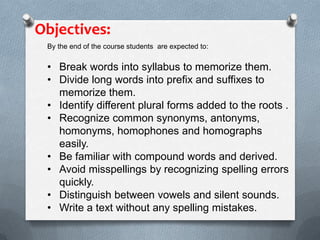
By the end of the course students are expected to:
• Break words into syllabus to memorize them.
• Divide long words into prefix and suffixes to
memorize them.
• Identify different plural forms added to the roots .
• Recognize common synonyms, antonyms,
homonyms, homophones and homographs
easily.
• Be familiar with compound words and derived.
• Avoid misspellings by recognizing spelling errors
quickly.
• Distinguish between vowels and silent sounds.
• Write a text without any spelling mistakes.
Objectives:
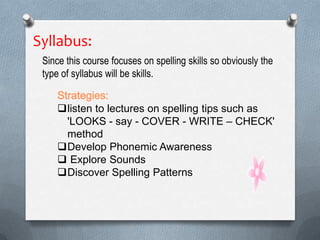
Syllabus:
Since this course focuses on spelling skills so obviously the
type of syllabus will be skills.
Strategies:
listen to lectures on spelling tips such as
'LOOKS - say - COVER - WRITE – CHECK'
method
Develop Phonemic Awareness
 Explore Sounds
Discover Spelling Patterns
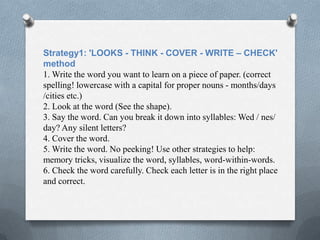
Strategy1: 'LOOKS - THINK - COVER - WRITE – CHECK'
method
1. Write the word you want to learn on a piece of paper. (correct
spelling! lowercase with a capital for proper nouns - months/days
/cities etc.)
2. Look at the word (See the shape).
3. Say the word. Can you break it down into syllables: Wed / nes/
day? Any silent letters?
4. Cover the word.
5. Write the word. No peeking! Use other strategies to help:
memory tricks, visualize the word, syllables, word-within-words.
6. Check the word carefully. Check each letter is in the right place
and correct.
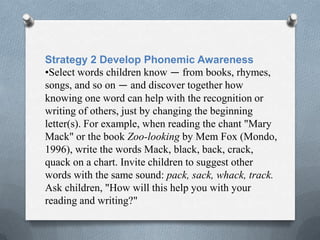
Strategy 2 Develop Phonemic Awareness
•Select words children know — from books, rhymes,
songs, and so on — and discover together how
knowing one word can help with the recognition or
writing of others, just by changing the beginning
letter(s). For example, when reading the chant "Mary
Mack" or the book Zoo-looking by Mem Fox (Mondo,
1996), write the words Mack, black, back, crack,
quack on a chart. Invite children to suggest other
words with the same sound: pack, sack, whack, track.
Ask children, "How will this help you with your
reading and writing?"
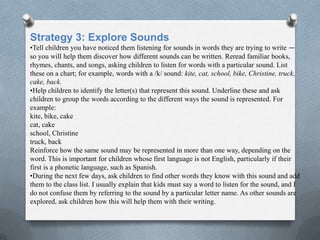
Strategy 3: Explore Sounds
•Tell children you have noticed them listening for sounds in words they are trying to write —
so you will help them discover how different sounds can be written. Reread familiar books,
rhymes, chants, and songs, asking children to listen for words with a particular sound. List
these on a chart; for example, words with a /k/ sound: kite, cat, school, bike, Christine, truck,
cake, back.
•Help children to identify the letter(s) that represent this sound. Underline these and ask
children to group the words according to the different ways the sound is represented. For
example:
kite, bike, cake
cat, cake
school, Christine
truck, back
Reinforce how the same sound may be represented in more than one way, depending on the
word. This is important for children whose first language is not English, particularly if their
first is a phonetic language, such as Spanish.
•During the next few days, ask children to find other words they know with this sound and add
them to the class list. I usually explain that kids must say a word to listen for the sound, and I
do not confuse them by referring to the sound by a particular letter name. As other sounds are
explored, ask children how this will help them with their writing.
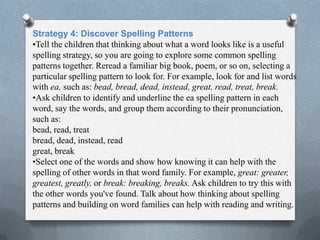
Strategy 4: Discover Spelling Patterns
•Tell the children that thinking about what a word looks like is a useful
spelling strategy, so you are going to explore some common spelling
patterns together. Reread a familiar big book, poem, or so on, selecting a
particular spelling pattern to look for. For example, look for and list words
with ea, such as: bead, bread, dead, instead, great, read, treat, break.
•Ask children to identify and underline the ea spelling pattern in each
word, say the words, and group them according to their pronunciation,
such as:
bead, read, treat
bread, dead, instead, read
great, break
•Select one of the words and show how knowing it can help with the
spelling of other words in that word family. For example, great: greater,
greatest, greatly, or break: breaking, breaks. Ask children to try this with
the other words you've found. Talk about how thinking about spelling
patterns and building on word families can help with reading and writing.
Content
1)The title of the text book:
“English spelling course”
Methodology :
2)Develop a sample activities
O Students will be given readymade texts containing spelling
mistakes and they are required to correct those mistakes
and differentiate between similar spelled words to help
them in comprehension reading . Besides, students will
listen to lecture about word form, syllabus, vowel sound
and the most misspelled words. Not only that but also
students will play small games and activities to practice
their spelling in a funny, interesting and effective way.
O Various ways of teaching will be used:
1. Writing the rules and spelling in the
bored and displaying a video or
pictures.
2. Audio like listening to pronunciation of
the words.
3. Listening tasks and dictations.
4. The use of different games such as
word cross, word build, missing letters
and so on.
Course Textbooks and Materials:
Kobayaa. Mohamad J. (2007). Correct Spelling and Dictation in
English. Lebanon, Beirut: Dar El Rateb.
http://www.artofspelling.com
http://www.skillsforlifenetwork.com/?atk=1335
Games:
http://www.bbc.co.uk/schools/ks2bitesize/english/spelling_grammar/spe
lling/play.shtml
http://www.spellzone.com/games/against_clock/index.cfm?wordlist=119
http://www.spellzone.com/games/word_search/index.cfm?wordlist=119
&width=13&height=10
http://www.spellzone.com/games/bouncing_anagram/index.cfm?wordlis
t=119&speed=2
http://www.spellzone.com/games/witch/index.cfm?wordlist=119&speed
=2
Practices:
http://www.spelling.hemscott.net/puzzles35.htm
http://www.studyzone.org/testprep/ela4/a/suffixp4.cfm
http://eps.schoolspecialty.com/external/read_write_think/practicing
_homophones.pdf
4)Strategies for teaching the course
 delivered in the classroom.
 students –centered learning approach .
 individual, pairs and group activities will be
applied.
 The theoretical part will integrated with
practical one (listening, reading and writing,
dictations and games).
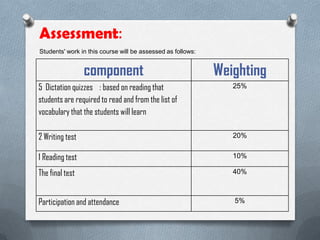
Assessment:
Students' work in this course will be assessed as follows:
component Weighting
5 Dictation quizzes : based on reading that
students are required to read and from the list of
vocabulary that the students will learn
25%
2 Writing test 20%
1 Reading test 10%
The final test 40%
Participation and attendance 5%
Course evaluation:
This course will be evaluated through three elements:
a)The performance in the first test will
be compared to the performance of
the pre-test.
b)Observation of students’
improvement through their portfolios.
c)Teachers & students feedback (what
they like about the course and how
they think the course should be
improved and developed)
Course Schedule:
Challenges and limitation
O the conflict of the member's
free time
O place of living is far from each
other
O Distributing and analyzing the
questionnaire
Our project, (2)

Our project, (2)

  • 1.
    English spelling course Doneby: Shareefa Al-Harrasi Huda Al-Belushi Dalal Al-Hajri
  • 2.
    Out line O Rationale ONeeds analysis: questionnaire & interview O Goalsobjectives O Types of syllabus O Content O Assessment and evaluation O Challenges
  • 3.
    Rational: O We havenoticed that 10 grade students lack the skills of spelling English words correctly. This problem in spelling has become one of the major reasons for misunderstanding of many words or mixing up the meaning of words which differ in one or two letters. Most of the students have difficulty memorizing the spelling of words in the right way. Therefore, it will affect their reading and writing skills negatively. They ;also, do not have the courage to write anything without checking a dictionary. O Gradually, this course will improve students spelling abilities. In addition, it will teach them how to avoid misspellings by using spelling strategies and tips and by recognizing spelling errors quickly. Moreover it will provide them with synonyms, antonyms, homonyms, suffixes and prefixes.
  • 4.
    Need Analysis:  Questionnaire:grade 10  2parts: 1. spelling exercise : eight multiple choice questions, to test the students' skills in spelling English vocabulary. • almost all the students did well in the first part. • our questions were very easy compared to their levels or maybe the students use a dictionary or ask for help while answering.
  • 5.
    2. measured thestudents' abilities and knowledge of spelling through scales questions..
  • 6.
    Results of the2nd part :  almost 55.1% were not good spellers.  Some students were not familiar with affixes, silent letters  not many students use effective strategies to memorize words such as dividing the word into syllables, or link it with sounds that they already familiar with.  Some students tended to spell the words according to their pronunciation, but they have difficulties with vowels, silent letters .  The majority of students prefer to use a dictionary while writing.
  • 7.
    By the endof the course students will: • Develop their spelling abilities in English language. • Develop their English language. • Build more vocabulary. • Develop their writing skills. • Develop their pronunciation skills. • Know the basic rules of spelling. • Apply spelling strategies and tips to memorize words. Goals:
  • 8.
    By the endof the course students are expected to: • Break words into syllabus to memorize them. • Divide long words into prefix and suffixes to memorize them. • Identify different plural forms added to the roots . • Recognize common synonyms, antonyms, homonyms, homophones and homographs easily. • Be familiar with compound words and derived. • Avoid misspellings by recognizing spelling errors quickly. • Distinguish between vowels and silent sounds. • Write a text without any spelling mistakes. Objectives:
  • 9.
    Syllabus: Since this coursefocuses on spelling skills so obviously the type of syllabus will be skills. Strategies: listen to lectures on spelling tips such as 'LOOKS - say - COVER - WRITE – CHECK' method Develop Phonemic Awareness  Explore Sounds Discover Spelling Patterns
  • 10.
    Strategy1: 'LOOKS -THINK - COVER - WRITE – CHECK' method 1. Write the word you want to learn on a piece of paper. (correct spelling! lowercase with a capital for proper nouns - months/days /cities etc.) 2. Look at the word (See the shape). 3. Say the word. Can you break it down into syllables: Wed / nes/ day? Any silent letters? 4. Cover the word. 5. Write the word. No peeking! Use other strategies to help: memory tricks, visualize the word, syllables, word-within-words. 6. Check the word carefully. Check each letter is in the right place and correct.
  • 11.
    Strategy 2 DevelopPhonemic Awareness •Select words children know — from books, rhymes, songs, and so on — and discover together how knowing one word can help with the recognition or writing of others, just by changing the beginning letter(s). For example, when reading the chant "Mary Mack" or the book Zoo-looking by Mem Fox (Mondo, 1996), write the words Mack, black, back, crack, quack on a chart. Invite children to suggest other words with the same sound: pack, sack, whack, track. Ask children, "How will this help you with your reading and writing?"
  • 12.
    Strategy 3: ExploreSounds •Tell children you have noticed them listening for sounds in words they are trying to write — so you will help them discover how different sounds can be written. Reread familiar books, rhymes, chants, and songs, asking children to listen for words with a particular sound. List these on a chart; for example, words with a /k/ sound: kite, cat, school, bike, Christine, truck, cake, back. •Help children to identify the letter(s) that represent this sound. Underline these and ask children to group the words according to the different ways the sound is represented. For example: kite, bike, cake cat, cake school, Christine truck, back Reinforce how the same sound may be represented in more than one way, depending on the word. This is important for children whose first language is not English, particularly if their first is a phonetic language, such as Spanish. •During the next few days, ask children to find other words they know with this sound and add them to the class list. I usually explain that kids must say a word to listen for the sound, and I do not confuse them by referring to the sound by a particular letter name. As other sounds are explored, ask children how this will help them with their writing.
  • 13.
    Strategy 4: DiscoverSpelling Patterns •Tell the children that thinking about what a word looks like is a useful spelling strategy, so you are going to explore some common spelling patterns together. Reread a familiar big book, poem, or so on, selecting a particular spelling pattern to look for. For example, look for and list words with ea, such as: bead, bread, dead, instead, great, read, treat, break. •Ask children to identify and underline the ea spelling pattern in each word, say the words, and group them according to their pronunciation, such as: bead, read, treat bread, dead, instead, read great, break •Select one of the words and show how knowing it can help with the spelling of other words in that word family. For example, great: greater, greatest, greatly, or break: breaking, breaks. Ask children to try this with the other words you've found. Talk about how thinking about spelling patterns and building on word families can help with reading and writing.
  • 14.
    Content 1)The title ofthe text book: “English spelling course” Methodology : 2)Develop a sample activities O Students will be given readymade texts containing spelling mistakes and they are required to correct those mistakes and differentiate between similar spelled words to help them in comprehension reading . Besides, students will listen to lecture about word form, syllabus, vowel sound and the most misspelled words. Not only that but also students will play small games and activities to practice their spelling in a funny, interesting and effective way.
  • 15.
    O Various waysof teaching will be used: 1. Writing the rules and spelling in the bored and displaying a video or pictures. 2. Audio like listening to pronunciation of the words. 3. Listening tasks and dictations. 4. The use of different games such as word cross, word build, missing letters and so on.
  • 16.
    Course Textbooks andMaterials: Kobayaa. Mohamad J. (2007). Correct Spelling and Dictation in English. Lebanon, Beirut: Dar El Rateb. http://www.artofspelling.com http://www.skillsforlifenetwork.com/?atk=1335 Games: http://www.bbc.co.uk/schools/ks2bitesize/english/spelling_grammar/spe lling/play.shtml http://www.spellzone.com/games/against_clock/index.cfm?wordlist=119 http://www.spellzone.com/games/word_search/index.cfm?wordlist=119 &width=13&height=10 http://www.spellzone.com/games/bouncing_anagram/index.cfm?wordlis t=119&speed=2 http://www.spellzone.com/games/witch/index.cfm?wordlist=119&speed =2
  • 17.
  • 18.
    4)Strategies for teachingthe course  delivered in the classroom.  students –centered learning approach .  individual, pairs and group activities will be applied.  The theoretical part will integrated with practical one (listening, reading and writing, dictations and games).
  • 19.
    Assessment: Students' work inthis course will be assessed as follows: component Weighting 5 Dictation quizzes : based on reading that students are required to read and from the list of vocabulary that the students will learn 25% 2 Writing test 20% 1 Reading test 10% The final test 40% Participation and attendance 5%
  • 20.
    Course evaluation: This coursewill be evaluated through three elements: a)The performance in the first test will be compared to the performance of the pre-test. b)Observation of students’ improvement through their portfolios. c)Teachers & students feedback (what they like about the course and how they think the course should be improved and developed)
  • 21.
  • 22.
    Challenges and limitation Othe conflict of the member's free time O place of living is far from each other O Distributing and analyzing the questionnaire