CSUF, Department of Literacy
and Reading Education
and
Orange County Reading Association
INQUIRY BASED
SPELLING INSTRUCTION
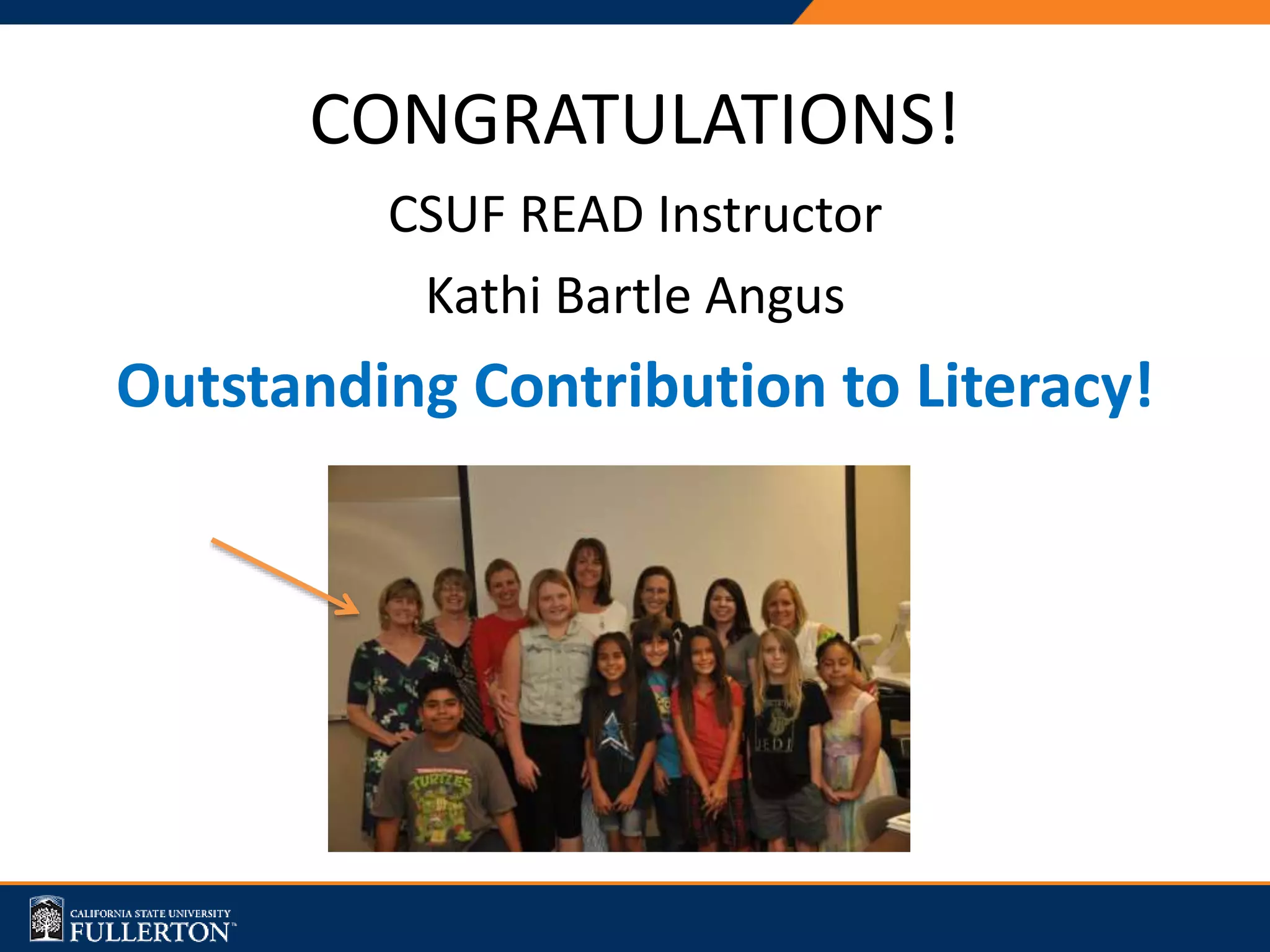
CONGRATULATIONS!
CSUF READ Instructor
Kathi Bartle Angus
Outstanding Contribution to Literacy!
Today’s Agenda
• Breakfast
• Welcome!
• Awards presentation
• What is developmental spelling?
• Explore sorting formats (20 min)
• Great games ANY level speller will love (20
minutes)
• What might the routine for the week look like?
Think-Write-Pair-Share
Think: How do you spell -------------?
Write: Try and spell the word.
Pair: How did you spell it? What were your
strategies for spelling?
Share: Who can share what their partner said?
Deliquescence
Deliquescent materials are substances (mostly salts) that have a
strong affinity for moisture and will absorb relatively large amounts
of water from the atmosphere if exposed to it, forming a liquid
solution. Deliquescent salts include calcium chloride, magnesium
chloride, zinc chloride, potassium carbonate, potassium phosphate,
carnallite, ferric ammonium citrate, potassium hydroxide, ferric
chloride, and sodium hydroxide. Owing to their very high affinity for
water, these substances are often used as desiccants, which is also
an application for concentrated sulfuric and phosphoric acids. These
compounds are used in the chemical industry to remove the water
produced by chemical reactions
HOW DO WE LEARN TO SPELL
(ENCODE)?
Developmental Spelling
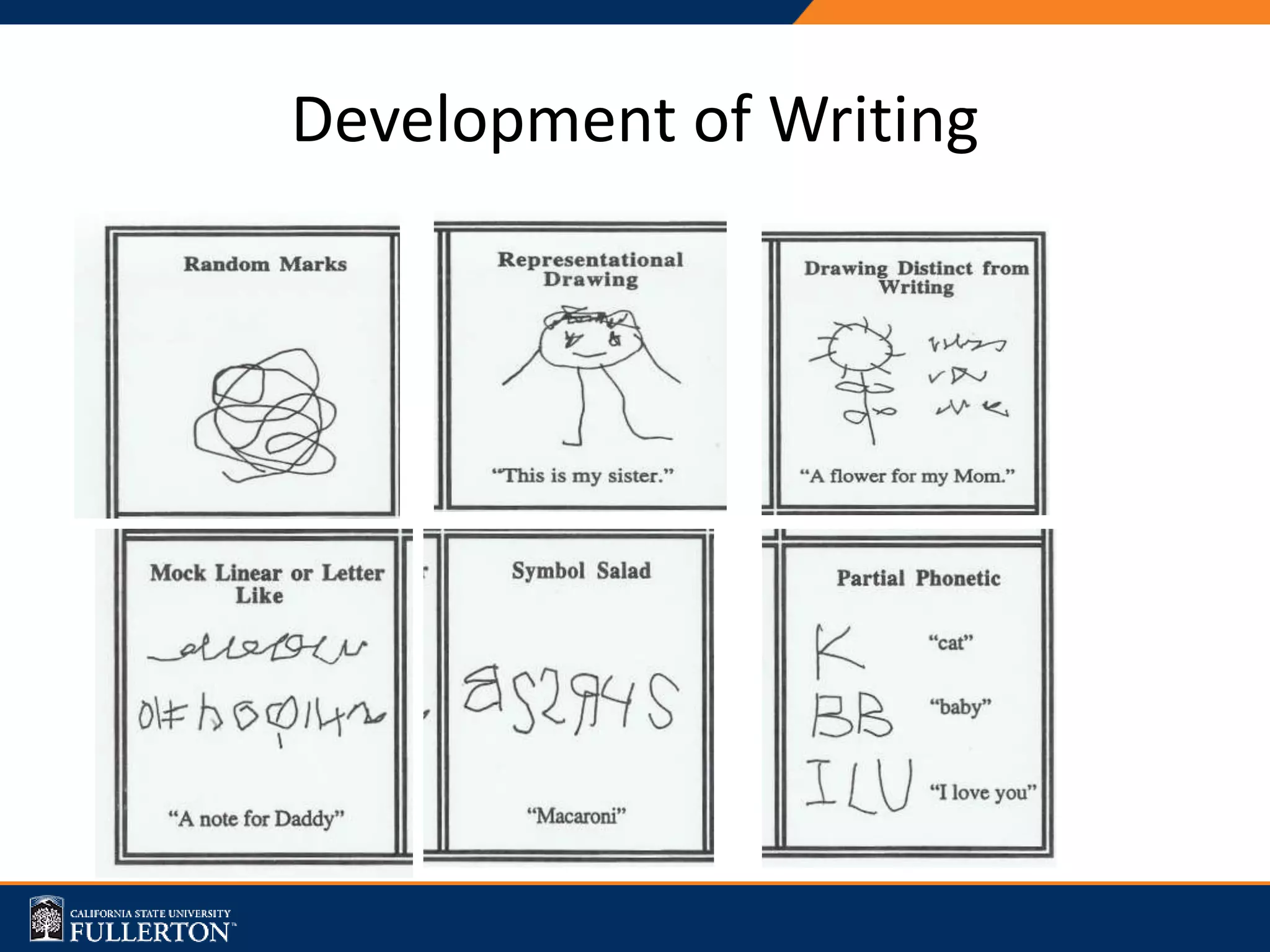
Development of Writing
The Relationship between the Stages of Spelling
and Reading Development
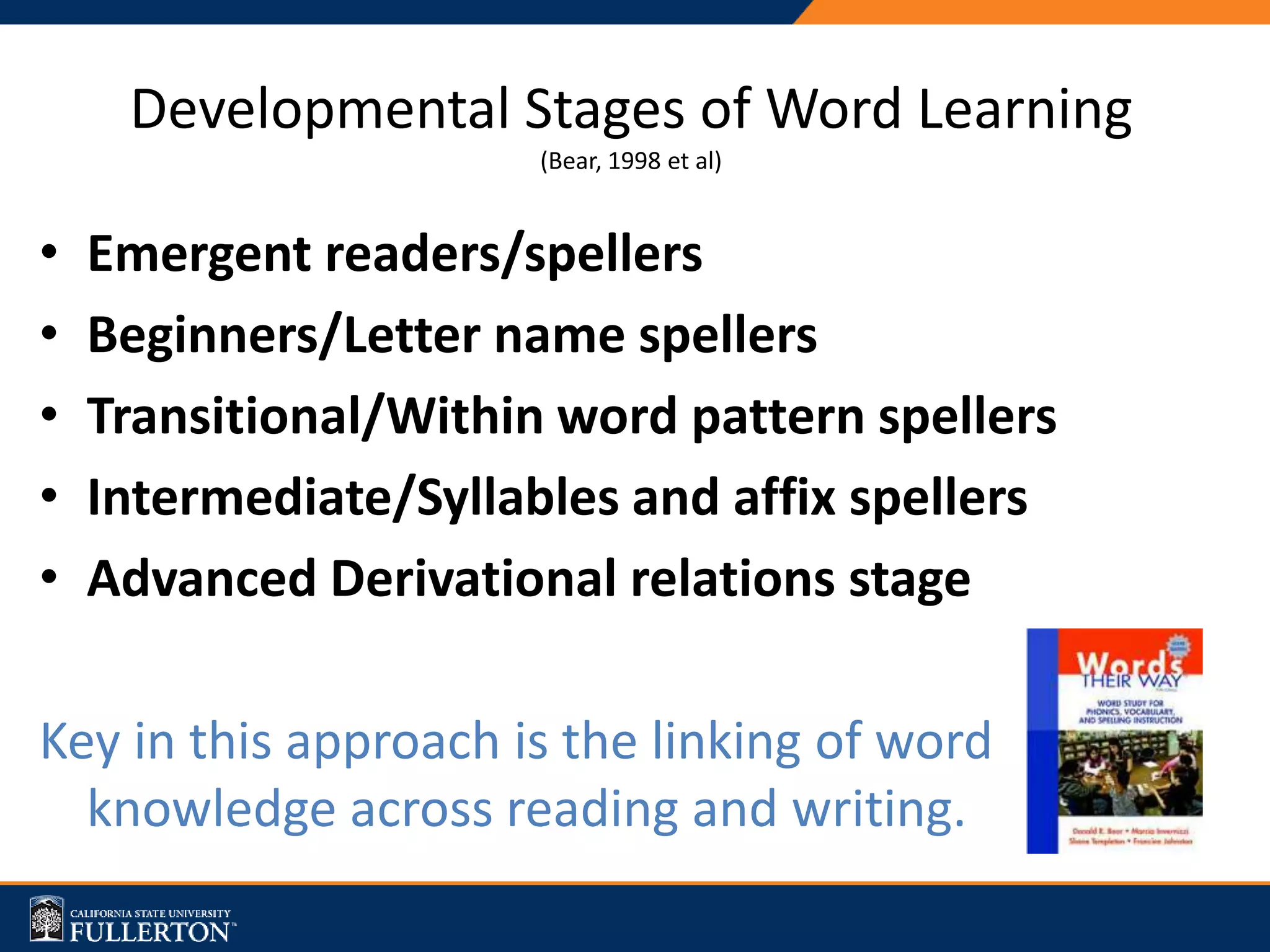
Developmental Stages of Word Learning
(Bear, 1998 et al)
• Emergent readers/spellers
• Beginners/Letter name spellers
• Transitional/Within word pattern spellers
• Intermediate/Syllables and affix spellers
• Advanced Derivational relations stage
Key in this approach is the linking of word
knowledge across reading and writing.
Levels of Spelling
and the Spelling/Reading Connection
WHAT CONNECTIONS DO YOU SEE
BETWEEN READING AND SPELLING?
It’s all related
The Emergent Stage
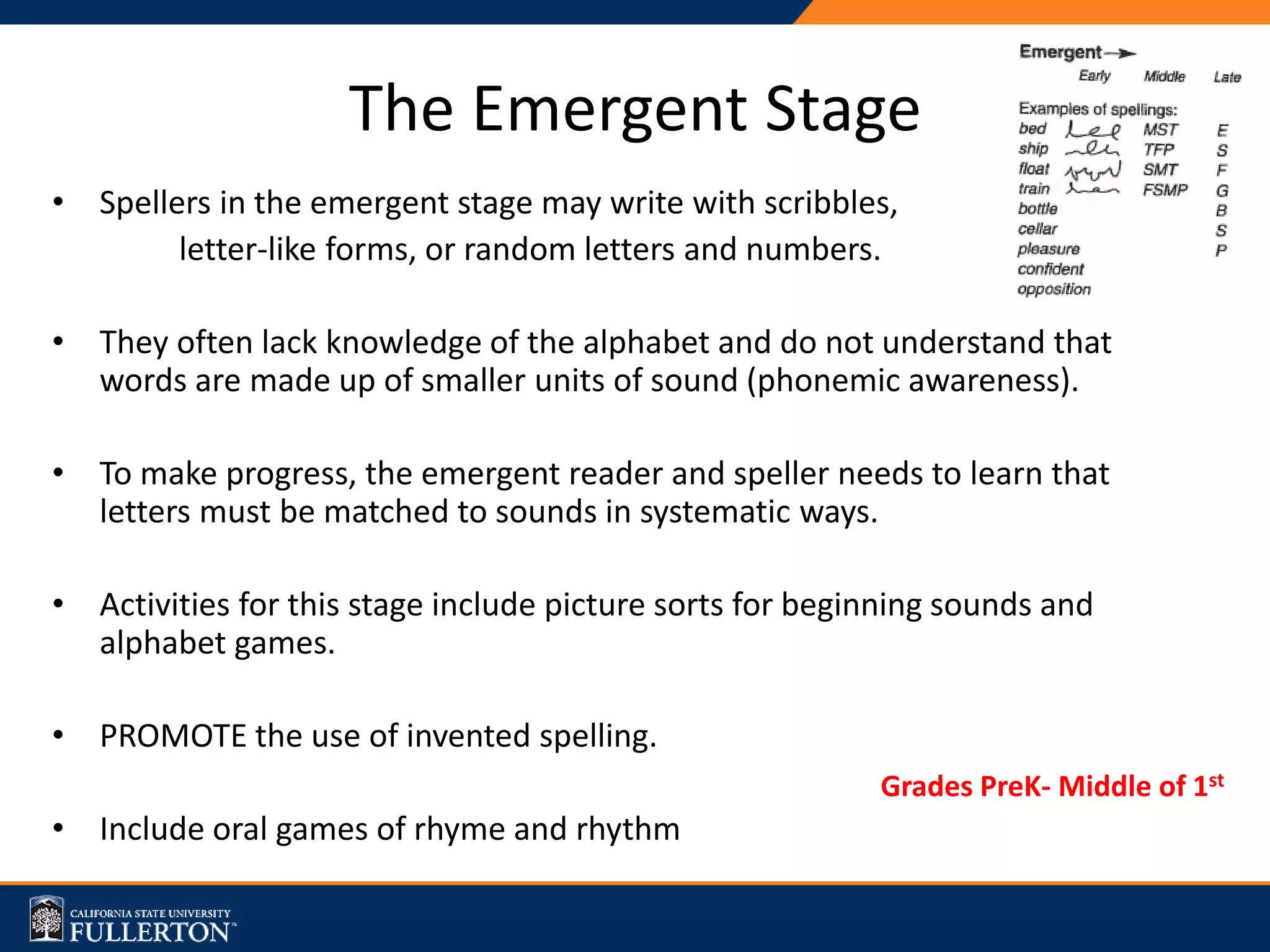
• Spellers in the emergent stage may write with scribbles,
letter-like forms, or random letters and numbers.
• They often lack knowledge of the alphabet and do not understand that
words are made up of smaller units of sound (phonemic awareness).
• To make progress, the emergent reader and speller needs to learn that
letters must be matched to sounds in systematic ways.
• Activities for this stage include picture sorts for beginning sounds and
alphabet games.
• PROMOTE the use of invented spelling.
• Include oral games of rhyme and rhythm
Grades PreK- Middle of 1st
The Letter-Name Alphabetic Stage
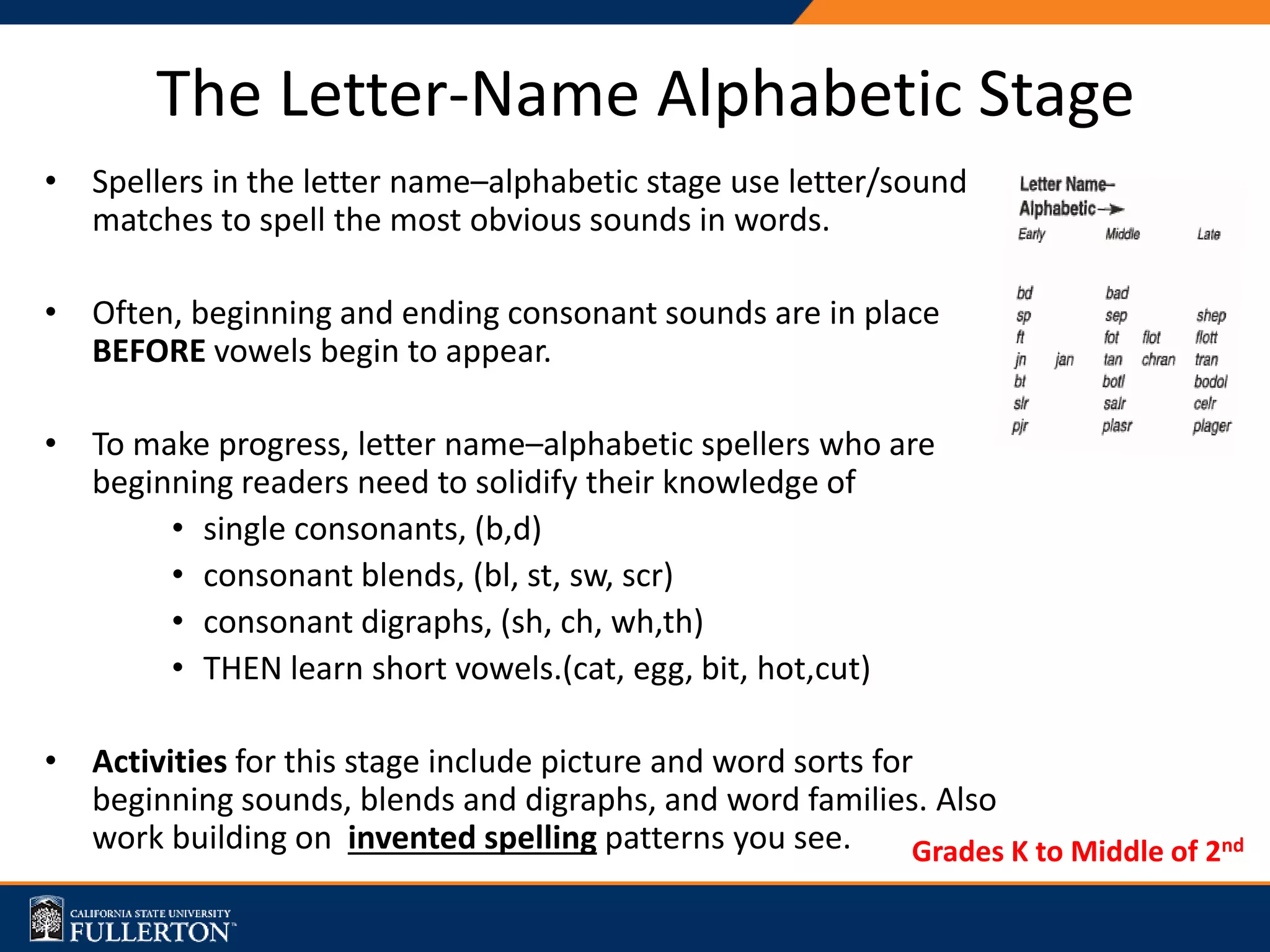
• Spellers in the letter name–alphabetic stage use letter/sound
matches to spell the most obvious sounds in words.
• Often, beginning and ending consonant sounds are in place
BEFORE vowels begin to appear.
• To make progress, letter name–alphabetic spellers who are
beginning readers need to solidify their knowledge of
• single consonants, (b,d)
• consonant blends, (bl, st, sw, scr)
• consonant digraphs, (sh, ch, wh,th)
• THEN learn short vowels.(cat, egg, bit, hot,cut)
• Activities for this stage include picture and word sorts for
beginning sounds, blends and digraphs, and word families. Also
work building on invented spelling patterns you see. Grades K to Middle of 2nd
The Within-Word Pattern Stage
• know about short vowels and the short vowel pattern,
the consonant-vowel-consonant (CVC) pattern.
• Explore common long vowel patterns.
• Focus on one long vowel sound
(e.g. long-a is seen in many words that have /ai/ in the middle, as in
nail, rail, and tail. These words are examples of the consonant-vowel-
vowel-consonant pattern (CVVC), and this pattern will be found
throughout their studies of long vowels, as in cheap and boat.
• Also CVV patterns (toe)
• Compare long vowel to short patterns (cap/cape)
• Activities: picture sorts that focus on vowel discrimination for long and
short and across long vowels. The word sorts focus on patterns.
Grades 1st to Middle of 4th
The Syllables and Affixes Stage
A MOVEMENT TOWARD POLYSYLLABIC WORDS
• have mastered many of the vowel patterns in one-syllable words.
• They have a good foundation for spelling words with
– two or more syllables
– base words and affixes.
• Explore rules that govern consonant doubling at the syllable juncture
and before suffixes (coma vs. comma, or hoping vs. hopping).
• Explore common prefixes (un-, re-, dis-) and suffixes (-ly, -ful) as well
as the spelling of unaccented syllables (-er, -ar, -or and el, le, al)
• Activities for this stage continue to focus on word sorts, word hunts,
and games..
Grades 3rd to 8th
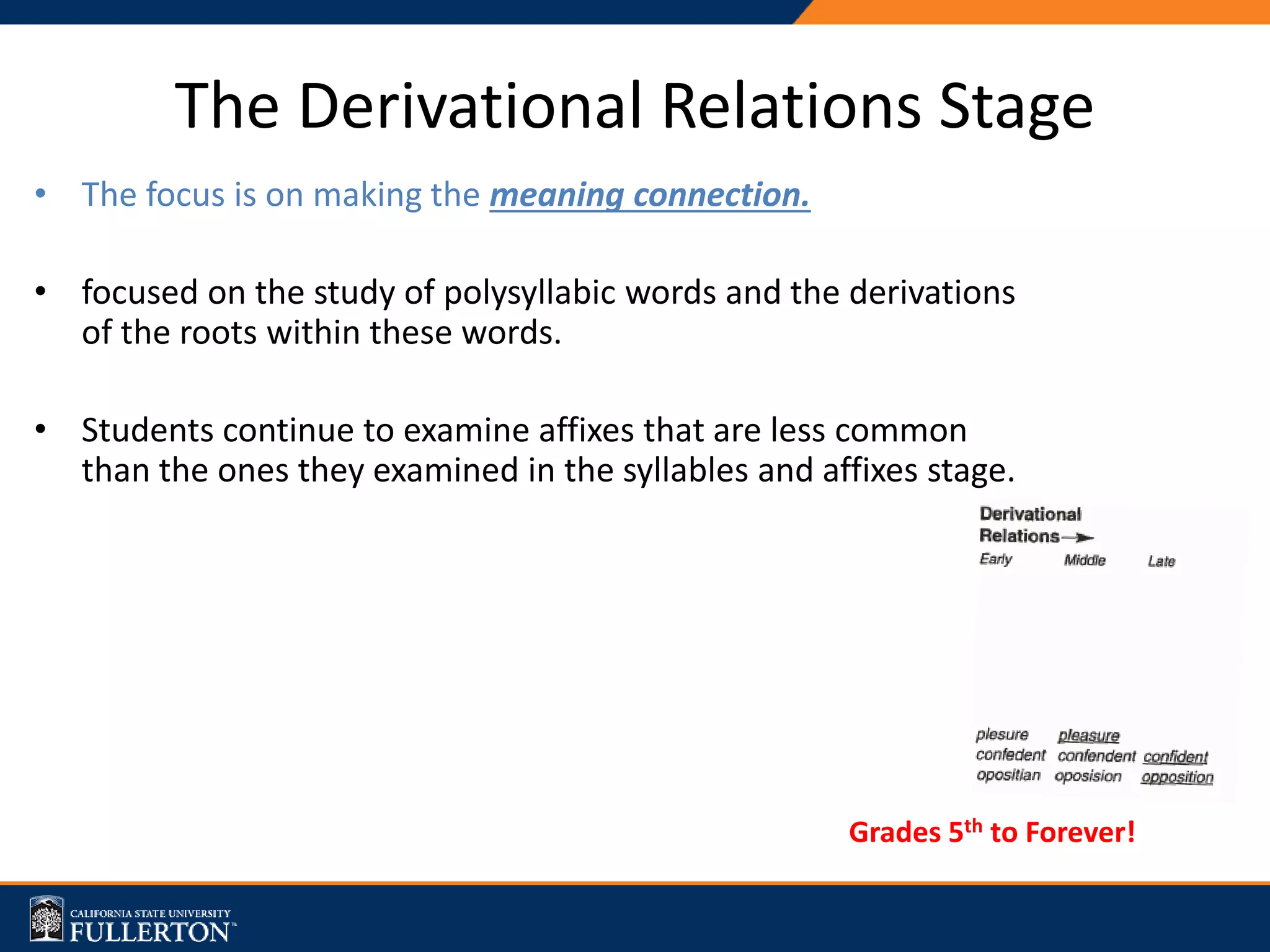
The Derivational Relations Stage
• The focus is on making the meaning connection.
• focused on the study of polysyllabic words and the derivations
of the roots within these words.
• Students continue to examine affixes that are less common
than the ones they examined in the syllables and affixes stage.
Grades 5th to Forever!
WHAT IS YOUR TAKE-AWAY ON THE
ELEMENTS OF THE DIFFERENT STAGES?
STUDENTS PROGRESS THROUGH
THE STAGES AT THEIR OWN PACE
Let’s take a look at a child moving through the grades
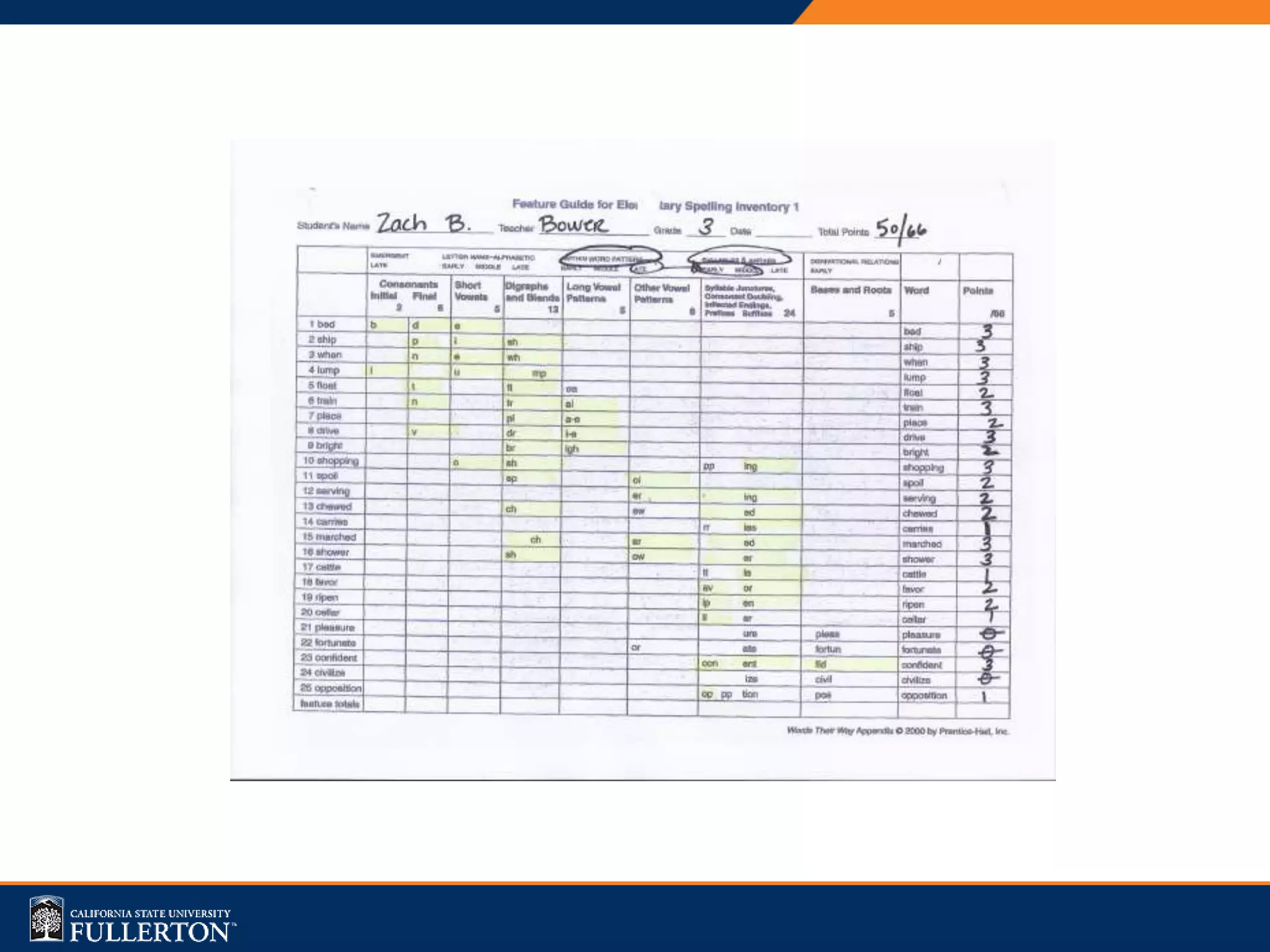
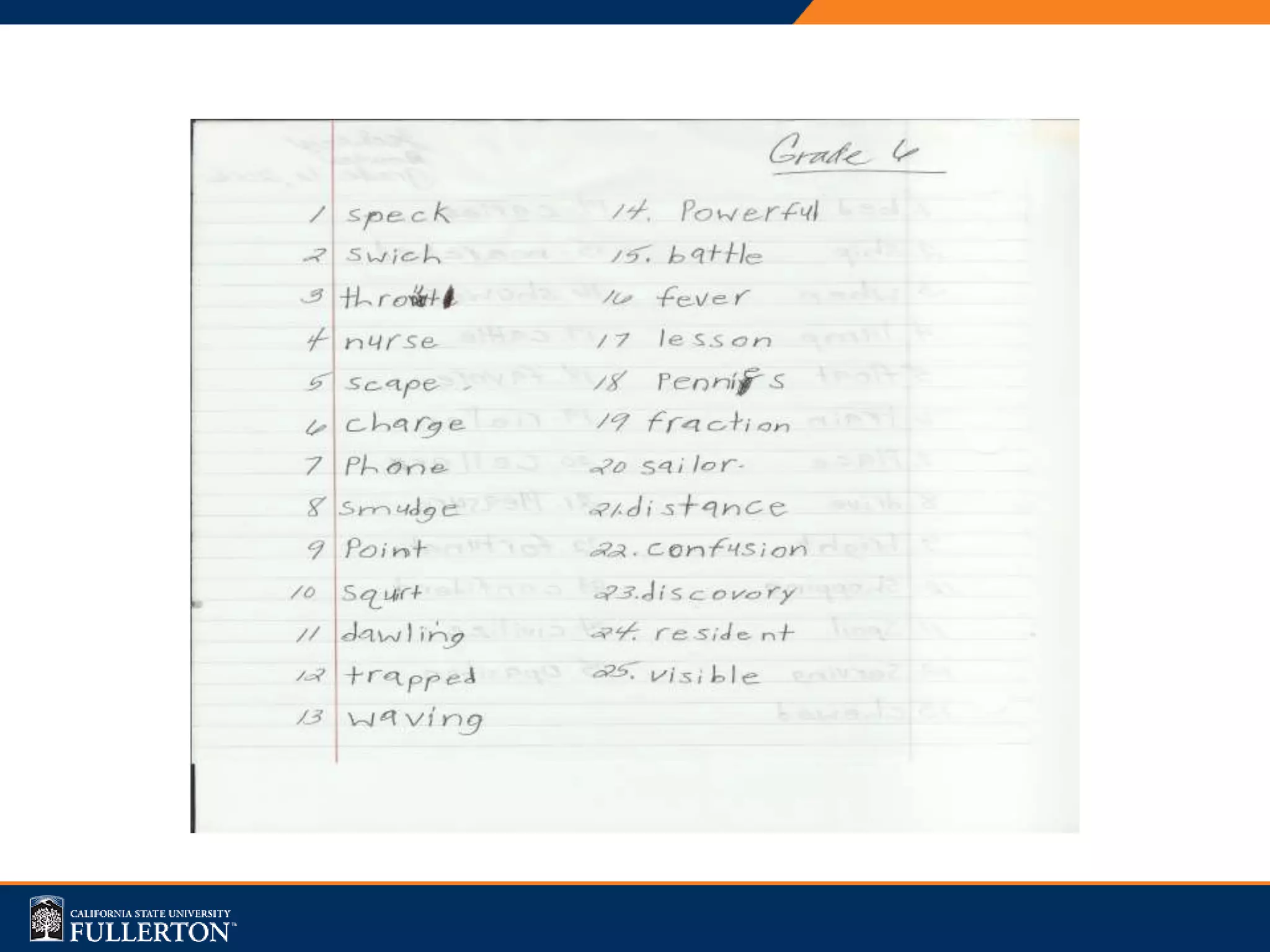
Qualitative Spelling Inventory
Second Grade Sample- 5 correctly spelled words
37/66 features
13 words spelled correctly
50/66 features
21 words spelled correctly
64/66 features
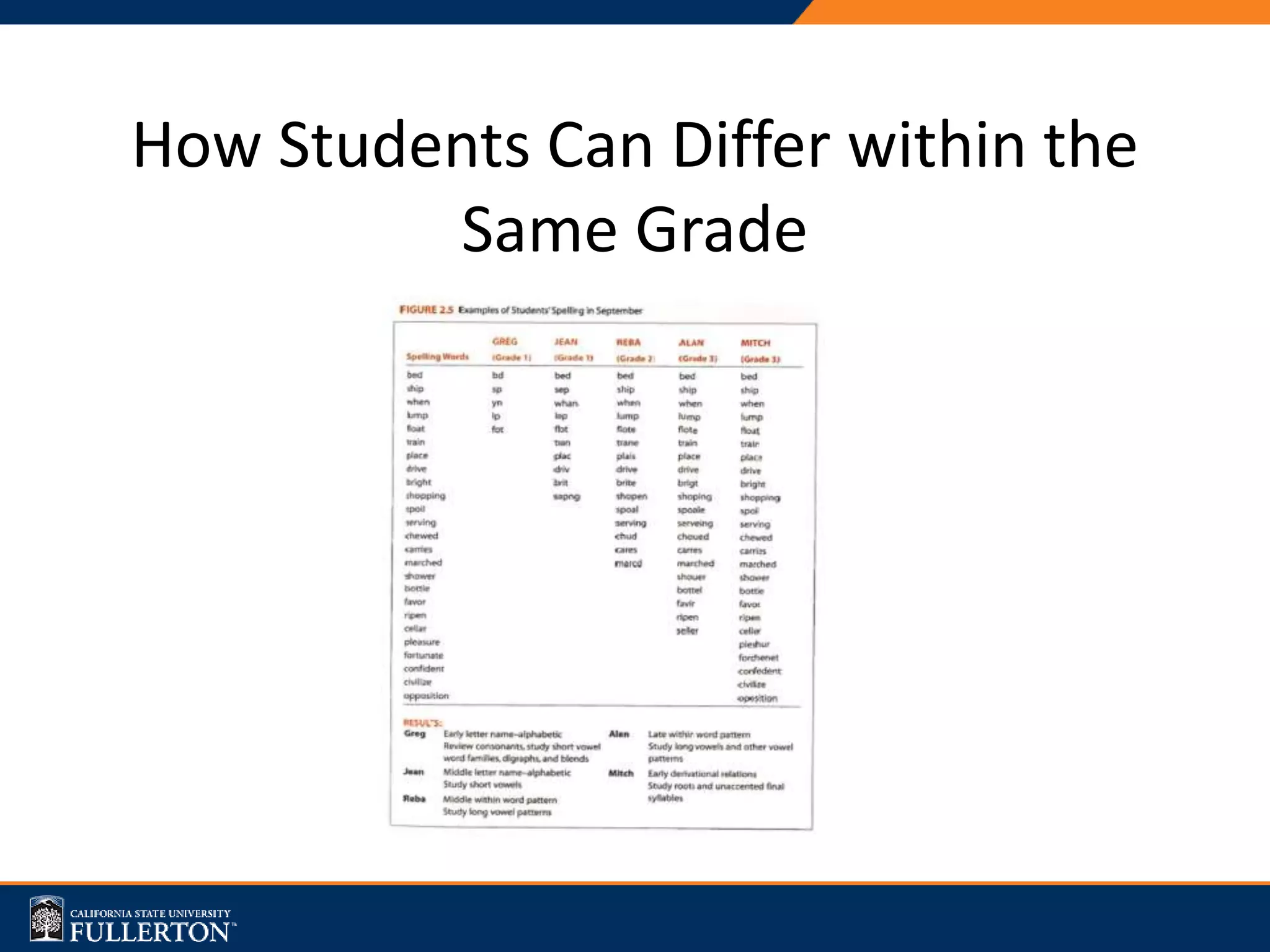
How Students Can Differ within the
Same Grade
Administering and Scoring
How do I figure out where they are?
Word List Given Just Like a Spelling
Test
How do I score?
Examining word-features
(Which parts of words do they know how to spell?)
• You will need:
• highlighter
• pencil
• each student’s test
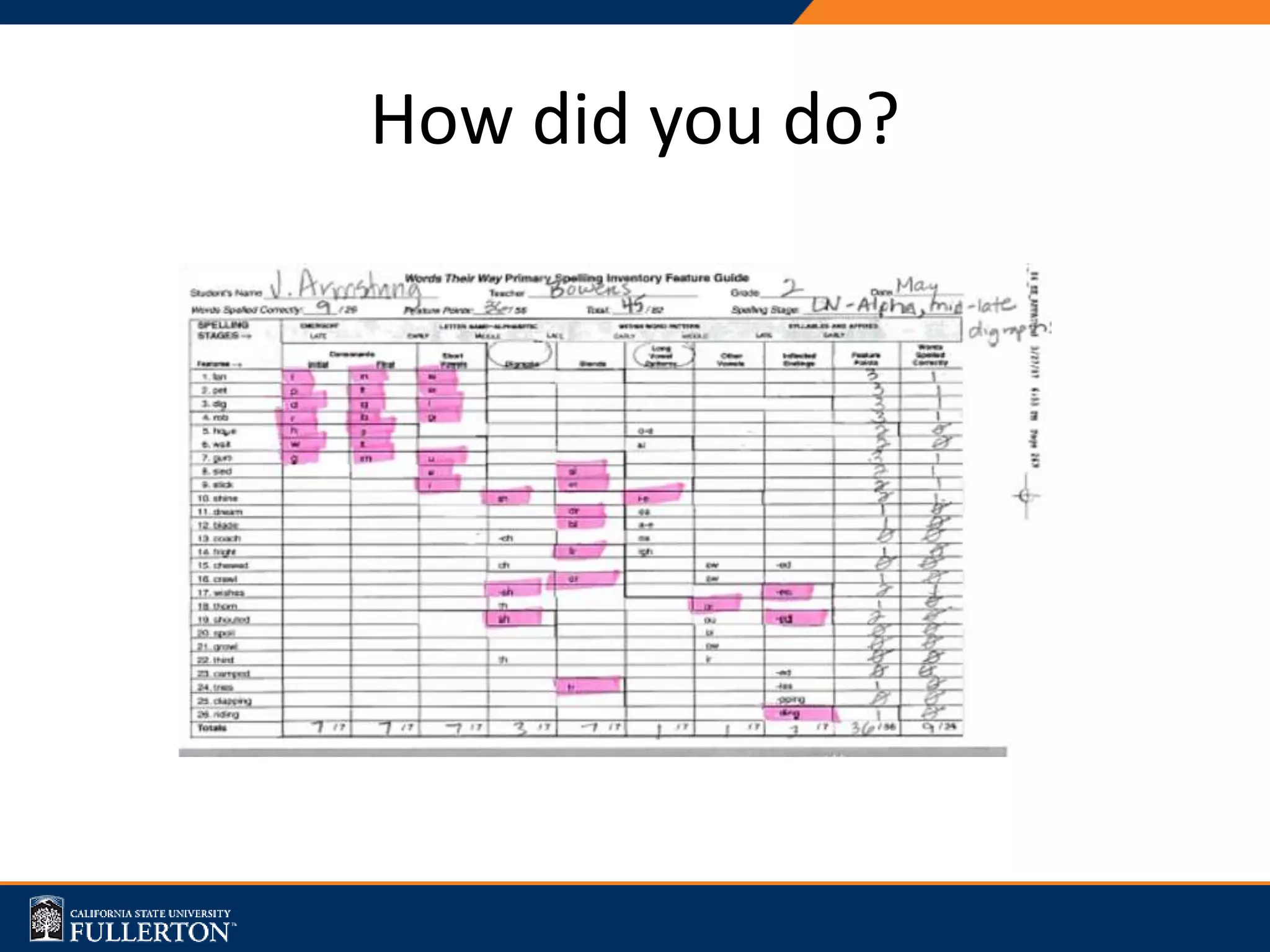
• A WTW Feature Guide worksheet.
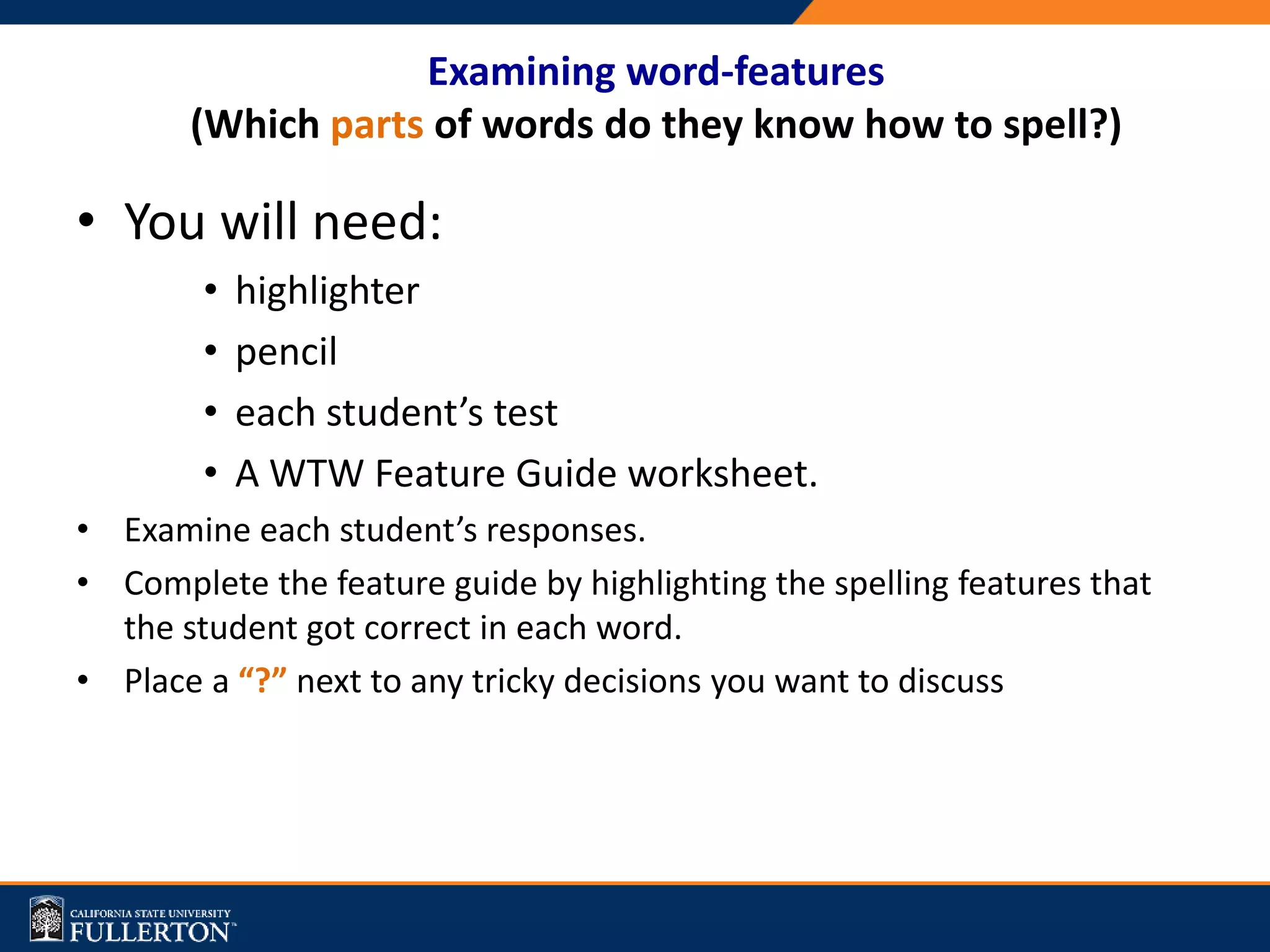
• Examine each student’s responses.
• Complete the feature guide by highlighting the spelling features that
the student got correct in each word.
• Place a “?” next to any tricky decisions you want to discuss
Helpful Hints on Scoring (WTW, p. 34)
• Highlight what they have spelled correctly.
• Although you calculate both, the number of correct features is
more important than the number of words spelled correctly.
• Reversals should be noted (b for d) but not counted against
young spellers
• Beginning spellers may add vowels to the end of words or
confuse the order of vowels. WTW says to give credit for the
consonants and vowels, but don’t give credit for the correctly
spelled word.
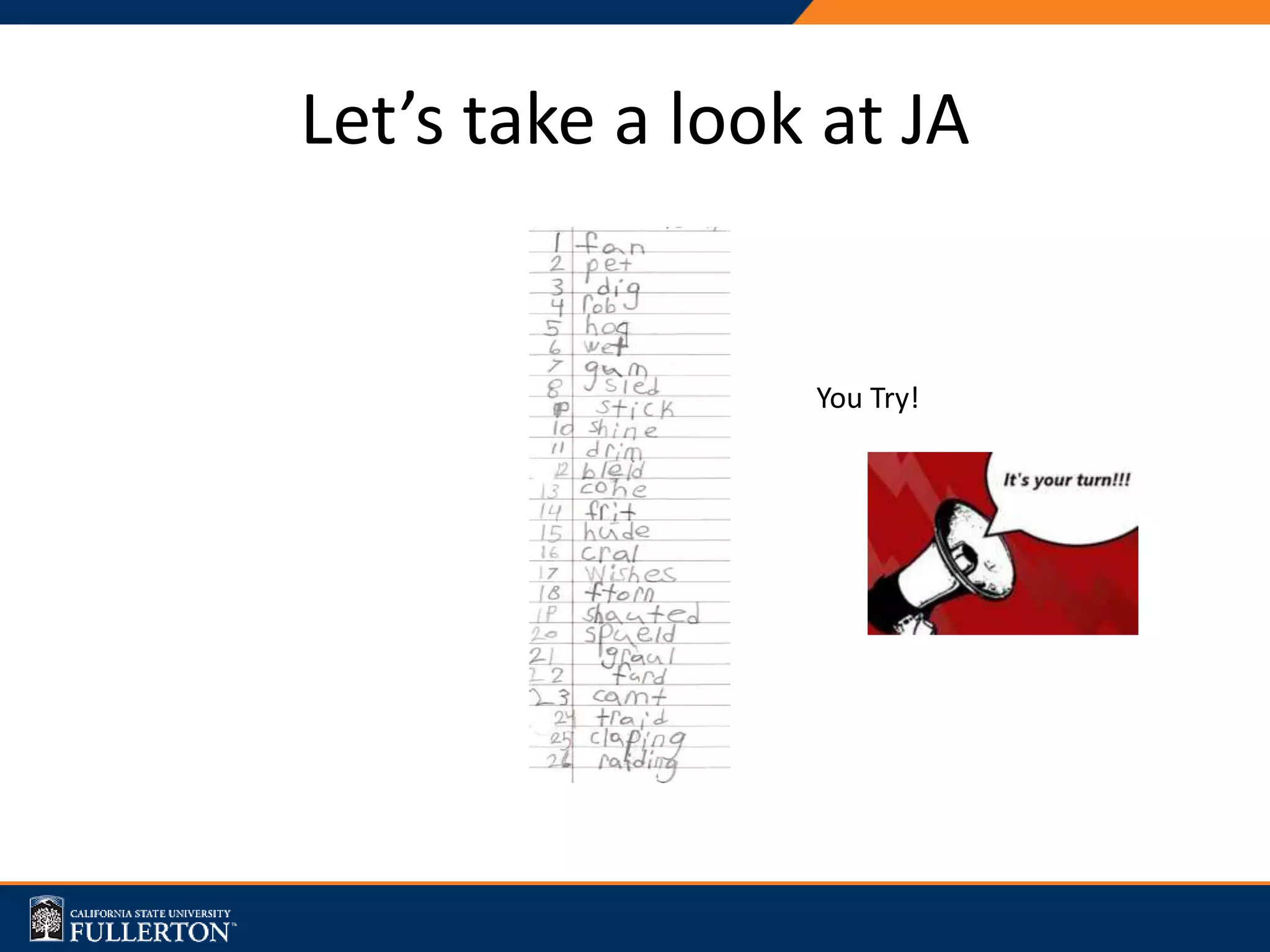
Let’s take a look at JA
You Try!
How did you do?
A Few More Hints
Primary Spelling Inventory
• If a child spells 22 words correctly, give the
Elementary SI
Elementary Spelling Inventory
• If a child spells 20 words correctly, give the
Upper-Level SI
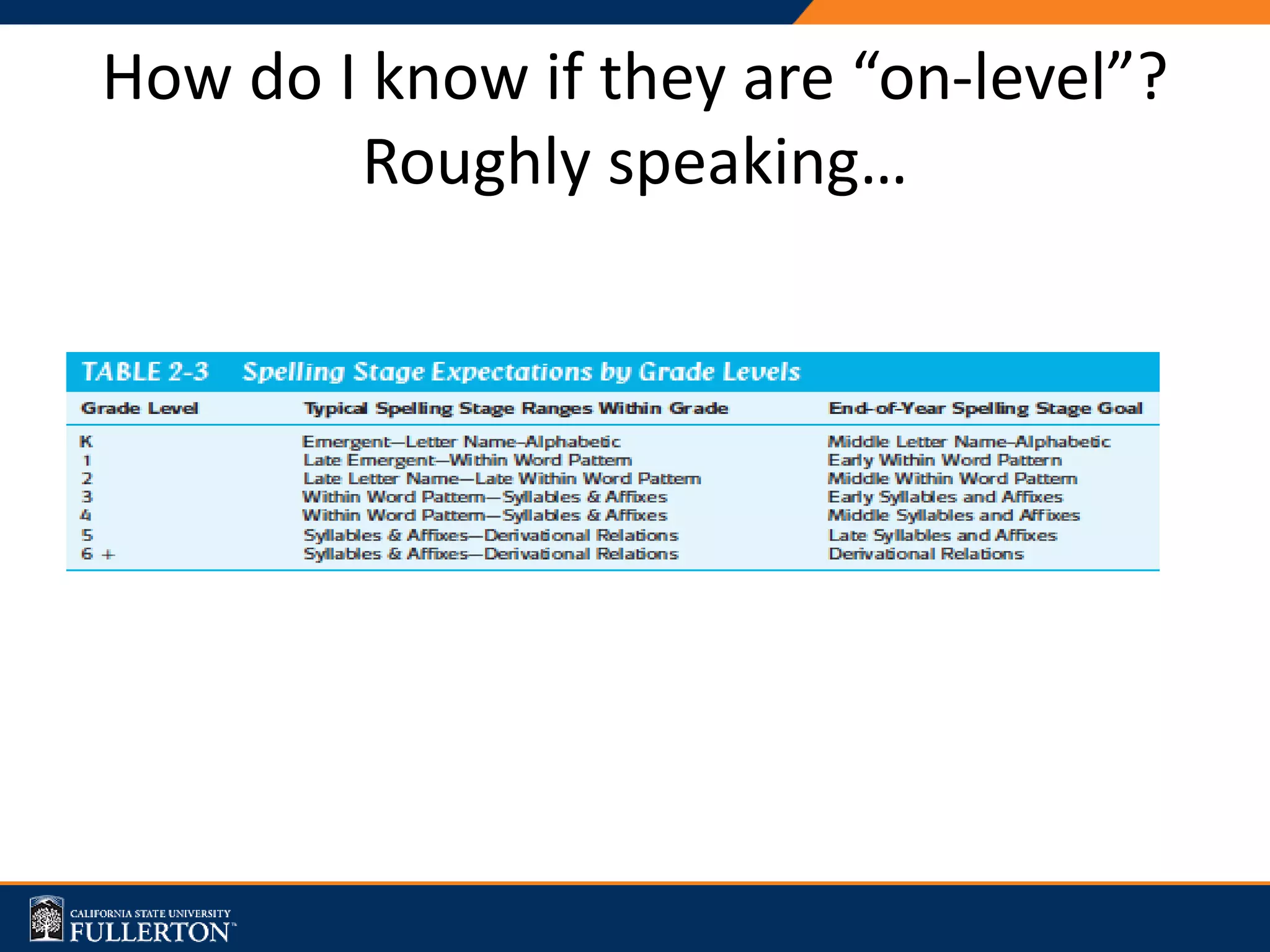
How do I know if they are “on-level”?
Roughly speaking…
Video demonstrations- Assessment
• https://www.youtube.com/watch?v=GlGkzJPC
4HY
• https://www.youtube.com/watch?v=CtfU1Qsv
Yk0
• https://www.youtube.com/watch?v=qtNn27u
OgRw
• https://www.youtube.com/watch?v=l7k_8vhN
p6I
I’VE ASSESSED AND GROUPED-
NOW WHAT?
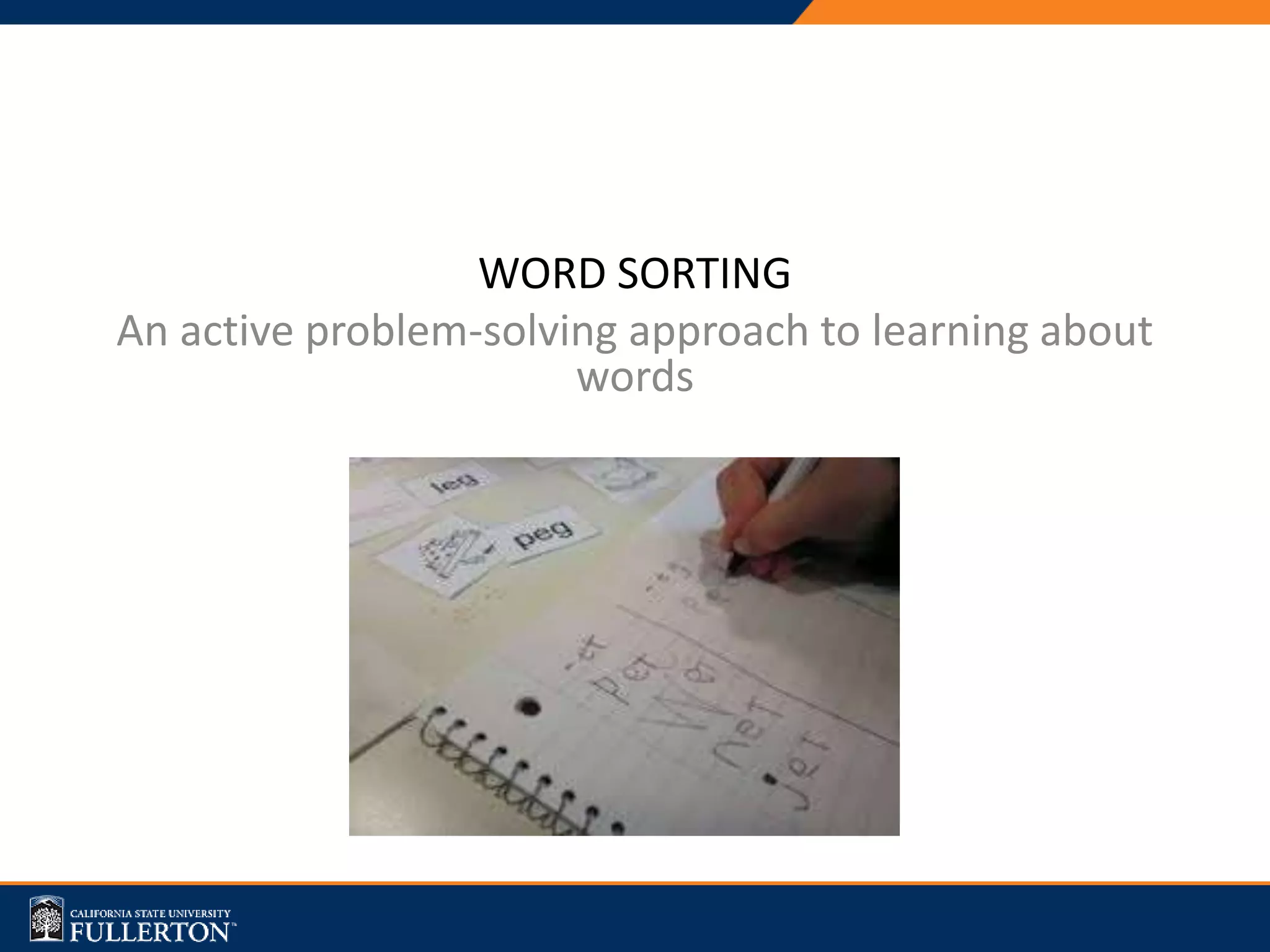
WORD SORTING
An active problem-solving approach to learning about
words
• Word sorting relies on focusing a speller’s visual
attending to letters, letter combinations and
word parts WHILE THINKING!
• The power is in active reflection and decision-
making while linking the visual features of words
to the spelling pattern
• REPETITION through revisiting words is
ESSENTIAL to making the patterns stick.
Word Sorting
Where to Begin?
Picture or Word Sorting
Sorting Overview:
• https://www.youtube.com/watch?v=-eH5KiH9lgw
Picture Sorting:
• https://www.youtube.com/watch?v=m7DCBpuuNJ4
Word Sorting:
(teacher led, small group)
• https://www.youtube.com/watch?v=sjgUx7zSX14
(children independently sorting)
• https://www.youtube.com/watch?v=UAoHriJ6_1Y
Remember, while you may be tempted to think
that cutting and sticking words into a workbook
is kinesthetic learning, glue and scissors will not
teach your kids to spell!
INSTRUCTIONAL TIME must go into DISCOVERING
and/or APPLYING knowledge of word patterns.
Word Sorting is not a Magic Bullet!
• Activity relies on discerning patterns rather than
on applying them
• Students create the categories as they examine
the words
• Reveals diagnostic information about what
students know and understand – or
misunderstand.
• Leads to productive discussion around justifying
why the students sorted words in the ways they
did
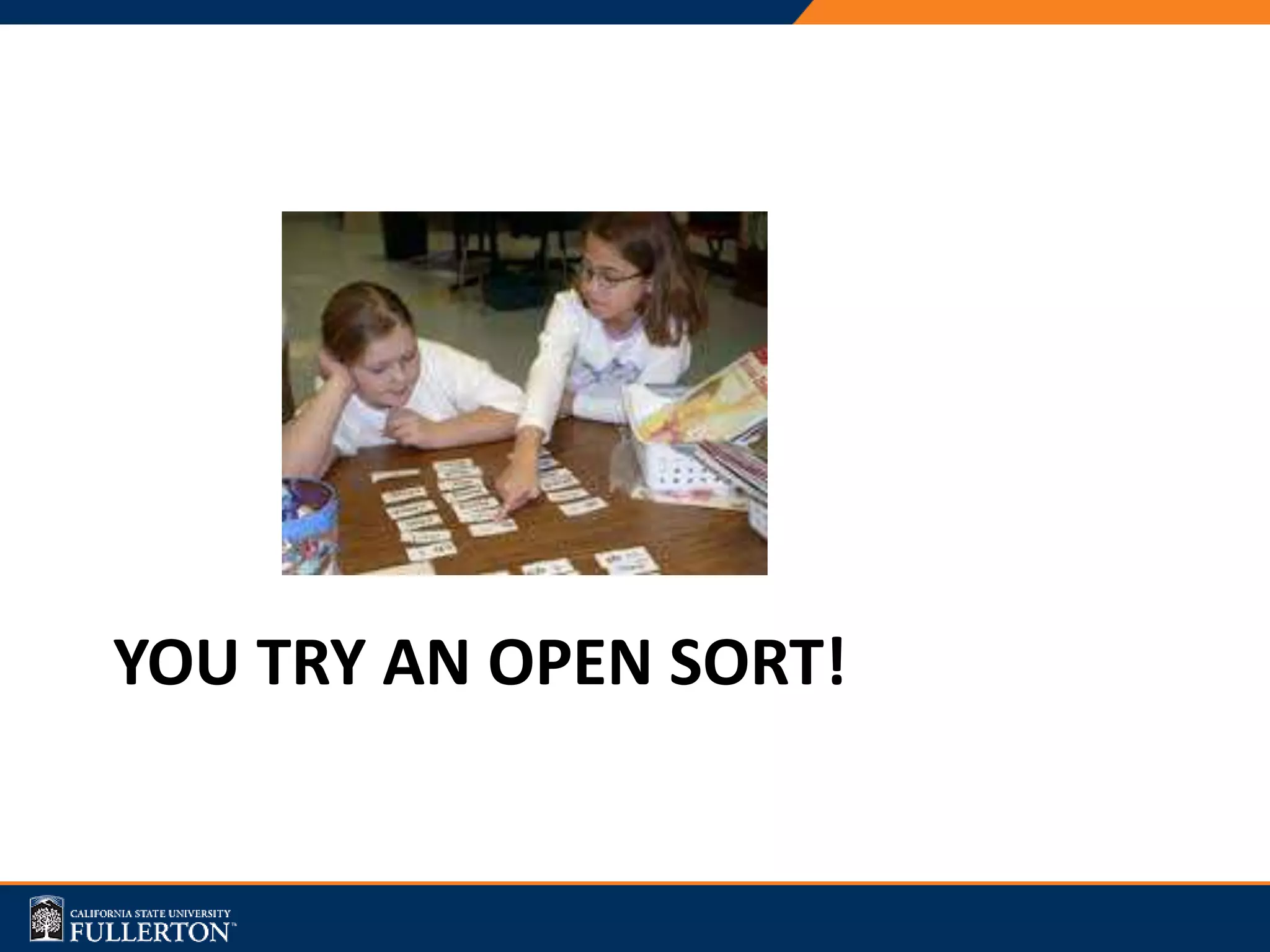
Open Sorts
YOU TRY AN OPEN SORT!
• Introduces students to word sort tasks
• Teacher-directed – the patterns are highlighted
and outlined
• Model the thinking process of problem-solving
a few times – think aloud.
• Follow this up with lots of discussion
– Students must articulate decision-making for words
placed in categories
Closed Sorts
• Add a stopwatch to an open, closed or written
sort to assist speed of processing and develop
speed in paying close attention to word
features.
Speed Sorts
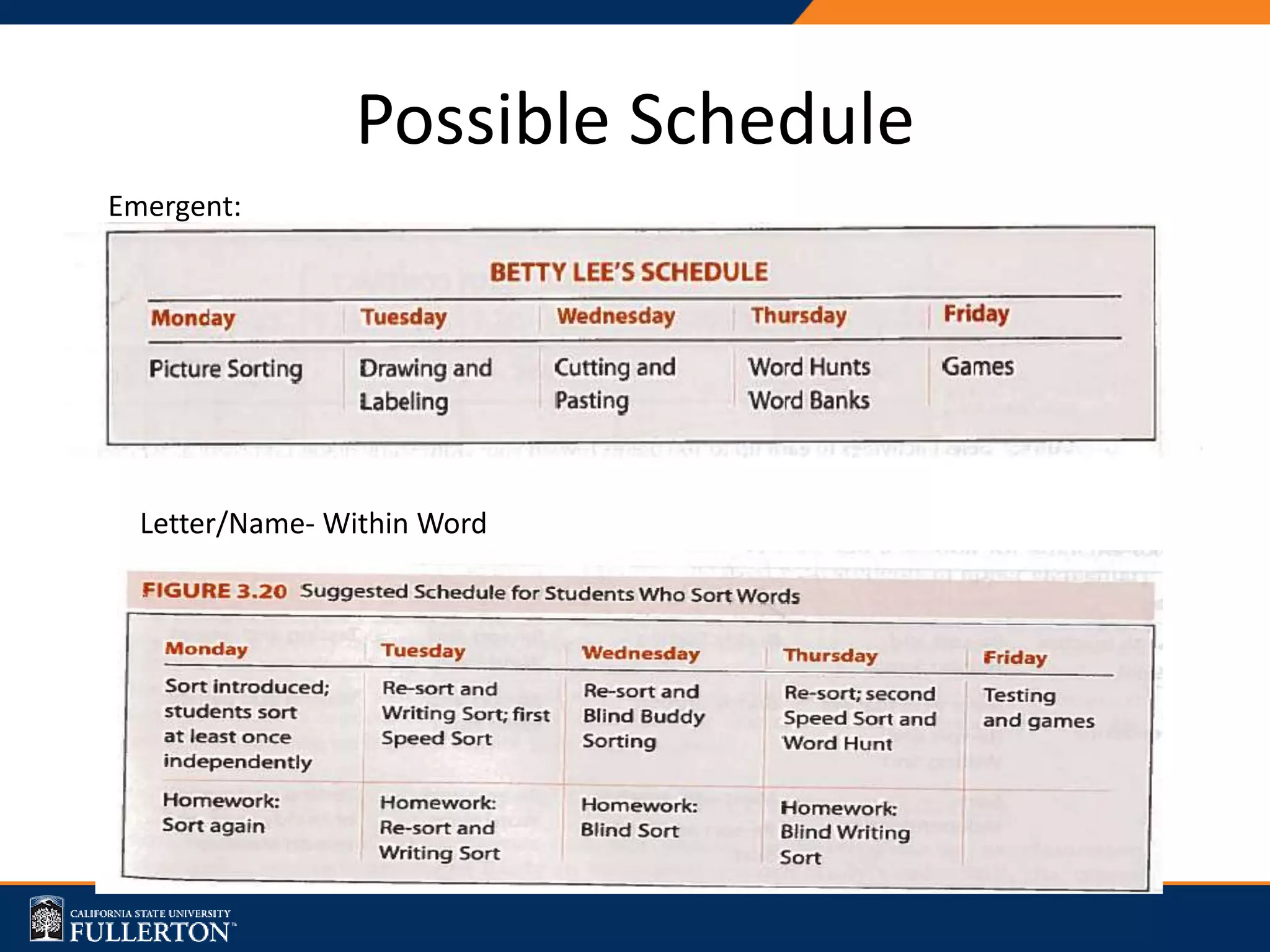
Possible Schedule
Emergent:
Letter/Name- Within Word
Possible Schedules
Some Variation on Sorting:
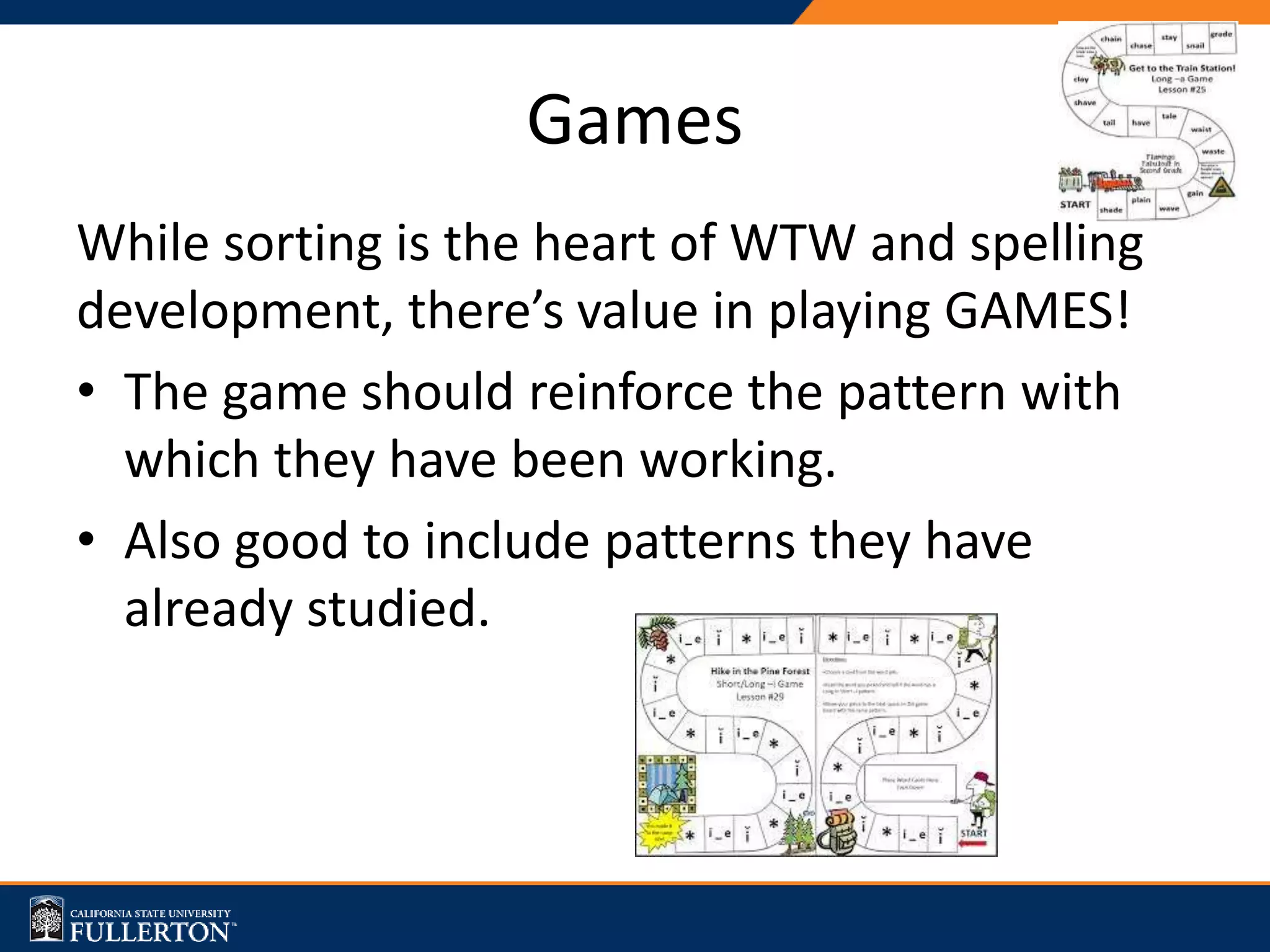
Games
While sorting is the heart of WTW and spelling
development, there’s value in playing GAMES!
• The game should reinforce the pattern with
which they have been working.
• Also good to include patterns they have
already studied.
Games!!
We’ll rotate around the room to try some of the
games.
1. Sheep in a Jeep
2. Racetrack for “i” patterns
3. Train Game
4. Double Dip
5. Apple and Bushel
6. Words that Grow
7. Latin Root Jeopardy
• Laminated card-stock
• Letter cubes
• Magnetic letters
• Word part dominoes/cards
• Small whiteboards and markers
• Word-building cards
• Spelling notebooks- scrapbook is fine
• Spelling/word-solving notebook
• Large chart paper for recording word explorations
Getting going…Some of the “stuff”
(use your imagination)
LET’S MAKE SOME!
Thanks for Coming!
• If you enjoyed what you learned, why not
consider getting an MS in Literacy and Reading
Education!! We are online and hybrid.
• Also, get involved with the Orange County
Reading Association
http://ocreading.org/

Eb.wtw ocra.4.30.16

  • 1.
    CSUF, Department ofLiteracy and Reading Education and Orange County Reading Association INQUIRY BASED SPELLING INSTRUCTION
  • 3.
    CONGRATULATIONS! CSUF READ Instructor KathiBartle Angus Outstanding Contribution to Literacy!
  • 4.
    Today’s Agenda • Breakfast •Welcome! • Awards presentation • What is developmental spelling? • Explore sorting formats (20 min) • Great games ANY level speller will love (20 minutes) • What might the routine for the week look like?
  • 5.
    Think-Write-Pair-Share Think: How doyou spell -------------? Write: Try and spell the word. Pair: How did you spell it? What were your strategies for spelling? Share: Who can share what their partner said?
  • 6.
    Deliquescence Deliquescent materials aresubstances (mostly salts) that have a strong affinity for moisture and will absorb relatively large amounts of water from the atmosphere if exposed to it, forming a liquid solution. Deliquescent salts include calcium chloride, magnesium chloride, zinc chloride, potassium carbonate, potassium phosphate, carnallite, ferric ammonium citrate, potassium hydroxide, ferric chloride, and sodium hydroxide. Owing to their very high affinity for water, these substances are often used as desiccants, which is also an application for concentrated sulfuric and phosphoric acids. These compounds are used in the chemical industry to remove the water produced by chemical reactions
  • 7.
    HOW DO WELEARN TO SPELL (ENCODE)? Developmental Spelling
  • 8.
  • 9.
    The Relationship betweenthe Stages of Spelling and Reading Development
  • 10.
    Developmental Stages ofWord Learning (Bear, 1998 et al) • Emergent readers/spellers • Beginners/Letter name spellers • Transitional/Within word pattern spellers • Intermediate/Syllables and affix spellers • Advanced Derivational relations stage Key in this approach is the linking of word knowledge across reading and writing.
  • 11.
    Levels of Spelling andthe Spelling/Reading Connection
  • 12.
    WHAT CONNECTIONS DOYOU SEE BETWEEN READING AND SPELLING? It’s all related
  • 13.
    The Emergent Stage •Spellers in the emergent stage may write with scribbles, letter-like forms, or random letters and numbers. • They often lack knowledge of the alphabet and do not understand that words are made up of smaller units of sound (phonemic awareness). • To make progress, the emergent reader and speller needs to learn that letters must be matched to sounds in systematic ways. • Activities for this stage include picture sorts for beginning sounds and alphabet games. • PROMOTE the use of invented spelling. • Include oral games of rhyme and rhythm Grades PreK- Middle of 1st
  • 14.
    The Letter-Name AlphabeticStage • Spellers in the letter name–alphabetic stage use letter/sound matches to spell the most obvious sounds in words. • Often, beginning and ending consonant sounds are in place BEFORE vowels begin to appear. • To make progress, letter name–alphabetic spellers who are beginning readers need to solidify their knowledge of • single consonants, (b,d) • consonant blends, (bl, st, sw, scr) • consonant digraphs, (sh, ch, wh,th) • THEN learn short vowels.(cat, egg, bit, hot,cut) • Activities for this stage include picture and word sorts for beginning sounds, blends and digraphs, and word families. Also work building on invented spelling patterns you see. Grades K to Middle of 2nd
  • 15.
    The Within-Word PatternStage • know about short vowels and the short vowel pattern, the consonant-vowel-consonant (CVC) pattern. • Explore common long vowel patterns. • Focus on one long vowel sound (e.g. long-a is seen in many words that have /ai/ in the middle, as in nail, rail, and tail. These words are examples of the consonant-vowel- vowel-consonant pattern (CVVC), and this pattern will be found throughout their studies of long vowels, as in cheap and boat. • Also CVV patterns (toe) • Compare long vowel to short patterns (cap/cape) • Activities: picture sorts that focus on vowel discrimination for long and short and across long vowels. The word sorts focus on patterns. Grades 1st to Middle of 4th
  • 16.
    The Syllables andAffixes Stage A MOVEMENT TOWARD POLYSYLLABIC WORDS • have mastered many of the vowel patterns in one-syllable words. • They have a good foundation for spelling words with – two or more syllables – base words and affixes. • Explore rules that govern consonant doubling at the syllable juncture and before suffixes (coma vs. comma, or hoping vs. hopping). • Explore common prefixes (un-, re-, dis-) and suffixes (-ly, -ful) as well as the spelling of unaccented syllables (-er, -ar, -or and el, le, al) • Activities for this stage continue to focus on word sorts, word hunts, and games.. Grades 3rd to 8th
  • 17.
    The Derivational RelationsStage • The focus is on making the meaning connection. • focused on the study of polysyllabic words and the derivations of the roots within these words. • Students continue to examine affixes that are less common than the ones they examined in the syllables and affixes stage. Grades 5th to Forever!
  • 18.
    WHAT IS YOURTAKE-AWAY ON THE ELEMENTS OF THE DIFFERENT STAGES?
  • 19.
    STUDENTS PROGRESS THROUGH THESTAGES AT THEIR OWN PACE Let’s take a look at a child moving through the grades
  • 20.
    Qualitative Spelling Inventory SecondGrade Sample- 5 correctly spelled words 37/66 features
  • 22.
    13 words spelledcorrectly 50/66 features
  • 24.
    21 words spelledcorrectly 64/66 features
  • 26.
    How Students CanDiffer within the Same Grade
  • 27.
    Administering and Scoring Howdo I figure out where they are?
  • 28.
    Word List GivenJust Like a Spelling Test
  • 29.
    How do Iscore?
  • 30.
    Examining word-features (Which partsof words do they know how to spell?) • You will need: • highlighter • pencil • each student’s test • A WTW Feature Guide worksheet. • Examine each student’s responses. • Complete the feature guide by highlighting the spelling features that the student got correct in each word. • Place a “?” next to any tricky decisions you want to discuss
  • 31.
    Helpful Hints onScoring (WTW, p. 34) • Highlight what they have spelled correctly. • Although you calculate both, the number of correct features is more important than the number of words spelled correctly. • Reversals should be noted (b for d) but not counted against young spellers • Beginning spellers may add vowels to the end of words or confuse the order of vowels. WTW says to give credit for the consonants and vowels, but don’t give credit for the correctly spelled word.
  • 32.
    Let’s take alook at JA You Try!
  • 33.
  • 34.
    A Few MoreHints Primary Spelling Inventory • If a child spells 22 words correctly, give the Elementary SI Elementary Spelling Inventory • If a child spells 20 words correctly, give the Upper-Level SI
  • 35.
    How do Iknow if they are “on-level”? Roughly speaking…
  • 36.
    Video demonstrations- Assessment •https://www.youtube.com/watch?v=GlGkzJPC 4HY • https://www.youtube.com/watch?v=CtfU1Qsv Yk0 • https://www.youtube.com/watch?v=qtNn27u OgRw • https://www.youtube.com/watch?v=l7k_8vhN p6I
  • 37.
    I’VE ASSESSED ANDGROUPED- NOW WHAT?
  • 38.
    WORD SORTING An activeproblem-solving approach to learning about words
  • 39.
    • Word sortingrelies on focusing a speller’s visual attending to letters, letter combinations and word parts WHILE THINKING! • The power is in active reflection and decision- making while linking the visual features of words to the spelling pattern • REPETITION through revisiting words is ESSENTIAL to making the patterns stick. Word Sorting
  • 40.
    Where to Begin? Pictureor Word Sorting Sorting Overview: • https://www.youtube.com/watch?v=-eH5KiH9lgw Picture Sorting: • https://www.youtube.com/watch?v=m7DCBpuuNJ4 Word Sorting: (teacher led, small group) • https://www.youtube.com/watch?v=sjgUx7zSX14 (children independently sorting) • https://www.youtube.com/watch?v=UAoHriJ6_1Y
  • 41.
    Remember, while youmay be tempted to think that cutting and sticking words into a workbook is kinesthetic learning, glue and scissors will not teach your kids to spell! INSTRUCTIONAL TIME must go into DISCOVERING and/or APPLYING knowledge of word patterns. Word Sorting is not a Magic Bullet!
  • 42.
    • Activity relieson discerning patterns rather than on applying them • Students create the categories as they examine the words • Reveals diagnostic information about what students know and understand – or misunderstand. • Leads to productive discussion around justifying why the students sorted words in the ways they did Open Sorts
  • 43.
    YOU TRY ANOPEN SORT!
  • 44.
    • Introduces studentsto word sort tasks • Teacher-directed – the patterns are highlighted and outlined • Model the thinking process of problem-solving a few times – think aloud. • Follow this up with lots of discussion – Students must articulate decision-making for words placed in categories Closed Sorts
  • 45.
    • Add astopwatch to an open, closed or written sort to assist speed of processing and develop speed in paying close attention to word features. Speed Sorts
  • 46.
  • 47.
  • 48.
    Games While sorting isthe heart of WTW and spelling development, there’s value in playing GAMES! • The game should reinforce the pattern with which they have been working. • Also good to include patterns they have already studied.
  • 49.
    Games!! We’ll rotate aroundthe room to try some of the games. 1. Sheep in a Jeep 2. Racetrack for “i” patterns 3. Train Game 4. Double Dip 5. Apple and Bushel 6. Words that Grow 7. Latin Root Jeopardy
  • 50.
    • Laminated card-stock •Letter cubes • Magnetic letters • Word part dominoes/cards • Small whiteboards and markers • Word-building cards • Spelling notebooks- scrapbook is fine • Spelling/word-solving notebook • Large chart paper for recording word explorations Getting going…Some of the “stuff” (use your imagination)
  • 51.
  • 52.
    Thanks for Coming! •If you enjoyed what you learned, why not consider getting an MS in Literacy and Reading Education!! We are online and hybrid. • Also, get involved with the Orange County Reading Association http://ocreading.org/