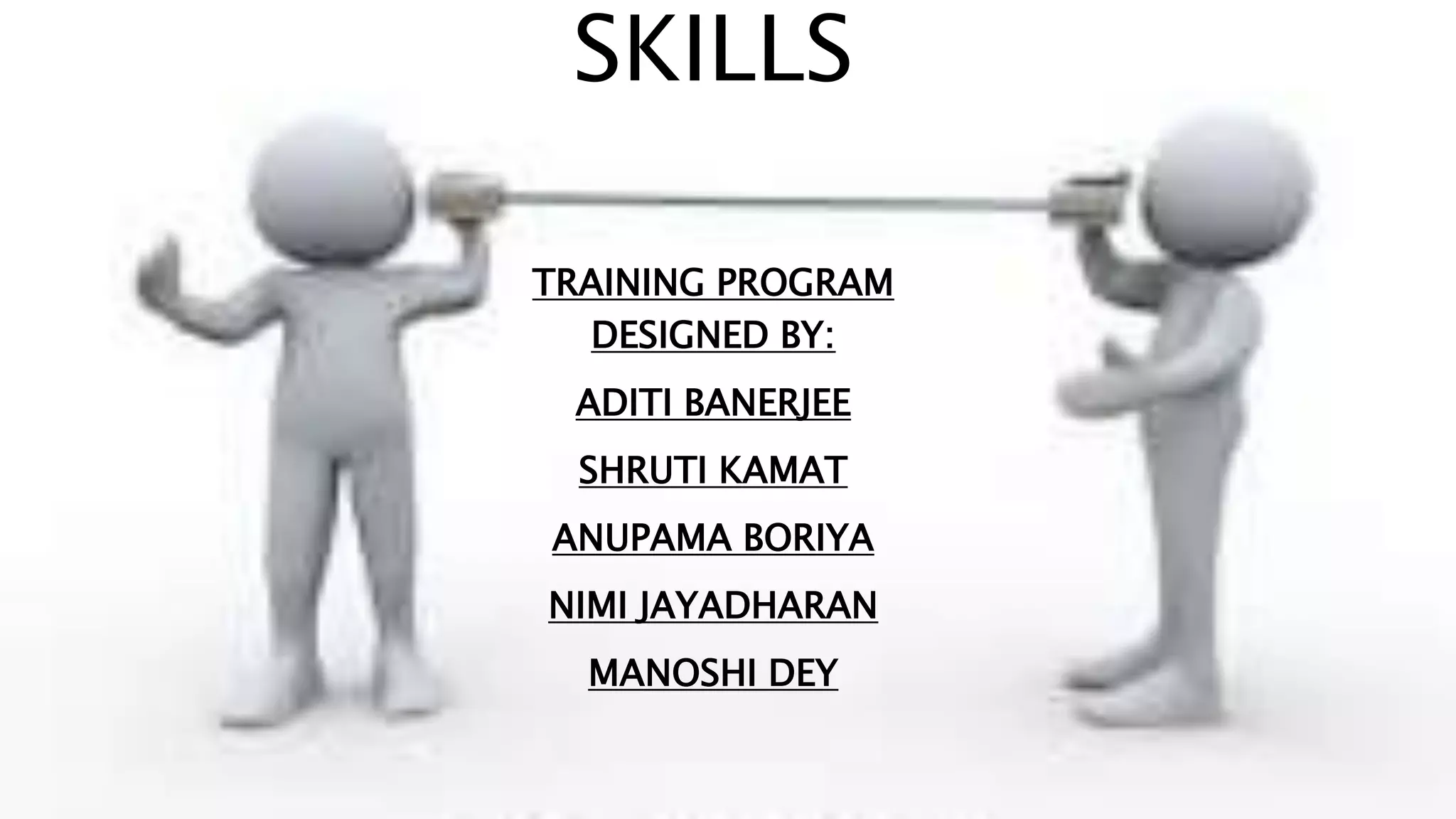

SKILLS
TRAINING PROGRAM
DESIGNED BY:
ADITI BANERJEE
SHRUTI KAMAT
ANUPAMA BORIYA
NIMI JAYADHARAN
MANOSHI DEY
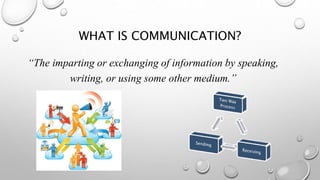
WHAT IS COMMUNICATION?
“The imparting or exchanging of information by speaking,
writing, or using some other medium.”
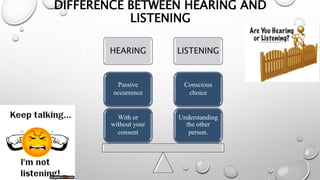
DIFFERENCE BETWEEN HEARING AND
LISTENING
HEARING LISTENING
Understanding
the other
person.
Conscious
choice
With or
without your
consent
Passive
occurrence
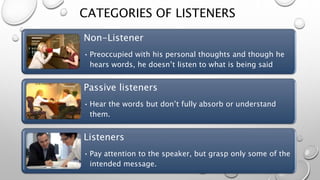
CATEGORIES OF LISTENERS
Non-Listener
• Preoccupied with his personal thoughts and though he
hears words, he doesn’t listen to what is being said
Passive listeners
• Hear the words but don’t fully absorb or understand
them.
Listeners
• Pay attention to the speaker, but grasp only some of the
intended message.
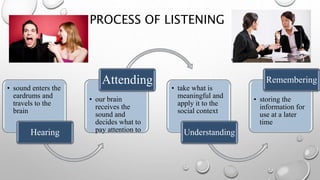
PROCESS OF LISTENING
• sound enters the
eardrums and
travels to the
brain
Hearing
• our brain
receives the
sound and
decides what to
pay attention to
Attending
• take what is
meaningful and
apply it to the
social context
Understanding
• storing the
information for
use at a later
time
Remembering
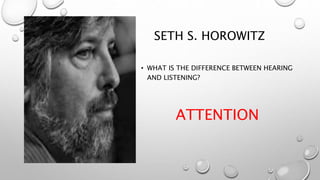
SETH S. HOROWITZ
• WHAT IS THE DIFFERENCE BETWEEN HEARING
AND LISTENING?
ATTENTION
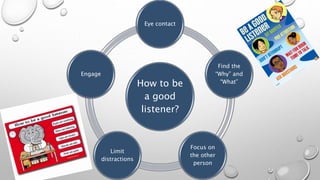
How to be
a good
listener?
Eye contact
Find the
“Why” and
“What”
Focus on
the other
person
Limit
distractions
Engage
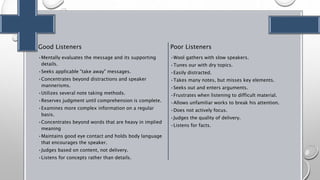
Good Listeners
•Mentally evaluates the message and its supporting
details.
•Seeks applicable "take away" messages.
•Concentrates beyond distractions and speaker
mannerisms.
•Utilizes several note taking methods.
•Reserves judgment until comprehension is complete.
•Examines more complex information on a regular
basis.
•Concentrates beyond words that are heavy in implied
meaning
•Maintains good eye contact and holds body language
that encourages the speaker.
•Judges based on content, not delivery.
•Listens for concepts rather than details.
Poor Listeners
•Wool gathers with slow speakers.
•Tunes our with dry topics.
•Easily distracted.
•Takes many notes, but misses key elements.
•Seeks out and enters arguments.
•Frustrates when listening to difficult material.
•Allows unfamiliar works to break his attention.
•Does not actively focus.
•Judges the quality of delivery.
•Listens for facts.
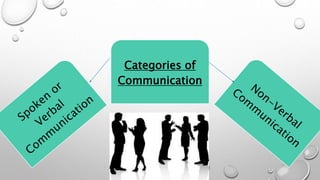
Categories of
Communication
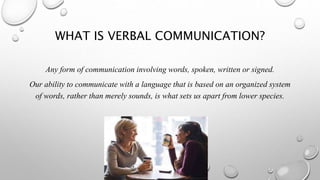
WHAT IS VERBAL COMMUNICATION?
Any form of communication involving words, spoken, written or signed.
Our ability to communicate with a language that is based on an organized system
of words, rather than merely sounds, is what sets us apart from lower species.
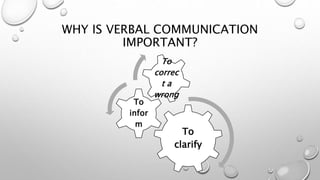
WHY IS VERBAL COMMUNICATION
IMPORTANT?
To
clarify
To
infor
m
To
correc
t a
wrong
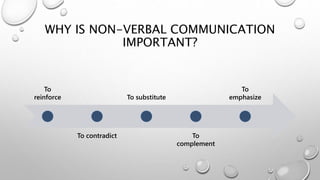
WHY IS NON-VERBAL COMMUNICATION
IMPORTANT?
To
reinforce
To contradict
To substitute
To
complement
To
emphasize
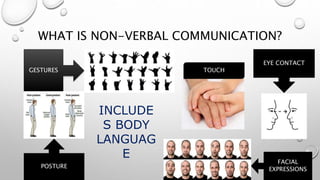
WHAT IS NON-VERBAL COMMUNICATION?
GESTURES
FACIAL
EXPRESSIONS
EYE CONTACT
POSTURE
TOUCH
INCLUDE
S BODY
LANGUAG
E
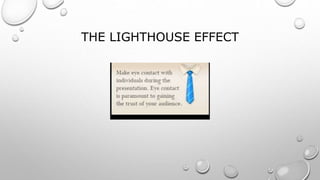
THE LIGHTHOUSE EFFECT
Please read the sentences carefully and share how you would react to the following situations.
1. You are done for the day at your office and you are just about to leave when your boss calls you and gives you
additional work which you have to complete right away. You are more upset because this is happening quite
frequently with you.
2. You plan a trip with your friend but after confirming everything, one day before your friend ditches you.
3. You are on a shopping spree because it is the sale time. You pick up a dress which you liked a lot and which on
a normal day is well above your budget but according to the tag on the dress is up for 50% discount due to the
sale. But when you go to the counter to pay you are told that there has been a mistake and that the dress does
not come under the sale criteria.
4. You have been going to your bank for the last few days to get your urgent work done, but every time the
employee just delays your work with some minute reason.
5. You friend keeps ignoring you without any reason.
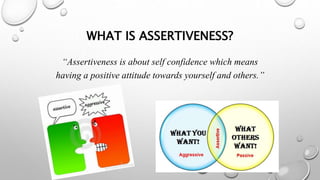
WHAT IS ASSERTIVENESS?
“Assertiveness is about self confidence which means
having a positive attitude towards yourself and others.”
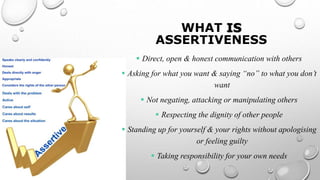
WHAT IS
ASSERTIVENESS
 Direct, open & honest communication with others
 Asking for what you want & saying “no” to what you don’t
want
 Not negating, attacking or manipulating others
 Respecting the dignity of other people
 Standing up for yourself & your rights without apologising
or feeling guilty
 Taking responsibility for your own needs
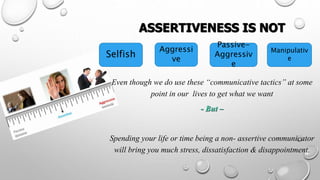
ASSERTIVENESS IS NOT
Even though we do use these “communicative tactics” at some
point in our lives to get what we want
- But –
Spending your life or time being a non- assertive communicator
will bring you much stress, dissatisfaction & disappointment.
Selfish
Aggressi
ve
Passive-
Aggressiv
e
Manipulativ
e
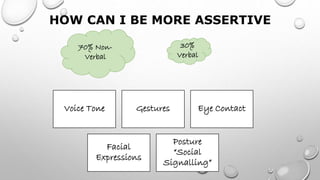
HOW CAN I BE MORE ASSERTIVE
70% Non-
Verbal
30%
Verbal
Voice Tone Gestures Eye Contact
Facial
Expressions
Posture
“Social
Signalling”
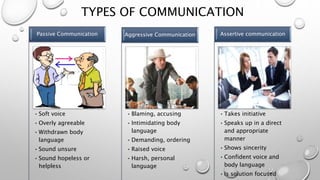
TYPES OF COMMUNICATION
• Soft voice
• Overly agreeable
• Withdrawn body
language
• Sound unsure
• Sound hopeless or
helpless
Passive Communication
• Blaming, accusing
• Intimidating body
language
• Demanding, ordering
• Raised voice
• Harsh, personal
language
Aggressive Communication
• Takes initiative
• Speaks up in a direct
and appropriate
manner
• Shows sincerity
• Confident voice and
body language
• Is solution focused
Assertive communication
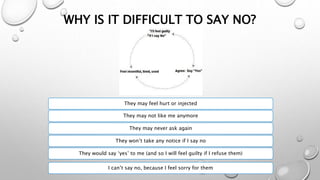
WHY IS IT DIFFICULT TO SAY NO?
They may feel hurt or injected
They may not like me anymore
They may never ask again
They won’t take any notice if I say no
They would say ‘yes’ to me (and so I will feel guilty if I refuse them)
I can’t say no, because I feel sorry for them
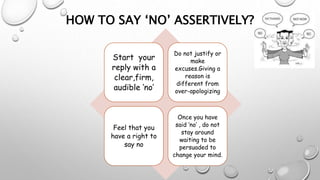
HOW TO SAY ‘NO’ ASSERTIVELY?
Start your
reply with a
clear,firm,
audible ‘no’
Do not justify or
make
excuses.Giving a
reason is
different from
over-apologizing
Feel that you
have a right to
say no
Once you have
said ‘no’ , do not
stay around
waiting to be
persuaded to
change your mind.
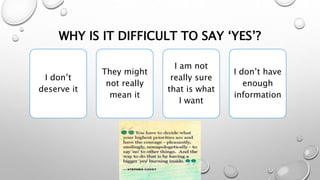
WHY IS IT DIFFICULT TO SAY ‘YES’?
I don’t
deserve it
They might
not really
mean it
I am not
really sure
that is what
I want
I don’t have
enough
information
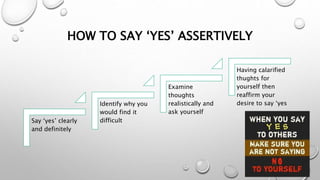
HOW TO SAY ‘YES’ ASSERTIVELY
Say ‘yes’ clearly
and definitely
Identify why you
would find it
difficult
Examine
thoughts
realistically and
ask yourself
Having calarified
thughts for
yourself then
reaffirm your
desire to say ‘yes
THANK YOU
EVALUATION
• DESCRIBE WHAT YOU LEARNT DURING THIS EXPERIENCE
THAT WILL BE HELPFUL IN THE REAL WORLD?
• WHICH PART OF THE PRESENTATION DID YOU LIKE THE
MOST?
• WHICH PART DO YOU THINK COULD HAVE BEEN
EXPLAINED BETTER?
• ANY OTHER OPINIONS/ SUGGESTIONS?

Communication skills

  • 1.
    SKILLS TRAINING PROGRAM DESIGNED BY: ADITIBANERJEE SHRUTI KAMAT ANUPAMA BORIYA NIMI JAYADHARAN MANOSHI DEY
  • 3.
    WHAT IS COMMUNICATION? “Theimparting or exchanging of information by speaking, writing, or using some other medium.”
  • 4.
    DIFFERENCE BETWEEN HEARINGAND LISTENING HEARING LISTENING Understanding the other person. Conscious choice With or without your consent Passive occurrence
  • 5.
    CATEGORIES OF LISTENERS Non-Listener •Preoccupied with his personal thoughts and though he hears words, he doesn’t listen to what is being said Passive listeners • Hear the words but don’t fully absorb or understand them. Listeners • Pay attention to the speaker, but grasp only some of the intended message.
  • 6.
    PROCESS OF LISTENING •sound enters the eardrums and travels to the brain Hearing • our brain receives the sound and decides what to pay attention to Attending • take what is meaningful and apply it to the social context Understanding • storing the information for use at a later time Remembering
  • 7.
    SETH S. HOROWITZ •WHAT IS THE DIFFERENCE BETWEEN HEARING AND LISTENING? ATTENTION
  • 8.
    How to be agood listener? Eye contact Find the “Why” and “What” Focus on the other person Limit distractions Engage
  • 9.
    Good Listeners •Mentally evaluatesthe message and its supporting details. •Seeks applicable "take away" messages. •Concentrates beyond distractions and speaker mannerisms. •Utilizes several note taking methods. •Reserves judgment until comprehension is complete. •Examines more complex information on a regular basis. •Concentrates beyond words that are heavy in implied meaning •Maintains good eye contact and holds body language that encourages the speaker. •Judges based on content, not delivery. •Listens for concepts rather than details. Poor Listeners •Wool gathers with slow speakers. •Tunes our with dry topics. •Easily distracted. •Takes many notes, but misses key elements. •Seeks out and enters arguments. •Frustrates when listening to difficult material. •Allows unfamiliar works to break his attention. •Does not actively focus. •Judges the quality of delivery. •Listens for facts.
  • 11.
  • 12.
    WHAT IS VERBALCOMMUNICATION? Any form of communication involving words, spoken, written or signed. Our ability to communicate with a language that is based on an organized system of words, rather than merely sounds, is what sets us apart from lower species.
  • 13.
    WHY IS VERBALCOMMUNICATION IMPORTANT? To clarify To infor m To correc t a wrong
  • 14.
    WHY IS NON-VERBALCOMMUNICATION IMPORTANT? To reinforce To contradict To substitute To complement To emphasize
  • 15.
    WHAT IS NON-VERBALCOMMUNICATION? GESTURES FACIAL EXPRESSIONS EYE CONTACT POSTURE TOUCH INCLUDE S BODY LANGUAG E
  • 16.
  • 18.
    Please read thesentences carefully and share how you would react to the following situations. 1. You are done for the day at your office and you are just about to leave when your boss calls you and gives you additional work which you have to complete right away. You are more upset because this is happening quite frequently with you. 2. You plan a trip with your friend but after confirming everything, one day before your friend ditches you. 3. You are on a shopping spree because it is the sale time. You pick up a dress which you liked a lot and which on a normal day is well above your budget but according to the tag on the dress is up for 50% discount due to the sale. But when you go to the counter to pay you are told that there has been a mistake and that the dress does not come under the sale criteria. 4. You have been going to your bank for the last few days to get your urgent work done, but every time the employee just delays your work with some minute reason. 5. You friend keeps ignoring you without any reason.
  • 20.
    WHAT IS ASSERTIVENESS? “Assertivenessis about self confidence which means having a positive attitude towards yourself and others.”
  • 21.
    WHAT IS ASSERTIVENESS  Direct,open & honest communication with others  Asking for what you want & saying “no” to what you don’t want  Not negating, attacking or manipulating others  Respecting the dignity of other people  Standing up for yourself & your rights without apologising or feeling guilty  Taking responsibility for your own needs
  • 22.
    ASSERTIVENESS IS NOT Eventhough we do use these “communicative tactics” at some point in our lives to get what we want - But – Spending your life or time being a non- assertive communicator will bring you much stress, dissatisfaction & disappointment. Selfish Aggressi ve Passive- Aggressiv e Manipulativ e
  • 23.
    HOW CAN IBE MORE ASSERTIVE 70% Non- Verbal 30% Verbal Voice Tone Gestures Eye Contact Facial Expressions Posture “Social Signalling”
  • 24.
    TYPES OF COMMUNICATION •Soft voice • Overly agreeable • Withdrawn body language • Sound unsure • Sound hopeless or helpless Passive Communication • Blaming, accusing • Intimidating body language • Demanding, ordering • Raised voice • Harsh, personal language Aggressive Communication • Takes initiative • Speaks up in a direct and appropriate manner • Shows sincerity • Confident voice and body language • Is solution focused Assertive communication
  • 25.
    WHY IS ITDIFFICULT TO SAY NO? They may feel hurt or injected They may not like me anymore They may never ask again They won’t take any notice if I say no They would say ‘yes’ to me (and so I will feel guilty if I refuse them) I can’t say no, because I feel sorry for them
  • 26.
    HOW TO SAY‘NO’ ASSERTIVELY? Start your reply with a clear,firm, audible ‘no’ Do not justify or make excuses.Giving a reason is different from over-apologizing Feel that you have a right to say no Once you have said ‘no’ , do not stay around waiting to be persuaded to change your mind.
  • 27.
    WHY IS ITDIFFICULT TO SAY ‘YES’? I don’t deserve it They might not really mean it I am not really sure that is what I want I don’t have enough information
  • 28.
    HOW TO SAY‘YES’ ASSERTIVELY Say ‘yes’ clearly and definitely Identify why you would find it difficult Examine thoughts realistically and ask yourself Having calarified thughts for yourself then reaffirm your desire to say ‘yes
  • 29.
  • 30.
    EVALUATION • DESCRIBE WHATYOU LEARNT DURING THIS EXPERIENCE THAT WILL BE HELPFUL IN THE REAL WORLD? • WHICH PART OF THE PRESENTATION DID YOU LIKE THE MOST? • WHICH PART DO YOU THINK COULD HAVE BEEN EXPLAINED BETTER? • ANY OTHER OPINIONS/ SUGGESTIONS?