



Empathy in Action
Can you put yourself in their shoes?
Which scenario is easier for you to connect to? Which one is more difficult?
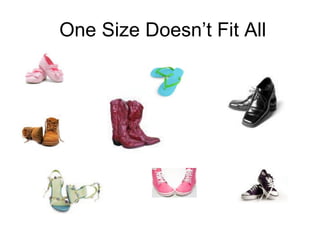
One Size Doesn’t Fit All
It’s  important  to  show  empathy  to customers in  need .
What gets in your way? What stops you from being empathetic?
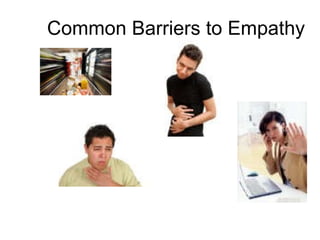
Common Barriers to Empathy
How do you personally define empathy?
How does empathy work? By combining various elements of empathy,  instead of including just one , connecting with the customer can be achieved faster and more convincingly.
 
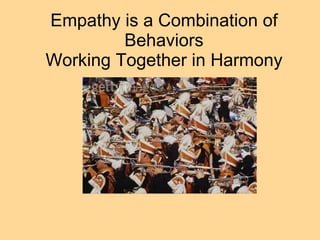
Empathy is a Combination of Behaviors Working Together in Harmony
Empathy in Action Learn how to overcome barriers to listening empathy. Understand the expectation of empathetic behavior. Recognize empathetic cues.  Understand how empathetic behavior will be assessed and measured.
Today’s Course Activities Collaborative Assessment Exercises Individual Assessment Exercises Group Discussion Assessment of Learning
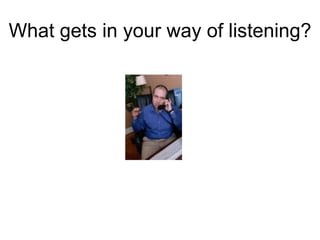
What gets in your way of listening?
Listening Exercise  Listen to the following conversation. Then, answer the following questions: 1. Why was the insured calling? 2.  What indication did she give that she was not satisfied with her experience? 3.  How long did she say she had been waiting for a call from the adjuster? 4.  Who did she say called on her behalf the day before? 5.  What it is the name of her mortgage company?
What are some ways to Listen better?
Keys to Effective Listening Focus  Avoid Multitasking Listen Objective Summarize Sit with Good Posture Do not focus on delivery Do not interrupt
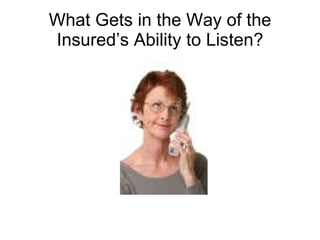
What Gets in the Way of the Insured’s Ability to Listen?
What Gets in the Way of the Insured’s Ability to Listen? Interrupting Sarcasm Laughing Tapping Loud Breathing Silence Frustration Sidebar Conversations Any others?
Listening Exercise  Listen to the next series of audio recordings. What distracting behaviors could get in the way of the insured’s ability to listen? Discuss as a group.
Listening Exercise  Listen to the next series of audio recordings. Discuss the nature of the calls as a group.
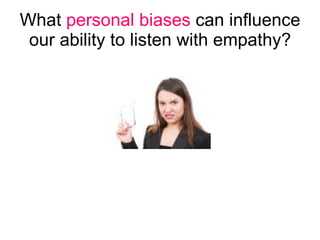
What  personal biases  can influence our ability to listen with empathy?
Personal Biases That Can Influence How We Listen? Money Region Job Language Education Understanding of insurance History with Insured Any others?
Word Choice  C hoose service words that encourage or discourage a positive claims handling experience. Positive 1 Negative
Word Choice  C hoose service words that encourage or discourage a positive claims handling experience. Positive Thank you 1 Great Satisfaction Excellent Value Welcome My Pleasure Negative Fault Blame I Told You You Didn’t You Claim Misinformed If you would…
Avoid Trigger Words Why  But Sorry Problem No Policy Try
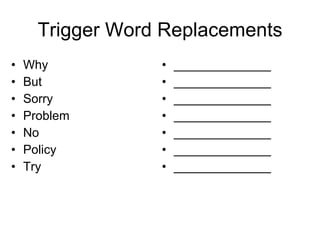
Trigger Word Replacements Why  But Sorry Problem No Policy Try ______________ ______________ ______________ ______________ ______________ ______________ ______________
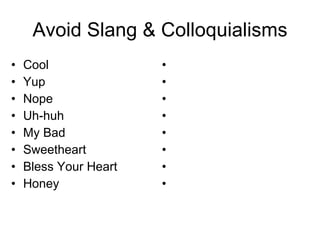
Avoid Slang & Colloquialisms Cool Yup Nope Uh-huh My Bad Sweetheart Bless Your Heart Honey
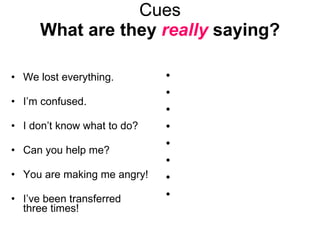
Reading Between The Lines of Cues What are they  really  saying? We lost everything. I’m confused. I don’t know what to do? Can you help me? You are making me angry! I’ve been transferred  three times!
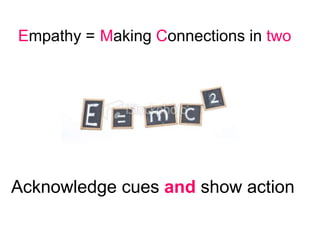
E mpathy =   M aking  C onnections in  two  ways Acknowledge cues  and  show action
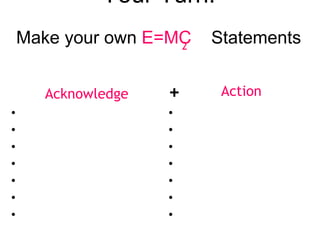
Your Turn! Make your own  E=MC  Statements  2 Acknowledge Action +
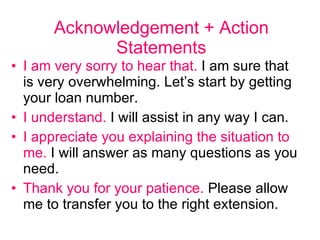
Acknowledgement + Action Statements I am very sorry to hear that.  I am sure that is very overwhelming. Let’s start by getting your loan number. I understand.  I will assist in any way I can.  I appreciate you explaining the situation to me.  I will answer as many questions as you need.  Thank you for your patience.  Please allow me to transfer you to the right extension.
It’s Not Just What You say…
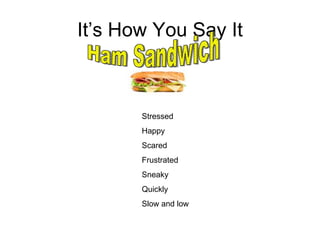
It’s How You Say It Stressed Happy Scared Frustrated Sneaky Quickly Slow and low Ham Sandwich
Elements of Empathetic Tone
Pitch How high or low your voice is when projected
Hum Happy Birthday This is your natural pitch
Pace How quickly or slowly you are speaking? Effects of Speaking  Too Fast Effects of Speaking Too Slowly
Volume How soft or loud you are speaking Effects of speaking too soft Effects of speaking too loud
Emphasis Which words are stressed and when Effects of placing too much stress on words Effects of placing not enough stress on words
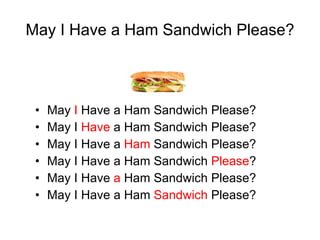
May I Have a Ham Sandwich Please? May  I  Have a Ham Sandwich Please? May I  Have  a Ham Sandwich Please? May I Have a  Ham  Sandwich Please? May I Have a Ham Sandwich  Please ? May I Have  a  Ham Sandwich Please? May I Have a Ham  Sandwich  Please?
Timing Knowing when to express empathy What are the effects  of over-stating empathy? What are the effects of not expressing empathy at the right time?
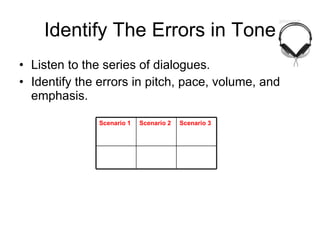
Identify The Errors in Tone Listen to the series of dialogues.  Identify the errors in pitch, pace, volume, and emphasis. Scenario 3 Scenario 2 Scenario 1
Maintaining Empathetic Tone During Difficult Calls
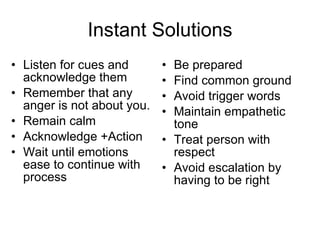
Instant Solutions Listen for cues and acknowledge them Remember that any anger is not about you. Remain calm Acknowledge +Action Wait until emotions ease to continue with process Be prepared Find common ground Avoid trigger words Maintain empathetic tone Treat person with respect Avoid escalation by having to be right
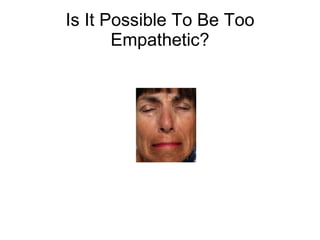
Is It Possible To Be Too Empathetic?
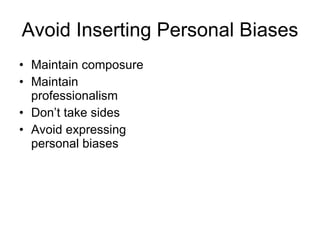
Avoid Inserting Personal Biases Maintain composure Maintain professionalism Don’t take sides Avoid expressing personal biases
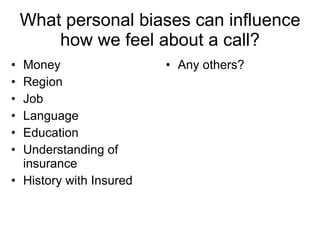
What personal biases can influence how we feel about a call? Money Region Job Language Education Understanding of insurance History with Insured Any others?
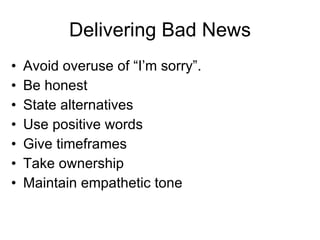
Delivering Bad News Avoid overuse of “I’m sorry”. Be honest State alternatives Use positive words Give timeframes Take ownership Maintain empathetic tone
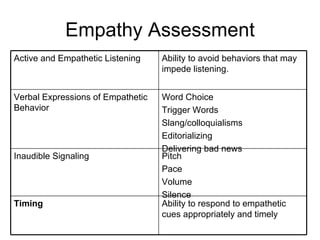
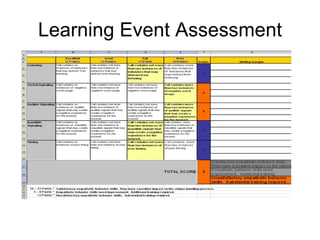
Empathy Assessment Ability to respond to empathetic cues appropriately and timely Timing Pitch Pace  Volume Silence Inaudible Signaling Word Choice Trigger Words Slang/colloquialisms Editorializing Delivering bad news Verbal Expressions of Empathetic Behavior Ability to avoid behaviors that may impede listening. Active and Empathetic Listening
Learning Event Assessment
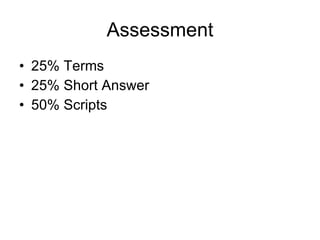
Assessment 25% Terms 25% Short Answer 50% Scripts

Empathy Course

  • 1.
  • 2.
    Can you putyourself in their shoes?
  • 3.
    Can you putyourself in their shoes?
  • 4.
    Which scenario iseasier for you to connect to? Which one is more difficult?
  • 5.
  • 6.
    It’s important to show empathy to customers in need .
  • 7.
    What gets inyour way? What stops you from being empathetic?
  • 8.
  • 9.
    How do youpersonally define empathy?
  • 10.
    How does empathywork? By combining various elements of empathy, instead of including just one , connecting with the customer can be achieved faster and more convincingly.
  • 11.
  • 12.
    Empathy is aCombination of Behaviors Working Together in Harmony
  • 13.
    Empathy in ActionLearn how to overcome barriers to listening empathy. Understand the expectation of empathetic behavior. Recognize empathetic cues. Understand how empathetic behavior will be assessed and measured.
  • 14.
    Today’s Course ActivitiesCollaborative Assessment Exercises Individual Assessment Exercises Group Discussion Assessment of Learning
  • 15.
    What gets inyour way of listening?
  • 16.
    Listening Exercise Listen to the following conversation. Then, answer the following questions: 1. Why was the insured calling? 2. What indication did she give that she was not satisfied with her experience? 3. How long did she say she had been waiting for a call from the adjuster? 4. Who did she say called on her behalf the day before? 5. What it is the name of her mortgage company?
  • 17.
    What are someways to Listen better?
  • 18.
    Keys to EffectiveListening Focus Avoid Multitasking Listen Objective Summarize Sit with Good Posture Do not focus on delivery Do not interrupt
  • 19.
    What Gets inthe Way of the Insured’s Ability to Listen?
  • 20.
    What Gets inthe Way of the Insured’s Ability to Listen? Interrupting Sarcasm Laughing Tapping Loud Breathing Silence Frustration Sidebar Conversations Any others?
  • 21.
    Listening Exercise Listen to the next series of audio recordings. What distracting behaviors could get in the way of the insured’s ability to listen? Discuss as a group.
  • 22.
    Listening Exercise Listen to the next series of audio recordings. Discuss the nature of the calls as a group.
  • 23.
    What personalbiases can influence our ability to listen with empathy?
  • 24.
    Personal Biases ThatCan Influence How We Listen? Money Region Job Language Education Understanding of insurance History with Insured Any others?
  • 25.
    Word Choice C hoose service words that encourage or discourage a positive claims handling experience. Positive 1 Negative
  • 26.
    Word Choice C hoose service words that encourage or discourage a positive claims handling experience. Positive Thank you 1 Great Satisfaction Excellent Value Welcome My Pleasure Negative Fault Blame I Told You You Didn’t You Claim Misinformed If you would…
  • 27.
    Avoid Trigger WordsWhy But Sorry Problem No Policy Try
  • 28.
    Trigger Word ReplacementsWhy But Sorry Problem No Policy Try ______________ ______________ ______________ ______________ ______________ ______________ ______________
  • 29.
    Avoid Slang &Colloquialisms Cool Yup Nope Uh-huh My Bad Sweetheart Bless Your Heart Honey
  • 30.
    Reading Between TheLines of Cues What are they really saying? We lost everything. I’m confused. I don’t know what to do? Can you help me? You are making me angry! I’ve been transferred three times!
  • 31.
    E mpathy = M aking C onnections in two ways Acknowledge cues and show action
  • 32.
    Your Turn! Makeyour own E=MC Statements 2 Acknowledge Action +
  • 33.
    Acknowledgement + ActionStatements I am very sorry to hear that. I am sure that is very overwhelming. Let’s start by getting your loan number. I understand. I will assist in any way I can. I appreciate you explaining the situation to me. I will answer as many questions as you need. Thank you for your patience. Please allow me to transfer you to the right extension.
  • 34.
    It’s Not JustWhat You say…
  • 35.
    It’s How YouSay It Stressed Happy Scared Frustrated Sneaky Quickly Slow and low Ham Sandwich
  • 36.
  • 37.
    Pitch How highor low your voice is when projected
  • 38.
    Hum Happy BirthdayThis is your natural pitch
  • 39.
    Pace How quicklyor slowly you are speaking? Effects of Speaking Too Fast Effects of Speaking Too Slowly
  • 40.
    Volume How softor loud you are speaking Effects of speaking too soft Effects of speaking too loud
  • 41.
    Emphasis Which wordsare stressed and when Effects of placing too much stress on words Effects of placing not enough stress on words
  • 42.
    May I Havea Ham Sandwich Please? May I Have a Ham Sandwich Please? May I Have a Ham Sandwich Please? May I Have a Ham Sandwich Please? May I Have a Ham Sandwich Please ? May I Have a Ham Sandwich Please? May I Have a Ham Sandwich Please?
  • 43.
    Timing Knowing whento express empathy What are the effects of over-stating empathy? What are the effects of not expressing empathy at the right time?
  • 44.
    Identify The Errorsin Tone Listen to the series of dialogues. Identify the errors in pitch, pace, volume, and emphasis. Scenario 3 Scenario 2 Scenario 1
  • 45.
    Maintaining Empathetic ToneDuring Difficult Calls
  • 46.
    Instant Solutions Listenfor cues and acknowledge them Remember that any anger is not about you. Remain calm Acknowledge +Action Wait until emotions ease to continue with process Be prepared Find common ground Avoid trigger words Maintain empathetic tone Treat person with respect Avoid escalation by having to be right
  • 47.
    Is It PossibleTo Be Too Empathetic?
  • 48.
    Avoid Inserting PersonalBiases Maintain composure Maintain professionalism Don’t take sides Avoid expressing personal biases
  • 49.
    What personal biasescan influence how we feel about a call? Money Region Job Language Education Understanding of insurance History with Insured Any others?
  • 50.
    Delivering Bad NewsAvoid overuse of “I’m sorry”. Be honest State alternatives Use positive words Give timeframes Take ownership Maintain empathetic tone
  • 51.
    Empathy Assessment Abilityto respond to empathetic cues appropriately and timely Timing Pitch Pace Volume Silence Inaudible Signaling Word Choice Trigger Words Slang/colloquialisms Editorializing Delivering bad news Verbal Expressions of Empathetic Behavior Ability to avoid behaviors that may impede listening. Active and Empathetic Listening
  • 52.
  • 53.
    Assessment 25% Terms25% Short Answer 50% Scripts

Editor's Notes

  • #6 What may be easy for one person to connect to, may be difficult for someone else.
  • #7 Regardless of our own personal ability to show empathy, it is an important part of our jobs to do so.
  • #11 Words or tone, or emphasis (for example) alone will not convey empathy. They must be used in concert.
  • #48 Discuss being empathetic without adding editorial Participants will understand how to express empathetic behavior without providing their personal biases and opinions to insureds.
  • #53 The chart above was created in Excel. The five categories covered in the class are indicated in column A. Points are assigned based on the number of errors in each category. The numbers automatically generate an overall score. The scoring system is based on the current Attributes document, section 1.8 (Empathy). In this way, empathetic behaviors can be defined and quantified. Also, the numbers can be tracked over time to show trends by individual and team.