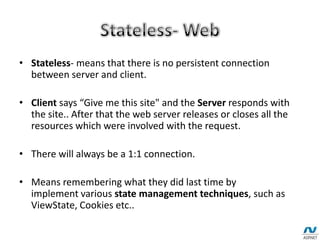
• Stateless- means that there is no persistent connection
between server and client.
• Client says “Give me this site" and the Server responds with
the site.. After that the web server releases or closes all the
resources which were involved with the request.
• There will always be a 1:1 connection.
• Means remembering what they did last time by
implement various state management techniques, such as
ViewState, Cookies etc..
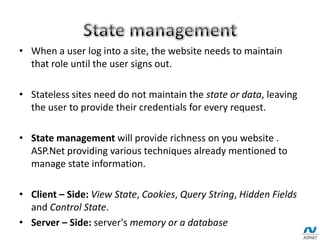
• When a user log into a site, the website needs to maintain
that role until the user signs out.
• Stateless sites need do not maintain the state or data, leaving
the user to provide their credentials for every request.
• State management will provide richness on you website .
ASP.Net providing various techniques already mentioned to
manage state information.
• Client – Side: View State, Cookies, Query String, Hidden Fields
and Control State.
• Server – Side: server's memory or a database
• Approach to saving data for the user.
• Allows ASP.NET to repopulate form fields on each postbacks
to the server.
• The view state of a page is, by default, placed in a hidden form
field named __VIEWSTATE.
• ViewState misconceptions: ViewState is encrypted or
somehow unreadable by the user.
• May look like it is unreadable to some users but to others the
ViewState can reveal juicy information regarding a user
actions within the site.
• It is only base64-encoded, not encrypted in any way.
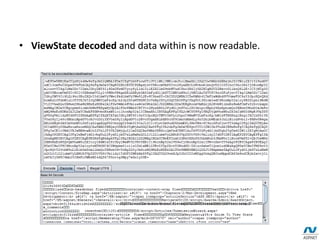
• ViewState decoded and data within is now readable.
• If encryption is turned on, which is not the default, ASP.NET
will use the web site machine key as the key used to encrypt
and sign ViewState and cookies.
• As you can set the machine keys (for validation and
decryption) to a known value in web.config you could then
use this to decrypt manually if necessary.
• In this case an attacker might modify the content of the
ViewState and subvert the logic of the application, or carry
out other attacks by changing the ViewState.
• Examples of these attacks could be XSS 
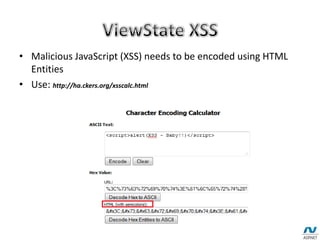
• Malicious JavaScript (XSS) needs to be encoded using HTML
Entities
• Use: http://ha.ckers.org/xsscalc.html
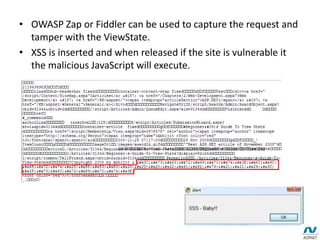
• OWASP Zap or Fiddler can be used to capture the request and
tamper with the ViewState.
• XSS is inserted and when released if the site is vulnerable it
the malicious JavaScript will execute.
• Don’t store critical information in ViewState.
• Encrypt – so no data will be readable.
• Sign the ViewState - enable the built in functions like
ViewStateMac, which will help prevent an attacker from
tampering with the ViewState.

ASP.NET View State - Security Issues

  • 3.
    • Stateless- meansthat there is no persistent connection between server and client. • Client says “Give me this site" and the Server responds with the site.. After that the web server releases or closes all the resources which were involved with the request. • There will always be a 1:1 connection. • Means remembering what they did last time by implement various state management techniques, such as ViewState, Cookies etc..
  • 4.
    • When auser log into a site, the website needs to maintain that role until the user signs out. • Stateless sites need do not maintain the state or data, leaving the user to provide their credentials for every request. • State management will provide richness on you website . ASP.Net providing various techniques already mentioned to manage state information. • Client – Side: View State, Cookies, Query String, Hidden Fields and Control State. • Server – Side: server's memory or a database
  • 5.
    • Approach tosaving data for the user. • Allows ASP.NET to repopulate form fields on each postbacks to the server. • The view state of a page is, by default, placed in a hidden form field named __VIEWSTATE.
  • 6.
    • ViewState misconceptions:ViewState is encrypted or somehow unreadable by the user. • May look like it is unreadable to some users but to others the ViewState can reveal juicy information regarding a user actions within the site. • It is only base64-encoded, not encrypted in any way.
  • 7.
    • ViewState decodedand data within is now readable.
  • 8.
    • If encryptionis turned on, which is not the default, ASP.NET will use the web site machine key as the key used to encrypt and sign ViewState and cookies. • As you can set the machine keys (for validation and decryption) to a known value in web.config you could then use this to decrypt manually if necessary. • In this case an attacker might modify the content of the ViewState and subvert the logic of the application, or carry out other attacks by changing the ViewState. • Examples of these attacks could be XSS 
  • 9.
    • Malicious JavaScript(XSS) needs to be encoded using HTML Entities • Use: http://ha.ckers.org/xsscalc.html
  • 10.
    • OWASP Zapor Fiddler can be used to capture the request and tamper with the ViewState. • XSS is inserted and when released if the site is vulnerable it the malicious JavaScript will execute.
  • 11.
    • Don’t storecritical information in ViewState. • Encrypt – so no data will be readable. • Sign the ViewState - enable the built in functions like ViewStateMac, which will help prevent an attacker from tampering with the ViewState.