Disclaimer: This presentation is prepared by trainees of
baabtra as a part of mentoring program. This is not official
document of baabtra –Mentoring Partner
Baabtra-Mentoring Partner is the mentoring division of baabte System Technologies Pvt .
Ltd
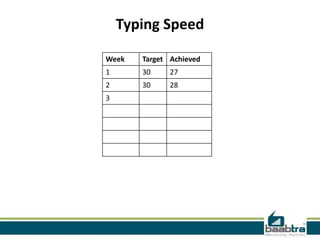
Week Target Achieved
1 30 27
2 30 28
3
Typing Speed
Jobs Applied
# Company Designation Applied Date Current Status
1
2
3
State Management
Name
@gmail.com
www.facebook.com/userna
me
twitter.com/username
in.linkedin.com/in/profilena
me
Phonenumber
Why is state necessary?
• The vast majority of Internet applications
operate using the HTTP protocol.
• HTTP is state less.
– This means that each request for a page is treated
as a new request by the server.
Introduction to State Management
• Remember that ASP.NET is stateless
– The Web server does not keep track of past client
requests
• Different technologies handle the issue of
statement management differently
– ASP.NET is quite unique in this regard
Types of State Management
• ASP.NET offers two categories of state
management
– Pure client-side statement management
– Server-side state management
Client State Management
• View state
• Control state
• Hidden fields
• Cookies
• Query strings
State Management
(ViewState)
• ASP.NET preserves the state of the page’s controls between
post backs by packaging and encoding it within a hidden
html field.
• This view state feature can also be used programmatically to
preserve additional information between post backs for the
same page
Eg :- ViewState["RequestCount"] = count;
int count = (int)ViewState["RequestCount"];
Advantages & Disadvantage of
View State
• It consumes no server memory.
• It is more hidden than Query String and Hidden
Fields
• Its possible to encrypt View State information.
Disadvantage :-
– It increases the size of the page.
State Management
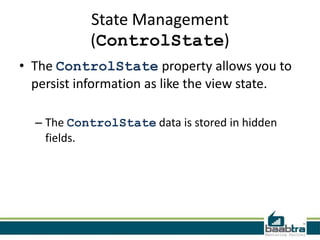
(ControlState)
• The ControlState property allows you to
persist information as like the view state.
– The ControlState data is stored in hidden
fields.
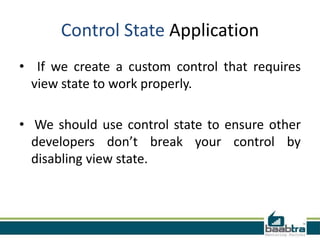
Control State Application
• If we create a custom control that requires
view state to work properly.
• We should use control state to ensure other
developers don’t break your control by
disabling view state.
State Management
(Hidden Fields)
• Use the HiddenField control to store
persisted data.
• The data is stored in the Value property
• It’s simple and requires no server resources
State Management
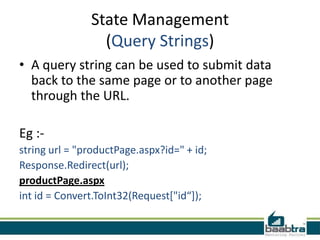
(Query Strings)
• A query string can be used to submit data
back to the same page or to another page
through the URL.
Eg :-
string url = "productPage.aspx?id=" + id;
Response.Redirect(url);
productPage.aspx
int id = Convert.ToInt32(Request*"id“+);
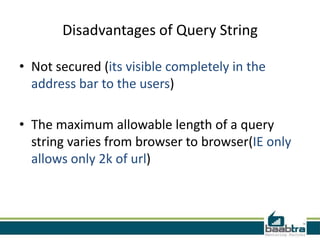
Disadvantages of Query String
• Not secured (its visible completely in the
address bar to the users)
• The maximum allowable length of a query
string varies from browser to browser(IE only
allows only 2k of url)
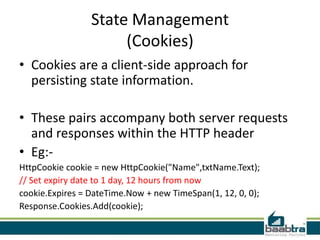
State Management
(Cookies)
• Cookies are a client-side approach for
persisting state information.
• These pairs accompany both server requests
and responses within the HTTP header
• Eg:-
HttpCookie cookie = new HttpCookie("Name",txtName.Text);
// Set expiry date to 1 day, 12 hours from now
cookie.Expires = DateTime.Now + new TimeSpan(1, 12, 0, 0);
Response.Cookies.Add(cookie);
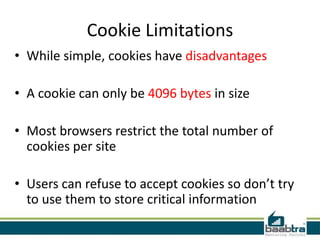
Cookie Limitations
• While simple, cookies have disadvantages
• A cookie can only be 4096 bytes in size
• Most browsers restrict the total number of
cookies per site
• Users can refuse to accept cookies so don’t try
to use them to store critical information
Server State Management
• Application state
• Session state
Session state
• Session state is a server-based state
mechanism that allows you to store data in a
dictionary-style collection.
• It is scoped to the current browser session.
• That is, each user or browser session has a
different session state.
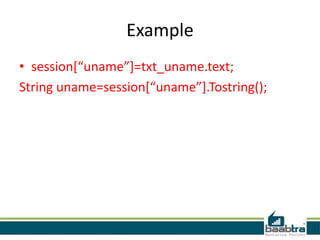
Example
• session*“uname”+=txt_uname.text;
String uname=session*“uname”+.Tostring();
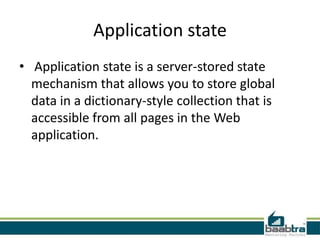
Application state
• Application state is a server-stored state
mechanism that allows you to store global
data in a dictionary-style collection that is
accessible from all pages in the Web
application.
Application state
• Thus, application state is ideal for storing
relatively small, frequently used sets of data
that do not change from user-to-user or
request to request.
• Eg :-
Application["SiteRequestCount"] = 0;
int count = (int)Application["SiteRequestCount";
If this presentation helped you, please visit our
page facebook.com/baabtra and like it.
Thanks in advance.
www.baabtra.com | www.massbaab.com |www.baabte.com
Contact Us
Emarald Mall (Big Bazar Building)
Mavoor Road, Kozhikode,
Kerala, India.
Ph: + 91 – 495 40 25 550
NC Complex, Near Bus Stand
Mukkam, Kozhikode,
Kerala, India.
Ph: + 91 – 495 40 25 550
Start up Village
Eranakulam,
Kerala, India.
Email: info@baabtra.com

State management in ASP .NET

  • 2.
    Disclaimer: This presentationis prepared by trainees of baabtra as a part of mentoring program. This is not official document of baabtra –Mentoring Partner Baabtra-Mentoring Partner is the mentoring division of baabte System Technologies Pvt . Ltd
  • 3.
    Week Target Achieved 130 27 2 30 28 3 Typing Speed
  • 4.
    Jobs Applied # CompanyDesignation Applied Date Current Status 1 2 3
  • 5.
  • 6.
    Why is statenecessary? • The vast majority of Internet applications operate using the HTTP protocol. • HTTP is state less. – This means that each request for a page is treated as a new request by the server.
  • 7.
    Introduction to StateManagement • Remember that ASP.NET is stateless – The Web server does not keep track of past client requests • Different technologies handle the issue of statement management differently – ASP.NET is quite unique in this regard
  • 8.
    Types of StateManagement • ASP.NET offers two categories of state management – Pure client-side statement management – Server-side state management
  • 9.
    Client State Management •View state • Control state • Hidden fields • Cookies • Query strings
  • 10.
    State Management (ViewState) • ASP.NETpreserves the state of the page’s controls between post backs by packaging and encoding it within a hidden html field. • This view state feature can also be used programmatically to preserve additional information between post backs for the same page Eg :- ViewState["RequestCount"] = count; int count = (int)ViewState["RequestCount"];
  • 11.
    Advantages & Disadvantageof View State • It consumes no server memory. • It is more hidden than Query String and Hidden Fields • Its possible to encrypt View State information. Disadvantage :- – It increases the size of the page.
  • 12.
    State Management (ControlState) • TheControlState property allows you to persist information as like the view state. – The ControlState data is stored in hidden fields.
  • 13.
    Control State Application •If we create a custom control that requires view state to work properly. • We should use control state to ensure other developers don’t break your control by disabling view state.
  • 14.
    State Management (Hidden Fields) •Use the HiddenField control to store persisted data. • The data is stored in the Value property • It’s simple and requires no server resources
  • 15.
    State Management (Query Strings) •A query string can be used to submit data back to the same page or to another page through the URL. Eg :- string url = "productPage.aspx?id=" + id; Response.Redirect(url); productPage.aspx int id = Convert.ToInt32(Request*"id“+);
  • 16.
    Disadvantages of QueryString • Not secured (its visible completely in the address bar to the users) • The maximum allowable length of a query string varies from browser to browser(IE only allows only 2k of url)
  • 17.
    State Management (Cookies) • Cookiesare a client-side approach for persisting state information. • These pairs accompany both server requests and responses within the HTTP header • Eg:- HttpCookie cookie = new HttpCookie("Name",txtName.Text); // Set expiry date to 1 day, 12 hours from now cookie.Expires = DateTime.Now + new TimeSpan(1, 12, 0, 0); Response.Cookies.Add(cookie);
  • 18.
    Cookie Limitations • Whilesimple, cookies have disadvantages • A cookie can only be 4096 bytes in size • Most browsers restrict the total number of cookies per site • Users can refuse to accept cookies so don’t try to use them to store critical information
  • 19.
    Server State Management •Application state • Session state
  • 20.
    Session state • Sessionstate is a server-based state mechanism that allows you to store data in a dictionary-style collection. • It is scoped to the current browser session. • That is, each user or browser session has a different session state.
  • 21.
  • 22.
    Application state • Applicationstate is a server-stored state mechanism that allows you to store global data in a dictionary-style collection that is accessible from all pages in the Web application.
  • 23.
    Application state • Thus,application state is ideal for storing relatively small, frequently used sets of data that do not change from user-to-user or request to request. • Eg :- Application["SiteRequestCount"] = 0; int count = (int)Application["SiteRequestCount";
  • 24.
    If this presentationhelped you, please visit our page facebook.com/baabtra and like it. Thanks in advance. www.baabtra.com | www.massbaab.com |www.baabte.com
  • 25.
    Contact Us Emarald Mall(Big Bazar Building) Mavoor Road, Kozhikode, Kerala, India. Ph: + 91 – 495 40 25 550 NC Complex, Near Bus Stand Mukkam, Kozhikode, Kerala, India. Ph: + 91 – 495 40 25 550 Start up Village Eranakulam, Kerala, India. Email: info@baabtra.com